
Public Perceptions and Reactions to Violent Offending and Victimization
Mark Warr
INTRODUCTION
During their life course, individuals will normally come to learn about violence through at least one of two distinct processes. Some will themselves become victims of violence and may draw on those experiences in reaching conclusions about the nature and circumstances of violent behavior. Others will never experience violent victimization directly but will instead learn of such events indirectly, through the social networks in which they participate, through news and other depictions of violence in the mass media, or from other sources. Still others will learn about violence through a mixture of direct and indirect information.
In the same way that learning about violence can be characterized as direct or indirect, the consequences of violence for an individual or a population can be direct or indirect. Some individuals will undergo short- or long-term changes in their lives as a consequence of being personally victimized. For others, the mere prospect of becoming a victim will be sufficient to produce voluntary or involuntary changes in behavior or lifestyle.
The distinction between direct and indirect experience with violence is of utmost importance, because the ratio of these two
Mark Warr is at the Department of Sociology, University of Texas at Austin.
is one of the features that most distinguishes violence from other social problems or adverse life events. In the United States, the proportion of citizens who suffer a violent victimization each year is rather small (e.g., U.S. Department of Justice, 1992; Federal Bureau of Investigation, 1993). In American culture, however, news and other forms of communication about violence are ubiquitous and unrelenting, with the result that one is far more likely to hear about, read about, or watch violent events than to experience them. To use an example, the crude annual probability of being murdered in the United States is roughly 1 in 10,000 (9.3 per 100,000 in 1992 according to Federal Bureau of Investigation data). According to the 1988 General Social Survey (National Opinion Research Center, 1988), approximately 10 percent of the adult population of the United States personally knew a victim of homicide during the year preceding the survey. The probability of knowing a victim of homicide is therefore about three orders of magnitude (or 1,000 times) greater than the probability of being a victim. Similarly, the proportion of Americans who worry about being murdered (22% by one estimate; see McGarrell and Flanagan, 1985) is far greater than the proportion who will actually be murdered.
These observations have two immediate implications. First, the social consequences of violence cannot be fully understood by focusing exclusively on victims; investigators must look beyond those who are directly victimized to those who suffer forms of indirect victimization. Although the plight of victims is not to be discounted, an exclusive emphasis on victims is a little like rushing to aid those caught in an apartment fire and ignoring those who jumped from the windows. Secondly, because indirect information on violence is far more prevalent than direct information, it is imperative that investigators examine the information on violence to which the general public is exposed, including the sources, accuracy, and consequences of such information.
This paper examines the current state of evidence on public perceptions and reactions to violent offending and violent victimization. The first topic on our agenda is public fear of victimization, including the individual and social consequences of fear. Next, we examine the images and information on violence to which the general public is exposed. Following this, we consider social evaluations of violent behavior, specifically, the perceived seriousness of offenses. Then we conclude with an examination of public opinion concerning legal sanctions and criminal justice.
The literature we consult in this paper falls for the most part
in the domain of criminology and, as such, pertains primarily to violent crime. And although our principal interest lies in violent offending and victimization, when appropriate, we examine violence as a special case within the larger context of criminal behavior.
FEAR OF VICTIMIZATION
In The Challenge of Crime in a Free Society, the President's Commission on Law Enforcement and Administration of Justice (1967:3) offered this observation: ''The most damaging of the effects of violent crime is fear, and that fear must not be belittled." By adopting this position and by commissioning research on fear, the commission granted legitimacy to an area that had largely been ignored or dismissed by criminologists. Since the commission's report, however, research on what has come to be known as fear of crime has increased markedly, and measures of fear have come to be included routinely in national polls and recognized as important social indicators. Although much research on fear of crime has been merely descriptive, the area is gradually acquiring a more theoretical and cumulative character. After considering some conceptual issues pertaining to fear, we examine the current state of knowledge about fear of crime.
CONCEPTUAL ISSUES
There is no conventional definition of fear of crime, and the term has been equated with a variety of emotional states, attitudes, or perceptions (including mistrust, anxiety, perceived risk, fear of strangers, or concern about deteriorating neighborhoods). In psychology and certain of the life sciences, however, the term fear is more uniformly used to denote a specific emotional state that is phenomenologically familiar to most people, that is, a feeling of alarm caused by an awareness or expectation of danger (see Sluckin, 1979). This affective state is frequently (though not necessarily) associated with certain physiological changes, including increased heart rate, rapid breathing, sweating, decreased salivation, and increased galvanic skin response (Thomson, 1979). Although fear of criminal victimization differs from other forms of fear (e.g., fear of falling, separation fear, fear of predators) in the object (stimulus) of fear, there is no evidence that fear of crime is qualitatively different from other forms of fear.
Fear of crime may be evoked by a clear and present danger, as
when an individual is confronted by an armed assailant or is issued a verbal threat of violence. This type of intense, immediate fear appears to be what some have in mind when they speak of fear of crime. As sentient and symbolic beings, however, humans have the ability to anticipate or contemplate events that lie in the future or are not immediately apparent. Hence people may experience fear merely in anticipation of possible threats or in reaction to environmental cues (e.g., darkness) that imply danger. Psychologists commonly use the terms fear and anxiety to differentiate reactions to immediate threats (fear) from reactions to future or past events (anxiety). This terminological clarity has not been adopted in research on fear of crime, but it appears that most measures of fear are designed to capture anxiety rather than fear of victimization. This approach evidently rests on the assumption that anxiety about possible victimization is more common among the general public than fear resulting from actual encounters with crime. In view of the high ratio of indirect to direct experience with crime, that assumption would seem to be eminently warranted, but there is no direct evidence for it. Another justification for emphasizing anxiety rather than fear is the possibility that anxiety about possible victimization commonly leads people to avoid places or situations in which the threat of actual victimization (and hence fear) is likely. Although we retain the conventional phrase "fear of crime" in this paper, the term fear is understood to include anxiety about future victimization, unless otherwise noted.
Fear of crime is sometimes portrayed as a discrete variable, much like a switch that can be turned off or on. However, the range of English-language terms commonly used to describe states of fear (terror, worry, alarm, apprehension, dread), as well as self-reports and physiological measures of fear, indicate that fear is a quantitative or continuous rather than a discrete variable (Sluckin, 1979). Consequently, fear in a human population is characterized both by its prevalence (the proportion of a population that experiences fear during some reference period) and its magnitude or intensity (the degree of fear experienced by fearful individuals). Hence one population may have small but intensely fearful subgroups, whereas another suffers from widespread but moderate fear. In addition to magnitude and prevalence, fear is also characterized by its duration, both among individuals and within social units (e.g., communities). Because criminal events (or exposure to immediate signs of danger) are commonly fleeting, episodes of fear (strictly defined) are likely to be relatively brief. Anxiety, on
the other hand, is by no means so short-lived and may become a chronic or obsessive condition (Sluckin, 1979).
When individuals are confronted with an ostensibly dangerous environment, they may quite naturally experience fear for their own personal safety. In addition, however, they may also fear for others (e.g., children, spouses, friends) whose well-being they value. Fear of crime is sometimes broadly construed to include fear for others, extending even to one's neighborhood, city, or nation. If investigators have been generous in defining fear, however, the fact is that virtually all research in the United States has concentrated on personal fear. This is most unfortunate because it is entirely possible that fear for others is at least as prevalent as personal fear and may have consequences that are distinct from, or that amplify, those arising from personal fear. Furthermore, measuring fear for others would permit investigations into the sociometry of fear in social units. For example, in family households, do wives fear for their husbands as much as husbands do for wives? Do they share equal fear for their children?
MEASURING FEAR
Fear can be measured by eliciting self-reports from subjects or by direct measurement of physiological indicators of fear (see Sluckin, 1979). In principle, physiological measures of fear are preferable to self-reports because they eliminate many of the problems associated with self-reports and survey methodology in general (e.g., demand effects, errors in recall, reluctance to admit fear, question-wording effects). Physiological measures have their own problems and limitations, however. Because they sidestep cognition, physiological measures of fear cannot reveal the object of fear (i.e., the persons, things, or events to which the subject is reacting), nor can they distinguish fear of crime from other forms of fear. This may present few problems in controlled laboratory experiments (as when subjects are presented with slides of dangerous or innocuous scenes) because the cues or stimuli of interest can be isolated and confounding cues eliminated or controlled. However, the number and variety of cues that appear in natural settings suggest that physiological measures of fear are of limited value in nonexperimental research. Another problem with physiological measures of fear is that the physiological changes commonly associated with fear are not unique to that emotion and may accompany other emotional states as well (Mayes, 1979). Thus, for example, there appears to be no physiological basis for distinguishing
between persons who react to a violent threat with anger and those who react with fear.
SURVEY RESEARCH ON FEAR
Survey research on fear of crime is extensive, but investigators have employed a bewildering variety of questions to measure fear. Indeed, more than 100 distinct questions have been employed in studies of fear during the past two decades (see Ferraro and LaGrange, 1987; DuBow et al., 1979). Much of this diversity stems from variation in the context stipulated in survey questions. Some questions measure fear during the day; others, at night. Some pertain to fear at home, whereas others question respondents about fear in their own neighborhood or in their city. Still others ask respondents about fear when alone or with others. Such sensitivity to context among researchers is admirable but is of little value unless the contextual variables are fully and systematically varied, and their effects assessed within the same, well-defined populations. Unfortunately, this is rarely the case, and the variety of survey questions and samples used in measuring fear makes it difficult to assess the prevalence or magnitude of fear in the United States as a whole.
Only one measure of fear has been applied routinely to national samples: Is there any area around here—that is, within a mile—where you would be afraid to walk alone at night? The question stipulates a rather narrow, if relatively clear, context. That is, the respondent is alone, it is nighttime, and the location is outside the home but within its general vicinity. The response categories (yes or no) permit only a crude assessment of the magnitude of fear among respondents, meaning that the question is better suited for measuring the prevalence rather than the magnitude of fear.
The question has appeared intermittently in both the Gallup survey and the General Social Survey (GSS) since 1965 (Gallup, 1983; National Opinion Research Center, 1988). Figure 1 shows the response distributions (i.e., the percentage answering yes) from 1965 to 1988. Inspection of the plot reveals that fear of criminal victimization is quite prevalent in the general population. From year to year, roughly one-third to one-half of Americans are afraid of their local environment. The most striking feature of the plot, however, is the relative constancy of fear through the 1970s and 1980s. From 1965 to 1972, fear rose moderately, from a low of 31 percent in 1967 to 42 percent in 1972. During the 1970s and
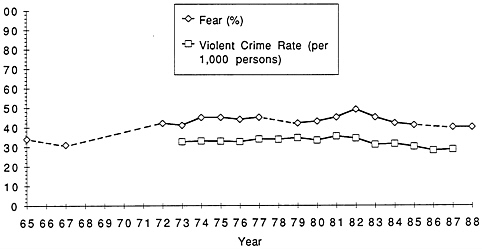
FIGURE 1 Percentage of respondents afraid to walk alone at night, 1965-1988, and NCS violent crime rate, 1973-1987. SOURCE: Gallup (1983), National Opinion Research Center (1988), Jamieson and Flanagan (1989).
1980s, however, the range of variation in fear is merely 9 percent, and only 5 percent if 1982 is excluded. If the prevalence of fear is rather high, then, it has also remained quite stable during the past two decades.
Data on trends in fear naturally invite comparisons with trends in crime rates. However, data from the Federal Bureau of Investigation (FBI) Uniform Crime Reports (UCR) and from the National Crime Survey (NCS) do not concur closely as to recent trends in crime, and in any event, there are too few observations in the fear series for a rigorous time-series analysis. Nevertheless, it is worth noting that the violent crime rate as measured by the NCS has been remarkably constant since 1973 (the first year of the NCS), as the lower plot in Figure 1 demonstrates. If we assume that the crimes that people fear outside the home (as stipulated in the Gallup/GSS question) are offenses against the person, then there appears to be no major disparity between trends in fear and trends in violent crime as measured by the NCS.
OFFENSE-SPECIFIC FEAR
General measures of fear of the sort used in the GSS and Gallup surveys serve a useful purpose, but they suffer a major limitation. Although such measures tell us how afraid individuals or groups are, they do not tell us what they are afraid of. That is, such measures do not tell us the crime or crimes that individuals have
in mind when they report fear. Consequently, two individuals may report identical levels of fear, but that fear may arise in response to quite different crimes.
An alternative to such omnibus measures of fear is to ask respondents to report their fear of a variety of specific crimes. Such data permit answers to one of the most critical questions about fear of crime: In any given population, what crimes are feared most, and which least? If the crimes that occur in our society were arranged according to the degree to which they are feared, which offenses would head the list, and how would the remaining crimes be arranged?
The answer to that question has important policy implications (see below), but the question was unfortunately ignored for years because the answer seemed self-evident. That is, investigators largely assumed that crimes are feared in direct proportion to their seriousness, implying that violent crimes are feared more than property crimes. Although seemingly plausible, this argument is far less compelling than it first appears. As a general rule, the incidence and the seriousness of crimes are inversely related; the more serious an offense, the less frequently it occurs (cf. Erickson and Gibbs, 1979). Hence, if the seriousness of crimes were the only determinant of fear, individuals would fear most exactly those offenses that are least likely to happen to them. To use an analogy, this is a little like fearing injury from lightning strikes more than rush hour traffic.
The seriousness of crimes, then, is not likely to be the sole determinant of fear. Drawing on this observation, Warr and Stafford (1983) proposed a model stipulating the degree to which different crimes are feared. According to this model, the degree to which a crime is feared depends on two factors—the perceived seriousness of the offense and the perceived risk of the offense (i.e., the subjective probability that it will occur). Neither of these factors, however, is itself a sufficient condition for fear. A serious crime will not be highly feared if it is viewed as unlikely, nor will a seemingly inevitable offense be highly feared if it is not serious. To provoke high fear, an offense must be viewed as both serious and likely, meaning that fear is a multiplicative function of perceived risk and perceived seriousness, that is,  , WHERE
  is the mean fear of the jth offense, and
  , and
, and  , are the mean perceived risk and seriousness, respectively, of the jth offense.
The multiplicative model of fear was tested by asking a sample of Seattle residents to report their everyday fear of becoming victims of different crimes, as well as the perceived risk and perceived
seriousness of each crime. Table 1 shows the mean fear scores (on a scale from 0 to 10) of the 16 offenses from the Warr and Stafford (1983) study, along with the mean perceived risk and perceived seriousness of the offenses (also rated on scales of 0 to 10). The most striking feature of these data is the order in which the offenses are feared. As the multiplicative model implies, there is no strong direct correlation between fear of the offenses and either perceived seriousness (R2 = .31) or perceived risk (R2 = .03). For example, murder, although perceived to be the most serious offense, ranked 10 among the 16 offenses on fear because of the very low perceived risk attached to murder. Indeed, respondents were more afraid of having juveniles disturb the peace than of being murdered. On the other hand, "having someone break into your home while you are away" was the offense most feared by Seattle residents, even though it carries no risk of personal injury. The high fear attached to residential burglary stemmed from the fact that it was viewed as both moderately serious and relatively likely to occur.
The multiplicative model of fear proved to be a very accurate predictor of fear for these data, with R2 = .93. In addition, the standardized coefficients for perceived risk (1.02) and seriousness (1.05) were each quite close to 1.0, meaning that risk and seriousness carry essentially identical weight in producing fear. Other offense-specific data suggest that the hierarchy of offenses found in the Warr and Stafford study is not unique to Seattle. Data from a 1987 survey of Dallas residents show a close match with the Seattle data in the order in which offenses are feared (Warr, 1988), as do data from a recent national Gallup survey (Warr, 1993).
Although the order in which crimes are feared is intrinsically interesting, it also has direct implications for public policy, particularly police policy. Suppose, for example, that to counteract public fear of crime, the police in a particular metropolitan area are given additional resources (e.g., manpower, hardware, salary) for the purpose of reducing crime and thereby (presumably) reducing fear. Where should these resources go? Public officials often seem to assume that the general public is most afraid of violent crime. Yet if the police decided to invest in the prevention of homicide, for example, their efforts would be largely wasted because homicide is not highly feared. A much more productive strategy would be to invest the money in reducing residential burglary.
Reducing fear is not the only purpose of crime reduction, however, and that goal must be balanced against other goals or values (reducing
TABLE 1 Mean Fear, Perceived Risk, and Perceived Seriousness of 16 Offenses Among Seattle Respondents
|
|
Fear |
Perceived Risk |
Perceived Seriousness |
Expected Fear |
|
|||
|
Description of Offense |
Mean |
Rank |
Mean |
Rank |
Mean |
Rank |
(PR = 5)a |
Rank |
|
1. Having someone break into your home while you are away |
5.86 |
1 |
4.50 |
2 |
7.20 |
8 |
7.26 |
8 |
|
2. Being rapedb |
5.62 |
2 |
2.51 |
11 |
9.33 |
2 |
9.86 |
2 |
|
3. Being hit by a drunk driver while driving your car |
5.11 |
3 |
3.57 |
6 |
7.66 |
5 |
7.81 |
5 |
|
4. Having someone break into your home while you are home |
4.49 |
4 |
2.72 |
8 |
7.72 |
4 |
7.88 |
4 |
|
5. Having something taken from you by force |
4.05 |
5 |
2.61 |
9 |
7.48 |
7 |
7.59 |
7 |
|
6. Having strangers loiter near your home late at night |
4.02 |
6 |
3.83 |
5 |
4.35 |
13 |
4.01 |
13 |
|
7. Being threatened with a knife, club, or gun |
4.00 |
7 |
2.57 |
10 |
8.25 |
3 |
8.52 |
3 |
|
8. Having a group of juveniles disturb the peace near your home |
3.80 |
8 |
4.25 |
3 |
4.30 |
14 |
3.95 |
14 |
|
9. Being beaten up by a stranger |
3.59 |
9 |
2.12 |
14 |
7.63 |
6 |
7.77 |
6 |
|
10. Being murdered |
3.39 |
10 |
1.29 |
15 |
9.66 |
1 |
10.27 |
1 |
|
11. Having your car stolen |
3.35 |
11 |
2.72 |
8 |
5.77 |
10 |
5.59 |
10 |
|
12. Being cheated or conned out of your money |
2.50 |
12 |
2.16 |
13 |
5.55 |
11 |
5.34 |
11 |
|
13. Being approached by people begging for money |
2.19 |
13 |
6.73 |
1 |
2.15 |
16 |
1.74 |
16 |
|
14. Receiving an obscene phone call |
2.07 |
14 |
3.87 |
4 |
3.18 |
15 |
2.77 |
15 |
|
15. Being sold contaminated food |
1.96 |
15 |
2.24 |
12 |
5.53 |
12 |
5.32 |
12 |
|
16. Being beaten up by someone you know |
1.04 |
16 |
0.83 |
16 |
6.17 |
9 |
6.05 |
9 |
|
a PR = perceived risk. b Female respondents only. SOURCE: Warr and Stafford (1983). |
||||||||
personal injury, enforcing community moral standards) that generally give priority to violent offenses. Moreover, although it is true that violent crimes are not uniformly feared more than other offenses, it would be a serious mistake to ignore such crimes because of the enormous fear they are capable of producing. The last column in Table 1 shows the expected fear score for each of the offenses under the multiplicative model, with perceived risk set to an arbitrary constant (i.e., 5). If all crimes were perceived to be equally likely, as in this example, violent crimes would clearly outweigh all other forms of crime in the fear they evoke. That is an unlikely scenario, to be sure, but the point is that even moderate increases in the perceived risk of violent victimization have the potential to increase fear enormously.
SOCIAL DISTRIBUTION OF FEAR
One of the most distinctive features of fear of victimization is that fear, like victimization itself, is not randomly distributed in the population. Evidence accumulated over the past two decades consistently indicates that fear is particularly pronounced in two groups: females and older individuals (Hindelang et al., 1978; Warr, 1984; Skogan and Maxfield, 1981; Baumer, 1978; Clemente and Kleiman, 1977; DuBow et al., 1979). In their three-city survey, for example, Skogan and Maxfield (1981) found that the proportion of respondents who felt "very unsafe" walking alone in their neighborhood at night rose from 7 percent among those aged 18-20 to 41 percent among those over 60, and although 6 percent of males reported such fear, the figure increased to 23 percent among females. Hindelang et al. (1978) report much the same results, but they also note that the association between fear and age is much stronger among males than among females. These patterns are quite evident in the GSS data. The sex difference in responses to the fear item is very large, with 22 percent of males and 60 percent of females responding yes in the cumulative (1972-1987) file. Among females, this proportion is rather constant across age groups, varying no more than 6 percent. Among males, however, the age gradient is much more marked, increasing from 14 percent among those under 20 to 32 percent among those over 60.
How can such large sex and age differentials in fear be explained? One possible explanation is that females and the elderly are more afraid than others because they face the greatest objective risk of victimization. In fact, however, exactly the opposite
is true. Although they have the greatest fear, females and the elderly are actually at substantially lower risk of victimization than males and the young for most crimes (e.g., Hindelang et al., 1978; Flanagan and Jamieson, 1988), a situation that is sometimes called the paradox of fear (e.g., Stafford and Galle, 1984; Warr, 1984; Skogan and Maxfield, 1981).
If females and older individuals are not at greater objective risk than others, perhaps their fear stems from higher perceived risk. However, Warr (1984) found that the perceived risk of victimization for different crimes is not consistently higher among females and the elderly. Indeed, for some crimes, females and the elderly are more afraid than their counterparts even when their perceived risk is lower.
How, then, can we explain the greater fear of females and older individuals? Much of the answer appears to lie in age- and sex-related differences in what can be called sensitivity to risk. To illustrate, suppose that we were to plot the relation, among individuals, between fear of a particular offense and the perceived risk of victimization for that offense. As shown in Figure 2, the relation has three primary features: the threshold of fear (the intercept), the slope of fear (the rate at which fear increases with
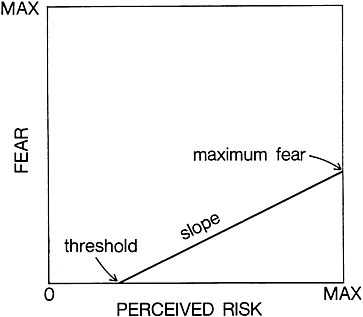
FIGURE 2 Parameters of the fear/perceived risk relation.
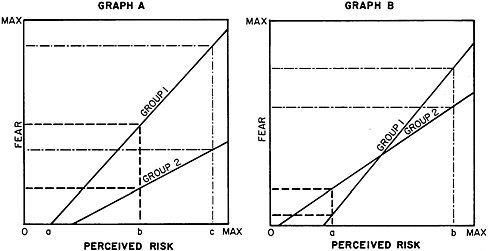
FIGURE 3 Some illustrative relations between fear and perceived risk for two groups.
perceived risk), and the maximum fear that the offense is capable of producing (i.e., at maximum perceived risk). Once this relation has been established, we can predict the degree of fear that will result at each level of perceived risk.
Now suppose that we were to plot the same relation for two different groups (e.g., males and females). If the relation were identical in both groups, then any given degree of perceived risk would produce the same degree of fear in both groups. Suppose, however, that the relation between fear and perceived risk is not the same for the two groups, as in Figure 3A. In this case, an equivalent level of perceived risk would produce quite different levels of fear in the two groups, meaning that the groups differ in their sensitivity to risk. Not only will a fixed level of risk produce different levels of fear under this condition, but it is entirely possible for one group to exhibit greater fear than another even when their perceived risk is lower (compare the fear of groups 1 and 2 at points b and c in Figure 3A). Group differences in fear may even be reversed at different points along the risk continuum (see Figure 3B). Using data from a sample of Seattle residents, Warr (1984) found substantial age and sex differences in sensitivity to risk across a variety of crimes. Moreover, the observed age and sex differences in fear were largely attributable, not to differences in perceived risk, but rather to differences in sensitivity to risk among these groups.
The notion of sensitivity to risk helps to explain sex and age
differences in fear, but at the same time it raises a larger question: Why do females and older persons display greater sensitivity to risk? Part of the answer seems to lie in rather small age- and sex-related differences in the perceived seriousness of crimes (Warr, 1984), but there appears to be a much more important reason. That is, females and the elderly seem to perceive crime in a way that is fundamentally different from males and the young. Specifically, among females and older individuals, different crimes are subjectively linked in a way that is not true for other groups. In examining the correlations between fear of different crimes, Warr found strong correlations between certain crimes. Examined closely, these configurations of offenses typically consisted of crimes that can (logically or empirically) occur contemporaneously or in continuous sequence (e.g., robbery and murder, burglary and rape), and the strong correlations between fear of these crimes suggested that they were in fact viewed as likely to occur together as part of the same criminal event. The frequency and strength of these subjective linkages were much greater among females than males and among older, rather than younger, individuals (Warr, 1984, 1985, 1987). Taken together, they suggest that circumstances or events that appear innocuous or comparatively minor to males or younger persons are apt to be viewed as more dangerous to females and the elderly because of the offenses they imply or portend.
One offense that looms large for women but not men, of course, is rape. Using data from the Seattle study, Warr (1985) found that (1) rape is feared more than any other crime among women under 35; (2) rape is viewed by women as approximately equal in seriousness to murder; (3) the highest sensitivity displayed by any age/sex group to any crime is that of young women to rape; (4) fear of rape is closely associated with a variety of other offenses for which rape is a possible outcome (e.g., burglary, robbery, receiving an obscene phone call) or precursor (e.g., homicide); and (5) fear of rape is strongly associated with certain lifestyle precautions (e.g., going out alone). For many women, then, fear of crime may be synonymous with fear of rape.
OTHER CORRELATES
Although age and sex have been the most thoroughly documented and closely examined correlates of fear, there are others as well. The prevalence of fear appears to be substantially greater among blacks than whites, and unlike age and sex differences in
fear, black/white differences in fear are quite consistent with objective risk (Hindelang et al., 1978; Skogan and Maxfield, 1981; DuBow et al., 1979; Garofalo, 1977). Not surprisingly, fear is a largely urban phenomenon, although the degree of inter-city variation in fear is striking. In the Law Enforcement Assistance Administration (LEAA) surveys of 26 cities conducted during 1972-1974, the proportion of respondents who reported feeling ''very unsafe" or "somewhat unsafe" when alone in their neighborhood at night ranged from a low of 26 percent in San Diego to a high of 58 percent in Newark (see Skogan and Maxfield, 1981; Garofalo, 1977). Finally, fear is inversely related to family income, and the relation holds among both blacks and whites (Hindelang et al., 1978; Garofalo, 1977; Skogan and Maxfield, 1981).
CUES TO DANGER
One of the proximate causes of fear, as we have seen, is the perceived risk of victimization. Although perceived risk is essential to explaining fear, explanations of fear based solely on perceived risk beg the larger question: How do individuals estimate or form impressions of their risk of victimization? One way to address the question is to examine the environmental stimuli, or cues to danger, that individuals confront in their everyday lives. The number and variety of such cues are probably enormous. Some cues may be encountered only occasionally and thus affect only situational or short-term perceptions of risk. Others may be routine if not constant reminders of danger and thus may be more likely to affect long-term perceptions of risk.
Relatively little work has been done on identifying cues to danger or assessing levels of exposure to such cues. However, the current state of evidence does permit some general conclusions.
Dangerous Places
There is strong evidence that people commonly perceive crime in geographic terms, meaning that they typify areas as dangerous or, alternatively, as safe zones. All cities, for example, seem to have widely understood folklore about dangerous areas of the city. These danger zones may be small, as in the case of particular parks, beaches, or neighborhoods, or they may extend to entire sections or regions of a city.
In an ingenious study of the perceptual geography of crime, Ley (1974) asked residents of the Monroe area of Philadelphia to
draw lines on a map indicating the routes they would take when walking between their home and different destinations on the map. When the routes drawn by respondents were overlaid, a clear picture of the "stress surface" of Monroe emerged, showing the spatial segmentation of the area into safe and dangerous zones. Ley did not directly question residents about their reasons for avoiding certain areas, but an inspection of the areas revealed a number of potential cues to danger, such as gang graffiti, abandoned buildings, and the presence of prostitutes and junkies.
Ley's work demonstrates the existence of microzones of danger (blocks, street corners), but larger areas may be feared as well. The downtown or central business districts of cities, for example, are often regarded as potentially dangerous places (DuBow et al., 1979; Pyle, 1980; Smith and Patterson, 1980). Pyle (1980) asked a sample of Akron residents to rate the crime problem in 10 geographic areas of the city and then used these perceptual data to construct a three-dimensional cognitive map of the city. The major distinction recognized by respondents was between the central city and the suburbs, with the central city rising like a mountain range from the plains of the suburbs. Although central-city areas actually displayed substantial variation in reported crime rates, respondents largely failed to differentiate among areas within the central city, perceiving it to be uniformly dangerous.
The downtown or central business districts of cities, however, are not necessarily perceived to be their most dangerous areas. In a 1987 survey of Dallas residents conducted by the author1, respondents were asked, "What area or place in Dallas do you think is most dangerous when it comes to crime?" Only 12 percent of respondents mentioned the downtown area, but a substantial majority named South Dallas or Fair Park, two largely residential areas that abut the central business district. The total rate of UCR index offenses in these areas, although high, was not markedly different from several other areas of Dallas. However, the rate of violent offenses (homicide, rape, and aggravated assault) was distinctly higher, suggesting that violent offenses are most important in defining areas as "dangerous places." This may be true because violent offenses carry the greatest fear potential, but it is also true that persons traveling outside the home are more susceptible to personal crimes than to property crimes (see Hindelang et al., 1978). The propensity to view these two areas of Dallas as dangerous places also increased with the number of years that respondents had lived in the city, which suggests that people come
to learn the reputations of areas as they acquire greater familiarity with their city.
Some environments pose a threat only to certain populations, and some are uniquely frightening because they must be faced on a routine basis. One environment that exhibits both these features is the school. In the National Institute of Education's Safe School Study (1978), one-fifth of secondary school students reported that they were afraid at school at least sometimes, although only 3 percent said they were afraid most of the time. Among junior high school students (who were more afraid than high school students), 22 percent reported avoiding three or more locations in the school (the most common being restrooms), a figure that rose to 33 percent among students in large cities. Among the latter group, 8 percent said that they had actually stayed home at least one day during the previous month because someone might hurt or bother them at school. A study of black Philadelphia students by Savitz et al. (1977:22) also demonstrates, in their words, the "dangerousness of the entire educational enterprise" and reveals something about the geography of fear in schools. The classroom itself appears to be the safest place in students' minds; only 21 percent of students thought there was a high risk of being beaten or robbed in the classroom. The hallways, however, were perceived to be more dangerous (34% feared them), and the school yard more dangerous yet (44%). More than half (54%) of the students regarded the streets leading to and from school as dangerous.
If certain locations are commonly perceived to be dangerous, what areas are perceived to be safe? One answer has repeatedly appeared in research on fear of crime. Using data from the attitude supplement to the National Crime Survey, Hindelang et al. (1978:168) found that "respondents were much more likely to view their own neighborhoods as safer, rather than more dangerous, than other neighborhoods in the metropolitan area." The same pattern was also observed by Reiss (1967) using data from Boston and the District of Columbia. Surveys conducted by the author in Dallas and Seattle (see note 1) also lead to the same conclusion. Whereas 64 percent of Dallas residents rated their city as "not very safe" or "not safe at all," only 23 percent described their own neighborhood that way. In Seattle, the corresponding figures were 34 percent and 15 percent, respectively.
Why should home and neighborhood be so widely regarded as safe? One possible answer is simply cognitive consistency; the notion of home as a dangerous place is not an easy one to live
with. There is, however, another possible explanation. Warr (1990) has shown that a key cue to danger is novelty; novel or unfamiliar environments evoke fear of criminal victimization. For most individuals, of course, home and the surrounding neighborhood are the environments that they are most familiar with (e.g., Holahan, 1982) and, hence, should fear least.
The fact that home is typically perceived to be comparatively safe, however, does not mean that it is perceived to be risk free. Not all individuals feel safe at home (see Skogan and Maxfield, 1981), and residential burglary, as we have seen, is among the most feared crimes. Although areas away from home may be especially feared, the large number of hours that people commonly spend in their home and neighborhood means that any risks in those environments are amplified by exposure to risk. Also, as a "storehouse" of valued possessions (and persons), the home is a uniquely vulnerable location.
Dangerous Persons
If crime is commonly perceived in geographic terms, it is also perceived in social terms. That is, there appear to be widely accepted images of dangerous persons, with the result that some persons in the population are feared more than others. Although the personal attributes that signify danger might appear to be subtle and numerous, that is not necessarily the case. Using data from a factorial survey, Warr (1990) found that two immediately apparent features of persons combine to form a potent cue for eliciting fear. The most frightening persons, quite simply, are young males. Young males are particularly frightening to females, but even young males are often frightened of other young males. Moreover, few cues or combinations of cues are more powerful in eliciting fear than a group of young males. This finding is corroborated by evidence that adults commonly avoid groups of "teenagers" (e.g., DuBow et al., 1979), but Warr's work indicates that it is young males (even when alone), rather than females, who provoke fear.
The question of dangerous persons, of course, raises one of the most sensitive questions of our day. Granted that young males are frightening, what about young black males? Are blacks more frightening than whites? Using data from residents of three cities, Graber (1980:55) reports that respondents "viewed crime largely as the work of young males, black or belonging to other minority races." In a detailed investigation of Chicago neighborhoods, Taub
et al. (1984) found substantial proportions of residents who believed that the in-migration of blacks into their neighborhoods would result in higher crime rates. In a 1982 national survey conducted for ABC News, 30 percent of respondents (32% of whites and 16% of blacks) agreed with the statement "a black person is more likely to commit a crime than a white person." None of these studies directly measured fear, and it remains unclear whether or how racial attitudes are translated into outright fear. Still, these findings suggest that blacks (or, most probably, young black males) are frequently typified as criminals or potential criminals and, as a consequence, are feared more than others.
Other Cues
Apart from geographic and social cues to danger, two other cues appear to be important in situational assessments of danger. One of these cues, not surprisingly, is darkness. Fear of crime is generally higher at night, and many Americans report that they avoid going out at night due to fear (see below). Indeed, Warr (1990) reports evidence that darkness is the single most important cue in evoking fear of crime in outdoor situations; an activity or situation (e.g., walking to an appointment) that is utterly innocuous during the day is apt to be much more frightening after dark. The second cue is the presence of bystanders or companions; the presence of others normally acts to reduce or alleviate the fear that individuals would feel if alone (Warr, 1990). However, this calming effect, as one might suspect, does not operate if those "others" are perceived to be dangerous persons.
FEAR AND PRIOR VICTIMIZATION
One of the most intuitively compelling hypotheses about fear is the notion that persons who have been victims of crime should display greater fear than those who have not. Numerous studies, however, have shown little or no difference in fear between victims and nonvictims, and the issue has remained something of a conundrum among researchers (see Hindelang et al., 1978; DuBow et al., 1979; Skogan and Maxfield, 1981). One possible explanation is that many criminal events are minor, have little salience to victims, and are quickly forgotten (e.g., DuBow et al., 1979). However, the absence of positive evidence for the hypothesis may be due to a common methodological deficiency in studies of the consequences of victimization. Most investigations of the victimization/fear
relation have failed to control for the confounding effects of demographic variables in comparing victims to nonvictims. As we have seen, victimization rates and fear show strong—but opposite—correlations with age and sex. Consequently, crude comparisons between victims and nonvictims may fail to reveal the effects of victimization experiences.
Skogan and Maxfield (1981) found only small initial differences in fear in comparing victims of crime with nonvictims, but when they controlled for the confounding effects of demographic variables, the differences increased substantially. In addition, the largest differences in fear between victims and nonvictims occurred in cases where the victim had suffered a violent offense that required medical attention. This evidence, along with arguments we consider later, suggests that investigators may have failed to detect what could be substantial effects of prior victimization.
CONSEQUENCES OF FEAR
Much of the increased attention devoted to fear of crime in recent years stems from a deep concern among social scientists, public officials, and the media with the social consequences of fear. As Skogan and Maxfield (1981:186) have noted, "It is widely believed that fear of crime has enormous consequences for the way we live." Claims that the United States has become a "fortress" society or a society "paralyzed by fear" are common, if rather alarmist, expressions of such concern. Yet if the American public has not quite reached the point of panic, there is abundant evidence that fear does indeed affect the lives of Americans to a substantial degree.
Reactions to fear take many forms, but they can be classified under some general rubrics. Avoidance behaviors are those actions "taken to decrease exposure to crime by removing oneself from or increasing the distance from situations in which the risk of criminal victimization is believed to be high" (DuBow et al., 1979:31). Thus, a fearful person may avoid certain locations or certain kinds of people that are perceived to be dangerous, or may avoid certain activities (e.g., shopping) during certain times. Reducing exposure to risk through avoidance behaviors, however, is not always possible. An individual may have no choice but to pass through a dangerous area on the way to work and may not have the option of moving his or her home to a safer neighborhood. Where avoidance is not an option, individuals may engage
in protective or precautionary behaviors, that is, strategies designed to reduce the marginal risk of victimization if avoidance is not feasible or acceptable. Thus, for example, a person who must navigate a dangerous environment may alter their mode of transportation (taking a taxi rather than a public bus or driving rather than walking) or seek companions for the journey. Similarly, a person living in a neighborhood with a high rate of residential burglary may invest in home security precautions or purchase a weapon.
Apart from reducing their risk through avoidance or precautionary behaviors, people may also seek to minimize the costs or damages that they will incur in the event of a victimization (what DuBow et al., 1979, call insurance strategies). To illustrate, some persons carry little or no money outside the home in anticipation of potential robberies, whereas others insure or engrave their property in the home or simply refrain from keeping valuable property at home altogether.
SURVEY DATA ON THE CONSEQUENCES OF FEAR
A large number of surveys designed to measure public responses to fear of crime have been conducted in recent years. Although the samples and methodologies of these surveys vary widely, certain findings appear with sufficient regularity to warrant some general conclusions. First, among the most common responses to fear of crime in the United States is spatial avoidance, meaning that individuals commonly report that they avoid areas perceived to be dangerous. Spatial avoidance typically ranks in frequency above most or all other responses to fear in social surveys, at least among those responses that occur outside the home (DuBow et al., 1979; Research and Forecasts, 1980; Skogan and Maxfield, 1981). For example, 77 percent of a sample of Dallas residents reported that they avoided "certain places in the city," as did 63 percent of Seattle residents (Warr, 1985).
As noted earlier, there is a strong tendency among individuals to perceive crime in geographic terms; hence the tendency to avoid "dangerous places" is not surprising. So prevalent is spatial avoidance, however, that it is reasonable to assume that the ecology of U.S. cities is regulated to some extent by such avoidance patterns. Neighborhoods that are perceived to be dangerous places are likely to be find themselves socially isolated, and retail businesses that are located in ostensibly dangerous areas may suffer a shortage of customers (Conklin, 1975; Skogan and Maxfield, 1981). For example,
after naming the most dangerous place(s) in their city, respondents in the Dallas survey (see note 1) were asked, "Do you go near or through this area regularly?" More than four-fifths (82%) answered no, and approximately three-quarters (73%) said that they did not know the area well, suggesting a long-standing pattern of spatial avoidance.
If people commonly avoid dangerous places, they also avoid dangerous times, the most obvious example being nighttime. As noted earlier, darkness is a principal cue to danger (Warr, 1990), and substantial proportions of Americans report that they avoid going out at night (DuBow et al., 1979; Warr, 1985; Skogan and Maxfield, 1981). There may well be other periodicities to fear, however. Godbey et al. (1979), for example, report a tendency among some elderly persons to return to their homes in the late afternoon, when schools let out and the streets fill with adolescents.
Another common response to fear is to employ precautionary measures when traveling outside the home. Among the most common is to seek the company of others during one's journey. In surveys of Dallas and Seattle conducted by the author (see note 1), 29 percent and 26 percent of respondents, respectively, reported that they avoided going out of the house alone. In surveys of Chicago, Philadelphia, and San Francisco, approximately 30 percent of respondents in each city reported that they take an escort "most of the time" when leaving home after dark (Skogan and Maxfield, 1981). Traveling by foot is also commonly avoided by urban Americans in favor of the safety of automobiles (Skogan and Maxfield, 1981), and a small percentage choose to carry a weapon or some other form of protection (e.g., a whistle or dog) outside the home (Skogan and Maxfield, 1981; DuBow et al., 1979; Warr, 1985; Research and Forecasts, 1980).
The foregoing responses to fear all pertain to situations outside the home, but although the home is generally regarded as safer than areas away from it, the large majority of Americans nevertheless take precautions, if frequently only minor ones, to protect their dwelling and its occupants. Skogan and Maxfield (1981) report that fully 96 percent of the households interviewed in San Francisco, Chicago, and Philadelphia reported at least one home security precaution. In accordance with other research (e.g., DuBow et al., 1979; Research and Forecasts, 1980), they found that the most common precautions (typically in excess of 80% of households) are such simple steps as locking doors, leaving a light on, asking neighbors to watch the house, identifying persons before
letting them in, or stopping mail delivery when away for extended periods. Such precautions, of course, require little financial investment or time. More expensive and time-consuming precautions, however, are not rare. Although estimates vary, roughly 25-40 percent of American households have invested in such measures as window bars or grates, improved locks, property engraving, alarm systems, improved lighting, or theft insurance (see generally DuBow et al., 1979; Research and Forecasts, 1980; Skogan and Maxfield, 1981). The most reliable national data come from the 1983 Victim Risk Supplement to the National Crime Survey (U.S. Department of Justice, 1987), in which household informants were questioned about the steps they had taken "to make [their home] safer from crime." Burglary alarms were present in 7 percent of U.S. households; 34 percent of households had engraved or marked valuables; 42 percent had a gun or firearm "for protection"; and 58 percent had a dog.
Among household security measures, the most controversial is gun ownership. According to repeated GSS surveys, approximately one-half of U.S. households contain one or more firearms (National Opinion Research Center, 1988), but the purpose of those firearms has been the subject of vigorous debate. In a review of the literature on fear of crime and gun ownership, Wright et al. (1983:101) conclude that "there is no credible study anywhere in the literature that shows, clearly and unmistakably, a fear … effect in the weapons trend," and argue that firearms are primarily purchased for hunting and recreational purposes. Two subsequent studies, however, cast some doubt on this conclusion. Using survey data from 59 neighborhoods in three standard metropolitan statistical areas (SMSAs), Smith and Uchida (1988) found that the probability of purchasing "a gun or weapon for your protection" was significantly related to respondents' perceived risk of victimization, prior victimization experiences, and perceptions of neighborhood crime trends. Like McDowall and Loftin (1983), they found that the probability of purchasing a weapon increased when the police were perceived to be ineffective. (For related research, see Smith and Uchida, 1988).
Apart from their frequency, perhaps the most striking feature of public responses to fear is their age and sex distribution. As Skogan and Maxfield (1981:195) have observed, "Every analysis of crime-related behavior indicates that women and the elderly are more likely to avoid exposure to risk and to take numerous measures to reduce their chances of being victimized." These differences appear to be most pronounced with respect to avoidance
and precautionary behaviors outside the home. For example, whereas 42 percent of women in a Seattle sample reported that they avoid "going out alone," only 8 percent of men reported this precaution. And whereas 40 percent of women reported that they avoid "going out at night," only 9 percent of men did so. The sex difference diminished substantially, however, when it came to spatial avoidance, with 67 percent of women and 58 percent of men reporting that they avoid "certain places in the city" (Warr, 1985). Even males, it seems, avoid dangerous places.
COLLECTIVE RESPONSES
The discussion thus far has concentrated on those avoidance and precautionary behaviors undertaken by individuals. One of the major developments in public responses to crime in recent years, however, has been the rise of collective, organized efforts within communities to reduce or prevent crime or fear of crime. These efforts have taken many forms, including (1) neighborhood watch programs, (2) citizen patrols, (3) neighborhood escort programs, (4) property-marking projects, (5) police-community councils, and (6) citizen crime-reporting programs (see Rosenbaum, 1986, 1988; Skogan, 1981; Skogan and Maxfield, 1981; DuBow et al., 1979; Garofalo and McLeod, 1989). Although estimates vary, it appears that approximately 10-20 percent of adults in the United States participate to some degree in such organized activities (Rosenbaum, 1988; Skogan and Maxfield, 1981).
Among these community-based programs, neighborhood watch programs appear to be the most prevalent, as well as the most frequently studied, programs. As Garofalo and McLeod (1989:326) have said, "Neighborhood watch has been the centerpiece of community crime prevention in the United States during the 1980s." According to the Victim Risk Supplement to the 1983 National Crime Survey (U.S. Department of Justice, 1987), 20 percent of U.S. householders report the presence of a "neighborhood watch or citizens protective group" in their area, although only 39 percent of these households participate. Drawing on a nationwide study of neighborhood watch programs, Garofalo and McLeod (1989) report that the principal goal of such programs is to increase surveillance of the neighborhood by residents, extending, as it were, the "eyes and ears" of the police. Most programs, they found, are sponsored by local police or sheriffs, and residents are encouraged to observe and report suspicious behavior, but not to intervene. The presence of neighborhood watches is usually announced by signs posted in the neighborhood or by stickers attached to homes
or vehicles. Although neighborhood surveillance is the primary goal of neighborhood watch programs, most engage in other activities as well, such as property identification, home security surveys, lighting improvement, and so on.
The rapid rise of neighborhood watch programs in the late 1970s and early 1980s was accompanied by strong claims in the media concerning the effectiveness of such programs in reducing crime and fear of crime, as well as high expectations among community activists and some researchers (Lurigio and Rosenbaum, 1986; Rosenbaum, 1988). However, the current state of evidence seems to support the rather pessimistic assessment of Garofalo and McLeod (1989) and others. Much of the evaluation research cited in support of neighborhood watch programs suffers from severe methodological deficiencies, and the most rigorous quasi-experimental studies indicate that victimization rates and fear are not significantly reduced by such programs (Rosenbaum, 1986, 1988; Skogan and Maxfield, 1981; Lurigio and Rosenbaum, 1986). One reason seems to be that neighborhood watch programs are most likely to arise in those neighborhoods that need them least (e.g., Garofalo and McLeod, 1989; Bennett and Lavrakas, 1989). Another is that the initial interest taken by residents often fades quickly, with the result that many neighborhood programs soon become dormant (Taub et al., 1984; Garofalo and McLeod, 1989). Finally, it is possible that neighborhood watch programs, by drawing attention to or dramatizing local crime, increase rather than alleviate fear among some residents.
FEAR IN BROADER CONTEXT
There can be little doubt that fear of criminal victimization affects the lifestyles and quality of life of U.S. citizens. In assessing the social implications of fear, however, several points need to be considered. First, much of the current concern with fear of crime arises from an assumption that fear is an intrinsically negative emotion with no redeeming features. In the biological sciences, however, fear is widely regarded as a beneficial rather than a deleterious reaction. Many animal species display apparent fear responses (escape behavior, tonic immobility or freezing, distress calls, crouching, jumping) when confronted by predators and other dangers, or exhibit forms of caution such as neophobia (reluctance to enter a novel area). Far from being dysfunctional, such behaviors are generally regarded as highly adaptive because they reduce individual or collective exposure to risk and maximize the probability of survival in the face of lethal risks (see Sluckin, 1979).
An organism with no fear of predators, after all, is one that is unlikely to live long enough to reproduce. The point is not that fear in humans is a desirable state; a society that feels safe and secure is surely to be preferred over one that does not. However, in the face of real danger, fear may lead individuals to take precautions that reduce their (or others') risk and thereby save them from injury.
A second issue concerns the extent to which fear of crime actually prevents citizens from engaging in normal everyday activities. Drawing on their findings from the National Crime Surveys, Hindelang et al. (1978) offer a provocative argument. Fear of criminal victimization, they argue, typically results in relatively subtle lifestyle changes. Rather than altering what individuals do, fear of crime is more likely to change the way they do it. Instead of forgoing shopping altogether, a fearful person may change their hours for shopping, alter the route or means of transportation employed in getting there, or choose to go shopping with companions. The argument would seem to understate the consequences of fear for some individuals, for whom fear does appear to be a profoundly debilitating condition (e.g., Skogan and Maxfield, 1981). For many Americans, however, it may well be true that fear is less of an outright obstacle than a hindrance in their daily activities.
Beyond the consequences of fear for individuals, however, lie questions about the consequences of fear for social institutions and American society as a whole. In recent years, a number of social commentators have charged that fear of crime has torn the very social fabric of the United States, making individuals afraid to leave their homes or strike up a conversation with a stranger. In a widely cited book, for example, Silberman (1980:7) argued that ''fear of crime is destroying the network of relationships on which urban and suburban life depends." Such broad charges, although easy to make, are difficult to verify. Yet it is true that many of the most common avoidance and precautionary behaviors (e.g., not going out at night, spatial avoidance) seem specifically designed to avoid social interaction, particularly with strangers, and such behaviors are sufficiently common to have affected the overall sociability of American life.
Against this rather gloomy assessment, however, stands a quite different view. In one of the most famous of sociological arguments, Emile Durkheim (1933:102) asserted that crime is functional for societies because it unites people against a common threat, thereby increasing rather than decreasing social solidarity:
Crime brings together upright consciences and concentrates them. We have only to notice what happens … when some moral scandal has just been committed. … [People] stop each other on the street, they visit each other, they seek to come together to talk of the event and to wax indignant together.
Viewed this way, the effect of fear of crime is not socially disintegrative, but rather integrative (see Conklin, 1975). Although it may be difficult to believe that violence has any positive consequences, Durkheim's position is supported by the nationwide growth of neighborhood watch programs and other community crime prevention organizations in the United States. Regardless of how effective these programs may be in reducing crime, the fact is that millions of Americans have joined such voluntary organizations. Ironically, then, the social consequences of fear may be contradictory, with fear reducing sociability in some domains of life while increasing it in others. Whether these countervailing trends cancel one another out and whether they are simultaneously occurring within the same subpopulations are clearly matters for further investigation.
There is another potential consequence of violence, however, about which there is less reason to be sanguine. The mere presence of violence in a society can, by itself, be construed as a failure of social institutions, most immediately those that have direct responsibility for controlling violence (police, courts, prisons), but also those that are perceived to be at least indirectly implicated (family, church, schools). When citizens come to perceive certain institutions as ineffective, those institutions stand to lose their traditional authority or legitimacy among the general public, a possibility that does not augur well for a society. For example, both the inception and the periodic resurgence of vigilantism in this country seem to have coincided directly with a loss of public confidence in law enforcement. Says historian Richard Brown (1979:154):
Vigilantism arose as a response to a typical American problem: the absence of effective law and order in a frontier region. It was a problem that occurred again and again beyond the Appalachians, and it stimulated the formation of hundreds of frontier vigilante movements. On the frontier, the normal foundations of a stable, orderly society—churches, schools, cohesive community life—were either absent or present only in rough, markeshift forms. The regular, legal system of law enforcement often proved to be woefully inadequate for the needs of the settlers.
Today the frontiers of law and order are more likely to be found
on an inner-city block than in a western territory, and despite the popularity of persons like Bernhard Goetz (see Fletcher, 1988), Americans seem more interested in helping the police than in usurping their power. However, as we see later, public confidence in the criminal justice system (or, more precisely, certain parts of that system) seems to be very low indeed.
SOURCES OF INFORMATION ON VIOLENCE
Violence is a phenomenon that Americans routinely hear about, read about, talk about, and through the medium of television, watch. To understand public perceptions and reactions to violence, therefore, we must examine the indirect sources of information on violence to which the general public is exposed. One of the principal ways in which Americans learn of violence is through news coverage of crime in the mass media. Crime news, as we shall see, not only is remarkably plentiful, but also gives special attention to violence.
NEWS COVERAGE OF CRIME
When a crime occurs, knowledge of that event is initially limited to the immediate participants in the event (i.e., victim, offender, and perhaps witnesses). If a crime is reported to the police, however, news of the crime becomes public information and is available to reporters who handle the "crime beat" (e.g., Sherizen, 1978; Ericson et al., 1987). If the crime is selected from the daily pool of crimes for reporting, news of the event may ultimately reach audiences in the thousands or millions. The mass media are thus a powerful amplifying mechanism; information known only to a few may within hours or days become common knowledge.
In the United States, crime and justice stories constitute a large and relatively steady portion of the daily news diet, in both the print and the broadcast media. In perhaps the most comprehensive study of crime news, Graber (1980) coded more than 75,000 news stories from the three network television news programs (CBS, ABC, and NBC), two local newscasts (the CBS and NBC affiliates in Chicago), and three newspapers (the Chicago Tribune, Daily News, and Sun-Times). Crime and justice stories constituted 22 percent to 28 percent of all news stories in the three newspapers, 20 percent of local television stories, and 13 percent of national television offerings. The attention devoted to crime
was particularly remarkable when compared to other news topics. In the Chicago Tribune, stories of individual crimes "received nearly three times as much attention as the presidency or the Congress or the state of the economy" (Graber, 1980:27). Even national television news, which had the smallest proportion of crime news, placed stories of individual crimes "on a par with the presidency and Congress" (Graber, 1980:27). Drawing on a content analysis of eight newspapers in three metropolitan areas (Philadelphia, San Francisco, and Chicago), Skogan and Maxfield (1981:128) report that "every day each paper reported at least one story about a violent crime in a prominent position." The number of violent crime stories averaged 4.4 to 6.8 stories per paper per day, with half of the stories devoted to homicides.
Although crime stories are a staple of media news coverage, this fact means little if the general public is not exposed to or is not attentive to such information. However, Skogan and Maxfield (1981) found that more than three-quarters of respondents in the three cities surveyed reported watching or reading a crime story on the previous day (44% had read a newspaper crime story, 45% had watched a crime story on television, and 24% had done both). Fully 95 percent of respondents in Graber's (1980) study cited the media as their primary source of information on crime, although 38 percent cited other sources (conversations or, more rarely, personal experience) as well. Not all media information, however, was absorbed. Only 48 percent of respondents claimed to pay "a lot" of attention to crime stories, and checks on newspaper reading habits showed that crime stories were often read only partially, ignored, or forgotten. Even so, crime stories were both read and recalled more frequently than stories on other topics.
CRITICISMS OF MEDIA NEWS COVERAGE
The prevalence of crime stories in media news coverage is scarcely surprising. Apart from the frequency of crime in our society, the inherent human interest character of crime stories means that it is a perpetually newsworthy topic. Yet if the media cannot be faulted for reporting crime, the manner in which they report it is open to scrutiny. Indeed, many critics have argued that news coverage of crime, although seemingly factual and objective, actually presents a badly distorted picture of crime. Some of these criticisms date back to the days of nineteenth-century yellow journalism, though they can be applied to the modern media of mass communication (e.g., television and radio).
Perhaps the most common criticism of media crime coverage pertains to what may be called the "mirror image" model. Although crime statistics or summaries are sometimes reported in the news, most crime news consists of reports of particular crimes, either as they are occurring (as in the case of a bank robbery in progress) or shortly after they have occurred (Graber, 1980; Fishman, 1981). Because the "supply" of crimes to be reported is virtually unlimited, choices must be made as to which to report. Like any other kind of potential news material, the central criterion for choosing crime stories is "newsworthiness." In the case of crime, newsworthiness translates into seriousness; the more serious a crime, the more likely it is to appear as a news story (Skogan and Maxfield, 1981; Sherizen, 1978; Sheley and Ashkins, 1981; Roshier, 1973; Graber, 1980). The brutal homicide is thus more likely to be reported than the nonviolent residential burglary. This standard is not in itself unreasonable, but it is at odds with a sociological reality. As noted earlier, crimes occur in inverse proportion to their seriousness; the more serious a crime, the less frequently it occurs (Erickson and Gibbs, 1979). Hence, by using seriousness as a criterion, the media are most likely to report precisely those crimes that are least likely to occur to individuals.
The image of crime presented in the media is thus a reverse image of reality; the most frequent crimes are the least frequently reported, and the least frequent crimes are the most frequently reported. For example, Graber (1980) reports that whereas murders constituted only 0.2 percent of UCR index offenses in Chicago in 1976, they accounted for 26 percent of crime stories in the Chicago Tribune. In a study of media crime coverage in New Orleans, Sheley and Ashkins (1981) found that violent crimes constituted 68 to 87 percent of the crime stories in local television and newspaper outlets, but only 20 percent of the offenses known to police. Skogan and Maxfield (1981) report that murder and attempted murders constituted 50 percent of all newspaper crime stories in the cities examined. Indeed, these investigators found that the number of homicide stories did not closely parallel the actual homicide rates of the cities examined, suggesting that the amount of space devoted to crime is determined less by the "supply" of crime than by the size of the "newshole" allocated to crime stories.
An alien who knew our world only through news coverage, then, might have a peculiar idea of the relative frequency of crimes and might well conclude that violent crime is the most frequent form of crime. The point is not that the presentation of crime
news is deliberately distorted, but rather that a standard editorial practice has an inadvertent consequence.
Another source of distortion that may appear in media crime coverage is the practice of using crime news as filler material (e.g., Graber, 1980; Gordon and Heath, 1981). Crime news, of course, is rarely in short supply. When other news (e.g., politics, foreign affairs, the economy) is slow, column space or air time may be filled in with crime stories. If crime news is routinely employed in this way, then the amount of time or space devoted to crime over time will not bear any constant relation to the actual number of crimes occurring. Graber (1980), for example, reports an inverse relation between crime news and political news, suggesting that crime news conforms to a version of Gresham's Law. Crime news may also be increased in an effort to raise circulation or viewership, or it may be heavily featured in order to appeal to a certain kind of audience (Gordon and Heath, 1981; Dominick, 1978). In addition, certain crimes (e.g., drug offenses, gang violence) may be selectively pulled from the larger daily pool of crimes and emphasized for journalistic purposes, resulting in what Fishman (1978) has aptly called a "media wave."
There are a number of other ways by which the media, wittingly or not, may present a distorted image of crime through news coverage. Annual increases in the number of crimes in a city, for example, may be reported without converting the figures into rates or without reporting changes in population. To illustrate, a reported 10 percent increase in the number of crimes in a city, although a potentially frightening statistic, might be considerably less frightening if the recipient of the news were also informed that the population of the city had also grown by 10 percent, meaning that the probability of being victimized had in fact remained constant (Biderman et al., 1967). Similarly, a television story announcing a substantial increase in crime might be unnecessarily frightening if the story did not also inform readers of the types of crime that had actually increased. An increase in shoplifting, for example, is not the same as an increase in robbery or homicide. Furthermore, the media, which frequently rely on FBI crime figures, do not always inform readers of well-known problems with those data.
CRIME AS ENTERTAINMENT
However accurate it may be, news coverage serves the ostensible purpose of informing the general public about crime, but
much of the information on crime promulgated in the mass media—in motion pictures, television crime dramas, and crime fiction—is designed for purposes of entertainment or commercial return, and makes little pretense toward objectivity. Crime fiction, for example, has been a major element of Western literature at least since Holmes and Watson appeared in the late nineteenth century, and remains so popular that entire sections of bookstores are frequently devoted to it. Crime-related themes or plots are also a staple of motion pictures, from the sophisticated Hitchcock classics to ultraviolent films like The Texas Chainsaw Massacre and Friday the 13th. The market for such entertainment, however, pales in comparison to that of television crime dramas, which constitute a large portion of prime-time television programming and may draw audiences in the tens of millions on a single night. Crime and "cop" shows have been a staple of television fare almost since the advent of television itself, owing no doubt to the immense public demand for such shows and to the fact that crime shows, with their emphasis on action, tension, and moral dilemma, are ideal dramatic settings for writers and producers.
Like news coverage of crime, television crime dramas have been subjected to withering criticism for misrepresenting the realities of crime and law enforcement. In one study, for example, investigators coded information on every prime-time crime-related program that appeared during six weeks of the 1980-1981 television season, yielding a total of 263 programs, 250 criminals, and 417 crimes (Lichter and Lichter, 1983). As in media news coverage, murder was by far the most commonly portrayed crime on television dramas, and television crime was much more violent than real crime. Offenders were correctly shown to be typically male, but the television offender was substantially older (usually over 30) than actual offenders and was frequently portrayed as either a businessman (or his flunkee) or a professional criminal. Private detectives were given considerable prominence as law enforcement agents and were frequently portrayed as more effective than the police in controlling crime. And, quite unlike the real world, virtually all offenders were caught and punished. Other research has supported these findings and pointed to other forms of distortion that appear in crime dramas (cf. Elias, 1986; Dominick, 1973).
EFFECTS OF MEDIA COMMUNICATIONS
As we have seen, there is reason to believe that the image of crime presented in the media, either in news coverage or in dramatic
presentations, does not closely conform to reality. In view of that evidence, a number of investigators have concluded that public beliefs about crime are seriously distorted (e.g., Conklin, 1975; Quinney, 1970). Such a conclusion, however, is highly premature. Even if the media do not accurately portray crime, it does not necessarily follow that the images of crime that appear there are readily accepted and adopted by the general public. On the contrary, claims about the accuracy of public beliefs about crime cannot be supported without direct measurements of such beliefs, and even if some public beliefs about crime are inaccurate, such inaccuracy is not necessarily attributable to the media. The causal influence of media crime coverage cannot be established without simultaneous measurements of (1) media content, (2) public exposure to that content, and (3) the postexposure effects of media communications. Such research is difficult to conduct in natural settings because of the enormous quantity and variety of media (and other) messages on crime to which the public is exposed (e.g., Graber, 1980).
One study that approaches an ideal design was conducted by Health (1984), who questioned samples of newspaper readers in 36 cities and examined their fear of victimization in light of the characteristics of the newspapers they read. Heath found that fear was higher among readers of newspapers that emphasized local crimes and crimes that were sensational (bizarre, violent) or random (apparently unprovoked). However, reports of sensational or random crimes reduced fear if those crimes were nonlocal. Evidently, readers were reassured by learning that such crimes were occurring to other people in other places.
Heath's study suggests that fear of crime can be influenced by the character of news coverage. Other research, however, suggests that media influence does not extend to all public perceptions or reactions to crime. For example, although the media present a reverse image of the frequencies of offenses, the general public seems well aware of the relative frequencies of crimes (Warr, 1980). Graber (1980) also reports a number of differences between public conceptions and media depictions of criminals, as well as evidence that crime news is not accepted uncritically by the public. Accordingly, she rejects the notion that "the public is a mere blotter for media images, absorbing them in rough outline." Although Skogan and Maxfield (1981) found an association between exposure to television news coverage and fear, the association proved to be spurious: both fear and exposure to media news were strongly associated with certain demographic characteristics
(most notably age). The exposure/fear association disappeared when these confounding variables were held constant.
INTERPERSONAL DIFFUSION OF CRIME NEWS
The mass media, of course, are not the sole sources of information on crime in the United States. Individuals may learn about crime by talking with friends, neighbors, family members, or coworkers. Crime is in fact a rather frequent topic of conversation among Americans. In surveys of three U.S. cities, Skogan and Maxfield (1981) found that 43 percent of respondents had talked with someone else about crime "in the past week or two." A survey of Seattle residents by the author (see note 1) found that 38 percent of respondents discussed crime at least once a week, and 74 percent at least once a month. Interviews with victims of street robberies suggest that crime victims frequently discuss their experiences with others (Lejeune and Alex, 1973).
Somewhat surprisingly, the propensity to talk about crime is quite general, meaning that it is not associated with such personal characteristics as age, sex, or race (Skogan and Maxfield, 1981). On the other hand, neighborhood characteristics strongly affect conversation about crime. Those who live in neighborhoods where crime is perceived to be a problem are more apt to talk about crime, and conversations among neighbors are more common in socially integrated neighborhoods (Gubrium, 1974; Skogan and Maxfield, 1981).
Everyday conversations about crime may cover a variety of topics, of course, but one of their functions is to transmit information about victimization experiences. As in the homicide example in the introduction, the multiplying effect of interpersonal networks in spreading news of crime can be stunning. Table 2 presents some additional evidence on the multiplying effect of interpersonal networks. The data come from a 1982 survey of 2,464 Americans conducted for ABC News (Inter-University Consortium for Political and Social Research, 1982). In the survey, respondents were asked to indicate whether they had been a victim of each of several offenses during the previous year, and whether these offenses had happened during the previous year to "anyone you personally know in your neighborhood." The first column in Table 2 shows the proportion of respondents who had been victimized by each offense, and the second column shows the proportion who knew neighborhood victims. As we would expect, respondents were much more likely to know a victim of each
TABLE 2 Diffusion Ratios for Some Offenses (n = 2, 464)
|
Offense |
Percentage of Respondents Victimized |
Percentage of Respondents Who Know Victims in Neighborhood |
Diffusion Ratio |
|
Having your car or some other property vandalized |
16.1 |
32.3 |
2.0 |
|
Having the home burglarized |
4.7 |
30.3 |
6.4 |
|
Being robbed of money or valuables on the street |
2.2 |
14.0 |
6.4 |
|
Being physically injured by a burglar in the home |
0.5 |
6.0 |
12.0 |
|
Being physically injured by a robber on the street |
0.6 |
8.0 |
13.3 |
|
Being raped |
0.1 |
4.9 |
49.0 |
|
SOURCE: Inter-University Consortium for Political and Social Research (1982). |
|||
offense than to have experienced victimization themselves. As indicated in column 3, however, the ratio of "vicarious" victimizations to direct victimizations (i.e., the diffusion ratio) is far from constant across offenses. For example, respondents were two times more likely to know a victim than to have been a victim of vandalism, but compared to their own chances of being victimized, they were about 13 times more likely to know someone injured in a robbery and 49 times more likely to know a victim of rape.
These data, then, suggest that interpersonal diffusion of crime news is not constant from one crime to the next, but rather increases with the seriousness of the crime. News of violent crime, especially, travels farther through social space than other crimes. Similar results are reported by Skogan and Maxfield (1981), whose analysis was not limited to knowledge of neighbors. Fully 66 percent of respondents in their city surveys reported knowing a victim of burglary, personal theft, stranger assault, or rape. When compared to property crimes, however, the proportions of respondents who knew victims of rape or assault were much greater than the relative frequencies of those crimes would suggest. The salience of violent crime was further demonstrated when Skogan and Maxfield asked respondents whether there was any particular crime that they "had read, seen, or heard about" in the last couple of weeks. Nearly all (95%) of the offenses mentioned by respondents were violent crimes, and nearly half were murders or attempted
murders. In their words, ''the processes which lead victims' stories to 'get around' seem to accentuate the apparent volume of personal as opposed to property crime" (Skogan and Maxfield, 1981:155).
Earlier we noted that the propensity to talk about crime does not vary significantly among sociodemographic groups. However, if talking about crime is a rather general phenomenon, it does not necessarily follow that knowledge of victims is also distributed equally in the population. Rather dramatic evidence of this fact comes from the 1988 General Social Survey. Whereas 10 percent of respondents reported that they personally knew a victim of homicide during the previous year, blacks were fully three times more likely to know at least one victim of homicide than whites (24 versus 8%). These same data also indicate that the social channels through which crime news passes can be very restrictive indeed. Of the homicide victims known to blacks, fully 98 percent were black. Of those victims known to whites, only 4 percent were black. Social differentials in the propensity to know victims were also detected by Skogan and Maxfield (1981:156), who found that "personal contact with victims increased toward the bottom of the income ladder and among Black." Higher-income respondents, however, were more likely to know victims of burglary, evidently reflecting the wider social distribution of burglary victims.
Does knowing (or knowing about) crime victims increase people's personal fear of victimization? Three studies designed to answer this question (Klecka and Bishop, 1989; Skogan, 1977; Skogan and Maxfield, 1981) all provide affirmative answers. However, Skogan and Maxfield (1981) note that the effect of knowing victims on fear is most pronounced among those who know local victims (e.g., neighbors or family members). Fear is also enhanced, they report, when individuals and the victims they know share similar characteristics (i.e., age and sex). Fear was most strongly associated with knowing victims of robbery, but knowledge of burglary victims was more common and, consequently, affected a larger number of individuals.
Although knowing crime victims appears to increase fear, firm conclusions on this matter are not yet warranted. The reason is that the probability of knowing crime victims in one's neighborhood, block, or city is likely to be affected by the crime rate, which may itself affect fear through mechanisms other than interpersonal diffusion of crime information. Unfortunately, no study has as yet controlled for such confounding effects; hence the unique effect of interpersonal diffusion on fear is yet to be established.
PERCEIVED SERIOUSNESS OF OFFENSES
Many of the most fundamental questions concerning public perceptions of violence are questions that pertain to social judgments of the seriousness of acts. For example, do Americans perceive a rape to be more serious than an armed robbery, or vice versa? Is the murder of a stranger more serious than the murder of a spouse or a son, and is the murder of an adult as serious as the murder of a child? Are violent acts always more serious than nonviolent acts (e.g., theft) and, if so, by how much? To what extent do Americans agree on the seriousness of different acts?
Answers to such questions are important because they speak to the cultural interpretations of violence that Americans hold. Judgments of seriousness are also important because they are closely tied to a variety of other public perceptions and reactions to violence. Judgments about seriousness, as we have seen, affect the degree to which different crimes are feared (Warr and Stafford, 1983) and are the principal determinants of public beliefs concerning appropriate punishments for crimes (see below). In addition, it appears that individuals attend to the seriousness of crimes in judging such things as the certainty of punishment or the relative frequencies of crimes (Warr, 1980; Erickson et al., 1977) and in deciding whether to report a crime to the police (e.g., Skogan, 1984). Ultimately, assumptions about the seriousness of acts are expressed or implied in criminal law, and thus constitute a crucial element of public policy.
At first glance, seriousness appears to be an objective property of crimes, in the same way that mass or volume are objective properties of physical objects. Unlike physical objects, however, there is no natural metric common to all crimes, although certain metrics (e.g., degree of injury, property loses in dollars) can be applied to some subsets of crime (Cohen, 1988). Yet even if all crimes could be gauged against some common objective metric, the value of such a scale would be debatable. The reason is that there is no necessary relation between the objective seriousness of crimes and their perceived seriousness. Individuals or cultures may disagree about the seriousness of an act or about the emphasis or weighting they place on features of the act (e.g., the dollar loss in a burglary). Moreover, there is no reason to presume that the perceived seriousness of crimes is invariant over time. Consequently, seriousness is conventionally treated as a perceptual property of crime (i.e., one that can be measured only by soliciting the opinions of a population).
The largest and most comprehensive study of perceived seriousness
to date has been the National Survey of Crime Severity (NSCS) (Wolfgang et al., 1985). Conducted as a supplement to the National Crime Survey in 1977, the NSCS obtained magnitude estimations of the seriousness of 204 offenses from a stratified random sample of 60,000 Americans. An unusually wide variety of offenses was covered in the survey, and the degree of injury, weapon used, and dollar loss were systematically varied for some offenses.
Table 3 presents all of the 204 offenses rated by respondents in the NSCS, along with the seriousness scores for each offense. The seriousness scores are ratio scores, meaning that they express the ratio of each offense (i.e., its geometric mean) relative to a modulus or standard offense ("A person steals a bicycle parked on the street") with a fixed score of 10. Scanning the entire list reveals a rather bewildering variety of crimes, often with little apparent order or pattern. However, a careful examination of the list shows that the scale can be viewed as a set of overlapping regions containing particular types or classes of crime. The overlapping character of these regions, along with the sheer number and variety of offenses, makes it difficult to spot transitions from one region to the next, but they can be identified through close inspection.
The single most important transition in Table 3 occurs between violent offenses (i.e., offenses against persons) and other offenses. The range of the seriousness scale is quite large (from 0.2 to 72.1), but roughly 80 percent of the entire range of the scale (i.e., the upper range) is occupied almost exclusively by violent crimes. Nonviolent offenses do not appear with any frequency until the seriousness scores drop to about 13-14.
Within the violent portion of the scale, homicides receive the highest scores. Of the ten most serious offenses, nine are forms of homicide, either simple homicides or homicides that occur in conjunction with some other crime (e.g., robbery/homicide, rape/homicide). The next several offenses following homicide include crimes in which death was a likely, if not the actual, consequence of the act (e.g., planting a bomb in a public building).
The remainder of the violent portion of the scale covers a variety of violent offenses including rape, aggravated assault, kidnapping, robbery, arson, toxic pollution, and terrorist acts (e.g., bombings). Of these, rape is among the most serious; the upper boundary of the rape "region" overlaps with the lower boundary of homicide. Even when the rape/homicide—which ranks second among all crimes—is excluded, at least one instance of rape ("A
TABLE 3 Seriousness Scores of 204 Offenses from the National Survey of Crime Severity
|
72.1 |
A person plants a bomb in a public building The bomb explodes and 20 people are killed. |
|
52.8 |
A man forcibly rapes a woman As a result of physical injuries, she dies. |
|
47.8 |
A parent beats his young child with his fists As a result, the child dies. |
|
43.9 |
A persons plans a bomb in a public building The bomb explodes and 1 person is killed. |
|
43.2 |
A person robs a victim at gunpoint The victim struggles and is shot to death. |
|
39.2 |
A man stabs his wife As a result, she dies. |
|
39.1 |
A factory knowingly gets rid of its waste in a way that pollutes the water supply of a city. As a result, 20 people die. |
|
35.7 |
A person stabs a victim to death. |
|
35.6 |
A person intentionally injures a victim As a result, the victim dies. |
|
33.8 |
A person runs a narcotics ring. |
|
33.0 |
A person plants a bomb in a public building The bomb explodes and 1 person is injured but no medical treatment in required. |
|
32.7 |
An armed person skyjacks an airplane and holds the crew and passengers hostage until a ransom is paid. |
|
30.5 |
A person plants a bomb in a public building The bomb explodes and 20 people are injured but no medical treatment is required. |
|
30.0 |
A man forcibly rapes a woman Her physical injuries require hospitalization. |
|
27.9 |
A woman stabs her husband As a result, he dies. |
|
26.3 |
An armed person skyjacks an airplane and demands to be flown to another country. |
|
25.8 |
A man forcibly rapes a woman No other physical injury occurs. |
|
25.2 |
A man tries to entice a minor into his car for immoral purposes. |
|
24.9 |
A person intentionally sets fire to a building causing $100,000 worth of damage. |
|
24.8 |
A person intentionally shoots a victim with a gun The victim requires hospitalization. |
|
24.5 |
A person plants a bomb in a public building The bomb explodes but no one is injured. |
|
24.5 |
A person kidnaps a victim A ransom of $1,000 is paid and the victim is returned unharmed. |
|
22.9 |
A parent beats his young child with his fists The child requires hospitalization. |
|
22.3 |
A person intentionally sets fire to a building causing $500,000 worth of damage. |
|
21.7 |
A person pays another person to commit a serious crime. |
|
21.2 |
A person kidnaps a victim. |
|
21.0 |
A person robs a victim of $1,000 at gunpoint The victim is wounded and requires hospitalization. |
|
20.6 |
A person sells heroin to others for resale. |
|
20.1 |
A man forcibly rapes a woman Her physical injuries require treatment by a doctor but not hospitalization. |
|
19.9 |
A factory knowingly gets rid of its waste in a way that pollutes the water supply of a city. As a result 1 person dies. |
|
19.7 |
A factory knowingly gets rid of its waste in a way that pollutes the water supply of a city As a result 20 people become ill but none require medical treatment. |
|
19.5 |
A person smuggles heroin into the country. |
|
19.5 |
A person kills a victim by recklessly driving an automobile. |
|
19.5 |
A high school boy beats a middle-aged woman with his fists She requires hospitalization. |
|
19.0 |
A person intentionally shoots a victim with a gun The victim requires treatment by a doctor but not hospitalization. |
|
18.3 |
A man beats his wife with his fists She requires hospitalization. |
|
18.0 |
A person stabs a victim with a knife The victim requires hospitalization. |
|
17.9 |
A person robs a victim of $10 at gunpoint The victim is wounded and requires hospitalization. |
|
17.8 |
Knowing that a shipment of cooking oil is bad, a store owner decides to sell it anyway Only one bottle is sold and the purchaser dies. |
|
17.8 |
A person intentionally shoots a victim with a gun The victim is wounded slightly and does not require medical treatment. |
|
17.7 |
A person, armed with a gun, robs a bank of $100,000 during business hours No one is physically hurt. |
|
17.7 |
An employer orders one of his employees to commit a serious crime. |
|
17.5 |
A high school boy beats an elderly woman with his fists She requires hospitalization. |
|
17.1 |
A person stabs a victim with a knife The victim requires treatment by a doctor but not hospitalization. |
|
16.9 |
A legislator takes a bribe of $10,000 from a company to vote for a law favoring the company. |
|
16.9 |
A man drags a woman into an alley, tears her clothes, but flees before she is physically harmed or sexually attacked. |
|
16.8 |
A person, using force, robs a victim of $1,000 The victim is hurt and requires hospitalization. |
|
16.6 |
A person, using force, robs a victim of $1,000 The victim is hurt and requires treatment by a doctor but not hospitalization. |
|
16.5 |
A person robs a victim of $1,000 at gunpoint The victim is wounded and requires treatment by a doctor but not hospitalization. |
|
16.4 |
A person attempts to kill a victim with a gun The gun misfires and the victim escapes unharmed. |
|
15.9 |
A teenage boy beats his mother with his fists The mother requires hospitalization. |
|
15.7 |
A county judge takes a bribe to give a light sentence in a criminal case. |
|
15.7 |
A person robs a victim of $10 at gunpoint The victim is wounded and requires treatment by a doctor but not hospitalization. |
|
15.6 |
A person, armed with a lead pipe, robs a victim of $1,000 The victim is injured and requires hospitalization. |
|
15.5 |
A person breaks into a bank at night and steals $100,000. |
|
14.6 |
A person, using force, robs a victim of $10 The victim is hurt and requires hospitalization. |
|
14.5 |
A company pays a bribe of $100,000 to a legislator to vote for a law favoring the company. |
|
14.1 |
A doctor cheats on claims he makes to a federal health insurance plan for patient services. |
|
13.9 |
A legislator takes a bribe from a company to vote for a law favoring the company. |
|
13.7 |
A person, armed with a lead pipe, robs a victim of $1,000 The victim is injured and requires treatment by a doctor but not hospitalization. |
|
13.5 |
A doctor cheats on claims he makes to a federal health insurance plan for patient services He gains $10,000. |
|
13.4 |
An employer orders his employees to make false entries on documents that the court has requested for a criminal trial. |
|
13.3 |
A person, armed with a lead pipe, robs a victim of $10 The victim is injured and requires hospitalization. |
|
13.0 |
A factory knowingly gets rid of its waste in a way that pollutes the water supply of a city. |
|
12.7 |
A person intentionally sets fire to a building causing $10,000 worth of damage. |
|
12.2 |
A person pays a witness to give false testimony in a criminal trial. |
|
12.0 |
A person gives the floor plans of a bank to a bank robber. |
|
12.0 |
A police officer takes a bribe not to interfere with an illegal gambling operation. |
|
11.9 |
A person intentionally injures a victim The victim is treated by a doctor and hospitalized. |
|
11.8 |
A person stabs a victim with a knife No medical treatment is required. |
|
11.8 |
A man beats a stranger with his fists He requires hospitalization. |
|
11.7 |
Ten high school boys beat a male classmate with their fists He requires hospitalization. |
|
11.4 |
A person knowingly lies under oath during a trial. |
|
11.3 |
Three high school boys beat a male classmate with their fists He requires hospitalization. |
|
11.2 |
A company pays a bribe to a legislator to vote for a law favoring the company. |
|
10.9 |
A person steals property worth $10,000 from outside a building. |
|
10.8 |
A person steals a locked car and sells it. |
|
10.5 |
A person smuggles marijuana into the country for resale. |
|
10.4 |
A person intentionally hits a victim with a lead pipe The victim requires hospitalization. |
|
10.3 |
A person illegally sells barbiturates, such as prescription sleeping pills, to others for resale. |
|
10.3 |
A person operates a store where he knowingly sells stolen property. |
|
10.3 |
A person threatens to harm a victim unless the victim gives him money The victim gives him $1,000 and is not harmed. |
|
10.0 |
A government official intentionally hinders the investigation of a criminal offense. |
|
9.7 |
A person breaks into a department store, forces open a safe, and steals $1,000. |
|
9.7 |
A person breaks into a school and steals equipment worth $1,000. |
|
9.7 |
A person robs a victim of $1,000 at gunpoint No physical harm occurs. |
|
9.7 |
A person walks into a public museum and steals a painting worth $1,000. |
|
9.7 |
A person breaks into a display case in a store and steals $1,000 worth of merchandise. |
|
9.6 |
A person breaks into a home and steals $1,000. |
|
9.6 |
A police officer knowingly makes a false arrest. |
|
9.4 |
A public official takes $1,000 of public money for his own use. |
|
9.4 |
A person robs a victim of $10 at gunpoint No physical harm occurs. |
|
9.3 |
A person threatens to seriously injure a victim. |
|
9.2 |
Several large companies illegally fix the retail prices of their products. |
|
9.2 |
A person knowingly makes false entries on a document that the court has required for a criminal trial. |
|
9.0 |
A city official takes a bribe from a company for his help in getting a city building contract for the company. |
|
9.0 |
A person, armed with a lead pipe, robs a victim of $1,000 No physical harm occurs. |
|
8.9 |
A person intentionally hits a victim with a lead pipe The victim requires treatment by a doctor but no hospitalization. |
|
8.6 |
A person performs an illegal abortion. |
|
8.5 |
A person sells marijuana to others for resale. |
|
8.5 |
A person intentionally injures a victim The victim is treated by a doctor but is not hospitalized. |
|
8.3 |
A person illegally gets monthly welfare checks of $200. |
|
8.2 |
Knowing that a shipment of cooking oil is bad, a store owner decides to sell it anyway Only one bottle is sold and the purchaser is treated by a doctor but is not hospitalized. |
|
8.0 |
A person steals an unlocked car and sells it. |
|
8.0 |
A person, using force, robs a victim of $1,000 No physical harm occurs. |
|
7.9 |
A person trespasses in a railroad yard and steals tools worth $1,000. |
|
7.9 |
A teenage boy beats his father with his fists The father requires hospitalization. |
|
7.9 |
A person intentionally hits a victim with a lead pipe No medical treatment is required. |
|
7.7 |
Knowing that a shipment of cooking oil is bad, a store owner decides to sell it anyway. |
|
7.7 |
A person conceals the identify of someone that he knows has committed a serious crime. |
|
7.6 |
A person steals $1,000 worth of merchandise from the counter of a department store. |
|
7.5 |
A person, armed with a lead pipe, robs a victim of $10 No physical harm occurs. |
|
7.4 |
A person illegally gets monthly welfare checks. |
|
7.3 |
A person threatens a victim with a weapon unless the victim gives him money The victim gives him $10 and is not harmed. |
|
7.3 |
A person beats a victim with his fists The victim is hurt but does not require medical treatment. |
|
7.3 |
A person breaks into a department store and steals merchandise worth $1,000. |
|
7.2 |
A person willingly hides a bank robber. |
|
7.2 |
A person signs someone else's name to a check and cashes it. |
|
7.1 |
A person, armed with a lead pipe, robs a victim of $10 The victim is injured and requires treatment by a doctor but it not hospitalized. |
|
6.9 |
A person beats a victim with his fists The victim requires hospitalization. |
|
6.9 |
A person breaks into a public recreation center, forces open a cash box, and steals $1,000. |
|
6.9 |
A factory knowingly gets rid of its waste in a way that pollutes the water supply of a city As a result, 1 person becomes ill but does not require medical treatment. |
|
6.9 |
A person steals property worth $1,000 from outside a building. |
|
6.8 |
Because of a victim's race, a person injures a victim to prevent him from enrolling in a public school No medical treatment is required. |
|
6.7 |
A person, using force, robs a victim of $10 The victim is hurt and requires treatment by a doctor but not hospitalization. |
|
6.6 |
A person does not have a weapon He threatens to harm a victim unless the victim gives him money The victim gives him $10 and is not harmed. |
|
6.6 |
A person steals $1,000 worth of merchandise from an unlocked car. |
|
6.5 |
A person uses heroin. |
|
6.4 |
An employer refuses to hire a qualified person because of that person's race. |
|
6.4 |
A person gets customers for a prostitute. |
|
6.3 |
A person, free on bail for committing a serious crime, purposefully fails to appear in court on the day of his trial. |
|
6.2 |
An employee embezzles $1,000 from his employer. |
|
6.2 |
A person beats a victim with his fists The victim requires treatment by a doctor but not hospitalization. |
|
6.1 |
A person runs a prostitution racket. |
|
6.1 |
A person cheats on his federal income tax return and avoids paying $10,000 in taxes. |
|
5.7 |
A theater owner knowingly shows pornographic movies to a minor. |
|
5.5 |
A person runs a place where liquor is sold without a license. |
|
5.4 |
A person has some heroin for his own use. |
|
5.4 |
A real estate agent refuses to sell a house to a person because of that person's race. |
|
5.4 |
A person threatens to harm a victim unless the victim gives him money The victim gives him $10 and is not harmed. |
|
5.3 |
A person loans money at an illegally high interest rate. |
|
5.1 |
A man runs his hands over the body of a female victim, then runs away. |
|
5.1 |
A person, using force, robs a victim of $10 No physical harm occurs. |
|
5.0 |
A person knowingly buys stolen property from the person who stole it. |
|
4.9 |
A person snatches a handbag containing $10 from a victim on the street. |
|
4.7 |
A man exposes himself in public. |
|
4.6 |
A person carries a gun illegally. |
|
4.5 |
A person cheats on his federal income tax return. Table 3 continued |
|
4.4 |
A person steals an unlocked car and later abandons it undamaged. |
|
4.4 |
A person picks a victim's pocket of $100. |
|
4.4 |
A person robs a victim The victim is injured but not hospitalized. |
|
4.3 |
A person breaks into a public recreation center, forces open a cash box, and steals $10. |
|
4.2 |
A person attempts to break into a home but runs away when a police car approaches. |
|
3.8 |
A person turns in a false fire alarm. |
|
3.7 |
A labor union official illegally threatens to organize a strike if an employer hires nonunion workers. |
|
3.6 |
A person attempts to break into a parked car, but runs away when a police car approaches. |
|
3.6 |
A person knowingly passes a bad check. |
|
3.6 |
A person steals property worth $100 from outside a building. |
|
3.5 |
A person runs a place where he permits gambling to occur illegally. |
|
3.3 |
A person breaks into a department store, forces open a cash register, and steals $10. |
|
3.3 |
A person picks a victim's pocket of $10. |
|
3.3 |
A person attempts to rob a victim but runs away when a police car approaches. |
|
3.2 |
A person breaks into a building and steals property worth $10. |
|
3.2 |
An employer illegally threatens to fire employees if they join a labor union. |
|
3.1 |
A person breaks into a home and steals $100. |
|
3.1 |
A person forces open a cash register in a department store and steals $10. |
|
3.1 |
A person breaks into a school and steals $10 worth of supplies. |
|
2.9 |
A person steals property worth $50 from outside a building. |
|
2.8 |
A person breaks into a department store and steals merchandise worth $10. |
|
2.4 |
A person knowingly carries an illegal knife. |
|
2.2 |
A person trespasses in a city-owned storage lot and steals equipment worth $10. |
|
2.2 |
A person steals $10 worth of merchandise from the counter of a department store. |
|
2.1 |
A person is found firing a rifle for which he knows he has no permit. |
|
2.1 |
A woman engages in prostitution. |
|
1.9 |
A person makes an obscene phone call. |
|
1.9 |
An employee embezzles $10 from his employer. |
|
1.9 |
A store owner knowingly puts "large" eggs into containers marked "extra large." |
|
1.7 |
A person under 16 years old is drunk in public. |
|
1.7 |
A person is a customer in a place where he knows gambling occurs illegally. |
|
1.7 |
A person steals property worth $10 from outside a building. |
|
1.6 |
A person is a customer in a house of prostitution. |
|
1.6 |
A male, over 16 years of age, has sexual relations with a willing female under 16. |
|
1.6 |
A person is a customer in a place where he knows liquor is sold without a license. |
|
1.6 |
A person breaks into a parking meter and steals $10 worth of nickels. |
|
1.5 |
A person takes barbiturates, such as sleeping pills, without a legal prescription. |
|
1.5 |
A person intentionally shoves or pushes a victim No medical treatment is required. |
|
1.4 |
A person has some barbiturates, such as sleeping pills, for his own use without a legal prescription. |
|
1.4 |
A person smokes marijuana. |
|
1.4 |
A person trespasses in a railroad yard and steals a lantern worth $10. |
|
1.3 |
A person has some marijuana for his own use. |
|
1.3 |
Two persons willingly engage in a homosexual act. |
|
1.1 |
A person disturbs the neighborhood with loud, noisy behavior. |
|
1.1 |
A person takes bets on the numbers. |
|
1.1 |
A group continues to hang around a corner after being told to break up by a police officer. |
|
1.1 |
A person under 16 years old illegally has a bottle of wine. |
|
0.9 |
A person under 16 years old is reported to police by his parents as an offender because they are unable to control him. |
|
0.8 |
A person under 16 years old runs away from home. |
|
0.8 |
A person knowingly trespasses in a railroad yard. |
|
0.8 |
A person is drunk in public. |
|
0.7 |
A person under 16 years old breaks a curfew law by being out on the street after the hour permitted by law. |
|
0.6 |
A person trespasses in the backyard of a private home. |
|
0.5 |
A person takes part in a dice game in an alley. |
|
0.3 |
A person is a vagrant That is, he has no home and no visible means of support. |
|
0.2 |
A person under 16 years old plays hooky from school. |
|
SOURCE: Wolfgang et al. (1985). |
|
man forcibly rapes a woman. Her injuries require hospitalization") is perceived to be more serious than one form of homicide ("A woman stabs her husband. As a result, he dies"). Even a rape without additional injuries is perceived to be quite serious.
Certain drug offenses (e.g., smuggling or selling heroin) are also perceived to be highly serious, with one such offense ("A person runs a narcotics ring") falling within the lower boundary of homicide. Robbery, on the other hand, is a rather unusual crime, covering much of the range of the seriousness scale and crossing the border between violent and nonviolent offenses. A look at the robbery cases in Table 3 indicates that this wide dispersion is attributable to the large variability of robbery with respect to degree of injury, weapon employed, and dollar losses.
As we leave the region of the scale that is exclusively violent,
offenses against the person appear only infrequently and are largely limited to simple assaults (see those offenses between 11.3 and 11.9) and less injurious robberies. Burglary (which first appears just below 10.0 on the scale) and other forms of property crime (e.g., larceny, fraud, auto theft, fencing, forgery, picking pockets) abound in the region extending from about 2.0 to 10.0. White-collar and corporate crimes (e.g., embezzlement, price fixing, insurance fraud) are generally scattered among the more serious property crimes. However, one such offense (''A legislator takes a bribe of $10,000 from a company to vote for a law favoring the company") falls within the lower range of violent crimes, and another ("A factory knowingly gets rid of its waste water in a way that pollutes the water supply of a city. As a result, 20 people die") ranks seventh among all 204 offenses. Approaching the bottom of the scale (especially below 2.0), several classes of offenses begin to predominate, including public order offenses (e.g., loitering, public drunkenness, trespassing, disturbing the peace), status offenses (e.g., truancy, curfew violation), victimless offenses (homosexuality, prostitution, illegal gambling), and numerous forms of petty theft.
As the NSCS and other studies (e.g., Rossi et al., 1974) clearly demonstrate, violent crimes are quite literally a class unto themselves when it comes to social judgments of the seriousness of offenses. But apart from their sheer heinousness, violent crimes are also distinctive for another reason. Because they involve a social interaction between two or more parties, violent crimes naturally raise certain sociological questions. First, does the relation between the victim and the offender affect the perceived seriousness of a crime? No study has been specifically designed to answer this question, but the large variety of offense descriptions typically included in seriousness studies provides some evidence for an affirmative answer. In their survey of Baltimore residents, Rossi et al. (1974:227) noted the tendency for "crimes involving persons known to the offender to be regarded as less serious than crimes committed against strangers." For example, whereas "forcible rape of a stranger in a park" ranked thirteenth among all offenses, "forcible rape of a neighbor" ranked twenty-first, and "forcible rape of a former spouse" ranked sixty-second. Similarly, "being beaten up by a stranger" was perceived to be more serious then "being beaten up by someone you know" among Warr and Stafford's (1983) respondents (see Table 1). More recently, Warr (1989) found that the existence of a standing social relationship between the victim and the offender (e.g., wife, classmate, girlfriend, child)
reduced the perceived wrongfulness—but not the perceived harmfulness—of criminal acts.
Apart from the relation between the victim and the offender, do other characteristics of the victim or offender (e.g., their age, sex, or occupation) affect seriousness ratings? The evidence on this question is limited, but highly suggestive. Drawing on the NSCS, Wolfgang et al. (1985:30) conclude that the "more vulnerable or weaker the victim is viewed as compared to the offender, the greater the severity of the act." Thus, for example, a man stabbing his wife to death is perceived to be more serious than a wife who does the same to her husband (39.2 versus 27.9). Both offenses, however, are perceived to be less serious than the death of a child at the hands of a parent (47.8).
The notion that judgments of seriousness are affected by the relative vulnerability of the victim is not surprising, particularly in view of the fact that statutory definitions of crimes often consider the victim's vulnerability (e.g., age, sex, and physical or mental handicap) in determining the seriousness (e.g., degree) of the offense and the attendant penalties. However, it remains unclear why stranger offenses should be perceived as more serious than nonstranger offenses. Perhaps individuals typically presume that violence between intimates is more likely to have been provoked than violence between strangers or that violence between intimates is often the outcome of deep and long-standing disputes. Perhaps, as Rossi et al. (1974) note, stranger offenses are simply less "understandable" than violence between intimates.
Much of the seriousness literature has been aimed at assessing the degree of social consensus on the seriousness of crimes. Because legal and social reactions to crimes are so strongly contingent on their seriousness, it is important to determine the extent to which the general public shares similar perceptions of the seriousness of crimes. Evidence from a variety of sources (see especially Rossi et al., 1974; Hamilton and Rytina, 1980; Wolfgang et al., 1985) has consistently indicated a high degree of social consensus on the relative seriousness of crimes. That is, the seriousness ratings assigned to crimes by any one population subgroup (e.g., males, blacks, the young) tend to be highly correlated with those of other subgroups. However, although the ordering of crimes is largely invariant from one group to the next, some differences in the absolute values of seriousness scores have been observed for certain crimes or demographic groups. Summarizing their analysis of the NSCS, Wolfgang et al. (1985:vi) report that "blacks and members of other racial groups in general assign lower scores
than whites. Older people found thefts of large amounts to be more serious than people in younger age brackets. Men and women, however, did not differ in any significant way in their overall scoring pattern. As might be expected, victims assign higher scores than nonvictims."
Although these differences appear to undermine the consensus argument, such intergroup differences are generally small and are dwarfed by the differences between crimes. Like most investigators, Wolfgang et al. (1985) strongly concur with the conclusion of Rossi et al. (1974:234-235) that "subgroup characteristics contribute only moderately to the overall ratings of crime seriousness," particularly when "compared to the overarching influence of the … crime being rated." Still, some investigators remain unconvinced by the evidence for consensus, arguing that such apparent consensus may be a methodological artifact arising from instructional bias (i.e., the designation of acts as crimes in seriousness questions), the overrepresentation of certain types of offenses (primarily violent crimes) in seriousness studies, or inappropriate statistical measures of consensus (Miethe, 1982; Rossi and Henry, 1980). Others have raised questions about the properties of seriousness scales themselves, including the additivity of offense components, bounding or compression effects produced by categorical scales, and perhaps most important, differences in the meanings that respondents attach to the term "seriousness" (Gottfredson et al., 1980; Wolfgang et al., 1985; Warr, 1989).
PUBLIC OPINION ON CRIMINAL JUSTICE
One of the most revealing methods of obtaining insights into public attitudes toward violence is to examine public opinion on legal sanctions for crimes and criminals. Because legal sanctions have an expressive as well as a utilitarian function, public opinion on legal sanctions can be construed as an expression of social sentiment concerning crime and criminals.
Although it is tempting to characterize public opinion on punishment in simple terms (e.g., as punitive, tolerant, or indifferent), the complexity of legal punishment means that there are numerous facets of public opinion that require attention. First, investigators must consider normative evaluations of punishment, or public opinion as to what legal punishments ought to be. According to the general public, for example, how severe should the punishments be for different offenses? What form(s) of punishment should be administered for any particular offense? How
should offenders of different kinds (e.g., habitual offenders, young offenders, retarded offenders) be treated? Second, what are the ethnopenologies, or folk theories of punishment, that guide public choices? Is the general public largely guided by a desire for retribution or by a concern for deterrence, rehabilitation, restitution, or incapacitation? Third, how knowledgeable is the general public when it comes to criminal justice? Do most individuals in our society, for example, have a realistic conception of the certainty of punishment for crimes, or are they aware of the statutory (or actual) penalties for different crimes? Finally, how does the general public appraise the effectiveness of the criminal justice system? Are the police perceived to be effective and, if so, what about the courts or prisons?
Answers to such questions are of course critical for public policy. A society that has lost faith in its courts and police is poised for trouble, as is a society in which social and legal norms of justice are sharply divergent. Moreover, as numerous legal and social scholars have observed, social norms of justice are among the most telling characteristics of cultures. A society that strongly favors execution, for example, is not the same as one that abjures it, and a society that favors public safety over individual liberties is fundamentally different from one that does not.
NORMATIVE EVALUATIONS OF PUNISHMENT
During the past decade, a number of survey studies have appeared in which respondents were asked to report the punishments they preferred for a variety of criminal offenses. Although the methodologies and samples employed in these studies vary widely, they nonetheless concur closely on certain points. First, there appears to be overwhelming support in our society for the principal of proportionality, or the notion that the severity of the punishment must be proportional to the seriousness of the crime. Numerous studies report extremely strong correlations (usually in excess of .9) between the perceived seriousness of crimes and the severity of punishments that individuals assign to those crimes (Blumstein and Cohen, 1980; Hamilton and Rytina, 1980; Warr et al., 1982, 1983; Jacoby and Dunn, 1987; White, 1975). Indeed, so strong is the relation between preferred punishments and perceived seriousness that the two are sometimes regarded as substitutable if not outright identical variables.
Another consistent finding concerns the form of punishment that individuals assign to crimes. Simply put, Americans overwhelmingly
regard imprisonment as the appropriate form of punishment for crimes. Although the proportion who prefer imprisonment increases with the seriousness of the crime (Blumstein and Cohen, 1980; Warr et al., 1982), imprisonment is by far the most commonly chosen penalty across crimes. For example, in their report on the National Survey of Punishment for Criminal Offenses, Jacoby and Dunn (1987:1-2) state that "respondents overwhelmingly supported the use of imprisonment as the most appropriate punishment for criminal offenses. Over all offense types, 71 percent of respondents said the appropriate punishment included prison. Other types of punishments (probation, a fine, or restitution) were most often combined with imprisonment, rather than being substitutes for imprisonment." Similar findings come from Warr et al. (1982), and Blumstein and Cohen (1980). It seems clear, then, that the Enlightenment conception of imprisonment as a general or "all-purpose" form of punishment continues to hold sway among the U.S. public.
Data on publicly preferred penalties for crimes naturally invite comparisons between public preferences and actual penalties (i.e., those sentences that are stipulated in statutes, imposed by judges and juries, or actually served by offenders). The evidence on this matter is not extensive, but it is consistent. Blumstein and Cohen (1980) compared the average prison sentences preferred by a sample of residents from Allegheny County (which includes Pittsburgh) with the average sentences actually served by state prison inmates. The preferred prison sentences for most crimes were substantially longer than the actual time served for those crimes, with ratios (preferred/actual) generally on the order of 2:1. The largest discrepancies between preferred and actual penalties occurred for violent offenses, narcotics offenses, and drunk driving, and the ratios of preferred to actual sentences were significantly larger for repeat offenders (typically 2-4:1) than for first-time offenders. Quite similar results were obtained in the National Punishment Survey (Jacoby and Dunn, 1987), where the prison sentences preferred by a national sample were compared with the average times served in 13 states. Across crimes, the average sentences preferred by respondents exceeded actual time served by ratios ranging from approximately 2:1 to 6:1, with the largest ratios again occurring for violent crimes and drug offenses.
It is possible, of course, that the longer sentences desired by the general public stem from knowledge that offenders frequently serve only a portion of their full sentence. However, at least in the Blumstein and Cohen (1980:229) study, this does not appear
to be the case, because respondents were specifically instructed that the sentence they selected was to be "the actual amount of time you want the convicted offender to spend in prison."
Although there are marked differences between public preferences with respect to prison sentences and the actual time served by offenders, the same is not necessarily true when it comes to statutory punishments or the sentences imposed by judges. Blumstein and Cohen (1980) report considerably greater congruence between preferred prison sentences and those imposed by judges in Pennsylvania. Warr et al. (1982) found that the median prison sentences selected by samples of four Arizona cities were typically below the statutory maxima, although this occurred in part because the statutory maxima include life for a rather large number of offenses in Arizona.
VICTIM, OFFENDER, AND RESPONDENT CHARACTERISTICS
If the perceived seriousness of offenses is the major determinant of preferred punishments, there is evidence that individuals also attend to characteristics of the offender and victim in deciding on appropriate punishments for crimes. The punishments recommended for juveniles are consistently lower than those for adults (Warr et al., 1982, 1983; Jacoby and Dunn, 1987), although elderly offenders are treated with somewhat greater lenience than other adults (Jacoby and Dunn, 1987). Male offenders are given more severe sentences than females (Jacoby and Dunn, 1987), and repeat offenders are treated more harshly than first-time offenders (Blumstein and Cohen, 1980; Jacoby and Dunn, 1987). The most severe penalties are also reserved for crimes in which the victim is very young or very old, and in which the victim is female (Jacoby and Dunn, 1987).
In addition to features of the victim and offender, respondent characteristics influence the severity of preferred punishments. Sanction severity increases with the age of the respondent and declines with educational attainment. Whites tend to assign more severe sanctions than blacks (particularly when it comes to the death penalty; see Vidmar and Ellsworth, 1982), and there is limited evidence that males desire more severe sanctions than females, although not for all offenses (see Jacoby and Dunn, 1987; Vidmar and Ellsworth, 1982; Blumstein and Cohen, 1980; Thomas et al., 1976).
Although the punishments desired by the general public are affected by characteristics of the offender, victim, and respondent,
it is important not to lose sight of the fact that such variables have rather modest effects when compared to the seriousness of the act. A homicide committed by a young female first offender is still a homicide, and although features of the victim, offender, or evaluator will influence the absolute severity of recommended sanctions, they are unlikely to change the order of offenses with respect to sanction severity (see especially Blumstein and Cohen, 1980; Thomas et al., 1976).
ETHNOPENOLOGIES
When Americans decide on appropriate punishments for offenses, what theories of punishment do they rely on? As we have seen, there appears to be wide social consensus on the principle of proportionality between offense seriousness and sanction severity. Because the principle of proportionality is a central tenet of retributive theories of punishment, this would seem to indicate that the general public is guided by a desire for retribution or just deserts, and some investigators concur with that conclusion (Hamilton and Rytina, 1980; Blumstein and Cohen, 1980). That conclusion has been strongly questioned, however, on the grounds that the principle of proportionality is not unique to retributive theories of punishment and because individuals may invoke seriousness in judging appropriate punishments for reasons having nothing to do with retribution (Warr, 1981; but see Hamilton and Rytina, 1981).
A less inferential method for measuring public theories of punishment is to question individuals directly about their reasons or justifications for punishment. For example, Warr and Stafford (1984) asked a sample of Seattle residents to choose the most important reason for imprisonment from among a list of phrases describing the major theories or justifications of punishment. Retribution was the single most common justification of punishment (42%), followed by incapacitation (20%), rehabilitation (17%), specific (9%) and general (7%) deterrence, and normative validation (5%). This "direct" method has been employed in other studies as well (e.g., Jacoby and Dunn, 1987), but wide variation in question wording and in the choice of theories and crimes (see Vidmar and Ellsworth, 1982; Warr and Stafford, 1984) makes it difficult to reach any general conclusions. One conclusion that does appear to be warranted, however, is that there is no single dominant ideology of punishment among the U.S. public. When asked, individuals commonly invoke or support more than one theory of punishment, and no one theory appears to dominate public thinking about punishment.
PUBLIC CONFIDENCE IN THE CRIMINAL JUSTICE SYSTEM
How do Americans rate the performance of their criminal justice system? One indication comes from responses to a survey question that has been routinely included in the General Social Survey: In general, do you think the courts in this area deal too harshly or not harshly enough with criminals? Responses to this question have been remarkably consistent and uniformly negative in recent years. From 1975 to 1987, the proportion responding "not harshly enough" has fallen within a narrow band, from 79 to 86 percent. As we might deduce from these numbers, there is a great deal of consensus across subgroups of the population. Although younger persons and minority members are less negative in their evaluation of the courts, the differences are quite small, typically no more than 5-10 percent (see Flanagan and Jamieson, 1988). The GSS question does not probe respondents about their sources of dissatisfaction with the courts, but it is reasonable to surmise from our earlier discussion that the principal source of dissatisfaction lies with the sentences meted out to offenders.
If Americans appear to have little confidence in the courts, the same is not true when it comes to the police. Survey evidence consistently indicates that Americans tend to hold favorable attitudes toward the police. In four Gallup surveys conducted between 1977 and 1985, no less than 85 percent of respondents rated the "honesty and ethical standards" of policemen as "average" to "very high" (Gallup, 1985). In a 1986 Media General/Associated Press poll, 59 percent of respondents rated the performance of the police in their community as "good," whereas 31 percent rated it ''fair" and 8 percent "poor" (Flanagan and Jamieson, 1988). Such favorable performance evaluations are also typical among those who have had reason to call the police. Data from a 1982 national survey conducted for ABC News show that, of the 35 percent of respondents who had called the police during the prior year, 72 percent reported that the police had responded within "a short time" (McGarrell and Flanagan, 1985). In the same survey, majorities of respondents said that they had a "great deal" or a "good amount" of confidence in the ability of the police to prevent (61%) or to solve crimes (60%).
Although public confidence in the police appears to be quite strong, it is not universal. Blacks (and according to some measures, younger persons) are substantially less likely than whites to hold favorable evaluations of the police (see Walker, 1983). For example, whereas 60 percent of whites in the 1986 Media General/Associated Press poll rated the performance of local police as
"good," only 39 percent of blacks offered that evaluation. Although most Americans express confidence in the police, such expressions may have more to do with a sense of gratitude toward or dependency on the police than with an objective assessment of their performance (e.g., Reiss, 1967).
FUTURE RESEARCH
As we have seen in this paper, the state of knowledge on public perceptions and reactions to violence has improved substantially during the past two decades. Although this trend is certainly encouraging, a good deal of both descriptive and analytical work remains to be done.
FEAR OF VICTIMIZATION
Many of the most important unresolved questions concerning fear of victimization are questions of process, meaning that they pertain to the sequence, timing, or duration of events. For example, as a consequence of fear, individuals commonly take steps to reduce their risk, steps that may have the effect of reducing or eliminating the fear that initially provoked them. (Indeed, it may be that people commonly "manage" their fear by taking those steps necessary to reduce it to acceptable levels.) If the adoption of avoidance/precautionary measures is typically followed by a reduction in fear, then conventional cross-sectional measurements of fear may seriously misrepresent the nature of fear in a population. Although such measures may accurately capture instantaneous levels of fear, they overlook the history of fear among members of that population. There is a pressing need, then, for longitudinal data to establish the sequential relations between fear and precautionary/avoidance behaviors. In the meantime, cross-sectional measurements of the prevalence of fear might prove to be much more informative if they were to express the proportion of the population "ever afraid" (or, perhaps, afraid during the past six months) as well as the proportion currently afraid.
Longitudinal data would also permit answers to questions concerning the duration of fear or anxiety. For example, in the wake of a frightening event (e.g., a violent attack by a spouse), what is the natural rate (i.e., absent any intervention by the victim or others) at which fear diminishes or decays? How does this rate differ for events of different types (e.g., a rape versus a robbery) and for victims of different types (e.g., males versus females)?
Answers to such questions might help to clarify the rather conflicting state of evidence concerning the relation between fear of victimization and prior victimization. Most studies on this topic report the correlation between current fear and prior victimization without controlling for the time elapsed since victimization or for the nature of the victimization. By failing to hold constant the interval since victimization, such a procedure is bound to capture the natural history of fear at different points in time among respondents.
Perhaps the most daunting task facing investigators is documenting the nature and consequences of what might be called victimization careers. In all likelihood, individuals in a population such as ours experience an enormous variety of patterns of victimization (both direct and indirect) during their life course. Even in the unlikely event that two persons were to experience the same number and types of victimization events, those events would likely differ in the order in which they occurred, the intervals between them, the density or rate of events during a given interval of time, or the ages at which the victims experienced the events. Sorting out such patterns of victimization and establishing their individual and social consequences will require concerted research on victimization careers, much in the same way that criminal careers became a major focus of criminological research during the 1980s.
Some additional questions concerning reactions to fear also need to be answered. First, how and why do individuals differ in the avoidance or precautionary measures they undertake? For example, do the size and the composition of households affect their responses to fear? Do lifestyle characteristics (e.g., amount of time spent away from home or amount of time spent with companions) affect such responses? How is the use of security precautions affected by their cost, perceived effectiveness, and the ease with which they can be adopted? Aside from individuals or households, research is also needed on the consequences of fear for businesses, including the reactions of commercial establishments to ostensibly dangerous environments. To what extent does spatial avoidance affect the livelihoods of retail businesses? Are the location and relocation decisions of businesses frequently affected by the reputations of areas and, if so, do such decisions stem from concern about the added costs of security, the danger to employees, or the potential lack of customers? Is the social designation of certain places as "dangerous" areas ultimately a self-fulfilling prophecy? That is, by driving out businesses and
curtailing normal forms of social intercourse (shopping, pedestrian traffic), might not such reputations cause or prolong the problems they imply?
Although the focus of this paper has been on fear of victimization among the general public, it would be of interest to examine fear within special populations, such as prison populations; those in mental institutions; or active, violent offenders in the free world. Such data are generally unavailable, with one notable exception. In a multistate survey of imprisoned felons, Wright and Rossi (1986:138) found that the reasons given by felons for purchasing and carrying firearms had less to do with committing crimes than with protecting themselves from the dangerous persons who inhabit their everyday world.
All the evidence we have assembled, therefore, points to the same conclusion, namely, that gun criminals carried guns at least as much to protect themselves against the uncertainties of their environment as to prey upon the larger population. That these men inhabit a violent and hostile world is easy to demonstrate. Over 70% of them had been involved in assaults; over 50% had gotten into bar fights; about 40% had been stabbed with a knife; 52% reported having been shot at with a gun. …
Even when it came to committing crimes, felons reported that a principal purpose of using a firearm was to protect themselves from injury by victims. Judging from Wright and Rossi's work, then, fear of victimization is not limited to the law-abiding segment of the population and, in a strangely ironic twist, may actually be more common or intense among those who employ violence as an occupational tool.
As noted at the outset of this paper, one form of fear that merits special attention is fear for others, or what might be called altruistic (as opposed to egoistic, or personal) fear. Perhaps no aspect of fear deserves more immediate attention than altruistic fear. One reason is that many of the behaviors that investigators commonly construe to be self-protective may in fact be primarily intended to protect others. Home security precautions are an obvious example (as is participation in neighborhood programs), but virtually any avoidance or precautionary behavior may have the intent or effect of protecting significant others. Another reason, noted earlier, is that the consequences of altruistic fear may be quite distinct from those of egoistic fear. The latter, after all, encompasses but a single individual, whereas altruistic fear may extend to a substantial number of persons and, consequently, may provoke more determined and perhaps more extreme safety precautions.
Furthermore, although we may surmise that many adults feel some confidence in their ability to protect their own security, it is probably true that they feel considerably less capable of protecting the safety of others, particularly those, such as children, who cannot readily protect themselves. Also, if one social consequence of fear is a loss of confidence in social institutions, then it is entirely possible that concern about the safety of loved ones may do more to erode such confidence than fear for oneself.
Finally, there is a compelling need for routine, nationwide measurements of fear in the United States. Such measurements should be obtained by using survey questions that (1) measure offense-specific fear; (2) capture the magnitude or intensity as well as the prevalence of fear; (3) cover the full range of contexts (e.g., home, work, commuting, shopping) in which fear is experienced; (4) contain both current and retrospective measures of fear; and (5) measure both personal fear and altruistic fear (i.e., by asking respondents to identify the persons—spouse, children—for whom they are afraid and the intensity of fear that they feel for each individual). Such data could be collected on an annual basis in the United States through a supplement to the National Crime Survey. Because fear is not a rare phenomenon (like some forms of victimization), the full NCS sample is not needed; the supplement could be administered to a small subset (perhaps 5%) of the NCS sample each year.
OTHER ISSUES
As we have seen in this paper, Americans are routinely exposed to numerous communications about violence, both through the mass media and through social networks. At present, however, little is known about how these two sources of information differ in their content, frequency, credibility, and consequences. Although it seems likely that people commonly receive information through both channels, investigators have typically focused on one source while ignoring the other. Consequently, there is a need for research that examines all of the messages that individuals receive about violence, as well as the ways in which such messages supplement, contradict, or override one another. In addition to media and interpersonal messages about violence, such research must also consider the environmental cues to danger that people encounter in their everyday lives. Exploratory work by the author points to a rather large variety of cues that evoke fear (e.g., liquor stores, litter and garbage, graffiti, abandoned buildings),
but beyond merely identifying such cues, several questions about them need to be answered. Is there a general social consensus on the meaning of such cues, or does their meaning vary from one subgroup of the population (e.g., urban residents, victims, males) to the next? Are some cues to danger offense-specific (suggesting a particular offense such as rape or robbery), whereas others are general (nonspecific) signs of danger? How is exposure to such cues distributed in the general population, and can individuals become habituated to such cues?
Another topic that merits more attention is the perceived seriousness of offenses. Perhaps the most striking deficiency in seriousness research is the absence of longitudinal data on judgments of seriousness. In recent years a number of social movements or public campaigns have arisen for the purpose of altering public opinion about certain offenses, including child abuse, drunk driving, rape, spouse abuse, white-collar crime, and drug use (e.g., Rose, 1977; Pfohl, 1977; Ferraro, 1989). For example, one of the principal goals of the women's movement during the past two decades has been to clearly establish rape as a violent crime, and groups such as MADD (Mothers Against Drunk Driving) have sought to increase the perceived seriousness of driving while intoxicated. Yet it is impossible to assess the effects of such movements on public opinion without longitudinal data on the perceived seriousness of crimes. To date, the only longitudinal study is that of Cullen et al. (1982), who found evidence of substantial increases in the seriousness ranking of white-collar crimes during the 1970s.
A second question concerning seriousness is more fundamental. That is, what is the perceived seriousness of offenses? When individuals rate the seriousness of an act, what property or attribute of the act are they in fact evaluating? Some investigators equate judgments of seriousness with normative (i.e., moral) evaluations of acts (Rossi et al., 1974), whereas others take them to be factual assessments of the harm or damage suffered by the victim (Wolfgang et al., 1985). Recent evidence indicates that the general public distinguishes between the wrongfulness and the harmfulness of offenses, and that certain classes of crime (e.g., property crime) are perceived to be more wrong than harmful, whereas others (e.g., public order offenses) are perceived to be more harmful than wrong (Warr, 1989). The distinction between wrongfulness and harmfulness may be critical in answering certain questions about the seriousness of crimes. To illustrate, does the general public consider mens rea (criminal intent) in evaluating the seriousness of a crime? It is reasonable to suppose that criminal
intent has little effect on the perceived harmfulness of an offense (an accidental homicide, for example, is still a homicide), but a good deal to do with moral evaluations of crimes. Similarly, the distinction between wrongfulness and harmfulness may prove critical in assessing the effect of such variables as victim vulnerability and victim/offender relations.
Although there is a good deal of research on both public preferences with regard to criminal penalties and public evaluations of the criminal justice system, there is no comparable body of research on public knowledge of the criminal justice system. What little research exists suggests that the American public is largely ignorant of the statutory punishments for crimes and has a limited understanding of the legal elements that constitute or differentiate criminal acts (Gibbs and Erickson, 1979; Williams et al., 1980). Further research in this area is sorely needed, for at least two reasons. First, to the extent that legal punishments serve the purpose of general deterrence, their deterrent effects cannot be realized if the general public is unaware or misinformed about such punishments. A legislature that imposes a five-year minimum mandatory sentence for armed robbery, for example, can scarcely hope for a deterrent effect if the public is unaware of this change. Second, public evaluations of the criminal justice system must be interpreted in light of public knowledge of that system. Public demand for longer prisons sentences, for example, is far more compelling if the public is aware of the costs of imprisonment and is not seriously misinformed about current sentencing practices.
NOTE
REFERENCES
Baumer, T.L. 1978 Research on fear of crime in the United States. Victimology 3 (3-4):254-264.
Bennett, S.F., and P.J. Lavrakas 1989 Community-based crime prevention: An assessment of the
Eisenhower Foundation's neighborhood program. Crime and Delinquency 35:345-364.
Biderman, A., L. Johnson, J. McIntyre, and A. Weir 1967 Report on a Pilot Study in the District of Columbia on Victimization and Attitudes Toward Law Enforcement. Field Surveys I of the President's Commission on Law Enforcement and Administration of Justice. Washington, D.C.: U.S. Government Printing Office.
Blumstein, A., and J. Cohen 1980 Sentencing convicted offenders: An analysis of the public's view. Law and Society Review 14:223-261.
Brown, R.M. 1979 The American vigilante tradition. Pp. 153-185 in H.D. Graham and T.R. Gurr, eds., Violence in America: Historical and Comparative Perspectives. Beverly Hills, Calif.: Sage Publications.
Clemente, F., and M. Kleiman 1977 Fear of crime in the United States: A multivariate analysis. Social Forces 56:519-531.
Cohen, M.A. 1988 Some new evidence on the seriousness of crime. Criminology 26:343-352.
Conklin, J.E. 1975 The Impact of Crime. New York: Macmillan.
Cullen, F.T., B.G. Link, and C.W. Polanzi 1982 The seriousness of crime revisited: Have attitudes toward white-collar crime changed? Criminology 20:83-102.
Dominick, J.R. 1973 Crime and law enforcement on prime time television. Public Opinion Quarterly 37:241-250.
1978 Crime and law enforcement in the mass media. Pp. 105-128 in C. Winick, ed., Deviance and Mass Media. Beverly Hills, Calif.: Sage Publications.
DuBow, F., E. McCabe, and G. Kaplan. 1979 Reactions to Crime: A Critical Review of the Literature. Washington, D.C.: U.S. Government Printing Office.
Durkheim, E. 1933 The Division of Labor in Society. Translated by G. Simpson. New York: Free Press.
Elias, R. 1986 The Politics of Victimization: Victims, Victimology, and Human Rights. New York: Oxford University Press.
Erickson, M.L., and J.P. Gibbs 1979 Community tolerance and measures of delinquency. Journal of Research in Crime and Delinquency 17:55-79.
Erickson, M.L., J.P. Gibbs, and G.F. Jensen 1977 The deterrence doctrine and the perceived certainty of legal punishments. American Sociological Review 42:305-317.
Ericson, R.V., P.M. Baranek, and J.B.L. Chan 1987 Visualizing Deviance: A Study of News Organization. Toronto: University of Toronto Press.
Federal Bureau of Investigation 1993 Uniform Crime Reports—1992. Washington, D.C.: U.S. Government Printing Office.
Ferraro, K.J. 1989 Policing woman battering. Social Problems 36:61-74.
Ferraro, K.F., and R. LaGrange 1987 The measurement of fear of crime. Sociological Inquiry 57:70-101.
Fishman, M. 1978 Crime waves as ideology. Social Problems 25:531-543.
1981 Police news: Constructing an image of crime. Urban Life 9:371-394.
Flanagan, T.J., and K.M. Jamieson 1988 Sourcebook of Criminal Justice Statistics—1987. Bureau of Justice Statistics. Washington, D.C.: U.S. Department of Justice.
Fletcher, G.P. 1988 A Crime of Self-Defense: Bernhard Goetz and the Law on Trial. New York: Free Press.
Gallup, G. 1983 The Gallup Report, Report No. 210. Princeton, N.J.: The Gallup Poll.
1985 The Gallup Report, Report No. 239. Princeton, N.J.: The Gallup Poll.
Garofalo, J. 1977 Public Opinion About Crime: The Attitudes of Victims and Nonvictims in Selected Cities. Law Enforcement Assistance Administration. Washington, D.C.: U.S. Department of Justice.
Garofalo, J., and M. McLeod 1989 The structure and operation of neighborhood watch programs in the United States. Crime and Delinquency 35:326-344.
Gibbs, J.P., and M.L. Erickson. 1979 Conceptions of criminal and delinquent acts. Deviant Behavior 1:71-100.
Godbey, G., A. Patterson, and L. Brown 1979 The Relationship of Crime and Fear of Crime Among the Aged to Leisure Behavior and Use of Public Leisure Services. Washington, D.C.: Andrus Foundation.
Gordon, M., and L. Heath. 1981 The news business, crime, and fear. Pp. 227-250 in D.A. Lewis, ed., Reactions to Crime. Beverly Hills, Calif.: Sage Publications.
Gottfredson, S.D., K.L. Young, and W.S. Laufer 1980 Additivity and interactions in offense seriousness scales. Journal of Research in Crime and Delinquency 17:26-41.
Graber, D.A. 1980 Crime News and the Public. New York: Praeger.
Gubrium, J.F. 1974 Victimization in old age: Available evidence and three hypotheses. Crime and Delinquency 20:245-250.
Hamilton, V.L., and S. Rytina 1980 Social consensus on norms of justice: Should the punishment fit the crime? American Journal of Sociology 85:1117-1144.
1981 On philosophical distinctions and observed judgements. American Journal of Sociology 87:435-437.
Heath, L. 1984 Impact of newspaper crime reports on fear of crime: A multimethodological investigation. Journal of Personality and Social Psychology 47(2):263-276.
Hindelang, M.J., M.R. Gottfredson, and J. Garofalo 1978 Victims of Personal Crime: An Empirical Foundation for a Theory of Personal Victimization. Cambridge, Mass.: Ballinger.
Holahan, C.J 1982 Environmental Psychology. Englewood Cliffs, N.J.: Prentice Hall.
Inter-University Consortium for Political and Social Research 1982 ABC News Poll of Public Opinion on Crime, December 1982. Inter-University Consortium for Political and Social Research, University of Michigan.
Jacoby, J.E., and C.S. Dunn 1987 National Survey on Punishment for Criminal Offenses: Executive Summary. Paper prepared for the National Conference on Punishment for Criminal Offenses, Ann Arbor, Michigan.
Jamieson, K.M, and T.J. Flanagan 1989 Sourcebook of Criminal Justice Statistics—1988. Bureau of Justice Statistics. Washington, D.C.: U.S. Department of Justice.
Klecka, W.R., and G.F. Bishop 1978 Neighborhood Profiles of Senior Citizens in Four American Cities: A Report of Findings to the National Council of Senior Citizens. Washington, D.C.: National Council of Senior Citizens.
LeJeune, R., and N. Alex 1973 On being mugged: The event and its aftermath. Urban Life and Culture 2:259-287.
Ley, D. 1974 The Black Inner City as Frontier Outpost. Washington, D.C.: Association of American Geographers.
Lichter, L.S., and S.R. Lichter. 1983 Prime Time Crime. Washington, D.C.: The Media Institute.
Lurigio, A.J., and D.P. Rosenbaum 1986 Evaluation research in community crime prevention: A critical look at the field. Pp. 19-44 in D.P. Rosenbaum, ed., Community
Crime Prevention: Does It Work? Beverly Hills, Calif.: Sage Publications.
Mayes, A. 1979 The physiology of fear and anxiety. Pp. 24-55 in W. Sluckin, ed., Fear in Animals and Man. New York: Van Nostrand Reinhold.
McDowall, D., and C. Loftin. 1983 Collective security and the demand for legal handguns. American Journal of Sociology 88:1146-1161.
McGarrell, E.F, and T.J. Flanagan 1985 Sourcebook of Criminal Justice Statistics—1984. Bureau of Justice Statistics. Washington, D.C.: U.S. Department of Justice.
Miethe, T.D., 1982 Public consensus on crime seriousness: Normative structure or methodological artifact? Criminology 20:515-526.
National Institute of Education 1978 Violent Schools—Safe Schools: The Safe School Study Report to the Congress, Vol. I. Washington, D.C.: National Institute of Education.
National Opinion Research Center 1988 General Social Surveys, 1972-1987: Cumulative Codebook. Chicago: National Opinion Research Center.
Pfohl, S.J. 1977 The ''discovery" of child abuse. Social Problems 24:310-323.
President's Commission on Law Enforcement and Administration of Justice 1967 The Challenge of Crime in a Free Society. Washington, D.C.: U.S. Government Printing Office.
Pyle, G.F. 1980 Systematic sociospatial variation in perceptions of crime location and severity. Pp. 219-45 in D.E. Georges-Abeyie and K.D. Harris, eds., Crime: A Spatial Perspective. New York: Columbia University Press.
Quinney, R. 1970 The Social Reality of Crime. Boston: Little, Brown.
Reiss, A.J. 1967 Studies in Crime and Law Enforcement in Major Metropolitan Areas . Field Surveys III, Part 1, of the President's Commission on Law Enforcement and Administration of Justice. Washington, D.C.: U.S. Government Printing Office.
Research and Forecasts 1980 The Figgie Report on Fear of Crime, Part 1: The General Public . Willoughby, Ohio: ATO, Inc.
Rose, V.M. 1977 Rape as a social problem: A byproduct of the feminist movement. Social Problems 25:75-89.
Rosenbaum, D.P. 1986 Community Crime Prevention: Does it Work? Beverly Hills, Calif.: Sage Publications.
1988 Community crime prevention: A review and synthesis of the literature. Justice Quarterly 5:323-395.
Roshier, B. 1973 The selection of crime news by the press. Pp. 28-39 in S. Cohen and J. Young, eds., The Manufacture of News. Beverly Hills, Calif.: Sage Publications.
Rossi, P.H., and J.P. Henry 1980 Seriousness: A measure for all purposes? Pp. 489-405 in M. Klein and J. Teilman, eds., Handbook of Criminal Justice Evaluation. Beverly Hills, Calif. : Sage Publications.
Rossi, P.H., E. Waite, C.E. Bose, and R.E. Berk 1974 The seriousness of crimes: Normative structure and individual differences. American Sociological Review 39:224-247.
Savitz, L.D., M. Lalli, and L. Rosen 1977 City Life and Delinquency—Victimization, Fear of Crime and Gang Membership. Washington, D.C.: U.S. Department of Justice.
Sheley, J.S., and C.D. Ashkins 1981 Crime, crime news, and crime views. Public Opinion Quarterly 45:492-506.
Sherizen, S. 1978 Social creation of crime news: All the news fitted to print. Pp. 203-224 in C. Winick, ed., Deviance and Mass Media. Beverly Hills, Calif.: Sage Publications.
Silberman, C.E. 1980 Criminal Violence, Criminal Justice. New York: Vintage Books.
Skogan, W.G. 1977 Public policy and fear of crime in large American cities. Pp. 1-18 in J.A. Gardiner, ed., Public Law and Public Policy. New York: Praeger.
1981 On attitudes and behaviors. Pp. 19-45 in D.A. Lewis, ed., Reactions to Crime. Beverly Hills, Calif.: Sage Publications.
1984 Reporting crimes to the police: The status of world research. Journal of Research in Crime and Delinquency 21:113-137.
Skogan, W.G., and M.G. Maxfield 1981 Coping with Crime: Individual and Neighborhood Reactions. Beverly Hills, Calif.: Sage Publications.
Sluckin, W. 1979 Fear in Animals and Man. New York: Van Nostrand Reinhold.
Smith, C.J., and G.E. Patterson 1980 Cognitive mapping and the subjective geography of crime. Pp. 205-218 in D.E. Georges-Abeyie and K.D. Harris, eds., Crime: A Spatial Perspective. New York: Columbia University Press.
Smith, D.A., and C.D. Uchida 1988 The social organization of self-help: A study of defensive weapon ownership. American Sociological Review 53:94-102.
Stafford, M.C., and O.R. Galle 1984 Victimization rates, exposure to risk, and fear of crime. Criminology 22:173-185.
Taub, R.P., D.G Taylor, and J.D. Dunham 1984 Paths of Neighborhood Change: Race and Crime in Urban America . Chicago: University of Chicago Press.
Thomas, C.W., R.J. Cage, and S.C. Foster 1976 Public opinion on criminal law and legal sanctions: An examination of two conceptual models. Journal of Criminal Law and Criminology 67:110-116.
Thomson, R. 1979 The concept of fear. Pp. 1-23 in W. Sluckin, ed., Fear in Animals and Man. New York: Van Nostrand Reinhold.
U.S. Department of Justice, Bureau of Justice Statistics 1987 National Crime Surveys: Victim Risk Supplement, 1983. Washington, D.C.: U.S. Department of Justice.
1992 Criminal Victimization in the United States. Washington, D.C.: U.S. Department of Justice.
Vidmar, N., and P.C. Ellsworth. 1982 Research on attitudes toward capital punishment. Pp. 68-84 in H.A. Bedau, ed., The Death Penalty in America. Oxford: Oxford University Press.
Walker, S. 1983 The Police in America. New York: McGraw-Hill.
Warr, M. 1980 The accuracy of public beliefs about crime. Social Forces 59:456-470.
1981 Which norms of justice? A commentary on Hamilton and Rytina. American Journal of Sociology 85:433-435.
1984 Fear of victimization: Why are women and the elderly more afraid? Social Science Quarterly 65:681-702.
1985 Fear of rape among urban women. Social Problems 32:238-250.
1987 Fear of victimization and sensitivity to risk. Journal of Quantitative Criminology 3:29-46.
1988 The Hierarchy of Fear: A Comparison of Two Cities. Unpublished manuscript, Department of Sociology, University of Texas, Austin.
1989 What is the perceived seriousness of crimes? Criminology 27:795-821.
1990 Dangerous situations: Social context and fear of victimization. Social Forces 68:891-907.
1993 Fear of victimization. The Public Perspective 5(1):25-28.
Warr, M., and M.C. Stafford 1983 Fear of victimization: A look at the proximate causes. Social Forces 61:1033-1043.
1984 Public goals of punishment and support for the death penalty. Journal of Research in Crime and Delinquency 21:95-111.
Warr, M., J.P. Gibbs, and M.L. Erickson 1982 Contending theories of criminal law: Statutory penalties versus public preferences. Journal of Research in Crime and Delinquency 19:25-46.
Warr, M., R.F. Meier, and M.L. Erickson 1983 Norms, theories of punishment, and publicly preferred penalties for crimes. Sociological Quarterly 24:75-91.
White, G.F. 1975 Public responses to hypothetical crimes: Effect of offender status and seriousness of the offense on punitive reactions. Social Forces 53:411-419.
Williams, K.R., J.P. Gibbs, and M.L. Erickson 1980 Public knowledge of statutory penalties: The extent and basis of accurate perception. Pacific Sociological Review 23:105-128.
Wolfgang, M.E., R.M. Figlio, P.E. Tracy, and S.I. Singer 1985 The National Survey of Crime Severity. Washington, D.C.: U.S. Government Printing Office.
Wright, J.D., and P.H. Rossi 1986 Armed and Considered Dangerous. New York: Aldine.
Wright, J.D., P.H Rossi, and K. Daly 1983 Under the Gun: Weapons, Crime, and Violence in America. New York: Aldine.


