
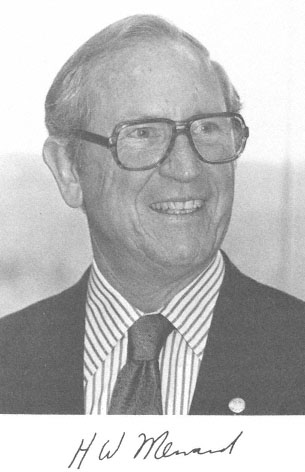
HENRY WILLIAM MENARD
December 10, 1920-February 9, 1986
BY ROBERT L. FISHER AND EDWARD D. GOLDBERG
HENRY WILLIAM MENARD was a scientific revolutionary. His research and his hypotheses, along with those of a relatively small, relatively young band of colleagues in the United States and the United Kingdom, provided the observational foundation from which grew the new global tectonics of the mid-twentieth century. A few scientific revolutionaries are scholars and Bill was one. His interests in the earth sciences were broad, spanning sedimentology, geomorphology, tectonics, geophysics, and geostatistics. But he ranged far into other areas of learned endeavors. He was a student of history, fascinated by events in the United States and England over the past several hundred years. English literature was especially attractive to him. Four of his six books melded natural science and social science. Of these, The Ocean of Truth: A Personal History of Global Tectonics, published posthumously by the Princeton University Press in 1986, is one insider's scientific history of the seafloor-spreading concept and plate tectonics. Henry Frankel, the distinguished philosopher of science, said in a review (Eos, October 13, 1987), ''I include Menard's work in the history of science within his professional legacy, since Menard did not approach the history of science as a retired scientist who decided to write, with memory as his only guide. . . .''
The Anatomy of an Expedition (McGraw-Hill, 1969) considers the problems, the excitement, and the serendipitous satisfactions of mounting an ocean-going, exploring expedition. In addition, Menard published over 100 scientific papers.
Menard was dedicated to an understanding of the history and sociology of science and brought together his observations in Science: Growth and Change, published by Harvard University Press in 1971. The volume was well received. The Science reviewer (C. Albritton, Science 176:639-41) noted that it was "an engaging and prophetic exposition of scientism at its operational best." Menard surveys the development of science in the United States, to a large extent based on his associations with the geological community. He develops many of the background problems of scientists—conflicts with administrators, absence of positions in specialties, the temporal ups and downs of scientific disciplines, salaries, and productivity. He utilizes elections to the highest-level scientific societies, such as the U.S. National Academy of Sciences and the Royal Society of London, and the receipt of prestigious awards, such as the Penrose Medal of the Geological Society of America, as more or less objective measures of scientific creativities, both in this volume and in The Ocean of Truth. Menard was well aware that prolific publication did not guarantee such recognition by peers and neither did notoriety in the media. Menard was a "lumper" as opposed to a "splitter" in his innovative ideas on the management of science. He proposed in Science: Growth and Change a coalescence of federal science departments into one superagency through which scientists could more effectively control their destinies.
The catholic interests of Menard can be illustrated by a rather tantalizing and unusual paper, "The Scientific Uses of Random Drilling Models" written with George Sharman (Science 190:337-43). They compare the expectable results
of drilling randomly for oil in the contiguous United States with strategies based on geological and geophysical information. They conclude that success in exploration depends as much on chance as on social, economic, and technological factors. On the basis of the historical records, drilling has been successful at finding small reservoirs and less so for large ones. Menard and Sharman suggest that industry has aimed at small targets. Perhaps inadvertently, the exploration system has been formulated to search in the wrong places. They conclude, probably correctly, that most of the undiscovered oil of the future will be found in Alaska and off the continental shelf, as well as in imports.
Bill Menard (he rarely answered to Henry) was born on December 10, 1920, in Fresno, California, and attended Los Angeles High School. He obtained a B.S. in geology from the California Institute of Technology in 1942. He entered the U.S. Navy immediately after Pearl Harbor and served at sea as a photointerpreter and staff intelligence officer in the South Pacific theater. Following detachment from the service, he returned to Caltech to receive an M.S. In 1946 Bill married Gifford Merrill of New York, who survives him (three children were born to them: Andrew of New York City; Elizabeth of Encinitas, California; and Dorothy Merrill Crist of Silver Spring, Maryland). Bill then entered Harvard University and in 1949 received his doctorate under the guidance of Professor Henry Stetson, a pioneer marine geologist. His thesis project involved an experimental study of sediment transport in a flume at the Woods Hole Oceanographic Institution.
Bill then joined the Sea Floor Studies Section (led by Robert S. Dietz) of the Oceanographic Branch (headed by Eugene LaFond) of the U.S. Navy Electronics Laboratory in San Diego. This association was most fortunate for within a mission-oriented organization of the U.S. government these
laboratory heads charted a path of basic marine geological research. Menard's proximity to the pioneer marine geologists Francis Shepard, of the Scripps Institution of Oceanography in La Jolla, and K. O. Emery, of the University of Southern California in Los Angeles, gave him access to cutting-edge research of the time. But more than this, " . . . all the publications I needed were convenient. They were few, which is one of the best reasons for entering a new field if it isn't too unpromising" (Ocean of Truth, p. 57).
This last sentence provides insight into the character of Bill Menard—he was a realist. He tackled only scientific problems of significance and substance that had a high probability of resolution. This mood was encouraged by his colleagues at the Navy Electronics Laboratory (especially Dietz and Edwin Hamilton), who with him undertook research following ongoing evaluations as to where to initiate potentially rewarding and productive scientific efforts. The Dietz/Menard collaborations resulted in five papers. The first author, according to Menard, wrote the first draft of the paper; the ideas were an amalgamation of their discussions. The trio participated in the exploration of the Mid-Pacific Mountains during the joint Naval Electronics Laboratory/Scripps Institution of Oceanography MIDPAC Expedition of 1950 led by Roger Revelle. This submarine range extends westward for nearly 5,000 kilometers from near Necker Island on the Hawaiian Ridge to Marcus Island northeast of Guam.
Revelle invited Bill to move to the nearby Scripps Institution of Oceanography in 1955, and he became a full professor in 1961. He remained there, with only two interruptions, until his death. In 1965-66 he was a technical advisor in the Office of Science and Technology during the term of President Johnson. He served as tenth director of the U.S. Geological Survey from 1978 to 1981 under President Carter.
Menard was elected a member of the National Academy of Sciences in 1968 and was awarded the Bowie Medal of the American Geophysical Union in 1985. He was a fellow of the Geological Society of America, the American Geophysical Union, the American Association for the Advancement of Science, the American Academy of Arts and Sciences, and the California Academy of Sciences and was a member of the American Association of Petroleum Geologists.
Another facet of Bill's activities was his involvement with practical problems. In the 1950s he was a consultant for the American Telephone and Telegraph Company for his knowledge of seafloor topography, crucially important in laying cable across the oceans. In 1953, he and his colleagues began to map the geology of the shallow seafloor by means of Scuba diving and soon after formed a corporation to interpret their prospecting observations for the oil companies. Early on Bill recognized, from numerous widely distributed bottom photographs taken on reconnaissance expeditions during the International Geophysical Year, 1957-58, the vast extent and potential economic value of manganese-iron nodules accreting on the deep seafloor. Such interests led him to join, and in 1967-69 to become the acting director of, the University of California's Institute of Marine Resources, headquartered at the Scripps Institution of Oceanography.
Bill Menard defined, in the strictest sense, several of the seafloor's topographic genera that became the key to the mechanisms of plate tectonics. In a classic paper in 1955 (Geological Society of America Bulletin 66:1149-98) he recognized and described the startlingly regular quartet of huge "fracture zones" that extend thousands of kilometers westward, almost as great circles on the spheroid, from the California and Baja California coastlines to the Central Pacific.
These four zones became the type localities for dozens of such linear features segmenting all the active midoceanic ridges around the world. Zones of disruption, they are the locales of the offsets in the "magnetic stripe" patterns first mapped in the mid-1950s off the western United States by SIO scientists aboard the U.S. Coast and Geodetic Survey vessel Pioneer. From additional observations that established the worldwide association of the fracture zones' topographic, seismic, petrological, and magnetic characteristics, Tuzo Wilson in 1964 proposed the "transform fault," an ingenious mechanism that unified and made compelling the accumulating observations that established plate tectonics.
Bill was a contributor and elucidator to all major themes in marine geology from the tumultuous turbidity currents of the early 1950s to the more subtle propagating rifts of the 1980s. His papers are models of succinct yet entertaining writing, gentlemanly attribution, and deft exposition. A generalist and a humanistic natural scientist, he read widely and could apply the principles or results of one field—say, plastic deformation in tested materials—to the observed shape of major geographic entities, in order to draw instructive, sometimes prescient, inferences. Ever the realist, Bill could judge how long, or far, to hold such views. As a collaborator he was generous, imaginative, and ever the scholar; as a shipmate Bill Menard was a "sea man" in the finest sense. No scientist, or adventurer, could ask for better.
SELECTED BIBLIOGRAPHY
1947 Analysis of measurements in length of the metapodials of Smilodon. Bull. S. Calif. Acad. Sci. XLVI (pt. 3):127-35.
1950 Sediment movement in relation to current velocity. J. Sediment Petrol. 20:148-60.
1951 With A. J. Boucot. Experiments on the movement of shells by water. Am. J. Sci. 249:131-51.
With R. S. Dietz. Origin of abrupt change in slope at continental shelf margin. Bull. Am. Assoc. Petrol. Geol. 35:1994-2016.
With J. C. Ludwick. Applications of hydraulics to the study of marine turbidity currents. Soc. Econ. Paleontol. Mineral. Spec. Publ. No. 2:2-13.
With R. S. Dietz. Submarine geology of the Gulf of Alaska. Bull. Geol. Soc. Am. 62:1263-85.
1952 With R. S. Dietz. Mendocino submarine escarpment. J. Geol. 60:266-78.
With P. H. Kuenen. Turbidity currents, graded and non-graded deposits. J. Sediment Petrol. 22:86-96
1953 With R. S. Dietz. Hawaiian swell, deep, and arch, and subsidence of the Hawaiian Islands. J. Geol. 61:99-113.
1954 With R. F. Dill, E. L. Hamilton, D. G. Moore, G. Shumway, M. Silverman, and H. B. Stewart. Underwater mapping by diving geologists. Bull. Am. Assoc. Petrol. Geol. 38:129-47
With R. S. Dietz and E. L. Hamilton. Echograms of the Mid-Pacific expedition. Deep-Sea Res. 1:258-72.
With G. Shumway, R. S. Dietz, R. F. Dill, E. L. Hamilton, and D. G.
Moore. Observations by diving geologists of bedrock off Southern California. Bull. Geol. Soc. Am. 65(pt. II):1304.
1955 Deformation of the northeastern Pacific Basin and the west coast of North America. Bull. Geol. Soc. Am. 66:1149-98.
1956 Archipelagic aprons. Bull. Am. Assoc. Petrol. Geol. 40:2195-2210.
1958 Development of median elevation in ocean basins. Bull. Geol. Soc. Am. 69:1179-86.
With C. J. Shipek. Surface concentrations of manganese nodules. Nature 182:1156-58.
With R. L. Fisher. Clipperton fracture zone in the northeastern equatorial Pacific. J. Geol. 66:239-53.
1960 The East Pacific rise. Science 132:1737-46.
Possible pre-Pleistocene deep-sea fans off Central California. Bull. Geol. Soc. Am. 71:1271-78.
1962 Correlation between length and offset on very large wrench faults. J. Geophys. Res. 67:4096-98.
1963 With H. S. Ladd. Oceanic islands, seamounts, guyots and atolls. In The Sea, vol. 3, ed. M. N. Hill, pp. 365-87. New York: Interscience.
With B. C. Heezen. Topography of the deep sea floor. In The Sea, vol. 3, ed. M. N. Hill, pp. 233-80. New York: Interscience.
1964 Marine Geology of the Pacific. New York: McGraw-Hill.
1965 The world-wide oceanic rise-ridge system. Philos. Trans. R. Soc. 258:109-22.
1966 Sea floor relief and mantle convection. In Physics and Chemistry of the Earth, vol. 6, pp. 315-64. London: Pergamon Press.
1968 With T. Atwater. Changes in direction in sea-floor spreading. Nature 219:463-67.
1969 Anatomy of an Expedition. New York: McGraw-Hill.
1970 With T. Atwater. Magnetic lineations in the northeast Pacific. Earth Planet Sci. Lett. 7:445-50.
1971 With T. E. Chase. Fracture zones. In The Sea, vol. 4, ed. A. E. Maxwell, pp. 420-43. New York: Wiley Interscience.
Science: Growth and Change. Cambridge: Harvard Univ. Press.
1973 Depth anomalies and the bobbing motion of drifting islands. J. Geophys. Res. 78:5128-37.
1974 Geology, Resources and Society. San Francisco: W. H. Freeman.
1975 With G. Sharman. Scientific uses of random drilling models. Science 190:337-43.
1976 Time, chance, and the origin of manganese nodules. Am. Sci. 64:519-29.
1978 Fragmentation of the Farallon plate by pivoting subduction. J. Geol. 86:99-110.
1981 Toward a rational strategy for oil exploration. Sci. Am. 244:55-65.
1982 With M. McNutt. Constraints on yield strength in the oceanic lithosphere derived from observations of flexure. Geophys. J. R. Astron. Soc. 71:363-94.
1984 Evolution of ridges by asymmetrical spreading. Geology 12:177-80.
1986 The Ocean of Truth: A Personal History of Global Tectonics. Princeton: Princeton Univ. Press.
Islands. New York: W. H. Freeman.


