
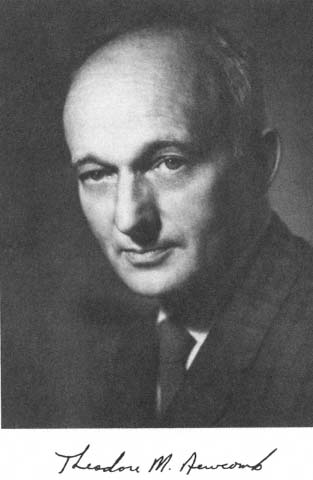
THEODORE MEAD NEWCOMB
July 24, 1903-December 28, 1984
BY PHILIP E. CONVERSE
THEODORE M. NEWCOMB was one of the principal pioneers in the establishment of social psychology as a fertile area for study at the boundary between the traditional disciplines of psychology and sociology. During five decades of research he sought to enrich individualistic treatments of human motivation, learning, and perception with a keener understanding of the social processes that shape them. He was author or co-author of three widely used textbooks that gave systematic definition to this emergent field, and he directed the influential doctoral program in social psychology at the University of Michigan for twenty-six years.
Newcomb's personal research made an impressive series of conceptual and empirical contributions to the new area of social psychology. These included work on autism and social communication; the first ambitious tracing of the evolution of political attitudes over the adult life course; a careful elucidation of the basic principles of cognitive balance; studies of the primary forces shaping interpersonal attraction; and, in a closely related way, the growth of mainstream and deviant subcultures. Throughout his life he was also interested in the dynamics of the education process. More than a small portion of his basic research was focused
on this interest, and he successfully applied much of what he learned to practical problems in higher education.
PERSONAL BACKGROUND
Theodore M. Newcomb was born July 24, 1903, in Rock Creek, a rural village in Ashtabula County at the northeastern tip of Ohio. His father was a Congregational minister. In an engaging autobiographical note entitled ''The Love of Ideas'' (1980), Newcomb recalled that his father had "a passion for the 'rural church,"' and as a consequence the family moved frequently from one small town to another. This meant in turn that his family provided the only continuity in his development, and he gave it uncommon loyalty.
The Newcomb ancestors had been early settlers in Connecticut and Vermont who had followed the westward movement to New York state, and then on into what was once the Western Reserve in Ohio. Family traditions were persistently Congregational, "not untouched by Calvinism." They had also been early abolitionists and, until a defection by Newcomb's parents in World War I, unshakably Republican.
Newcomb grew up feeling that the family was, however, sharply set apart from its rural setting. Both his parents were college-educated and held advanced degrees. They subscribed to "serious" magazines otherwise unknown in the community, and the family spent much time reading books, often aloud. There were even moments of ostracism for the family as the father took up locally unpopular positions from the pulpit, attacking the Ku Klux Klan or supporting pacifism. Family solidarity was thereby enhanced, and young Ted received his first lessons in the invigoration of departing from the herd politically.
Given the rural setting, Newcomb's early education was spent in one-room schools. The big transition came as he began ninth grade in a large high school in Cleveland,
Ohio. He weathered the change well, however, and four years later was class valedictorian. His valedictory address heaped scorn on the New York State Legislature for having denied seats to two legally elected members on grounds that they were "bolshevistic" socialists. He was pleased that his parents liked the talk, and that the principal did not.
All of his social world, including Ted, took for granted that he would enroll at Oberlin College, where all good Congregationalists went. He and his closest high school friend had made a joint decision to become Christian missionaries, and his undergraduate days at Oberlin, spent as a faithful student volunteer, were heavily dominated by this goal. He graduated summa cum laude in 1924, but in retrospect found any serious learning from the college years a near blank.
To pay off college debts he put in a year teaching high school, and then entered Union Theological Seminary in New York City. With Columbia University across the street and a tradition of cross-enrollments in courses, the pace of his intellectual growth began to quicken. He was excited by fellow students, his professors, and the issues that were gripping them all. He recalled particular fascination with exegesis of the Old Testament from Julius Bewer; progressive education, as taught by William Kilpatrick at Columbia Teachers College; educational psychology with Goodwin Watson, also at Teachers College; general psychology with Gardner Murphy at Columbia, with whom he would later develop a most fruitful collaboration; and ethics with Harry Ward at the Seminary, who dealt more in current issues than in Bible studies.
Ironically, Newcomb's two years at Union convinced him that he might prefer to be a psychologist in academe rather than a Christian missionary. One small reinforcement for this decision was exposure to a seminary professor who lec-
tured frequently on the total superiority of Christianity to all other religions, at a time when Newcomb was reading anthropology about cultural differences and the illusions of ethnocentrism. Therefore, he switched his registration, continued his graduate work for another two years, and received his Ph.D. in psychology from Columbia in 1929.
PROFESSIONAL, CAREER
Newcomb took his first academic position in the psychology department at Lehigh University in the fall of 1929. In part because of his exposure to educational issues at Teachers College, the fledgling instructor was asked to prepare an analysis of some of the university's operating policies. Newcomb's report to the dean was apparently not flattering, and officials requested that he make a number of changes in his findings to put the university in a more favorable light. Newcomb refused, and despite the growing national gloom following the collapse of the stock market, he felt obliged to look elsewhere for employment.
His next position was at Cleveland College, Western Reserve University, where he spent four years. On August 27, 1931, he married Mary E. Shipherd of an old Oberlin family. The relationship was an uncommonly devoted one for the remaining half-century, and soon the family grew to include three children: Esther, Suzanne, and Theodore, Jr. Meanwhile the Depression continued to gain force, and Newcomb was deeply affected. He recalls that he "learned as much from suffering students and their families as from newspapers," and during the darkest days of the early thirties he joined the Socialist Party.
1934 brought a remarkable job change, which influenced the rest of Newcomb's career. He received an offer to join the faculty at the new Bennington College in Vermont, and he accepted with what he called "indecent haste." His Western
Reserve colleagues were baffled by his choice of a tiny and nearly unknown women's college in the Vermont hills over his Cleveland position. Newcomb was, however, thoroughly committed to experiments in progressive education and was aware of the new college's philosophies. He found the prospect of dispensing wisdom in a more intimate setting an exciting one, and it was not until he had moved to Vermont that the sympathizer with the underdog came to realize that the Bennington student body was unrelievedly "upper crust."
The next seven years at Bennington were heady ones. Despite the implausible setting, Newcomb plunged into an array of mildly radical political activities, including the organization of student political groups on the one hand, and a teachers' union at the college on the other.
These considerable distractions notwithstanding, he saved his main energies for his research and writing, and in this period he became a nationally established scholar. He was invited by his former mentor Gardner Murphy at Columbia to participate in a thorough revision of a popular text, Experimental Social Psychology (1937), that Murphy and his wife had first published in 1931. Newcomb was to add a major new section systematizing the flood of studies of social attitudes, attitude change, and personality measurement that had appeared since the first edition. His statement increased the bulk of the volume by one quarter and was widely admired. The contribution put him in the habit of using skillful textbook writing to introduce fresh synthetic theory to his peers.
The collaboration with the Murphys dovetailed nicely with a rapid expansion of Newcomb's own research agenda. Although the Murphy book was originally focused on social psychological experiments, Newcomb's part dealt more with measurement of attitudes and personality in natural settings. He appreciated the inferential power of the experi-
mental method, but worried about the potential artificiality of the behavior of self-conscious human beings in plainly contrived laboratory situations. Moreover, he had picked up from Kurt Lewin, his "principal social-psychological hero" as he once described him, a fascination with the "whys and hows of change" in groups over more extended periods of time than fitted the normal confines of the tightly controlled laboratory experiment.
Given these predilections, it is not surprising that Newcomb quickly came to see Bennington in the mid-1930s as a promising "natural experiment" in large-scale attitude change. Young women from genteel and often deeply conservative political backgrounds were gathered together at a time of national economic distress so overwhelming as to stimulate widespread interest in radical reform. It was clear that cohorts graduating from Bennington had on average arrived at views of the political world fundamentally different from the ones they had when they entered, and that the details of this change—who changed, who resisted, and under what circumstances—were shaped in no small degree by internal group processes. Issues pivotal to basic theory in social psychology were at stake here, and Newcomb wanted to subject this changing scene to systematic study.
Therefore, he designed an ambitious longitudinal project to monitor the timing and extent of these changes during the undergraduate career, and to specify the circumstances under which they were most likely to occur. Among a rich array of results reported in his monograph Personality and Social Change (1943), some of the clearest findings tied change closely to the college experience itself. Not only did movement toward more liberal views cumulate steadily over the undergraduate years, but the change was greatest among those students most involved in college affairs and most respected among their peers.
The "Bennington Study," as this research effort came to be called, had a major impact on the nascent field of social psychology. Not only was the longitudinal design novel for the period, but the study contained numerous innovative ways of capturing the interplay between individual dispositions and group process. And, of course, the careful demonstration of the potent shaping of individual responses by factors of group context gave empirical reassurance for some of the most central assumptions motivating the study of social psychology.
The Bennington Study also shaped Newcomb's own intellectual development in important ways. The long-term longitudinal study became something of a trademark, despite Newcomb's wry comment that waiting for such studies to ripen on the vine had notably shortened his list of publications relative to peers who completed a number of experiments or shorter studies per year. Some of the substantive findings about the effects of college also influenced some major institutional experiments involving the harnessing of group process to deepen the educational experience, which Newcomb put to real-world application at the University of Michigan thirty years later.
Finally, he was to carry on the Bennington study itself with further longitudinal extensions. About 1960 he returned to the same students, now middle-aged, whom he had studied at Bennington in order to assess the persistence of the attitude change associated with the college experience. The stability was impressive, and as clear for college converts as for those who had come to college already liberal in their views. At the time of his death in 1984, Newcomb and the young social psychologist Duane Alwin were in the late stages of yet another interview with the Bennington students, after more than forty years had passed.
In his seventh year at Bennington, Newcomb was invited
to join the faculty at the University of Michigan. He accepted the new position with alacrity, as he had come to miss the stimulation of contact with graduate and pre-professional students. He took up his work in Ann Arbor a few months before Pearl Harbor plunged the United States into World War II. Soon thereafter he was on his way to Washington, D.C., to join a growing cadre of middle-aged social scientists drawn into various forms of research associated with the war effort. He served with the Foreign Broadcast Intelligence Service and the Office of Strategic Services, and, late in the war, spent time in Europe helping to carry out the U.S. Strategic Bombing Survey.
At the war's end he returned to Ann Arbor to resume serious effort on the task for which he had originally been hired: to help the University of Michigan develop strength in the growing area of social psychology. This he did in the grand manner; he proposed to the university the establishment of a joint doctoral program, which he would chair, shared by his two departments of sociology and psychology.
The new program, which had but one loose parallel at Harvard, turned into an instant success. It accepted students only beyond the master's level, but soon attracted a deluge of applications and was able to set a high threshold for entrance. Newcomb assembled a distinguished faculty to help define and teach in the program, including most centrally Daniel Katz and Dorwin Cartright, as well as other social psychologists from his Washington days who had come to Michigan to form the Institute for Social Research. In short order, the program was awarding Ph.D.'s at a rate that made it one of the largest in the university. Under Newcomb's leadership over the next two decades, program graduates went to all corners of the land, colonizing both sociology and psychology departments in the name of the joint discipline.
In the early period of the program Newcomb published his basic text Social Psychology (1950). This was a gentle but thoughtful work that enjoyed great popularity. Several good texts in this new area had appeared over the preceding fifteen years, including the 1937 Murphy revision to which Newcomb had contributed. Most of these were, however, written by psychologists from a distinctly psychological point of view. Although his own primary background had also been in psychology, Newcomb's definition of the field welded in a richer complement of basic sociological concepts, including social roles, social norms, and other essentials of social structure.
In this same general period Newcomb extended his Bennington studies by joining with W. W. Charters in experimental work manipulating the situational salience of reference groups to gauge variation in their impact (1952, 2).
He also began work on a set of theoretical notions that would permeate his own research agenda for at least another decade. He had become intrigued with the work of Fritz Heider in the 1940s, developing propositions about cognitive "balance," or a hypothesized tendency toward symmetry in feelings about objects that the actor cognitively associates with one another in "unit relations." One obvious special case of such an association might be the linking of a message with its source. If, for example, the actor listens to a source, for whom he has feelings, express some attitudes, for which he also has feelings, it is of course possible that at any given time these feelings are opposite in sign: the source is liked but the message is disliked, or vice versa. Such configurations represent a form of disequilibrium, which has predictable consequences for both the actor's attitudes and behavior, the most general of these being the longer-run expectation of a move toward greater symmetry of these linked preferences.
Newcomb took these ideas of structural equilibria out of the heads of individual actors and worked with them as a set of basic terms for the understanding of two-person or dyadic interactions. The relationship between persons A and B could be described as an attitude of liking or disliking, and each could like or dislike a shared object of orientation X. These terms formed an ABX "system" because there was some interdependence or "strain toward symmetry" between the valences present. The more detailed exposition of the nuances of the ABX system appeared in his influential article, ''An Approach to the Study of Communicative Acts" (1953, 2).
Much of Newcomb's work over the ensuing decade was addressed to the phenomena surrounding interpersonal perception and liking. He was eager to test the predictions of his ABX theorizing in a more natural setting, and gravitated toward a field-experimental design that bore no small resemblance to the earlier Bennington Study. He felt he needed to capture the formative beginnings of such systems, catching "A's" and "B's" before they were aware of one another's existence, and hence before either knew the other's orientation toward various X's. Therefore, he arranged an intensive two-year study of students' attitudes and interpersonal attractions based in their living units from the time of arrival at the university, when dorm mates met for the first time. The resulting monograph, The Acquaintance Process (1961), stands as another milestone contribution to social psychology.
In his later years Newcomb turned his lifelong fascination with the useful integration of "living and learning" to some practical institutional consequence at the University of Michigan. He was one of the central figures in the design and creation of a small, informal residential college within the university. In an early role as associate director
of this unit he devoted a great deal of time to the formation of its institutions and particularly to the creation of its community governance in a mode that involved a remarkable level of student participation. He frequently served as a consultant to similar developments elsewhere in the country, and summarized a good deal of informal experience, personal research, and a copious external literature in a two-volume work entitled Impact of College on Students (1968).
Over the course of his career, Newcomb served his two parent disciplines of psychology and sociology in a variety of roles. He was president of the Society for the Psychological Study of Social Issues in 1945-46 and president of the Division of Personality and Social Psychology of the American Psychological Association in 1948-49. He edited the summit journal, the Psychological Review, from 1954 to 1959. In 1955-56 he was president of the full American Psychological Association.
In a different context he served on the Board of Trustees of Antioch College for twelve years from 1959 to 1972, chairing the board for the last six years. From 1961 to 1966 he spent periods of each year at the Western Behavioral Sciences Institute as a Visiting Fellow. He also completed terms as Visiting Professor at both San Diego and Santa Cruz in the University of California system and as Distinguished Visiting Professor at York University (Toronto) and Amherst College. In his final years at Michigan he was the Mary Ann and Charles R. Walgreen, Jr., Professor for the Study of Human Understanding.
Newcomb's intellectual contributions brought him many other honors and awards in addition to his election to the National Academy of Sciences in 1974. He was a Fulbright Scholar in London in 1951-52, a fellow at the Center for Advanced Study in the Behavioral Sciences at Stanford in 1956-57, and a Guggenheim Fellow in 1960. He was elected
to the American Academy of Arts and Sciences in 1957. Other awards included the Kurt Lewin Memorial Award from the Society for the Psychological Study of Social Issues (1962); the first annual Research Award from the American Educational Research Association (1972); the Distinguished Scientific Contributions Award of the American Psychological Association (1976); and the Cooley-Mead Award of the American Sociological Association (1980).
TED NEWCOMB, THE PERSON
It remains to us to capture the essence of Ted Newcomb as a most lively colleague, mentor, and friend.
In his autobiographical statement, Ted recalled that when he was a boy in his early teens, his father announced to the family that he would present them with phrases that would best distinguish each of the children. For Ted, the phrase was ''Isn't it going to be wonderful!" Seventy years later, as a group of Ted's closest colleagues and former students presented remembrances of him in a memorial service at the University of Michigan, one of several traits mentioned by all was his bursting joie de vivre, a zest for life that simply seemed irrepressible.
Closely related, and mentioned with equal frequency, was an infectious playfulness. He was a quick wit, often irreverent and what one speaker called "bratty," but never mean-spirited to others in his humor. He also expected work to be play. "He never confused seriousness with solemnity," said William Gamson at the memorial. "A class was a time to play with ideas—serious play.''
He was also a profoundly generous person. He was known for giving "not just money for good causes, needy students, or embarrassed colleagues," Robert Kahn recalled, "but generosity of time and self." His pervasive generosity was nowhere more clear than with his students, whom Ted once
called his "jewels." Just as he was a stellar role model for aspiring young people, his marriage with Mary was a notably loving one. Their home was remarkably open, and they were considered as spiritual godparents by virtually all of the hundreds of students who came through the social psychology program. Over the years Ted drew many students into personal collaboration on research projects and other professional writing, a priceless learning experience for the students, although not always the most efficient use of his own time.
Ted was also unusual in his response to situations of rules and authority, and this was equally true whether he came at them from the top side or the bottom. He was, of course, intensely egalitarian, but this value he shared with many others of the same time and place. He was uncomfortable around pomp and puffery and resisted it in others in a quiet and good-humored way.
A hasty and superficial observer might have coded Ted as deeply irreverent toward authority. But in the degree such a description calls to mind the hostile malcontent, nothing could be further from the mark, or less in tune with his sunny and trusting disposition. He was not negatively disposed toward human institutions; in fact, as noted, he created several very innovative institutions himself and led them with high distinction. But he did not have a bureaucratic bone in his body. He knew that rules and social organization could facilitate progress toward many enticing goals, but he also knew that they could become obstructions as well, an outcome he was not prepared to tolerate.
Indeed, in his memorial service remembrance of Ted, William Gamson credited him with "a certain deliberate obtuseness about obstacles." His instinct was always "Why not?", with "the burden of proof always on the resisters and foot draggers rather than on those who would create some-
thing new and different." Boundaries were there to be crossed and unspoken rules to be broken. "Why not? They were our boundaries and rules, weren't they?" His focus was always on the goals and the main vision. Decisions about the best means were left to come tumbling after.
He did have one major public confrontation with Higher Authority, and acquitted himself impressively. In the early 1950s the House Un-American Activities Committee (HUAC) descended on Ann Arbor to interrogate suspected Communist sympathizers on the University of Michigan faculty. Although Ted was himself on one of HUAC's lists because of his memberships of the 1930s, he was not one of the immediate quarry. Several younger faculty members refused to identify their associations for the committee, however, and an intimidated university administration agreed to expel or suspend them. This capitulation distressed a substantial fraction of the faculty. When the president came to a meeting of the university senate to defend his actions, Ted took the floor with a calm but forceful challenge to both HUAC and the administration on the fundamentals of academic freedom. It was a matter of widespread embarrassment to many sympathetic colleagues that Ted alone had stood up to be counted on the issue.
Ted Newcomb was a person of thorough-going convictions without a trace of sanctimony. He was a warm and playful companion at the same time that he was an inspiring colleague and mentor. He did as much as anyone to define and systematize social psychology as an area of specialization, and he helped adorn the subject with five decades of excitement. Above all, he was insatiably curious about the human condition and how it might best be understood. And to a generation of us, he conveyed with consummate skill "the love of ideas."
MUCH OF THIS MEMOIR is based on a diffuse range of informal sources, including my personal recollections as a student of and later collaborator with Ted Newcomb, and many conversations over the years with friends and colleagues from different periods and sectors of his life. Two "hard-copy" sources were, however, indispensable. One was the self-portrait "The Love of Ideas" (see bibliography). The other was "Remembering Ted Newcomb: A Biographical Sketch and Remembrances from a Memorial Service for Theodore M. Newcomb, Held January 25, 1985, at the University of Michigan."
SELECTED BIBLIOGRAPHY
1929 Does extroversion-introversion offer a clue for the prognosis and treatment of problem boys? Ment. Hyg. 14:919-25.
1937 With Gardner and Lois Murphy. Experimental Social Psychology. Wilmington, N.C.: Harper.
Determinants of opinion. Pub. Opin. Q. 1:71-78.
1942 Community roles in attitude formation. Am. Soc. Rev. 7:621-30.
1943 Personality and Social Change. Hinsdale, Il.: Dryden Press.
1946 The influence of attitude climate upon some determinants of information. J. Abnorm. Soc. Psychol. 41:291-302.
1947 Autistic hostility and social reality. J. Hum. Rel. 1:68-86.
1950 Social Psychology. Hinsdale, Il.: Dryden Press.
1951 Social psychological theory: Integrating individual and social approaches. In Social Psychology at the Crossroads, eds. J. Rohrer and M. Sherif, pp. 31-49. New York: Harper and Brothers.
1952 Attitude development as a function of reference groups: The Bennington study. In Readings in Social Psychology, eds. G. E. Swanson, T. M. Newcomb, and E. L. Hartley, pp. 420-30. New York: Henry Holt.
With W. W. Charters, Jr. Some attitudinal effects of experimentally increased salience of a membership group. In Readings in Social
Psychology, eds. G. E. Swanson, T. M. Newcomb, and E. L. Hartley, pp. 415-20. New York: Henry Holt.
1953 Social psychology and group processes. Annu. Rev. Psychol. 4:183-214. Stanford: Stanford University Press.
An approach to the study of communicative acts. Psychol. Rev. 60:393-404.
1956 The prediction of interpersonal attraction. (Presidential Address to American Psychological Association, September 1956) Am. Psychol. 2:575-86.
1958 Cognition of persons as cognizers. In Person Perception and Interpersonal Behavior, eds. Renato Tagiuri and Luigi Petrullo, pp. 179-90. Stanford: Stanford University Press.
1959 The study of consensus. In Sociology Today, vol. II, eds. R. Merton, L. Broom, and L. Cottrell, Jr. New York: Harper and Row.
1961 The Acquaintance Process. New York: Holt, Rinehart and Winston.
1963 Stabilities underlying changes in interpersonal attraction. J. Abnorm. Soc. Psychol. 66:376-86.
1966 With K. O. Price and E. Harburg. Psychological balance in situations of negative interpersonal attitudes. J. Pers. Soc. Psychol. 3:265-70.
1967 With K. Koenig, R. Flacks, and D. Warwick. Persistence and Change: Bennington College and Its Students After 25 Years. New York: John Wiley and Sons.
1968 With K. A. Feldman. Impact of College on Students, vols. I and II. San Francisco: Jossey-Bass.
1970 With D. R. Brown, J. A. Kulik, D. J. Reimes, and W. R. Revelle. Self-selection and change. In The Cluster College, ed. Jerry Gaff, pp. 137-60. San Francisco: Jossey-Bass.
1971 Dyadic balance as a source of clues about interpersonal attraction. In Theories of Attraction and Love, ed. Bernard I. Murstein, pp. 31-45. New York: Springer.
1979 Reciprocity of interpersonal attraction: A nonconfirmation of a plausible hypothesis. Soc. Psychol. Q. 14:299-306.
1980 The love of ideas. Autobiographical statement. Society 17(6):76-82.


