
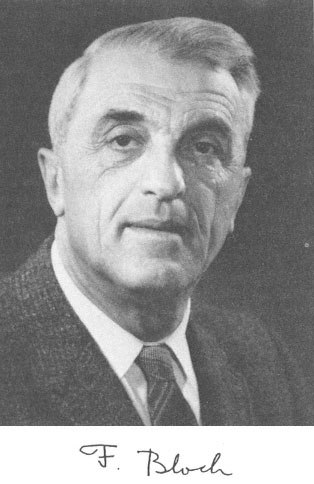
FELIX BLOCH
October 23, 1905-September 10, 1983
BY ROBERT HOFSTADTER
FELIX BLOCH was a historic figure in the development of physics in the twentieth century. He was one among the great innovators who first showed that quantum mechanics was a valid instrument for understanding many physical phenomena for which there had been no previous explanation. Among many contributions were his pioneering efforts in the quantum theory of metals and solids, which resulted in what are called ''Bloch Waves" or "Bloch States" and, later, "Bloch Walls," which separate magnetic domains in ferromagnetic materials. His name is associated with the famous Bethe-Bloch formula, which describes the stopping of charged particles in matter. The theory of "Spin Waves" was also developed by Bloch. His early work on the magnetic scattering of neutrons led to his famous experiment with Alvarez that determined the magnetic moment of the neutron. In carrying out this resonance experiment, Bloch realized that magnetic moments of nuclei in general could be measured by resonance methods. This idea led to the discovery of nuclear magnetic resonance, which Bloch originally called nuclear induction. For this and the simultaneous and independent work of E. Purcell, Bloch and Purcell shared the Nobel prize in physics in 1952.
The aim of the physicist is to carry out and interpret
experiments that yield new results. In this sense Bloch reached tremendous heights in both theory and experiment, and it can truly be said that he "made" physics in great leaps and discoveries.
In the detailed account of Felix's career which follows, I shall describe these and several other important advances made over the years. But I shall first speak about his background and early life, as he himself described it in a talk he gave at Stanford on January 20, 1970, entitled "How I Became a Physicist."
Felix Bloch was born in Zurich on October 23, 1905. This was the same year in which Albert Einstein made three transcendent discoveries in physics. His father was Gustav Bloch, a wholesale grain dealer in Zurich. His mother was Agnes Meyer Bloch, a cousin from Vienna. Gustav came from a large family living in western Bohemia and although he had strong interests in history and languages was unable to attend a university for financial reasons. He moved to Zurich in 1890 to take a position in his uncle's business and became a Swiss citizen. Gustav and Agnes had a daughter in 1902 and, as stated above, Felix was born in 1905. The name "Felix" means "lucky," and it was a propitious way to start out in life with this name.
The love of mountains that Felix acquired through vacations in the Alps remained a very deep part of his character all his life. He entered public elementary school when he was six years old. Experiences in school at that tender age were difficult for Felix, who spoke Swiss German with a somewhat different accent than most members of the class. He was also treated rather shabbily by his teacher. This led to a dislike for school, but his sister gave him strong support; when she died at the age of twelve, it was an extremely tragic event for him.
Felix led a depressed and isolated life in the years follow-
ing the outbreak of World War I. But his feelings changed gradually after moving to a new school where education was governed by the benevolent Pestalozzi method. Arithmetic was a subject that had a special appeal because of its clarity and beauty. He also started music studies and played the piano when he was eight years old. He had a preference for Bach's harmonies. At twelve, Felix finished elementary school and began secondary school. At this time he and his parents made a decision to choose a six-year curriculum that would prepare him for a university. He attended the gymnasium run by the Canton of Zurich, entering in the spring of 1918. This was a very good choice because many of the professors were not only good teachers but were scholars at the same time who had previously earned the title of Ph.D. It was hard work in the gymnasium but his Latin studies were very enjoyable and stimulating. French, English, and Italian were taught, as well as Latin, mathematics, physics, and chemistry. Numbers were especially attractive to Felix and dealing with them instilled a deep respect for quantitative ideas. He applied elementary mathematics, which he had just learned, to astronomy and proved for himself that he could successfully calculate the length of daylight in Zurich at various times of the year.
At age fifteen, after three years in gymnasium, Felix started to study physics and continued in gymnasium with languages and mathematics until 1924. He entered the Federal Institute of Technology (ETH) in Zurich in the fall of 1924, having made a choice of engineering as a future profession. This early choice of career is similar to that of Dirac, Wigner, and von Neumann. Following the thorough program of that school, he took calculus and mechanics as well as a course in drafting that he didn't greatly appreciate but was necessary for an engineering degree. During summer vacation he worked in a small iron foundry on the lake of
Zurich. This experience provided him with grounds for the decision he needed, and he changed from engineering to physics. His father was rather skeptical of this choice because teaching in high school or working with physics in industry didn't seem to lead to a very promising career. Wishing advice, Felix went to see Professor Hermann Weyl who was the division head for mathematics and physics at the ETH and asked him whether he should study physics. Weyl said ''no," but Bloch did not accept this advice because, as he indicated, he "couldn't help it."
In Peter Debye's class in introductory physics Felix found what he desired and felt later that he learned more from that class than from all his other courses together. Coming across Sommerfeld's famous book, Atomic Structure and Spectral Lines, Felix found that he needed to know what was meant by an "electromagnetic field." He did his own reading about that subject and many others in classical physics and made a brief foray into experimental physics that he never completed. On the other hand, he was absorbed by the lectures in the small colloquia held alternately in the departments of the University of Zurich and the ETH.
In 1926 an event occurred that had a great influence on his career. He described this in an article for Physics Today in December 1976. He writes:
Once at the end of a colloquium I heard Debye saying something like: "Schrödinger, you are not working right now on very important problems anyway. Why don't you tell us some time about that thesis of de Broglie, which seems to have attracted some attention?"
So in one of the next colloquia, Schrödinger gave a beautifully clear account of how de Broglie associated a wave with a particle and how he could obtain the quantization rules of Niels Bohr and Sommerfeld by demanding that an integer number of waves should be fitted along a stationary orbit. When he had finished, Debye casually remarked that this way of talking was rather childish. As a student of Sommerfeld he had learned that, to deal properly with waves, one had to have a wave equation. It
sounded quite trivial and did not seem to make a great impression, but Schrödinger evidently thought a bit more about the idea afterwards.
Just a few weeks later he gave another talk in the colloquium which he started by saying: "My colleague Debye suggested that one should have a wave equation; well I have found one!"
And then he told us essentially what he was about to publish under the title "Quantization as Eigenvalue Problem" as the first paper of a series in the Annalen der Physik. I was still too green to really appreciate the significance of this talk, but from the general reaction of the audience I realized that something rather important had happened, and I need not tell you what the name of Schrödinger has meant from then on. Many years later, I reminded Debye of his remark about the wave equation; interestingly enough he claimed that he had forgotten about it and I am not quite sure whether this was not the subconscious suppression of his regret that he had not done it himself. In any event, he turned to me with a broad smile and said: "Well, wasn't I right?"
This quotation not only illustrates an important event in Felix's career but demonstrates as well how charmingly he could write and tell stories.
A little earlier Felix asked Debye for comments on an idea he had, since it concerned improving an older paper of Debye's on the Compton Effect. Instead Debye suggested that Felix should study Schrödinger's new wave mechanics. Many years later, Felix returned to the Compton Effect and wrote a paper on his original idea, this time using quantum mechanics.
Over the next eight years Felix's travels were complex and varied. Aside from short stays he spent extremely productive working periods successively in Leipzig, Zurich, Utrecht, Haarlem, Leipzig again, Copenhagen, Leipzig once more, and Rome before he went to Stanford in 1934. At almost every institution where he stayed, Felix made a major contribution to physics. Some of his achievements over these years are described below.
Debye left Zurich in 1927 and became professor at the University of Leipzig in Germany. Once more, taking Debye's
advice, Bloch followed him to Leipzig to start graduate work there with Werner Heisenberg, who had just been appointed professor of theoretical physics at the university. Heisenberg was then twenty-six years old and Felix was twenty-two, but Heisenberg was already a famous man. This was a "happy" step, since Heisenberg was one of the discoverers of quantum mechanics, developing his own matrix mechanics approach, and was in a position to apply this new theory to many problems that until then had not been solved. While still in Zurich, Felix had studied Schrödinger's wave theory and learned that the Schrödinger approach and Heisenberg's matrix mechanics were equivalent.
Heisenberg had not yet arrived in Leipzig when Felix first went to the University and so he introduced himself to Gregor Wentzel, who was a young professor at that institution. Felix described to Wentzel a calculation he had made on radiation damping of a harmonic oscillator that he thought would moderate the spreading of electron wave packets that followed from the wave theory. When asked for advice, Wentzel suggested that he wasn't an expert and Felix should talk with Heisenberg directly about this calculation. Heisenberg pointed out that the wave would spread in any case, but he encouraged Bloch to complete the calculation for the general case, which he did promptly. This work resulted in Bloch's first paper and, as he later remarked, it was a forerunner of the paper by Weisskopf and Wigner on radiation damping and the natural line widths of spectral lines.
Heisenberg took Felix as his first graduate student and suggested that for his thesis Felix should study the conductivity of metals by applying the new quantum mechanical theory. This was a well-known problem in classical theory whose complete solution had baffled such accomplished physicists as Drude, Lorentz, Pauli, and Sommerfeld, even though they had made considerable progress and had ex-
plained experimental results concerning the specific heat in metals and the relationship between thermal conductivity and electrical conductivity. This last relationship was known as the Wiedemann-Franz ratio. Classical theory, with some quantum modifications, agreed with experiment, at least approximately, but in these semiclassical treatments, no one understood why the conduction electrons should be treated as an ideal gas of free electrons. By making the assumption of an ideal gas, Pauli had already explained the temperature independence of the paramagnetism of metals by applying Fermi statistics to the conduction electrons. Sommerfeld and Pauli had also produced the results mentioned above for the Wiedemann-Franz ratio as well as for specific heat, but the entire situation about an ideal gas in metals seemed very puzzling. Why the free electron approach worked for metals and why the electrons didn't contribute to the specific heat in solids also needed to be incorporated into any consistent explanation.
Felix wrote:
When I started to think about it, I felt that the main problem was to explain how the electrons could sneak by all the ions in a metal so as to avoid a mean free path of the order of atomic distances. Such a distance was much too short to explain the observed resistances, which even demanded that the mean free path become longer and longer with decreasing temperature. But Heitler and London had already shown how electrons could jump between two atoms in a molecule to form a covalent bond, and the main difference between a molecule and a crystal was only that there were many more atoms in a periodic arrangement. To make my life easy, I began by considering wave functions in a one-dimensional periodic potential. By straight Fourier analysis I found to my delight that the wave differed from a plane wave of free electron only by a periodic modulation.
This was so simple that I didn't think it could be much of a discovery, but when I showed it to Heisenberg he said right away, "That's it." Well, that wasn't quite it yet, and my calculations were only completed in the summer when I wrote my thesis on "The Quantum Mechanics of Electrons in Crystal Lattices."
Felix's thesis was published under the title "Uber die Quantenmechanik der Elektronen in Kristallgittern" in the Zeitschrift für Physik (1928). In this work he also calculates the specific heat and electrical resistance of metals. The importance of this paper can hardly be overstated for it provided the basis for the band theory of condensed matter. Out of it followed the formulation by A. H. Wilson of the difference between metals and insulators and the theory of semiconductors. Everyone knows now what this implies for the enormous strides made in our times in radio, television, computers, communications, space exploration, etc., by the replacement of vacuum tubes, with their limited lifetimes, by the long-lived and rugged simplicity of semiconductors.
The waves that Felix discovered have been called "Bloch Waves" or "Bloch States," and the concept of these waves turns up everywhere in the theory of condensed matter.
Incidentally, the wave solution that Felix discovered was a version of what was known in mathematics as Floquet's Theorem and had been used previously by physicists without realizing its full implications for the quantum mechanics of solids.
In 1928, as was customary in those days, Bloch wanted to gain experience in other centers of theoretical physics in Europe, and so he spent the academic year 1928-29 as assistant to Pauli in Zurich. Superconductivity was the main topic that concerned Pauli at the time, and he asked Felix to help in solving that problem which no one had done previously. Pauli was apparently anxious to clean up the subject of superconductivity and even worked on it a bit himself, but Bloch somehow felt that Pauli was not as deeply interested in this as he was in other current problems.
Bloch's thesis, in which he introduced waves known by his name, also contains a theory of electrical conductivity in normal metals. One of the results obtained concerned
the resistance of metals at low temperature, and it could be observed from this theory that superconductivity could not result from an approach using single electrons. Thus, Bloch could see that one needed something new to explain superconductivity.
In the work on superconductivity Bloch contributed an important idea, though he never published it, and we know about it mainly from references by others, such as Bethe, London, Brillouin, and Pauli. Bloch and London pointed out that it was necessary, on thermodynamic grounds, that the superconducting state required a minimum of the energy below the critical temperature but that at temperatures above that point a zero current state is more probable. A theorem, known as Bloch's first theorem on superconductivity, stated that the minimum energy state carried no current, much less a supercurrent. On the other hand, he did realize that the flow of current in the superconducting state involves a correlation between the velocities of the free electrons. But he could make no progress in finding a solution and Bloch's second theorem on superconductivity was humorously stated as, "In the absence of external fields every theory of superconductivity can be disproved." This negative statement, never published by Bloch himself, influenced the work of many others in very constructive ways.
Since Bloch never felt he had a successful theory of superconductivity, he did not publish an original article in this field. However, as mentioned above, he had a great influence on the theoretical side of the field through his comments and criticisms of ideas of Bohr, Kronig, Brillouin, and others. Nevertheless, his interest in superconductivity never lagged, and he returned to the subject in the 1960s. His year as Pauli's assistant came to have a lasting influence on his career in physics. Bloch has commented on his early
ideas in an article he wrote in 1980 for the Proceedings of the Royal Society of London. He describes his interaction with Pauli and in particular refers to a discussion in which he reminds Pauli that the problem was not as easy as Pauli thought when he gave it to one who had just completed his Ph.D. thesis. Pauli agreed. Felix later remarked that this was an indication that Pauli was "softening up."
While serving as Pauli's assistant Bloch also studied the magneto resistance of metals and shortly afterwards attacked the fundamental problems of ferromagnetism. Ferromagnetism had already been treated by Heisenberg, who showed that the basic explanation depended on the exchange interaction of electrons. Heitler and London showed previously that the hydrogen molecule's binding followed from the exchange interaction, and this mechanism offered, at least in principle, a basis for ferromagnetism. Bloch attempted to put Heisenberg's idea into a more rigorous framework. In doing this he showed how it was possible to calculate the exchange energy of a free electron gas and used John Slater's newly invented determinantal formulation of the wave function. His conclusion was that the zero point energy of the electrons figured importantly in determining whether a metal would be ferromagnetic. Slater extended Bloch's calculation at a later time and surmised that the 3d and 4s electrons, rather than the conduction electrons that Bloch studied, could explain ferromagnetism.
In the fall of 1929 Bloch went to Utrecht as a Lorentz Foundation fellow, where H. A. Kramers was his host. In November 1929 he published a relatively brief article on the electrical resistivity of metals at low temperature in which he reconsidered a calculation previously made that gave a T3 dependence, where T is the absolute temperature. He included a small term omitted in the first calculation and obtained a T5 law that agreed with experiment.
While he was visiting Kramers at the Physical Laboratory of the Rijks University, Felix came upon the idea of spin waves and their connection with ferromagnetism. The imaginative idea of spins flipping around the lattice was very novel at that time. Although J. C. Slater also had the same idea, he did not associate it with ferromagnetism. The discovery of spin waves proved to be an important precursor of quasi-particle theories. In this work Bloch derived the dependence of the magnetic moment on the absolute temperature in the low-temperature region.
He followed his visit to Utrecht by spending a few months in Haarlem with A. D. Fokker. There he wrote a short qualitative paper on the interactions between metallic electrons, summarizing his ideas on spin waves developed in Utrecht. Felix greatly enjoyed his stay in Holland and kept a painting of the Dutch landscape above his desk for many years. Both he and Kramers enjoyed the visit and became lifelong friends. In Utrecht Bloch and L. D. London met again after their brief acquaintance in Copenhagen, when Bloch and Kramers attended a meeting at Bohr's institute.
Late in 1930 Bloch returned to Leipzig, this time as Heisenberg's assistant. In May 1931 he wrote a paper, with B. Gentile, on the anisotropy of magnetization in single crystals of ferromagnetic materials. Returning to the developments that resulted from his thesis work, Bloch summarized in a small article the nature of the allowed and forbidden bands, especially in connection with electrical conduction and photoelectric phenomena. In this paper we see the modern theory of solids emerging because references are given to other participants who were developing the theory, such as R. E. Peierls and A. H. Wilson. Wilson had explored the nature of semiconductors and showed that the differences between insulators and conductors could be explained with bands generated by Bloch States.
After spending the academic year 1930-31 with Heisenberg in Leipzig, Bloch wrote his Leipziger Habilitationsschrift. This is a monumental paper on exchange interactions and remanence in ferromagnetism that includes much more than those two topics. It is interesting that this long article was written while Bloch was hospitalized due to an injury he received while climbing in the Alps with Egon Bretscher. A quotation from a historical paper on the solid state by Lillian Hoddeson, Gordon Baym, and Michael Eckert follows:
Nominally devoted to exchange-interaction problems and residual magnetization in ferromagnets, the paper presents an exceptional wealth of formalism which has become part of the fabric of the modern theory of condensed matter physics and collective phenomena. Beyond its contribution to the theory of domain walls, this work serves as a bridge between the quantum theory of ferromagnetism in the 1930's and present theories of many-particle systems.
The process of magnetization in ferromagnets had been studied experimentally by R. Becker, who investigated domain structure and how it varied as magnetization proceeds. A vital step in understanding this process involved the boundary wall between domains and the manner in which it could move. Bloch worked out the thickness and structure of the boundary walls, and the wall structure became known as the ''Bloch Wall." In a space of a few hundred angstroms the magnetization could reverse direction, and this proved to be energetically more favorable than a complete reversal at the boundary. Many years later the details of this progressive change at the boundary became observable experimentally.
In the fall of 1931 Bloch worked on an Oersted fellowship at Bohr's Institute in Copenhagen. Bohr had an enduring interest in stopping power, the loss of energy of a charged particle as it passes through matter. Ever since he wrote a famous article on this subject in 1913, Bohr wished
to improve the theory to agree better with experiment. In many conversations with Bohr, Bloch was slowly led into making calculations of his own on stopping power. Bohr's classical calculation gave energy loss results larger than the observed losses of alpha and beta particles. H. A. Bethe developed a more accurate theoretical result in 1930 in a paper based entirely on quantum mechanics. Except for the treatment of close collision, it was not clear why Bohr's treatment and Bethe's results differed. Bloch explained this discrepancy, in a paper that appeared in 1933, by obtaining a result for the energy loss which showed that both the Bohr and Bethe calculations were opposite limiting approaches corresponding to the different ways in which the relative phase varied as the particle passed near an atom. This result pleased Bohr but did not end his interest in the stopping power phenomenon. Indeed fifteen years later Bohr returned to the problem and wrote a well-known monograph on this subject, which also included considerations of the energy loss of charged fission fragments.
Bloch returned to Leipzig in the spring of 1932 as a privatdocent. While there he completed the paper on stopping power that he submitted to the Annalen der Physik in the summer of 1932. At the end of 1932 he made an elegant modification of the stopping power calculation by employing the Thomas-Fermi atomic model in a particularly successful and practical way. The Bethe-Bloch formula that resulted from the work of Bethe and Bloch remained useful for many years and served as the basis of improved calculations that would include dielectric shielding and straggling effects not contained in the original works. Bloch's paper was published in the Zeitschrift für Physik (1933).
Nazism was beginning to spread in Europe, and in late 1932 Bloch could see what the future might hold. He obtained a Rockefeller fellowship with which he could leave
Leipzig and have support wherever he chose to go. In March 1933 Hitler came to power and Felix left Leipzig, never to return. The Rockefeller fellowship allowed him to go to Rome, where he worked in Fermi's institute at the University of Rome. But he spent about six months in Zurich before he went to Rome. This ''free" period arose because Bloch left his position as a privatdocent in Leipzig and could not assume his fellowship until the fall. During this period he visited Paris for a short time, gave lectures, and stayed at the home of Langevin. After Paris Bloch visited Kramers once more in Utrecht. At that time it was known that, because of anti-Semitism and Nazism, Bloch's name, among others, was placed on a list of "displaced" scholars and he felt that this is how he came to the attention of Stanford. In the fall of 1933, actually while visiting Bohr in Copenhagen, Bloch received a telegram from David Webster at Stanford offering him a position in the Physics Department.
I quote from Bloch's interview with Charles Weiner in 1968:
There's a rather amusing story there. Heisenberg was also in Copenhagen at that time and I went to him and asked him. I knew he had been around the world, so I asked him whether he knew something about Stanford, and he said he only remembered it vaguely. He said, "It's somewhere on the west coast and nearby is another university, the name of which I've forgotten," and he told me, "They steal each other's axe." Now you may not appreciate this, but this was a sort of a game with students. Before the big football game, Stanford has a symbol, an Indian axe, and the Berkeley team stole that. This incident was the only thing that Heisenberg remembered about Stanford. Also the name of Webster, I'm ashamed to say, didn't mean anything, either to me or to him.
But then I went to Niels Bohr, and Niels Bohr did indeed know the place and he advised me. "It's a very fine place." He advised me strongly to accept it.
In Rome Bloch wrote a paper on X-ray scattering and a
review paper on the molecular theory of magnetism, but, perhaps more importantly, he became familiar with Fermi's approach to physics. In fact, Fermi advised Bloch to do some experimental physics because "it was fun." In Rome Felix brought "quantized amplitudes" to the attention of Fermi, and shortly afterwards Fermi wrote his famous paper on beta decay.
At age twenty-eight Felix left Europe to go to Stanford. After a rough sea trip he arrived in New York where he was met by Gregory Breit. He then left New York by train for California, arriving in Stanford in early April 1934. His position at Stanford was as acting associate professor of physics. He was warmly welcomed at Stanford and felt that the people he met were very friendly.
Robert Oppenheimer was teaching at the time at Berkeley, and, since Bloch had already been acquainted with him, they saw each other constantly. They set up a joint seminar on theoretical physics, meeting alternately in Berkeley or Stanford and occasionally elsewhere on the West Coast. Because of Felix's reputation and presence at Stanford, prominent physicists visited him, most often in the summer, and stayed for a few weeks or longer. Among these many visitors were Gamow, Fermi, Rabi, Bethe, Weisskopf, Lamb, Nordsieck, Schein, and Bohr.
In his first research paper at Stanford Bloch treated the theory of the Compton line, which went back to his much earlier proposal to improve Debye's work. Soon afterwards he joined in the interests of his new Stanford colleagues and published papers on the "Radiative Auger Effect" with P. A. Ross, on "Double Electron Frontiers in X-Ray Spectra," and on the ''Mechanism of Unimolecular Electron Capture" with N. E. Bradbury. These papers are still of interest in their respective fields.
Felix made a trip to Switzerland in the summer of 1935
that lasted about four months. In between he had spent some time in the summer school at the University of Michigan in Ann Arbor. This school attracted many of the then-rising group of American theoreticians and also prominent visitors from Europe, such as Fermi. On the trip to Europe Felix also visited Copenhagen, where once again he met Bohr. On this occasion he was encouraged by Bohr to think about doing neutron physics. The discovery of the neutron took place in 1932, and the physics of neutron interactions was very new. It was known that the neutron had a magnetic moment, and Felix's earlier knowledge of ferromagnetism made him think about polarizing neutrons in a ferromagnetic material.
In July 1936 Bloch submitted a "Letter to the Editor" of the Physical Review in which he first described the theory of magnetic scattering of neutrons. He also showed how the scattering could lead to a beam of polarized neutrons and how he could separate the atomic scattering from the nuclear scattering by temperature variations of the ferromagnet. From experiments on the scattering at small angles the magnetic moment of the neutron could be determined.
Bloch was thinking about neutron experiments in 1937 while he was visited by Arnold Nordsieck, who had been a visitor in Leipzig after Felix left. Nordsieck returned later to the United States, and together they worked on a problem of electrodynamics that had presented a great deal of difficulty to theorists. The problem appears in the scattering of an electron in a Coulomb field accompanied by the emission of a single light quantum. For low frequencies, if the results are taken seriously, there would be an infinity in the cross section. This infinity has been known as the "infrared catastrophe." The paper by Bloch and Nordsieck demonstrated that even though the mean total number of quanta emitted is infinite at low frequencies the mean radi-
ated energy is finite. Thus, the infrared catastrophe was resolved.
Bloch returned to his considerations about neutrons and, together with Norris E. Bradbury and colleagues at Stanford who were experimentalists, built a low-voltage neutron source. The neutrons were produced by the deuteron-deuteron reaction and were used to find the scattering cross section of neutrons on cobalt. This work showed that the anomalously large cross sections for iron and nickel do not depend on their ferromagnetism, since cobalt, which is also ferromagnetic, has a normal cross section.
During Fermi's summer visit to Stanford in 1937 Bloch had a very important idea about neutron scattering that could permit measuring the magnetic moment of a free neutron. In a different context, Rabi had the same idea perhaps slightly earlier and used it in his celebrated molecular beam experiments to measure the magnetic moments of nuclei. But a beam of neutrons similar to the molecular beams that Rabi used would be very difficult to generate, and so Bloch applied his idea to a different sort of experiment. He thought of using a polarized beam that would pass through a region of constant magnetic field in which a radio frequency magnetic field could also interact with the neutron. He would look for a change in the transmission of the beam as the radio frequency was varied through the "resonant" Larmor frequency. Putting together his considerations about polarized neutron beams and the resonance idea, Bloch started to work experimentally on the idea. This work was carried out in 1938 when Rabi was visiting Stanford. The first experiment that was witnessed by Rabi gave a negative result because the neutron source was too weak. The second experiment was done at Berkeley where the 37-inch cyclotron produced a much more intense source of neutrons. At Berkeley Ernest Lawrence
suggested that a young experimental physicist, Luis Alvarez, might work with Felix, and Luis and Felix started their famous experiment in the fall of 1938. They worked together through the spring and summer of 1939 on the cyclotron, which worked only sporadically at that time.
In this celebrated work Felix and Luis made a precise determination of the neutron magnetic moment equal to 1.935 ± 0.02 nuclear magnetons, and the sign was negative with respect to the proton's moment, which was known to be 2.785 ± 0.02 n.m. The deuteron moment was equal to 0.855 ± 0.066 n.m. Both the latter two values were determined by Rabi and his collaborators. The deuteron moment was thus seen to be the approximate sum of the proton and neutron magnetic moments, a result that seemed plausible since the proton and neutron were bound rather loosely in the deuteron. But more exact values of all the moments were obviously necessary to test whether there could be new physics in the binding of the deuteron, particularly since the deuteron had an electric quadrupole moment. The establishment of the resonance method by Bloch and Rabi was therefore important in more ways than one, since it involved the nucleon-nucleon interaction, which was the very heart of nuclear physics at that time.
The resonance method used by Bloch and Alvarez employed a beam of polarized neutrons obtained by passing the unpolarized neutron beam from the cyclotron through a very strongly saturated plate of magnetized iron. Fractional depolarization of the neutron beam could be measured by the passage of the beams through an analyzer plate of iron, also strongly magnetized. Between the two plates a constant strong magnetic field was placed, and, in addition, a weak oscillating magnetic field was introduced normal to the constant field and of variable frequency. As the frequency of the oscillating field was changed, the trans-
mitted beam would pass through a resonance at the Larmor precessional frequency corresponding to the value of the magnetic moment in the constant magnetic field. At the value of the resonance, the polarization of the incident beam was changed, and the scattering of the beam in the second plate could be detected. At the observed value of the Larmor resonance, v = 2µH/h, the value of the magnetic moment µ could be determined, since the frequency v and the magnetic field H could be measured, and h was, of course, the known value of Planck's constant.
The technique was beautiful, and the only big problem was to obtain significant polarization of the neutron beam. This was accomplished since the neutron resonance dip was clearly observed by a change of intensity of the beam equal to about 2 percent.
Felix and Luis worked intensely on this problem for a long time, and the resulting observation made them extremely happy. This experiment remains to this day a celebrated example of a theorist turning experimental physicist, as Felix did. Thus, Fermi was right—"it was fun."
Of course, the experiment itself was very important, but in doing it Felix was bothered by having to measure the magnetic field with a flip coil. The flip coil method was a standard one, but it was not very accurate, and so Bloch tried a new approach whereby the accuracy could be greatly improved. This seemed possible since frequencies were employed and could be determined with great experimental accuracy. But a first step in getting accuracy was made by using two flip coils, one just as used previously, with the second inserted in the magnetic field of the cyclotron. The resonant orbital cyclotron frequency for protons, or a harmonic of it, could then be used to determine the proton moment. By taking the ratio of the two magnetic fields, that is, (a) that in the neutron beam and (b) that for
protons in the cyclotron, the magnetic moment of the neutron could be measured absolutely in nucleon magnetons. Indeed the method could be applied to any nucleus, not just the neutron itself.
The success of this method inspired Bloch to think about how to measure the neutron moment with even higher precision and in absolute units. He decided that a small cyclotron should be built at Stanford that would provide the opportunity of making further measurements "at home" besides improving the method of polarizing neutrons. With this cyclotron and the collaboration of M. Hamermesh and H. Staub, a figure of 8 percent was established at saturation magnetic field values, a great improvement over the value observed in the Bloch-Alvarez experiment. Later 20 percent polarization effects were achieved. The cyclotron had a 20-inch diameter and was built by Bloch, Hans Staub, and William Stephens.
In 1939 while in New York and on their way to the spring meeting of the American Physical Society in Washington, D.C., Felix and Lore Misch met each other. Lore was a physicist in X-ray crystallography who had left Europe in 1938 and worked in G. Harrison's spectroscopy laboratory at MIT. She had obtained her Ph.D. degree with V. M. Goldschmidt in 1935 in Göttingen. In September 1939 Felix spent some time in the East, and he and Lore decided to get married. They were married on March 14, 1940, in Las Vegas. They had four children, three boys and a girl, who are now all happily married. There were eleven grandchildren, all devoted to Lore and Felix.
During World War II Bloch worked first at Stanford with the 20-inch cyclotron, measuring the energy distribution of neutrons emitted during fission. Interesting classified results were obtained that showed that the neutron spectrum extended well above the energy of 2 MeV that had been
expected. After completing this work, Felix was invited to Los Alamos by Oppenheimer. At Los Alamos he was interested in the implosion method suggested by Seth Neddermeyer. Bloch left the Manhattan District Project after the implosion work and joined the Radio Research Laboratory at Harvard. He worked there in Van Vleck's group on reflectivity of materials to waves used in radar research. Later Felix wrote papers on his war work with Van Vleck and with L. Brillouin. At Cambridge he met with William W. Hansen, who came from Stanford and was an expert in electromagnetic radiation. The experience Felix obtained with microwaves was to serve him in good stead on his return to Stanford.
In 1946 Leonard Schiff was invited to Stanford. Shortly afterwards Leonard became chairman of the Physics Department and from that point he and Felix formed an appointments committee that gave the department international stature in just a few years.
The experiments with neutrons gradually led Bloch to new combinations of his previous experiences with ferromagnetism and magnetic moments. As a result he thought of the method of measuring atomic magnetic moments, which he called "nuclear induction." The idea is the following: If atomic nuclei are placed in a constant, say vertical (z direction) magnetic field, an alignment of their magnetic moments would take place that would be limited by thermal agitation. A weak oscillating magnetic field in a horizontal (x) direction perpendicular to the constant field could be superimposed on the constant field. When the Larmor frequency is approached, the original rotating polarization vector will be driven nearer the plane perpendicular to the constant magnetic field. The rotating horizontal component of the polarization vector will induce a signal in a pickup coil whose axis is in the y direction, that
is, perpendicular to the weak oscillating field. The exact value of the frequency that gives the maximum signal can then be used, as in the Larmor resonance formula, to calculate the magnetic moment. It is clear that nuclear induction had a close filial relation with the Bloch-Alvarez experiment.
The nuclear induction idea was first applied experimentally to water, and the proton moment was measured to be in agreement with the value previously determined in the Rabi experiments with molecular beams. Bloch's collaborators at Stanford who carried out those first measurements were W. W. Hansen and graduate student Martin Packard. These results appeared nearly simultaneously with those of H. C. Torrey, E. M. Purcell, and R. V. Pound at Harvard who used a resonance method involving energy absorption of radiation in a cavity. The two methods that provided nuclear magnetic moments with relatively simple apparatus are now known as "nuclear magnetic resonance." For their invention of these techniques and the discoveries made with them Bloch and Purcell shared the Nobel prize in physics in 1952. For Stanford this was its first Nobel prize.
In the magnetic resonance technique there are two parameters, introduced by Bloch, known as T1 (longitudinal) and T2 (transverse) relaxation times, which relate to the interaction of the nuclear magnetic moment with the surrounding atomic or molecular environment. The behavior of these parameters is clearly related to chemical bonding or biological processes in the material examined. In a theoretical paper accompanying the experimental demonstration of nuclear induction, Bloch developed a phenomenological description of the nuclear inductive process including T1 and T2. The equations he developed have been known as the "Bloch Equations" since then.
The Bloch method of nuclear induction has had scien-
tific and practical uses that no one could have foreseen. Obviously it allowed evaluation of many nuclear magnetic moments, for which it was originally designed. However, refinements of the technique and applications to chemistry, following from "chemical shift" experiments performed in Bloch's laboratory, have been so successful that magnetic resonance has become the most important spectroscopic tool used in structural and dynamic studies in chemistry. The practical value of research using refinements of the original method in chemistry and biology has been immense.
Moreover, a medical imaging method based on the Bloch technique has been developed by P. C. Lauterbur and others that uses the resonant frequencies in an inhomogenous magnetic field, thus connecting the frequencies with spatial coordinates. This medical tool is known as magnetic resonance imaging, or MRI. Although introduced only a few years ago, this method now rivals the traditional X-ray imaging method and even the very successful computer-assisted tomographic technique known as CT. Indeed, MRI probably represents the greatest advance in medical imaging since the discovery of X-rays by Wilhelm Röntgen in 1895. The MRI method is also complementary to X-ray studies since physiological and metabolic processes can be investigated through the parameters T1 and T2.
After a period of working with the novel nuclear induction measurements and obtaining interesting new results, Felix returned to a precise measurement of the magnetic moment of the neutron by the Bloch-Alvarez method. The small Stanford cyclotron was used as a neutron source, and the measurement was carried out by Bloch, Nicodemus, and Staub. The magnetic moment of the neutron could now be given in units of the proton's magnetic moment. To complete the accuracy needed for nuclear physics considerations,
Bloch and Jeffries also measured the magnetic moment of the proton in nuclear magnetons. These measurements permitted a study of the additivity of the moments of proton and neutron as they are bound in the neutron, and a small difference was observed. This difference was a result to be compared with the theory of strong interaction physics and involves the value of the quadrupole moment of the deuteron.
In addition to measuring precise values of the magnetic moment of the neutron, proton, and deuteron, Bloch and his colleagues made a precise determination of the magnetic moment and spin of the triton.
Niels Bohr continued to have a strong influence on Felix and suggested that he should take on the job of director-general of CERN, which was just being organized. Although Felix had many doubts about the operation of big accelerators, he accepted the appointment in 1954, which, of course, was largely administrative. Even so, when he went to Geneva, he took along Stanford equipment, and he and two colleagues, Jim Arnold and Wes Anderson, continued nuclear induction experiments. As Felix had predicted, he didn't care for administrative work, and after a trial period of one year, he returned to Stanford, but not before leaving a great and positive influence at CERN.
When Bloch returned to Stanford in the fall of 1955 he joined four colleagues in proposing to build what is now called the Stanford Linear Accelerator Center. At that time it was called ''Project M," where M stood for "Monster." The idea to build a very long linear accelerator (now two miles long) appeared first in mid-1954 after Felix left Stanford for CERN. Through correspondence he expressed caution about this idea but finally felt that it could be a very good thing if its administrative infrastructure did not come to dominate the Physics Department at Stanford. He also put
it this way: ''If we are going to build a Monster, let's make sure it is a Good Monster."
In a series of papers between 1950 and 1957, Felix, together with R. K. Wangsness, worked out a microscopic justification for the use of the phenomenological relation parameters T1 and T2 in nuclear induction. This work also established an understanding of the relative intensities and widths of the observed resonance lines.
In 1961 magnetic flux quantization was discovered by B. Deaver and W. M. Fairbank and by W. Doll and M. Näbauer. At that time, N. Byers and C. N. Yang investigated the superconducting properties that were needed for flux quantization. Considerations such as these demonstrated that pairing of electrons, as proposed by Bardeen, Cooper, and Schrieffer, was the right idea and was further confirmed by the observation of the flux quantum equal to one-half the London quantum. At this point, Felix returned to his old interest in superconductivity and, working with H. E. Rorschach, employed a model based on previous proposals of M. R. Schafroth for the superconductive state of a metal in which a charged condensed Einstein-Bose gas, made of di-electrons, reproduced many, but not all, of the main features of superconductivity. A long hollow cylinder was used to simplify the geometry of the model, and questions of stability of the superconductive state were investigated.
Felix had a great desire to simplify the theory of superconductivity in order to bring out the physics more clearly. In 1964 he again considered the long hollow cylinder but employed the off-diagonal long-range order introduced by C. N. Yang in 1962. He showed that Schafroth's model could be justified but generalized the theory to include either Bose or Fermi statistics.
Felix was elected president of the American Physical Society in 1965 and conscientiously attacked the many details
required by such a position. Upon retiring from the presidency a year later he addressed the society with parting remarks. These remarks were really an attempt, once more, to develop a simplified physical theory of superconductivity. Although he made considerable progress, as outlined in his talk, he stated modestly:
It seems to become of the many cherished traditions of the American Physical Society that every third retiring presidential address somehow refers to the theory of superconductivity. Thus in 1960, George E. Uhlenbeck (Physics Today 13, no. 7, 18, 1960) expressed in his address the thought that the theory of superconductivity "is still a bit controversial." In 1963, W. V. Houston (Physics Today 16, no. 9, 36, 1963) stated on the same occasion his belief that "a simple physical picture of superconductivity still remains to be carried out." Apparently it is indicated at this time to look again at the situation and to see what has happened along the lines desired by my predecessors. Although further progress has been made, I am afraid that I shall be unable to fulfill all their wishes; it is my hope, however, that the tradition will be maintained and that the retiring president will favor us in 1969 with a comprehensive account of the insights achieved.
I don't know for sure, but I have the feeling that Felix never did have the satisfaction of seeing his hopes realized.
Bloch's last original papers were connected with superconductivity and included discussions of the Josephson Effect, which he explained in a simple way.
In the ensuing years, particularly after his retirement, Felix started to write a book on statistical mechanics. He worked very conscientiously and carefully on it, and getting things just the way he wanted took a long time. In fact, he couldn't finish it before his death in 1983. J. D. Walecka took Felix's notes and organized them into a book which has recently been published with the title Fundamentals of Statistical Mechanics. The result is a lucid and elegant account of the subject. This book represents years of lecturing to students on thermodynamics and statistical mechanics and shows Felix's concern as a teacher for these often
puzzling and hard-to-understand subjects. I think Felix would have been delighted with Walecka's presentation of his original material.
I won't discuss his many honors except to say that he was a member of the National Academy of Sciences, the American Academy of Arts and Sciences, the American Philosophical Society, and the extremely prestigious German honor society known as Pour le Mérite. Among the members of this society were Charles Darwin, Carl Friedrich Gauss, Otto Hahn, Werner Heisenberg, Max Planck, Otto Warburg, and Hideki Yukawa, to name just a few illustrious scientists.
I would now like to make a few personal remarks. Felix Bloch was a consummate physicist. He had a very deep love of physics, and he was working and thinking about physics up to the last day of his life in 1983. In choosing physics there could hardly have been a better time for him to enter the field, for during the years 1924-27 modern quantum theory emerged in great splendor and he was a witness to it. He rode the crest of the waves of this great new science, contributed to it, and showed how it could be applied to real unsolved problems, such as the conductivity of metals and ferromagnetism. It can truly be said that he was the father of solid-state physics and one of the great physicists of the twentieth century.
Felix was many faceted. Besides science he loved music, literature, nature, and particularly mountain climbing and skiing. Once in 1953 he, Leonard Schiff, and I hiked up a mountain in the Mono Recesses of the Sierra to a height of about 13,000 feet. We were all greatly pleased to get to the summit, and this climb remains one of the best memories of my life.
A few years ago my wife, Nancy, and I were visiting Lore and Felix in Zurich. On one beautiful day we took a téléférique to the top of a mountain called the Rigi, which
could be viewed from their apartment. Families were walking there and brown Swiss cows were grazing, the sounds of their bells floating across the meadows. On the rim of the hill were some young sportsmen preparing hang gliders to take off down the valley. It was the first time any of the four of us had watched this procedure so closely. When they were ready there was a moment's pause. The human glider glanced around, and then took off into space, swooping down over the green valley and soaring in the wind. In the background were the jagged snowy peaks that characterize Switzerland and that Felix loved so much. It was a time to remember—a special time that we all shared.
Felix was full of slightly ironic humor. He was a raconteur with many reminiscences of some of the great men of science in our times. His stories transformed those legendary giants of science onto a human scale. Felix admired honesty, intelligence, originality, and kindness. He appreciated eccentricity and was usually tolerant of the idiosyncracies of others. One thing he did not like was an inflated sense of self-importance, and he was not above taking delight in the comeuppance experienced sometimes by those having such a tendency.
Although Felix was a convivial man, he sometimes liked solitude. When he was thinking about a difficult problem he would take long walks alone. He and Lore liked coming to our ranch located in a remote area of the Sacramento Valley. Sometimes in the early morning he would be up and out before anyone else, and he could count on not seeing anyone but curious cattle and birds. Later we would all four walk together enjoying the wildflowers and the running creeks in spring or the lush grass of winter. Felix helped in mending fences and bringing in firewood, and his hearty appetite made shared mealtimes a double pleasure. It is very hard right now to think of those times, but
we will not forget them. When I came to California in 1949 to do summer work at Berkeley, on the Compton Effect at Ed McMillan's synchrotron, I came to Felix's attention because Leonard Schiff had suggested me as a candidate for a position in the Stanford Physics Department.
Felix traveled to the Radiation Laboratory one day to see what I was doing, and there is no doubt that he went there to check on me. I was fascinated to talk with him, and I guess I passed some of his tests, too. As a result I was privileged to know Felix for some thirty-four years. During that time I learned much from him, not only in physics but also about the best things in human companionship. When he worked at his Stanford desk his office door was open 100 percent of the time. I could, and did, see him practically every day and visited with him three or four times a week. I felt I had great rapport with Felix. I don't know if I ever disagreed with him on any matter of consequence, for his thoughts were very lucid and convincing. That is not to say that I was merely absorbing his ideas. Nor does it say that I could keep up with him all the time. But I always did have a fresh way of looking at things after a conversation with him. Felix laid out his thoughts very carefully and would have made a superlative lawyer.
When visiting in his office or his home I marveled at how few physics books or journals he had. This illustrates how he worked things out for himself and how his work always had a very personal viewpoint.
Felix had extraordinary gifts and he shared them with the world. He had a very honest appreciation of himself and his contributions. He was a man of strong principles and opinions and was direct and outspoken in expressing them. No one had any doubt about where he stood at any time. He had a knack of going to the core of any problem, whether in science, politics, or otherwise. As I have re-
marked earlier, he had a superb sense of humor and was often a bit sardonic. He saw through pretension and often enjoyed exposing it. He could see both sides of almost any issue and always tried to see the good side.
In 1950 Felix helped me start an electron scattering program at the High Energy Physics Laboratory. I needed the munificent sum of $5,000. Felix arranged a lunch with Ed Ginzton and me during which Felix asked Ed, as director of the laboratory, how big his science budget was for that year. Ed gave him the figure, and Felix remarked with a smile that the support I would need, and for which he asked, wouldn't even be noticed in the total. Ed agreed graciously. During the fifteen years or so I spent on the electron scattering program, I would often come to see Felix after I had worked through the night on a particularly successful run. I would tell him the results. Obviously enjoying what he heard, he would almost always ask a question or make a suggestion that had not occurred to me. This is an example of the exhilarating effect he had on others.
Once when Nancy and I visited Felix and Lore in their Zurich apartment, he and I started to talk about Einstein's views on chance, determinism, and quantum mechanics. I ventured the thought that Einstein's view would ultimately prevail. Brusquely he said to me, "Anyone who takes that view doesn't understand quantum mechanics." That sort of bowled me over, but he was right. We continued our discussion, since he never thought I was too dense to recant. I hope this shows how he sometimes expressed his mind.
There are some things that I greatly missed in our relationship. For example, I would have liked to have been a musician and to have been able to play music with him. It is a matter of deep regret to me that while he was alive I didn't read his papers with the thoroughness I gave them in preparing this biographical obituary. For I would have
told him how much I appreciated and marveled at the depth, elegance, and beauty of his treatments of many fundamental problems in physics. I would have enjoyed listening to how he came upon his ideas and about his conversations with his colleagues on these subjects. I hope he would have enjoyed hearing about how I liked what he did.
My last conversation with Felix occurred the day before he and Lore left for Zurich in 1983. I telephoned him at his home from the small conference room in the Stanford Physics Department. There is a smiling picture of him on the wall across the room from the phone. He was looking forward to their trip, and he sounded happy to get my call. That cheery voice together with his smiling face is the way I want to remember Felix Bloch. I miss Felix a great deal. Many of us do. I was among the lucky ones to know him well. He was a friend, ally, mentor, and much more.
Felix Bloch died suddenly on September 10, 1983, after suffering a heart attack. He is buried on the side of a mountain that overlooks the city of Zurich.
THE AUTHOR WISHES TO express his appreciation to Mrs. Lore Bloch; the Stanford University Archives; and the Niels Bohr Library, Center for History of Physics, at the American Institute of Physics, for access to documentary source material. He wishes also to thank Ms. Lois Nisbet for her help in preparing the manuscript.
SELECTED BIBLIOGRAPHY
1928 Zur Strahlungsdampfung in der Quantenmechanik. Phys. Z. 29:58.
Uber die Quantenmechanik der Electronen in Kristallgittern. Z. Phys. 52:555.
1929 Bemerkung zur Elektronentheorie des Ferromagnetismus und der electrische Leitfähigkeit. Z. Phys. 57:545.
1930 Zum electrischen Widerstandsgesetz bei Tiefen Temperaturen. Z. Phys. 59:208.
Uber die Wechselwirkung der Metallelektronen. In Leipziger Vorträge, ed. P. Debye and S. Hirzel.
Zur Theorie des Ferromagnetismus. Z. Phys. 61:206.
1931 With G. Gentile. Zur Anisotropie der Magnetisierung ferromagnetischer Einkristalle. Z. Phys. 70:395.
Vorträge und Diskussionen des VII Deutschen Physikertages in Bad Elster. Z. Phys. 32:881.
1932 Zur Theorie der Austausch problems und der Remanenzerscheinung der Feromagnetika. Z. Phys. 74:295.
1933 Zur Bremsung rasch bewegter Teilchen beim Durchgang durch Materie. Ann. Phys. 16:285.
Bremsvermögen von Atomen mit mehreren Elektronen. Z. Phys. 81:363.
1934 Contribution to the theory of the Compton Line. Phys. Rev. 46:674.
Molekular theorie des Magnetismus Akademische Verlagsgesellschaft M.B.H., Chapter IV, Leipzig.
1935 With P. A. Ross. Radiative auger effect. Phys. Rev. 47:884.
With C. Møller. Recoil by beta-decay. Nature 136:911.
1936 On the magnetic scattering of neutrons. Phys. Rev. 50:259.
On the continuous gamma-radiation accompanying the beta-decay. Phys. Rev. 50:272.
1937 On the magnetic scattering of neutrons II. Phys. Rev. 51:994.
With A. Nordsieck. Note on the radiation field of the electron. Phys. Rev. 52:54.
1940 With L. W. Alvarez. A quantitative determination of the neutron moment in absolute nuclear magnetons. Phys. Rev. 57:111.
With A. Siegert. Magnetic resonance for nonrotating fields. Phys. Rev. 57:522.
1943 With M. Hamermesh and H. H. Staub. Neutron polarization and ferromagnetic saturation. Phys. Rev. 64:47.
1945 With I. I. Rabi. Atoms in variable magnetic fields. Rev. Mod. Phys. 17:237.
1946 With W. W. Hansen and M. Packard. Nuclear induction. Phys. Rev. 69:127.
With W. W. Hansen and M. Packard. Nuclear induction. Phys. Rev. 69:680.
With W. W. Hansen and M. Packard. Nuclear induction. Phys. Rev. 70:460.
With W. W. Hansen and M. Packard. The nuclear induction experiment. Phys. Rev. 70:474.
With R. I. Condit and H. H. Staub. Neutron polarization and ferromagnetic saturation. Phys. Rev. 70:972.
1947 With J. H. Van Vleck and M. Hamermesh. Theory of radar reflections from wires or thin metallic strips. J. App. Phys. 18:274.
With A. C. Graves, M. Packard, and R. W. Spence. Spin and magnetic moment of tritium. Phys. Rev. 51:373.
With A. C. Graves, M. Packard and R. W. Spence. Relative moments of H1 and H3. Phys. Rev. 71:551.
With E. C. Levinthal and M. E. Packard. Relative nuclear moments of H1 and H2. Phys. Rev. 72:1125.
1948 With D. Nicodemus and H. H. Staub. A quantitive determination of the magnetic moment of the neutron in units of the proton moment. Phys. Rev. 74:1025.
1950 With C. D. Jeffries. A direct determination of the magnetic moment of the proton in nuclear magnetons. Phys. Rev. 80:305.
1951 Nuclear induction. Physica XVII:272.
With L. Brillouin. Electronic theory of the cylindrical magnetron. Advances in Electronics, Vol. III, p. 145. New York: Academic Press.
1953 With R. K. Wangsness. The dynamical theory of nuclear induction. Phys. Rev. 89:728.
Experiments on the g-factor of the electron. Physica XIX:821.
The principle of nuclear induction. In Les Prix Nobel en 1952. Stockholm: Kungl. Boktryckeriet, P.A. Norstedt och Soner.
1955 Nuclear magnetism. Am. Sci. 41:48.
1956 Dynamical theory of nuclear induction II. Phys. Rev. 102:104.
1957 Generalized theory of relaxation. Phys. Rev. 105:1206.
1958 Theory of line narrowing by double-frequency irradiation. Phys. Rev. 111:841.
Methods of application of nuclear magnetism. Robert A. Welch Foundation Conferences on Chemical Research, II. Atomic Structure, Chapter V.
1962 With H. E. Rorschach. Energetic stability of persistent currents in a long hollow cylinder. Phys. Rev. 128:1697.
1965 Off-diagonal long range order and persistent currents in a hollow cylinder. Phys. Rev. A 137:787.
Some fundamental aspects of NMR. In Nuclear Magnetic Resonance in Chemistry. New York: Academic Press.
1966 Some remarks on the theory of superconductivity. Phys. Today 19(5):27.
1968 Flux quantization and dimensionality. Phys. Rev. 166:415.
Simple interpretation of the Josephson effect. Phys. Rev. Lett. 21:1241.
1970 Josephson effect in a superconducting ring. Phys. Rev. B 2:109.
1973 Superfluidity in a ring. Phys. Rev. A 7:2187.
1976 Reminiscences of Heisenberg and the early days of quantum mechanics. Phys. Today 29:23.
1980 Memories of electrons in crystals. Proc. R. Soc. London A 371:24.
1982 Dirac equation of the electron in a magnetic field. Phys. Rev. A 25:102.
1987 Past, present and future of nuclear magnetic resonance. In New Directions in Physics. New York: Academic Press.
1989 With J. D. Walecka. Fundamentals of Statistical Mechanics. Stanford, Calif.: Stanford University Press.


