
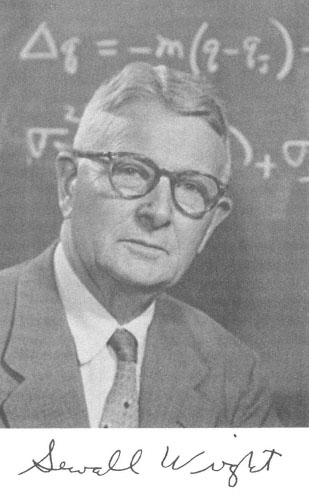
SEWALL WRIGHT
December 21, 1889-March 3, 1988
BY JAMES F. CROW
THE MATHEMATICAL THEORY of evolution and the science of population genetics began with, and for a generation was almost totally dominated by, three men: R. A. Fisher, J. B. S. Haldane, and Sewall Wright. Wright's unique contribution was his "shifting balance theory," which holds that the best opportunity for evolutionary progress is afforded by a large population comprising many partially isolated local groups. Within each group a certain amount of trial and error experimentation can take place, and successful combinations can spread throughout the population. Although the theory remains controversial, it has been very popular and influential in the biological community.
Wright also developed much of the theory of inbreeding (his coefficient of inbreeding is standard material in elementary textbooks) and the genetics of quantitative traits. In addition, he was a pioneer in physiological genetics and was uniquely responsible for the developmental and coat-color genetics of guinea pigs. Wright's method of path analysis, originally used mainly by animal breeders, has become a standard statistical technique in the social sciences.
Wright was elected to the National Academy of Sciences in 1934.
PERSONAL HISTORY
Sewall Green Wright (he later dropped the middle name) was born in Melrose, Massachusetts, December 21, 1889. His father, Philip Green Wright, was an economist who moved with his family to Galesburg, Illinois, in 1892 to join the faculty at Lombard College. There he taught an astonishing variety of subjects—economics, mathematics, astronomy, surveying, English composition—and was director of the gymnasium. He also printed the Lombard College bulletin on his own printing press. Later, he did research at the Brookings Institution and published several books; one, The Tariff on Animal and Vegetable Oils, included a statistical appendix by his son Sewall.
Sewall had two brothers. Both became distinguished, Quincy in international law and Theodore in aeronautical engineering. Quincy and Sewall regularly operated their father's printing press and were the first to publish the poetry of Carl Sandburg, then studying writing with their father at Lombard College. Philip Wright was indeed a polymath. Carl Sandburg called him the "Illinois Prairie Leonardo."
Sewall was a precocious child. He could read before starting school. At the age of seven he wrote a pamphlet—still preserved—on natural history, with chapters on marmosets, ants, dinosaurs, chicken gizzards, astronomy (he had seen the constellation Lyra through his father's telescope), and a wren that could not be discouraged from nesting in the family mailbox. He read his father's math books and learned to extract cube roots before entering school, a skill that he said brought him instant, lasting unpopularity with the other students. Later he became fascinated with analytical geometry and invented for himself a way of determining areas, somewhat like the integral calcu-
lus that he would learn later from his father at Lombard. His interests were clearly in science, and he never developed his father's passionate fondness for Greek and poetry, although he did enjoy Latin and became interested in sound changes and grammatical forms in the Indo-European languages. He found grade school a disappointment, having learned most of the material at home on his own. In high school he pursued his interests in natural history and took what science courses were offered; but, as with grade school, he did most of his learning outside. In his senior year he read Darwin's Origin of Species in its entirety.
Entering Lombard College Wright started to major in chemistry, but found much of analytical chemistry, at least the way it was taught, not to his liking. He took math courses from his father, going as far as differential and integral calculus. He never took any advanced mathematics and his later theoretical work in population genetics depended on methods that were learned on his own or were his own invention.
Philip Wright also taught a course in surveying and this led to Sewall's obtaining a job between his junior and senior years. At that time the Chicago, Milwaukee, and St. Paul Railroad was building a new spur through the Cheyenne and Standing Rock Indian Reservations in western South Dakota, and Sewall's knowledge of surveying was put to use. He also used his mathematical skills to calculate the rail curvature. The year was a rich experience in the old west tradition, with hardships, adventures, and Indians. In his nineties, Wright still remembered words from the Sioux language. These were the same local tribes that had destroyed General Custer's troops at the Little Big Horn thirty-three years earlier. In the latter part of the year Wright's work was cut short by an attack of pleurisy. During his illness he lived in a caboose and read about quaternions. I
find it interesting that J. B. S. Haldane also read the same book (Tait's Elementary Treatise on Quaternions) while convalescing from war injuries. The book is still preserved, along with some of Wright's marginal notes, so it is possible to see that he got about half way through the book. This was the year of Halley's Comet, and Wright saw it from the roof of his caboose. Unfortunately, his failing eyesight prevented his seeing it again in the 1980s. As a result of his lung infection, Wright was refused standard life insurance, a fact that he found increasingly ironic as he continued to live into his late nineties.
Returning to Lombard for his senior year, Wright took a biology course for the first time. Wilhelmine Entemann Key, one of the first women to receive a Ph.D. from the University of Chicago, was an inspiring teacher and led a graduate—type seminar. Wright learned his first genetics by reading Punnett's article in the eleventh edition of the Encyclopedia Britannica. His professional interests were now clear. He obtained a $250 scholarship to the University of Illinois. (This was awarded automatically to the valedictorian of the class. Wright was second in a class of seven, but the woman who was first declined.) William E. Castle visited the University of Illinois during this year and, on meeting Wright, offered him a Harvard assistantship on the spot.
Castle was then the nation's leading mammalian geneticist. Each student had a species to study. C. C. Little worked on mice and later founded the Jackson Laboratory. E. C. MacDowell studied rabbits and Wright took over the guinea pig work. At the time, Castle was selecting hooded rats for greater and lesser amounts of white. Wright played a crucial role by suggesting the experiments to distinguish between the view, wrongly held by Castle, that the color changes were in the major gene itself, and the opposing (and correct) one, that there were many segregating modi-
fiers. Wright did important size and coat-color experiments on guinea pigs, starting a program of research that he continued for more than forty years.
Upon receiving his doctorate from Harvard, Wright moved to Washington where he became senior animal husband-man in the U.S. Department of Agriculture (USDA). There he took over the analysis of a colony of guinea pigs, some of which had been sib-mated for many generations. Wright's analysis of the effects of inbreeding and hybridization are classic. At the same time he continued his studies of coat-color inheritance. This was the period in which Wright began to make major theoretical advances. He worked out the consequences of various mating systems, and his studies on quantitative inheritance, along with those of R. A. Fisher, became the foundation for scientific animal breeding. During this period Wright also developed what he later called the ''shifting balance theory.''
In 1926 he moved to the University of Chicago where he continued his theoretical work as well as his experiments with guinea pigs. He also took up the standard academic duties, teaching several courses and supervising graduate students. This continued until 1955 when he retired from Chicago at age sixty-five and moved to Wisconsin, which had a retirement age of seventy. Wright was not paid a full salary, only a supplement to his Chicago retirement annuity. This lasted for five years, after which Wright continued to work an additional quarter century. What a bargain Wisconsin got!
After his second retirement Wright completed the monumental set of four volumes, Evolution and the Genetics of Populations (1968, 2; 1969, 2; 1977; 1978, 1), in which he not only summarized his own work but reviewed and analyzed an enormous body of experimental and theoretical literature.
In his nineties Wright's eyesight became so poor that he could read only with the aid of an enlarging machine. He gradually gave up active research and scientific reading. Yet he continued to write. His last paper was published in 1988 and reprints came only a few days before his death. My last conversation with him was concerned with his asking me to mail reprints to his friends and with his wondering how he could handle his income tax from a hospital bed.
Wright was in excellent health until the end. It was on one of his customary long walks that he slipped on an icy spot. He died suddenly and unexpectedly a few days later, March 3, 1988, from a pulmonary embolism, the consequence of a pelvic fracture. He had passed his ninety-eighth birthday anniversary three months earlier.
In 1921 Wright married Louise Williams, a genetics teacher at Smith College. She died in 1975. This left him very lonely, but he didn't complain; this was not his nature. He just went on working.
Wright was survived by three children, Richard (dec. 1993), Robert, and Elizabeth (Mrs. John Rose).
SCIENTIFIC WORK
Wright's first scientific paper was published in 1912. It was a morphological study of a fish parasite, a trematode, done while he was at the University of Illinois. His first genetic paper (1914) was a suggestion that one could make a distinction between auto- and allo-polyploidy by the frequency of homozygosis for recessive genes.
Three of Wright's major areas of interest were apparent in the next few years, at Harvard and USDA. These were: correlation analysis, animal breeding, and mammalian physiological genetics. His evolutionary ideas followed soon after. Although the major papers were published after reach-
ing Chicago, the main idea was already formulated while he was still in Washington.
Statistics. Wright's first statistical paper (1917, 1) corrected Raymond Pearl on the use of probable error to test Mendelian ratios. In the same year (1917, 2) he used the additivity of variances and covariances to separate guinea pig weights into within-and between-strains components. This was actually analysis of covariance, though he was unaware of Fisher's work and the words were to come later. Wright (1920, 1; 1926, 1) also found a transformation to linearize cumulative percentage data, now called the probit transformation.
Wright's most important contribution to statistics is his method of path analysis (1921, 1; 1934, 10; 1983; 1984, 2). He always wanted to use statistics interpretatively rather than for description and prediction. Although the mathematics are those of partial regression, the point of view is original. A simple and useful Wrightian device is to diagram causal sequences so that paths of direct causation are indicated by arrows, while correlations between anterior, unanalyzed causes are represented by double-headed arrows. Each causal step is associated with a path coefficient, a partial regression coefficient standardized by being measured in standard deviation units. These coefficients measure the relative importance of the different paths. From such a diagram Wright found simple rules by which one can easily write all the appropriate equations. The method has the virtue of making immediately obvious whether there are enough data and relationships to permit a solution.
In addition to using the method for genetic problems, Wright applied it to such diverse situations as growth and transpiration of plants, respiratory physiology, prey-predator relations, and the relative importance of heredity and environment in human IQ. The most impressive analysis is
that of the production and prices of hogs and corn. Wright had 510 correlations, and did the calculations himself, a time-consuming job in those days before computers. He was able to account for 80 percent of the variance of hog production and prices by fluctuations in the corn crop, various intercorrelations, and cleverly adjusted time lags. This paper (1925, 1) was not published immediately; it was deemed improper for an animal husbandman to write a paper in economics. It required the help of Henry Wallace, who prevailed on his father, then secretary of agriculture, to intervene and see that the paper was published.
From 1920 to 1960 the method was seldom used outside of animal breeding circles. Scientists in general and biologists in particular made almost no use of it. Why? One reason is that the method cannot be applied routinely; it doesn't lend itself to "canned" programs. The user must have a hypothesis and diagram it. Biologists have made a great deal of use of correlation and regression analysis, but the emphasis has been on prediction and significance tests, for which Fisherian methods are more appropriate. At the same time psychologists preferred to use factor analysis, which uses much of the same algebra but has a different conceptual basis.
Recently, however, path analysis has become popular in the social sciences. New methods of formulation, and particularly the use of computers, have greatly increased the power of Wright's methods. Yet, he was not always pleased with the uses, or with mathematical criticisms of it. One of his last papers (1983) was a spirited defense of his methods.
Animal Breeding. Wright's (1922, 2-4) studies on inbreeding and crossbreeding of guinea pigs, utilizing the accumulated USDA records and data of his own, were masterful. The meticulously-kept records included not only pedigree information, but many kinds of measurements—litter size,
individual and litter weight at various stages, and viability. The husbandry conditions were often miserable, including wartime shortages and the Washington summer heat. It is a testimony to Wright's analytical skills that he could extract so much consistent and useful information. He documented the usual, but not invariable, decline on inbreeding; the recovery on crossbreeding; and the quantitative predictability of decline when these hybrids were inbred. He showed that all this was entirely consistent with Mendelian inheritance and dominance.
At the same time Wright developed his widely used algorithm for computing the inbreeding coefficient for any pedigree, however complex (1922, 1), and wrote a series of papers on the consequences of different mating systems (1921, 3-7). He later (1925, 3; 1926, 4; 1943, 1) showed how to separate the effects of nonrandom mating from those of reduction in population size, and showed that in Short-horn cattle the small size of the breeding population was by far the most important.
For many years animal breeding was dominated by a single figure, Jay L. Lush, of Iowa State University. A Wright disciple, he carried the gospel. He wrote a book that became the standard, and his numerous students came from all over the globe. As a result, Wright's path analysis, inbreeding theory, and prediction formula for selection of quantitative traits spread widely and rapidly. Animal breeding changed from an art to a quantitative science. In recent years, with computerized records and artificial insemination, the methods have become very sophisticated. The steady improvement of milk production testifies to the effectiveness of a well-organized, cooperative selection program. The current methods superficially look quite different from path analysis, but they trace back to the Wright-Lush influence.
Mammalian Genetics. Wright's work on physiological and developmental genetics is much less well known than his work on animal breeding and evolution. Yet for many years Wright devoted the major share of his research time to guinea pig studies. He did his own mating and record keeping; the guinea pig colony was often the best place to find him. He continued this work throughout the Chicago years and stopped on moving to Madison only because the University of Wisconsin could not furnish guinea pig facilities. I believe this was fortunate, for it gave Wright the chance to complete his long-contemplated project, writing his four-volume monument (1968, 1; 1969, 2; 1977; 1978, 1). As it was, he spent his first five years at Wisconsin writing up his guinea pig studies, some done years before.
Early in his Washington years Wright wrote a series of eleven papers on color inheritance in various mammals (1917, 2-9; 1918, 1-4). These papers are noteworthy in two regards. First, Wright interpreted the color interactions in terms of the latest knowledge of pigment chemistry and enzyme kinetics. Second, he discovered extensive similarities among the mammals and inferred that the causative genes had a common ancestry, facts that are now being definitively confirmed by DNA similarity.
Throughout his guinea pig studies Wright went as far toward a chemical explanation as knowledge of the time would permit; he wanted to explain dominance and epistasis in chemical terms. His quantitative bent led him to formulate the relationships in path diagrams and to express the kinetics as differential equations, assuming flux equilibrium kinetics. Wright's major analyses (1941, 1, 3) appeared the same year as the work of George Beadle and Edward Tatum on biochemical mutants in Neurospora. This started a new direction in genetic research, and molecular biology and microorganisms took over. Wright continued
his guinea pig studies for another fifteen years, but these later works—masterful as they were in extracting maximum information from difficult material—attracted little attention.
Wright's early work was ahead of its time in other regards. One of these was in the correlation of size of various body parts (Wright 1918, 6). He analyzed the phenotypic variance into components associated with general size, limb-specific factors, fore-and hind-limb specific factors, and factors associated with the upper and lower limb (whether fore or hind). This kind of work has had a recent resurgence of interest.
Population Genetics and Evolution. In this area the name of Wright is regularly associated with those of Haldane and Fisher. Each had his own style and made distinctive contributions. Haldane wrote a series of papers exploring selection under a variety of genetic conditions; usually, but not always, these involved single factors. Fisher dealt with many problems, but his best-known was showing how to deal with gene interactions for quantitative traits, in particular for fitness itself. He showed in his "Fundamental Theorem of Natural Selection" that, regardless of gene interactions, selection acts on the additive (least squares linear) component of the genetic variance. To Fisher, gene interactions and random gene-frequency fluctuations were impediments to efficient selection, much like noise in a physical system. To Wright, these provided an opportunity for evolutionary creativity.
Wright's shifting balance theory is a way of taking advantage of gene interactions. He had long been concerned with cases in which genes interacted in ways not predictable from their individual effects. He believed that evolutionary creativity often depended on putting together favorable combinations of genes that were individually
deleterious. But selection will not ordinarily incorporate such genes in a large, sexually reproducing population. So he argued that the best chance for the evolution of harmonious gene combinations lies in the population structure. In a population divided into many local populations between which there is limited interchange, the gene frequencies will vary randomly in each of them (provided the size is small enough). Among the local populations, one or more may drift into a happy gene combination. This local population will then be at a selective advantage relative to the others and can be expected to reproduce faster. It will then increase or, more likely, send out migrants to adjacent local populations upgrading them to the level of the immigrants. These in turn become more fit and send migrants to still other populations until eventually the whole population attains the favorable gene combination.
This theory has found a great deal of favor with biologists who are impressed by interactions and see this as a way for a sexual population to have some of the benefits of asexuality (i.e., the ability to select for the entire genotype rather than individual genes) and still retain the advantages of Mendelian segregation and recombination. The theory has been criticized on three grounds: (1) The theory requires rather specific relations among the magnitude of selection, migration, and local population size—conditions that may not often be met; (2) The theory may not be needed. It may be that a population hardly ever, if ever, finds itself in the position that no allele frequency change can increase fitness. A Fisherian process may suffice. (3) The theory is very difficult to test, mathematically, experimentally, or observationally.
The different viewpoints of Wright and Fisher led to a bitter controversy that lasted from around 1930 until Fisher's death. It produced two opposing camps that to some ex-
tent still exist. It is quite possible that both were correct; that evolution usually proceeds by a Fisherian process but that some innovative changes take place by the Wright model. In his last paper, written at age ninety-seven, Wright (1988) was more conciliatory:
Kimura's "neutral" theory dealt with the exceedingly slow accumulation of neutral biochemical changes from accidents of sampling in the species as a whole. Fisher's "fundamental theorem of natural selection" is concerned with the total combined effects of alleles at multiple loci under the assumption of panmixia in the species as a whole. He recognized that it was an exceedingly slow process. Haldane gave the most exhaustive mathematical treatment of the case in which the effects of a pair of alleles are independent of the rest of the genome. He included the important case of ''altruistic" genes, ones contributing to the fitness of the group at the expense of the individual. I attempted to account for the occasional exceedingly rapid evolution on the basis of intergroup selection (differential diffusion) among small local populations that have differentiated at random, mainly by accidents of sampling (i.e., by local inbreeding), exceptions to the panmixia postulated by Fisher. All four are valid.
Wright made many contributions to the mathematical theory of population genetics. As mentioned before, he developed the F-statistics. These extend the inbreeding coefficient to include hierarchical population structure. They now form the basis for analysis of natural population structure. With the coming of molecular polymorphisms, this theory has found a much wider use.
The stochastic theory of population genetics comes mainly from Wright and Fisher. Although Fisher first worked out a quantitative theory, he largely dismissed it as not likely to be very important. Wright, in contrast, regarded random processes as central and spent much of his life working out more and more general forms of his basic stochastic equation. I enjoyed reading Wright's papers sequentially, seeing that as the methods became more general and sophisticated they became easier to understand. Wright (1945, 4)
finally realized that his equations were solutions of the Kolmogorov forward equation. These equations represent the high point of Wright's mathematical work.
Wright's work in population genetics was almost entirely theoretical, but he had an important collaboration with Th. Dobzhansky. Dobzhansky played the same role in evolutionary circles that Lush did in animal breeding. By his combination of lucidity, forceful personality, and indefatigable experimentation, Dobzhansky did more than anyone else to bring Wright's work to the biological public. Their collaboration (1941, 2; 1942, 1; 1943, 3; 1947, 2) was the beginning of a burst of activity studying natural populations of Drosophila, a subject that is enjoying a renewed interest because of molecular techniques.
WRIGHT AS PHILOSOPHER
Wright was one of a small number of biologists who had a serious, personal, original philosophy. Early in his life he arrived at what is now called "panpsychic dualism." Wright rejected any notion of emergence. He saw no clear borders between living and nonliving, or between thinking and nonthinking. There is no place at which one can say that mind exists after this point but not before. Emergence of mind from no mind is, in his words, "sheer magic." He thus arrived at the view that mind is everywhere. Mind and matter are both universal. Science can produce a statistical description, but not the deeper reality. "Science is a limited venture, concerned with the external and statistical aspects of events and incapable of dealing with the unique creative aspect of each individual event," he wrote (1964, 1).
Most biologists have either disagreed with, or more often have ignored, Wright's philosophy. Some regard the mind-body problem as something best left to philosophers. Others think of mind as a consequence of a sufficiently compli-
cated and appropriately organized state of matter. Wright did, however, find a sympathetic companion in his philosopher friend, Charles Hartshorne, who was for many years Wright's colleague at the University of Chicago. Wright was quick to say that his philosophical views had little relevance to the day-to-day practice of science, and philosophy hardly ever entered his conversations with biological colleagues.
WRIGHT'S IMPACT
Wright made lasting contributions in statistics, mammalian genetics, animal breeding, population genetics, and the theory of evolution. He would rank as an important contributor in any of these areas. Collectively they place him among the greatest of twentieth-century biologists. I'll cite one example of his remaining influence: The 1988 Science Citation Index lists some 500 articles that refer to his papers.
WRIGHT AS A PERSON
Socially, Wright was shy and retiring. He had no small talk and was hard to engage in conversation. But, paradoxically, when he did start to talk about something of interest—his childhood, his experience on the railroad surveying team, his ancestors, guinea pigs, evolution, genetics, politics—he could, and would, talk at length. His lectures invariably ran far over the allotted time. He was always gentle, yet he defended his views forcefully and he stated them fully.
Wright was extremely generous with his time. He spent an inordinate amount of time helping others with their papers and data analysis, and often this involved extensive calculations. Likewise, he was an extremely careful reviewer of manuscripts, often providing the author with substantial improvements. He was a conscientious teacher, and spent
many hours in the classroom and in the laboratory, which he ran himself. In regard to his time, he was generous to a fault. He published 211 scientific papers, most of them alone. What would he have done had he followed the not uncommon practice of selfishly concentrating on his own work?
Wright has received virtually every honor that is open to evolutionary biologists. He received ten honorary doctorates, far fewer, he used to say, than Herbert Hoover. I have appended a list of honors.
I should like to repeat an anecdote that I have frequently cited before, but which epitomizes this modest, unselfish man and his self-deprecating wit. In his late eighties while writing his four books he received a small stipend from the National Science Foundation. When I brought him the news that the foundation had offered to provide an inflationary adjustment he demurred. According to his calculations, he said, his productivity was declining at the same rate as the value of the dollar and he therefore didn't deserve any increase. He never accepted it.
Wright died at the age of ninety-eight. It is perhaps wrong to regard a death at this age as premature, but I do. Wright was in good health, enjoying life, and intellectually alert. He knew that a centennial celebration was being planned and looked forward to it. But for encountering an icy spot on the sidewalk, he would surely have been in attendance.
MY MAIN SOURCE of information has been a regular association with Wright for more than three decades. I obtained much information from a full-length personal and scientific biography by Will Provine (1986), based on hundreds of hours of taped interviews with Wright and a study of his extensive correspondence. It is a treasure of information for those who would like to know more than can be presented in this short article. I have also drawn freely on my own earlier writings, listed in the references below.
REFERENCES
J. F. Crow, ''Sewall Wright, the Scientist and the Man," Perspectives in Biology and Medicine, 2(1982):279-94.
J. F. Crow, "Sewall Wright and Physiological Genetics," Genetics, 115(1987):1-2.
J. F. Crow, "Sewall Wright (1889-1988)," Genetics, 119(1988):1-4.
J. F. Crow, "Sewall Wright's Place in Twentieth Century Biology," Journal of the History of Biology, 23(1990):57-89.
W. B. Provine, Sewall Wright and Evolutionary Biology (Chicago: University of Chicago Press, 1986).
CHRONOLOGY
|
1889 |
Born December 21, in Melrose, Massachusetts, to Philip Green Wright and Elizabeth Quincy Sewall Wright. |
|
1892 |
Moved to Galesburg, Illinois, where his father taught at Lombard College. |
|
1902 |
Entered high school in Galesburg. |
|
1906 |
Enrolled in Lombard College. |
|
1909-10 |
Instrument man on an engineering party for a new line of the Chicago, Milwaukee, and St. Paul Railroad in South Dakota. |
|
1911 |
Received B.S. from Lombard College, which later merged with Knox College. |
|
1911-12 |
Graduate student at the University of Illinois, receiving M.S. in 1912. |
|
1912-15 |
Graduate student with W. E. Castle at Harvard University, receiving Sc. D. in 1915. |
|
1915-25 |
Senior Animal Husbandman, U. S. Department of Agriculture, Washington. |
|
1921 |
Married Louise Smith, February 21, in Granville, Ohio. |
|
1926-29 |
Associate Professor of Zoology, University of Chicago. |
|
1930-37 |
Professor of Zoology. |
|
1938-54 |
Ernest D. Burton Distinguished Service Professor. |
|
1943 |
Hitchcock Professor, University of California, Berkeley. |
|
1949-50 |
Fulbright Professor, University of Edinburgh. |
|
1955-60 |
Leon J. Cole Professor of Genetics, University of Wisconsin, Madison. |
|
1960-88 |
Professor Emeritus. |
|
1988 |
Died in Madison, Wisconsin, March 3. |
HONORARY DOCTORATES
|
1942 |
University of Rochester |
|
1948 |
Yale University |
|
1951 |
Harvard University |
|
1955 |
Michigan State University |
|
1957 |
Knox College |
|
1958 |
Case Western Reserve University |
|
1959 |
University of Chicago |
|
1961 |
University of Illinois |
|
1965 |
University of Wisconsin |
|
1984 |
State University of New York-Stony Brook |
AWARDS AND HONORS
|
1944 |
President, American Society of Zoologists |
|
1947 |
Elliot Medal, National Academy of Sciences |
|
1947 |
Weldon Memorial Medal, Oxford University |
|
1949 |
Lewis Prize, American Philosophical Society |
|
1952 |
President, Genetics Society of America |
|
1952 |
President, American Society of Naturalists |
|
1955 |
President, Society for the Study of Evolution |
|
1956 |
Kimber Award, National Academy of Sciences |
|
1958 |
President, Tenth International Congress of Genetics |
|
1966 |
National Medal of Science |
|
1980 |
Darwin Medal, Royal Society of London |
|
1982 |
T. H. Morgan Award, Genetics Society of America |
|
1982 |
J. F. Meckel Prize, American Society of Medical Genetics |
|
1984 |
Balzan Prize, Balzan Foundation, Milano |
MEMBERSHIPS
National Academy of Sciences
American Philosophical Society
American Academy of Arts and Sciences
American Association for the Advancement of Science
American Genetics Association
American Statistical Association
Genetics Society of America
Biometric Society
Royal Society of London (Foreign Member)
Royal Danish Academy of Science and Letters (Foreign Member)
Royal Society of Edinburgh (Honorary Fellow)
Genetical Society (Honorary Fellow)
Econometric Society
Phi Beta Kappa (Honorary Member)
SELECTED BIBLIOGRAPHY
1912 Notes on the anatomy of the trematode, Microphallus opacus. Trans. Am. Microscop. Soc. 31:167-75.
1914 Duplicate genes. Am. Nat. 48:638-39.
1915 The albino series of allelomorphs in guinea pigs. Am. Nat. 49:140-48.
With W. E. Castle. Two color mutations of rats which show partial coupling. Science 42:193-95.
1916 An intensive study of the inheritance of color and of other coat characters in guinea pigs with especial reference to graded variation. Carnegie Institute Washington Publ. 241:59-160.
1917 On the probable error of Mendelian class frequencies. Am. Nat. 51:373-75.
The average correlation within subgroups of a population. J. Wash. Acad. Sci. 7:532-35.
Color inheritance in mammals. I. J. Hered. 8:224-35.
Color inheritance in mammals. II. The mouse. J. Hered. 8:373-78.
Color inheritance in mammals. III. The rat. J. Hered. 8:426-30.
Color inheritance in mammals. IV. The rabbit. J. Hered. 8:473-75
Color inheritance in mammals. V. The guinea pig. J. Hered. 8:476-80.
Color inheritance in mammals. VI. Cattle. J. Hered. 8:521-27.
Color inheritance in mammals. VII. The horse. J. Hered. 8:561-64.
1918 Color inheritance in mammals. VIII. Swine. J. Hered. 9:33-38.
Color inheritance in mammals. IX. The dog. J. Hered. 9:87-90.
Color inheritance in mammals. X. The cat. J. Hered. 9:139-44.
Color inheritance in mammals. XI. Man. J. Hered. 9:227-40.
With H. R. Hunt. Pigmentation in guinea pig hair. J. Hered. 9:178-81.
On the nature of size factors. Genetics 3:367-74.
1920 The relative importance of heredity and environment in determining the piebald pattern of guinea pigs. Proc. Natl. Acad. Sci. USA 6:320-32.
Principles of livestock breeding. U.S. Dept. Agric. Bull. 905.
1921 Correlation and causation. J. Agric. Res. 20:557-85.
With P. A. Lewis. Factors in the resistance of guinea pigs to tuberculosis with special regard to inbreeding and heredity. Am. Nat. 55:20-50.
Systems of mating. I. The biometric relation between parent and offspring. Genetics 6:111-23.
Systems of mating. II. The effects of inbreeding on the genetic composition of a population. Genetics 6:124-43.
Systems of mating. III. Assortative mating based on somatic resemblance. Genetics 6:144-61.
Systems of mating. IV. The effects of selection. Genetics 6:162-66.
Systems of mating. V. General considerations. Genetics 6:167-78.
1922 Coefficients on inbreeding and relationship. Am. Nat. 56:330-38.
The effects of inbreeding and crossbreeding on guinea pigs. I. Decline in vigor. U.S. Dept. Agric. Bull. 1090:1-36.
The effects of inbreeding and crossbreeding on guinea pigs. II. Differentiation among inbred families. U.S. Dept. Agric. Bull. 1090:37-63.
The effects of inbreeding and crossbreeding on guinea pigs. III. Crosses between highly inbred families. U.S. Dept. Agric. Bull. 1121:1-59.
1923 Two new color factors of the guinea pig. Am. Nat. 57:42-51.
The theory of path coefficients: A reply to Niles' criticism. Genetics 8:239-55.
Mendelian analysis of the pure breeds of livestock. I. The measurement of inbreeding and relationship. J. Hered. 14:339-48.
Mendelian analysis of the pure breeds of livestock. II. The Duchess family of short-horns as bred by Thomas Bates. J. Hered. 14:405-22.
The relation between piebald and tortoise shell color pattern in guinea pigs. Anat. Rec. 23:393.
With O. N. Eaton. Factors which determine otocephaly in guinea pigs. J. Agric. Res. 26:161-82.
1925 Corn and hog correlations. U.S. Dept. Agric. Bull. 1300:1-60.
The factors of the albino series of guinea pigs and their effects on black and yellow pigmentation. Genetics 10:223-60.
With H. C. McPhee. Mendelian analysis of the pure breeds of livestock. III. The short-horns. J. Hered. 16:205-15.
An approximate method of calculating coefficients of inbreeding and relationship from livestock pedigrees. J. Agric. Res. 31:377-83.
1926 A frequency curve adapted to variation in percentage occurrence. J. Am. Stat. Assoc. 21:162-78.
With O. N. Eaton. Mutational mosaic coat patterns of the guinea pig. Genetics 11:333-51.
Effects of age of parents on characteristics of the guinea pig. Am. Nat. 60:552-59.
With H. C. McPhee. Mendelian analysis of the pure breeds of livestock. IV. The British dairy short-horns. J. Hered. 17:397-401.
1927 With Leo Loeb. Transplantation and individuality differentials in inbred families of guinea pigs. Am. J. Pathol. 3:251-85.
The effects in combination of the major color-factors of the guinea pig. Genetics 12:530-69.
1928 An eight-factor cross in the guinea pig. Genetics 13:508-31.
1929 With O. N. Eaton. The persistence of differentiation among inbred families of guinea pigs. U.S. Dept. Agric. Tech. Bull. 103:1-45.
Fisher's theory of dominance. Am. Nat. 63:274-79.
The dominance of bar over intra bar in Drosophila. Am. Nat. 63:479-80.
The evolution of dominance. Am. Nat. 63:556-61.
1930 The genetical theory of natural selection (by R. A. Fisher). A review. J. Hered. 21:349-56.
1931 Statistical methods in biology. J. Am. Stat. Assoc. 26(suppl.):155-63.
Statistical theory of evolution. J. Am. Stat. Assoc. 26(suppl.):201-8.
Evolution in Mendelian populations. Genetics 16:97-159.
1932 Complementary factors for eye color in Drosophila. Am. Nat. 66:282-83.
General, group, and special size factors. Genetics 17:603-19.
The roles of mutation, inbreeding, crossbreeding, and selection in evolution. Proc. 6th Intl. Congr. Genet. 1:356-66.
Hereditary variations of the guinea pig. Proc. 6th Intl. Congr. Genet. 2:247-49.
1933 Inbreeding and homozygosis. Proc. Natl. Acad. Sci. USA 19:411-20.
Inbreeding and recombination. Proc. Natl. Acad. Sci. USA 19:420-33.
1934 Physiological and evolutionary theories of dominance. Am. Nat. 68:25-53.
The genetics of growth. Proc. Am. Soc. Anim. Prod. 1933:233-37.
With K. Wagner. Types of subnormal development of the head from inbred strains of guinea pigs and their bearing on the classification and interpretation of vertebrate monsters. Am. J. Anat. 54:383-447.
On genetics of subnormal development of the head (otocephaly) in the guinea pig. Genetics 19:471-505.
Polydactylous guinea pigs. Two types respectively heterozygous and homozygous in the same mutant gene. J. Hered. 25:359-62.
An analysis of variability in number of digits and in an inbred strain of guinea pigs. Genetics 19:506-36.
The results of crosses between inbred strains of guinea pigs differing in number of digits. Genetics 19:537-51.
Genetics of abnormal growth in the guinea pig. Cold Spring Harbor Symp. Quant. Biol. 2:137-47.
Professor Fisher on the theory of dominance. Am. Nat. 68:562-65.
The method of path coefficients. Ann. Math. Stat. 5:161-215.
1935 A mutation of the guinea pig, tending to restore the pentadactyl foot when heterozygous, producing a monstrosity when homozygous. Genetics 20:84-107.
The analysis of variance and the correlation between relatives with respect to deviations from an optimum. J. Genet. 30:243-56.
Evolution in populations in approximate equilibrium. J. Genet. 30:257-66.
On the genetics of rosette pattern in guinea pigs. Genetics 17:547-60.
1936 With H. B. Chase. On the genetics of the spotted pattern of the guinea pig. Genetics 21:758-87.
1937 The distribution of gene frequencies in populations. Proc. Natl. Acad. Sci. USA 23:307-20.
1938 Size of population and breeding structure in relation to evolution. Science 87:430-31.
The distribution of gene frequencies under irreversible mutation. Proc. Natl. Acad. Sci. USA 24:253-59.
The distribution of gene frequencies in populations of polyploids. Proc. Natl. Acad. Sci. USA 24:372-77.
1939 The distribution of self-sterility alleles in populations. Genetics 24:538-52.
Genetic principles governing the rate of progress of livestock breeding. Proc. Amer. Soc. Anim. Prod. 1939:18-26.
Statistical genetics in relation to evolution. Actualités scientific et industrielles. Exposés de Biometrie et de la Statistique Biologique XIII. Paris: Hermann & Cie.
1940 Breeding structure of populations in relation to speciation. Am. Nat. 74:232-48.
The statistical consequences of Mendelian heredity in relation to speciation. In The New Systematics, ed. J. S. Huxley, pp. 161-83. London: Oxford at the Clarendon Press.
1941 A quantitative study of the interactions of the major colour factors of the guinea pig. Proc. 7th Int. Genet. Congr. 1939:319-29.
With Th. Dobzhansky. Genetics of natural populations. V. Relations between mutation rate and accumulation of lethals in populations of Drosophila pseudoobscura. Genetics 26:23-51.
The physiology of the gene. Physiol. Rev. 21:487-527.
Tests for linkage in the guinea pig. Genetics 26:650-69.
On the probability of fixation of reciprocal translocations. Am. Nat. 75:513-22.
1942 With Th. Dobzhansky and W. Hovanitz. Genetics of natural populations. VII. The allelism of lethals in the third chromosome of Drosophila pseudoobscura. Genetics 27:363-94.
The physiological genetics of coat color of the guinea pig. Biol. Symp. 6:337-55.
Statistical genetics and evolution. Bull. Am. Math. Soc. 48:223-46.
1943 Isolation by distance. Genetics 28:114-38.
The analysis of local variability of flower color in Linanthus parryae. Genetics 28:139-56.
With Th. Dobzhansky. Genetics of natural populations. X. Dispersion rates in Drosophila pseudoobscura. Genetics 28:304-40.
1945 Physiological aspects of genetics. Annu. Rev. Physiol. 5:75-106.
Genes as physiological agents. General considerations. Am. Nat. 79:289-303.
Tempo and mode in evolution: A critical review. Ecology 26:415-19.
The differential equation of the distribution of gene frequencies. Proc. Natl. Acad. Sci. USA 31:383-89.
1946 Isolation by distance under diverse systems of mating. Genetics 31:39-59.
With Th. Dobzhansky. Genetics of natural populations. XII. Experimental reproduction of some of the changes caused by natural selection in certain populations of Drosophila pseudoobscura. Genetics 31:125-56.
1947 On the genetics of several types of silvering in the guinea pig. Genetics 32:115-41.
With Th. Dobzhansky. Genetics of natural populations. XV. Rate of diffusion of a mutant gene through a population of Drosophila pseudoobscura. Genetics 32:303-24.
1948 On the roles of directed and random changes in gene frequency in the genetics of populations. Evolution 2:279-94.
Evolution, organic. Encyclopedia Britannica, 14th ed., 8:915-29.
Genetics of populations. Encyclopedia Britannica, 14th ed., 10:111-12.
1949 Adaptation and selection. In Genetics, Paleontology, and Evolution, eds. G. L. Jepson, G. G. Simpson, and E. Mayr, pp. 365-89. Princeton: Princeton University Press.
With Z. I. Braddock. Colorimetric determination of the amounts of
melanin in the hair of diverse genotypes of the guinea pig. Genetics 34:223-24.
Estimates of the amounts of melanin in the hair of diverse genotypes of guinea pig from transformation of empirical grades. Genetics 34:245-71.
Population structure in evolution. Proc. Am. Philos. Soc. 93:471-78.
On the genetics of hair direction in the guinea pig. I. Variability in the patterns found in combinations of the R and M loci. J. Exp. Zool. 112:303-24.
On the genetics of hair direction in the guinea pig. II. Evidence for a new dominant gene, Star, and tests for linkage with eleven other loci. J. Exp. Zool. 112:325-40.
1950 On the genetics of hair direction in the guinea pig. III. Interaction between the processes due to loci R and St. J. Exp. Zool. 113:33-64.
Discussion on population genetics and radiation. J. Cell Comp. Physiol. 35:187-210.
Genetical structure of populations. Nature 166:247-53.
1951 The genetical structure of populations. Ann. Eugen. 15:323-54.
Fisher and Ford on the Sewall Wright effect. Am. Sci. 39:452-58.
1952 The Genetics of Quantitative Variability. London: Her Majesty's Stationery Office.
The theoretical variance within and among subdivisions of a population that is in a steady state. Genetics 27:312-21.
1953 Gene and organism. Am. Nat. 87:5-18.
The interpretation of multivariate systems. In Statistics and Mathematics in Biology, eds. O. Kempthorne, T. A. Bancroft, J. W. Gowen, and J. L. Lush, pp. 11-33. Ames: Iowa State College Press.
1954 With W. E. Kerr. Experimental studies of the distribution of gene
frequencies in very small populations of Drosophila melanogaster. I. Forked. Evolution 8:172-77.
With W. E. Kerr. Experimental studies of the distribution of gene frequencies in very small populations of Drosophila melanogaster. II. Bar. Evolution 8:225-40.
With W. E. Kerr. Experimental studies of the distribution of gene frequencies in very small populations of Drosophila melanogaster. II. Aristapedia and spineless. Evolution 8:293-302.
Summary of patterns of mammalian gene action. J. Natl. Cancer Inst. 15:837-51.
1956 Classification of the factors of evolution. Cold Springs Harbor Symp. Quant. Biol. 20:16-24.
Modes of selection. Am. Nat. 90:5-24.
1958 Genetics, the gene, and the hierarchy of biological sciences. Proc. 10th Int. Congr. Genet. 1:475-89.
1959 On the genetics of silvering in the guinea pig with special reference to interaction and linkage. Genetics 44:387-405.
Silvering (si) and diminution (dm) of coat color of the guinea pig and male sterility of the white or near-white combination of these. Genetics 44:563-90.
A quantitative study of variations in intensity of genotypes of the guinea pig at birth. Genetics 44:1001-26.
Physiological genetics, ecology of populations, and natural selection. Persp. Biol. Med. 3:107-51.
Qualitative differences among colors of the guinea pig due to diverse genotypes. J. Exp. Zool. 142:75-114.
1960 On the number of self-incompatibility alleles maintained in equilibrium by a given mutation rate in a population of given size: A reexamination. Biometrics 16:61-85.
Path coefficients and path regressions: Alternative or complementary concepts. Biometrics 16:189-202.
The treatment of reciprocal interaction, with or without lag, in path analysis. Biometrics 16:423-45.
Residual variability in intensity of coat color in the guinea pig. Genetics 45:583-612.
Postnatal changes in the intensity of coat color in diverse genotypes of the guinea pig. Genetics 45:1503-29.
The genetics of vital characters of the guinea pig. J. Cell Comp. Physiol. 56:123-51.
1963 Plant and animal improvement in the presence of multiple selection peaks. In Statistical Genetics in Plant Breeding, eds. W. D. Hanson and H. F. Robinson, pp. 116-22. Washington, D. C.: National Academy Press.
Gene interaction. In Methodology in Mammalian Genetics, ed. W. J. Burdette, pp. 159-92. San Francisco: Holden-Day.
1964 Biology and the philosophy of science. The Monist 48:265-90.
Pleiotropy in the evolution of structural reduction and of dominance. Am. Nat. 98:65-69.
Stochastic processes in evolution. In Symposium on Stochastic Models in Medicine and Biology, ed. J. Gurland, pp. 199-244. Madison: University of Wisconsin Press.
1965 Factor interaction and linkage in evolution. Proc. R. Soc. B 162:80-104.
The distribution of self-incompatibility alleles in populations. Evolution 18:609-19.
The interpretation of population structure by F-statistics with special regard to systems of mating. Evolution 19:395-420.
1966 Polyallelic random drift in relation to evolution. Proc. Natl. Acad. Sci. USA 55:1074-81.
1967 ''Surfaces'' of selective value. Proc. Natl. Acad. Sci. USA 58:165-72.
1968 Dispersion of Drosophila pseudoobscura. Am. Nat. 102:81-84.
Evolution and the Genetics of Populations, vol. 1. Genetic and Biometric Foundations. Chicago: University of Chicago Press.
1969 Deviations from random combination in the optimum model. Jap. J. Genet. 44(suppl 1):152-59.
Evolution and the Genetics of Populations, vol. 2. The Theory of Gene Frequencies. Chicago: University of Chicago Press.
The theoretical course of directional selection. Am. Nat. 103:561-74.
1970 Random drift and the shifting balance theory of evolution. In Mathematical Topics in Population Genetics, ed. K. Kojima, pp. 1-31. Heidelberg: Springer-Verlag.
1975 Panpsychism and science. In Mind and Nature, eds. J. E. Cobb and D. R. Griffen, pp. 79-88. Washington, D.C.: University Press of America.
1977 Evolution and the Genetics of Populations, vol. 3. Experimental Results and Evolutionary Deductions. Chicago: University of Chicago Press.
1978 Evolution and the Genetics of Populations, vol. 4. Variability Within and Among Natural Populations. Chicago: University of Chicago Press.
The relation of livestock breeding to theories of evolution. J. Anim. Sci. 46:1192-1200.
1980 Genic and organismic selection. Evolution 34:825-43.
1982 Character change, speciation, and the higher taxa. Evolution 36:427-43.
The shifting balance theory and macroevolution. Annu. Rev. Genet. 16:1-19.
1983 On "Path analysis in genetic epidemiology: A critique." Am. J. Hum. Genet. 35:757-68.
1984 The first Meckel oration: On the causes of morphological differences in a population of guinea pigs. Am. J. Med. Genet. 18:591-616.
Diverse uses of path analysis. In Human Population Genetics: The Pittsburgh Symposium, ed. A. Chakravarti. New York: Van Nostrand Reinhold.
1986 Evolution, Selected Papers, ed. W. B. Provine. Chicago: University of Chicago Press.
1988 Surfaces of selective value revisited. Am. Nat. 131:115-23.


