
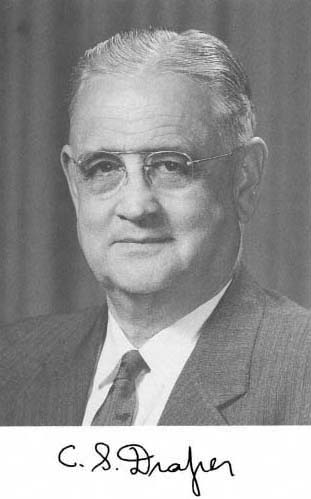
CHARLES STARK DRAPER
October 2, 1901-July 25, 1987
BY ROBERT A. DUFFY
CHARLES STARK DRAPER, a complex genius of the twentieth century, was truly a modern version of the Renaissance man. A teacher, scientist, and engineer by profession, but self-described as a ''greasy thumb mechanic,'' he was born in the American Midwest at the turn of the century, October 2, 1901. He grew up in the small Missouri town of Windsor, the son of the town dentist. He went through the town's public school system and entered college when he was fifteen years old at the Rolla campus of the University of Missouri as a liberal arts student. After two years at Rolla, he transferred to Stanford University from which he graduated in 1922 with a Bachelor of Arts degree in psychology. Among all of the other things at which he excelled, "Doc" understood human beings and he understood how to challenge them. The psychology curriculum probably did no harm, but instinctively Doc knew how to lead and how to get people to follow towards a common goal. He naturally interacted well with people. He liked and was interested in his students and his colleagues, and his students and colleagues loved him in return. Above all; however, despite his empathy with and for people, he lived for his technology and his life became the technology he nurtured to useful maturity.
He often told the story of hitching a ride across the continent in September of 1922 with friends, as a lark really, following graduation from Stanford. Crossing the Charles River from Boston over the Harvard bridge the new MIT campus, on the Cambridge side, attracted his attention. His friends went on to Harvard. Doc not only wandered about MIT but got so interested in what was going on that he enrolled himself. In another four years he had earned a Bachelor of Science degree in electro-chemical engineering. Despite short defections, he essentially remained at MIT for the rest of his life.
Legend has it that he took more courses at MIT than any one else has ever taken. He earned a Master's degree in 1928 and a Doctorate in Physics in 1938, both at MIT. There was another story Doc told about how he placed a numbered slip or chit in the back pages of each volume of his Doctoral dissertation. When he met with his examining committee in defense of his thesis, he asked for the chits from the reviewers, all of whom he'd worked with for ten years or more. Each chit authorized the examiner who had read that much of the thesis one bottle of scotch whisky; none were cashed.
Doc was supported as a research associate at MIT for a dozen or so years after his bachelor's degree. A Sloan fellowship and a Crane Automotive fellowship, for instance, paid his way in the Taylor brothers' Aeronautical Power Plant Laboratory. As a research associate and with industrial support from the Sperry Gyroscope Company, he invented a number of interesting devices, one of which was an engine detonation or "knock" indicator. At that time leaded fuel additives were being developed by others. The measurement of detonation in the engine cylinder was difficult to do precisely. Draper devised the technology for that measurement using a simple cylinder head-mounted
accelerometer. His instrumentation permitted him in time to create a more comprehensive system involving multiple "knock" indicators. The system became vital in over-water flying years later. The resultant real-time engine analyzers, manufactured in large numbers by Sperry, were installed on multi-cylinder engines and allowed the aircrew to lean engine fuel-air ratios to the point where detonation just began to occur. Changing the mixture ratio slightly below that critical point eliminated "knock," regulated engine temperature, and minimized fuel consumption—a key at that time to over-ocean flight safety.
Doc's involvement with MIT became convincingly more permanent by the mid-1930s when he became an assistant, then an associate professor of aeronautical engineering. By 1939 he was a full professor. It was during those early days, however, before advancing as a member of the junior faculty, that he tried and failed to become an Air Corps pilot. A tendency towards air sickness was revealed during simulated flight in a crude multi-axis dynamic simulator. Perhaps as a consequence of this rejection he enrolled in and quickly passed a civilian course qualifying him to fly. He acquired an airplane with an associate, and after some flying recognized the need to improve the pilot's flight instrumentation. He taught a course in aircraft instruments concurrently. To make his point about instrumentation inadequacies, he took Professor Jay Stratton, later to be president of MIT, up in his airplane and showed him how one used the flight instruments, indicating shortcomings he had perceived. He caused the airplane to perform stalls and spins over Boston's outer harbor. Professor Stratton was duly impressed by the inadequacy of the instrumentation and Draper's ideas about needed improvements. He did not fly again with Draper!
In his memoirs Stratton remarked that one never knew
who was the instructor and who was the student with Doc in the class. Draper was so conscientious and so dedicated that he scrupulously worked every problem in great detail. Normally he came back able to tell the professor more about the problem than the professor understood. That is a trait that many have noted in Draper. He understood the details and he knew mastery of those details was vital. He stressed understanding the physical significance of what was going on in the process he was attempting to control, maintain, or teach. Once one grasped the physical principles of what was going on, the mathematics one applied to the problem became greatly simplified.
The concept of understanding the physical significance of an event or process was so fundamental that most of his students never forgot it. They believed that Doc had so thorough an understanding of the subject matter that it was all right if he illustrated fine points in his lecture by telling magnificent stories about flying his Curtiss Robin. He was an entertaining lecturer. That took the mathematical magic and a lot of the mystery out of the instrumentation problems he sought to explain. Of course, there was always a day of reckoning. Later there would be an examination that would have been put together by Professor Sidney Lees, Professor Walter Wrigley, or Professor Walt McKay, all of whom were associates. The answer had to be stated, by the way, in Draper notation—Doc's self-defining mathematical notation, a noble experiment which never quite captured the hearts and minds of either the educators or the educatees.
Draper really provided three major thrusts in his life's work: measurement of physical processes, primarily the instrumentation of dynamic geometry; the systems engineering of those processes in the larger context of new concepts; and finally, the education of the engineering profession. Following his early experiments with basic instruments he
used that knowledge to seek the solution of the dynamic geometry problems associated with gunfire control, both on fixed-wing aircraft-mounted guns and with deck-mounted anti-aircraft guns. The second major thrust was the systems study, analysis, and synthesis which came from using instrumentation to measure quantities which are part of a larger issue. Here his conceptualization and vision were applied to what we later termed the systems engineering process. The solution was usually implemented by some control means using intelligence from the sensory elements processed through what Draper termed the informetics of some computational element. Using that information to change, through a comparator, a state so that a new control function could be performed is the essence of, for instance, the aircraft flight control process—in effect a simple adaptive control. An effector moved or regulated so that a desired configuration of control surfaces resulted in new aircraft flight vector alignments is the example—much more complicated systems evolved combining vehicle controls with fire control.
In the development of this process, Draper and his people, with Dr. Bob Seamans leading in the late 1940s and early 1950s, developed and demonstrated the first all-attitude adaptive autopilot. The system was installed in an early version of the two place Lockheed F94 jet interceptor. The aircraft was flown out of the Bedford Flight Facility of the MIT Instrumentation Laboratory on Hanscom Field. Draper had assembled there a mini-Air Force with his own air crews and maintenance personnel. Both Air Force and Navy aircraft covered the ramp in front of his hangar. Rocket and gunfire control systems, the early inertial navigation systems, and later the MIT student-built manpowered aircraft and the sailplanes of the MIT soaring society, all shared the same facility well into the 1980s.
Draper was also the entrepreneur who was capable of seeing a total problem and its solution as an harmonious amalgam of the sub-elements he knew in such detail. In this role his concept of automatic navigation and control for naval vessels and for aircraft and missiles suggested to him a whole new environment for military activities. Aircraft inertial navigators—SINS (the submarine inertial navigation system) and the ballistic missile guidance systems—were designed and prototyped in this country first by his laboratory. In the age of Apollo, the unheard of challenge of putting men on the moon safely and safely returning them to Earth appealed to Doc as a prime application for his technology. The creation of the guidance, navigation, and control elements of the Apollo program were inspired by Draper, although many others made fundamental contributions and younger, more energetic engineers in his unit actually implemented the designs.
Underlying all of that was the third, and perhaps most important of all his interests, the education process that he created when he had both the MIT Aero Department and his Instrumentation Lab under his direct control in the 1950s. "Mens et Manus," minds and hands—the MIT motto—had real meaning in this context. The invention and creation of the elements that went with measuring and controlling complex functions and processes served as a superb environment for learning. This happy set of conditions pertained in both the Aeronautical Power Plant Laboratory and in the Instrumentation Laboratory, which Draper created at the time the fire control systems were coming into being. The people whom it took to understand his methodology and who were able to follow his brilliant leadership, he chose out of the academic side of his activity at the Department of Aeronautical Engineering. The Instrumentation Laboratory itself, the Department of Aeronautical
Engineering and its distinguished faculty, and the long list of his students, led by him into leadership positions, are as much his legacy as the magnificent systems capabilities he created. It is that story which makes Stark Draper the paragon he grew to be. One needs to keep in mind in all this that he was a very human character—one of many, many facets. Totally involved, he radiated energy and self confidence. The simple father image of a man of devotion and care for his extended family is not enough. His entrepreneurial spirit and verve, concepts like navigating in a "black box" so that a submerged vehicle can know its position and velocity without external reference, the creation of spacecraft and booster guidance systems, and a mathematical language—the unsuccessful Draper notation—optimalization as a control theory, the conceptualization (with Milton Trageser) of a Mars Mission in the 1950s, were as much a part of this genius as his care and concern for children and the young as students. He was dogged and of course at times dogmatic. He had friends in the Soviet technocracy whom he knew as the humans behind the official image. He flew with and chatted in a familiar fashion with President Lyndon Johnson. He knew the names of all or nearly all the technicians in his laboratory. Secretaries called him "Doc." If he missed on remembering their names, "darling'' sufficed and satisfied. He was their friend. Somewhat a gourmet, he frequently gathered a group of the secretaries and a few staff people and took the gathering to Locke Obers restaurant for lunch. On occasion a larger contingent would join him for dinner at the Athens Olympia or at one of the excellent Chinese restaurants in Boston's Chinatown. He had a grand manner about him during the meals. The restaurant proprietors appreciated him and the lab folks became more family. He really worked the laboratory interpersonal problems at those times. He was effective.
Draper's attention to detail and thorough knowledge of all factors governing the performance of the systems he designed or whose design he greatly influenced are best illustrated by the experience he and his laboratory had with the single-degree-of-freedom rate integrating floated gyro. It was developed in the 1940s in Draper's laboratory. Industrial organizations in this country and abroad following his lead. Although Draper's primary attention was devoted to this instrument, he did get himself deep into the development of the gyro accelerometer which, with other devices, was perfected at the Instrumentation Laboratory.
Draper had experience from the early days of the fire control developments with unfloated instruments. They evidenced sensitivities to acceleration and vibration which would make them poor performers for the precision high dynamic environment applications he had in mind. He began with a program to understand the properties of the materials involved. Perhaps most fundamental was the structural material itself. The Draper gyros were cylinders floated in a narrow gap (a few thousandths of an inch) inside a cylindrical container. The long axis of the cylinder, used as the torque summing member, was the output axis of the instrument. Inside the cylindrical float and perpendicular to that axis was the spin axis of the gyroscopic wheel. The third axis, orthogonal to the other two, became the gyro's input axis. The basic performance equation of the instrument says that the torque on the output axis of the gyroscope is proportional to the angular momentum of the gyro wheel assembly and the rate of turning about the input axis. The plane defined by the input axis and the gyro wheel spin axis is the reference surface, and the wheel resists twisting motion out of that plane. Since the input axis was aligned either to ship coordinates, a major axis of an aircraft, or other inertial or vehicular reference, the resultant torque on the out-
put axis of the sensing instrument, balanced by the damping of the flotation, created an angular rotation of the output axis. The signal generator of the output axis generated a precise indication of the direction and rate at which the instrumented axis of the moving vehicle was turning. To minimize uncertainties on that torque summing member, it was important that no forces or torques appear inside the instrument that were not a direct response to the angular motions of the aircraft or the reference system in which the sensing gyroscope was installed. Magnetic suspensions were developed in time to refine the flotation of the sensing element.
Invar, an alloyed steel, was the original forged structural material. Invar was strong, but it was heavy. Aluminum, much lighter, followed, and combinations of Invar and aluminum evolved in structures in the instrument industry of the day. Draper was not satisfied with the way these materials held their dimensions under acceleration and with changes in time, temperature, and pressure. He experimented with alternatives, and he particularly relied on the MIT materials scientists during the process. Slowly over the years he began to appreciate the dimensional stability of the powdered beryllium materials then being formed into structures by the Atomic Energy people. Les Grohe, a staff member in his lab, took the lead on this subject. The structures fabricated of beryllium were sintered and, therefore, had no preferred axis of strain. The resultant shapes were light and had strength properties very close to those of steel. The early material was not quite the ideal because it was notch-sensitive and therefore difficult to machine, and during machining operations there were potential health hazards to the operators. Draper got himself involved in industrial health medicine as a consequence. A very capable safety engineer at MIT, Alice Hamilton, collaborated with him.
The result of this teamwork was that the initial cleanliness and safety standards for machining and handling beryllium were developed.
Since the wheel of the gyro was spun on an axis normal to the torque summing or output axis of the instrument, it was important that the wheel not shift axially when loaded down by acceleration forces. Draper developed, to a state of perfection not seen elsewhere in the industry, the instrument class of ball bearing. These instrument bearings on the rotor axis were pre-loaded and caged separately to prevent axial shift. The materials for the races, balls, the lubricant, the cage, or separator, as well as the shaft, were carefully controlled and developed under Draper's long-term guidance. He was fascinated by the performance of the wheel itself, and never quite became comfortable with the gas sleeve bearings which finally evolved as the configuration of choice in the highest performance instruments that his own laboratory produced. He did not exactly fight the replacement of ball bearings by the gas instrument rotor bearings, but he certainly could never be termed their champion. He contended that the starting friction and particularly the friction during power-off rundown of the wheel, would damage the shaft and rotor surfaces of the gas sleeve bearing so that over the long-term the instrument would fail.
Predictable characteristics for wheels equipped with either bearing type were empirically determined. One could, for instance, time the rundown of a wheel when power was removed, measure running amperage, measure start-up voltage, and measure power delivered to the wheel. From those quantities and the long history on bearing life that had been accumulated, an accurate prediction of the ball bearings' demise could be determined. The performance of these instruments was of such a nature that any conceivable mission at the time would fit well around the availability of the
rotors. The Apollo missions were only the most well known of the applications where they performed successfully.
Many people in the bearing industry became involved with Draper in the development of the precision instrument bearings. In his own lab he spent countless hours seated with the craftsman who assembled these bearings. The bond that developed between the leader and his skilled workers was a hallmark of the man. Without question, the bearings worked satisfactorily for the mission for which they were designed. On the other hand, when configured with ball bearings they were comparatively expensive, and had to be assembled by highly skilled craftsmen.
The early fire control instruments were not floated. Flotation was developed to isolate the sensing element from the environment so as to eliminate uncertainty torques on the output axis of the instrument. Flotation fluid facilitated maintaining the temperature constant across the instrument. It isolated the output axis gimbal from acceleration and it damped vibration inputs to the sensing wheel. The high density needed to float the weight of the inner elements and the Newtonian qualities of those fluids were a constant source of interest to Draper. They were also a constant source of trouble for the people who had to design both the fluids and the instruments.
Draper's first family of instrument fluids was developed at the Penn State Petroleum Refining Laboratories. The key quality or characteristic of the Penn State University developed fluids was their Newtonian quality. That is, the viscosity of the fluids was independent of the shear rate. Therefore, a viscus shear integration could be performed within the instrument and the outer servo loop, a vital part of the way Draper's systems worked. As time went by, these fluids became more and more complex as the fluid properties were altered by additives to give specific densities and
high Newtonian viscosities. In doing this, one became vitally conscious of the issue of compatibility between the materials of the gyroscope and the fluids, since the gyroscope sensing element was sealed in a complete though tenuous bath. An example of this effect was that the seal-ants and potting compounds and the fluid could chemically react, thereby generating gases. These gases given off into the fluid created bubbles. The bubbles made the instruments temperature and acceleration sensitive.
In the same manner, seal integrity was vital, for leaks permitted the environmental pressures to enter into the inner elements disturbing very carefully engineered performance parameters. The temperature of the instrument and any temperature gradient across the device must be held to close tolerances during operation because the flotation fluid has a given density only at a given temperature. The proportionality of the integration performed depends on the temperature calibrated viscosity. Variation of these qualities disturbed the calibration of the instruments. Careful thermostatic control had to be developed, applied, and maintained across the operating environment. A jeweled pivot centered the shaft of the floated element in the early designs.
The encoder needed on the output (or information) axis was a synchro device which differentially summed fluxes on multiple poles, creating an AC signal proportional to the rotation of the rotor with respect to the stator which was attached to the outer case. This signal generator could function also as a torquer. Termed a ''microsyn," it was developed by Professor Robert Mueller of the MIT Aero Department with Draper as a collaborator. A very useful variation in Mueller's design was added later when Phil Gilinson, a lab engineer, developed a complimentary magnetic suspension. For extreme precision in the most demanding ap-
plications, this design improvement levitated any remaining off-neutral flotation in the sensing element. Uncalibrated drifts in the instrument were reduced to essentially zero.
The plastics that were used to encapsulate the microsyn stator and the synchro receiver had to be especially developed. One big problem was to lower the coefficient of expansion to match more closely the copper coils and magnetic steels. The plastics were proven to be adaptable to this criterion by the addition of large quantities of earth fillers.
In a typical system the instrument was operated at null or close to null in normal operating modes. The combination of a rapid servo, a very short time constant control loop which included the rate integrating gyro as its sensor, and the Instrumentation Lab developed torque motors of the gimballing that enclosed the device, preserved reference systems integrity. In essence, the instrument was happiest at rest, or null signal. Any disturbance moved the microsyn off null and caused the reaction in the isolating servo to preserve the reference. Computational elements operating on sensor outputs performed the functions necessary to accomplish the tasks to which the instrumentation was applied.
Another problem in calibrating the instruments was the continuing spurious torque affect of the little pigtail leads that bring power into the synchronous motor of the rotor through the wall of the floated element. The issue was to get the leads light enough so that they were buoyant in the flotation fluid and curled in a way that was calculated to minimize any residual torque expressed in fractions of a dyne-centimeter onto the inner gimbal. Over the years, kinking and detachment of the leads during assembly were problems that created torque uncertainty difficulties in performance and reliability. It was at about this time that Draper's
definition of the dyne-centimeter, as the miniscule torque required to twist his arm so as to induce him to have a drink, came into vogue.
The story relating Doc's attention to detail, illustrated through the development of the single-degree-of-freedom rate integrating gyro, wouldn't be complete without mentioning that all of the testing methods and most of the test equipments needed to evaluate the characteristics of the gyro were developed by Draper's team in his laboratory. The suppliers for the materials used in the gyroscope were qualified by Draper and supported by him until commercial or industrial contracts began to draw on them as suppliers for their production needs. Everyone really had a vote in the process because Draper listened, then acted on his judgement after evaluating the inputs. He tried to have at least two proponents in contention on every issue. He claimed over the years that his lab was really an Athenian democracy where talent ruled. The better solution would evolve from the contest—but if it wasn't Doc's preferred solution it didn't always survive. He could be ruthless.
Draper's collegial decision-making side frequently came out in his evening reports ritual. Key people congregated outside his reasonably spacious office from four o'clock in the afternoon on. In time he'd have half a dozen arguing around a conference table which abutted his large wooden desk. At times the atmosphere was tense—particularly if a major point was in contention. When things seemed to be deteriorating too rapidly, Doc would reach under his desk and push a button activating a relay which jumped his large wall clock exactly one hour. Marie Allen, his faithful secretary early on and Alice Moriarty or Peg Hood later, would then announce cocktail time and break out the contents of the John B. Nugent Medicinal Aid Foundation locker. Quiet would momentarily reign and the meeting would recom-
mence on a less strident basis. Shortly people would slowly break off to make their way home to the suburbs where most would be greeted by indignant wives awaiting supper.
Although many people worked on the design of the single-degree-of-freedom gyro, there is without question no single person who put in the totality of the effort that Draper himself gave to the development of the instrument. It isn't even clear that Draper was first, but he was foremost. Ben Johnson, at the General Electric Research Labs, has a filed patent covering the single-degree-of-freedom gyro that predates Draper's by a very, very short period of time. On the other hand, GE did not see fit to continue the development of the instrument and Draper's patents were followed up and exploited by many industrial sources. Honeywell comes to mind immediately, since it was their small single-degree-of-freedom rate integrating gyro that was used in the A-4 gun-bomb-rocket sight for the fixed-wing fighters such as the F-86 Sabre.
The applications for this unique family of sensors ranged from the high dynamic range pointing needs for automatic gunfire control through enormously demanding navigational references where stability governed. In the latter case, mounting three of his instruments ortagonally formed the reference system from which the navigational quantities were measured. Their usefulness in naval anti-aircraft fire control is one of Dr. Draper's salient achievements.
Since the time of Admiral Sims pre-World War I, the U.S. Navy rightly prided itself on its marksmanship with large caliber guns against shore installations and naval surface targets. Optical range finders and gun directors, shot pattern "laddering" tactics and automatic range keepers were a deadly combination with naval ordnance against slow moving or stationary targets. On the other hand, the British loss of the Repulse and the Prince of Wales to multiple attacks
by Japanese aircraft off Singapore just after Pearl Harbor, was a shock to the Navy.
Anti-aircraft fire control against a rapidly moving target had been an art until Draper's time. Essentially, the rate at which the target moved and the time that it took for the projectile of get from the gun to the target were estimated by a skilled gunner who guessed the future position and time of arrival of both. The time that it took for the projectile to get to the target was a function of the initial vector velocity of the bullet or projectile and the range to the target, and was of course the prime determinant of how far gravity would "drop" the projectile over the length of the trajectory. Because the probability that any one round would hit the target was so low, automatic weapons had to be employed. In using those weapons, a tracer shell was placed periodically in the stream of bullets that came from the gun. The trained gunner would follow the tracer shell to the vicinity of the target and then adjust his aim and either raise or lower the gun or adjust its angular rate to anticipate the future position of the target. The gunners' range estimation process in its crudest form used a circular ring sight which he looked through at the target. The sight had concentric circles decreasing in diameter from the outer rim to the center. Knowing the type of airplane at which he was shooting, the gunner placed and maintained the appropriate ring at the wing tips of the target, and from that information and a nomigraph he estimated the range. This input he manually entered into the sight by a knob setting. It was not an accurate measurement, but it was good enough given automatic weapons and a trained operator. Draper recognized that in war time the trained operator would be in short supply. It took a long time to train the gunner so that he was proficient. Doc felt that if you could measure the range and range rate precisely, and measure the angu-
lar rate at which the target was moving, you had the essentials for an accurate prediction angle—the ''lead" the gunner required. Using the instrumentation which he himself developed he demonstrated a workable solution for the angular rate problem. The instrument was the rate gyro. The "computer" was a torque-summing analog device mechanically coupled to the gyro. The precise solution for range and range rate was solved later when radar was developed—literally next door at the MIT-operated Radiation Laboratory.
The use of the gyroscope as a key element in shipboard gun directors was what brought Professor Ralph Howard Fowler to Draper's laboratory just after the start of World War II. Sir Ralph was the British government's senior technical officer in ballistics and fire control, and he was with a U.K. mission visiting in Cambridge, Massachusetts. He knew that Draper had demonstrated what our Navy at first ignored but which became the functional prototype for the Mark 14 sight. The British bought the development.
The Mark 15 shipboard anti-aircraft gun director followed, incorporating the MK-14 as its sensor element. In the case of the Mark 15, Draper used modern servo control theory, the rate gyro, and a thorough understanding of all of the elements of the fire control problem. He made an attack on the major error sources in gun fire prediction by establishing an error budget. Selecting those error sources that he could diminish or eliminate by using his instrumentation, he established a set of instruments so arranged that he could perform the desired functions of tracking and lead prediction in two dimensions quantitatively and dynamically with estimates in the third dimension, range. In his scheme, as the gun is aimed at the target and tracked, the gyros generated torques while elastically restrained by a spring connection to a mirror through which the target was
sighted. The other major issue of course was how to accommodate the gravity drop of the projectile. His system elevated the gun line by using an eccentric mass on the torque summing member, also creating a torque against the elastic restraint for the elevation element of the instrumentation. Velocity jump, the vector product of bullet and aircraft or ship velocity, and range wind had mechanisms for error compensation which were knob settings for the associated crude mechanical analog "computer." The British apparently also adapted the sight or a variant for aircraft installations. The U.S. never quite got to use Draper's invention directly in aircraft gun sights until the Korean War. There is some indication, however, that the primitive gyroscopic aircraft gun sights used during the Second World War came to America via the British, having originated in Cambridge, Massachusetts in the Instrumentation Laboratory. Using Draper's equipment, the carrier Enterprise and the battleship South Dakota entered into the engagement known as the Battle of Santa Cruz with light anti-aircraft automatic gun (20-mm Oerlikin) batteries, armed with Draper's gun sight as manufactured by commercial industrial sources. (Some 100,000 of the sights were built during World War II.) The crew of the South Dakota shot down approximately thirty attacking aircraft. The Battle of Santa Cruz went into the record books as a significant U.S. naval victory.
In time, the Mark 14 became a subcomponent of the Mark 51 gun director for 40-mm batteries, and was later incorporated in the Mark 52 gun director which was used with the larger 5-inch guns. The addition later in the war of the range setting radar resolved one of the major operational difficulties with Draper's systems, the twiddling of the range dials the crew had to do before automatic ranging with radar was available. During the proofing of the Mark 52 gun director another fascinating anecdote of
Draper's human nature comes out. He had made a speech to a yacht club in the Boston area and as an honorarium, since he wouldn't accept money, the yacht club sent to him a case of liquor which he put in his campus office at MIT and marked the 'John B. Nugent Medicinal Aid Foundation," as noted earlier. The establishment of that foundation was essential because the campus was nonalcoholic. Nugent happened to be the commodore of the yacht club, but he was also the employee of the Instrumentation Laboratory who had asked Draper to address his gathering. At Dam Neck, Virginia, the "John B. Nugent Medicinal Aid Foundation" was the source for the shipment to the Draper crew of commodities labeled as "nonlinear damping fluid," a convenient euphemism for Plymouth Gin.
Refinements of the basic Draper fire control system continued through the end of the war when Mark 63 systems appeared with a gun-mounted radar. The radar-directed tracker coupled with a correction device for removal of the cross roll error, an error source Draper was not able to accommodate early in the Mark 14 system design, made for a more precise solution. The elimination of the cross roll disturbance was again accommodated by a clever use of a gyro.
The development of the Air Force's fire control equipment at the Instrumentation Laboratory followed the Navy's fire control developments in part. Where the original Navy Mark 14 and derivative systems used elastically restrained gyros, the Air Force used an unrestrained but viscously damped single-degree-of-freedom gyro, the gyro with which Doc is most readily identified. That instrument was freely floated and held longitudinally by jeweled bearings on the output axis of the gyroscope. The actual pursuit curve mathematics worked out during the development was accomplished by Lt. Col. Leighton I. Davis, an Air Corps officer
who flew many of the experiments. Lt. Gen. Lee Davis, USAF, retired much later from his position as president of the National War College. Doc did what he called the "greasy thumb mechanic" work, putting the instrumentation together and of course adapting his floated gyroscope to the solution to the problem. Davis's pursuit curve equations were solved in the A-1 gun sight computer, also designed at the laboratory by a crew that worked very closely with Dr. Draper and Davis. Besides the application of the superb single-degree-of-freedom floated gyros to the airborne gun fire control system problem, the development of the concept of aided tracking by controlling the stability of the tracking system was a unique Instrumentation Laboratory contribution. The relationship between the motions of the aircraft and the motion of the pipper, the projected reticle through which the target is acquired and tracked, indicates the computed line-of-sight and governs the ability of the pilot gunner to keep the sight on the target. A lead angle changing slower than the angular motion of the gun line is required to have stable tracking. That was a key problem in use of computing gun sights and for that matter bombing equipment in the early days of these developments. Draper's people understood through experimentation the significance of this criterion.
At any rate the fixed gun airborne application exhibited remarkable performance. The Soviet-designed and-built MIG 15 fighters used by the North Korean Air Force in the air war of the early 1950s were downed at a ratio of at least 10 to 1 vs. the U.S.-built F-86 Sabre fighter. It's argued correctly that in all probability American pilots had better training and more time in the airplanes and in combat than their adversaries in the MIGs. It's also probable that the Draper instrument made a significant difference militarily.
This was particularly true where our younger and less experienced pilots were concerned.
By the mid-1940s, Draper's interest was shifted from fire control and he began the all-consuming task of developing the inertial guidance equipments. Applied to both spacecraft and boosters they also became the ship's navigation systems and the guidance systems for the Navy's fleet ballistic missiles and the Air Force's ICBMs. His systems were the prototype for many commercial transport automatic navigation systems as well as those applied to military aircraft.
In August of 1945, Draper had proposed to the Armament Laboratory of the Air Force's engineering activity at Wright-Patterson AFB that he build a "Stellar Bombing System." The report included a statement to the effect that "robotizing the system for use with guided missiles" was feasible. In the postwar euphoria that factor was not emphasized. Khruschev's polemics in the 1950s, which included missile threats, brought renewed attention worldwide to the issues raised by the substance of the debate.
In the background Draper flew a stellar-aided inertial system in the late 1940s and a pure inertial system in 1953. SPIRE, developed by Roger Woodbury, and systems-engineered by Don Atwood at Draper's laboratory, was that revolutionary system. Consolidated Aircraft Corporation, peopled in key positions by a few German refugee scientists and exmilitary engineers, had quietly begun a program which became in time ATLAS. They were impressed with SPIRE's performance but not its rather formidable size. Draper had sold himself and his laboratory to the Convair decision-makers to the extent that he got a small contract to design inertial guidance and control for the evolving Atlas Intercontinental Ballistic Missile using down-sized SPIRE components. When the nation began to gear itself to the ICBM
problem, this contract was quietly shifted to Air Force control.
Inertial guidance evolved in much the same manner as most of our technology. We are technologically Darwinian. In 1923 a German, Max Schuler, explained in satisfying engineering detail the essentials of dynamic vertical indication. He tuned theoretically his pendulous element so that it had the earth's natural period, 84.4 minutes. A minor detail prevented his physical realization of the concept—the pendulous arm had to be equal in length to the earth's radius! Dr. Walter Wrigley, a student of Draper and with Draper's encouragement and help, wrote his doctoral dissertation in 1938 at MIT, ''On Vertical Indication From a Moving Base." The technology had evolved so that the servo loop closed around a gyro stabilized pendulum instrument of physical dimensions that could be electronically tuned to the required periodicity. Schuler was, as is often the case, before his time. The war intervened but FEBE, the MIT stellar-aided system, was flown in 1948 as noted above. German engineers during the war did not "close the loop" around the pendulous instrumented range axis with the crude V-2 guidance system. They had most of the idea but not the technology. The Russians apparently understood the principle too, but like the Germans did not have the technology to create practical systems.
Walter Huesserman, J. M. Kooy, and Reisch appear to have been the "systems" thinkers in the field in Germany. Schuler and Boykow, though earlier in the field, were instrument-oriented rather than systems designers. In Russia, A. Y. Ishlinsky, a friend and correspondent of Draper's, and B. V. Bulgakov and L. I. Tkachov seem to have had the same systems concepts at approximately the same time. The difference was Draper himself. He believed. He also carried with him a team of his own fashioning. Financially main-
tained in the field and challenged by the Air Force and Navy, the capability they created made possible the string of achievements which culminated in guidance for Apollo, which was ironically neither Schuler-tuned nor "pure" inertial, perhaps to Doc's chagrin.
A very simple guidance law which stated that when the quantity "velocity to be gained" equals zero, thrust must terminate, devised by Dr. Hal Laning at the Instrumentation Laboratory, served as the control function for all of the early missile systems. John Kirk, building on basic ideas of Laning and Phil Lapp with the Instrumentation Lab team members and a contingent of knowledgeable engineers from the AC Spark Plug Division of General Motors, created the basic system based on Laning's unique law, by then termed "Q" matrix guidance. When the Air Force reacted to the strong words emanating from the Soviets and quickly established a program for an Intermediate Range Ballistic Missile, Thor was the result. The MIT work was converted to the Thor program. AC division of GMC took over and twenty-two months after program initiation the first Thor flew.
General Ben Schriever had been appointed to conduct the USAF ballistic missile program when the emergency situation was first perceived in 1954. He wisely disengaged from the normal bureaucracy and the technical conservatism it seems always to exhibit. In hiring the Ramo-Wooldridge corporation as his technical partner he did not quite make all of the severance from conservatism he had hoped. Inertial technology being new and closely held was neither widely known nor well understood. Draper found he was isolated by what he called the "electronischers," from realizing for the ICBM program the benefits of inertial navigation and guidance systems. Atlas and the early TITANs were fielded using the better understood radio guidance schemes General Electric and the Bell Laboratories had invented. When
in short order their vulnerabilities were more clearly evident, they were replaced with the inertial systems all ICBMs and FBMs now carry. During this time Draper was not discouraged, fought doggedly for what he felt was correct, but maintained the dispute within the family. Autonetics, a rival in technology development, clearly won the race for the next generation inertial system, Minuteman, with gas bearing gyros! The autonetics gas bearing instruments better fit the Minuteman operational concept of "alert" (fully running missile systems). Guidance for MX is a Draper design but, significantly, with Draper gas bearing single-degree-of-freedom gyros.
The Fleet Ballistic Missile (FBM) systems grew out of the Thor technology. SINS had made long-term submerged operation for the nuclear powered submarines practical. The smaller hydrogen bombs and the solid propellants had made ship-or submarine-launched missiles safe and able to be adapted to the volumetric constraints of the submarines. Polaris in its three variants, Poseidon, and the two versions of Trident, are all Draper-guided. It is not appropriate to comment on the performance requirements for these applications. It is pertinent, however, to state that Draper's gyroscopes are not particularly stressed by the ballistic missile environment except for the initialization of the systems. On the other hand, the accelerometer design and its performance over the full dynamic range is crucial. Draper's miniaturization of the earlier systems was vital to the FBM systems success. Even more importantly, his adamant insistence of maintaining an overall authority from design through prototyping and transition to production and operational usage played a major role in the successful Navy missile program.
Draper became a public person with the Apollo program. Although he had been honored by both the Air Force and
the Navy for his wartime contributions, it wasn't until the Apollo program began that the nation as a whole knew Charles Stark Draper. Even before President Kennedy made the public announcement that within the decade man would be landed on the moon and brought safely back to Earth, Draper, always with an ear to the ground, had seen that evolving challenge as applying to him and his laboratory. NASA had been formed as a reaction to the Sputnik launch by the Soviet Union. Jim Webb, the NASA administrator, had known Draper from his days at the Sperry Corporation where Doc helped the Sperry people develop aircraft instrumentation for commercial and military applications. The Jimmy Doolittle blind flying experiment had cast Doc into the breech at MIT to teach instruments for the Aero Department, because the regular instructor went to Sperry to support the Doolittle program. Doc always remembered that Webb and Hugh Dryden (of NACA heritage) believed Draper's statements to the effect that navigation to the vicinity of the moon without external aid was feasible and practical. In fact, to be as convincing as only Draper could be, he told them he would go along on the mission to be sure the equipment worked correctly. The MIT Instrumentation Laboratory received the first contract award made by the new National Aeronautics and Space Administration for the moon program, but only after a careful evaluation of Doc's proposal had been made by the NASA staff. The design of the guidance, navigation, and control equipment was not an extraordinary task for the Instrumentation Laboratory. The fundamentals of the inertial navigation capabilities had been well proven earlier with the single-degree-of-freedom gyro, Draper's prize instrument, and the related gyro accelerometer. The SPIRE, FEBE, 117L and other programs had demonstrated the fundamentals. The instruments had an industrial manufacturing base established and their
performance required less precision than that which had been demonstrated in the ballistic missiles (the ICBM and FBM) programs. So the challenge for the Instrumentation Laboratory was not to prove a concept or even a technology, but rather to adapt to the extraordinary distances and the demanding reliability requirements of the manned moon mission. In actuality, the version of Draper's system implemented by Dave Hoag and his team used both a star tracker and accepted radio position and velocity updates from NASA's long-base link earth-based tracking stations—a sort of belt and suspenders solution which worked.
In the 1950s, a small group of Air Force people had foreseen the usefulness of projected satellite capabilities and the mission that these capabilities could support. They contracted with the Instrumentation Laboratory for the design for the Mars reconnaissance probe. Draper himself and a brilliant engineer, Milton Trageser, had thought through most of the problems involved in a Mars reconnaissance mission. Both Drs. Laning and Dick Battin contributed effectively. It was that mission which required the systems engineering that was most convincing in Draper's sales program with the NASA management. The pioneering activity of the digital computer as the computational element of the inertial equipment had been proven in concept in the Ray Alonso design for the Mars probe, which had been proven in practice with the fleet ballistic missile Polaris guidance system. The computer, a digital differential analyzer in the case of the first Polaris system, had the technological elements that were to be repeated, in more modern form, of course, for the Apollo computer. Draper himself had little interest in and no effect on its design; he did have a strong influence on the total system design and cared deeply about the astronaut interface with the displays and controls, all computer driven. He was vitally interested in safety.
Typical of such criterion was the provision for ''restart" in the guidance and control digital computer used in the command and service module and identically in the lunar landing module. The logical succession designed into the computer was such that flight-critical functions were performed with priority, and other functions were performed when the computer had time to accommodate them. In establishing the check list for lunar descent, a NASA functionaire did not demand that the rendezvous radar be in the "off" or a standby position for the landing operation. Apollo 11 caused some tense moments when in real time this provision for restart in the computer was proven to be a wise one. The computer receiving multiple pulses from the unneeded and unwanted rendezvous radar ignored them, but displayed alarms indicating it was overloading. Neil Armstrong, Buzz Aldrin, and the ground control crew at Houston knew the computer design was such that the essential tasks for landing would be accomplished but it was a distraction to have the alarm and "restart" functioning at so critical a time in the lunar descent. Today's far more competent computers would easily cope with the capacity and speed problem which taxed the early designers but possibly would have permitted less stringent programming rules and more margin for error. At any rate, the conservatism built into the instructions the computer got before flight clearly saved the day—and reemphasized Doc's important design criterion to keep the design tolerant of the unknown unknowns.
Dave Hoag, the systems engineer Draper chose to conduct the Apollo amalgamation, and the team he had developed for Polaris moved naturally and effectively into engineering control of the Apollo effort at the laboratory. Reliability, dependability, and adaptability to the situations likely to occur and, where possible, tolerance to those pos-
sible but unlikely to occur in a manned space environment were key design considerations.
The Apollo inertial system was a take-off from the Polaris designs using the same instruments in a different gimbal system. An optical sighting capability, a sextant built into the structural base of the navigation system and referenced to the gyroscopic axes gave the system long-term autonomy. Since the system was manned and a communication link had to be available, the console permitted updated information from the ground-tracking net to be entered into the guidance system. All features of the Command Module's guidance capabilities had been tested in space by the completion of the Apollo 8 mission to circumnavigate the moon. The moon did interrupt the transmission path, of course, so Draper's claim for autonomy was met. Simulators were developed early on at Draper's laboratory in their primitive form. Later, much more elaborate simulations were assembled as NASA facilities. There were no significant surprises as a consequence. The actual landing on the moon during Apollo 11 was the proof test of the complete guidance and control system.
Draper's philosophy as an educator was actually a near-perfect example of what the MIT motto, "Mens et Manus," was meant to extol. In this activity he was not always appreciated by the faculty where worries about a "trade school" reputation prevailed. The MIT administration vacillated in its support. One tower of strength early on was Nathaniel Sage, director of MIT's Division of Industrial Cooperation, who encouraged Draper during the tough early years of the Instrumentation Laboratory's formation and growth. Sage fought Draper's battles at the top. Later that task fell to Albert G. Hill, a Physics Department professor, who, after Radiation Lab experience during World War II, advanced to MIT vice president for research, a successor position to
that of "Nat" Sage earlier. His responsibility for Lincoln Laboratory, on campus research, and the Draper Laboratory included well over half of the institute's annual budget and gave him a commanding influence. Without Hill, the transition of the former Instrumentation Laboratory, which had been renamed The Charles Stark Draper Laboratory, from a member of the MIT family to a distant cousin status might not have occurred so smoothly and efficiently and possibly not at all. Hill brought with him two superb administrators: Dave Driscoll performed spectacularly in managing the new company's at first nonexistent finances, and Joe O'Connor handled the laboratory administration. Draper had very little interest in either of these essential functions, but the lab as a stand-alone corporation would have sunk without these services.
Draper produced an impressive group of graduates of his courses in aircraft instruments, the Aero Department itself where he served as department head between 1951 and 1966, and of course the Instrumentation Lab, its predecessor activities, and the subsequent C. S. Draper Laboratory. The latter is still connected to MIT by a Memorandum of Agreement sharing research and, significantly, joint education activities.
It is appropriate in this treatment of Dr. Draper's professional life to dwell on this element of the story. A few examples can illustrate one more facet of this extraordinary individual's nature. During the 100th anniversary of the invention of the telephone celebrated at MIT in 1976, a distinguished graduate, member of the MIT Corporation, and former president of the Bell Telephone Laboratories surprised his escort during a tour of the just completed Draper Laboratory facilities by stating that he might have been Draper's first paid employee! Dr. James Fisk had been a research associate in the MIT Aero Department at the
Aeronautical Power Plant Laboratory where Draper had been his supervisor.
The listing of distinguished proteges and students always risks the inadvertent omission of important personages. It is not attempted here. Despite that hazard it is estimated that four to five hundred active duty military officers came under Draper's influence in their professional education. They range from four-star flag officers through the ranks to second lieutenants and ensigns—and all services are represented in their ranks. Rivals of Draper's have complained that "he grew his own contracting officers." While there is some truth in the allegation, since many of those individuals did serve as key decision makers later in their careers, it can scarcely be claimed that this was to the disadvantage of the country. Draper himself remained a university professor and reaped no financial gain personally. His laboratory to this day remains a not-for-profit corporation whose assets are held in trust (by its charter) for the people of the United States.
Many senior executives in industry today share a common background which includes undergraduate and graduate education at MIT in the Aero Department, or with research association to the Draper Laboratory. Every major aircraft corporation and most electronics organizations are seeded with his proteges. Government has been and still is sprinkled with graduates usually in senior engineering roles or in major executive roles where the agency has a technical mission.
The academic world not only has his graduates in senior administrative roles from president through department heads but, the supreme accolade, in departments which copy his course content and his philosophy of "Mens et Manus" as well. During the fifteen years, 1951 through 1966, of Draper's tenure as department head at MIT's Aeronauti-
cal Engineering (later Aero and Astro Department), 1,642 degrees were awarded, approximately 100 doctoral level and 70 engineer level were included in that total. These statistics attest to his success on the third thrust of his professional life.
James Killian, in his The Education of a College President, suggests the most difficult task facing the then-president of MIT in the late 1960s, Howard Johnson, was the consequences of the attacks being made on the Instrumentation Laboratory because of its association with the military services and the Defense Department. Draper's laboratory was essentially "on" campus. The shared overhead of the institute roughly proportionally split costs between the academic departments representing a quarter of the institution's budget and the lion's share of the remainder represented by Al Hill's area of responsibility—losing the Instrumentation Lab as a revenue source was a significant trauma to the fiscal managers. The overwhelming majority of the student body was not really concerned. There was, however, a very vocal and effective minority who did stage loud and flamboyant demonstrations. MIT has a subway stop on the Boston Cambridge red line, a convenience not lost on the organizers who imported like-minded sympathizers from the many other Boston area colleges and universities, and from some of the communes and special interest groups active at the time. Draper was never personally offended by the demonstrators. He frequently met and talked with them and on occasion was known to take a few to lunch.
A goodly share of the faculty was perhaps most influential at the time the decision to divest the Draper Lab had to be made. It is, however, important to note that no vote of the faculty was ever taken on the issue. It is probably best for all concerned that the vote was not taken. Doc was hurt by the decision to divest his beloved creation. To the lasting
gratitude of the nation and particularly the military the separation was accomplished with a minimum of disruption. Al Hill made the personal commitment of his considerable talents to make the transition work, a task he accomplished with one foot in each camp. Draper maintained his poise and gained the respect of the MIT management by quietly devoting himself to the lab's success and maintaining the connection to MIT from which he had retired as an Institute Professor Emeritus. He did not join in any of the public clamor after the decision was made. He did defend the lab vigorously in faculty debate before the divestiture. MIT did not gain nor did it seek to gain financially from the decision.
Draper died in the summer of 1987 on a Saturday night, the 25th of July. The MIT community (along with the Draper Laboratory) honored him in a memorial service during the fall academic session of 1987, when his long-term friends and colleagues had returned to the campus. MIT has two endowed chairs in his name (for junior faculty members) in the Aeronautics and Astronautics Department. The Draper Laboratory awards graduate fellowships at MIT in his name and supports military officers studying for graduate degrees at MIT, also in Draper's name.
Dr. Draper was elected to the National Academy of Sciences, the National Academy of Engineering, and as a foreign associate member to the French Academy of Sciences. He was president of the Von Karman Foundation, the International Academy of Astronautics, and the National Inventors Council. He had many academic honorary degrees and citations.
The Board of Directors of the Draper Laboratory authorized an annual award in Draper's name to be administered by the National Academy of Engineering. The award honors the engineer who has contributed most to engineering
in the opinion of the NAE-appointed selection committee. The award approximates the Nobel award in value, and is permanently endowed and may be awarded as frequently as annually.
Draper's passing took from us an innovative, insightful, productive leader of very rare qualities. His warmth and humor lightened many a heavy discussion. He could get to the nugget of an argument rapidly and he saw elements of an issue most of us would miss. In his Wright Brothers lecture to the Royal Aeronautical Society in London, he surprised his audience by selecting the flight control contributions of the Wrights as their most significant achievement. He noted that they, unlike Langley and others, destabilized the aircraft by having the nose pitch down, except when the human operator exerted back pressure on the control column. Inertial navigation was another grossly different way in which to look at the process of getting from here to there. He was different.
Dr. Draper is survived by his wife, the former Ivy Hurd Willard, and four children, James, Martha Draper Ditmeyer, John, and Michael. The Drapers lived for many years in Newton, Massachusetts, where Mrs. Draper now resides, remembered fondly for her strong support of Draper through many long years of extended separations, interminable Saturday sessions in her home, and memorable parties and picnics for Doc's students and colleagues.
BIBLIOGRAPHY
1935 Dynamic characteristics of aircraft instruments. J. Aeronaut. Sci. (March) :59.
1936 The new Instrument Laboratory at MIT. J. Aeronaut. Sci. 3(March):151-53.
1937 With G. P. Bentley and H. H. Willis. The MIT-Sperry apparatus for measuring vibrations. J. Aeronaut. Sci. 4(7):281-85.
1939 With G. V. Schliestett. General principles of instrument analysis. Instrum. 12(6):137-42.
1944 Theory of Gyroscopic Instruments. Cambridge, Mass: MIT Aeronautical Instrument Laboratory.
1945 With W. McKay. Instrument Analysis. Cambridge, Mass: MIT Aeronautical Instrument Laboratory, 1945-46.
1947 With the staff of the Instrumentation Laboratory. Gunsight Mark 15 for the control of short-and medium-range anti-aircraft fire from naval vessels. Navord Report 3 47, 4 volumes, 8 parts. Cambridge, Mass: MIT Aeronautical Instrument Laboratory for the U.S. Bureau of Ordnance, 1947-49.
1950 With Y. T. Li. U.S. patent 2,628,606—control system. Assigned to Research Corporation, N.Y.
1952 With S. Lees and W. McKay. Instrument Engineering, 3 vols. Vol. 1:
Methods for Describing the Situations of Instrument Engineering. New York: McGraw-Hill.
1953 Methods for Associating Mathematical Solutions with Common Forms, vol. 2. New York: McGraw-Hill.
1955 Applications of the Instrument Engineering Method, vol. 3, pt. 1: ''Measurement Systems." New York: McGraw-Hill.
Flight control. J. R. Astronaut. Soc. 59(July): 449-78. Paper presented at the 43rd Wilbur Wright Memorial Lecture, Royal Institution, London, England, in May.
1958 Improved ball bearings will meet tomorrow's needs. Aviat. Age 30(2):52-59.
Instrumentation aspects of inertial guidance. Instrum. Soc. Am. J. 5(11).
1959 With R. B. Woodbury and W. Wrigley. Principles of inertial guidance. In Advances in Aeronautical Sciences, vol. 1, pp. 524-62, London: Pergamon.
1960 With J. Hovorka and W. Wrigley. Inertial Guidance, International Series on Aeronautical Sciences and Space Flight, Division 7 (Astronautics), vol. 3, London: Pergamon.
1961 Development criteria for space navigation gyroscopes. Navigation 8(4):273-83.
1963 The contribution of instrumentation in aero-space engineering. J. Eng. Educ. 53(10):716-20.
S. Lees, ed. Air Space and Instruments, Draper Anniversary Volume. New York: McGraw-Hill.
1965 Survey of inertial navigation problems in sea, air, and space navigation. Papers of the International Congress on Long-Range, Sea, Air; and Space Navigation. 1:26-31.
1969 With S. Herrick. Astrodynamics, pp. 1971-72. New York: Van Nostrand.
1971 The evolution of aerospace guidance technology at the Massachusetts Institute of Technology 1935-1951. AIAA Bulletin 8(10). Paper presented at the 5th History Symposium of the 22nd International Astronautics Conference, International Astronautical Federation, Brussels, Belgium, 20-25 September.


