
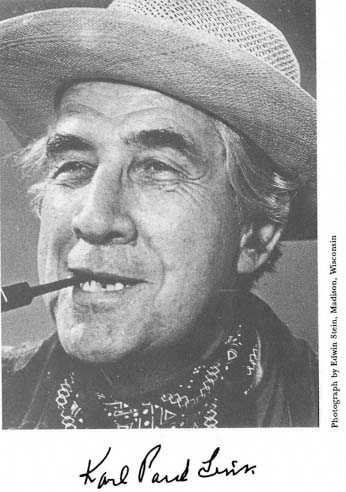
KARL PAUL LINK
January 31, 1901-November 21, 1978
BY ROBERT H. BURRIS
KARL PAUL LINK was a carbohydrate chemist and plant biochemist, whose research changed direction abruptly when he initiated work on the isolation and characterization of the hemorrhagic factor produced in spoiled sweet clover hay. The isolation of a modified coumarin as the causative agent led Link and his colleagues to the synthesis of a variety of anticoagulants that have had wide medical application as anticlotting agents and that have also proved highly effective as rodenticides.
Karl Paul Gerhard Link was born in LaPorte, Indiana, the eighth of ten children, to Frederika (Mohr) and George Link, a Missouri Synod Lutheran minister. At age two he survived a serious case of pneumonia; he never was a robust child. Karl characterized his early family life as ''on the edge of poverty," but his parents, brothers, and sisters were supportive. His father had a fine library that the children were encouraged to use, and they possessed a piano that had been brought from Germany by Karl's maternal grandparents. As Karl's sister Margret stated of their group singing, "we cut our eye teeth on the Bach chorals. So a deep appreciation of literature, poetry, and music became a part of us. We spoke both German and English."
When Karl was two years old, his father developed a throat
condition that forced him to leave the ministry. After a difficult period of holding miscellaneous jobs, he was elected in 1904 as Clerk of the Superior Court of LaPorte County, Indiana, and later was admitted to the Indiana Bar Association.
Margret A. Link Ponomareff characterized Karl as ''a very generous, kind and thoughtful person. . . . He was also a prolific letter writer. He loved a good argument, was also a great tease." Karl's letters and cards were famous, as they characteristically were on the most unattractive and outdated postcards obtainable, or on some old envelope or scrap of paper rescued from the wastebasket. They always conveyed time and meteorological data. I have a card in hand, for example, with the data: "Temp. 30 F., B. P. 29.93", overcast-snow is predicted. XI/26/67 at 5:00 A.M. C.S.T.". This was characteristic, and although he often recorded very early hours, the hour was generally disbelieved.
Times were not easy for the Links, as Karl's father died of cancer in 1913, when Karl was twelve. Karl's sister Margret states that, "There always was enough food for the family, we were adequately clothed wearing 'hand me downs,' given the best toys and of course many books. We often asked each other, how did our mother raise us when there was so little money?. . . When people asked this question of our mother she would reply with a smile on her face, 'My husband left me a great heritage, a library with many books, a thirteen-room house without a mortgage, a good reputation, and ten children.' "
Karl did well in school, and family members were mutually helpful. He attended St. John's Lutheran parochial school from 1905 to 1914, and LaPorte High School from which he graduated in 1918. The children were encouraged to attend college. George K. K. (1888-1979) received his Ph.D. from the University of Chicago and was professor of botany
and plant pathology there; Alfred J. (1889-1971) graduated in law from the University of Chicago and was a circuit court judge; Herbert J. (1891-1969) remained in the LaPorte area as a politician; Helene F. (1892-?) taught voice, piano, and conducted choirs; Ruth Marie (1895-1978) designed and sold millinery; Theodore A. (1897-1980) received a Ph.D. from the University of Chicago and was a petroleum geologist; Agnes L. (1898-?) was a registered nurse; Karl Paul (1901-78); Walter K. (1902-?) was chief geologist for Standard Oil of New Jersey; Margaretha (1905, died at age six weeks); and Margret A. Ponomareff (1906-?) was manager of the Tucson Red Cross.
Karl chose to attend the University of Wisconsin. It has been suggested that he was attracted there because his father was born in Wisconsin and his mother had a particular interest in Bob LaFollette and the Progressive movement in Wisconsin. Karl would have preferred to enter medical school, but it was more economical to take agricultural chemistry (now biochemistry) in the College of Agriculture. He started his university education in 1918 and received the B.S. degree in 1922, the M.S. in 1923 and the Ph.D. in 1925. The record of his days as a student is meager.
Link did his Ph.D. work with Professor William E. Tottingham, a plant biochemist whose Ph.D. research was on plant nutrition at Johns Hopkins. The personalities of Tottingham and Link were entirely different, but they seem to have gotten along well. Tottingham was a quiet, reserved person and a gentleman in every way. Link was boisterous, flamboyant, and certainly would have rejected the title "gentleman." Not having met Link before he was thirty-five, I do not know how flamboyant a posture he exhibited as a youth and student, and how much he cultivated it with time.
Obviously Link had an excellent record as a student because he was chosen as a postdoctoral fellow by the Inter-
national Education Board at a time when there were few postdoctoral fellowships. He took up his studies at St. Andrews in Scotland in 1925 under Sir James Irvine, a distinguished carbohydrate chemist. The relationship did not last a year before Link was evicted from the laboratory. Link's version was that he made an observation in conflict with a concept of Irvine, and because he refused to compromise his principles he was asked to leave. I do not have the other side of the story, but the incident caused such a hassle that in a subsequent year when Elizabeth McCoy's application was being considered for a comparable fellowship, the question was raised whether the board could risk having another University of Wisconsin appointee. This question was ludicrous to those who knew both Karl Link and Elizabeth McCoy well.
From St. Andrews, Link moved to Graz, Austria, and studied with Professor Fritz Pregl during 1926. Pregl had developed microchemistry to a fine art, and Link was fascinated by the techniques and mastered them. When he returned to Madison, he brought a microbalance and other critical pieces of equipment so that he could set up a unit for microchemical analysis. Link's microchemical lab was a showplace and was displayed proudly to visitors for many years.
Link's next move was to Professor Paul Karrer's organic chemistry lab in Zurich, Switzerland. Apparently this period marked the first flare-up of Link's tuberculosis, and he spent weekends at a tuberculosis retreat in Davos. In addition to microchemical equipment, Karl acquired a cape and knickers that he could wear in Madison to present a distinctive appearance.
Karl affected "non-traditional" clothing. Large bow ties, flannel shirts, work shoes, shorts, and sometimes the cape combined with his flowing locks gave him a distinctive ap-
pearance. Never let it be said that K. P. hid his light under a bushel.
Link returned to an assistant professorship in agricultural chemistry at the University of Wisconsin in 1927. In 1928 he was promoted to associate professor—shades of our present day hesitation in giving even the best of candidates tenure before five to seven years. But no mistake was made; the staff knew K. P. Link was capable as a teacher and researcher, and he justified their confidence many times over.
Link's thesis work under Tottingham was on the effect of temperature on the composition of corn seedlings and the nature of the principal carbohydrates in relation to seedling blight, and he retained his interest in plant biochemistry. After he had set up his lab, Link initiated studies on carbohydrate chemistry, and this is the area in which he first established his solid reputation. His microchemical lab was an important adjunct to his characterization of carbohydrate derivatives that he and his students isolated and synthesized. Although Link's interest was directed primarily to plant carbohydrates, he did collaborative work with J. C. Walker, a plant pathologist who became a member of the National Academy of Sciences in 1945. Link, Angell, and Walker (1929) found that brown onions contained protocatechuic acid and that it conferred resistance to the fungus Colletotrichium circinans, the causative agents of onion smudge. In contrast, the white onions lacked protocatechuic acid and were susceptible. As Link, Dickson, and Walker stated, "It appears that we have established for the first time a specific chemical difference between a resistant host (the pigmented onion) and a non-resistant host (the white onion)." This became a textbook example of a specific compound that could confer disease resistance on a plant.
On September 20, 1930, Karl and Elizabeth Feldman were married. Elizabeth was a philosophy and German student at the university. The story was that Karl came back to the lab to work in the afternoon after the morning wedding, but that may be apocryphal. The Links purchased a large plot of land in the "Highlands" at the far west edge of Madison and lived in a cabin there while they built their home, which was completed in 1933. Karl grew legumes and plowed them under for a few years to build up the soil before planting a lawn. The homesite furnished a beautiful view of Lake Mendota in the distance.
The Links had three sons: John Kailin (June 20, 1938-80); Thomas Paul (born January 20, 1941) and Paul Konrad Karl (born June 20, 1953). John completed a Ph.D. in physics at the California Institute of Technology and then moved to the University of Colorado, where he studied toward a doctorate in psychology. He was training for a Pike's Peak run when he fell down a 200-foot embankment to his death, in August 1980.
In 1936 I came to the University of Wisconsin as a graduate student in bacteriology. That fall I enrolled in the general course in agricultural chemistry. It was a staff course taught by Link, W. H. Peterson, W. E. Tottingham, C. A. Elvehjem, and H. Steenbock. This was an impressive array of research talent, but Link was the best lecturer of the group. He taught with a flair. He dressed to attract attention and spoke with a booming voice that all could hear. He directed his remarks to the students, not the blackboard, and above all he kept people's attention while he transferred a remarkable amount of information. He sometimes injected outrageous statements: slurs at the university administration, pithy quotations, or his own aphorisms to keep minds from wandering. He affected a spontaneity in his lectures, but in truth, he worked diligently on them to gain
the optimal effect. Link was accepted as a showman, but he accomplished the goal of teaching, i.e., he conveyed information in a form that was absorbed readily by his students.
Link established himself as one of the outstanding carbohydrate chemists of his day, and C. E. Ballou has written a fine review emphasizing the carbohydrate research done in Link's laboratory ["Advances in Carbohydrate Chemistry and Biochemistry," 39(1981):1-12]. However, his fame rests chiefly on his work with blood anticoagulants. The story has been told many times of the farmer coming to Link's lab with blood from a cow that had died from hemorrhaging after eating spoiled sweet clover hay. The distance the farmer traveled has increased with the years and the weather at the time of the visit has deteriorated considerably, but it is a good story, and I repeat it in part (Link, 1959), although frankly, I distrust direct quotations that are recorded twenty-six years after the fact, and there are certain discrepancies between original documents and Link's 1959 version. Individuals who did the early research on anticoagulants in Link's lab, e.g. Willard Roberts and Mark Stahmann, say that during their years in the lab they never heard the gripping details of the initial 1933 drama. As Link himself described it:
On a Saturday afternoon in February 1933 following the first conferences with Brink, while a blizzard was howling and the mercury was hovering near zero, a farmer from the vicinity of Deer Park, Wisconsin, some 190 miles from Madison appeared with what the late Professor A. J. Carlson might have called "the evidence." Curiously the farmer's name was Ed Carlson. The hemorrhagic sweet clover disease of cattle was rampant on his farm. He had fed sweet clover hay for years previously without encountering any difficulties and he doubted the veterinarian's diagnosis. Accordingly he was advised to go to the Agricultural Experiment Station authorities to get the facts. The office of the State Veterinarian had closed and pure chance had brought him to the Biochemistry Building.
Farmer Carlson's multiple evidence was a dead heifer, a milk can
containing blood completely destitute of clotting capacity, and about 100 pounds of spoiled sweet clover—the only hay he had to feed his cattle.
His account of the over-all course of the disease coincided perfectly with the classical "sweet clover poisoning" picture. Late in December he had lost 2 young heifers. In January, one of his favorite old cows had developed a massive hematoma on a thigh and following a skin puncture fatal bleeding set in rapidly. Finally two young cows had died on Friday and the bull was oozing blood from the nose. So he took off for Madison in a blizzard.
I immediately had to tell farmer Carlson that we could do no more at this time than to recommend the teachings of Roderick and Schofield. He had to stop feeding that hay, and possibly transfuse those desperately sick cattle, if he wanted to save them. Eventually it might become possible to make some usable recommendations to avoid such disasters, but not now.
When farmer Carlson came to see us, my senior student and old man Friday was Eugen Wilhelm Schoeffel, a volatile Schwabian who came to the U.S. in 1926 with a diploma in Agricultural Chemistry. He began to study with me in 1929. He was then and still is, somewhat of a mystic and inclined in ordinary conversation to quote freely from Goethe's Faust, Shakespeare, and the Bible, as well as other primary sources. In 1933 his spoken English was not only strongly guttural, but also very earthy, punctuated frequently with Schwabian German. After farmer Carlson left, Schoeffel stormed back and forth in the laboratory shouting, "Vat da Hell, a farmer shtruggles nearly 200 miles in dis Sau-wetter, driven by a shpectre and den has to go home vit promises dat might come true in five, ten, fifteen years, maybe never. Who knows? 'Get some good hay—transfuse.' Ach!! Gott, how can you do dat ven you haf no money?" he snarled.
He dipped his hands into the milk can repeatedly and while rubbing them muttered, "Dere's no clot in dat blook! 'BLUT, BLUT VERFLUCHTES BLUT. Die Menschen dauern mich in ihren Jammertagen,' "(Faust Prolog., line 297) and then, "Vat vil he find ven he gets home? Sicker cows. And ven he and his good voman go to church tomorrow and pray and pray and pray, vat vill dey haf on Monday! MORE DEAD COWS!! He has no udder hay to feed—he can't buy any. And if he loses de bull he loses his seed. Mein Gott!! Mein Gott!! Vy didn't ve anti-shi-pate dis? Ya, ve should haf anti-shi-pated dis."
We took the blood and hay and played about with them until about 7:00 p.m. when I headed for home. As I left the laboratory, Schoeffel grabbed me by the shoulders, looked me squarely in the face and said,
"Before you go let me tell you something. Der is a deshtiny dat shapes our ends, it shapes our ends I tell you! I vill clean up and gif you a document on Monday morning."
As indicated, it had been shown by Schofield in Canada and Roderick in the United States that the feeding of improperly cured sweet clover hay could induce a hemorrhagic disease in cattle. There was evidence that a deficiency in prothrombin led to defective coagulation.
Regardless of the details of the original encounter, Link and his students (first Willard L. Roberts and Harold A. Campbell) turned their investigations in a new direction and sought to isolate and characterize the hemorrhagic agent from spoiled sweet clover. Recovery of the anticoagulant required extraction of spoiled sweet clover hay and concentration of the active compound. A reliable bioassay had to be developed, and rabbits were utilized as test animals. It took the efforts of the group from 1934 to 1939 before Campbell recovered crystalline anticoagulant. He collected about 6 mg of crystals and tested their anticoagulant properties on a rabbit. Campbell completed his Ph.D. degree in 1939.
As a graduate student in Link's laboratory, Mark A. Stahmann had been working from 1936 in the area of plant disease resistance. Although he had almost completed his thesis work, at Link's request he now turned his attention to isolation of the anticoagulant following Campbell's research. He acquired a number of oak barrels and initiated large-scale extraction of spoiled sweet clover hay that had been stored by Roberts in the campus horse barn. In about four months he had isolated about 1.8 g of recrystallized anticoagulant. This was enough for Stahmann and Charles F. Huebner to check the coagulation results obtained earlier on a rabbit with Campbell's material and to perform a convincing characterization. The structure was established
as 3,3'-methylenebis-(4 hydroxycoumarin) and later it was named dicumarol. Over 100 analogs of dicumarol were synthesized, and many were tested for their activity. Some were active in much lower doses than dicumarol, their solubility varied, and it appeared that a number had potential for specific applications. Vitamin K antagonized the action of dicumarol.
In a factual letter written shortly after the events occurred (April 9, 1940), Link indicated to C. L. Christensen, dean of the College of Agriculture, what progress they had been making on research:
I am sure that you will be glad to learn that the combined efforts of Messrs. Harold Campbell, Ralph Overman, Charles Huebner, and Mark Stahmann have led to the elucidation of the chemical structure of the hemorrhagic agent present in spoiled sweet clover hay, and to its synthesis from known starting products.
The hemorrhagic agent (6.0 mg.) was first isolated in a chemically pure and physiologically active state by Mr. Campbell on the night of June 28, 1939. (Mr. Campbell had succeeded W. L. Roberts on the chemical work in May 1937 and in June 1939 he assumed full charge of the project, when W. K. Smith of the Genetics Department found it necessary to withdraw from the work.) Before Mr. Campbell left in October 1939 he repeated the isolation three times and had also demonstrated that the hemorrhagic agent was not identical with any of the naturally occurring coumarins previously reported.
In October 1939 leadership of the problem was assigned to Mr. Mark Stahmann who, with the help of Mr. Huebner, placed the isolation work on a practical basis. A stock of the substance (about 2.0 gm.) was accumulated, whereupon the costly isolation work had to be abandoned due to lack of funds.
Late in January Messrs. Huebner and Stahmann began the preparation of derivatives of the substance not previously considered by Campbell. Oxidative and alkaline degradation studies were also undertaken. In late February and particularly during March (while I was basking in the sun on the Florida east coast) Huebner and Stahmann were able to account for 14 out of the 19 carbon atoms demanded by Campbell's analysis. On April Fool's Day these boys set out to account for the five missing carbon atoms
by synthesis. Three days after the synthetic approach was begun, the artificially prepared hemorrhagic agent was on the bench, having been built up from known starting products (acetylsalicylic acid, commonly known as aspirin, was one of them) via a method that established its structure unequivocally. The chemical and physical properties were in full agreement with the naturally occurring product. On Friday, April 5, Ralph Overman confirmed the identity of the two through bioassay by measuring their prothrombin-destroying power in rabbits. The extraordinary feature of Huebner and Stahmann's work is that they realized the essential structure of the substance on less than 0.120 gm.
This compound was synthesized in 1903 by the German chemists Anschutz and Fresenius, but Campbell's isolation from toxic sweet clover hay represents to our knowledge the first time that this substance has been found in nature. Naturally the prothrombin-destroying properties of the substance escaped the pioneer organic chemists....
The findings of this worthy quartet of station workers confirm the idea expressed in the classical study on the sweet clover disease by L. M. Roderick and A. F. Schalk, North Dakota Agricultural Experiment Station, No. 250, 1931.... ''It is not likely that the coumarin is the cause of the injury from damaged sweet clover unless it results from a decomposition. The fresh green plant and well-cured hay do not cause characteristic injury of the damaged product."
The crew is also engaged at present with the preparation of synthetic analogues with higher prothrombin-destroying powers than the 3,3'-methylene Bis (2,4 di-oxchroman). It appears that one of the compounds made to date exerts its prothrombin-destroying powers more rapidly than the aforementioned substance. Arrangements will be made to survey the application of our hemorrhage-inducing substances to medical practice.
In closing it gives me great pleasure to state that all of the chemical and biochemical work done on this problem during the past five years has been executed by regular station assistants in the process of training for the Ph.D. degree.
After tests with laboratory animals, Link and colleagues were ready to collaborate with clinicians in trials of dicumarol as an anticoagulant. Tests at Wisconsin General Hospital and at the Mayo Clinic indicated the potential of dicumarol for control of clotting in human patients. The fact that vitamin K could counter the action of dicumarol aided
in its acceptance as a therapeutic agent. The use attained high visibility when President Eisenhower was treated with dicumarol after a heart attack.
In the fall of 1945 Link had a recurrence of his TB. He spent a couple of months in Wisconsin General Hospital and then moved to the Lake View Sanatorium for six months. As he could have only limited contact with his laboratory group, he invited Mark Stahmann to direct the lab while he recovered in the sanatorium.
The analog number 42, now known as Warfarin, was many times as potent as dicumarol in tests on animals, and it had been judged so toxic by Link that he had made no move to patent it. Stahmann, however, thought it had potential, and after consulting with Ward Ross and George I. Haight of the Wisconsin Alumni Research Foundation (WARF), he took the initiative in February 1945 and wrote a patent in Indianapolis with the aid of WARF attorney, George B. Schley. Filing was completed twenty-three days before the possibilities for patenting would have expired (the pertinent paper was published April 25, 1944). This became the compound most widely used as a rodenticide as well as a therapeutic agent. The patent was held jointly by Link, Mark A. Stahmann, and Miyoshi Ikawa, and they shared the royalties assigned by WARF. Later, the sodium derivative, which was more soluble, was patented.
After returning from the sanatorium, Link again directed his laboratory group. Stahmann and Link worked together for a time, but Link had a disagreement, told Stahmann he must cease all work on anticoagulants, attacked him physically, and severed relationships.
Although Link generally was an affable person, he had a temper that at times reduced him to violence. Link was jealous of others who received attention, and he particularly disliked Harry Steenbock whose vitamin D research
and patents had brought him fame. Everyone in the department quickly learned the story about Link throttling Steenbock in the men's room. As the audience there was limited, K. P. dragged Steenbock into the hallway where he could perform to an increased audience.
Link was elected to the National Academy of Sciences in 1946 at the age of forty-five. He never was very active in its affairs. In 1967 he was awarded the Kovalenko medal of the Academy. He did not attend the fall meeting of the Academy at the University of Michigan, so I had the privilege of accepting the medal for him from Merle A. Tuve. At that time, the medal was issued in 24 carat gold, and at 6.21 troy ounces it was a valuable addition to my luggage and Karl's collection. I had the pleasure of presenting the medal to him on October 25, 1967, at a seminar in the Biochemistry Department with about 200 in attendance. Karl also received the Cameron Award in 1952 from the University of Edinburgh, the John Scott medal in 1959 from the city of Philadelphia, the Lasker Award in 1955 from the American Public Health Association, and the Lasker Award in 1960 from the American Heart Association.
Link had little time for administrators, and he frequently attacked their policies, often by communications to the press. He was censured by the University of Wisconsin Board of Regents in 1952 when he charged publicly that the university administrators failed to cooperate with him in supporting his research on calf scours, forcing him to take the project out of state. He was fortunate to have a stalwart ally in E. B. Hart, who was chairman of Agricultural Chemistry from 1906 to 1944. (Agricultural Chemistry became Biochemistry in 1938, but Link opposed the change and kept his address Agricultural Chemistry.) Whenever K. P. got into trouble, Hart ''bailed" him out. Hart was a bit iconoclastic
himself and admired Link, whom he considered as his protege.
Link automatically took the part of students in any issue between the students and staff or administration. The students loved him, because not only was he a superb and colorful lecturer, but he always backed their position. He established a legal defense fund for students in trouble with the university or with the law because of their support of unpopular causes. During the 1960s and 1970s when student unrest was at a peak, Link did his bit for the students, but after his third bout with TB (1958-59), he lacked his old vigor in the fray.
After Link returned to the Biochemistry Department from his final session in the TB sanatorium, he never regained his momentum in research. Science moves so rapidly today that if there is a hiatus in a person's work he is unlikely to catch up again. The debilitation of TB made recovery of momentum doubly difficult for Link. He sensed the problem but could not solve it. At a biochemistry staff meeting he offered his opinion on an issue at some length. A new staff member, who had switched from physics to biochemistry and was unacquainted with Karl's carefully cultivated role as champion of liberal causes, stated after Karl's comments, "Spoken like a true conservative." Karl was crushed. He concluded that people no longer were interested in his viewpoint, and he wrote me a letter indicating he had decided not to come to future staff meetings. We were poorer for lack of his insight and input, but I could not persuade him to rejoin us. He retired in 1971 to emeritus professor status.
Some of the biographical material I have read about Link describes him as a complex character. This surprises me, as I usually got along well with him because I found him so predictable. I was a student in his class in 1936, a
colleague on the biochemistry staff from 1944 until he retired in 1971, and his departmental chairman from 1958 to 1970. I was a "kid" to him and posed no threat. He occasionally "needled" me as chairman by some irrational request or action (generally trivial), but one could see it coming and initiate an avoidance response. One of my favorite incidents was when K. P. was asked to address the graduating class in the Medical School. He grasped the opportunity, and as usual prepared his talk with great care. This was a golden opportunity for him to roast the incompetence of M.D.s and elaborate on all the things wrong with medical education. He presented his talk and then left the stage. He had arranged with the Bureau of Audio and Visual Instruction (BAVI) to play a record of the "Triumphal March'' from Aida for his exit. He had the BAVI bill sent to the Department of Biochemistry. Biochemistry was not even in the same college as medicine, so it was illogical and illegal for us to pay. So I sent the bill to the med school dean. He demurred, because he said they could have used their own scratchy Aida record if forewarned; but he did pay the bill.
People tend to play up Link as a great liberal and defender of unpopular causes. For example, some biographical records praise him as being against Joe McCarthy. On the U. W. campus during the McCarthy era, one was hard pressed to find anyone on the faculty who was for McCarthy. Link did serve as faculty sponsor for certain left-wing groups (the John Cookson Karl Marx Discussion Group, the Labor Youth League, and The Folk Arts), and this was accompanied by extensive press coverage and increased visibility. K. P. was a news reporter's dream, and reporters cultivated him for stories. In my opinion, Link did not really embrace and actively promote any radical causes, but he was happy to serve as front man. If one wanted to find a true activist in the family, one turned to Mrs. Link. She was a leader in
the local peace movement for many years, and she left the family home to a peace group upon her passing.
Karl Paul Link died at home November 21, 1978, from heart failure. Mrs. Link wrote, "Many have written or called telling of their sadness and their deep sense of loss as well as the debt they feel they owe to their beloved Professor. I am so very grateful that Karl's death came so simply and painlessly. His slow deterioration was very hard for him to bear. He is now at peace."
A memorial service was held for Karl on May 27, 1979, at the First Unitarian Society in Madison, Wisconsin. This church and the Greek Orthodox church in Milwaukee were the only churches designed by Frank Lloyd Wright, and in some ways Wright and Link were kindred souls. The memorial was a joyful occasion as Karl would have liked. There were tributes by his family, his students, faculty members, and other friends.
A Karl Paul Link Fellowship was established at the University of Wisconsin to be open to any student "whose area of study is concerned with the application of scientific research in the evolution and encouragement of a peaceful and just international order." As Mrs. Link stated, "Karl was deeply committed to the concept of science as a great and beneficial instrument for improving the lives of mankind. He spoke often of his refusal to participate in what he felt were destructive uses of science. It is fitting that the principles by which he lived be embodied in a university Fellowship."
As K. P. Link recorded in a letter of 5/21/44 to Deans E. B. Fred, Noble Clark, and Professor E. B. Hart, "I came away from the session somewhat perplexed—due to Noble's contention that the College of Agriculture is staffed by idealists and the L. S., Law, Medicine and Engineering Schools harbor the amoral. This led to a perusal of my file of fac-
ulty memorial resolutions collected during the past twenty-five years. Upon rereading most of them I note that cheerful dignified lying is the leit motif of these epitaphs." My hope is that K. P. would not have categorized the leit motif of this contribution of mine in the same way.
If some of the above statements about Link are not entirely complimentary, they are given merely in a spirit of honesty, because as a scientist I object to skewed data. I am happy to have been Karl's friend. Not one of us is perfect! Let it be said for the record that Link was a superb teacher, he ran one of the best labs in his department, he trained many excellent scientists and instilled in them an honest concern for the acquisition of valid data, and he and his coworkers made discoveries that have had global impact on medicine and rodent control. To me, that is enough to insure him a firm place in the history of science.
IN PREPARING THIS memoir, I have consulted the extensive files on Karl Paul Link maintained by the Department of Biochemistry, University of Wisconsin. I also thank P. P. Cohen, M. A. Stahmann, L. Anderson, and D. L. Nelson for their helpful suggestions.
SELECTED BIBLIOGRAPHY
1923 With W. E. Tottingham. Effects of the method of desiccation on the carbohydrates of plant tissue. J. Am. Chem. Soc. 45:439-47.
1929 With H. R. Angell and J. C. Walker. The isolation of protocatechuic acid from pigmented onion scales and its significance in relation to disease resistance in onions. J. Biol. Chem. 81:369-75.
With A. D. Dickson and J. C. Walker. Further observations on the occurrence of protocatechuic acid in pigmented onion scales and its relation to disease resistance in the onion. J. Biol. Chem. 84:719-25.
1933 With C. Niemann and E. Schoeffel. Substituted hydrazine derivatives of the hexuronic acids, Phenylhydrazine and p-bromo phenylhydrazine derivatives of d-galacturonic acid and p-bromophenylhydrazine derivatives of d-mannuronic acid. J. Biol. Chem. 101:337-58.
1941 With H. A. Campbell. Studies on the hemorrhagic sweet clover disease. IV. The isolation and crystallization of the hemorrhagic agent. J. Biol. Chem. 138:21-33.
With M. A. Stahmann and C. F. Huebner. Studies on the hemorrhagic sweet clover disease. V. Identification and synthesis of the hemorrhagic agent. J. Biol. Chem. 138:513-27.
1943 With M. A. Stahmann and I. Wolff. Studies on 4-hydroxycoumarins. I. The synthesis of 4-hydroxycoumarins. J. Am. Chem. Soc. 65:2285-87.
1944 With M. Ikawa and M. A. Stahmann. Studies on 4-hydroxycoumarins. V. The condensation of a, ß-unsaturated ketones with 4-hydroxycoumarins. J. Am. Chem. Soc. 66:902-6.
1952 With C. E. Ballou and J. A. Snyder. Kinetics of the acid and enzyme hydrolysis of cis-trans enolic D-glucosides and D-galactosides of methyl acetoacetate. J. Am. Chem. Soc. 74:2063-65.
1959 The discovery of dicumarol and its sequels. Circulation 19:97-107.
1961 With B. D. West, et al. Studies on the 4-hydroxycoumarins. XVII. The resolution and absolute configuration of warfarin. J. Am. Chem . Soc. 83:2676-79.
1969 With M. A. Hermodson and J. W. Suttie. Warfarin metabolism and vitamin K requirement in the warfarin-resistant rat. Am. J. Physiol. 217:1316-19.


