
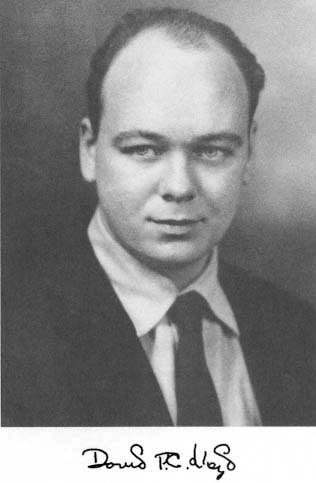
DAVID P. C. LLOYD
September 23, 1911-April 20, 1985
BY HARRY D. PATTON
ONE OF THE MOST EXCITING and fulfilling physiological accomplishments of this century has been the analysis of the spinal reflex system. This triumph has progressed through three major eras. The first, beginning late in the last century and extending into the first decades of this century, was the era of myographic analysis of reflexes; it emanated mainly from Sir Charles Sherrington's laboratory at Oxford and resulted in the award of the Nobel Prize to Sherrington (jointly with E. D. Adrian) in 1932. The final era extended through the 1950s and 1960s and was characterized by the use of micropipette electrodes to measure membrane potentials of motoneurons subjected to controlled afferent inputs. A refinement of this technique utilizes computerized averaging of membrane potential transients that permits one to assess the influence of single filter inputs. Many investigators engaged in this phase of the analysis but the major protagonist of the microelectrical technique was Sir John Eccles for which he received the 1963 Nobel award (with A. Hodgkin and A. F. Huxley). Sandwiched between these two eras was a fertile and productive period in which the fundamental technical approach involved the use of monosynaptically evoked ventral root discharges as measures of the numbers of reflexly discharged motoneurons
and the employment of conditioning testing procedures to assess subliminal synaptic influences. A number of investigators contributed to this phase of the analysis but its originator and major exponent was David P. C. Lloyd. While his contributions never received the acclaim of a Nobel award, it can scarcely be denied that his detailed functional mapping of the intricate reciprocal reflex patterns of the lumbar cord and his identification of the peripheral sources and central connections of afferent fibers of different sizes constituted a critically essential connecting link between the two eras and one without which the third era could not easily have been prosecuted. In fact it may be that the ''rules of the game" that Lloyd laid down were so clear and reasonable that subsequent investigators routinely employing them in designing experiments often took them for granted and forgot how dependent they were on his revelations.
Lloyd came by an academic career naturally. His father was a distinguished scientist and a professor at McGill University in Montreal. David was born in Auburn, Alabama, on September 23, 1911. The family, which later moved to Montreal, had Welsh forefathers and Lloyd delighted in pointing out that one of his names, Caradoc, was that of an early Welsh king. He was also particular to bequeath his children with multiple Welsh given names. A feature of his upbringing was a high degree of music appreciation, especially of grand opera. The senior Lloyds were devoted opera buffs who often took into their home visiting opera stars from whom young David, who was gifted with absolute pitch, learned many of the melodies and scores of major operas. In later years he delighted in accompanying himself on the piano and rendering with gusto and feeling his favorite Italian operatic arias. While his performance was perhaps not of a quality to challenge Pavarotti, his decibel output was impressive.
David attended McGill where he received a B.S. in 1932. He competed for, and was awarded, a Rhodes Scholarship which took him to Sir Charles Sherrington's laboratory, where he earned the D. Phil. degree in 1938 for studies on transmission through the inferior mesenteric ganglion. His sojourn at Oxford had a profound influence on Lloyd, not only educationally, but emotionally; he became a devoted anglophile, and years later after his retirement he returned to live in England. Upon acquiring his degree, Lloyd accepted a research position at the Banting Institute in Toronto. At about the same time, he married Kathleen Elliot, who received a medical degree from McGill, and they subsequently had three children: a daughter, Marion, and two sons, Owen and Evan.
In 1939 Lloyd joined the research group at the Rockefeller Institute for Medical Research (now Rockefeller University) under the aegis of Dr. Herbert Gasser, the director of the institute. At that time the institute was the mecca of electrophysiology of the nervous system. Gasser's own interests were mainly in peripheral nerves but he gathered together a group including Lloyd, Birdsey Renshaw, Harry Grundfest, Lorente de Nó, and others who were interested in using the institute's available electronic gear to explore the spinal cord. It is hard for the modern reader to realize that in 1939 the kind of equipment needed for electrophysiological research was not, as it is today, commercially available and was, indeed, rarely found even in major laboratories. Amplifiers, oscilloscopes, stimulators and other electronic gear had to be constructed, so the neurophysiologist needed to be something of an electronic engineer. Gasser imported to Rockefeller a gifted Dutch engineer, Jan Toennies, who designed and built most of the electronic equipment for the laboratories. The possession of such facilities gave Rockefeller a preeminent position over other research in-
stitutions equipped mainly with inductoria, smoked paper kymographs and other mechanical recording devices. Renshaw first began to record from the ventral root events elicited by dorsal root stimuli. In an ingenious adaptation of an earlier experiment of Lorente de Nó's on the oculomotor nucleus, he was able in 1946 to measure the synaptic delay at the spinal motorneurons as 0.5-0.9 msec. Having established this critical datum, he proved that the earliest ventral root discharge following a dorsal root volley must be monosynaptic, for its reduced central latency was too brief to allow more than one synaptic delay. The monosynaptic reflex provided a uniquely valuable experimental tool to study synaptic events, for it eliminated all concerns about the contributions of interneurons.
Lloyd was quick to realize the value of this tool and began a series of epochal experiments in which he determined the peripheral origin of the reflex to be the largest efferent fibers (20-12 mm), which innervate the primary endings of muscle spindles and proved that the monosynaptic ventral root discharge is destined exclusively for the fibers of the muscle from which the afferent volley arose. Conditioning-testing techniques established that the afferent volley facilitates but does not normally discharge the motoneurons supplying muscles that are synergists of the muscle from which the afferent volley arises and that it depresses the motoneurons supplying antagonistic muscles. This latter observation was a major step for it had hitherto been postulated (by no less a personage than Gasser) that central inhibition might be a consequence of postexcitatory depression of interneurons. Lloyd further found that the influence of the large afferent fibers underlying the reflex was strictly confined to motoneurons supplying muscles acting around a single joint. This highly focal, or private, reflex pattern was so closely similar to that of the stretch
reflex described by Sherrington that there could be little doubt that they were one and the same, a likelihood that Lloyd subsequently proved conclusively by showing that the central delay of the earliest ventral root discharge elicited by a brief muscle stretch was too short to allow for more that one synaptic delay. The afferent fibers smaller in diameter than 12 mm feed the much more diffuse multisynaptic reflex arcs, including the flexion and crossed extension reflex of Sherrington.
An important outcome of these studies was a classification of afferent nerve fibers of muscle nerves according to size and peripheral termination—a classification that was universally adopted and is still employed. Group I fibers are the largest elements of the nerve, measuring 21-12 mm in diameter; they are confined to muscle nerves and are of two functional types, a and b. Group Ia fibers innervate the annulospiral endings of muscle spindles and constitute the afferent limb of the monosynaptic stretch reflex as described above. Group Ib fibers innervate the Golgi tendon organs, and can be recognized by the fact that their discharge ceases when the muscle is made to contract, in contrast to the Group Ia fibers which characteristically respond to muscle contraction with increased discharge rates. Group Ib fibers make disynaptic connections that are inhibitory to their homonymous motoneurons (i.e., those innervating the muscle from which the afferent fibers come) and facilitate their motoneurons supplying antagonists, an arrangement that is just the reverse of Ia connectives. It was once thought that this inverse myostatic reflex is the clasp knife reflex, but more recent studies question this conclusion and the functional significance of the Ib-fed inverse reflex is unknown.
Group II afferent fibers are 12-6 mm in diameter; they make polysynaptic connections excitatory to ipsilateral flexor motoneurons and inhibitory to extensors motoneurons, the
pattern of the flexion reflex. Some of these clearly innervate the secondary ends of the muscle spindles, yet their functional significance remains unclear. Finally, the group III fibers 6-2 mm and the Group IV (unmyelinated or C) fibers make flexion reflex type of connections and presumably innervate deep pain receptors. The cutaneous fibers, the largest of which overlap in size the Group I fibers, make only polysynaptic connections, the smallest presumably being pain afferents that mediate the nocifensor reflex.
Although Lloyd made the segmental spinal reflexes his major target of investigation, he made an early study of the pyramidal tract and the effect of its discharge on segmental motoneuron excitability gauged by its affect on monosynaptic reflexes. To assure that only the pyramidal tract was being excited he devised a guillotine-like blade with a curved edge so flanged that when it was applied from the dorsum it severed the medulla completely except for the pyramids. Stimuli applied above such a section thus reached the cord only through the pyramids. Surprisingly, the Rockefeller Institute, although preeminent in electrophysiology, had no histological facilities, so Lloyd was compelled to check the completeness of his section by an ingenious, nonmicroscopic method. He inserted the transected brain stem in a bottle of ink which clearly stained the cut surfaces. The stained stump was then dried and the transection completed with a sharp knife neatly and cleanly exposing the unstained tracts that had been spared by the guillotine blade.
In 1943 Lloyd, concerned about the uninviting prospects of raising his two children in a New York City apartment, left the institute to accept a faculty position in John Fulton's department at Yale Medical School. In New Haven he settled his family in a large house on Whitney Avenue, a location better fitted for child rearing that a New York apartment. Yale, like most other physiology departments at this time,
had no electronic gear of the sort Lloyd required for his work. In the entire department there was one rather delapidated Dumont oscilloscope kept jealously locked in a cabinet. Lloyd brought with him to Yale a set of wiring diagrams of the Toennies electrophysiological rack and patiently set about the long and arduous task of building his own equipment, an occupation that along with his other duties kept him occupied for over a year. These were war years and John Fulton, an ardent supporter of the war effort, had installed in the department a large decompression chamber to be used in experiments relating to the physiological effects of high altitude. Lloyd participated in the operation of this chamber, which among other things was used to test equipment produced at Chance-Voight and to indoctrinate flyers in the use of oxygen equipment. This was all classified work conducted behind locked and guarded doors and produced no publication in the scientific press. During this time Lloyd also contributed several important chapters to Howell's Textbook of Physiology, which Fulton was revising.
In 1945 Lloyd left Yale to return to the institute after purchasing a house in Great Neck, a move that solved the problem of child rearing but incurred for him a long daily commutation to and from work. Almost immediately he produced two major publications, in one of which he sought to determine the time course of facilitation and inhibition using, in the first instance, a Group Ia conditioning and test volleys synergistic in nerve supplying muscle, and in the latter in nerves supplying antagonistic muscles. The facilitation curve was maximal at zero interval between conditioning and test volley and decayed exponentially with time constant of 4 msec. The curve for inhibition reached maximum depression at an interval of 0.5 msec between conditioning and test volleys, and thereafter decayed with a
4 msec time constant. In a second paper the interaction of various kinds of afferent valleys upon test motoneurons were elegantly and quantitatively displayed in a series of conditioning test curves that dramatically outline the interrelations of the spinal reflexes. Only one element is lacking from these—the Ib connections. These were later worked out in collaboration with La Porte and showed, as already mentioned, to be the reverse of those of the Ia fibers.
These two papers had one unfortunate consequence. Lloyd believed that the inhibitory connections, like the excitatory, were directly monosynaptic. The delay of 0.5 msec in the buildup of inhibition was unexplained, but he steadfastly refused to credit an internuncial relay because, as he pointed out, clearly measurable depression, although not maximal, occurred at intervals less than 0.5 msec. Later Eccles, on the basis of microelectrode studies, claimed the presence of an interneuron in the inhibitory pathway and explained the delay in the excitatory curve as the result of slight synchrony of the reflex discharge, so that some motoneurons are subject to depression at later times than others. Lloyd never accepted this interpretation and with Wilson conducted ingenious experiments on the motosynaptic reflexes of the sacral segments, innervating the tail muscles which he claimed were incompatible with interneuronal involvement in inhibition.
One further contribution that should be noted is his serendipitous discovery of the phenomenon of posttetanic potentiation. By chance turning the wrong dial on his stimulator he subjected an afferent trunk to a brief high frequency tetanus. Quickly correcting this error so that the stimulus returned to a moderate repetition rate of one per second, he watched with amazement as the evoked reflexes grew to overfill the scope face and for a matter of some minutes remained at supranormal size. This persistent po-
tentiation he explained as a consequence of a persistent hyperpolarization of the tetanized terminals leading to increased transmitter potential of the presynaptic spike. The phenomenon can be used to bring out responses to small afferent volleys that otherwise escape detection.
In the late 1950s, Lloyd deserted the spinal cord and began a series of investigations on the innervation of sweat glands, a subject that had long interested him. He made the interesting discovery that sweat extruded into the ducts of the sweat glands during sympathetic activation is rapidly reabsorbed during neural quiescence. He made a number of pharmacological observations demonstrating that, although the innervation of the sweat glands is cholingic, injected epinephrin is nevertheless excitatory.
His life by this time had altered. He had divorced his first wife, and remarried an English woman, Cynthia Maynell, whom he had known when he was a young Rhodes Scholar at Oxford years before. His anglophilia, always a burning passion, now became more pressing; he retired in 1970 and moved to England. Unfortunately, England in 1970 was not the England that had captured his heart as a young student in the 1930s, and he found existence in a small London village lonely and frustrating. Despite an honorary research fellowship at University College in London, he was isolated from all that had been for so long his life and interests. A welcome reprieve came in 1978 when Rockefeller University held a special symposium to honor Lloyd and his colleague Lorente de Nó, and presented them both with honorary degrees, a belated and wholly deserved recognition. A few years later, after the death of his wife in an automobile accident, he returned to the United States and lived in Carmel, California. There he died at age seventy-three, in April 1985.
David Lloyd's contributions to science were stellar. He
was a superb experimentalist and seemed to have the gift of figuratively turning to gold whatever he touched. He possessed a complex personality that featured surprising mixtures of pride, strong loyalties (as well as antipathies), and stubbornness; traits that were at once gifts and drawbacks. He could not bear the thought of being wrong and he insisted on excellence, precision, and neatness. Before giving a paper, he always carefully polished his slides for he had nothing but contempt for the unfastidious speaker who displayed slides adorned with finger prints. He was a generous friend to those who worked in his laboratory, and he contributed to the training and support of many, including Carlton Hunt, H. T. Chang, Elwood Henneman, Yves La Porte, A. K. McIntyre, and Victor Wilson.
BIBLIOGRAPHY
1937 The transmission of impulses through the inferior mesenteric ganglia. J. Physiol. 91:296-313.
1941 Activity in neurons of the bulbospinal correlation system. J. Neurophysiol . 4:115-34.
The spinal mechanism of the pyramidal system in cats. J. Neurophysiol . 4:525-546.
1942 Mediation of descending long spinal reflex activity. J. Neurophysiol . 5:435-58.
1943 Reflex action in relation to the pattern and peripheral source of afferent stimulation. J. Neurophysiol. 6:111-19.
Neuron patterns controlling the transmission of ipsilateral hind limb reflexes in cat. J. Neurophysiol. 6:293-315.
Conduction and synaptic transmission of the reflex response to stretch in spinal cats . J. Neurophysiol. 6:317-26.
1946 Facilitation and inhibition of spinal motoneurons. J. Neurophysiol . 9:421-38.
Integrative pattern of excitation and inhibition in two-neuron reflex arcs. J. Neurophysiol. 9:439-44.
1948 With H. T. Chang. Afferent fibers in muscle nerves. J. Neurophysiol . 11:199-207.
With A. K. McIntyre. Analysis of forelimb-hindlimb reflex activity in acutely decapitate cats. J. Neurophysiol. 11:455-70.
1949 With A. K. McIntyre. On the origins of dorsal root potentials. J. Gen. Physiol. 32:409-43.
Post-tetanic potentiation of response in monosynaptic reflex pathways of the spinal cord. J Gen. Physiol. 33:147-70.
1950 With A. K. McIntyre. Dorsal column conduction of Group I muscle afferent impulses and their relay through Clark's column. J. Neurophysiol. 13:39-54.
1951 After-currents, after-potentials, excitability, and ventral root electrotonus in spinal motoneurons. J. Gen. Physiol. 35:289-321.
1952 With Y. La Porte. Nature and significance of the reflex connections established by large afferent fibers of muscle origin. Am. J. Physiol . 169:609-21.
1953 Influence of asphyxia upon the responses of spinal motoneurons. J. Gen. Physiol. 36:673-702.
1955 With C. C. Hunt and A. K. McIntyre. Transmission in fractionated monosynaptic spinal reflex systems. J. Gen. Physiol. 38:307-17.
With A. K. McIntyre. Monosynaptic reflex responses of individual motoneurons. J. Gen. Physiol. 38:771-87.
With A. K. McIntyre. Transmitter potentiality of homonymous and heteronymous monosynaptic reflex connections of individual motoneurons. J. Gen. Physiol. 38.
1957 Temporal summation in rhythmically active monosynaptic reflex pathways. J. Gen. Physiol. 40:427-34.
Monosynaptic reflex response of individual motoneurons as a function of frequency. J. Gen. Physiol. 40:435-50.
Input-output relation in a flexor reflex. J. Gen. Physiol. 41:297-306.
On the question of reabsorption in sweat glands. Science 126:1233.
1959 Secretion and reabsorption in sweat glands. Proc. Natl. Acad. Sci. USA 45:405-9.
With V. J. Wilson. Functional organization in the terminal segments of the spinal cord with a consideration of central excitatory and inhibitory latencies in monosynaptic reflex systems. J. Gen. Physiol . 42:1219-31.


