
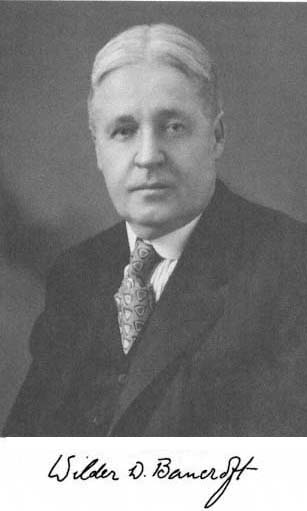
WILDER DWIGHT BANCROFT
October 1, 1867-February 7, 1953
BY JOHN W. SERVOS
WILDER DWIGHT BANCROFT, although little known today, was one of America's best-known physical chemists during the early twentieth century and among the founders of that specialty in the United States. A pupil of Wilhelm Ostwald and J. H. van't Hoff, Bancroft brought to America a firsthand knowledge of the "Ionists"' teachings about electrolytic dissociation, osmotic pressure, and electromotive force at a time when those teachings were still new and controversial. In America, he became an apostle for the study and application of the phase rule of J. Willard Gibbs and, later, an enthusiastic and sometimes erratic advocate of the study of colloid chemistry. At Cornell, where Bancroft taught from 1895 to 1937, he helped educate scores of chemists and took a leading role in founding the Journal of Physical Chemistry, the first English-language journal in its field. As its owner and editor from 1896 to 1933, Bancroft brought a sharp wit and shrewd judgment to bear on the work of his colleagues through hundreds of reviews and review articles. Although he earned enemies through his editorializing, even the victims of his criticism often found it impossible to resist his personal charm. He served two terms as president of the Electrochemical Society and, in 1910, he was elected president of the American Chemical Society.
For a chemist of his accomplishments, Bancroft viewed his career with surprising diffidence. At the twenty-fifth anniversary of his Harvard class Bancroft told former classmates that he "had worked hard" but had "much less to show for it than I expected"; as if a professorship at Cornell and the presidency of the American Chemical Society were gentlemen C's on the Bancroft scale. Entwined with this ambition, and sometimes frustrating it, were threads of iconoclasm and stubbornness. By the time he retired, much of the diffidence had turned to bitterness. "Owing to my lifelong habit of being a minority of one on all occasions,'' he wrote to his Harvard classmates in 1937, "my research work does not look convincing to most people. Since I have become avowedly a specialist in unorthodox ideas in the last decade the situation is getting worse, because now I irritate more people.''1
Both his high expectations and his taste for the unorthodox were traits long present among Bancrofts. Aaron Bancroft, Wilder Bancroft's great-grandfather and the author of a popular life of George Washington, threw over the rigid Calvinism of his youth to become a leader in the Unitarian movement during the early nineteenth century. Wilder Bancroft's grandfather was George Bancroft, the diplomat and cabinet member who is best remembered today for his magisterial history of the United States. Whereas Aaron Bancroft had renounced New England's established theology, George renounced its established political traditions. Surrounded by Whigs, he joined the Democratic party of Jackson and Van Buren and rose to prominence in its national councils. While holding a succession of responsible positions in government and pursuing his passion for history, Aaron Bancroft made a tidy fortune through an advantageous marriage and shrewd investments. Wilder Bancroft's personality and career are best understood in
the light of these forebears. Like his great-grandfather and grandfather, he was adept with the pen; like them, he believed learning was linked to action—that a scholar could and should mix in the world of practical affairs; and like them, he took pride in playing the role of dissenter in an established community.2
Of Wilder Bancroft's father, John Chandler Bancroft, much less can be said. Lacking the discipline and talents of Aaron or George, he compiled a poor record at Harvard and failed in a succession of pursuits, legal, artistic, and commercial. Unable to succeed on his own, John spent much of his adult life in the orbit of his famous father, depending upon him for money and eventually for shelter. John's first wife, Louisa Mills Denny, died when their son, Wilder, was four; subsequently Wilder spent much time in his grandfather's households in Newport and Washington. Although aging, George Bancroft was still vigorous, addicted to writing and horseback riding, and welcome in the homes of the nation's rich and powerful. Chester Arthur is said to have remarked that the President is "permitted to accept the invitations of members of his cabinet, Supreme Court judges and—Mr. George Bancroft."3 The bright youngster could not have ignored the contrast between his grandfather's power, wealth, and fame and his father's failures and dependence. Nor could he have missed the lesson that vigorous effort and independence of mind would reap rewards.
Following what was by then family custom, Wilder attended Harvard after completing preparatory studies at the Roxbury Latin School and the Milton Academy. Entering in 1884, he compiled a record that was better than mediocre, although not brilliant. Football, a sport in which Bancroft was sufficiently adept to win a place on the Harvard eleven, competed with books for his attention. Harvard's controversial elective system permitted Bancroft to concentrate
heavily in the sciences, and this he did. His program was consistent with a major in either physics or chemistry until his senior year, when, by taking three electives, he met the requirements for a degree in chemistry. After his graduation in 1888, Bancroft stayed at Cambridge for an extra year, having been invited to serve as a laboratory assistant.4
Little evidence exists to explain Bancroft's interest in science or his choice of chemistry as a career, although his grandfather may have encouraged such thoughts. George Bancroft had written his undergraduate thesis on astronomy and had done graduate work at Göttingen in oriental languages and philology, fields that were considered no less scientific than chemistry. During his years in Europe he had relished the company of Alexander von Humboldt, Charles Babbage, Charles Lyell, August Wilhelm von Hofmann, and many other luminaries of European science. As a private citizen in Washington, his dinner companions included the neurologist S. Weir Mitchell and others prominent in American scientific circles.
The models available to Wilder Bancroft at Harvard must have been no less influential. Prominent among these was a chemist under whom Bancroft did much of his course work: Josiah Parsons Cooke. A wealthy gentleman of distinguished family who spent summers near the Bancrofts in Newport, Cooke's fame was sufficient to draw talented young men like Theodore William Richards to Harvard. Joining the faculty in the 1850s under the worst possible conditions—his incompetent predecessor had been hanged for murdering a colleague—Cooke had built a place for chemistry in the Harvard curriculum. His success owed in part to his introduction of laboratory practice into his courses, but, in part as well, to his skill in describing the moral and cultural rewards of chemical study. "Success in the observation of phenomena," he wrote, "implies . . . quickness and sharp-
ness of perception, accuracy in details, and truthfulness; and on its power to cultivate these qualities a large part of the value of science, as a means of education, depends .... Slovenly work means slovenly results, and habits of carefulness, neatness, and order produce as excellent fruits in the laboratory as in the home."5 Nor did the study of chemistry simply foster the development of socially desirable traits; it also afforded striking evidence of the existence of a beneficent God. "Illustrations of the Divine attributes," Cooke wrote, "lie all around us, in the air we breathe, in the water we drink, and in the coal we burn.'' Like his colleague, Louis Agassiz, Cooke believed that "the laws of nature are the thoughts of God . . . the most direct evidence possible of Infinite wisdom."6
Colleagues acquainted with his unfortunate predecessor must have found this new chemist's sincere expressions of piety reassuring. Students like Wilder discovered in Cooke an example of how secular scholarship might be integrated comfortably into what was still largely a religious culture. Cooke, like George Bancroft, had one foot planted in the patrician world of old New England, where learning was linked with piety, where scholarship was undifferentiated, and where educators were dedicated to molding character, and the other in a new world where the traditional virtues were valued for their contributions to secular success, where knowledge was specialized, and where teachers transmitted expertise.
Cooke's special interest in chemistry was a field he called chemical physics, meaning by that simply those portions of physics "which are more closely connected with Chemistry than the rest."7 In practice, this meant the study of the relation between the physical properties and chemical constitution of substances, the action of heat on matter, and methods of measuring the weight and volume of bodies—
topics that also engaged the attention of Cooke's European contemporaries, Regnault, Kopp, Bunsen, and Landolt. Cooke bequeathed these interests to his student and successor, Theodore William Richards, who took his Ph.D. at Harvard in the same year that Bancroft completed his undergraduate studies. He also may have planted seeds in Bancroft; after studying organic chemistry for two years under C. Loring Jackson at Harvard and under Rudolph Fittig at Strassburg, Bancroft entered Wilhelm Ostwald's institute at Leipzig.
Bancroft arrived at Leipzig in 1890; his timing was impeccable. Under Ostwald's energetic leadership, Leipzig had vaulted into a position of leadership in the study of physical chemistry. Surrounded by assistants such as Walther Nernst, Ernst Otto Beckmann, and able students from a half-dozen countries, Ostwald was prosecuting research on electrochemistry and thermochemistry, editing the Zeitschrift für physikalische Chemie , translating the papers of J. Willard Gibbs, writing textbooks, and lecturing to all who would listen about the achievements and prospects for his new field. Others, notably J. H. van't Hoff, Svante Arrhenius, and Gibbs, had developed the intellectual foundations of physical chemistry, but Ostwald supplied the voice, pen, and personality that made this specialty the molecular biology of its day. Bancroft spent two years at the center of this maelstrom. After successfully defending a doctoral thesis on oxidation and reduction cells, Bancroft made a leisurely pilgrimage to scientific shrines. His first stop was Berlin, where he spent the autumn of 1892 attending the lectures of the feeble but legendary Helmholtz. Then he moved on to Amsterdam where he worked in van't Hoff's laboratory on the chemical potential of metals and developed a strong and enduring affection for the Dutchman.
After completing this tour of Europe, Bancroft returned to Cambridge where he served for two years as a laboratory
assistant and instructor. It must have been an uncomfortable position. Josiah Parsons Cooke was in failing health, and it was clear that the college would soon need someone to assume responsibility for Cooke's courses. Bancroft had fine credentials, but so did T. W. Richards, who had stayed one rung above Bancroft since both arrived at Harvard in the mid-1880s. When Bancroft had taken his A.B., Richards had taken a Ph.D.; while Bancroft worked as a laboratory assistant, Richards had done postdoctoral work in European laboratories; while Bancroft was in Europe, Richards was teaching at Harvard; now Richards was an assistant professor and Bancroft an instructor. Shortly after Cooke died in 1894, the Corporation of the University voted Richards a leave of absence to spend a year with Ostwald and Nernst, thereby anointing him as Cooke's successor.8 A few months later Bancroft accepted an offer of an assistant professorship at Cornell.
The chemistry department that Bancroft joined at Cornell was hardly yet a research center to compare with Leipzig or even Harvard, but it was beginning to show promise. As at many American universities, growth in enrollments at Cornell was driving an expansion of facilities and faculty. A new chemical laboratory had been built in 1890 and a staff of able young instructors, many of them "made in Germany," was being assembled. Bancroft was not the first physical chemist on the faculty; another of Ostwald's students, Joseph E. Trevor, had been hired in 1892 to assist in teaching elementary chemistry and to start elective courses in physical chemistry. But Trevor's severe and demanding style had intimidated students. Bancroft, by contrast, proved a far more effective "draw." Well-bred, physically imposing, possessed of a lively mind and a keen wit, Bancroft personified many of the ideals of the gentleman-scholar. Undergraduates responded to his irreverence, and graduate students
were attracted by his encyclopedic command of the chemical literature, his intellectual generosity, and his insistence that neither mathematical acumen nor experimental diligence could substitute for clear and independent thought. By 1900, Bancroft had helped make Cornell an important American center for graduate study in physical chemistry.
Bancroft's forceful personality and strong opinions were also a source of controversy. A former student described him as "a wild man on committees. One time . . . on a Ph.D. examination, he asked some student what there was in water that put out fire? . . . the poor guy was completely flabbergasted, and Bancroft said, 'It's easy, there are fireboats.' "9 Even friends acknowledged that Bancroft's judgment could be uneven. Critics found his celebration of independent thought a substitute for rigor, his skepticism about mathematics and his distaste for exact measurements signs of sloth, and his biting wit a source of unnecessary conflict. Yet despite criticism from within and outside his department, Bancroft rose through the academic ranks with a speed that was unusual at the turn of the century; by 1903 he was a full professor.
The key both to Bancroft's position at Cornell and to his growing reputation outside Ithaca was the Journal of Physical Chemistry. Following its first appearance in October 1896, the Journal was published monthly at Ithaca throughout the academic year. Although Joseph Trevor served for a few years as co-editor, Bancroft was the senior editor from the outset. It was Bancroft who promoted the Journal by means of letters to physical chemists around the country, who worked hardest to fill its early issues with articles and reviews, and who paid the difference between the cost of publication and income from subscriptions.
Close to home, Bancroft's enterprise strengthened his standing with Cornell's president, Jacob Gould Schurman.
Ambitious to see Cornell become a center for scholarship and graduate study, he strongly encouraged professors to be active in their disciplines. One method to assert leadership in a discipline, a method much favored at Cornell, was to establish and edit scholarly journals. Schurman had himself founded the Philosophical Review in 1892, the year he was inaugurated president of Cornell; later he encouraged members of the engineering faculty to set up the Sibley Journal of Engineering and members of the Physics Department to organize the Physical Review. Journals had brought prestige to Liebig and Giessen and to Remsen and Johns Hopkins. Why not Cornell? Bancroft, who had greater facility with the pen than most chemists and rather less skill in the laboratory than many, took to the idea of editing a journal with enthusiasm.
Nationalistic sentiment also played a part in the creation of the Journal of Physical Chemistry. At the turn of the century, chemists, like other American scientists, were beginning to feel restless under the scientific hegemony of Germany. The grievances were many: the need for American students to learn German; the patronizing tone of some German scientists; the delays in obtaining imported glassware, fine chemicals, and equipment; and the slights Americans felt when their work was ignored or needlessly duplicated abroad. "[M]any of our German friends are apparently of the opinion that unless work has been done in Germany it has not been done," lamented one prominent electrochemist.10 The grandson of a historian who celebrated America's independence from Europe and the great-grandson of a biographer of George Washington, Bancroft was eager to see America attain scientific parity with Germany. If American scientists were to improve their international standing, Bancroft believed that they would have to emulate the German example by concentrating their best work
in a few good disciplinary journals, thereby compelling Europeans to take notice of American work and, at the same time, quickening the pace of research in the United States.
The new journal reflected favorably on Bancroft and was born amid hopes that it would become the alternative to publishing in Germany for American physical chemists, but its most important function was as a medium for a viewpoint. From its inception, the Journal of Physical Chemistry gave expression to the independent, even idiosyncratic, conception of physical chemistry that Bancroft was developing in his courses and writings.
For Bancroft, physical chemistry was at the core of chemistry, a science which itself was central to all other sciences and technologies. Physical chemists investigated and ordered the laws governing chemical change; they were, in Bancroft's view, those chemists who aimed "to present the science of chemistry as a clear and complete whole."11 Much taken with Ostwald's rhetoric about founding a new science of allgemeine Chemie that would unify the various branches of chemistry, Bancroft saw his lineage as a chemist stretching back through Ostwald to the great generalists of the early nineteenth century. In a review of Mitscherlich's collected works, he asked where the spirit of Mitscherlich still dwelled: "Not among the inorganic chemists for they know little of organic chemistry; not among the organic chemists for they care less for inorganic chemistry. It is only the physical chemist who is of necessity interested in the whole field and he is the legitimate successor of Berzelius, Mitscherlich, Gay-Lussac, Dumas, Liebig, Davy, and Faraday."12 By making the laws governing the direction and yield of chemical reactions their concern, physical chemists transcended the traditional division between organic and inorganic chemistry. Physical chemists did not define their subject according to the nature of the substances under consideration. They
made a specialty of generalizations applicable to all branches of chemistry.
As Bancroft saw it, physical chemistry's central role in chemistry and chemistry's central position among the sciences gave practitioners of his young specialty special opportunities and responsibilities. Many of the problems and phenomena of geology, biology, and industry were known to be related, although the structure of science and scientific institutions often seemed to obscure those relations. Physical chemists, by defining themselves as students of change rather than as masters of some particular form of matter, could appreciate similitudes and affinities lost upon those with narrower training and ambitions. Their knowledge gave them license to act as intellectual brokers—middlemen who might prosper by matching techniques to problems, regardless of traditional patterns of interaction among the sciences. In Bancroft's view, wherever matter underwent alteration, whether in the interior of the earth or in stars, in human bodies or in industrial vessels, the physical chemist could both learn and teach.13
Before physical chemists could meet their duties as generalists, Bancroft believed they would have to find a rational system for organizing their subject. Entering the field at a time when it was expanding rapidly, Bancroft felt need of a structure into which might be fit that which was known and that which was yet to be learned. "There has been so much work done in physical chemistry during the last ten years," wrote Bancroft in 1897, "that the mass of accumulated material is now too large to be remembered as miscellaneous facts. It becomes comparatively easy to survey the whole field if we consider the phenomena as examples illustrating a few general principles."14
The classificatory scheme on which Bancroft settled first divided physical chemistry according to whether the ideas
and treatments involved were primarily mathematical or nonmathematical in nature.15 To the mathematical side of physical chemistry belonged the formal structure of chemical thermodynamics—the austere work of those who, like Gibbs, Planck, Duhem, and Trevor, could as easily be called physicists as chemists. To the non-mathematical side belonged the work of investigators who, like van't Hoff, Arrhenius, Ostwald, and Nernst, adopted a more empirical approach. These workers might draw upon the mathematical tradition and occasionally contribute to it, but they were experimentalists as well as theoreticians and chemists rather than physicists.
After distinguishing between the mathematical and nonmathematical sides of physical chemistry, Bancroft further subdivided the non-mathematical branch, distinguishing between quantitative and qualitative work. On the quantitative side stood research involving the law of mass action and the principles of thermochemistry, electrochemistry, and reaction kinetics; in other words, the sort of work for which Bancroft's teachers and colleagues were best known. Just as a railroad timetable provides information about the number of trains traveling a route on a given day and their destinations, so these principles provided precise information about the amounts of materials participating in a reaction and the end point of the reaction under specified conditions. By contrast, Bancroft also envisioned a qualitative physical chemistry that would resemble not a timetable but rather a map showing the location of railroad tracks. ''If one knows where the railroad tracks are one can predict with absolute accuracy where the trains will run"; likewise, Bancroft suggested, there were means by which the physical chemist could determine the constraints under which a physico-chemical system existed and the directions in which equilibria would be displaced when subject to changes in
physical conditions.16 As Bancroft saw it, the theorem of Le Châtelier and the phase rule of Gibbs constituted the basis for such a qualitative understanding of chemical processes.
Le Châtelier's theorem, really more a rule-of-thumb, predicts that whenever an equilibrium is disturbed by an external event, there ensues a readjustment in the system so as to relieve the strain. First enunciated by Le Châtelier in 1884, the theorem had purely historical interest to most of Bancroft's colleagues, concerned as they were with obtaining a quantitative and precise understanding of equilibria. Bancroft, however, viewed the qualitativeness of Le Châtelier's principle as an advantage rather than a liability. He saw in it an exceedingly practical method of quickly and simply determining the direction in which equilibria will shift when subject to changes in condition; more precise methods, entailing the application of the law of mass action, the equation of the reaction isochore, or the equation of the reaction isotherm, demanded laborious measurements and calculations and were generally accurate only for very dilute solutions. Although Le Châtelier's theorem yielded qualitative rather than quantitative information, this, Bancroft argued, was frequently sufficient for petrologists, engineers, or industrial chemists.
The phase rule, of course, affords users a subtle but powerful tool for inferring information about the number of components in a system and their mutual relations from such physical data as freezing points or boiling points. Like much of Gibbs's work, the phase rule was largely ignored following its publication. Tucked away in the middle of a long, abstract article that was published in an obscure American journal, it might have suffered the same fate as Mendel's principles and been overlooked for decades had not Gibbs sent reprints of his paper to scores of Europe's leading physicists and chemists. Even so, only one chemist who re-
ceived such a reprint appears to have read the paper with any understanding, and he needed "a translation of the paper into ordinary language" by Clerk Maxwell before recognizing its merit.17 A small circle of French chemists, many of them with strong backgrounds in physics and mathematics, also discovered Gibbs's work in the early 1880s. But the phase rule did not begin to attract serious and widespread attention from chemists until the mid-1880s, when H. W. Bakhuis Roozeboom and Ostwald independently learned of it.
Roozeboom, a Dutch chemist at the University of Leiden, was studying the hydrates of sulphur dioxide when, in 1886, the professor of physics at Leiden, van der Waals, called his attention to Gibbs's work. About the same time, Ostwald was told of Gibbs by his colleague and former teacher of physics at Dorpat, A. Oetingen. Gibbs had sent both physicists reprints of his work. Within a year, Ostwald had begun to incorporate elements of Gibbs's thinking into his massive textbook of physical chemistry. Roozeboom, even more enthusiastic, had quickly published a paper arranging all known dissociation equilibria on the basis of the number of components and phases.18
By the time Bancroft went to Europe, Ostwald was preparing a German translation of Gibbs's papers, van't Hoff was beginning to study the formation of "solid solutions," and Roozeboom was beginning to use graphical methods to depict temperature-pressure-concentration relations in heterogeneous systems. Bancroft no doubt learned of the phase rule while studying at Leipzig; he could not have spent the spring of 1893 in Holland, fast becoming a hotbed of interest in the phase rule, without becoming reacquainted with it. Initially the phase rule made no great impression on the young American. His research at Leipzig had dealt with Nernst's theory of electromotive force, a topic that seemed
to have little relation to Gibbs's work on heterogeneous equilibrium. As he wrote ten years later, ''I can remember the time when I thought that people made a good deal of unnecessary fuss over the phase rule. It seemed to me an interesting mathematical relation but nothing more."19
After returning to the United States, however, Bancroft's research interests and his opinion of the phase rule gradually changed. In a series of papers published while he was at Harvard, Bancroft studied solubility relations in ternary systems, those, for example, composed of two non-miscible liquids and a salt dissolved in both, or of two non-miscible liquids and a liquid miscible in both. Although notable for introducing the word "solute," these papers were, in other respects, dismal failures.20 Convinced that such heterogeneous physical equilibria could be treated by expressions similar to those derived from the law of mass action for homogeneous chemical equilibria, Bancroft had fit his data to equations with up to four arbitrary constants. After several harsh rebukes, Bancroft abandoned his effort to give such systems precise, quantitative treatment and instead began to view them in the context of Gibbs's phase rule.
Shortly after moving to Cornell, this interest found expression in his monograph, The Phase Rule, an extended study not so much of the phase rule itself as of its uses in the classification and analysis of various classes of heterogeneous equilibria. Published in 1897, Bancroft's book was among the earliest works to offer an extended treatment of these applications of the phase rule and served an important role in introducing American chemists to the significance of the work of their countryman, Gibbs. Building upon this work, Bancroft continued to explore the rule and its applications in articles and reviews, making himself the leading American authority on heterogeneous equilibria. Together with his students, notably Charles A. Soch, E. S.
Shepherd, G. B. Upton, B. E. Curry, and F. E. Gallagher, Bancroft explored the equilibrium conditions of a variety of heterogeneous systems that posed knotty puzzles for physical chemists: dynamic isomerides, binary liquid mixtures, two component systems capable of forming compounds, and a variety of three-component systems. His work on the phase diagrams of brass and alloys of aluminum was supported from 1902 to 1911 by the Carnegie Institution of Washington and constituted some of the earliest work done on the behavior of alloys by physical chemists in the United States.
Bancroft's explorations of the uses of the phase rule in the interpretation of experimental data earned him the respect of his colleagues. But Bancroft was not content to see the phase rule acknowledged as a useful auxiliary in the study of equilibria; it should also, he insisted in his monthly reviews and articles, become the cornerstone of research and education in physical chemistry. While promoting the study of the phase rule, Bancroft also launched assaults on other physical chemists for what he took to be their narrow-minded and exclusive concern with dilute solutions. "The majority of the papers on physical chemistry published every year," he wrote in 1899,
deal with so-called dilute solutions, solutions containing less than two per cent of one of the components. Practically all of our quantitative theory of solutions fails to apply to ninety six per cent and over of the possible field. We have accomplished a great deal inside the narrow limits we have set ourselves, but it is obvious that we are handicapped seriously in the application of physical chemistry to technical chemistry so long as we discuss quantitatively only such solutions as do not occur in technical work. Quite apart from the technical bearing, we can never obtain for physical chemistry its proper title as the science of chemistry until we can say that we do cover the whole field. . . . the ideal training in physical chemistry cannot be obtained until we have broken away from the shackles of "ideal" solutions.21
Bancroft regarded those hypotheses which described the
larger number of facts as being the more useful, and, in his estimation, this meant that the phase rule was of much greater significance than the collection of hypotheses that went under the name of solution theory. Whereas the theory of solution was rife with exceptions and adequately described only those solutions approaching infinite dilution—"slightly polluted water" was Bancroft's pungent phrase—the phase rule was perfectly general. "The beauty of the phase rule is that, though qualitative, it is absolute and applies to every case of equilibrium. . . . It is therefore the framework on which everything must rest."22
Bancroft's enthusiasm for the phase rule dimmed only slightly in later years; his skepticism about the study of dilute solutions, and chemists who studied them, altered not at all. Ironically, when G. N. Lewis and A. A. Noyes developed the concept of activity to extend the range of applicability of the equations of chemical thermodynamics from ideal to real solutions, Bancroft could only see mathematical juggling—a desperate attempt to make experimental data conform to theoretical predictions. Lewis and Mary Baker Eddy, he wrote, were "the Gold Dust Twins of Christian and Physical Science. Mrs. Eddy eliminates sickness but admits error. Lewis admits sickness but eliminates error."23 Friendly colleagues viewed Bancroft's passion for the phase rule as an eccentric but harmless enthusiasm; some members of the "dilute school" understandably saw it as reckless and irrational. A. A. Noyes, it is said, refused to allow the library of Caltech's Gates Chemical Laboratory to subscribe to Bancroft's journal.24
Although Bancroft's identification with the phase rule was so strong as to lead some of his students to nickname him "The Phase Ruler," Bancroft's concern with making knowledge useful found other avenues for expression. He and his students conducted numerous studies of such im-
portant problems in electrochemistry as overvoltage and the electrodeposition of metals. Just before World War I, George J. Sargent made signal improvements in the process for plating iron with chromium while working in Bancroft's laboratory, although without attaining a consistency of deposition necessary for commercialization. During World War I, Bancroft served as head of the editorial section of the Chemical Warfare Service with the rank of lieutenant colonel. In addition to editing monographs on the preparation and properties of poison gases, he prepared a history of the Chemical Warfare Service. After the war, as chairman of the Division of Chemistry of the National Research Council, Bancroft wrote a report outlining opportunities in chemical research, especially in industrial chemistry. His frequent review articles in the Journal of Physical Chemistry covered topics as diverse as the chemistry of photographic plates, the theory of dyeing, the aging of paints and pigments, and contact catalysis. Just before the war, however, Bancroft commenced work on a new topic that would occupy a central role in his research and writing for the remainder of his career: colloid chemistry.
Colloid chemistry was nothing new. Its roots went back well into the nineteenth century. The term "colloid" was itself coined in 1861 by the British chemist Thomas Graham to describe substances which would not pass readily with a solvent through a parchment membrane that was permeable to salt solutions. When isolated, these substances (gelatin, albumin, and a variety of other materials both organic and inorganic) did not appear as crystals but rather had an amorphous form—hence the name colloid, meaning "glue-like." Although practically inert to chemical reaction, colloids were easily displaced from solution by electrolytes. They also appeared to have molecular weights much higher than ordinary molecules, leading Graham and oth-
ers to suppose that they might be combinations of smaller molecules. Whether these complexes were held together by valence bonds or by mechanical means was an open question.25 During the next four decades, the colloidal state and substances which could enter it received sporadic attention from a variety of biochemists, physical chemists, and physicists. This work resulted in a great deal of empirical data, a proliferation of special terms, and some valuable generalizations. But until the turn of the century, colloids remained an esoteric topic, typically treated in footnotes rather than textbooks. This attitude began to change, however, during the decade or so preceding the World War.
The new interest in this old subject had several sources. In part it owed to advances in technique. New filtration methods, for example, facilitated the isolation of colloidal particles of uniform size; improvements in methods of measuring osmotic pressure and freezing-point depression afforded more reliable means of measuring molecular weights; and with the invention of the ultramicroscope in 1903, it even became possible to watch colloidal particles dancing in solution. Important, too, was the growth of biochemistry and industrial chemistry, which provided an ever-larger number of scientists with opportunity and motive to study colloidal systems. Industry already produced scores of such colloidal products as paints and resins, and was eager to produce others, such as artificial rubber. Many biological substances were also of colloidal dimensions, too small to be observed under an ordinary microscope and too large to diffuse easily across organic membranes. Since Graham's day there had been chemists who suspected that the peculiar properties of living matter might find a basis in the chemistry and physics of colloids. During the years around the turn of the century, a growing number of chemically minded biologists and biochemists, impressed by similari-
ties between the in vitro behavior of colloidal systems and the in vivo behavior of protoplasmic constituents, came to agree with them.26 By the eve of World War I, the ingredients were present for an explosion of interest in colloids, much as had happened in the case of the chemistry of solutions thirty years earlier.
Wilder D. Bancroft was among the first American physical chemists to develop an interest in colloids. By 1910 he was advising students that colloidal phenomena might prove important in the study of biological problems; soon thereafter he began systematic study of the literature on emulsification in connection with work on the chemistry of the photographic plate. This flirtation with colloid chemistry became an engagement during the winter of 1915-16, when a fire destroyed his apparatus and very nearly consumed the entire chemical laboratory. Until the new Baker Chemical Laboratory was completed in 1923, Bancroft and his students had to work "in the patched-up ruins of a building of which the whole top story had been burned off . . . . [O]ur equipment," he wrote, "consisted chiefly of an inadequate supply of burettes and beakers. That meant that we had to do colloid chemistry whether we wanted to or not."27
"This was very likely a blessing in disguise," Bancroft added, and not without reason. His laboratory's research on alloys had made little progress after Carnegie funds were cut off in 1912, and subsequent work on electrochemical and photochemical problems had led to few concrete results. In all of these areas, other laboratories, better equipped and led by scientists with stronger credentials in physics and mathematics, had seized leadership. In colloid chemistry, however, Bancroft found a field that seemed well-suited to his interests and talents. It was, for one thing, a subject of great and growing practical significance. Bancroft described it as "the chemistry of everyday life," since it dealt
with matter in the form of bubbles, drops, grains, filaments, and films.28 A knowledge of colloid chemistry was essential, Bancroft thought, to understanding the behavior of such disparate substances as cement, oils, paints, plastics, inks, wine, dairy products, smoke, and fog, since all consisted of matter in a finely divided state. Secondly, since intensive study of the chemistry of colloids was just beginning, the subject was at a stage of development, in Bancroft's view, when mathematical ingenuity was not essential; it could benefit, he believed, from treatment with broad, qualitative strokes. Bancroft, in other words, was drawn to colloid chemistry for very much the same reasons he had been attracted to the phase rule two decades earlier.
After his service in the Chemical Warfare Service, Bancroft attempted to consolidate a position of leadership among American colloid chemists. Drawing on knowledge of the industrial uses of colloids that he had acquired during the war, Bancroft published a textbook in which he emphasized the abundant practical uses to which an understanding of colloids could be put. Relying on a few thermodynamic principles and eschewing all but the most elementary mathematics, the book was intended, Bancroft wrote, for "those who are interested in colloid chemistry as chemistry rather than mathematical physics." In addition to writing this textbook, which won sufficient readers to go through three editions, Bancroft also turned over more and more of his Journal to articles in the field. By the mid-1920s nearly half of each volume of the Journal of Physical Chemistry dealt with colloids. He also initiated an undergraduate lecture course on colloid chemistry at Cornell and repeatedly sought funds for an Institute of Colloid Chemistry to study phenomena fundamental to those industries whose processes or products involved colloidal solutions. Although this institute remained a dream, Bancroft and his students did conduct a
series of studies on the preparation and properties of emulsions, on the theory of emulsification, and on the role of colloids in biological processes.29
Bancroft gained a following among colloid chemists in the 1920s not only because of his textbook, his editorial work, and his own contributions to the literature, but also because he championed a point of view—what has been called the ''isolationist" position among colloid chemists.30 For Bancroft the chemistry of colloids was essentially distinct from the chemistry of ordinary molecules. This is best exemplified by his treatment of proteins, substances which, according to Bancroft, were colloidal aggregates—complexes of many smaller molecules—and not chemical compounds. These aggregates, according to Bancroft, did not behave at all like molecules of definite proportions. For one thing, they did not form salts. So, for example, when a protein such as wool was colored with a dye or acquired a positive charge through exposure to an acid, it did not participate in a chemical reaction, but rather in an adsorption. The dye or hydrogen ion was bound to the surface of the protein by electrostatic forces, forces of physical cohesion, or by residual chemical affinities rather than by valence bonds. The result was not a new chemical compound of definite proportions, but a new and larger colloidal aggregate whose properties were modified by the adhesion of additional molecules or ions to its surface. The model he applied to these processes, in other words, was not that of the chemical reaction but rather that of the essentially physical binding of gases to activated charcoal.31 Nor did Bancroft believe that proteins were capable of entering the state of solution. In water, particles of protein remained suspended because they were constantly agitated by collisions with the far smaller molecules of the solvent, but unlike true solutions these suspensions consisted of two phases rather than
one. The particles were visible under the ultramicroscope and were separable from the solvent by mechanical means such as dialysis or ultrafiltration. By definition, Bancroft insisted, such heterogeneous mixtures did not obey the laws of true solution.32
By no means did all students of colloids share Bancroft's isolationism. In Zürich, the organic chemist Hermann Staudinger argued forcefully for a unionist position; many colloidal particles, he insisted, were nothing more than giant molecules which could be synthesized by classical methods from simpler units. In Paris, the dean of French physical chemists, Jean Perrin, believed that he had proved that dilute colloidal solutions obeyed the laws of solution, as did The Svedberg in Uppsala. And no less a physicist than Albert Einstein had reached the same conclusion by theoretical reasoning.33
Closer to home, Albert P. Mathews, former head of the Physiology Department at the University of Chicago and professor of biochemistry at the Medical College of Cincinnati, roundly condemned Bancroft for confusing descriptive and explanatory terms. "Adsorption," Mathews wrote, "is a name descriptive of a physical (or chemical) phenomenon. It says . . . nothing as to the cause or causes which produce the phenomenon described by it."34 Bancroft, by treating practically all processes in which colloids participated as adsorptions and their products as adsorption complexes, simply confessed his own ignorance and confused his readers:
The exact mechanism of this surface condensation or adsorption is not yet clear. The fact that the energy relations are satisfied gives us no picture at all of the mechanism of the process, and before we really understand it we must have such a picture.35
In fact, Mathews asserted, such a picture was beginning to emerge in the form of evidence that suggested that pro-
teins were nothing more than larger versions of the definite chemical compounds of organic chemistry. Containing both free amino and carboxyl groups, they were capable of forming salts with both acids and bases. The protein did not physically adsorb dyes or hydrogen ions, as Bancroft suggested, but rather reacted with them to form compounds. Even if a protein could not be isolated as a definite chemical species, "it leads only to confusion to treat it as if it were a compound of some other nature," for in that case, "the extreme specificity of the reactions, the clear cut substitutions of one base or acid for another, pointing clearly to a chemical union, remain wholly unexplained. . . . [T]he whole subject [colloid chemistry] at the present time," Mathews concluded, "is a perfect morass and those who wander in this field with physical adsorption for their lantern climb out of one mud hole only to fall into another."36
Beset on all sides by critics, Bancroft gave little ground. His stubborn refusal to accept the growing evidence that proteins were simply very large molecules eroded his standing among colleagues and tarnished the reputation of his journal. Even more damaging, however, was Bancroft's inflexible response to other changes taking place in his science. Never at ease with mathematics or the physics of the twentieth century, Bancroft fought a prolonged rear-guard action against those whom he believed would make physical chemistry a department of physics. His attitude was reflected in the Journal of Physical Chemistry. During the 1920s its pages only hinted at the enormous progress being made in the study of the free energies and entropies of chemical reactions or in the understanding of the chemistry of dilute solutions. Nearly absent were articles on the problem of valence, on the use of X-ray diffraction techniques, and on the applications of quantum mechanics to the problem
of molecular structure. A reader of Bancroft's journal could hardly discern in its pages evidence of the revolutionary changes in physical chemistry then under way.
Unsurprisingly, Bancroft faced constant difficulties in keeping the Journal of Physical Chemistry afloat during the 1920s. Unwilling to consider a merger with the Journal of the American Chemical Society that would strip him of his editorial control and unable to meet growing deficits from his own pocket, Bancroft successfully petitioned the Chemical Foundation for support. Created to administer the income from German patents seized during World War I, the Chemical Foundation was run by a New York attorney, Francis P. Garvan, who shared with Bancroft an intense fear that Germany would recapture supremacy in chemical science and industry. Subsidies to the Journal of Physical Chemistry, begun in 1921, were part of Garvan's effort to forestall the reestablishment of German hegemony in chemical publications. Yet as the Chemical Foundation's income dwindled during the late 1920s and as the deficits of the Journal of Physical Chemistry increased, Garvan and his associates became increasingly disenchanted with their commitment to Bancroft.
By the end of 1929, Bancroft was growing desperate to achieve a spectacular coup—a scientific success that would at once vindicate his commitment to colloid chemistry and capture the headlines (and subscriptions) that Garvan seemed to covet. Nor did he crave fame simply to satisfy his patrons. Now in his sixties, Bancroft realized that opportunities to match the achievements of his grandfather and his European mentors were fast dwindling. "One cannot count on having somebody else exploit one's discoveries," he would soon be telling a graduating class at the University of Southern California:
Consequently, [the scientist] must make up his mind to sell himself to the scientific world if he is not going to run the risk of being classified as a man whose ideas, though excellent, came when the time was not ripe for them. . . . Since the greatest discoveries are likely to be ones for which the world is least ready, we see that the greatest scientific men should really be a super-salesmen.37
The answer to Bancroft's needs seemed to appear that summer in the form of a paper on the chemistry of anesthetics by a National Research Fellow working in his laboratory, George H. Richter. "I knew nothing about anaesthetics or the nervous system," Bancroft later wrote, "but I never let a promising research man get away from me. I asked him to write a critical summary of the theories of anaesthesia . . . . "38 Among the theories that Richter discussed was one developed by the great French physiologist, Claude Bernard, in 1875. Anesthetics, according to Bernard, induced drowsiness and unconsciousness by effecting a "semi-coagulation of the substance of the nerve cells."39 Bancroft, reading Richter's paper, was struck by Bernard's idea and quickly translated his terms into the language of colloid chemistry. Anesthetics, Bancroft suggested, acted much like salts added to a sol; they were nothing more than agents which caused a coagulation of the colloids in the protoplasm of sensory nerves. By causing a cell's colloids—chiefly albumin-like proteins—to flocculate or agglomerate, an anesthetic reduced their surface area and thus slowed all the cell's many catalytic reactions.
It was known that under certain conditions the coagulation of an albumin sol could be reversed by the addition of peptizing agents, chemicals which increased the dispersion of colloids. So, too, Bancroft supposed that the effects of an anesthetic wore off as the result of the gradual displacement of the foreign agglomerating agent by the normal electrolytes of the cell. As the cell's proteins returned to
their normal state of dispersion, their catalytic activity increased and alertness was restored. If, however, coagulation went too far granulation of colloidal proteins ensued, resulting in the death of the organism. "From my knowledge of colloid chemistry," Bancroft wrote, "it was evident that the objections against Claude Bernard's theory were unsound. We therefore proceeded to show that the theory was right."40
Convinced that after decades of work he had now stumbled upon a truly important discovery, Bancroft hastened to share it with the world. During the next three years, Bancroft, Richter, and their associates published more than a score of papers on this colloid theory of anaesthesia, some in Bancroft's Journal and others in the prestigious Proceedings of the National Academy of Sciences. Theirs, however, was not just a theory of anesthesia. It very soon became a theory of poisoning, drug addiction, alcoholism, and insanity as well. In each instance, Bancroft and his co-workers claimed that changes in the dispersion of the colloids of nerve cells produced dysfunction. In the case of morphine addiction and alcoholism, for example, prolonged exposure to agglomerating agents induced a coagulation of colloidal proteins that was, to some degree, irreversible. In cases of depression, the normal balance between dispersion and agglomeration was displaced and the colloids of the brain were abnormally coagulated; in cases of schizophrenia, the brain colloids were over-peptized.41
Reasoning that if foreign agents could disturb the natural state of the proteins of nerve cells, Bancroft and his associates concluded that it should be possible to counter their action by the administration of other substances with antagonistic effects. For example, the addition of a powerful peptizing agent ought to reverse the effects of coagulating agents. Experiments with both egg albumin and anes-
thetized rabbits and dogs convinced Bancroft that sodium thiocyanate, also known as sodium rhodanate, was the most effective such substance that could be tolerated by a living organism in therapeutic dosages. Announcing that sodium rhodanate was a veritable elixir that "alleviates all troubles due to reversible coagulation of proteins," Bancroft and his colleagues plunged into a program of clinical trials, using colleagues' private patients—morphine addicts, alcoholics, and manic depressives—as subjects.42
Bancroft's results, while unfailingly optimistic, resisted duplication elsewhere. Indeed, it would have been surprising had they been duplicated, for his procedures violated just about every standard of clinical research. His trials involved a handful of subjects who suffered from ill-defined maladies, little effort was made to establish controls, and follow-up was almost non-existent. It took time, however, for his methods to receive critical scrutiny, and for a year of so Bancroft rode high on a wave of publicity and public acclaim. Written up in all the major New York newspapers and even in Time magazine, Bancroft was touted as a scientist who had found a cure for the alcoholism, insanity, and the "drug habit." Nor was it only journalists who were impressed. Bancroft's fellow chemists in the New York Section of the American Chemical Society were also enthusiastic. Meeting in February 1933, their awards committee voted to bestow on Bancroft the William H. Nichols Medal in recognition of his work on the colloid chemistry of the nervous system.43
The announcement of this award precipitated an avalanche of congratulatory letters and newspaper stories. It also triggered a sharp rebuke from the Journal of the American Medical Association, whose editors had already expressed skepticism about Bancroft's claims and worry about his infringements on the prerogatives of physicians. Chemists,
they charged, were casting "doubt on the whole system of rewards and prizes in the field of scientific research and discovery," by awarding Bancroft a medal "for his extraordinary views on the effects of sodium thiocyanate and for his theory of agglomeration—or maybe it is conglomeration . . . "44 Chauncey D. Leake, professor of pharmacology at the University of California Medical School, was more direct:
There is not objection to Professor Bancroft amusing himself in biologic speculation. But one may justifiably object when he claims scientific validity for what is certainly speculative on his part, even though he may try to disguise it by plausible argument, superficial experimentation, and selected reference to the scientific literature.45
Noting that potassium thiocyanate was known to be toxic to human beings and that he and other pharmacologists had been unable to confirm Bancroft's results, Leake concluded that "it is reprehensible for him [Bancroft] to claim scientific validity for the application of his notions to medical fields."46
Appalled to discover that their would-be medalist was being charged with quackery, the Nichols Award Committee hurriedly sought to dissociate themselves from the controversy. Three weeks before the medal was to be presented, the chairman of the committee asked Bancroft to accept the award for his work on applications of the phase rule rather than for his "agglomeration theory." Bancroft, nettled by their fickleness, told the committee's chairman that he would refuse the medal before he would accept an alteration in the announced terms of the award. Taking Bancroft at his word, the awards committee announced that Bancroft had declined to accept the honor and that no award would be made in 1933.47
Bancroft, ever ready to cast himself in the role of righteous dissenter, never abandoned his belief in his colloid
theory of nerve function. Indeed, as criticism mounted, Bancroft's claims for sodium rhodanate became ever more extravagant. Disease might be a result of an excessive degree of coagulation or of dispersal of bodily colloids and might be cured by the administration of agents that restored tissues to their natural state. The process of aging itself might be a process of coagulation of cellular colloids which might be reversed simply by the regular administration of a suitable dispersing agent. Citing personal experience, Bancroft asserted that daily doses of sodium rhodanate would increase resistance to infection, improve sleep, and prolong life by hindering the aging of protoplasmic colloids. By 1935, however, when these claims were advanced, only a handful of scientists were still listening.48
Like the Wall Street speculators of 1929, Bancroft had gambled on a flyer. It had briefly carried him upward but eventually proved worthless. In the crash, it was not money that Bancroft lost, but his reputation—and his journal. Disappointed by the Journal of Physical Chemistry's failure to show signs of growth despite ten years of subsidies and appalled by criticism of Bancroft's foray into pharmacology, the Chemical Foundation abruptly announced that it was terminating its support at the end of 1932. Bancroft, unable to meet the Journal's large deficits alone, was compelled to convey ownership and editorial control to the American Chemical Society.
Stripped of his journal, Bancroft continued to teach at Cornell until his retirement in 1937 at the age of seventy. Although he subsequently did some consulting for industrial firms and published occasional articles and reviews, his retirement was punctuated by tragedy. Struck by a car on the Cornell campus in 1938, Bancroft had to give up the golf and other outdoor activities that he had long enjoyed and spend the remainder of his years a semi-invalid. Four
years later, his wife of forty-nine years and mother of his five children, Kate Bott Bancroft, died. Endowed with a strong constitution that had been fortified further by years of vigorous activity, Bancroft endured these blows with forbearance. When Bancroft died in 1953, he was remembered by former students and friends as a "gentleman-scholar" of somewhat eccentric but always stimulating ideas, an independent-minded critic of conventional wisdom, and a talented mediator between basic and industrial science whose enthusiasm was both virtue and vice.
I AM GRATEFUL to the staff of the Cornell University Archives for access to the papers of Wilder D. Bancroft; most original documents upon which this memoir is based may be found in this collection. Biographical sketches of Bancroft include Alexander Findlay's in Journal of the Chemical Society (1953): 2506-14; reprinted in Great Chemists, ed. Eduard Farber (New York: Interscience, 1961), pp. 1245-61; H. W. Gillett in Industrial and Engineering Chemistry—News Edition 24 (1932): 1200-1201; and C. W. Mason in Journal of the American Chemical Society 76 (1954): 2601-2. For a fuller treatment of Bancroft's career and context see chapters 4 and 7 of my Physical Chemistry from Ostwald to Pauling: The Making of a Science in America (Princeton: Princeton University Press, 1990), portions of which have been incorporated into this memoir with the permission of the publisher.
NOTES
BIBLIOGRAPHY
1892 Über oxydationsketten. Zeit. physik. Chem. 10:387-409.
1893 Das chemische potential der metalle. Zeit. physik. Chem. 12:289-97.
1894 On ternary mixtures. Proc. Am. Acad. 30:324-68.
1895 On ternary mixtures. Phys. Rev. 3 (1895-96): 21-33, 114-36, 193-209.
1896 Ternary mixtures. II. J. Phys. Chem. 1:34-50.
1897 Ternary mixtures. III. J. Phys. Chem. 1:760-65.
The Phase Rule. A Treatise on Qualitative Chemical Equilibrium. Ithaca, N.Y.: Journal of Physical Chemistry.
1898 The equilibria of stereoisomers. J. Phys. Chem. 2:143-58; 245-55.
The variance of the voltaic cell. J. Phys. Chem. 2:427-40.
1899 Pressure-temperature diagrams for binary systems. J. Phys. Chem. 3:1-11.
Dissociation studies. I. J. Phys. Chem. 3:72-94.
The dilution law. Zeit. phys. Chem. 31:188-96.
The equilibria of stereoisomers. J. Phys. Chem. 3:144-55.
Ternary mixtures. IV. J. Phys. Chem. 3:217-31.
1903 Chemical potential and electromotive force. J. Phys. Chem. 7:416-27.
Present status of the electrolytic dissociation theory. Trans. Am. Electrochem. Soc. 4:175-92.
1905 The chemistry of electroplating. J. Phys. Chem. 9:216-29.
1917 Contact catalysis. J. Phys. Chem. 21:573-602, 644-75, 734-75.
1918 Contact catalysis. J. Phys. Chem. 22:22-43.
1921 Applied Colloid Chemistry, General Theory. New York: McGraw-Hill.
1926 Physical chemistry. In A Half Century of Chemistry in America, ed. Charles A. Browne, pp. 89-110. Easton, Pa: American Chemical Society.
1931 With George H. Richter. Reversible coagulation in living tissue. Proc. Natl. Acad. Sci. USA 17:105-11, 186-92, 294-301, 410-13.
The chemistry of anaesthesia. J. Phys. Chem. 35:215-68.
With J. E. Rutzler, Jr. Reversible coagulation in living tissue. Proc. Natl. Acad. Sci. USA 17:105-11, 186-91, 482-84, 570-78, 597-601, 637-42.


