
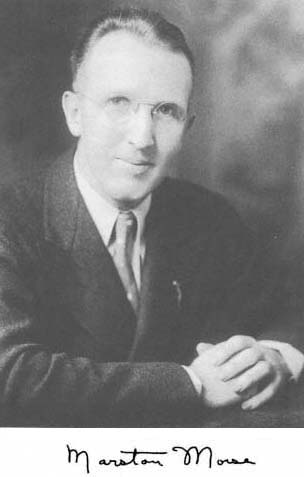
MARSTON MORSE
March 24, 1890-June 22, 1977
BY EVERETT PITCHER
THE SINGLE MOST SIGNIFICANT contribution of Marston Morse to mathematics and his undoubted claim to enduring fame lie in the area of critical point theory, also known because of the force and scope of his contribution as Morse theory. His work in this field was initiated in the paper (1925) and was expanded and elaborated in several subsequent papers, particularly (1928). He further developed and organized the material in his Colloquium Lectures, presented before the American Mathematical Society in 1931 and published by the society in 1934 as vol. 18 in its series Colloquium Publications (1934,3). It was paper (1928) that was specifically cited when he was awarded the Bôcher Prize of the American Mathematical Society in 1933. He returned to aspects and developments of the theory in papers and books throughout his life.
Morse theory is concerned with a real valued function on a topological space and relates two apparently quite different kinds of quantities. One is the algebraic topology of the underlying space. This is exhibited in its homology groups, or in its most elementary form by its Betti numbers. The other is the set of critical points of the function, separated into connected sets that are classified analytically and algebraically or by local homological properties. In the most
elementary version, these are isolated nondegenerate critical points that are classified by index and are counted. The relation in general is group theoretic but in the elementary case, the Morse inequalities relate the Betti numbers and the numbers of critical points of various indices.
Harold Calvin Marston Morse was born on March 24, 1892, in Waterville, Maine, and died at his home in Princeton, New Jersey, on June 22, 1977. He was the son of Howard Calvin Morse and Phoebe Ella Marston, who were married on January 22, 1890. His father was a realtor and was vice-president of the Waterville Savings Bank. On his father's side his ancestry can be traced to Anthony Morse, who came from Marlboro, Wiltshire, England to settle in Newbury (now in Massachusetts) in 1635. On his mother's side he is a descendant of John Marston, who came to Plymouth (now in Massachusetts) in 1637. He is a collateral relative of Samuel F. B. Morse, who is a descendant of William Morse, brother of Anthony, who came to the new world with Anthony.
Morse attended school in Waterville, first the public schools from 1897 to 1906 and then the Coburn Classical Institute from 1906 to 1910. He moved on to Colby College, where he graduated summa cum laude in 1914. He was a member of the Delta Kappa Epsilon fraternity.
He continued his education immediately at Harvard, where he obtained his A.M. in 1915 and his Ph.D. in 1917 under the direction of G. D. Birkhoff. The development of his dissertation appeared in papers (1921,1) and (1921,2). He had already published (1916) while a graduate student.
He was awarded a Sheldon Fellowship (a postdoctoral traveling fellowship) at Harvard, but resigned from it in order to volunteer in June 1917 for the army, in which he served until June 1919. He was commissioned a second lieutenant in the Coast Artillery on February 1, 1919, after
training at the Saumur Artillery School. He was awarded the Croix de Guerre with silver star for bravery under fire.
There is a tale that I have heard him tell more than once about his passage to Europe. The location and destination of the ship were not revealed to the soldiers on board. One could of course make personal observations and calculations if one wished, as he did. The one missing piece of information was provided by the ship's officers, for the time of local noon was announced daily. Morse was thus able to complete his calculations.
He was married on June 20, 1922 to Celeste Phelps. They had two children, Meroë and Dryden. This marriage ended in divorce. Issues concerning the marriage and divorce were resolved in such fashion that as a subsequent convert to Catholicism he was able to marry within the church. He was married to Louise Jefferys on June 13, 1940. They had five children, Julia, William, Elizabeth, Peter, and Louise. His wife outlived him by many years.
Initially, as in papers (1916, 1921,1-2) in the bibliography that follows, he used the style Harold Marston Morse, but beginning with paper (1925), he preferred the style Marston Morse and was so known professionally throughout his life.
Following the World War, Morse returned to Harvard as a Benjamin Pierce Instructor in the academic year 1919-20. He was at Cornell as an instructor in 1920-22 and as assistant professor in 1922-25. He was associate professor at Brown in 1925-26.
He again returned to Harvard in 1926 as assistant professor and became associate professor in 1928 and professor in 1930.
Morse directed the Ph.D. theses of two men, B. F. Kimball and D. E. Richmond, while at Cornell. At Harvard he directed theses of ten men and one woman, namely, A. B.
Brown, A. E. Currier, G. A. Hedlund, T. H. Kiang, S. S. Cairns, S. B. Myers, Nancy Cole, Walter Leighton, Everett Pitcher, Arthur Sard, and George B. van Schaack.
The last four named above all took their degrees in 1935. We gave a farewell dinner for Morse at a Boston club after our degrees were assured. We introduced him to the game of ''battleship'' after dinner. He had never seen it and it was analyzed empirically that evening.
The Institute for Advanced Study was founded in 1930 through a gift from Mr. Louis Bamberger and his sister Mrs. Felix Fuld. The initial director was Abraham Flexner. The staff of the new institute was gathered together in space provided by Princeton University. The mathematics offices were in Fine Hall along with the departmental offices. This was the old Fine Hall adjoining Palmer Laboratory, which has since absorbed it, not the newer Fine Hall which now houses the university mathematics department. There was one initial appointment of professor made in 1932, namely Oswald Veblen. There were four appointments in mathematics or mathematical physics made in 1933, namely James W. Alexander, Albert Einstein, John von Neuman, and Hermann Weyl. The next appointment in mathematics, effective in 1935 and the last for a number of years, was Marston Morse. He remained at the institute for the rest of his life. His nominal retirement in 1962 brought about no change in his work.
As with many scientists, Morse's career was interrupted and somewhat diverted by World War II. He served as consultant in the Office of the Chief of Ordnance of the Army. The title represented merely a way of putting him on the payroll, for it was a full time job. A major portion of the work, which was close to my own at the same time and which I used to see, was concerned mostly with terminal ballistics, such questions as bomb damage and the power
needed to achieve it. Notwithstanding, according to his collaborator Maurice Heins, then a professional in the Washington ordnance office, they worked evenings on mathematical problems of their own and Morse prepared drafts in Princeton over the weekends. He received the Ordnance Department Meritorous Service Award in 1944 and the Army-Navy Certificate of Merit in 1948.
Morse was honored diversely and repeatedly. In addition to the military honors and the Bôcher prize already noted, the honors included the following: Phi Beta Kappa at Colby, the A.B. degree summa cum laude; Sigma Xi while at Cornell; fellow of the American Academy of Arts and Science in 1929; fellow of the National Academy of Sciences in 1932; election to the American Philosophical Society in 1936; Chevalier in the French National Order of the Legion of Honor in 1952; associate member of the French Academy of Sciences; corresponding member of the Italian National Academy Lincei. He received twenty honorary doctoral degrees and honors from the Polish and Romanian academies. In 1964 he received the National Medal of Science. I doubt that this list is exhaustive.
He held many positions that are a blend of honor and service. He was president of the American Mathematical Society in 1940-42, held an initial appointment to the National Science Board in 1950-54, and was chairman of the Division of Mathematics of the National Research Council in 1950-52. He was instrumental in reconstituting the International Mathematical Union in 1950 and served as vice-president.
Morse was very much interested in the rapid and wide propagation of his work. He took care that an announcement of new results received prompt publication, as through the Proceedings of the National Academy, and that results
were reworked and reformulated beyond their initial publication in full in order to reach greater audiences.
He had many opportunities to lecture. These included his Colloquium Lectures in 1931 as already noted, and his Gibbs Lecture for the American Mathematical Society in 1952. He gave an invited address, titled "Calculus of Variations in the Large," at the International Congress of Mathematicians in Zürich in 1932. See (1932). He gave a second such address, titled "Recent Advances in Variational Theory in the Large," at the Congress in 1950 in Cambridge, Massachusetts.1
My contact with Morse during the writing of my thesis consisted of only a few sessions. He assigned me reading, consisting of chapters from his Colloquium Lectures (1934,3), then in typescript. He handed me a problem together with the statement of what he was sure was the first theorem. I remember the lesson I received when I returned with a body of results on the way to a solution. My work to that point had involved characteristic roots of matrices and the associated characteristic solutions. I had paused to consider the details associated with using the solutions when there were multiple roots. He told me that I should have gone ahead toward the principal result, that "these things always work out."
Professor Morse was on leave during the semester when I did the major portion of the real work on my thesis. He was between marriages at the time and spent the semester at the family home in Waterville, Maine, where the sole permanent resident was his unmarried sister. At his invitation I spent three days there, laying out my results for critical comment. Our recreational activity was chess, at which I had acquired some technical proficiency in high school and college. When I won the first game, nothing would do but
that we play some more. When he won the fourth, that settled the matter and we never played again.
Mathematics to Morse was a highly competitive enterprise. He had particular competitors in mind, individuals or schools of thought. When he had a specific and possibly new approach in mind, I have heard him say repeatedly that "they" don't understand the problem. "They" are trying to do this when it should be that. Only he understood the problem. It must be said that his position was frequently justified.
He was conscious of priority in publication. At the conference when I reported that I had carried out the line of research for my thesis that he had proposed, he told me that he had heard that someone else was onto the problem and that we had better publish quickly. This was on a Friday and I regarded his advice with such seriousness that I had a draft of a joint paper in his hands by Monday for him to offer to the Proceedings of the National Academy.
Morse needed an audience. As a consequence he sought collaborators and assistants, a substantial function of these individuals being to listen to his explanations of mathematical situations as he perfected his understanding of them. He had more than a dozen collaborators, mostly at the postdoctoral level, some of whom did a great deal of the writing of their joint work as it grew out of their discussions. I was his first assistant at the institute.
Morse was also an accomplished musician. He was the chapel organist while in college but his principal instrument was the piano. He focused on classical music.
Raoul Bott has written a substantial article of appreciation of Marston Morse and his work, beginning with his own reminiscences and those of three principal collaborators, Maurice Heins, William Transue, and Stewart Cairns.2 In the treatment of the scientific work, Bott has selected
eight topics, not thereby exhausting the scope of Morse's work. It is not my intention to duplicate the work of Bott, not only because of limitations of space but also from lack of capacity to do justice to some of the material. I propose to write more briefly and only about Morse theory and supporting work in the calculus of variations.
First let me state background definitions and facts for critical point theory. The word "smooth" will be used to mean "sufficiently differentiable" without being technically precise. Let M be a compact smooth manifold of dimension n with local coordinates (x) = (x1, . . . ,x") and let f be a smooth real-valued function. A critical point of f is a point p of M such that at p

At such a point, distinguish the quadratic form

with summation on the repeated indices, with

evaluated at p. In (1/2)Q one has an approximation near p to the difference between f and f(p). The form Q has two invariants, known as index and nullity. When Q is reduced by a non-singular linear change of variables to the form Εiwi2, with Ei = ±1 or 0, the index is the number of negative coefficients and the nullity is the number of zero coefficients. The index is the dimension of a plane of maximum dimension on which Q is negative except at the origin. The nullity is the dimension of the plane in variables (z) = (z1, . . . z,,) such that aijziyj= 0 for all (y). The index and nullity can be
expressed in terms of characteristic roots. The index is the number of negative roots λ which together with some set (z) (0) satisfy the system

and the nullity in the number of zero roots λ. In either case roots are counted according to their multiplicities, that is, the dimension of the associated set (z).
With this in mind suppose first that all critical points off are non-degenerate that is, of nullity zero. Then they are finite in number. Suppose that Mi is the number of index i. Suppose that Ri is the rank of the ith homology group Hi(M). Then Morse established the inequalities that bear his name, to wit

The second inequality is essentially the Birkhoff mini-max principle,3 and Morse in (1925) credits it with being a source of his idea for the inequalities. Poincaré was aware of the equality when n = 2.
The Morse inequalities yield the weaker but very useful inequalities

Morse's initial treatment in (1925) was of an even simpler case than the one just described. The space M was a bounded region in euclidean n-space and the boundary
was the locus of the constant maximum value of the function, which is not a critical value. This simplifies the presentation in that the overlapping coordinate systems of a compact manifold are unnecessary but this is only a technical simplification. Morse did the work for the case of the compact manifold along with other extensions in (1934,3). He initially worked with homology with coefficients mod 2, but this again is only a technical simplification.
Morse then asked about the state of affairs in case degenerate critical points are admitted. See (1927) for the first mention and then (1934,2). With mild assumptions, he showed that the critical points off lie at a finite number of critical values or levels. The function is constant on a connected set of critical points. If c is a critical level, associate the relative homology groups Hi(fb, fa), where a < c < b and a,b isolate c as a critical level and fa, = {x I fx a}. He showed that the groups Hi(fb, fa) are independent of a,b and are determined in an arbitrary neighborhood of the set of critical points at the level c.
Morse established how to regard the set of critical points at the level c as equivalent to an idealized finite set of M; non-degenerate critical points of index i for each value of i. With this convention the numbers Mi of critical points continue to satisfy the Morse inequalities. The use of the equivalence is justified at length in the book (1934,3).
The work was amplified in other directions. When the function f is defined on a manifold with boundary, it is sufficient for the theory that there be no critical point lying on the boundary. Then in the formulation of the inequalities some of the critical points of the function restricted to the boundary should be counted, namely those at which the function has negative outer normal derivative. See (1934,2).
It should be observed that arguments that would now be
handled by standard methods of algebraic topology were more difficult for Morse because the tools of algebraic topology were not sufficiently well developed and organized. Algebraic topology was not axiomatized by Eilenberg and Steenrod4 until nearly twenty years after the paper (1925) and more than ten years after the book (1934,3). The details of topological arguments in singular homology intrude into arguments intrinsic to critical point theory in the earlier work of Morse. The same is true of Vietoris homology later.
In more modern terms, the critical point inequalities depend on analysis of the nest of sets fa, as a increases in terms of exact sequences on pairs of such sets. The local interpretation near critical points or connected critical sets of the groups or the numbers that appear depends substantially on excision.
Although critical point theory in the setting of functions on a manifold is a self-contained and finished theory, it was only a stepping stone for Morse. One is led to speculate whether he already had more inclusive plans when he wrote the paper (1925). From the paper that won him the Bôcher prize (1928), he went on to consider the analogous problem in the calculus of variations. In fact his contributed ten minute oral presentation to the American Mathematical Society preceding (1925) and the first of such offerings preceding (1928) were only a year apart.
Morse wrote many papers about critical point theory in the context of the calculus of variations and devotes almost all of his colloquium lectures (1934,3) to it. He was concerned with the development of the calculus of variations both per se and to make it available and amenable to his theory. He considered a variety of extensions and abstractions of critical point theory as well.
The underlying space in a problem in the calculus of
variations is a space of curves C. The function is a function of the calculus of variations, for instance one of the form

Here F is positive homogeneous of degree 1 in the second variable, i.e. F(x,kr) = kF(x,r) when k > 0, so that the value of the integral is independent of the parametrization of the curve C. The usual complication of the calculus of variations in parametric form must be resolved in that different parametrizations of the same curve must be identified or a standard parametrization introduced. In a major part of the paper (1928), the curves join two fixed points in the plane. It should be noted that the analytical details of the parametric problem in the calculus of variations were better developed in the plane case at the time than they were in higher dimensional spaces.
New invariants appear. Critical points of J are the extremals in the sense of the calculus of variations. The index associated with an extremal in the case of fixed end points that are not conjugate is equal to the number of conjugate points of one end that lie on the extremal and precede the other end. The degenerate case arises when the two end points are conjugate.
With proper definition and interpretation, Morse showed that the basic inequalities of critical point theory or their topological extension to degenerate cases continue to hold in the enlarged context.
He extended the theory to n-dimensional base spaces, non-parametric as well as parametric problems, and to variable end point problems in many papers, including (1929,1-2, 1930,2) and in his colloquium lectures.
Periodic extremals, i.e. closed curves, to which Morse devoted considerable attention [see (1929,3, 1931,2,
1934,1,3)], introduced another kind of complication into the theory. There is no intrinsic initial point on a closed curve at which to begin the interval of a parameter in representing the curve. In other terms, the parametric problem does not reduce globally to a non-parametric problem. Even if a periodic extremal is intuitively isolated, it is analytically a member of a one parameter family. Extensive modification of the theory is needed in order to formulate the non-degenerate case and to establish the correct invariants associated with the general case. Morse contributed substantial ideas to this problem but was not entirely successful.5,6
Morse was interested in significant examples to which his theory applied. In the paper (1928), the example of the number of normals to a manifold from an external point appears. In (1934,3) he studied critical chords of a manifold embedded in a euclidean space. The function is the length of a curve joining two points of the manifold and the critical points are the straight lines orthogonal to the manifold at each end. However, the underlying space offers complications. The chords are determined by their end points but the underlying space is not the cartesian product of the manifold with itself since the two orders of presenting the ends of a chord yield the same chord. Rather it is the symmetric square of the manifold. The connectivities needed are not those of the symmetric square but rather the relative connectivities because the points of the diagonal in the formation of the symmetric square yield chords of zero length, which minimize length but should not be interpreted as orthogonal to the manifold, and so should be ignored.
Morse explored critical point theory in abstract settings, particularly in (1937) and (1940). The theory in (1937) applies to a real valued function f on a metric space for which f is lower semicontinuous and the sets fc are compact.
The object is to compare two sets of data. One is the nest of sets fa as a increases, with attention to the topological changes in fa . The other is homotopy or homology properties localized at points or sets associated with the level a that are defined locally to be critical points. Vietoris homology was an essential tool. The concepts and developments are of sufficient complexity not readily to be explained in a paragraph. However the abstract theory supplies an effective and illuminating extension of the concrete theory that applies to smooth functions and to the functionals of the calculus of variations.
In (1940), Morse carried the development further with the introduction of the concept of span. A principal result, roughly stated, is that one can ignore critical points associated with certain well defined ''small'' variations in the function f In fact, the problem of counting critical points may be improved in the process. First, critical points, either actual or in the ideal equivalent of connected critical sets, become finite in number. The easily manipulated and interpreted critical point inequalities become available instead of the less tractable group homomorphisms. Second, critical points to be ignored are excess critical points, those by which Mi exceeds Ri. Moreover, they occur in related fashion in consecutive dimensions in such a way that neglecting them does not alter the validity of the Morse inequalities.
Critical point theory has had a substantial influence on further developments in mathematics. An outstanding example is Stephen Smale's proof7 of the Poincaré conjecture in higher dimensions, which is heavily dependent on critical point theory. The conjecture states that a compact manifold with the homotopy groups of a sphere is in fact a sphere. Unfortunately, Smale's proof seems not to be available in the dimension three considered by Poincaré.
Another such development is the work of Bott on the
homotopy groups of the classical groups. For instance, if Un, is the unitary group in dimension n and On is the orthogonal group, then in appropriate ranges of k and n these groups are periodic in the sense that k+2( Un) = k( Un) and k+8(On) = k(On)
Marston Morse wrote 176 papers, four books, and several sets of lecture notes. More than a third of the papers and one of the books were joint works with second authors of his choosing. More than forty of the papers and three of the books are concerned with critical point theory or with supporting material such as developments in the calculus of variations that round out the local theory. The complete list of his publications is appended to the paper already cited.2 There is a volume of selected works edited by Bott,8 containing thirty-five of his papers and a reprint of the article including the complete list of papers.2 There is a set of volumes edited by C. C. Hsiung containing all of the papers of Morse,9 an article by Deane Montgomery, and a reprint of Bott2 with an abbreviated list of papers.
NOTES
SELECTED BIBLIOGRAPHY
1916 Proof of a general theorem on the linear dependence of p analytic functions of a single variable. Bull. Am. Math. Soc. 23:114-17.
1921 A one-to-one representation of geodesics on a surface of negative curvature. Am. J. Math. 43:33-51.
Recurrent geodesics on a surface of negative curvature. Trans. Am. Math. Soc. 22:84-110.
1925 Relations between the critical points of a real function of n independent variables . Trans. Am. Math. Soc. 27:345-96.
1927 The analysis and analysis situs of regular n-spreads in (n + s)-space. Proc. Natl. Acad. Sci. USA 13:813-17.
1928 The foundations of a theory of the calculus of variations in the large. Trans. Am. Math. Soc. 30:213-74.
1929 The critical points of functions and the calculus of variations in the large. Bull. Am. Math. Soc. 35:38-54.
The foundations of the calculus of variations in the large in m-space (1st paper). Trans. Am. Math. Soc. 31:379-404.
Closed extremals. Proc. Natl. Acad. Sci. USA 15:856-959.
1930 The critical points of a function of n variables. Proc. Natl. Acad. Sci. USA 16:777-79.
The foundations of a theory of the calculus of variations in the large in m-space (2nd paper). Trans. Am. Math. Soc. 32:599-631.
1931 The critical points of a function of n variables. Trans. Am. Math. Soc. 33:72-91.
Closed extremals. (1st paper). Ann. Math. 32(2):549-66.
1932 The calculus of variations in the large. Verh. Intl. Math. Kong. (Zürich) 1:173-88.
1934 With Everett Pitcher. On certain invariants of closed extremals. Proc. Natl. Acad. Sci. USA 20:282-87.
With George B. Van Schaack. The critical point theory under general boundary conditions. Ann. Math. 35(2):545-71.
Calculus of Variations in the Large. Providence, R.I.: American Mathematical Society.
1936 Functional topology and abstract variational theory. Proc. Natl. Acad. Sci. USA 22:313-19.
With George B. Van Schaack. Critical point theory under general boundary conditions. Duke Math J. 2:220-42.
1937 Functional topology and abstract variational theory. Ann. Math. 38(2) :386-449.
1940 Rank and span in functional topology. Ann. Math. 41(2):419-54.
1943 With George Ewing. Variational theory in the large including the non-regular case. First paper, Ann. Math. 44(2):339-53; second paper, Ann. Math. 44(2):354-74.


