
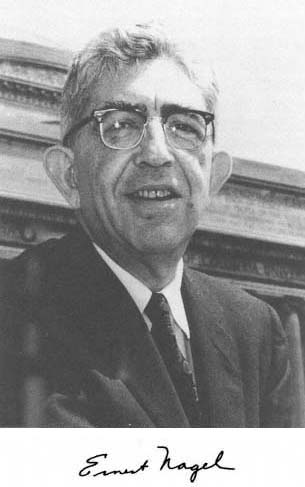
ERNEST NAGEL
November 16, 1901-September 20, 1985
BY PATRICK SUPPES
ERNEST NAGEL was born November 16, 1901, in Nové Mesto, Bohemia (now part of Czechoslovakia) and came to the United States when he was ten years old. He became a naturalized U.S. citizen in 1919, and received his higher education entirely in the United States. In 1923 he received a Bachelor of Science from the College of the City of New York, in 1925 a Master's Degree in philosophy from Columbia University, and in 1931, a Ph.D. in philosophy from Columbia. He spent most of his academic career at Columbia. He was on the faculty there from 1931 to 1970, with the exception of the academic year 1966-67 when he accepted a position at Rockefeller University. From 1967 to 1970 he held the position of university professor at Columbia, and he continued to be active in the intellectual affairs of the university after his retirement, including teaching seminars and courses. Ernest Nagel died in New York City on September 20, 1985.
After his arrival in New York City in 1911, Nagel spent his entire life there, although he and his family regularly spent the summer in Vermont for many years. On January 20, 1935, he married Edith Alexandria Haggstrom, and they had two sons, Alexander Joseph, who is a professor of mathematics at the University of Wisconsin-Madison, and Sidney
Robert, who is a professor of physics at the University of Chicago. His wife Edith died in 1988.
During his long and active academic career Nagel received many honors including honorary doctorates from a number of institutions. He was a Guggenheim Fellow in 1934-35 and 1950-51. He was elected to the American Academy of Arts and Sciences in 1954, and to the American Philosophical Society in 1962. In 1977 he was elected to the National Academy of Sciences.
Nagel's many contributions to the philosophy of science are discussed below, but what is most important to emphasize about his more than forty years' association with Columbia University is the central role he played in the intellectual life of Columbia, and more generally, of New York City. To many generations of students he was the outstanding spokesman of what philosophy could offer in terms of analysis of the scientific method, as it is practiced in many different sciences, and in the relation between science and perennial problems of philosophy such as those of causality and determinism. What is important about this influence is that it was not simply students of philosophy, but students of many different disciplines whom he influenced in a way that many of them still remember. He saw his principal role as that of a philosophical critic of ill-conceived notions from whatever quarter they might come. It is this critical spirit of analysis and reflection that he especially communicated to others. He was properly skeptical of philosophical edifices built independent of detailed scientific considerations. But he was equally critical of the writings of scientists who too blithely thought they could straighten out their colleagues on fundamental philosophical questions without proper knowledge of the many issues involved.
His own intellectual mentors were Morris R. Cohen, with
whom he wrote the most influential textbook in logic and scientific method published in the period between the mid-1930s and the mid-1950s, and John Dewey, who taught at Columbia for many years and was one of the most important American philosophers in the first half of the twentieth century. Throughout his career Nagel tried to combine the best elements of Cohen's philosophical realism and Dewey's radical instrumentalism.
His closest colleague, personally and philosophically, was probably Sidney Hook, who also taught in New York City for many years, primarily at New York University. Like Dewey and Hook, Nagel also enjoyed the wider arena of intellectual and political life in New York. He wrote extensively for such publications as Partisan Review and The Nation , as well as for the standard scholarly journals. With these many different interests and engagements he occupied a position, especially in the intellectual life of New York City, that extended far beyond the boundaries of academic philosophy. Within the university Nagel interacted with colleagues in the sciences in a way that was unusual then, and is unusual now, for philosophers. For example, he gave for many years a famous seminar with Paul Lazarfeld on the methodology of the social sciences, which was widely attended by social scientists as well as philosophers at Columbia. His interest in current research in physics continued well into retirement. It is not common practice for philosophers to be elected to the National Academy of Sciences, and there is no special section to which they naturally belong. His election was a tribute to Ernest Nagel's wide-ranging interests and extensive substantive knowledge of many different branches of science. It is fair to say that the range of his scientific interests and knowledge exceeded that of any other philosopher of science of his generation in the United States.
A SURVEY OF NAGEL'S WIDE-RANGING INTERESTS
Nagel wrote about too many different parts of science to survey in detail all that he had to say. What I do want to do, however, is to give a sense of the wide range of his interests and the continual concern for foundational issues discussed from the critical standpoint he thought essential for a philosopher.
CAUSALITY, EXPLANATIONS AND LAWS
The general topic of causality, and also the nature of scientific explanations and laws, are topics to which Nagel returned again and again in his career. His most extensive discussion is to be found in his magisterial book, The Structure of Science, which has as its subtitle Problems in the Logic of Scientific Explanation. Here he devoted a chapter to patterns of scientific explanation with an analysis of four kinds of explanation offered in science: the deductive model, the probabilistic model, the functional or teleological model, and the genetic model, where by ''genetic'' is meant the study of the historical roots of phenomena. Although he gave a very sympathetic exposition on various occasions of teleological explanations in biology, he favored the classical deductive model as providing the best examples of scientific explanation. However, he also recognized the problems of characterizing what a nontrivial deductive pattern of explanation must be and in various publications went to some length to analyze the various puzzles surrounding this notion. It would probably be generally conceded that the intuitive notion of a nontrivial deductive explanation is still not thoroughly analyzed, and is possibly not a notion that we shall ever put on a completely formal basis. Nagel was also concerned with the logical character of scientific laws. Many of the same puzzles that beset explanations beset char-
acterizing the nontriviality of laws. He was equally concerned to distinguish purely experimental laws from theoretical laws. He had many wise things to say on all of these problems of explanation, laws and theories without proposing or even believing in some grand general scheme that would satisfactorily account for all the puzzles that have been raised about these concepts. As I have already emphasized, what is important about Nagel's role as a critic of science and philosophy is that he did not focus only on general issues about causality and explanation, but went on to the detailed analysis of these concepts and their use in individual scientific disciplines.
FOUNDATIONS OF MEASUREMENT
In his dissertation completed in 1931 and throughout his academic career, Nagel had continuing interest in the theory of measurement. More than any other philosopher of his generation he built on the nineteenth century work of Helmholtz and Hölder, as well as the earlier twentieth century work of the British physicist Norman Campbell. It was characteristic of Nagel's approach that he did not extend the formal results obtained earlier by Hölder and others, but critically examined the conceptual assumptions back of the formal developments.
FOUNDATIONS OF GEOMETRY
Already in his dissertation he exhibited his deep interest in the history of nineteenth-century geometry. He continued this interest in a number of publications; one of his most well known pieces of work is a detailed examination of the development of the conception of systems of geometry as abstract mathematical structures in the nineteenth century. The central role that geometry played in the development of the abstract form of modern mathematics has
often not been appreciated sufficiently in discussions of the foundations of mathematics by mathematicians and philosophers. The development of projective geometry by Monge, Poncelet, Gergonne, Von Staudt, and others, as well as the abstract theory of Grassman's Ausdehnungslehre and related work, formed the background for the rapid development of the modern axiomatic view of geometry developed by Pasch, Hilbert, and Klein in the last decades of the nineteenth century. Nagel's long essay, published in 1939, was one of the first historical analyses to recognize the great importance of the break that was made by the introduction of projective geometry for later views on the foundations of mathematics. What was essential was the new understanding that pure geometry is neither the science of quantity nor the science of extension in the sense so thoroughly developed by Euclid.
Years later, Nagel took up again his interest in geometry, in the chapter devoted to space and geometry and in another chapter to geometry and physics, in The Structure of Science. He analyzed with care the foundational discussions of the differences between pure and applied geometry and the nature of conventions in geometry, with particular reference to the much earlier discussions by Poincaré and Einstein. Nagel presented persuasive arguments why Poincaré was wrong in his judgment that Euclidean geometry would never be abandoned.
FOUNDATIONS OF PHYSICS
As already indicated, Nagel devoted a substantial part of his critical energy to the fundamental philosophical issues raised by the development of relativity theory and quantum mechanics during the period spanned by his academic career. His concern to give a detailed philosophical critique of the relation between geometry and physics was just men-
tioned. The issues raised by quantum mechanics were of equal importance to him. In various publications he was concerned to distinguish the sense in which quantum mechanics preserves causality as reflected in the deterministic solutions of the Schroedinger equation for given initial conditions, and at the same time to analyze the many different senses in which quantum phenomena could be said to be indeterministic. He was very much aware of the fact that there is no single sense of indeterminism that is agreed upon as the central one, and also that different senses of indeterminism depend upon different senses of the concept of probability. Here is a characteristic passage from Nagel's writings on the matter: "In the voluminous literature on the 'indeterminism' of microphysics, one point stands out clearly: whatever the issue may be, it is generated by the theoretical interpretations that are placed on the acknowledged data rather than by any disagreement as to what those data are."
Another classic paper of Nagel's is concerned with the detailed analysis of the reduction of theories, with special emphasis on the reduction of thermodynamics to statistical mechanics. This is a subject that has received much attention from applied mathematicians and theoretical physicists in the last half century. Nagel does not add to the technical results on the complex problem of giving clear mathematical results concerning under what conditions a representation theorem can be proved, but he does provide the most extensive conceptual analysis to be found over a long period in the literature of the philosophy of science on this important case of reduction. More generally, his analysis of the reduction of theories in a chapter of The Structure of Science is a classical presentation of philosophical views on reductionism.
FOUNDATIONS OF PROBABILITY
Throughout this century there has been extended conceptual controversy over the nature of probability. The terrain of the conflict has not been restricted to any one domain of science, although physics has been central to much of the discussion, but equally important has been the Bayesian view that the most important sense of probability is the subjective one of degree of belief, advocated most persuasively by Bruno de Finetti and L. J. Savage. Most of Nagel's writings on the foundations of probability appeared before Savage's 1954 book, The Foundations of Statistics. Although Nagel vigorously defended the frequency interpretation of probability, he was careful to survey the various logical problems that have been raised about the frequency interpretation, including well-known objections to Von Mises's concept of a collective. He was also among the first in the philosophical literature to call attention to the important method of arbitrary functions in probability theory, developed to provide an account of physical mechanisms in coin flipping and other such physical devices for producing symmetric probability distributions. He acknowledged especially the important work of Poincaré, carried on later by G. D. Birkhoff, E. Hopf, and others, providing a detailed account of the ordinary physical mechanisms by which symmetric probabilities are produced in games of chance such as roulette, craps, and so on.
THEORIES OF INDUCTION
Much more of Nagel's intellectual energy was devoted to critical analyses of theories of induction put forth, especially by the philosophers Hans Reichenbach and Rudolf Carnap, who made proposals sufficiently detailed to also attract the attention of statisticians interested in the foundations of statistical inference.
Although agreeing with Reichenbach that the relative frequency interpretation of probability is the fundamental one, Nagel on numerous occasions criticized Reichenbach's wholesale attempts to extend the relative frequency theory to give an account of the quantitative degree of confirmation of a scientific theory. Nagel rightly believed that Reichenbach's efforts in this direction were too crude and general to provide a serviceable methodology for evaluating the probability of a theory. Nagel's characteristic skepticism of philosophers who propose simple and general theories for complex matters comes through again and again in his criticisms of Reichenbach's ideas. It is fair to say that Reichenbach's analysis no longer has serious currency. Nagel's published criticisms were one of the most effective lines of attack against Reichenbach's far too sweeping proposals.
Nagel criticized in a similar fashion Reichenbach's unorthodox and equally sweeping proposals for the interpretation of quantum mechanics. For example, Reichenbach proposed a three-valued logic of true, false, and indeterminate, but did not provide anything like the proper intuitive and technical development of this logic. Nagel's criticisms were characteristically sharp and pointed.
With equal claim to generality but with a completely different interpretation of probability, namely what is usually termed a logical theory of probability, Rudolf Carnap proposed a general approach to the theory of confirmation of scientific theories. Nagel managed to find as many intuitive difficulties with Carnap's theory as with Reichenbach's. What is important to record here is not the technical criticisms of Carnap or Reichenbach, but rather the general perspective from which he conducted these critical investigations. He clearly felt that the effort to have a general methodology for quantitative confirmation of scientific theories taken as wholes, was an unworkable and unfeasible idea. Drawing
upon his own wide scientific knowledge he offered numerous counter-examples to Carnap's ideas. Nagel was equally critical of the fact that Carnap based his theory of induction on assuming that we were able to characterize a set of independent and complete primitive predicates for describing experience. Nagel puts his criticism this way: "it is difficult to avoid the conclusion that the assumption that we have, or some day shall have, a complete set of primitive predicates is thoroughly unrealistic, and that in consequence an inductive logic based on that assumption is a form of science fiction."
SCIENTIFIC EXPLANATION IN BIOLOGY
Over a period of many years, Nagel published a number of articles on the character of scientific explanations in biology. He included in The Structure of Science a chapter on mechanistic explanation and organismic biology, and in the John Dewey lectures, given at Columbia University in 1977, he gave perhaps his most thorough analysis of the concept of teleology in biology. Nagel's Dewey lectures provided a reformulation and reexamination of his earlier writings on teleological explanation. The written version of the lectures is divided into two parts. In the first part Nagel examined three alternative accounts of the notion of goal and goal-directed processes. The first is the intentional account, which is modeled on purposive human behavior, and, rightly enough, Nagel finds difficulties with this view in talk about goal-directed processes in lower organisms such as protozoa and plants. The second account is the computer-program view of such processes; genetic coding is a striking and appealing example, but Nagel points out that the concept of goal-directedness is one that we attribute to behavior without having the possibility of examining any proposed internal computer program that controls it.
The third account of goal-directed behavior Nagel refers to as the "system-property" view of goal-directed processes. An example that illustrates this view is the collection of mechanisms that act homeostatically to maintain the water content of the blood at about ninety per cent. Nagel imposes the reasonable requirements that the process be plastic, that it be persistent, and that the relevant variables controlling it be for the normal range of their values independent. It should be obvious that there is no inconsistency between the computer-program view and the system view, but it is the system view that he uses for the definition of goal-directed behavior, for the reason already indicated. Nagel also deals with several objections to the system view which I shall not examine here. The important point is that once the system-property view is accepted, then a general analysis of the concept of being goal-directed can be given without using specifically biological notions or other expressions that have a teleological connotation. By giving an analysis of goal-directed processes in this fashion, Nagel wanted to make the important point that explanations of goal-directed processes in biology are, in principle, similar in structure to explanations of nonbiological processes in the physical sciences.
The second part of the essay is devoted to functional explanations in biology, the second main type of teleological explanation. Nagel says that a typical example of a functional explanation is the assertion, "fish have gills in order to obtain oxygen." The basic form of functional explanations for Nagel is this: "During a given period t and in environment E, the function of item i in system S is to enable the system to do F" An example would be green plants being provided during a period of time, water, carbon dioxide, and sunlight, with the function of chlorophyll then being to enable the plants to perform photosynthesis.
As Nagel notes, such functional explanations are not causal, in contrast to explanations of goal ascriptions. In the process of setting forth his own views, Nagel examines Carl Hempel's well-known critique of functional explanations and defends a proper formulation of their use in biology.
METHODOLOGY OF THE SOCIAL SCIENCES
Nagel's General Thesis About The Social Sciences Is That They Are Subject To The Same General Canons Of Scientific method applicable in the natural sciences. He was particularly concerned to argue on numerous occasions that subjective explanations of human behavior either individually or in groups—an approach that has a long history of proponents—does not satisfy the usual standards for scientific inquiry and can be avoided. He dealt in the same way with the claims that investigations in the social sciences are subject to a peculiar form of value-oriented bias. In various publications Nagel was also concerned to offer a detailed analysis of the nature of statistical explanations in the social sciences, especially emphasizing their importance for causal analysis. Finally, I would not want to omit the fact that he devoted the last chapter of The Stucture of Science to problems in the logic of historical inquiry. He provided in this final chapter a particularly careful and detailed analysis of three important problems: the problem presented by the selective character of historical inquiry for the achievement of historical objectivity; the scientific justification for assigning relative importance to causal factors, as for example, the relative weight of economic as opposed to political factors as causes of the American Civil War; and finally, the possibility of using effectively in history contrary-to-fact judgments about the past, in order to evaluate the nature of various historical events.
FINAL NOTE
I have surveyed in a necessarily superficial way Ernest Nagel's many philosophical and scientific interests. What is equally important is to emphasize the unity of his vision of the nature of scientific inquiry and the critical role that philosophy of science can have in rooting out mistaken conceptions and ill-thought-out claims of significance. Because of the emphasis he placed on criticism, it is not possible in any simple way to summarize the unity of Ernest Nagel's intellectual vision. However, an easily identified style and manner of thought come through in his writings in any of the areas I have surveyed. The same patient critical tone permeated his seminars as well as his written work. As legions of students will attest, a seminar or course with Ernest Nagel was a memorable experience, perhaps above all because his persistent criticisms were tempered by a rare gentleness of personality and spirit.
SELECTED BIBLIOGRAPHY
1933 A frequency theory of probability. J. Philos. 30:533-54
1934 With Morris R. Cohen. An Introduction to Logic and Scientific Method . New York: Harcourt, Brace, Jovanovich.
1939 The formation of modern conceptions of formal logic in the development of geometry. Osiris 7:142-224.
Probability and the theory of knowledge. Philos. Sci. 6:212-53.
Principles of the Theory of Probability, vol. 1, no. 6 of International Encyclopedia of Unified Science. Chicago: University of Chicago Press.
1945 Some reflections on the use of language in the natural sciences. J. Philos. 42:617-30.
Probability and non-demonstrative inference. Philos. Phenomenol. Res. 5:485-507.
1946 Russell's philosophy of science. In The Philosophy of Bertrand Russell , ed. P. A. Schilpp, pp. 317-49. Evanston, Ill.: Library of Living Philosophers.
1949 The meaning of reduction in the natural sciences. In Science and Civilization, ed. Robert C. Stouffer, pp. 99-135. Madison: University of Wisconsin Press.
1950 Dewey's theory of natural science. In John Dewey: Philosopher of Science and Freedom, ed. Sidney Hook, pp. 231-48. New York: Dial Press.
1951 With S. W. Baron and K. S. Pinson, ed. The causal character of modern physical theory . In Freedom and Reason, pp. 244-68. Glencoe, Ill.: Free Press.
Mechanistic explanation and organismic biology. Philos. Phenomenol . Res. 11:327-38.
1952 Wholes, sums, and organic unities. Philos. Stud. 3:17-32.
1953 Teleological explanation and teleological systems. In Vision and Action, ed. Sidney Ratner, pp. 537-58. New Brunswick: Rutgers University Press.
1954 Sovereign Reason. Glencoe, Ill.: Free Press.
1955 Naturalism reconsidered. Proceedings and Addresses of the American Philosophical Association 28:5-17.
1956 Logic Without Metaphysics. Glencoe, Ill.: Free Press
1959 Methodological issues in psychoanalytic theory. In Psychoanalysis Scientific Method and Philosophy, ed. Sidney Hook, pp. 38-56. New York: New York University Press.
1960 Determinism in history. In Philosophy and Phenomenological Research 20:291-317.
1963 The Structure of Science. New York: Harcourt, Brace, World.
Assumptions in economic theory. Am. Econ. Rev. 53:211-19.
1964 Carnap's theory of induction. In The Philosophy of Rudolf Carnap, ed. Paul A. Schilpp, pp. 785-825. LaSalle, II.: Open Court.
1965 Types of causal explanation in science. In Cause and Effect, ed. Daniel Lerner, pp. 11-32. Glencoe, II.: Free Press.
1967 Preference, evaluation, and reflective choice. In Human Values and Economic Policy, ed. Sidney Hook, pp. 73-84. New York: New York University Press.
1979 Teleology Revisited. New York: Columbia University Press.


