
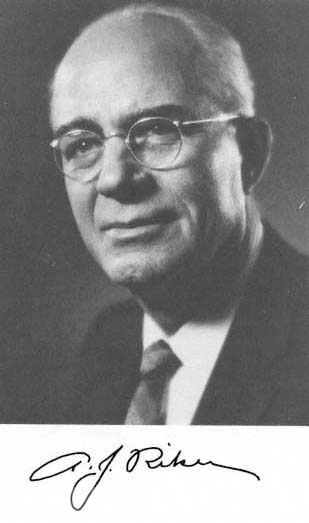
ALBERT JOYCE RIKER
April 3, 1894-February 21, 1982
BY LUIS SEQUEIRA
ALBERT JOYCE RIKER, one of the most distinguished plant pathologists in the United States during a career that spanned over four decades, will be remembered mostly by the leadership he provided in strengthening the field of forest pathology. He led through gentle persuasiveness. A mild and rather unobtrusive person in appearance, he was nevertheless stubbornly independent and extremely persistent in his quest for increased public funding for research on diseases that affect trees. He loved a challenge and, in fact, fame came early in his career when he doggedly questioned the opinions of senior, highly respected scientists. A man with a keen sense of the future of the profession of plant pathology, he assembled a large group of students and colleagues at the University of Wisconsin into an effective center for research in forest pathology, crown gall disease, and plant tissue culture. The pioneering research on crown gall and on plant tissue culture that he and his colleagues carried out for many years provided some of the basis for modern plant genetic engineering. He gave impetus to research on forest and shade tree diseases, an area that had remained neglected in this country in spite of its obvious importance to industry, recreation, and the urban environment. This research brought additional prestige to
the University of Wisconsin and to one of the leading departments of plant pathology in the country. He was destined to become a member of the famous Wisconsin quartet: Walker, Dickson, Keitt, and Riker, who were the recognized leaders of research in plant pathology in the United States for several decades. Riker's uncanny ability to garner research funds from university, state, and federal sources was legendary. An indication of the strength of his persuasiveness is perhaps the fact that support for many of his favorite research projects in crown gall and forest pathology at Wisconsin gradually dwindled after his retirement.
My recollection of Joyce is that of a quiet but effective insider, a promoter, and a manager who possessed the vision of where the future of research in plant pathology might reside. At the same time, he was a very private person who kept detached of the day to day problems of carrying out the research, of manipulating glassware or dealing with bulky equipment. Although he was a superb technician, as his early work on crown gall indicates, one obtains the impression that the he was happier guiding students or persuading government officials of the benefits of research on plant diseases than working directly at the bench. Perhaps another example of contrasting aspects of his personality is the fact that he had a deep interest in teaching and wrote one of the most widely-used laboratory manuals of its day for elementary plant pathology courses. Yet, in the classroom, he was a kind, but rather detached, distant teacher.
THE EARLY YEARS
Joyce was born in Wheeling, West Virginia, on April 3, 1894, the son of Albert Birdsall and Mary Edith (Davis) Riker. It is unfortunate that not much is known about his parents or his life as a child. He rarely talked about his
childhood or his family, which was not unusual because of his highly reserved nature. We know that his father was a Methodist minister who became president of Mount Union College in Alliance, Ohio. Young Riker attended public school in Alliance and finished high school in Moundsville, West Virginia, where he developed an early interest in biology. At different times after high school graduation, however, he worked for the Royal Three Barrel Gun Company, he was an automobile repairman and salesman, and he helped build greenhouses. Eventually, he returned to his early interest in biology, an inclination that he pursued when he attended Oberlin College in Ohio, where he received the A.B. degree in botany in 1917. He started graduate work in botany at the University of Cincinnati, but World War I interrupted his career. In 1918-19 he served as a bacteriologist in an Army hospital in France. That tour of duty kindled a profound interest in microbial pathogens as well as in the French language, two subjects that he pursued intensely at that stage of his professional life. After the armistice, he returned to earn the M.A. degree in botany and bacteriology at the University of Cincinnati in 1920. Soon thereafter, he accepted an offer of a research assistantship from Professor L. R. Jones to pursue the Ph.D. degree in plant pathology at the University of Wisconsin.
GRADUATE STUDENT
Jones was the chairman of the Department of Plant Pathology at the University of Wisconsin at that time. He had been a leading plant bacteriologist for many years and had a strong interest in expanding this area of research in his department. He was supported in this endeavor by Harry L. Russell, the long-term dean of the College of Agriculture, and himself one of the first trained plant bacteriologists in the world. Phytobacteriology had provided the raison
d'etre for establishing the Department of Plant Pathology at Wisconsin in 1910, but by 1920, the department had expanded far beyond the initial interest in plant pathogenic bacteria. Jones had brought to the department George W. Keitt, James G. Dickson, J. C. Walker, and others who were destined to become great figures in the development of plant pathology as a science. The staff that Jones had assembled covered a very wide range of disease problems caused by fungi and viruses, but Jones himself was increasingly involved in administrative work and saw the need to bring additional expertise in his own area of phytobacteriology. Walker was already there to continue the research on bacterial diseases of vegetables that Jones had initiated; the need now was for someone to provide strength in the area of bacterial diseases of orchard crops, which were under Keitt's area of responsibility. Thus, Riker became one of Keitt's first students. Keitt's responsibilities included a wide variety of problems affecting the orchard fruit industry in Wisconsin; among these were fireblight and crown gall of apple, diseases that to this day have proven refractory to control. By the time he arrived at Wisconsin, Riker was unusually well qualified to work on bacterial diseases and Keitt was happy to hand him the crown gall problem. Other students were placed in charge of developing control measures for fireblight.
YOUNG PROFESSIONAL
Riker's appointment as an instructor of plant pathology at Wisconsin immediately upon completion of his Ph.D. degree in 1922 indicates clearly that his abilities were recognized early in his career. Jones and Keitt obviously had confidence that young Riker could fulfill the needs of an increasingly complex department. This confidence stemmed, no doubt, from the superb work that Riker had done for
his Ph.D. thesis on crown gall initiation and morphology. He continued that research once he joined the faculty at Wisconsin. It was this early work that established Riker's reputation as a scientist for it brought him to a classic confrontation with Erwin F. Smith, the leading phytobacteriologist in the world at that time. Smith had stated that, according to his observations, the bacterium that causes crown gall, Agrobacterium tumefaciens, multiplied within the plant cells. Riker, on the other hand, maintained that the bacterium remained outside of the host cells throughout the entire process of tumor formation. Smith was a formidable figure in those days; a man of great drive and a rather messianic nature, he had singlehandedly lifted phytobacteriology from obscurity and had made it a leading area of plant sciences. He was also famous for his mistrust of the work of colleagues and for his bad temper. A rather irascible individual, he did not suffer fools lightly. Thus, it must have been difficult for Riker to confront Smith with his data, but he did so; Smith eventually conceded the point and was uncharacteristically magnanimous in retreat. This episode provides some useful insight into Riker's character. The rather sedate, unobtrusive exterior masked a determined, stubborn personality.
Much later, Riker was involved in another classic confrontation that gives us further insight into his personality. At a meeting of the American Phytopathological Society, George McNew, a rather forceful individual who later became head of the Boyce Thompson Institute, stated that bacteria could be purified by the simple procedure of dilution plating. Riker insisted that only single cell isolation could give assurance of purity. When McNew persisted in his position, Riker became ''livid with rage,'' as was related to me by the late Dr. C. J. Nusbaum, one of Riker's first
students. Riker was right, of course, but this was the only time anyone had ever seen him lose his calm demeanor.
THE PROMOTER
Riker's most significant contribution at Wisconsin was the leadership he provided in developing the field of forestry—not only forest pathology, but forest entomology, forest genetics, and forest management. For many years he developed strong ties with the Wisconsin Conservation Department (now the Department of Natural Resources), the U.S. Forest Service, the Lake States Forest Experiment Station, the Forest Products Laboratory, the lumber industry, and individual woodland owners. This provided a strong coalition that supported forestry research and lobbied successfully for financial support from the state legislature. Riker brought into his program a large number of students who went on to work on tree diseases. The emphasis was on the mechanisms for spread of pathogens that caused oak wilt, Dutch elm disease, white pine blister rust, poplar canker, and maple dieback, among others. Eventually, many of these students became leaders in forest pathology at many institutions in the United States and abroad. Several of his students, including Robert Patton, James Kuntz, and John Berbee, became staff members at the University of Wisconsin.
Riker and his associates gave particular emphasis to the epidemiology and control of white pine blister rust. Convinced that there should be resistance to blister rust among the native white pines, he established a blister rust nursery where many thousands of young trees were screened. This work led to the discovery of resistant trees. A program of selection and breeding eventually resulted in the development of blister rust-resistant planting stock. This stock, combined with the proper selection of planting sites, will lead
to satisfactory control of the disease. At the same time, his work with poplars showed that intensive cultivation could lead to great increases in production of this important source of wood fiber for paper pulp. Until this new planting method became available, the poplar had been considered a weed tree species of little value. Riker also initiated research on vascular wilt problems, including oak wilt and Dutch elm disease, two diseases that had been spreading rapidly throughout the Midwest in the 1940s and 1950s. He and his colleagues discovered that trees are often connected to one another by root grafts and that vascular wilt fungi often grow along these connections, thus effectively spreading from tree to tree. A simple observation perhaps, but one that has wide implications in terms of the epidemiology of two extremely important diseases. Riker also was instrumental in obtaining support from the Wisconsin Legislature for a new staff member who would work on Dutch elm disease, a disease that had decimated urban shade trees throughout the eastern seaboard in the United States and that, at the time, was beginning to move into the Midwest. Riker's interests in tree diseases also covered a variety of nursery tree diseases, diebacks, declines, cankers, and so on, problems that were investigated by a large number of students who, for many years, converted the University of Wisconsin into a major center for research and training in forest pathology.
Riker's pioneering research with tree diseases in Wisconsin eventually led him to a broader concern for diseases of international impact and for the need for international cooperation to prevent the dissemination of the causal agents. He traveled to many parts of the world to seek out scientists who shared his concern for adequate quarantine safeguards, and he pressured international agencies into supporting research to identify important disease agents and to lessen
their impact. He was instrumental in organizing a Symposium on Internationally Dangerous Forest Tree Disease and Insects, which was sponsored jointly by the Food and Agriculture Organization (FAO) of the United Nations and the International Union of Forestry Research Organizations. This work on international cooperation became the focus of much of Riker's efforts during the last years of his professional life at Wisconsin until his retirement in 1964. He was prophetic in his often-expressed views that countries should be prepared to meet the consequences of a potential introduction of major diseases that affect important tree crops. For example, in 1960 he expressed the fear that coffee rust, which had remained restricted to the Old World, would become a serious problem in Latin America. These fears were well founded, because the disease appeared in Brazil in the early 1970s and has since spread to every coffee-growing country in the Americas.
Although forest pathology became an increasing focus of Riker's career at Wisconsin, he also maintained his lifetime interest in crown gall disease, which had been the subject of his Ph.D. research. He was instrumental in convincing the National Institutes of Health that there were parallels at the basic cellular levels between plant and animal cancer, which justified support for research on crown gall. This support allowed Riker to hire a graduate student, A. C. Hildebrandt, to work on basic aspects of crown gall. Later, Hildebrandt became a staff member and in association with Riker and a large number of graduate students, provided the early foundation for work on crown gall in tissue culture. One of the early converts to the crown gall tissue culture system was A. C. Braun, a graduate student in plant pathology at Wisconsin. Although not one of Riker's students, Braun was interested in phytobacteriology, and he realized the potential of studying the differences in nutri-
tional requirements between normal and crown gall tumor tissues, work that he pursued once he joined the staff at the Rockefeller Institute (now Rockefeller University) in 1938. Braun's seminal contributions, along with the work in Riker's and Folke Skoog's laboratories at Wisconsin, provided the basis for plant transformation by means of the crown gall bacterium, a method that has been the mainstay of modern genetic engineering of plants for many years.
It is evident that many of Riker's major contributions to science stemmed from his ability to promote plant pathology at the university, state, and federal levels. He was also an extremely able promoter of collaboration at a personal level. For example, it was his friendship with Fred G. Wilson, superintendent of the Cooperative Forestry Division at Wisconsin, that resulted in the establishment of the forest pathology program at the University of Wisconsin. Wilson became convinced that the Wisconsin Conservation Department should not fund a research program of its own, but instead should put money into the university for a cooperative program. Another example was his long-lasting friendship with O. N. Allen of the Department of Bacteriology, and one of the leading experts on root-nodulating bacteria (Rhizobia) that fix nitrogen in legumes. Agrobacterium and Rhizobium are closely-related organisms, and both scientists saw interesting parallels in the parasitic and symbiotic relationships of these bacteria with their host plants. Riker and Allen established cooperative projects and the close ties they developed between the departments of plant pathology and bacteriology initiated a tradition of collaboration that remains to this day. Over the years, this collaboration has benefited a large number of students because they are exposed to a broader range of interests and expertise than they would otherwise. The collaboration between Riker and Allen has had long-lasting effects in other ways. The estab-
lishment of a fund in 1978 to promote work on plant-associated bacteria at Wisconsin, and the establishment of the O. N. Allen Graduate Fellowships, all due to the generosity of Mrs. O. N. Allen, continue to honor to this day the close friendship and professional interests of two remarkable scientists.
THE GRADUATE ADVISOR
Although Joyce kept close tabs on his students and required monthly, written reports of research progress, he did not establish strong rapport with his students. In the early days of his career, a few fortunate students were invited to his home to listen to recordings of Gilbert & Sullivan operettas, for which Joyce had a special liking. Others received invitations to play tennis, a game that Joyce enjoyed and considered highly invigorating. He often stated that playing tennis was the best way to treat depression. For the most part, however, he remained curiously distant from his students. As students arrived, all were subjected to an initial lecture by Joyce in which he stressed that he was only providing "an opportunity." It was up to the student to take advantage of that opportunity by dint of hard work and dedication. Students were also told that they were expected to set up field experiments at the forestry research center that Joyce had established at Wisconsin Rapids, and, incidentally, to help with construction of the facilities. Carl Beckman, one of Joyce's most preeminent students, recalls that as several students completed work on the road that led to their living quarters at the Rapids, someone put up a sign that named the road "Opportunity Road." Joyce, who often visited the station with dignitaries in tow, apparently never quite understood the significance of the sign.
Joyce was a meticulous, careful writer; the meaning of every word had to be carefully examined. He was a labori-
ous, method writer: a general outline was sketched first, then paragraphs were outlined, and then each paragraph was meticulously filled in and worked over and over until each sentence stated precisely what was intended and was in the proper sequence. What impressed his students was the fact that this intensely reworked writing style somehow seemed spontaneous at the end. Joyce imposed the same style on his students and was most demanding at the time they were writing their dissertations. Carl Beckman recalls that after he had labored intensely on the first draft of his thesis, he turned it in and waited impatiently for Joyce's comments for several weeks. When the thesis was finally returned to him, Carl was pleased to see that no comments had been written in the text until he came to the last page, where Joyce had penciled in: "Good start—rewrite". This process went on a few more times and, exasperated, Carl finally asked one of his senior colleagues when he could expect the thesis to be approved. He was told not to worry; the thesis would be approved when the sixth version was submitted. Carl simply labeled his next version "6th. draft" and, true to form, Joyce promptly approved it.
A PRIVATE MAN TO THE END
Joyce was a person of strong contrasts. Charming and suave in a social setting, persuasive in articulating research needs at the highest levels of government, he preferred to keep his personal life private. He married three times. His first wife was Regina Stockhausen, whom he married in 1922. Regina was a plant scientist in her own right and a rather determined, strong-willed person who many feel provided Joyce with much of his incentive and drive during the early years as a professor at Wisconsin. She collaborated with him in the preparation of the famous textbook, Introduction to Research in Plant Diseases , which became the standard manual
for plant pathology students for over thirty years. After Regina's sudden death, Joyce reportedly went into a protracted period of depression, but he recovered and married again in 1953. His second wife, Helen Burgoyne, was a former acquaintance from his college days in Cincinnati. A gracious, charming person, she gave Joyce a happy home life and strong moral support. She was his constant companion during many world travels until her death in 1963. After retirement in 1964, Joyce moved to Tucson, Arizona, and there he married again. His third wife, Adelaide Evenson, was a retired microbiologist from the University of Arizona in Tucson. A gentle, loving person, she made his retirement happy and secure in spite of Joyce's advancing age and delicate health. Adelaide was there to provide Joyce with loving care after he suffered a series of strokes beginning in 1973 that seriously impaired his mobility, and a heart attack in 1982 that ultimately caused his death.
Adelaide survived Joyce for only a relatively short time. It is significant that their joint will provided that after her death, the bulk of their estate should go to the University of Wisconsin Foundation for the establishment of merit scholarships for undergraduate students. In addition, the Rikers provided graduate and undergraduate fellowships in plant pathology to promote research in forest pathology and plant tissue culture. This was yet another example of Joyce's great generosity to the Department of Plant Pathology at the University of Wisconsin. For example, throughout his career Joyce gave strong financial support to the departmental library. When the department moved to new quarters in Russell Laboratories in 1964, it was Joyce who donated all the furnishings for the conference room in that building. The beautiful oak panels that adorn that room came from a famous 600-yr-old old oak that grew in Wetumpka, Alabama and that reportedly had provided shade for President Andrew
Jackson while he negotiated a treaty with the Creek Indians. The oak panels were a gift of Mr. San Nickey to the department, as a gesture of esteem for A. J. Riker. The Riker Conference Room, as it is known today, remains a wonderful memorial to a man of keen insight whose contributions were of immeasurable benefit to the plant sciences.
In his lifetime, Joyce received many awards and honors in recognition of his contributions. He was the American Men of Science Star in 1944 and was the recipient of the Eighth International Botanical Congress Medal in 1954. He was a Haight Traveling Fellow in 1959, 1962, and 1964. He was president of the American Phytopathological Society in 1947 and was a Fellow of the American Association for the Advancement of Science. He was elected to the National Academy of Sciences in 1951 and was chairman of the Section of Botany, 1959-62.
FOR THE PREPARATION of this memoir I have consulted the archives of the Department of Plant Pathology at the University of Wisconsin. I was fortunate in that the department had published a history of its first seventy-five years (With One Foot in the Furrow, P. H. Williams and M. Marosy, eds. Kendall/Hunt, Iowa, 1986), which dealt with many of Riker's contributions. In addition, I had conversations with many of Riker's students and colleagues, including Robert Patton, Carl Beckman, Eugene Smalley, and Deane Amy. The help of these colleagues is gratefully acknowledged. I am also indebted to Dr. Elizabeth Sherman, former editor of Biographical Memoirs, for her help in the preparation of the manuscript.
SELECTED BIBLIOGRAPHY
1923 Some relations of the crown gall organism to its host tissue. J. Agr. Res. 25:119-32.
1927 Cytological studies of crown gall tissue. Am. J. Bot. 14:25-37.
1930 With S. S. Ivanoff. Studies on the movement of the crown-gall organism within the stems of tomato plants. Phytopathology 20:817-29.
1936 With R. S. Riker. Introduction to Research on Plant Diseases. A Guide to the Principles and Practice for Studying Plant Disease Problems . Chicago.
1938 With S. B. Locke and B. M. Duggar. Growth substances and the development of crown gall. J. Agr. Res. 57:21-39.
1939 With I. L. Baldwin. The efficiency of the poured plant technique as applied to studying bacterial plant pathogens. Phytopathology 29:852-63.
1943 With L. F. Roth. Influence of temperature, moisture, and soil reaction on the damping off of red pine seedlings by Pythium and Rhizoctonia. J. Agr. Res. 67:273-93.
1946 With A. C. Hildebrandt and B. M. Duggar. The influence of the composition of the medium on growth in vitro of excised tobacco and sunflower tissue cultures. Am. J. Bot. 33:591-97.
1949 With J. E. Mitchell and R. H. Burris. Inhibition of respiration in plant tissue by callus stimulating substances and related chemicals. Am. J. Bot. 36:368-78.
1958 With A. J. Hildebrandt. Plant tissue culture opens a botanical frontier. Ann. Rev. Microbiol. 12:469-90.
With B. E. Struckmeyer and J. E. Kuntz. Histology of certain oaks infected with the oak wilt fungus. Phytopathology 48:556-61.
1960 With L. E. Jones, et al. Growth of somatic tobacco cells in microculture. Am. J. Bot. 47:468-75.
With T. Tamaoki, et al. Respiration and phosphorylation of mitochondria from normal and crown-gall tissue culture of tomato. Plant Physiol . 35:942-47.
1964 Internationally dangerous tree diseases and Latin America. J. For. 62:229-32.
With L. S. Cooper, et al. Chromosome numbers in single cell clones of tobacco tissue. Am. J. Bot. 51:284-90.


