
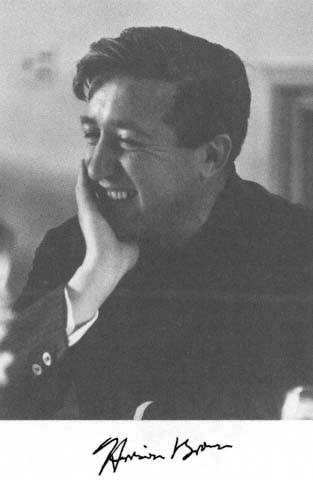
HARRISON BROWN
September 26, 1917 -December 8, 1986
BY ROGER REVELLE
HARRISON SCOTT BROWN WAS born in Sheridan, Wyoming, on September 26, 1917, the son of Harrison H. Brown, a rancher and cattle broker, and Agnes Scott Brown, a piano teacher and a professional organist. His father died when he was ten years old, and mother and son moved to San Francisco, where Mrs. Brown supplemented her income as a dental assistant by teaching music and playing piano for silent movies. Young Harrison grew up to be a competent pianist, who organized his own jazz orchestra. He played entirely by ear; apparently, his mother had never taught him to read music.
After graduating from Galileo High School in San Francisco, where he is said to have built his own chemistry laboratory, he entered the University of California at Berkeley, and received a B.S. in chemistry in 1938. One of the faculty members who influenced him was the chemist, G. E. Gibson, who did research on stable isotopes and their separation by mass spectrometry and gaseous thermal diffusion. Another Berkeley professor, Robert D. Fowler, also interested him in nuclear chemistry. When Fowler moved to Johns Hopkins
Roger Revelle died on July 15, 1991. This memoir was reviewed and revised in small part by Edward Goldberg, Claire C. Patterson, and George Tilton.
University, Harrison followed him there as a graduate student. Before that time, Harrison had married Adele Scrimger, and they had a son, Eric Scott Brown, who later became a marine biologist. For his doctoral studies, Harrison developed mass spectrometric techniques for studying the isotopic composition of cobalt as part of the development of knowledge concerning relative stabilities of nuclides, and of the more general case of occurrences of nuclear species in solar nebula formed from nuclear reactions in stars. With the discovery of nuclear fission in 1939, Brown and Fowler devoted their attention to the diffusion properties of uranium hexafluoride. Within a year they found themselves with the largest gaseous uranium fluoride generating capacity in the United States and they were soon major suppliers of uranium tetrafluoride and hexafluoride to embryonic atomic fission projects initiated at Columbia University and the University of Chicago.
In 1942 Harrison was asked by Glenn Seaborg to join him in the Metallurgical Laboratories at the University of Chicago, to work on the use of the chemistry of plutonium to separate it from uranium where it had been generated in fuel rods of atomic reactors. He and his colleague, Orville Hill, discovered at the University of Chicago that plutonium could be separated from uranium by gaseous evaporation of fluorides prepared by dry fluoridation. Harrison moved with other members of the Chicago group to Oak Ridge, Tennessee, where, at the Clinton Engineering Works (wartime code name: X-10), he worked with a small group to continue development of procedures that might be used for isolating gram quantities of plutonium from its trace occurrences in metallic uranium fuel rods. These procedures, involving dry volatilization of fluorides, were intended to serve as an alternative fall back, if needed, to liquid chemical separation procedures that were being concurrently
developed in the Oak Ridge pilot plant for isolation of plutonium. These latter methods later served as the chemical engineering framework eventually used at Hanford to produce kilogram amounts of plutonium used in the bomb exploded over Nagasaki three years after Harrison has started his postdoctorate work concerning plutonium at the University of Chicago.
After the two atomic fission bombs were exploded and the war with Japan ended, Harrison joined other Manhattan Project scientists in expressing their grave concern about the future, for no matter what strong justifications for their involvement in the bomb project may have been during the war, they felt powerfully committed to do things that would help rectify existing social evils. By December 1945, Harrison had completed a 160-page book, Must Destruction Be Our Destiny? (Simon and Schuster, 1946), warning about the extreme dangers of nuclear weapons. It was typical of him not to be satisfied with simply writing a book. He was concerned that it should have the maximum possible political impact, and for this purpose he gave 102 lectures within three months throughout the United States. He used royalties from the book sales to support the work of one of the organizations of atomic scientists that later became part of the Federation of American Scientists whose aims and efforts were directed to proper regulation of atomic power and weapons.
In 1946 Harrison returned to the University of Chicago as assistant professor in the Department of Chemistry and the Institute for Nuclear Studies, where some of his faculty colleagues were also former members of the Manhattan Project. Both he and they were driven by powerful urges to focus their attentions on new concepts for developing scientific knowledge in fields as far from military applications as possible. These concepts had been nurtured to fruition
in their minds as outgrowths of insights generated from the engineering developments they had devised during work on the atomic bomb, and some of these ideas led to their creating at the University of Chicago a new scientific field: nuclear geochemistry. Research developments in this arena exerted an enormous impact in the fields of Earth and planetary sciences and revolutionized them during the next several decades. Methods for measuring paleo temperatures were developed by Harold Urey, Samuel Epstein, Heinz Lowenstam, Mark Inghram, and their student colleagues. Methods for measuring C14 ages were developed by Willard Libby, James Arnold, and their student colleagues, while methods for measuring potassium/argon ages were developed by Mark Inghram, Jerry Wasserburg, and John Reynolds. The concept of the nuclear shell model was developed by Maria G. Mayer, who used nuclear mass abundance data provided in part through studies carried out by Harrison Brown, Hans Suess, and their colleagues.
During this same period Harrison's outstanding intuitive ability as a scientist became focused on problems in three major fields: estimating relative elemental abundances in the solar system by determining the composition of meteorites; determining the temporal progress of magmatic evolution of the Earth's crust by measuring uranium/lead ages of common igneous rocks; and determining the age of the Earth by measuring the isotopic composition of lead in iron meteorites. He had developed these concepts through earlier doctoral studies in measuring isotopic abundances by mass spectrometric techniques in collaboration with colleagues who worked in fields of neutron activation analyses, in fields of elemental solar abundances coupled either with nuclear stabilities and structures or with the chemical composition of the proto-earth, and in the field of geology.
As part of his aim in dealing with nuclear reactions and
stabilities of end products in evolving stars, relative abundances of nuclear species in solar nebula, chemical composition of condensed planetary material in evolving solar systems, and evolution of planetary atmospheres, he stimulated and focused the interests of his student, Edward Goldberg, into developing and applying the first neutron activation analytical methods used in the Earth sciences to studies of trace occurrences of gallium, gold, palladium, and rhenium in meteorites. The correlation between Ga and Ni in Goldberg's study led to the first grouping of iron meteorites based upon geochemical data. These data formed part of a larger context Harrison developed of occurrences of elements in solar nebula resulting from nuclear reactions, which helped his colleagues Hans Suess and Maria Meyer formulate concepts concerning shell stabilities of the atomic nucleus.
Another of his major aims dealt with the development of new uranium/lead dating methods which could be used to revolutionize geological knowledge of the chronology of the evolution of the crust of the Earth. Previous studies of scattered, ore-grade occurrences of uranium minerals, using chemical and mass spectrometric techniques that required tens of milligrams of samples of lead, uranium, and thorium for measurements of isotopic compositions and concentrations, had established, through measurements of parent-daughter occurrences within those gram-sized minerals, a mere handful of geologic ages in the Earth's crust. Harrison stimulated and focused the interests of two students, George Tilton and Claire Patterson, to develop new methods that could operate on micro scales to perform similar measurements on micro minerals that occurred generally in igneous rocks throughout the crust, which in turn allowed uranium/lead geochronometric measurements to be made ubiquitously within the entire scale of geologic
strata, with no requirements for special occurrences as macro minerals. This allowed a large amount of geochronometric data to be generated that enabled geologists to develop sophisticated chronological interrelationships among geological evolutionary features that described the history of maturation of the Earth's crust. His student, George Tilton, developed a new isotope dilution mass spectrometric method for determining trace amounts of uranium in micro quantities of igneous rock minerals. To do this Tilton had to track down, evaluate, and eliminate ubiquitous sources of uranium contamination that existed in the laboratory he was using at Argonne National Laboratory, in order to properly utilize the ultra-sensitive IDMS analytical method for uranium he had developed. His student, Claire Patterson, developed new ultra-sensitive mass spectrometric methods for measurements of abundances and isotopic compositions of micro amounts of lead in micro quantities of igneous rock minerals. He too had to solve serious lead contamination problems in order to properly utilize the new IDMS method he had developed for lead. Harrison's colleague, Esper Larson, Jr., of Harvard, provided the samples of rocks and minerals used by Tilton and Patterson in their work. They succeeded in establishing a foundation of knowledge concerning how to determine the ages of common igneous rocks and how to use lead isotopes to trace chemical pathway origins of crustal magmas and rocks. They and other investigators developed and expanded investigations based on this foundation to build our present large body of knowledge concerning the geologic evolution of the Earth's crust.
Another of Harrison's aims involved determining the Earth's age. The Earth is older than its minerals, so it's age cannot be measured by direct radiogenic measurement. However, it can be obtained from mathematical combinations of decay parameters, and isotopic composition of ura-
nium today with isotopic compositions of the Earth's lead, today and at the time it was formed. All of these had been measured and were reasonably well known except the last item, the isotopic composition of primordial lead. Harrison conceived the idea from his studies of nuclear abundance data in meteorites that it could be measured in iron meteorites, which were reported to contain traces of lead but essentially no uranium, because the latter had been sequestered in silicate meteorites.
Harrison encouraged Patterson to isolate lead from an iron meteorite and determine its isotopic composition. To do this Patterson had to spend many years discovering and solving difficult lead contamination problems that had not been encountered before, not only because the amounts of lead involved in the measurements were thousands of times smaller than any studied previously, but also in part because the amounts of lead he found in iron meteorites were much less than had been reported by previous investigators to be present. Harrison obtained financial support and facilities for Patterson throughout the years of this work, which finally yielded, in combination with the determination of the isotopic composition of lead in silicate meteorites, the first close approximation of the age of the solar system and of the Earth, of 4.5 billion years.
Harrison suggested that it might be possible to extend these concepts to determine the age of formation of the elements themselves by making use of extinct radioactive nuclides such as iodine 129. He also carried out theoretical studies with his University of Chicago faculty colleagues to propose features of the secondary origin of the Earth's present atmosphere, using differences between relative abundances of noble gases in solar nebula source material at the time of Earth formation and relative abundances of the gases in the present atmosphere. Working with faculty col-
leagues Patterson and Mark Inghram, Brown generated a striking series of findings linking the chemical and isotopic composition of meteorites with those of the Earth, the other planets, and the Sun.
The concentration of scientific talent in the Institute for Nuclear Studies at the University of Chicago in the early 1950s was unprecedented. Fifteen members of the faculty and graduate student bodies became members of the National Academy of Sciences. Harrison Brown was elected to the Academy in 1955 at the unusually early age of 37. He had moved several years before, in 1951, to the California Institute of Technology as professor of geochemistry. Earlier, Harrison and Adele had gotten a divorce, and Harrison married Rudd Owen. Rudd worked as a colleague with Harrison in his humanitarian writings and social endeavors.
In his geochronometric studies as Brown's student, George Tilton discovered that most of the uranium in granitic rocks could be leached out of the pulverized rock with dilute acid. Harrison seized on the concept that here was an enormous potential source of uranium fuel for atomic power reactors. The energy available from utilizing in this manner the uranium and thorium recovered from one ton of granite would be equivalent to that contained in about 15 tons of coal, making it possible to operate an energy-rich world powered by breeder reactors for millions of years. He stimulated his geologist postdoctoral student, Leon Silver at the California Institute of Technology, to develop sophisticated knowledge of occurrences and stabilities of uranium and thorium containing micro minerals in rocks (related to development of knowledge concerning magmatic origins of those rocks using lead isotopic tracers), which Harrison used to promote the recognition of the existence of potentially unending supplies of energy that might become available to society in the future.
At Caltech, as at Chicago, he gathered graduate students and colleagues around him, collaborated with Jesse Greenstein and other Caltech astronomers, brought Patterson with him from Chicago, attracted Bruce Murray from MIT, helped initiate the field of infrared astronomy, introduced new types of telescope instrumentation, and greatly bolstered the involvement of Caltech and its Jet Propulsion Laboratory in NASA's early missions of planetary exploration.
Starting in 1949, Harrison Brown went frequently to Jamaica where he first came in contact with the problems of rapid population growth and technological backwardness in the Third World. From this experience he wrote his most famous book, a monumental survey of the human prospect entitled The Challenge of Man's Future, published by the Viking Press in 1954 and reprinted in 1984.
In this book he contended that the division of human society into a set of industrialized, relatively prosperous nations containing a minority of the world's population, and a set of primarily agrarian nations containing an impoverished majority, is not only unsatisfactory from a humane point of view but is fundamentally unstable and cannot persist. Either the agrarian nations would become industrialized, he argued, or the collapse of machine civilization would produce a mainly agrarian world of virtually universal poverty and misery. Whether the first outcome would materialize would depend on mankind's achieving a stable human population size, a sustainable agriculture and industry, harmony with its environment, peace, and freedom.
Bertrand Russell and Albert Einstein proposed in 1955 an international conference of scientists, including scientists of the two great antagonists in the Cold War, the Soviet Union and the United States, to discuss the dangers and the possible control of nuclear weapons and problems of
international cooperation across the Iron Curtain that separated the Soviet Union and Eastern Europe from the West. The first of these conferences was held in July 1957 in Pugwash, Nova Scotia, the birthplace and country home of industrialist Cyrus Eaton.
The series of annual conferences held ever since, together with many specialized smaller meetings, have been collectively named the Pugwash Conferences. From the beginning Harrison was one of the leaders in organizing and directing these conferences. His protege, John P. Holdren, has been for several years chairman of the International Pugwash Council and of the American sponsoring committee. The agenda was soon broadened to include problems of Third World development, European security, and certain environmental problems. For example, the International Foundation for Science, which supports research by young Third World scientists in their own countries, is a direct outcome of the Pugwash Conferences.
In 1957, Detlev Bronk, president of the National Academy of Sciences, asked Harrison to organize a new committee on oceanography (actually the fourth Academy committee on the subject). Bronk chose Harrison to be chairman of the committee (usually called NASCO for short) because of Brown's skill in dealing with temperamental, often egotistical leading scientists. The directors of the three major oceanographic institutions—Woods Hole, Lamont, and the Scripps Institution—were all members of NASCO, as was Fritz Koczy of Miami, Dixie Lee Ray of University of Washington (later governor of Washington), Gordon Riley of Yale, Benny Schaefer of the Inter-American Tropical Tuna Commission, and Athelstan Spilhaus, the inventor of the Bathythermograph and at that time dean of engineering at the University of Minnesota. Harrison succeeded beyond any reasonable expectation in harnessing these disparate,
highly competitive individuals into a cooperative working team. Within less than two years they had produced a famous report entitled ''Oceanography 1960,'' which described many opportunities for oceanographic research and advocated a ten-year program of large-scale expansion of scientific research and teaching about the ocean.
One of the reasons NASCO was successful was that Harrison made sure everyone enjoyed himself. Sumner Pike, former member of both the Atomic Energy and the Securities and Exchange Commissions, was an original member of NASCO. Beside being a gifted raconteur with a wonderful down-east accent, Pike was the senior member of the family that had settled and largely owned Lubec, Maine, the farthest east and northern town in the United States. NASCO used to meet every summer in this Pike family fiefdom and practically lived on Maine lobsters while they were there.
George Kistiakowsky, President Eisenhower's science advisor, decided to use the NASCO report as a demonstration of what a presidential science advisor could do in organizing and influencing the federal government. This suited Harrison very well, because as usual he was determined that the report should not sink into oblivion, but should become the basis of political action. Both the House and the Senate were persuaded to create permanent committees or subcommittees on oceanography, and the federal budget for support of oceanographic research was greatly increased in real terms. Later the NASCO report was widely emulated by groups of scientists in other fields, who found their own opportunities for research and justified expansion of their budgets.
In 1962 H. P. Robertson, foreign secretary of the National Academy of Sciences, died suddenly. President Bronk asked Harrison to fill in Robertson's unexpired term. He
agreed, and then was repeatedly reelected as foreign secretary for a total of twelve years. Before Brown's tenure the Office of the Foreign Secretary had been a small, low-key operation, concerned with communicating with academies of science in other countries. Harrison converted it partially into a development agency, concerned with fostering science and technology in the Third World countries of Africa, Asia, and Latin America. For this purpose he assembled a competent and dedicated staff, including Wilton Dillon, Michael Dow, Julian Engel, John Hurley, Victor Rabinowitch, Theresa Tellez, Murray Todd, Noel Vietmeyer, and others. Interested scientists were organized in a series of regional science boards for Latin America, Asia, and Africa. After a few years these were consolidated in the Board on Science and Technology for International Development, which is now the Academy's leading agency for technical assistance to Third World countries. With strong support from the Ford, Rockefeller, and Kellogg Foundations, and the U.S. Agency for International Development, some fifty workshops and study groups on aspects of science and development in a dozen countries resulted in educational, research, and industrial projects as well as in the creation of scientific bodies and institutions. These were described in a book published in 1973 by Harrison Brown and Theresa Tellez, International Development Programs of the Office of the Foreign Secretary.
As foreign secretary, Harrison was equally interested in fostering East-West exchanges and collaboration. He helped organize the Committee on Scholarly Communication with the People's Republic of China, a joint venture between the National Academy of Sciences, the Social Science Research Council, and the American Council of Learned Societies. He promoted a variety of other exchanges with the Soviet Union and European countries, both East and West. He played a key role in founding the International Insti-
tute for Applied Systems Analysis (IIASA) in Laxemberg, Austria, in which the Soviet Union, the United States, and ten other nations joined together in cooperative research on large-scale problems of energy, water, ecosystem modelling, and regional planning. One of IIASA's recent accomplishments is the work by W. C. Clark and R. E. Munn on the nature and requirements of indefinitely sustainable agriculture. Brown was a member of IIASA's first executive committee and chairman of its finance committee.
Harrison Brown also focused his concerns on the International Council of Scientific Unions, linking academies of science in some sixty countries, plus international scientific unions in seventeen fields. He worked hard to increase the council's effectiveness in scientific development in the Third World and in global collaboration on problems of agricultural productivity, environmental degradation and hazards, and climate change. In 1974 he was elected president of ICSU for the two-year term of 1974-76.
Even after his task as foreign secretary was completed in 1974, Harrison continued to make major contributions to the Academy. In 1975 he was asked to chair a large-scale study of world food and nutrition and to make recommendations as to what the United States might reasonably do to help improve the situation. The study was completed in 1977. Its principal conclusion was that sufficient food and an adequate level of nutrition could be provided on a sustainable basis for a human population of ten billion, provided successful research efforts were undertaken and utilized on increasing yields per hectare and on nitrogen fixation by leguminous and cereal plants. The principal problem was to insure the use of research results by poor and ignorant farmers in the Third World. Late in his career, Harrison and Rudd were divorced and Harrison married Theresa Tellez, anthropologist from New Mexico.
After a number of years as professor of geochemistry at Caltech, Harrison received a joint appointment both as a professor of science and government and as a professor of geochemistry. In this new role he undertook a series of studies of human population problems in collaboration with economist Alan Sweezy. However, Harrison became increasingly dissatisfied with the pace of development of the social sciences at Caltech, and in 1977 he accepted the appointment as director of the newly created Resource Systems Institute at the East-West Center in Hawaii. There he assembled a team of analysts, including energy and environment specialist Kirk Smith, geologist Richard Sheldon, marine scientist John Bardach, and energy economists Fereidun Fesharaki and Corazon Siddayo. They concentrated on international comparative studies, mainly with Asian colleagues who were brought to the institute as visitors.
Harrison retired from the East-West Center in 1983 and moved to Albuquerque with his wife, Theresa. By this time he was confined to a wheelchair as a result of progressive paralysis caused by irradiation of his spine during therapy for an earlier bout with lung cancer. Despite his disabilities he was persuaded to become editor-in-chief of the Bulletin of the Atomic Scientists. He attained thereby a highly appropriate platform to express his life-long concerns about the nuclear arms race. In a monthly series of editorials he proposed many ideas for cooling off and eventually eliminating the arms race. He continued to produce these editorials until shortly before his death on December 8, 1986. He would have been the first to rejoice at the events of 1989 which made his ideas largely irrelevant in the growing atmosphere of cooperation between the United States and the Soviet Union.
Harrison Brown was the author or editor of ten books, including one work of science fiction, The Cassiopeia Affair,
written in cooperation with Chloe Zerwick, which supposed the arrival of a message from the stars.
In the March 1987 Bulletin of the Atomic Scientists, Professor John Holdren published an eloquent memorial to Harrison. I will conclude this memoir by quoting part of Holdren's final paragraph. "Harrison Brown was a warm and witty man, cheerful, always a twinkle in his eye, and surprisingly modest . . . . I visited him in the hospital a week before his death, and the twinkle in his eye was still there . His friends will miss that twinkle as well as the extraordinary mind behind it. The world will miss his insights and the energy he devoted to making it a better place."


