
JAMES JEROME GIBSON
January 27, 1904–December 11, 1979
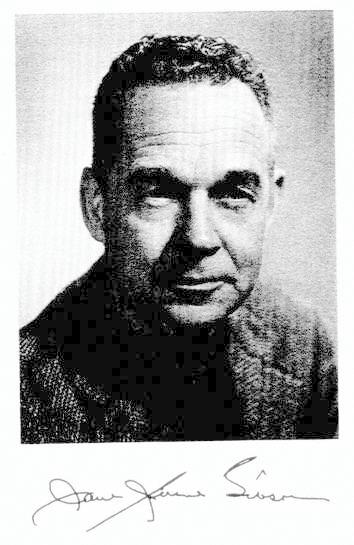
BY JULIAN HOCHBERG
AS I WRITE THIS, ten years have passed since James Jerome Gibson died, and his influence on perceptual psychology and related disciplines is as strong or stronger than ever. His analyses and arguments still continue to change the ways in which problems of perception of space and the environment, whether by humans or by computational models, are approached; books continue to be written about him (the latest was by Reed in 19881); and the solutions that he posed to problems he set, some of them in 1950, are still (or only now) being tested experimentally. To the degree that the Gibsonian revolution succeeds, it will replace all previous assumptions about how we must analyze information about the world that is offered to the sensory system by the environment; accordingly, it will replace our assumptions about what, in the course of perceptual development, must be learned and about how it is learned.
James Gibson was a man of great personal charm who was deeply and cheerfully engaged by ideas and who wrote and debated clearly, forcefully, and tirelessly. He was born on January 27, 1904, in McConnelsville, a small town in southeastern Ohio. His father, Thomas Gibson, was a surveyor for the railroads whose job took his family through
the Dakotas and Wisconsin until they settled in Wilmette, a suburb of Chicago. Gibson's mother, Gertrude, taught country school until her marriage to Thomas. James had two younger brothers, Thomas and William; the latter also became an academic, prominent in the field of American literature.
In 1921 Gibson enrolled in Northwestern University, transferring after his freshman year to Princeton. There he majored in philosophy, and, after a course in experimental psychology taken in his senior year with Herbert S. Langfeld, newly come from Harvard, he stayed on as a graduate student in psychology. From Edwin Bissell Holt, who came to Princeton in 1926, Gibson learned an enthusiasm for radical empiricism—the doctrine that the characteristics of our behavior (and indeed of our nervous systems themselves) reflect the ways in which the regularities of the world write upon the blank tablet of the organism that learns to behave appropriately in that world. Holt's was a sophisticated and elegant motor theory of consciousness in which the forms and contents of cognition are themselves aspects of bodily responses to the world.
Undertaken in this context, Gibson's doctoral dissertation, in 1938, refuted a recent thesis by Wulf (1922)2 reporting that subjects' memories of visual forms changed spontaneously toward simpler and more compactly organized configurations or Gestalten. Wulf was a student with Kurt Koffka, in Berlin, and Wulf's results were important because they seemed to reveal the operation of innate factors in form perception. The changes Gibson found, however, were more attributable to perceptual habit than to the organizational determinants of Gestalt theory, results consistent with Holt's empiricist framework.
This approach, based on a thoroughgoing empiricist behaviorism, was soon subject to a challenge that it did not
in the end survive. Gibson had received his B.S., M.A., and Ph.D. degrees in psychology from Princeton in 1925, 1926, and 1928, respectively, and went to teach psychology at Smith College in 1928, where he found Kurt Koffka, brought there in 1927. Koffka, with Max Wertheimer and Wolfgang Köhler, was one of the three most influential of the Gestalt psychologists. Koffka was then undertaking his general treatise, vigorously and explicitly opposed to the widely accepted theoretical framework epitomized by Helmholtz; to Koffka, the central question was "why do things look as they do?" and the answer lay in the organization imposed by the "field forces" of the central nervous system. Nearby, at Northampton, was another prominent Gestalt psychologist, Fritz Heider, who had introduced the terms distal and proximal stimulation to refer, respectively, to the physical properties of objects and to those of the stimulus patterns they provide to the sensory organs. To both Gestalt theorists, the organization necessary to provide for object perception could come only from the viewer and from the proximal input. Gibson was exposed to these eloquent anti-empiricist, antipositivist, antibehaviorists from 1928 until 1941, and, although he never accepted Gestalt theory and was eventually to take a position diametrically opposed to Heider's on the source of perceived object properties, his own approach as it evolved over the years was at least as close in several important respects to Koffka's as it was to Holt's.
In 1932 Gibson married Eleanor Jack, who was herself to become a major figure in the psychology of perceptual learning and development, an occasional collaborator, and a constant colleague. They had two children, James Jerome, Jr., in 1940, and Jean, in 1943. Gibson pursued a number of research topics during this period, most notable being
his studies on what has since become known as the "Gibson effect," in which the free inspection of a curved or tilted line results in an adaptation and after effect, so that a subsequently viewed line appears oppositely curved or tilted (1933, 1937, 1–3); the work pitting visual against proprioceptive indications of the gravitational vertical (1938, 2), initiated with O. H. Mower during a semester sabbatical that Gibson spent at Yale in 1936; and an analysis of automobile driving as visually guided behavior (with L. E. Crooks, 1938, 1).
The United States entered World War II in 1941, and in 1942 Gibson entered the Army Air Force. He was stationed briefly in Washington, where a program of psychological research was being organized, then in Fort Worth at the Flying Training Command for one and one-half years, and then at the Santa Anna Army Air Base for another two and one-half years. He went from captain in 1942 to lieutenant colonel in 1946. He was director of the Motion Picture Research Unit in the Aviation Psychology Program, the motion picture unit that was to develop visual aptitude tests for the screening of pilot applicants, and that toward the end of the war was given the immensely important question of how a training film conveys the information that film is best able to present. These matters and research on aircraft identification (done with R. M. Gagne) were published in 1947 and 1948 and were of central importance in the evolution of Gibson's approach.
With the end of the war, the Gibsons returned briefly to Smith College, moving to Cornell University in 1949, to which I came as a fresh Ph.D. the same year. Jimmy and Jackie, as they are known to virtually every psychologist in this country and abroad, remained on the Cornell faculty until their retirements. Jimmy taught there from 1949 un-
til 1972; because of the antinepotism rules then in force at Cornell, Jackie did not get a proper appointment until 1966, made possible by Jimmy having then received a National Institute of Mental Health Senior Career Development Award. During a leave from Smith, Gibson had been a research associate at Yale in 1935–36; during his tenure at Cornell, he was visiting professor at Berkeley (1954–55), a senior research scholar at Oxford, on a Fulbright (1955–56), a member at the Institute for Advanced Studies at Princeton in 1958–59, and at the Center for Behavioral Science in Palo Alto in 1964–65.
Gibson was never happier than when immersed in debate about ideas, which he almost always was. We were colleagues at Cornell from 1949 to 1964 and remained friends until 1979; we were engaged in continuous argument until 1964 and more intermittently during subsequent summers. Gibson had several goals, some of them essentially philosophical, and, intensely self-critical, he kept his approach under constant review and revision. Above all and throughout, however, he wanted a scientific discipline that would start to answer, as directly and immediately as possible, the perceptual question of why things look as they do—not simple patches of color in the laboratory, or line figures in demonstrations, but the things and layouts of the world in which we move and act, walk and drive and fly.
In 1950 Gibson published The Perception of the Visual World. I believe that book was the most important work on perception since that of Helmholtz's volume three of Physiological Optics, approximately a century earlier. It was a comprehensive approach to the perception of surfaces, things, and movement through the environment, primarily the outcome of his observations and thoughts about the visual
task involved in flying and landing aircraft. It had been foreshadowed by two shorter publications in 1947 and 1948, and Gibson's much earlier interest in the perceptual guidance of automobile driving.
The book was clearly intended to initiate a revolutionary movement. I believe that intention has, just as clearly, been successful. Some forty years after its publication, the book is still widely cited and controversial, the direct source of substantial current experimental research, and the starting point for more extreme departures from what had been the established way of thinking about perception. In order to explain Gibson's remarkable contribution, I will have to set his proposal against the background structure of presumptions and goals that were shared by the various disciplines—sensory physiology, psychology, philosophy, art theory, and now artificial intelligence—that are concerned with perception.
Gibson proposed a global psychophysics. Most prior psychophysical research dealt with the effects of local aspects of stimulation: for example, measuring how much two adjacent patches of light, at different wavelengths, must differ in energy if a viewer is to detect their difference, a line of inquiry shaped early by Helmholtz and Maxwell. The major purpose of psychophysical research was to analyze the fundamental human sensory capacities, or sensations, and their corresponding neural bases, such as the three cone types successfully predicted by the Young-Helmholtz theory. The two-dimensional receptor mosaic of cones and rods, and the sensations they provide when stimulated, were long thought to provide the sensory units by which all that we see is first analyzed and the sufficient units from which all visual perception derives.
By themselves such sensory units cannot even remotely
explain how objects and their distal attributes (such as size, shape, and reflectance) and the spatial layouts of the world (surfaces, distances, and movements) are perceived. An object's distance from the eye could not, of course, be conveyed by the light at any local receptor. In a tradition that goes back to fifteenth-century treatises in philosophy and art, perceived distance was therefore explained in terms of characteristic patternings, now called "depth cues," that modulate the light that the tridimensional normal world provides the eye's bidimensional sensory mosaic. Other properties were held to be perceptible only by routes that are even less direct: for example, although retinal image sizes and luminances vary, respectively, with object sizes and reflectances, and the latter two are essentially invariant physical attributes, retinal size also depends on the objects' distances, retinal luminance varies with illumination, and these viewing conditions are highly variable. The seeing conditions must therefore be discounted in some way: perceived size, it seemed clear, must rest on the depth cues as well as on retinal size; perceived reflectance must rest on illumination cues as well as retinal luminance.
In general, it seemed most parsimonious, and closest to what was believed true of neurophysiology when Gibson's first book was being written, that no new prewired nervous structures, beyond the receptor level of rods and cones, were needed to account for these abilities: the depth cues were supposedly learned from experience with the world, through mechanisms of associative learning that provided for learning in general; and object properties, like size, are perceived only after these depth cues are used to interpret the retinal image by means of nonsensory processes, like Helmholtz's still popular speculations about "unconscious inference," that perform what amount to problem-solving
computations to arrive at the objects' properties. Only then are such properties apparent to the viewer.
This simple armature underlay most thinking about man, mind, and behavior through mid-century. It was entertained in one form or another by most psychologists, physiologists, philosophers, political scientists, and theorists about art and meaning, and indeed by most thinkers within the Western tradition.
To Gibson, writing in 1950, sensations were irrelevant, the products of artificial and impoverished laboratory situations; the depth cues were merely artists' tools; and inference was an unnecessary postulate, when discussing normal perception, because the properties of objects and surfaces in the world—their slants, distances along the ground, sizes, etc.—are all perceived directly and are not inferred from the patterned mosaic of sensations through the use of higher mental processes. That is, the effective patterns to which our visual systems respond are themselves higher-order variables of stimulation. They are mathematically definable aspects of the patterning in the light to the eye, extended in space and time, that are in correspondence with those distal physical properties in the environment that are important for us to know. Gibson's book offered plausible candidates for such higher-order variables; for example, the gradient of texture-density along the ground specifies the slant of the surface to the line of sight, it specifies the distance of the object standing on the ground, and it specifies the object's size as well, with no inference needed for any of these—hence, the need for, and possibility of, a global psychophysics of objects and events.
There were, of course, precedents for some aspects of these assertions. There had been several earlier proposals of mechanisms that would provide for direct response to
such distal properties of objects as their reflectance and binocularly registered distance (notably by Ewald Hering and Ernst Mach). Gestalt psychologists had argued compellingly that patterns or configurations much larger than the individual receptor were treated as units by the nervous system. Few psychologists believed that the depth cues were used in processes of conscious and deliberate inference—it should be noted that the information provided by the patterning of stimulation was usually called "cues" in American usage, connoting a rapid and unthinking response, as opposed to "clues," which implies higher mental processes. And numerous but isolated psychophysical studies of object properties, often for the purposes of applied psychology, had been performed. But none of these precedents approached Gibson's bold and consistent programmatic account of visual perception.
Gibson's 1950 book and several papers that he and his colleagues published soon after on the optical information that is potentially available to moving perceivers (optic flow patterns and gradients of motion perspective) are only now receiving experimental vindication (e.g., Warren et al., 1989)3 but appear in myriad computational models of human and machine perception. The global psychophysics that Gibson then championed is now a firmly established field of inquiry.
Gibson received the Howard Crosby Warren Medal from the Society of Experimental Psychologists in 1952, was elected president of the Eastern Psychological Association in 1959, received the Distinguished Scientific Contribution Award of the American Psychological Association in 1961, and was elected to the National Academy of Sciences in 1967. These honors were given primarily in recognition of the global psychophysics and the revolutionary approach Gibson
initiated in 1950. But Gibson's initiatives did not stop there.
In the traditional view that Gibson had opposed in 1950, depth cues are learned much as words in languages are learned, by association with other patterns of sensation—reaching, touching, etc. For the viewer, patterns of stimulation have been "enriched" through associations accrued in the course of perceptual learning. In 1955 James and Eleanor Gibson argued that, because the information needed to account for perception is already present in the light at the eye, perceptual learning consists not of such associative additions but of a process of differentiation, a sharpening of the aspects of the changing flux of light to which the identification occurs. Psychophysics (including Gibson's global psychophysics of 1950) stayed close to physics not only for its measures of stimulation but also for the response properties it studied. Both a behaviorist background and a concern with practical problems would incline one to turn first, as Gibson did, to the perception of surfaces' distances and orientations. But if perceptual learning is driven by aspects of the world that the organism needs to distinguish, such psychophysics seems arbitrary.
Gibson himself soon left psychophysics behind. From his emphasis on a moving perceiver came The Senses Considered as Perceptual Systems (1966). The momentary retinal image, he now argued, is the wrong level of analysis, just as much so as the momentary static patterns of pressures on the fingers are the wrong level of analysis when the fingers explore an object (1962, 2): it is the invariants in the transforming patterns of stimulation of the sensory system that specify the relevant properties of the environment, not the successions of momentary arrays of light or pressure. Our sensory systems have evolved for active retrieval
of information about the environment; they are active systems sensitive to the invariant under transformation, not arrays of passive receptors merely responding to stimulation.
Perceptual information becomes available, therefore, through the interaction of the perceiver and the environment. Gibson's book, The Ecological Approach to Visual Perception (1979), suggests some of the information that viewers might obtain from interaction with their normal environments, including places and the paths between them along which movement can occur, sit-on-ableness, etc. Again, this approach was not without precedents: in particular, "cognitive maps" and "plans" are featured by other attempts to frame theories about informed purposive behavior. But Gibson's affordances are not mental structures. They are optical structures of information about the environment, structures that exist objectively but that must be defined in terms of the needs and potential behaviors of the individual animal.
Although Gibson's last books seem very different from the first in their goals and in the kinds of analyses they advocate, a consistent thread unites all three: a vigorous and direct attempt to frame an approach that operates at a level appropriate to the perceptual domain of interest. As to the first book, the virtually unbridgeable conceptual gap between retinal points of classical psychophysics, and the surfaces and distances of the real world, was finessed by the global psychophysics Gibson proposed in 1950. By the time of his second book, in 1966, the hopeless complexity of obtaining a stable world from moving eyes and head was simplified at a stroke, in Gibson's concepts of the optic array, optical proprioception, and sensory systems. The uncharted wilderness faced in getting from either of these
to a system capable of describing and studying how we navigate successfully in a world of objects and vistas was given a taxonomy and the potential for explanatory principles by 1979, as laid out in Gibson's third book. Although it is too soon to assess whether its consequences for research and theory will emerge as a coherent program and how inclusive its influence will be, the last two books have already had a remarkable impact—a society and journal dedicated to the study of event perception; an honorary degree bestowed on Gibson by Uppsala University in 1976; a flood of articles in the name of ecological psychology (and many in opposition as well); and at least four books since 1966 devoted to Gibson's views, not counting a Festschrift (MacLeod and Pick, 1974),4 Michaels and Carello (1981),5 Brickhard and Richie (1983),6 Lombardo (1987),7 and Reed (1988).8
Many of those who have taken up this approach, as well as those who oppose it, are philosophers, but there is also a solid core of experimental psychologists who are committed to it, and interest in the approach has shown no sign of flagging over the decade. James Gibson died on December 11, 1979. There seems to be a good chance that he will have left us with not only one but two successive and successful restructurings of perceptual psychology and its related disciplines.
THE BIOGRAPHICAL FACTS I have used come largely from Gibson's brief autobiography in A History of Psychology in Autobiography, vol. 5, eds. E. G. Boring and G. Lindzey (New York: Appleton-Century-Crofts, 1967); from Reed's biography; and from personal recollection.
NOTES
BIBLIOGRAPHY
1929 The reproduction of visually perceived forms. J. Exp. Psychol. 12:1–39.
1932 With E. G. Jack and G. Raffel. Bilateral transfer of the conditioned response in the human subject. J. Exp. Psychol. 15:416–21.
1933 Adaption, after-effect and contrast in the perception of curved lines. J. Exp. Psychol. 16:1–31.
1934 Retroaction and the method of recognition. J. Gen. Psychol. 10:234–36.
Vertical and horizontal orientation in visual perception. Psychol. Bull. 31:739 (Abstract).
With E. J. Gibson. Retention and the interpolated task. Am. J. Psychol. 46:603–10.
1935 Studies in psychology from Smith College, (Editorial). Psychol. Monogr. 46(6).
With L. Hudson. Bilateral transfer of the conditioned knee-jerk. J. Exp. Psychol. 18:774–83.
With D. Robinson. Orientation in visual perception: The recognition of familiar plane forms in differing orientations. Psychol. Monogr. 46(6):39–47.
With M. Radner. Orientation in visual perception: The perception of tip-character in forms. Psychol. Monogr. 46(6):48–65.
1936 A note on the conditioning of voluntary reactions. J. Exp. Psychol. 19:397–99.
With G. Raffel. A technique for investigating retroactive and other inhibitory effects in immediate memory. J. Gen. Psychol. 15:107–16.
1937 Adaptation with negative after-effect, and contrast in the perception of tilted lines: II. Simultaneous contrast and the areal restriction of the after-effect. J. Exp. Psychol. 20:553–69.
Adaptation with negative after-effect. Psychol. Rev. 44:222–44.
With M. Radner. Adaptation, after-effect and contrast in the perception of tilted lines: I. Quantitative studies. J. Exp. Psychol. 20:453–67.
1938 With L. E. Crooks. A theoretical field analysis of automobile-driving. Am. J. Psychol. 51:453–71.
With O. H. Mowrer. Determinants of the perceived vertical and horizontal. Psychol. Rev. 45:300–23.
1939 The Aryan myth. J. Educ. Sociol. 13:164–71.
1941 A critical review of the concept of set in contemporary experimental psychology. Psychol. Bull. 38:781–817.
Review of social psychology of modern life, by S. H. Britt. Psychol. Bull. 38:895–97.
Visual organization in relation to camouflage. In Perception, ed. S. W. Fernberger. Psychol. Bull. 38:432–68.
1944 History, organization, and research activities of the Psychological Test Film Unit, Army Air Forces. Psychol. Bull. 41:457–68.
1947 Motion picture testing and research. Aviat. Psychol. Res. Rep. no. 7. Washington, D.C.: U.S. Government Printing Office.
1948 Studying perceptual phenomena. In Methods of Psychology, ed. T. G. Andrews. New York: Wiley.
1950 With E. J. Gibson. The identifying response: A study of a neglected form of learning. Am. Psychol. 7:276 (Abstract).
The Perception of the Visual World. Boston: Houghton Mifflin.
The implications of learning theory for social psychology. In Experiments in Social Process: A Symposium on Social Psychology, ed. J. G. Miller. New York: McGraw-Hill.
The perception of visual surfaces. Am. J. Psychol. 63:367–84.
1951 What is a form? Psychol. Rev. 58:403–12.
Theories of perception. In Current Trends in Psychological Theory, ed. W. Dennis. Pittsburgh: Univ. of Pittsburgh Press.
1952 The visual field and the visual world: A reply to Professor Boring. Psychol. Rev. 59:149–51.
The relation between visual and postural determinants of the phenomenal vertical. Psychol. Rev. 59:370–75.
With W. Carel. Does motion perspective independently produce the impression of a receding surface? J. Exp. Psychol. 44:16–18.
With J. Cornsweet. The perceived slant of visual surfaces—optical and geographical. J. Exper. Psychol. 44:11–15.
With F. N. Dibble. Exploratory experiments on the stimulus conditions for the perception of a visual surface. J. Exp. Psychol. 43:414–19.
With D. Waddell. Homogeneous retinal stimulation and visual perception. Am. J. Psychol. 65:263–370.
1953 Social perception and the psychology of perceptual learning. In Group Relations at the Crossroads, eds. M. Sherif and M. O. Wilson. New York: Harper & Brothers.
1954 The visual perception of objective motion and subjective movement. Pschol. Rev. 61:304–14.
A theory of pictorial perception. Audio-Visual Commun. Rev. 1:3–23.
1955 With J. Beck. The relation of apparent shape to apparent slant in the perception of objects. J. Exp. Psychol. 50:125–33.
The optical expansion pattern in aerial locomotion. Am. J. Psychol. 68:480–84.
Optical motions and transformations as stimuli for visual perception. (Film). State College, Penn.: Psychology Cinema Register.
With E. J. Gibson. Perceptual learning: Differentiation or enrichment? Pschol. Rev. 62:32–41.
With E. J. Gibson. What is learned in perceptual learning? A reply to Professor Postman. Pschol. Rev. 62:447–50.
With P. Olum and F. Rosenblatt. Parallax and perspective during aircraft landings. Am. J. Psychol. 68:372–85.
With J. Purdy and L. Lawrence. A method of controlling stimulation for the study of space perception: The optical tunnel. J. Exp. Psychol. 50:1–14.
1956 The non-projective aspects of the Rorschach experiment: IV. The Rorschach blots considered as pictures. J. Soc. Psychol. 44:203–6.
1957 Optical motions and transformations as stimuli for visual perception. Pschol. Rev. 64:288–95.
With E. J. Gibson. Continuous perspective transformations and the perception of rigid motion. J. Exp. Psychol. 54:129–38.
With O. W. Smith. Apparatus for the study of visual translatory motion. Am. J. Psychol. 70:291–94.
1958 With O. W. Smith, A. Steinschneider, and C. W. Johnson. The relative accuracy of visual perception of motion during fixation and pursuit. Am. J. Psychol. 70:64–68.
The registering of objective facts: An interpretation of Woodworth's theory of perceiving. Curr. Psychol. Issues: Essays in Honor of Robert S. Woodworth, eds. G. Seward and J. Seward. New York: Holt.
Visually controlled locomotion and visual orientation in animals and men. Brit. J. Psychol. 49:182–94.
1959 With R. Bergman. The negative after-effect of the perception of a surface slanted in the third dimension. Am. J. Psychol. 72:364–74.
With E. J. Gibson, O. W. Smith, and H. Flock. Motion parallax as a determinant of perceived depth. J. Exp. Psychol. 58:40–51.
Perception as a function of stimulation. In Psychology: A Study of a Science, vol. 1, ed. S. Koch. New York: McGraw-Hill.
With K. von Fieandt. The sensitivity of the eye to two kinds of continuous transformation of a shadow-pattern. J. Exp. Psychol. 57:344–47.
1960 Pictures, perspective, and perception. Daedalus 86:216–77.
The information contained in light. Acta Psychol. 17:23–30.
The concept of the stimulus in psychology. Am. Psychol. 16:694–703.
1961 Ecological optics. Vision Res. 1:253–62.
1962 With E. J. Gibson, E. D. Pick, and H. Osser. A developmental study of the discrimination of letter-like forms. J. Comp. Physiol. Psychol. 55:897–906.
Observations on active touch. Pschol. Rev. 69:477–91.
With H. Flock. The apparent distance of mountains. Am. J. Psychol. 75:501–3.
With W. Schiff and J. Caviness. Persistent fear responses in rhesus monkeys to the optical stimulus of "looming." Science 136:982–83.
1963 The useful dimensions of sensitivity. Am. Psychol. 18:1–15.
With F. Backlund. An after-effect in haptic space perception. Q. J. Exp. Psychol. 15:145–54.
With A. D. Pick. Perception of another person's looking behavior. Am. J. Psychol. 76:386–94.
1965 Research on the visual perception of motion and change. Readings
in the Study of Visually Perceived Movement, ed. I. Spiegel. New York: Harper & Row.
1966 The problem of temporal order in stimulation and perception. J. Psychol. 62:141–49.
The Senses Considered as Perceptual Systems. Boston: Houghton Mifflin.
1967 With James J. Gibson. In A History of Psychology in Autobiographies, vol. 5, eds. E. G. Boring and G. Lindzey. New York: Appleton-Century-Crofts.
On the proper meaning of the term "stimulus." Pschol. Rev. 74:533–34.
Invariant properties of changing stimulation as information for perception. In The Origin of Human Information Processing: Symposium von XVII Int. Kongress für Psychology, ed. F. Klix. Berlin: Akademie-Verlag.
New reasons for realism. Synth. 17:162–72.
1968 What gives rise to the perception of motion? Pyschol. Rev. 75:335–46.
Depth perception. In International Encyclopedia of the Social Sciences New York: Macmillan.
The change from visible to invisible: A study of optical transitions. (Film). State College, Penn.: Psychology Cinema Register.
Are there sensory qualities of objects? Synth. 19:408–9.
1969 Further thoughts on the perception of rigid motion. In Contemporary Research in Psychology of Perception: In Honorem Kai von Fieandt Sexagenarii, ed. J. Jarvinen. Porvoo, Finland: Werner Soderstrom Osakeyhtio.
With G. Kaplan, H. Reynolds, and K. Wheeler. The change from visible to invisible: A study of optical transitions. Percept. Psychophys. 5:113–16.
1970 On theories for visual space perception: A reply to Johansson. Scand. J. Psychol. 11:75–79.
1971 The information available in pictures. Leonardo 4:27–35.
The legacies of Koffka's Principles. J. Hist. Behav. Sci. 7:3–9.
1972 A theory of direct visual perception. In Psychology of Knowing, eds. J. Royce and W. Rozeboom. New York: Gordon & Breach.
1973 On the concept of "formless invariants" in visual perception. Leonardo 6:43–45.
Direct visual perception: A reply to Gyr. Psychol. Bull. 79:396–97.
1974 A note on ecological optics. In Handbook of Perception, vol. 1, eds. E. Carterette and M. Friedman. New York: Academic Press.
Visualizing conceived as visual apprehending without any particular point of observation. Leonardo 7:41–42.
1975 Pickford and the failure of experimental esthetics. Leonardo 8:319–21.
1976 Three kinds of distance that can be seen, or how Bishop Berkeley went wrong. In Studies in Perception: Festschrift for Fabio Metelli, ed. G. B. Flores D'Arcais. Milano-Firenze: Giunte Editore.
1977 On the analysis of change in the optic array. Scand. J. Psychol. 18:161–63.
The theory of affordances. In Perceiving, Acting and Knowing: Towards an Ecological Psychology, eds. R. Shaw and J. Bransford. Hillsdale. N.J.: Erlbaum.
1978 The perceiving of hidden surfaces. In Studies in Perception, eds. P. Machamer and R. Turnbull. Columbus: Ohio State Univ.
The ecological approach to the visual perception of pictures. Leonardo 11:227–35.
1979 The ecological approach to visual perception. Boston: Houghton Mifflin.
1980 Foreword. A prefatory essay on the perception of surfaces versus the perception or markings on a surface. In The Perception of Pictures, vol. 1, ed. M. A. Hagen. New York: Academic Press.
1982 What is involved in surface perception? In Organization and Representation in Perception, ed. J. Beck. Hillsdale, N.J.: Erlbaum.


