
6
CONDITION ASSESSMENT AND MONITORING TECHNOLOGY
Infrastructures normally deteriorate slowly and often in subtle ways that are difficult to observe until substantial damage has occurred. For some facilities the nature and rate of this deterioration are sufficiently well understood to warrant regular inspection and preventive maintenance. More often, the costs of such assessment must be weighed against the prospect of avoiding maintenance and accepting the risk of structural failure and its potential impact on service. Costs of condition assessment and monitoring often appear high because facilities are massive, geographically separated, not readily accessible, or difficult to examine without interrupting service. However, these costs are typically much lower than those incurred when service deteriorates or fails.
Concerns about various components of the infrastructure have traditionally made for a piecemeal approach to research, development, maintenance, and rehabilitation, but resource constraints and subsystem interactions mandate the more global system-wide view that underlies this study. Furthermore, experience has taught infrastructure professionals that environmental and economic as well as technical factors must be considered. Research on condition assessment and monitoring technology will have the greatest payoff if it fosters development and management of infrastructure as a broad, multidimensional service. Three research areas that offer high payoff potential are discussed in this chapter:
-
extension of science and technology for more effective techniques for nondisruptive, nondestructive, monitoring of facility conditions;
-
development of methods for system-wide condition monitoring; and
-
development of better ways to monitor environmental factors and manage by-products or residuals of infrastructure operation.
NONDISRUPTIVE, NONDESTRUCTIVE, CONDITION-MONITORING TECHNIQUES
Nondestructive evaluation of the entire infrastructure is a key element in the effective management to insure maximum benefits to users and minimum costs to owners. Evaluation methods must deal with both surface and subsurface elements: e.g., street and highway and rail networks at grade, in tunnels, and on bridges; intermodal transfer facilities (e.g., ports and airports); pipelines and cable networks; and water supply and wastewater treatment facilities.
Current condition assessments, using both visual and mechanical non-destructive evaluation methods, are meant to provide data for deciding on effective maintenance, rehabilitation, and replacement actions. Research on assessment methods could enhance timeliness and availability of information for decision making. Condition assessment of structures and site characterization are considered in this section.
Structural Assessment
Research on structures is relevant to a wide range of infrastructure. Bridges and electric-power or telecommunication transmission towers are perhaps the most obvious applications, followed closely by institutional buildings. However, the design and management of water and waste containment structures, highway pavements, and tunnels and pipelines have all been substantially improved by developments in such areas as finite-method analysis, characterization of dynamic loading, and stress-strain behavior of complex materials. Much of this work is done by professionals specializing in particular types of structures or materials.
Improved maintenance and rehabilitation of pavements could significantly decrease the cost of goods transport both in terms of truck operating expense and reduction of goods damage from rough roads. The same is true for rail networks since improved maintenance and rehabilitation can prevent damaging and costly derailments. Nondestructive testing is a part of this evaluation process. The SHRP (Strategic Highway Research Program) provided impetus to methods for nondestructive pavement evaluation.1 However, effort is still needed to assess pavement condition and structural capacity. In addition, improved methods for measuring the pavement profile are needed to minimize pavement damage and optimize packaging of goods as well as to establish roughness criteria for the emerging Intelligent Vehicle-Highway Systems.2
The structural response of institutional buildings and bridges to severe loading conditions, such as seismic and hurricane force winds, is not yet fully understood. Designers must rely on empirically derived design methods and codes. Research can enhance knowledge of the behavior of such structures under severe loading, development of damage and failure, and analysis of risk.
Typical questions for research might include the following examples:
-
How can accurate indicators of pavement condition and profile be developed and maintained for street and highway pavements in service without disrupting traffic speed and flow?
-
Can more accurate and cost-effective methods be found for measuring and monitoring in situ characteristics of pavements, that protect the pavement's performance capability (e.g., nondestructive methods)?
-
How can structures be effectively instrumented to monitor response to dynamic or transient loading where partial collapse or failure of elements may occur?
-
What methodologies can be effectively applied to detect and monitor critical stress changes and damage in steel, concrete, and timber bridges?
-
Can adaptive control devices (e.g., self-healing devices) and supporting algorithms be developed to cost-effectively reduce structural failure risks under nonlinear response and large deformations?
-
Can "smart" and "intelligent"3 materials be developed for structural monitoring and control purposes in buildings and other structures subjected to low-intensity repetitive loading?
-
Can automated, nondestructive detection, measurement, and evaluation methods be developed for building maintenance and rehabilitation and for sewage collection and water distribution systems?
Site Characterization
Site characterization, an essential part of condition assessment and monitoring technology, deals with procedures to locate and define features within the subsurface environment. For the infrastructure, subsurface environment may be distinguished at two different scales: "near-surface," typically within 5 meters of the ground surface, or "conventional depth," encompassing soil, groundwater, bedrock, and underground structures within the zone of influence associated with particular construction activities.
The near-surface zone contains the pavement, most buried utilities, and relatively shallow underground structures. It is within this zone that the majority of new utility installations and maintenance are carried out.
Because of the crowded nature of urban and suburban neighborhoods, it is highly desirable to identify and locate existing utilities and obstructions without excavation. Avoiding the disruption that accompanies excavation yields great advantages with respect to time, risk exposure, and environmental impact. The effective use of nonintrusive sensing procedures is important for promoting reliable and cost-effective applications of trench-less construction.4
Nonintrusive sensing technologies such as electromagnetic methods, magnetometers, acoustics, ground penetrating radar, and infrared detection systems are now used for locating buried pipelines and obstructions. Some of these technologies, such as electromagnetic methods, have been used in practice for a number of years. For example, electromagnetic technology was developed in conjunction with user feedback and has evolved into a variety of commercially available devices. Questions remain, however, regarding measurement accuracy, maximum operative distances and coverage areas, and signal strength from various inductive devices. Research may also provide the bases for other technologies.
Such technologies, developed initially for exploration, may be adaptable to infrastructure condition monitoring and management, especially for underground conduits and pipelines, tunnels, and other buried structures. Remote on-line chemical monitoring of water quality during treatment and distribution and in-service performance of telecommunications equipment (e.g., switches, repeaters, and signal amplifiers) could improve system reliability and economy.
Typical questions for near-surface research might include the following examples:
-
How can improvements be made in signal transmission and processing to enhance application of magnetometers and ground-penetrating radar for reliable location of buried utilities?
-
Which nonintrusive sensing technologies are most promising for locating subsurface plastic piping, and how can the accuracy of such procedures be enhanced?
-
Are there combinations of various sensing technologies which, in aggregate, provide an improved and more accurate detection system?
Conventional-depth site exploration and characterization typically rely on soil borings and soundings. These methods are used for in situ soil and rock testing and to recover soil and rock samples for laboratory assessment. Such in situ testing devices as cone penetrometers, pressuremeters, dilatometers, and vane-shear equipment, and geophysical methods such as seismic refraction and electrical resistivity are capable of delineating underground features at a relatively small scale and with moderate refinement, but substantial improvements could be made in accuracy and cost-
effectiveness. Transfer of technology from medical and other fields offers particular challenge and promise.
Typical questions for conventional-depth research might include the following examples:
-
Can seismic tomography (i.e., three-dimensional images created by processing seismic data) be developed for more detailed site characterization?
-
Can spectral analysis of surface waves, either generated by special on-site equipment or by background microtremors associated with street traffic or other ambient activities, yield useful information on conventional-depth conditions?
-
What geophysical methods, or combinations of methods, are well suited to delineating subsurface strata and constructed facilities, and what degree of resolution and accuracy can be achieved in crowded urban settings?
-
Can geophysical methods or penetration devices be applied to characterizing intrusion, concentration, and migration of contaminants in groundwater?
SYSTEM-WIDE CONDITION ASSESSMENT
Component interdependence and the inevitable competition for both monetary and spatial resources make system-wide condition assessment of the infrastructure an important concern, distinct from individual components. Condition monitoring and assessment may be needed continuously or at regularly scheduled intervals throughout the system, but is essential where failure would be catastrophic. The 1992 flooding of freight tunnels in Chicago, which knocked out other systems throughout a multi-block downtown area, illustrated the system-wide effects and monumental costs that can be caused by damage to a single infrastructure element. Research can yield better methods for characterizing system behavior, monitoring system condition, and anticipating and responding to threats to overall performance.
Typical questions for research might include the following examples:
-
Can flow monitoring determine location and severity of obstructions, damage, or leakage in water-supply and sewerage networks?
-
Can real-time data collection and computer-based simulation be combined effectively for management of infrastructure lifeline systems to improve both service reliability and emergency response strategies?
-
How can the degree of risk associated with aging, weakened, and abandoned infrastructures be assessed and evaluated?
-
Can protocols, storage and access systems, and financing arrangements be developed for centralized data repositories for complete site profiles (e.g., buried utilities, subsurface conditions, environmental hazards, and hydrologic conditions) in metropolitan areas?
ENVIRONMENTAL FACTORS AND MANAGEMENT OF RESIDUALS
Infrastructure systems and the environment interact in many and often subtle ways. Infrastructure may be the source of contaminants that require monitoring, control, and disposal. Increasingly numerous and stringent environmental regulations have added new constraints to which infrastructure design and operation must respond.
The primary concern addressed in these regulations is the residuals or waste products of infrastructure activities that influence air and water quality, energy consumption, and solid waste management (e.g., construction wastes and roadside rubbish). At the same time, infrastructure plays a role in the management of residuals of other activities, for example when the ash from coal-fired electricity generation processes is used in concrete. Research can yield both better understanding of these interactions of infrastructure and environment and more effective ways to use these interactions to enhance environmental quality while maintaining high levels of service in the infrastructure.
Chemical Grouting
The effect of chemical grouting,5 commonly used in both foundation construction and waste containment, on groundwater quality must be carefully analyzed and monitored to avoid adverse effects on water supply. The introduction of new grouting materials and procedures has been effective, yet raises grave concerns as to their effects on groundwater quality. Both laboratory and full-scale field studies are necessary to determine the effectiveness and long-term impact of grouting. Typical research might consider whether more effective procedures can be developed for characterizing and monitoring the water-quality influence of grouting, or whether new chemical grouts pose a threat to groundwater safety.
Management of Infrastructure Waste and Residuals
The services that infrastructure provides (e.g., transportation and waste disposal) themselves produce residuals that must be managed. Research is needed to enhance understanding of the processes of waste production and ways to reduce and manage these wastes.
Disposal of residential and commercial wastes in landfills or abandoned mine and quarry excavations poses threats to surface and groundwater quality and hazards related to methane and hydrogen-sulfide emissions. The large areas and heterogeneous compositions of landfills make their management more challenging. Research leading to development of continuous monitoring of process variables and ambient conditions would facilitate process optimization and risk management.
Typical questions for research might include the following examples:
-
Can improved techniques be found for monitoring the change in landfill properties (e.g., density, compressibility, and permeability due to biodegradation)?
-
What procedures will be most effective for monitoring long-term effects of groundwater seepage in altering landfill constituents and diffusion of contaminants?
Air-pollution monitoring technology has focused primarily on vehicle emissions and pollution concentrations, with relatively little linkage to traffic operation and control. Research could lead to better strategies for traffic control to reduce both emissions and concentrations of vehicular air pollution. A typical research project might consider whether computational models can be developed to link vehicle emissions and traffic flow data, to support metropolitan traffic management.
Urban heat gain in heavily congested areas results in high cooling energy use and may exacerbate problems associated with urban smog. Landscaping using shade trees and light-colored surfaces can lower air temperatures and reduce energy consumption for cooling. Light-colored surfaces stay cool because they typically have a high albedo6 and reflect solar radiation that would otherwise heat the surface. Using more highly reflective surfaces to increase the albedo of a city would conserve energy and reduce pollution, an alternative that is both economically and environmentally attractive. However, reflections from buildings often cause significant increases in the temperatures of surrounding sites, making the problem of reducing urban heat gain very complex.
Typical questions for research might include the following examples:
-
Can meteorological and smog modeling be used to assess the effects on air quality of metropolitan urban and landscape design to control albedo?
-
What are the relative merits of conventional dark-colored and more reflective alternative materials for extensive urban surfaces (e.g., roofs and pavements)?
Sewage treatment in metropolitan areas yields substantial volumes of sludge that is typically sent to landfills for disposal. Some progress has been made in the search for alternative uses for this residual material, but many questions remain regarding how to increase the proportions of waste that can be used and whether products manufactured with sewage sludge as a constituent pose particular hazards.7 Typical research might explore instrumentation, data collection and analysis systems, and other tools needed to support cost-effective, long-term performance monitoring and assessment of paving blocks, vitrified blocks, and other products that incorporate sewage sludge.
NOTES
|
1 |
SHRP was a multi-year program established by federal legislation, following a recommendation by NRC. |
|
2 |
IVHS refers to applications of electronic guidance-system and computer technology in highways and vehicles to enable higher system performance. |
|
3 |
The terms ''smart'' or "intelligent" are used in this context to denote materials that provide indicators of their condition without additional instrumentation (e.g., by changing color or emitting electrical signals). |
|
4 |
Refer also to Chapter 8 for discussions of trenchless and other underground construction research issues. |
|
5 |
Chemical grouting involves injection of low-viscosity material, such as Portland cement or bentonite clay slurry, into porous soil and rock formations to strengthen or significantly reduce the permeability of the formation. |
|
6 |
Albedo is a scientific measure of the degree to which energy is reflected rather than absorbed. Absorption of solar energy raises the temperature of highways and roofs to levels much higher than surrounding air temperatures. |
|
7 |
Uses of residuals in construction and product development is also a subject for research in the science of materials performance and deterioration (Chapter 7). |
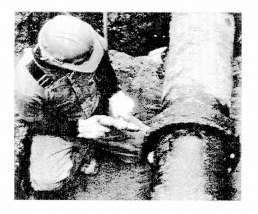
PIPE INJECTION WITH ANAEROBIC SEALANT
NEW MATERIALS FOR AGING INFRASTRUCTURE
Hundreds of thousands of miles of cast iron mains are used for U.S. water and gas distribution—over 10,000 miles in New York City alone. To improve the performance of these aging systems, new materials—using polyurethanes and anaerobic methacrylates—are being developed by gas utility and chemical companies to seal leaking joints. Because of the scale of U.S. infrastructure, more effective use of materials presents significant opportunities for improved performance and cost savings.

CYCLIC TEST OF POLYMER SEALANT
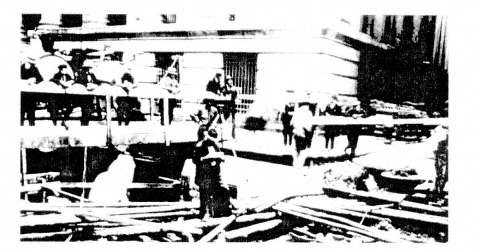
PIPELINES UNDER WALL STREET
New York City, circa 1917


