
NOTICE: The project that is the subject of this report was approved by the Governing Board of the National Research Council, whose members are drawn from the councils of the National Academy of Sciences, the National Academy of Engineering, and the Institute of Medicine. The members of the committee responsible for the report were chosen for their special competences and with regard for appropriate balance.
This report has been reviewed by a group other than the authors according to procedures approved by a Report Review Committee consisting of members of the National Academy of Sciences, the National Academy of Engineering, and the Institute of Medicine.
The National Academy of Sciences is a private, nonprofit, self-perpetuating society of distinguished scholars engaged in scientific and engineering research, dedicated to the furtherance of science and technology and to their use for the general welfare. Upon the authority of the charter granted to it by the Congress in 1863, the Academy has a mandate that requires it to advise the federal government on scientific and technical matters. Dr. Bruce M. Alberts is president of the National Academy of Sciences.
The National Academy of Engineering was established in 1964, under the charter of the National Academy of Sciences, as a parallel organization of outstanding engineers. It is autonomous in its administration and in the selection of its members, sharing with the National Academy of Sciences the responsibility for advising the federal government. The National Academy of Engineering also sponsors engineering programs aimed at meeting national needs, encourages education and research, and recognizes the superior achievements of engineers. Dr. Robert M. White is president of the National Academy of Engineering.
The Institute of Medicine was established in 1970 by the National Academy of Sciences to secure the services of eminent members of appropriate professions in the examination of policy matters pertaining to the health of the public. The Institute acts under the responsibility given to the National Academy of Sciences by its congressional charter to be an adviser to the federal government and, upon its own initiative, to identify issues of medical care, research, and education. Dr. Kenneth I. Shine is president of the Institute of Medicine.
The National Research Council was established by the National Academy of Sciences in 1916 to associate the broad community of science and technology with the Academy's purposes of furthering knowledge and of advising the federal government. Functioning in accordance with general policies determined by the Academy, the Council has become the principal operating agency of both the National Academy of Sciences and the National Academy of Engineering in providing services to the government, the public, and the scientific and engineering communities. The Council is administered jointly by both Academies and the Institute of Medicine. Dr. Bruce M. Alberts and Dr. Robert M. White are chairman and vice-chairman, respectively, of the National Research Council.
Funding for the project was provided through the following agreement between the indicated federal agency and the National Academy of Sciences: National Science Foundation Grant No. MSS-9116411, under master agreement 8618642.
Disclaimer. The grantee is responsible for assuring that every publication of material based on or developed under this grant, except scientific articles or papers appearing in scientific, technical or professional journals, contains the following disclaimer:
"Any opinions, findings, and conclusions or recommendations expressed in this material are those of the author(s) and do not necessarily reflect the views of the National Science Foundation."
Library of Congress Catalog Card Number: 94-67335
International Standard Book Number: 0-309-05144-4
Additional copies of this report are available from:
National Academy Press
2101 Constitution Avenue, NW Box 285 Washington, D.C. 20055 800-624-6242 or 202-334-3313 (in the Washington Metropolitan Area)
Copyright 1994 by the National Academy of Sciences. All rights reserved.
Printed in the United States of America
COMMITTEE FOR AN INFRASTRUCTURE TECHNOLOGY RESEARCH AGENDA
Chairman
JAMES P. GOULD, Partner,
Mueser Rutledge Consulting Engineers, New York, New York
Members
EDWARD COHEN, Managing Partner,
Ammann and Whitney, Consulting Engineers, New York, New York
THOMAS J. EGGUM, City Engineer,
Department of Public Works, City of St. Paul, Minnesota
EZRA D. EHRENKRANTZ, Chair,
Architecture and Building Science, School of Architecture, New Jersey Institute of Technology, Newark
CARL MONISMITH, The Robert Horonjeff Professor of Civil Engineering,
University of California at Berkeley, Department of Civil Engineering
ROBERT S. O'NEIL, President,
De Leuw, Cather & Company;
President,
Parsons Transportation Group, Washington, D.C.
THOMAS D. O'ROURKE, Professor of Civil Engineering,
Cornell University, Ithaca, New York
JOSEPH C. PERKOWSKI, Manager,
Advanced Civil Systems, R&D Bechtel National, Inc., San Francisco, California
JOHN RAMAGE, Vice President,
CH2M Hill, Inc., Milwaukee, Wisconsin
SARAH SLAUGHTER, Assistant Professor,
Civil Engineering, Lehigh University, Center for Advanced Technology for Large Structural Systems, Bethlehem, Pennsylvania
JOEL A. TARR, Richard S. Caliguiri Professor of Urban and Environmental History and Policy,
Carnegie Mellon University, Pittsburgh, Pennsylvania
Liaison Members
KEN P. CHONG, Director,
Structural Systems and Construction Processes Program, National Science Foundation, Arlington, Virginia
JOHN B. SCALZI, Program Director for Structures and Building Systems,
National Science Foundation, Arlington, Virginia
MEHMET T. TUMAY, Director,
Geomechanics Program, Directorate for Engineering, National Science Foundation, Arlington, Virginia
National Research Council Liaison Representatives
NANCY RUTLEDGE CONNERY, Consultant,
Public Works Infrastructure, Woolwich, Maine
ALBERT A. GRANT, Chairman,
Committee on Infrastructure Consultant, Potomac, Maryland
RITA B. LEAHY,
Strategic Highway Research Program;
Visiting Assistant Professor,
Department of Civil Engineering, Oregon State University, Corvallis
Staff
MAHADEVAN MANI, Director,
Division of Infrastructure, Energy, and Environmental Engineering
ANDREW C. LEMER, Director,
Building Research Board (1988-1993)
PETER H. SMEALLIE, Staff Officer
PATRICIA M. WHOLEY, Staff Associate
MARY McCORMACK, Project Assistant
BUILDING RESEARCH BOARD (1992-1994)
Chairman
HAROLD J. PARMELEE, President,
Turner Construction Company, New York, New York
Members
RICHARD T. BAUM,* (Retired) Partner,
Jaros, Baum and Bolles, Consulting Engineers, New York, New York
LYNN S. BEEDLE, University Distinguished Professor of Civil Engineering and Director,
Council on Tall Buildings and Urban Habitat, Lehigh University, Bethlehem, Pennsylvania
CATHERINE BROWN, Director of Special Projects,
Design Center for American Urban Landscape, University of Minnesota, Minneapolis
GERALD L. CARLISLE,* Secretary-Treasurer,
International Union of Bricklayers & Allied Craftsmen, Washington, D.C.
NANCY RUTLEDGE CONNERY, Consultant,
Woolwich, Maine
C. CHRISTOPHER DEGENHARDT,* Chairman,
EDAW, Inc., San Francisco, California
AUGUSTINE A. DiGIACOMO, Partner,
Jaros, Baum and Bolles, Consulting Engineers, New York, New York
ELISHA C. FREEDMAN,* Regional Manager,
The Par Group—Paul A. Reaume, Ltd., West Hartford, Connecticut
DELON HAMPTON,
Delon Hampton & Associates, Washington, D.C.
DONALD G. ISELIN,
U.S. Navy Retired,
Consultant,
Santa Barbara, California
FREDERICK KRIMGOLD,* Associate Dean for Research and Extension,
Virginia Polytechnic Institute and State University, Alexandria
GARY T. MOORE, Professor of Architecture and Director,
Wisconsin Space Grant Consortium, University of Wisconsin, Milwaukee
WALTER P. MOORE, President and Chairman of the Board,
Walter P. Moore and Associates, Inc., Houston, Texas
J. W. MORRIS, U.S. Army Retired, President,
J. W. Morris Ltd., Arlington, Virginia
BRIAN P. MURPHY, Senior Vice President,
Prudential Property Company, Prudential Plaza, Newark, New Jersey
LESLIE E. ROBERTSON,* Director,
Design and Construction, Leslie E. Robertson Associates, New York, New York
JEROME J. SINCOFF, AIA, President,
Hellmuth, Obata & Kassabaum, Inc., St. Louis, Missouri
JAMES E. WOODS,* William E. Jamerson Professor of Building Construction,
College of Architecture and Urban Studies, Virginia Polytechnic Institute and State University, Blacksburg
APRIL L. YOUNG,* CRA Coordinator,
First American Metro Corporation, McLean, Virginia
Staff
MAHADEVAN MANI, Director,
Division of Infrastructure, Energy, and Environmental Engineering
ANDREW C. LEMER, Director,
Building Research Board (1988-1993)
HENRY A. BORGER, Executive Secretary,
Federal Construction Council
PATRICIA M. WHOLEY, Staff Associate
LENA B. GRAYSON, Program Assistant
MARY T. McCORMACK, Project Assistant
GEOTECHNICAL BOARD (1993-1994)
Chairman
JAMES K. MITCHELL,
University of California, Berkeley
Members
CLARENCE R. ALLEN,
California Institute of Technology, Pasadena
JOAN (JODIE) Z. BERNSTEIN,
Waste Management, Inc., Oak Brook, Illinois
DAVID E. DANIEL,
University of Texas, Austin
WILLIAM S. GARDNER,
W.S. Gardner and Associates, Blue Bell, Pennsylvania
JAMES P. GOULD,
Mueser Rutledge Consulting Engineers, New York, New York
FRANÇOIS E. HEUZE,
Lawrence Livermore National Laboratory, Livermore, California
CHARLES C. LADD,
Massachusetts Institute of Technology, Cambridge
JAMES D. MURFF,
Exxon Production Research Company, Houston, Texas
SHLOMO P. NEUMAN,
The University of Arizona, Tucson
THOMAS D. O'ROURKE,
Cornell University, Ithaca, New York
REUBEN SAMUELS,
Parsons Brinckerhoff, New York, New York
ROBERT L. SCHUSTER,
U.S. Geological Survey, Denver, Colorado
DON W. STEEPLES,
The University of Kansas, Lawrence
Staff
MAHADEVAN MANI, Director,
Division of Infrastructure, Energy, and Environmental Engineering
PETER H. SMEALLIE, Director,
Geotechnical Board (1990-1993)
JENNIFER T. ESTEP, Administrative Assistant
AMELIA B. MATHIS, Senior Secretary/Project Assistant
|
|
||||
|
|
||||
|
|
|
|||
List of Tables
|
Table 1 |
Infrastructure Research Niches and Suggested Topic Areas |
|||
|
Table 2 |
Estimated Infrastructure Research Spending in the United States, 1992 |
|||
|
Table 3 |
International Comparison of Infrastructure Research Spending |
|||
|
Table 4 |
Selected Research Organizations Associated with Professional and Trade Associations |
|||
|
Table 5 |
CIS Program Elements Recommended by the NSF Task Group |
List of Illustrations
|
|
''Infrastructure Blues,'' |
|||
|
|
Failure of Schoharie Creek Bridge, New York |
|||
|
|
Gateway Center, Union Station, Los Angeles |
|||
|
|
Battery Park City, Lower Manhattan, New York |
|||
|
|
Reconstruction of Croton Lake Gatehouse, New York |
|||
|
|
Morton Street Vent Shaft, Manhattan, New York |
|||
|
|
Computer Simulation of Emergency Water Supply |
|||
|
|
The Fire Alarm Telegraph |
|||
|
|
Bridge Inspection Data Processing |
|||
|
|
New Materials for Aging Infrastructure |
|||
|
|
Pipelines Crossing Transportation Arteries |
|||
|
|
Jacked Sewer Pipe on Staten Island, New York |
|||
|
|
Cable Railway Construction, New York, 1891 |
|||
|
|
Testing to Failure |
|||
|
|
New Materials, New Forms |
|||
|
|
Infrastructure in the Lab |
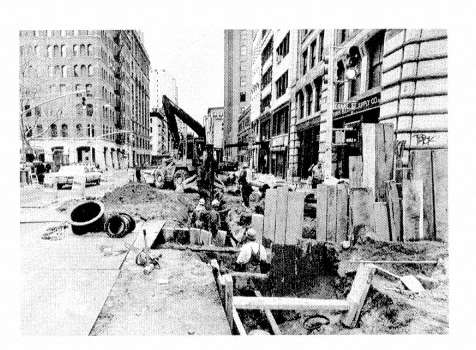
"Infrastructure Blues"
Replacing a 48" water main along Hudson Street in Greenwich Village, Manhattan, created havoc with the neighborhood. Begun in January 1992, to be completed in June 1994, it was halted periodically by rejection of the new pipe, teamster strikes, conflicting utilities, threat of contractor default, and holiday shutdowns and may be completed before June 1995. Developments in trenchless technology—for installation, renovation, and replacement of underground utility systems without open cut construction—has been rapid and extensive. The benefits of this technology in urban applications include reduced disruption of street traffic and adjacent businesses, longer service life of street pavement, improved safely far construction personnel, and ground movement and vibration hazards to nearby structures. (Photo courtesy of The New York Times)


