
3
Criteria for Comparing Disposition Options
The primary motivation of the U.S. government in its search for the most suitable means of disposition of surplus weapons plutonium (WPu)—and thus the primary motivation driving the current study—is to minimize the security risks posed by the existence of this material. Our parent committee concluded in its 1994 report that the tens of thousands of plutonium pits that will emerge over the next decade from the dismantlement of surplus nuclear weapons in the United States and Russia must be regarded as a "clear and present danger to national and international security," and we agree.
Accordingly, our discussion of relevant criteria for comparing the options for WPu disposition begins with the security risks: their nature, the disposition-option characteristics that influence them, and the formulation of figures of merit to quantify or otherwise illuminate those influences. The issues of timing and capacity—how quickly an option can be put into operation and how rapidly it can process WPu thereafter—will be seen to be tightly intertwined with other aspects of security, and we treat these matters together here. We then turn to criteria related to economics; environment, safety, and health; and other considerations.
TABLE 3-1 Threats Associated with Surplus Weapons Plutonium
|
Types of Threats |
||
|
1. |
Diversion of the WPu by the original possessor nation for reincorporation into nuclear weapons ("breakout"), which may be |
|
|
|
a. |
overt, or |
|
|
b. |
covert. |
|
2. |
Theft of the WPu by or for other countries or subnational groups, with or without the complicity of insiders in the custodial organization, by means that are |
|
|
|
a. |
forcible, or |
|
|
b. |
overt but not forcible (as could occur under loss of national authority), or |
|
|
c.. |
covert |
|
3. |
Harmful influences of the management of WPu on |
|
|
|
a. |
the strength and stability of institutions for nuclear weapons management and monitoring in the United States and the former Soviet Union; |
|
|
b. |
incentives and disincentives for further nuclear arms reductions in the United States, the former Soviet Union, and other nuclear-weapon states; |
|
|
c. |
incentives and disincentives for acquisition of nuclear weapons by other countries; and |
|
|
d. |
management of reactor plutonium in ways that increase its accessibility to prospective bomb-makers. |
|
Time Frames in Which the Threats May be Operative |
||
|
|
• |
the near term, roughly the next 10 years, within which the quantities of WPu accumulated from dismantlement activities are increasing and most disposition options would be in their developmental or initial operational stages; |
|
|
• |
the middle term, roughly from 10-50 years hence, within which most disposition options would be in full operation and at the end of which the bulk of the surplus WPu would have been processed; and |
|
|
• |
the long term, beyond 50 years hence, wherein the surplus WPu would be in whatever final form and location had resulted from the disposition option selected. |
CRITERIA RELATED TO SECURITY AND TIMING
The Context for Security Concerns and Criteria
In view of the linkages, noted earlier, between U.S. and Russian choices for disposition of excess WPu, we have been attentive in this report to circumstances in both countries. We have also been attentive to the implications, for choices about management of surplus WPu, of the existence of civilian stocks of both separated and unseparated plutonium, which pose security risks in widely varying degrees and which altogether contain considerably more plutonium than the military stocks.
It is necessary to ask, more specifically, what standards of physical protection and monitoring are appropriate for all of the various forms of plutonium that occur in both the nuclear-weapons and the nuclear-energy sectors. Related questions include:
-
Is it worthwhile to invest significant resources-or to tolerate significant additional delays, risks, and uncertainties-to transform the small stock of surplus WPu into a form that is substantially more difficult to recover for use in weapons than the larger and growing stock of plutonium in spent fuel?
-
Should the existing levels of security and monitoring for separated and unseparated civilian plutonium be upgraded, regardless of what is decided about the disposition of WPu?
-
Could the options that might become available for eliminating surplus WPu, or otherwise making it less accessible for use in weapons than is plutonium in civilian spent fuel, be expanded (with tolerable cost, uncertainties, and timing) to do the same with the global stock of plutonium in spent fuel if that were deemed desirable?
-
How might choices about the disposition of WPu influence decisions about the management of reactor plutonium in ways that affect-for better or for worse-the danger that the latter might be used in weapons?
Questions (a) and (b) relate to the strategy for managing the security risks from plutonium of all kinds, and we return to them shortly. Issues (c) and (d) relate to the properties and implications of particular candidate options for the disposition of WPu, and we address them in the subsequent sections devoted to those options.
Specific Security Concerns and Threat Characteristics
It is useful, for purposes of developing criteria relating to security, to subdivide the security threats associated with surplus WPu using the framework presented in Table 3-1, which distinguishes among threats of diversion (by the
original possessor nation), theft (by other countries or subnational groups), and harmful influences (with respect to nuclear weapons management, arms control, and nonproliferation). Options for the disposition of WPu should then be judged with respect to:
-
how the options would affect the difficulty, duration, cost, and detectability of attempts—within the categories of diversion and theft listed under items (1) and (2) in Table 3-1—to acquire WPu and carry out the processing and fabrication steps necessary to fashion it into functional nuclear bombs, and
-
on how the options might influence the weapon management, arms control, and nonproliferation institutions, incentives, and outcomes indicated under item (3) in Table 3-1.
Ideally, these evaluations should take into account the interaction of the time dimensions of different disposition options with the possible changes over time in the relative importance of different threats.
Candidate disposition options typically consist of several steps, beginning with intact nuclear weapons, proceeding through some number of intermediate processing, storage, and transport steps, and ending with either the physical destruction of the plutonium (by fission or transmutation) or its disposal in a form and location where it is intended to remain until its disappearance via radioactive decay. 1 Evaluation of the security benefits and liabilities of any such option, with respect to the threats described above, requires assessing the security risks, with respect to each type of threat, of each step the option entails. Such an assessment must take into account the barriers to acquisition and weapons use of the material associated with the form of the material at each step, the additional barriers to acquisition associated with the way the step is implemented, the quantities of material at risk at each step and the time interval during which it is at risk, and the interaction of these risk factors with the characteristics of the threat. These factors are summarized in Table 3-2.
A Matrix Scheme for Characterizing Options
The foregoing considerations suggest a matrix approach to characterization of the security implications of different options for the disposition of WPu, in which the rows of the matrix are the steps in an option and the columns portray,
TABLE 3-2 Factors Governing Security Risks of Disposition Steps
|
1. |
Relevant quantitative characteristics: duration, integrated inventory, dilution |
|||
|
|
a. |
start dates and end dates for the step in question; |
||
|
|
b. |
integrated inventory, i.e., average inventory in step times duration in years (kilograms-years); and |
||
|
|
c. |
dilution of plutonium in accompanying material (kilogram of material per kilogram of plutonium). |
||
|
2. |
Barriers to the acquisition and use of the material to make nuclear explosives, specifically |
|||
|
|
a. |
barriers intrinsic to the form of the material, including |
||
|
|
|
i. |
isotopic barriers, meaning the relative difficulty of making nuclear explosives with material of this isotopic composition, or the difficulty of suitably altering its isotopic composition; |
|
|
|
|
ii. |
chemical barriers, meaning the extent and difficulty of chemical processing required to separate the weapons usable substance(s) from accompanying dilutants and contaminants; |
|
|
|
|
iii. |
radiologic barriers associated with the radiation fields and internal dose potentials of the weapon-usable substance(s) and accompanying materials; and |
|
|
|
|
iv. |
barriers of mass and bulk, relating to the difficulty of moving the material in the course of theft or diversion, and the difficulty of concealing such activity. |
|
|
|
b. |
barriers dependent on the details of the option's implementation, including |
||
|
|
|
i. |
locational barriers, such as site isolation, difficult terrain, burial depth, difficulty of excavation and tunneling; |
|
|
|
|
ii. |
containment barriers, such as massive containers, vaults, buildings, fences, detectors, alarms; and |
|
|
|
|
iii. |
institutional barriers, such as proximity, capability, and reliability of guard forces, and intensity and reliability of monitoring. |
|
|
3. |
The characteristics of the threat, including |
|||
|
|
a. |
its type in the categorization scheme of Table 3-1; |
||
|
|
b. |
complicity of custodial organization or individuals within it; |
||
|
|
c. |
capabilities of attacking forces (numbers, weapons, training, organization, determination) in the case of forcible theft; and |
||
|
|
d. |
knowledge, skills, money, and technology available to the prospective bomb-makers. |
||
TABLE 3-3 Format for Characterizing Security Risks of a Disposition Option
|
|
Time and Quantity |
Dilution (kg of material per kg of Pu) |
Qualitative Evaluations (scale 0 to 4) of Intrinsic Barriersa |
Implementation-Dependent Barriers |
Qualitative evaluation of vulnerability (low, medium, high) based on threat-barrier interactions with respect to threats of |
|||||||||||
|
Step |
Start Date |
End Date |
Integrated Inventory (kg-yr) |
|
Isotopic |
Chemical |
Radiologic |
Mass/ Bulk |
Location |
Containment |
Institutional |
Overt Diversion |
Covert Diversion |
Forcible Theft |
Covert Theft |
|
|
A |
|
|||||||||||||||
|
B |
|
|||||||||||||||
|
C |
|
|||||||||||||||
|
D |
|
|||||||||||||||
|
E |
|
|||||||||||||||
|
F |
|
|||||||||||||||
|
G |
|
|||||||||||||||
|
H |
|
|||||||||||||||
|
I |
|
|||||||||||||||
|
J |
|
|||||||||||||||
|
a Intrinsic barriers refer to form of plutonium at end of step. Example: once-through mixed-oxide (MOX)/spent fuel option in light-water reactor (LWR), followed by eventual emplacement of spent fuel in geologic repository. Step A: Storage as pits. B: Conversion to oxide. C: Transport as oxide. D: Fabrication to MOX. E: Transport as MOX. F: Storage as MOX. G: Burnup in LWR. H: Spent fuel storage. I: Spent fuel transport. J: Repository disposal. |
||||||||||||||||
for each step, the quantitative and qualitative risk factors and the vulnerability to different types of threat in the light of those factors. The format for such a matrix is illustrated in Table 3-3 for a disposition option centered around converting the WPu into spent light-water reactor fuel. In Chapter 6 we fill in a few such matrices for the plutonium management options of greatest interest. In the following paragraphs we elaborate on the justifications for the entries in this scheme.
Start Dates
The date at which operations in a particular step would be expected to commence determines the beginning of the period of potential vulnerability for the step and is relevant for consideration of the interaction of (potentially) time-varying threats with the "opportunities" presented by the disposition option. The start date of the first disposition step beyond the storage of pits is a particularly informative indicator of security risk, since it reflects the duration of a phase of plutonium management that is problematic both from the standpoint of the attractiveness, for weapons purposes, of the stored material and from the standpoint that delay in moving beyond pit storage may call into question the commitment of the possessor states to actually demilitarizing this material, with potentially harmful influences on the prospects for further nuclear arms reductions and for nonproliferation. This first start date beyond pit storage depends on the state of scientific and technical readiness of the disposition option and the research and development time needed to remedy any defects in these respects: on the time needed to construct all of the relevant facilities; on the time needed to accomplish any necessary licensing steps; and on the time needed to gain acceptance for the option by the relevant publics and decision-makers (which might include, for example, local and state as well as federal officials, electric utility managements, or foreign governments).
End Dates
Clearly, the overall security risk associated with a disposition option depends, among other factors, on the lengths of time that the WPu spends in its most weapon-usable forms and most vulnerable locations and processes within the option—hence the relevance of durations of the steps within an option, as determined by the combination of start date and end date. These durations depend on the quantity of plutonium to be processed altogether and on the rate at which it can be processed. We base our quantitative estimates in this study on a nominal quantity of 50 tons of WPu, roughly the amount expected to become surplus in the United States by the year 2005. Processing rates are based on scales of operation we judge plausible in light of the capacities of existing relevant facilities (if any) and the trade-offs among cost, timing, and other aspects
of security. (This question of scale is addressed in detail in subsequent chapters dealing with individual options and in Chapter 6, dealing with comparisons.)
Integrated Inventory
Somewhat more informative than duration alone as an indicator of the security-risk "exposure" associated with a given step in plutonium disposition is the integrated inventory for that step, defined as the integral under the curve of quantity of WPu in the step versus time. As explained in Appendix A at the end of this chapter, this indicator can be calculated for processing and transport steps as well as for storage steps, given sufficient information about how these operations will be conducted. For the purposes of the preliminary comparisons undertaken in Chapter 6, which necessarily are based on quite sketchy and tentative characterizations of the options, we calculate integrated inventories only for two phases of the disposition process—the phase in which the WPu exists in the form of pits and the phase between conversion of the pits to oxides and the loading of this material into a reactor or melter (marking a great decrease in vulnerability). These two integrated inventory figures are, in our view, reasonably informative indicators2 of the timing aspect of security, and they are calculable with a minimum of assumptions about the details of the disposition options.
Dilution
An additional quantitative figure provided for each step is the degree of dilution of the plutonium in whatever matrix contains it, measured in kilogram of total material per kilogram of plutonium. This dilution figure can be used to determine how much material must be moved and processed to acquire a weapon's worth of plutonium.
Intrinsic Barriers
Our qualitative evaluations of barriers will employ a scale in which 0 means "negligible," 1 means "small," 2 means "medium," 3 means "large," and 4 means "very large.” This is not intended to be a linear scale but rather to denote qualitatively significant differences in the barriers to weapons use of the material. In cases where the differences do happen to be more or less quantifiable (as
with, e.g., the radiologic barrier), the difference between adjacent levels is an order of magnitude (factor of 10) or more. The meaning of the levels in relation to the different barriers is elaborated further in the following subparagraphs.
Isotopic Composition. Relevant aspects include fractions of plutonium-240 (Pu-240) and Pu-242, which affect critical mass and difficulty of design; fraction of Pu-238, which complicates design through its high heat generation; and fraction of Pu-241, which governs buildup of heat-generating and radiologically hazardous americium-241. We take high-enriched uranium (HEU) as the 0 ("negligible") reference point for isotopic barriers, and characterize weapons-grade plutonium (approximately 90 percent Pu-239) as 1, typical reactor-grade plutonium (approximately 60 percent Pu-239) as 2, and very-high-burnup plutonium (40 percent Pu-239 or less) as 3. Uranium with uranium-235 (U-235) or U-233 content less than 20 percent would qualify as 4, but no plutonium composition relevant to this study would so qualify.
Chemical Form. Relevant aspects include whether the plutonium is in metallic form (the most convenient for immediate use in a weapon, but not necessarily the most convenient for further processing or for storage if such steps will be part of a weapons effort) or oxide, carbide, nitrate, etc., and admixture of impurities (such as other metals, oxides, or carbides, or fission products, or other neutron absorbers, which, variously, affect chemical processing requirements and radiological hazard to bomb-makers). We take pure plutonium metal to be the 0 reference point for chemical barriers, and characterize pure plutonium oxides as 1, mixed uranium and plutonium oxides (MOX)—including MOX mixed with additional dilutents or neutron absorbers other than fission products—as 2, and plutonium embedded in spent fuel or vitrified radioactive waste as 4. (Here the jump from level 2 to 4 is not because the chemistry per se is very much harder, but because the penetrating radiation from the fission products necessitates that the chemistry be done using degrees of shielding and remote handling that greatly increase the difficulty.)
Radiologic Hazard. This barrier depends both on the gamma-emitting properties of the material, which govern the radiation field and shielding requirements associated with approaching and handling the material, and the beta- and alpha-emitting properties governing the hazards that occur if as a result of processing or dispersal the material is inhaled or ingested. We take natural, low-enriched, or depleted uranium to be the 0 reference point for radiologic hazard, and characterize HEU as 1, WPu in metal or plutonium oxide as 2, reactor plutonium in metal or plutonium oxide as 3, and plutonium in spent fuel or mixed with high-level radioactive wastes as 4.3 The twenty-fold or more dilution from
plutonium metal or oxide to MOX reduces the radiologic hazard one level: WPu in MOX is characterized as 1, and reactor plutonium in MOX as 2.
Mass/Bulk. This barrier relates to whether the form of the material permits ready partitioning in a way that facilitates concealment on the person of a thief or divertor (as would be the case with small quantities of HEU or plutonium metal or oxide, taken as level 0), or is readily portable by one person although somewhat more difficult to conceal (as in the case of a pit, level 1), or can be moved by one person but only with some difficulty and little chance of concealment (fuel assemblies weighing tens of kilograms, level 2), or requires a forklift (approximately 100 kg or more, level 3) or a crane (approximately 1,000 kg or more, level 4).
Implementation-Dependent Barriers
For these barriers, too, it is convenient to employ a scale of qualitative distinctions ranging from 0 for negligible barriers to 4 for very large ones.
Location/Exposure. We associate level 0 with transport, 1 with processing at multiple sites, 2 with processing at a single site or storage at multiple sites, and 3 with storage at a single site, and we add 1 if the sites are remote or otherwise difficult of access.
Containment. We associate level 0 with storage containers that can be opened by hand or ordinary tools and are not equipped with seals; and with material in unsealed processing equipment that can be similarly opened. Level 1 is for containers and processing equipment with seals that render any tampering detectable after the fact. Level 2 is for containers and processing equipment requiring more substantial tools (such as industrial cutting equipment) to open, and also equipped with seals. The characteristics of the next level of containment then add 0, 1, or 2 to the rating: 0 is for containment that could be breached quickly and easily by a single individual (such as an ordinary industrial building behind a chain-link fence); 1 denotes a significant extra degree of difficulty, making it unlikely that an individual or small group could enter the facility and reach the material before guard forces could respond (as might be achieved by alarmed fences, intrusion-detection devices, special locks and reinforcement on doors and other penetrations, etc.); and level 2 denotes a significant further level of difficulty (such as imposed by a highly engineered vault or vault-like building, deep burial, etc.) requiring such quantities of people, equipment, and time to overcome that such an intrusion could not be accomplished covertly, even with the assistance of insiders.4
Institutional Barriers. Here 0 would denote an absence of guards or other protective services beyond reliance on local police forces on the usual basis. Level 1 denotes typical industrial security in terms of private guard forces and monitoring of personnel entering and leaving. Level 2 denotes armed guard and monitoring capabilities that would be typical of a nuclear weapons laboratory such as Livermore, including the ability to counter intrusions that involve an insider at the facility. Level 3 denotes a capability (such as would characterize a nuclear weapons storage site) to successfully defend against organized attack by well-armed intruder groups—possibly including the participation of more than one insider—and corresponding inspection and monitoring capabilities. Level 4 means the same physical capabilities as 3, but with multinational or international participation that reduces the possibility of access to the material by the possessor country or by subnational groups under conditions of civil disorder.
The Threat and Vulnerability Interaction
Our characterization of vulnerability in the matrix format of Table 3-3 is presented in relation to four classes of threat: overt and covert diversion (categories 1.a and 1.b in Table 3-1), and forcible theft and covert threat (categories 2.a and 2.c). Harmful influences (all of category 3) do not lend themselves to characterization in the disaggregated step-by-step format of the matrix and so must be treated separately. Vulnerability at each step to each of the four threat categories considered are characterized simply as "low," "medium," or "high," based on our judgment about the effectiveness of the relevant barriers against the indicated threats. Any more discriminating characterization than this probably would not be warranted in light of the uncertainties associated with threats and barriers alike. Of course, the overall security risk associated with any combination of disposition option and threats will be disproportionately influenced by the characteristics of the most vulnerable step or steps in that option, because the threats are all associated with human intervenors who can be expected to seek out the points of greatest vulnerability. Accordingly, our security-risk comparisons among disposition options—presented in Chapter 6—stress the identification and characterization, for each option, of the most vulnerable step or steps.
The foregoing matrix scheme for characterizing security hazards bears some relation to official classification schemes for nuclear materials subject to safeguards, such as those of the U.S. Department of Energy (USDOE 1993c), the U.S. Nuclear Regulatory Commission (NRC) (OFR 1992c), and the International Atomic Energy Agency (IAEA 1987). The DOE scheme, based on a combination of material quantities and "attractiveness levels" related to our "intrinsic barriers," is shown in Table 3-4. The NRC classification is summarized in Table 3-5. The IAEA scheme is similar, defining "significant quantities" of different categories of material and characterizing "conversion times"
TABLE 3-4 Attractiveness Levels and Safeguards Categories From DOE Order 5633.3A
|
|
|
Safeguards Category (I = greatest concern) Versus Kilograms of Contained: |
|||||||
|
Type of Material |
Attractiveness Level |
Pu or U-233 |
U-235 |
||||||
|
|
|
I |
II |
III |
IV |
I |
II |
III |
IV |
|
Weaponsa |
A |
Any quantity is Category I |
Any quantity is Category I |
||||||
|
Pure productsb |
B |
>2 |
0.4-2 |
0.2-0.4 |
<0.2 |
>5 |
1-5 |
0.4-1 |
<0.4 |
|
High-grade materialsc |
C |
>6 |
2-6 |
0.4-2 |
<0.4 |
>20 |
6-20 |
2-6 |
<2 |
|
Low-grade materialsd |
D |
NA |
>16 |
3-16 |
<3 |
NA |
>50 |
8-50 |
<8 |
|
All other materialse |
E |
Any reportable quantityf is Category IV |
Any reportable quantityf is Category IV |
||||||
|
NOTE: NA indicates not applicable. a Assembled weapons and test devices. b Pits, major components, buttons, ingots, recastable metal, directly convertible materials. c Carbides, oxides. solutions of >25 gram per liter (g/l), nitrates, etc., fuel elements and assemblies, alloys and mixtures, UF4 or UF 6 at ≥ 50 percent enrichment. d Solutions of 1-25 g/l, process residues requiring extensive reprocessing, moderately irradiated material, Pu-238 (except in waste), UF4 or UF6 at 20-50 percent enrichment. e Highly irradiated forms, solutions of <1 g/l, uranium in any form and quantity containing greater than 20 percent U-235. f Is 1 g of Pu-239 to Pu-242 and enriched uranium, 0.1 g of Pu-238. SOURCE: USDOE 1993c. |
|||||||||
TABLE 3-5 Nuclear Regulatory Commission Definitions Characterizing Special Nuclear Material (bracketed numbers refer to paragraphs in the source document [OFR 1992c]
|
Strategic special nuclear material (SSNM) means plutonium, U-233, or U-235 contained in uranium enriched to 20 percent or more in U-235 [73.21] |
||
|
|
Formula quantity means SSNM in any combination that adds up to 5.000 g or more by the formula, grams U-235 + 2.5 (grams plutonium + grams U-233) [73.2]. |
|
|
|
Category IA material means SSNM directly usable in a nuclear-explosive device, except if |
|
|
|
• |
the dimensions are large enough to preclude hiding the item on an individual (defined as ≥2 m in one dimension, or >1 m in each of two dimensions, or >25 cm in each of three dimensions), or |
|
|
• |
the total weight of 5 formula kg of SSNM plus its matrix cannot be carried inconspicuously by one person (defined as ≥50 kg), or |
|
|
• |
the quantity of SSNM in each container requires protracted diversions in order to accumulate 5 formula kg (defined as <0.05 formula kg per container) [74.4]. |
|
Special nuclear material of moderate strategic significance means less than a formula quantity of SSNM but |
||
|
|
> 1,000 g U-235 contained in uranium enriched to 20 percent or more in U-235, or |
|
|
|
> 500 g of U-233 or plutonium, or |
|
|
|
> 1,000 g in combination calculated as grams contained U-235 + 2.5 (g U-233 + g Pu), or |
|
|
|
≥ 10,000 g U-235 contained in uranium enriched to >10 percent but <20 percent U-235 [73.2]. |
|
|
Special nuclear material of low strategic significance means less than an amount of special nuclear material of moderate strategic significance but |
||
|
|
> 15 g U-235 contained in uranium enriched to 20 percent or more in U-235, or |
|
|
|
> 15 g of U-233 or plutonium, or |
|
|
|
> 15 g in combination calculated as grams contained U-235 + g U-233 + g Pu, or |
|
|
|
> 1,000 g U-235 contained in uranium enriched to ≥ 10 percent but <20 percent U-235, or |
|
|
|
≥ 10,000 g U-235 contained in uranium enriched above natural but <10 percent U-235 [73.2]. |
|
|
Special nuclear material that is not readily separable from other radioactive material and that has a total external radiation dose rate in excess of 100 rem/hr at a distance of 3 feet from any accessible surface without intervening shielding is exempt from certain safeguards requirements [73.6]. |
||
estimated to be needed for a divertor to transform the material into a "finished Pu metal component;" the IAEA also presents a relation for estimating "expected accountancy capability," meaning the minimum loss of nuclear material that will be detectable with a given probability and given risk of false
alarm, as a function of the material stock or throughput and the measurement accuracy expected for IAEA safeguards applied to the activity in question (e.g., uranium enrichment, MOX fabrication). We have drawn on elements of all of these approaches in developing our own characterization scheme. Our scheme is more disaggregated and more context-dependent than these other approaches, as we believe is necessary in order to illuminate—as fully as present information and judgment allow—the security characteristics of alternative options for WPu disposition.
Criteria for Choice
Characterization of the security risks of the various disposition options in the matrix format just described will provide insight into the loci of greatest risk within each option, as well as a basis for judgmental comparison of overall risk between options. (The comparison involves judgment in reaching a conclusion from comparison of multiattribute and partly qualitative characterizations; we can find no defensible way to compute a single quantitative index of overall risk for each option, which would require agreeing on numerical values and relative weights for each relevant characteristic.)
A useful assessment should not only provide a basis for relative comparisons among options, however, but also should give some guidance with respect to some absolute standard of adequacy. It is important to ask, in other words, "How good is good enough?," and, having formulated such standards, to ascertain which options meet them. The 1994 study by CISAC put forward two standards for use in this connection, the "stored weapons standard" and the "spent fuel standard."
The "stored weapons standard" holds that "to the extent possible, the high standards of security and accounting applied to storage of intact nuclear weapons should be maintained for these [nuclear explosive] materials throughout [the] processes [of dismantlement, storage, and disposition]" (NAS 1994, p. 31). We take this standard to be appropriate for the management of WPu up to the point in the disposition process where the spent fuel standard has been attained. 5 The argument for the stored weapons standard is that the pathway leading from any separated plutonium form (a pit, an ingot, plutonium oxide, or even plutonium and uranium mixed oxide) is sufficiently direct and easily traversed by at least some potential proliferators that applying less than the stored weapons standard to the protection of such material could lead to the highly undesirable result that dismantlement of surplus nuclear weapons and disposition of their nuclear-explosive materials could produce an increase in proliferation risk.
The "spent fuel standard" means that the plutonium has become "roughly as inaccessible for weapons use as the much larger and growing stock of plutonium in civilian spent fuel" (NAS 1994, p. 34). We note that this does not imply a specific combination of radiation barrier, isotopic mixture, and degree of dilution of plutonium. Rather, it describes a condition in which WPu has become roughly as difficult to acquire, process, and use in nuclear weapons as it would be to use plutonium in commercial spent fuel for this purpose. The rationale for the spent fuel standard is, first, that the bulk, composition, and ionizing-radiation field of spent fuel pose very appreciable barriers to the theft or diversion of this material and extraction of the contained plutonium for use in nuclear weapons and, second, that the existence in the world of many hundreds of tons of civilian plutonium in spent fuel means that there would be little security gain from special efforts to completely eliminate the WPu, or to render it much less accessible even than the plutonium in spent fuel, unless society were prepared to take the same approach with the global stock of civilian plutonium.6 Addressing this global issue, on the other hand, would entail time periods (and costs) far greater than needed or appropriate to address the "clear and present danger" from the existing WPu.
Additional questions do suggest themselves, as indicated earlier in this section: To what standard of protection for WPu and civilian plutonium combined should society aspire in the longer term? How well does aging spent fuel need to be protected? Should separation of plutonium from fission products be avoided altogether? Should the inventory of plutonium be minimized, insofar as possible, by fissioning it in ways that do not produce more? Or should commerce in plutonium for energy production be allowed to become commonplace, accompanied by a vigorous effort to develop and implement safeguards adequate to the challenge this would represent? We do not think these questions can be answered except in the context of an evolving understanding of the role society expects nuclear fission to play in its energy future, and of the technological and institutional options through which fission might do so with reduced risks to both safety and security, compared to the fission technologies of today. These are crucial issues, but they go far beyond the mandate of this panel.
ISSUES AND CRITERIA IN ECONOMIC EVALUATION OF ALTERNATIVES
The monetary costs (or benefits) of alternative approaches to the disposition of WPu are of secondary importance compared to the security aspects: the security risks associated with this material are so great that it is difficult to imagine choosing the riskier of two candidate approaches because it saves money, all the more so because the total sums involved are unlikely to be nearly as large as those that the United States and the former Soviet Union routinely invested in the past in attempts to buy security against nuclear-weapon dangers. It is nonetheless worthwhile to illuminate the economic dimension of alternative disposition approaches as clearly as possible, both to assist in ranking schemes that are not readily distinguishable on security grounds and to facilitate planning for the investments that will be required for the option that is chosen.
Principles and Pitfalls in Cost Comparisons
The monetary costs of any disposition option arise in connection with preoperational, operational, and decommissioning phases: preoperational activities include research, development, demonstration, licensing, and construction of new facilities or modifications to existing ones; operational activities consist of the actual processing and handling of the surplus WPu; and decommissioning consists of dismantling the facilities, disposing of their components, and managing the sites (restoring them to other uses, or quarantining them) after the operational phase is over. For options that entail the generation of electricity in the course of plutonium disposition, revenues as well as costs will be associated with the operational phase.
Comparison of the economics of alternative options requires that the costs and revenues be estimated on a consistent basis. Such calculations can be quite complex, and the range of conventions and assumptions routinely used in carrying them out is wide. Relevant factors include:
-
the treatment of inflation;
-
whether the activities are carried out by government or civilian entities, or a combination, and corresponding assumptions about
-
the real cost of money and rates of return appropriate for the entities operating the option, and
-
property taxes and insurance costs associated with the facilities and operations involved;
-
-
conventions and assumptions relating to the components of the capital investments associated with the activities, including
-
the costs of land, materials, labor, and purchased components in the region where the option will be implemented;
-
-
the conventions by which indirect as well as direct costs are included in the calculation;
-
the size of the "contingency" factor allowing for anticipated but a priori unspecifiable sources of growth in construction costs beyond the baseline estimate; and
-
the inclusion or exclusion of interest on investments made before the operational phase commences (often termed "interest during construction," although in principle the category is broader);
-
the degree of comprehensiveness in inclusion of all of the facilities and operations needed to perform the plutonium disposition mission;
-
the means by which subsidiary benefits of plutonium disposition operations (such as the generation of electricity) are taken into account in the economic calculations;
-
the treatment of "sunk" costs in relevant facilities and operations, that is, costs incurred prior to the current consideration of the possible use of such facilities and operations for disposition of WPu; and
-
the operational lifetime of the facilities (or, in some cases, the period over which the investment in them is to be written off).
Variations and inconsistencies in the treatment of these factors make it practically impossible to derive informative conclusions about costs of alternatives from direct comparison of final cost estimates obtained in different studies of the individual disposition options; rather, it is necessary to construct a consistently based set of estimates starting from the building blocks (such as estimates of direct construction costs, or of labor and materials requirements) that such studies provide.7 In the paragraphs that follow, we explain our own assumptions about the factors (a)-(g), identify some generic uncertainties, and call attention to differences between our treatment and those of others.
Inflation and the Real Cost of Money
The concepts of inflation and real cost of money are reviewed in the box on p. 76. We choose 1992 U.S. dollars as our reference currency, and, following the Office of Management and Budget guidance for cost-benefit analysis of federal programs (OMB 1992), we choose the gross domestic product (GDP) implicit price deflator (annual average) as the index of inflation. We assume the post-1992 annual rate of inflation, based on this index, will be 3.0 percent per
|
THE CONCEPTS OF INFLATION AND REAL COST OF MONEY Because of inflation, the purchasing power of a dollar in 1993 is less than that of a dollar in 1992, that of a dollar in 1992 much less than that of a dollar in 1972, and so on. As a result, the rather common practice of calculating the total costs of an activity over a span of time by adding up its yearly costs in then-current dollars—as in, e.g., calculating U.S. defense spending for the 1980s as the sum of current-dollar defense expenditures for 1980-1989—amounts to an aggregation of apples and oranges (more precisely, of bigger apples with smaller ones). To avoid the distortion associated with this practice, expenditures (and income) from different years should be converted to the currency of a single reference year before being summed. Performing this conversion requires, in addition to the choice of a reference year, choice of an index of inflation from among such candidates as the consumer price index, the producer price index, and the implicit price deflator for gross domestic product (GDP); it may also require estimating future rates of inflation. (If inflation rates are high, it is appropriate to specify not just a reference year but a reference date for the currency, e.g., January 1, 1992 dollars.) Although the inflation rate and the time-value of money are sometimes conflated in perception and analysis, they are distinct concepts. If the effects of inflation are removed by working with constant dollars of a specified reference year, it remains true that having a 1992 dollar today is preferable to having a 1992 dollar next year, and preferable by far to having a 1992 dollar 10 years hence. This |
year.8 The corresponding relation of 1992 dollars to dollars of other years encountered in recent studies is shown in Table 3-6.
For federal government projects, values for the real cost of money in the range of r = 4-5 percent per year often have been used in recent years, corresponding to nominal rates of return on long-term government bonds in the range of 7 to 8 percent per year and inflation rates, experienced and projected, in the
|
time-value of money is associated, if the money is yours, with the real (inflation-corrected) rate of return that the money could bring if invested; and, if the money must be borrowed from a bank, or raised by the sale of stocks or bonds, its time-value is associated with the real rate of return you must pay its owners in order to have the use of it. It is conventional to use the term “cost of money" for both of these closely related cases. The real cost of money is equal to the nominal (current-dollar) cost of money minus the rate of inflation and is ordinarily expressed as an annual percentage rate. One must specify a figure for the real cost of money in order to compute the levelized annual capital charges associated with an initial investment that is to be retired over a specified number of years, or to compute the "present value" of a stream of future costs or revenues (see Appendix B at the end of this chapter). The real cost of money depends on the entities (individuals, institutions) involved and the financial instruments (e.g., bank credit cards, home mortgages, electric utility financing, venture capital, government borrowing)—including whether the returns involved are subject to income tax—and it varies with time because of macroeconomic conditions that affect the relative scarcity or abundance of capital. It is customary, for purposes of financial evaluation of projects, to choose a single annual percentage rate that is thought to be appropriate to the entities, context, and time frame involved. Since the choice of this figure is not only dependent on a variety of factors and judgments but also crucial to the outcome of project evaluations (often determining whether a given project will appear to be a moneymaker or money-loser), the question of what figure to choose can be controversial. |
range of 2.5 to 3.5 percent per year. A figure of 4 percent per year was chosen by the Technical Review Committee for DOE's Plutonium Disposition Study (USDOE 1993a), and, as noted, is certainly defensible as a value of the real cost of money to the government based on prevailing government-bond yields and inflation rates.
The guidelines published by OMB for benefit-cost analysis of federal programs, however, call for the use of a real cost of money of 7 percent per year for projects that have effects in the private sector, i.e., outside the government (OMB 1992). OMB (p. 9) identifies this figure as "approximately the marginal pre-tax rate of return on investment in the private sector in recent years." The rationale for using this figure for the analysis of federal projects is that use of a
TABLE 3-6 Inflation: Relation of 1992 Dollars to Dollars of Other Years
|
1982 |
1985 |
1986 |
1987 |
1988 |
1989 |
1990 |
1991 |
1992 |
1993 |
1994 |
|
0.695 |
0.783 |
0.803 |
0.829 |
0.862 |
0.900 |
0.939 |
0.977 |
1.000 |
1.030 |
1.061 |
|
SOURCE: The figures for 1982-1992 are derived from data for current-dollar and constant-dollar calendar-year (as opposed to fiscal-year) gross domestic product, as reported by the Council of Economic Advisors (CEA 1993); the index of inflation embodied in these figures is thus the implicit price deflator for GDP. The figures for 1993 and 1994 are based on our assumed inflation rate of 3.0 percent per year. |
||||||||||
lower one can lead in practice to what is seen as unfair government competition with the private sector or to unwanted taxpayer subsidy of projects too risky or unrewarding to be undertaken privately.
In any case, the OMB states (p. 9) that the 7-percent per year real rate is to be used for all "public investments and regulatory programs that provide benefits and costs to the general public," reserving lower figures for the analysis of cases in which a program's only effect is to save the government money. It is clear, therefore, that the 7-percent figure would be the appropriate one, in the view of the OMB, to use for the analysis of projects for the disposition of WPu—this is after all a public benefit, whether or not electricity is generated in the process—and we use this figure in most of our analyses. (It should be noted that the real cost of money used in the evaluations of private firms depends on project risk, tax liability, and shares of financing from debt and equity, as well as other factors, and the resulting figures are often considerably higher than 7 percent per year.)
Some consequences of DOE's decision to use a figure of only 4 percent per year in its Plutonium Disposition Study are discussed below.
Property Taxes and Insurance
Corporate and individual income taxes enter, where appropriate, into the determination of the real cost of money, while, by convention, property taxes and insurance are accounted for by the addition, to the fixed charge rate (FCR), of a simple annual percentage of the initial capital investment (see "The Concepts of Inflation and Real Cost of Money"). Government entities do not in general pay property taxes; private entities generally do. Government activities are usually "self-insured" (although liability is sometimes limited by law); private entities usually must pay for insurance. There is controversy about the existence, magnitude, and appropriateness of the "subsidies" for government activity associated with government's freedom from property taxes and insurance costs, and about whether evaluations of the costs of government projects should be
adjusted to cover these factors. In this study, we perform economic evaluations of facility costs both with and without an adjustment, to the fixed charge rate, of a nominal 2-percent per year of initial capital investment for the sum of property taxes and insurance. Thus we have:
FCR = | CRF (capital recovery factor) without allowance for property taxes and insurance | CRF + 0.02/yr with allowance for property taxes and insurance,
with CRF as given in Appendix B at the end of this chapter. The composition of the capital investment, I, to which the fixed charge rate is applied, is elaborated in "Composition of the Capital Investment" on p. 80.
Costs of Land, Materials, Labor, and Purchased Components
These "direct" costs of construction can vary significantly from region to region within the United States, and they can vary drastically between countries. Distortions in cost comparisons of different plutonium disposition options can arise from failure to account for such differences, as well as from inconsistencies in what has been included at all (e.g., whether land costs have been included).
In DOE's 1992-1993 Plutonium Disposition Study (PDS), no allowance was made for land costs, on the supposition that needed facilities would be constructed on existing DOE sites. Estimates of the costs of labor, materials, and purchased components are supposed to have been developed (in January 1, 1992 dollars) using standardized assumptions and models for a central-U.S. site as documented in the Nuclear Energy Cost Data Base maintained by the Oak Ridge National Laboratory (USDOE 1988). We have assumed, for purposes of our own economic evaluation, that these PDS direct-cost estimates were correctly and consistently obtained. In the several cases in which we consider plutonium disposition options not evaluated in the DOE study, we have assumed that the estimates of direct costs made available to us by others were derived by procedures roughly consistent with those used in the DOE work.
These assumptions are difficult to substantiate in the absence of a detailed vetting or reconstruction of the economic estimates in the various other studies, which would have required time and effort well beyond what was available to us for this study. They must be considered a source of significant uncertainty in our evaluation of the comparative economics of different options. This uncertainty is estimated on a case-by-case basis in Chapter 6; generally we take it to be in the range of ± 30 percent.
Relevant costs of labor, materials, and purchased components for plutonium disposition options would be much more difficult to estimate, of course, for the former Soviet Union. A recent study (Burns and Roe 1992) of fossil-fuel power-plant construction prospects in the former Soviet Union estimated labor costs at
|
COMPOSITION OF THE CAPITAL INVESTMENT The initial capital investment, I, which the capital recovery factor(CRF) multiplies to give the levelized annual capital charges (LACC), can be subdivided in any number of ways. In the analysis of large construction projects, the following categorization is widely used: I = OC + IDC, where OC is the "overnight" cost, meaning what it would cost to build the facility if this could be done "overnight," and IDC is "interest during construction." The overnight cost is given by OC = DCC + ICC + OPC + CGY, with DCC = direct construction costs, comprising the costs of construction labor, land, materials, and purchased components; ICC = indirect construction costs, comprising construction facilities, equipment, and support services, safety and environmental engineering, inspection and other quality-assurance activities, project administration, and the like; |
25 percent of those for the United States and material costs at 50 percent of the U.S. figures. We have seen another estimate that the total costs of construction and operation of facilities relevant to plutonium disposition should be assumed to be half as large in the former Soviet Union as in the United States. We consider the many difficulties of meaningful comparisons between U.S. and former Soviet Union costs to be so great, however, as to make them not worth attempting at the present time, and we have confined our detailed economic estimates to contexts outside the former Soviet Union.
Indirect Construction Costs
In detailed cost-estimation work, indirect construction costs are broken down into detailed subcategories that are estimated individually. In comparisons at the concept-evaluation level, however, it is customary to estimate the indirect costs either as a flat percentage of total direct costs, typically between 25 and 40
|
OPC = any other preoperational costs chosen for inclusion in a particular study, which could include research and development costs, costs of safety analysis and licensing work conducted by the government instead of by the contractor, and so on; and CGY = contingency, which is an allowance for sources of cost increases above the baseline capital-cost estimates, of kinds that inevitably arise but cannot be predicted in detail (and thus cannot be incorporated in the specific line-items in the direct- and indirect-cost budget estimates). Interest during construction, IDC, is calculated by escalating the constant-dollar value of investments made n years before the start of operation by a factor of (1 + r)n (with r the real cost of money), applying a factor of (1 + r)n+1 to the part of the investment made n + 1 years before the start of operation, and so on. When this quantity is being estimated in advance, it is customary to assume that the trajectory of cumulative investment versus time during the construction period will be an S-curve, which is to say that the distribution of annual investments will be symmetric around the midpoint of the construction period with the largest ones in the middle years. Issues and problems that arise in the estimation of these capital-cost components in the case of plutonium disposition options are elaborated in the main text. |
percent, or to divide the direct costs into two or three categories according to the expected amounts of "indirect" activities expected to be associated with them, applying a different indirect-cost percentage to each.
In the case of the contractor studies of advanced reactor options for DOE's PDS, the Department's Technical Review Committee (TRC) found that the treatment of indirect costs among the studies was not uniform (USDOE 1993a, p. SC6-5). It also appears, from our review of the contractor studies and the TRC report, that there were nonuniformities in the manner in which various preoperational costs were allocated between the "indirect-costs" category and a separate "preoperational-cost" category. It has been difficult to determine, from the often less-than-transparent contractor and TRC reports, how extensive and drastic these nonuniformities were, or to what extent the TRC was able to correct them in the process of arriving at its own adjusted cost estimates. It is, similarly, often difficult to tell what conventions concerning indirect costs were used in obtaining cost estimates found elsewhere in the literature for options not
considered in the PDS. These ambiguities represent a source of uncertainty of order ± 20 percent in our comparison of the DOE cost estimates with each other and with estimates for other options.
Contingency
The contingency is customarily calculated using a multiplier—typically 15-25 percent—on the sum of direct and indirect construction costs. In an attempt to gain more accuracy in cost estimation, the costs of a project sometimes are disaggregated into higher-uncertainty and lower-uncertainty components, to which different contingency multipliers are applied. (Given that the contingency factor is at best a rough attempt to capture sources of cost escalation that cannot be predicted in detail, the value of the more complicated approaches is questionable.)
DOE provided detailed guidance on the calculation of contingency factors to its contractors in the PDS, but the TRC found that the contractors' treatment of the contingency was "uneven" and varied from the guidance (USDOE 1993a, p. SC6-3). Again, it has not been easy for us to determine, in the time available for this work, either the magnitude of these variations or the extent to which the TRC was able to correct them in making its own adjusted cost estimates. It is similarly not always easy to tell whether cost estimates we have used for other options, from elsewhere in the literature, do or do not include a contingency factor. These ambiguities represent an additional source of uncertainty of order ± 20 percent in our comparison of the DOE cost estimates with each other and with estimates for other options.
Interest on Preoperational Investments
Since construction of major facilities inevitably extends over a span of years, the calculation of the effective capital investment as of the start of operation must account for interest on money spent for construction (and other preoperational investments) in the years prior to the start date. It is customary to refer to this correction as "interest during construction," but it should be applied as well to other preoperational costs (such as research and development and licensing work) if these are not included in the indirect construction costs where they would automatically be multiplied by the interest-during-construction factor.
The magnitude of the multiplicative correction factor depends on the duration of the preoperational period, the phasing of the investments during this period, and the real cost of money. Magnitudes are shown in Table 3-7 for construction periods of 3, 6, and 9 years, typical "S-curve" investment trajectories, and real costs of money of 4, 7, and 10 percent per year. (Some analysts tally up interest-during-construction costs in variable dollars using nominal rather than
TABLE 3-7 Constant-Dollar Multiplicative Correction Factors for Interest During Construction
real costs of money, which leads to impressively large—but essentially meaningless—figures.)
Interest during construction does not appear to have been consistently included in the contractor studies for DOE's PDS, and the report of DOE's TRC for the PDS study presents some of its findings in the form of constant-dollar but undiscounted cost and revenue streams—a highly misleading format that does not account for the cost of money during construction or at any other time. This shortcoming is sharply criticized in the Peer Review Report commissioned by the DOE for the PDS (Brodsky et al. 1993, pp. 11-12). The TRC report compensates partly for this deficiency by also presenting figures for net discounted present values (NDPV) (as of 1994, in 1992 dollars, using a real discount rate of 4 percent per year) for each option. This procedure is a valid and relatively straightforward way to account for the real cost of money at all times during the project (including the equivalent of interest during construction)—see Appendix B to this chapter—although as noted the choice of the discount rate can be problematic. When we use the NDPV approach in this report, we present results for real discount rates of 7 percent per year.
Comprehensiveness
In comparative economic analysis of alternative options it is important not only to be appropriately comprehensive in including the costs of all of the relevant facilities and operations, but also to be comparably comprehensive in the costing of the different options: all of the important elements must be included for all of the options. A particularly common pitfall in this respect in the case of
economic analysis of nuclear-energy options is incomplete or inconsistent treatment of costs of radioactive waste management, including the dismantling and disposal (D&D) of the fuel-cycle facilities themselves at the end of their useful lives.
In U.S. practice, costs of managing low-level radioactive wastes generally are included in facility operating costs, based on a combination of experience and estimates concerning future requirements, while for ultimate disposal of high-level wastes—with which there is as yet no relevant experience—a highly approximate estimate of $0.001 per kilowatt-hour is added to the fuel-cycle costs. (In some of the cost comparisons in DOE's PDS, this assessment for the cost of high-level waste disposal appears to have been omitted from MOX fuel-cycle costs while included for low-enriched uranium.)
Regarding D&D costs for nuclear reactors, the latest estimate of DOE's Nuclear Energy Cost Data Base group at the Oak Ridge National Laboratory (Delene and Hudson 1993) gives the formula
D&D (million 1992 dollars per unit, paid at shutdown) = B + 0.020 (P - 1200)
where the base cost B is $145 million for pressurized-water reactors, $185 million for boiling-water reactors, and $165 million for other reactor types, and where P is the unit thermal power in megawatts. Costs are constant at the 1,200-megawatt-thermal (MWt) value for unit sizes smaller than this and constant at the 3,400-MWt value for sizes larger than that. For other facilities, such as fuel fabrication plants, DOE's PDS recommended use of the "rule of thumb" that the at-shutdown cost of decommissioning is 10 percent of the construction investment as of startup. It is customary either to include in nonfuel operating costs the appropriate annual payment to an accumulating fund (equal to the at-shutdown figure times r / [(1 + r)n - 1], with r the real interest rate and n the operating lifetime in years) or capitalize the D&D cost as an increment to the initial investment I (equal to the at-shutdown figure divided by (1 + r)n).
Another "comprehensiveness" issue that arises in comparative costing of plutonium disposition options is the need for consistent treatment of the costs of any required conversion of plutonium from the metallic form in which it is found in the pits from dismantled nuclear weapons to oxide or other forms required by particular disposition options. In the PDS, some vendors included the cost of conversion from metal to oxide in their overall cost estimates for MOX-burning reactor options, while others assumed that DOE would provide the plutonium to the fuel-cycle operators in oxide form, cost-free. Because not all options would require conversion to oxide, a fair economic comparison of all of the possibilities clearly requires that those options requiring this conversion should be assigned the costs of conversion.
Other problems of comprehensiveness identified by the TRC in the vendor studies for the DOE's PDS included (USDOE 1993a, pp. SC-2, SC-6):
-
across-the-board neglect of site-support and infrastructure costs that would be incurred even at government sites, as well as of a variety of design-phase costs DOE believes should have been included;
-
uneven coverage of the costs associated with waste streams;
-
uneven representation of seismic considerations in cost estimation; and
-
uneven coverage of spent fuel storage costs.
Again, we found it difficult to determine, from the available information, how large the distortions resulting from this array of omissions and inconsistencies might be, or to what extent the TRC was able to correct them in developing its modified cost estimates. We consider that these ambiguities produce uncertainties of the order of 25 percent in our comparison of DOE cost estimates with each other and with estimates for other options.
Net Versus Gross Costs and Revenues and the Treatment of Sunk Costs
Perhaps the most fundamental conceptual issues in the economic evaluation of plutonium disposition options are (1) distinguishing the net costs and revenues attributable to the plutonium disposition mission itself from the gross costs and revenues associated with larger contexts in which the disposition mission may be embedded, such as generation of electricity, and, relatedly, (2) determining which if any of the costs incurred in the past in connection with facilities and options related to the disposition mission should be considered as "sunk," that is, ignored in the preparation of cost estimates to be used in the characterization of the alternative options. For these purposes, it is useful to distinguish four types of situations according to whether (a) the facilities involved are preexisting or new and (b) their use in the plutonium disposition mission will be single-purpose or multipurpose. Table 3-8 provides a matrix illustrating this categorization. In what follows, we treat in turn the marginal-versus-gross and sunk-cost considerations appropriate to each of the categories.
-
Single-Purpose Use of New Facilities. In this simplest case, new facilities are constructed and operated for no purpose other than the disposition of WPu, and no marketable products or other quantifiable economic benefits to society result besides the disposition of the WPu. In such situations, all of the capital charges and operating costs clearly are assignable to the plutonium disposition mission, there are no offsetting revenues or other economic benefits, and no costs need be ignored as sunk. Either the NDPV approach or the levelized annual cost (LAC) approach can be used in a straightforward way to characterize the costs in such a case.
TABLE 3-8 Cost-Estimation Categorization of Plutonium Disposition Facilities and Uses, With Examples
|
Use |
Preexisting Facilities |
New Facilities |
|
Single-purpose |
"Igloos" at Pantex weapon assembly/disassembly facility, used for WPu storage |
Dedicated (nonelectricity-producing) plutonium burner reac-tor designed for this purpose |
|
Multi-purpose |
Existing commercial pressurized- water reactor using MOX fuel to process WPu and generate electricity |
Advanced reactor constructed at government site for WPu processing and electricity generation |
-
Single-Purpose Use of Preexisting Facilities. Because in this case the use is still single-purpose, all of the operating costs are assignable to the plutonium disposition mission as in the previous case. Capital charges should only be assigned to the mission, however, to the extent that (a) they are associated with renovation or modifications of the facility that were required to enable it to perform the mission or (b) the facility had residual value in another role from which it is being displaced by the plutonium disposition mission. The first circumstance can be accounted for straightforwardly in either the NDPV or LAC cost-estimation approaches; the second circumstance requires some care in the determination and representation of residual value, but can also be handled in either cost-estimation approach. Capital costs associated with the facility's earlier uses for other purposes should be ignored as sunk.
-
Multipurpose Use of Preexisting Facilities. This situation typically arises in connection with plutonium disposition options that generate electricity, but it also would apply to the incorporation of WPu into glasses being produced in facilities that would have to exist anyway for the purpose of disposing of high-level radioactive wastes. The costs that should be assigned to the plutonium disposition mission in such cases are only those attributable to the modifications—for purposes of plutonium processing—of the preexisting system, including any changes in operating cost and any replacement costs or avoided costs associated with decreased or increased outputs (e.g., steam, electricity, vitrified wastes). Either NDPV or LAC cost-accounting can be used, as long as care is taken to include only the changes attributable to the addition of the plutonium in whichever of the two prescriptions is chosen.
-
Multipurpose Use of New Facilities. If new facilities are constructed for the primary purpose of plutonium disposition but these also generate revenues (as from electricity or steam) or some other useful but unpriced product, the problem in costing the plutonium disposition is deciding how much of the project's costs to subtract in the form of credit for the other output(s). If the project in question generates electricity, for example, it still differs from the counterpart situation (3) in that the “byproduct" electricity now replaces electricity that society otherwise would be generating in some other way. In this case, the project should be credited with the "avoided cost" associated with not having to supply that electricity in the way that would be chosen in the project's absence. We take this figure to be $0.05 ± $0.015 per kilowatt-hour (1992 dollars in 2015, the midpoint of a nominal 2000-2030 operating lifetime), as explained in Appendix C at the end of this chapter. The avoided-cost approach is obviously applicable, as well, to byproduct services other than electricity—including unpriced ones, for which one would credit the project with the cost of producing these services by the most plausible alternative means. The approach lends itself to use in either the NDPV or LAC costing models.
These prescriptions for the costs attributable to plutonium disposition in the four situations are summarized in compact form in Table 3-9. A given disposition option will often be made up, of course, of a variety of activities falling into more than one of the above categories, in which case a proper accounting of the costs may require particular care in matching the appropriate costing conventions to different parts of the project.
In DOE's PDS, in which all of the options considered involved the construction of new reactors for the combined purpose of plutonium disposition and electricity generation, the avoided costs were taken to range from about $0.03/kWh in the year 2000 to about $0.05/kWh in the year 2050 (1992 dollars) (USDOE 1993b, based on Hudson 1993). These figures are somewhat lower than ours mainly because their author (Hudson 1993) used a more complicated estimation scheme that took separate account of "energy credit" and "capacity credit": he assumed that 80 percent of the electricity displaced by the plutonium disposition option came from coal (with lower energy costs than for gas), while only 20 percent came from gas; and, while he assumed all the displaced capacity was gas-fired combined-cycle (consistent with our approach), he reduced the capacity credit by applying a low (45 percent) "firmness" factor based on an earlier study of government tritium-production reactors-in which it was supposed that electric utilities could not place high reliance on the capacity because of the unpredictability of the government's tritium-production schedule. Our approach is both simpler and more appropriate, we think, to the circumstances of plutonium disposition in a MOX-burning power reactor that is not producing
TABLE 3-9 Summary of Prescriptions for Costs Attributable to Plutonium Disposition in Different Situations
tritium and can be operated in the same manner as any other baseload power plant.
It should be noted, finally, that the PDS documents give the impression at several points that that study's economic treatment of byproduct revenues will be based on the supposition that the electricity-generation portion of dual-purpose nuclear power plants is owned by a private entity, to which the government-owned plutonium disposition reactor will sell steam. In such a circumstance, it would be possible to calculate a reasonable figure for the steam credit to be subtracted from the government's plutonium disposition costs, by costing the electricity-generation equipment at private cost of money and subtracting the resulting capital charges and other electricity-generation operating costs from a plausible busbar selling price to get the amount of money the electricity-generating entity should be willing to pay for the steam. In fact, however, the economic calculations finally presented in the PDS documents were not done this way; instead, they simply credited against the total costs of the project—all estimates based on a real cost of money of 4 percent per year—the avoided-cost electricity revenues calculated by Hudson in the manner just described. The effects of the inappropriately low cost of money that was assumed and the inappropriately low "firmness" factor embedded in the avoided-cost calculation partly cancel, but the cost-of-money effect is bigger and produces, as a result, an over-optimistic impression about the financial aspects of the new reactor disposition options considered in the PDS.
Operational Lifetime of Facilities
Clearly, the operating lifetime assumed for a facility will have a strong effect on the annualized capital charges through the capital recovery factor, r × (1 + r)n / [(1 + r)n - 1], or, if the NDPV approach is used, on the discounted present values (DPVs) of the streams of operating costs and revenues. Although tax
policies sometimes encourage corporations to depreciate investments in facilities over periods shorter than the operating lifetime (whereupon the n in the formula for the CRF is the depreciation life rather than the operating life), cost comparisons of alternative approaches to obtaining a given service should set n equal to the expected operating lifetime. The operating lifetime of nuclear power reactors has typically been taken as 30 years for purposes of comparative economic assessment (including in most of the vendor studies for the PDS), although reactors may in fact operate for longer than this and NRC operating licenses are for 40 years.
Another economically significant aspect of operating lifetime is the coincidence, or lack of it, between the duration of plutonium disposition operations and that of electricity-generation operations in a dual-purpose facility. For example, some of DOE's studies of advanced-reactor approaches to plutonium disposition took credit for 20 years of additional electricity generation based on low-enriched uranium (LEU) fuel following a 20-year period of operation using WPu in MOX fuel.9 A reasonable, conceptual approach to the economics of such a situation is to treat it during the period of dual-purpose operation as the appropriate combination of cases (3) and (4), as described above, and then at the end of this period to credit the project with the residual value of the facilities based on their potential for electricity generation in the remainder of their operational lifetimes.10
If the economics of the entire operation is calculated as if conducted in the private sector, thus avoiding multiple cost-of-money distortions, it is easily seen that the costs (or benefits) attributable to plutonium disposition will—indeed must—be identical whether the plutonium-disposing entity continues to operate the facilities itself after the end of the plutonium disposition phase or, instead, sells the facility at the end of the plutonium disposition phase, at the facility's then DPV, to a purely electricity-generating entity. The DOE study's attribution of 40 years of electricity revenue to a 20-year plutonium disposition operation is, therefore, not wrong in principle; but it amplifies the exaggerated impression of profitability associated with calculating the project's costs based on a government cost of money not appropriate for the evaluation of an electricity-generating operation.
The impression, conveyed by the PDS, that the government can not only make a profit by building new power reactors for WPu disposition, but can in
crease the profitability of the venture by continuing to operate the reactors on LEU after the WPu is gone, should already be seen to be suspect when it is noticed that, according to the DOE analysis, allocating the same amount of WPu to a larger number of reactors (and thus using a smaller fraction of the total operating lifetime of each for the plutonium disposition mission) greatly increases the profitability of the enterprise. That is, the more reactors are used in the disposition mission and the less plutonium each one processes, the more money the disposition operation appears to make. The reason for this bizarre result, of course, is that the basis of the apparent profitability of the enterprise is not the value of the plutonium for electricity generation but, rather, that the plutonium disposition mission has been assumed to justify the government's building electric power plants with money borrowed at publicly subsidized interest rates and then operating these plants in competition with power plants financed at much higher rates in the private sector.
ISSUES AND CRITERIA RELATING TO ENVIRONMENT, SAFETY, AND HEALTH
The greatest dangers to public welfare associated with the existence and disposition of WPu are unquestionably those connected with national and international security—that is, the dangers associated with the potential uses of this material in nuclear weapons, as well as the dangers that could be posed for global arms reduction and nonproliferation prospects by failure to manage the WPu in a manner widely understood to preclude its reuse in weapons. The preeminence of these security dangers, however, should not obscure the need for careful attention to the environment, safety, and health (ES&H) risks posed by the WPu under the different possible options for its disposition.
As is well known, plutonium itself poses radiological hazards, and the production, separation, and processing of the WPu used in the U.S. and former Soviet Union arsenals has been associated with a dismaying—and still unfolding— array of ES&H problems, the residues of which may cost hundreds of billions of dollars to clean up (National Research Council 1989, IPPNW/IEER 1992, EESI 1993). The circumstances under which these ES&H burdens were generated— above all, the isolation of weapon production facilities and bureaucracies, under Cold War secrecy, from the scrutiny of the public and the oversight of regulatory agencies—no longer exist. Nor is there any need, as some may have felt at times in the past, to push ES&H concerns aside in order to expedite programs crucial to national security. Certainly, reducing the security risks posed by surplus WPu is the paramount goal in choosing a disposition option for this material, but that goal can and must be accomplished subject to reasonable ES&H constraints.
Proposed ES&H Criteria for Disposition of Weapons Plutonium
We regard it as very important that the governments involved express in the strongest terms their commitment to respect such constraints, and that they demonstrate this commitment by promulgating promptly an appropriate set of ES&H criteria for the plutonium disposition process and by putting in place whatever supplemental institutional mechanisms and resources may be required to give confidence that those criteria will be met. We propose, as appropriate criteria, that any disposition option to operate in the United States
-
should comply with U.S. regulations governing allowable emissions of radioactivity to the environment, and allowable radiation doses to workers and the public, from civilian nuclear-energy activities;
-
should comply with international agreements and standards covering the disposition of radioactive materials in the environment; and
-
should not add significantly to the ES&H burdens that would be expected to arise, in the absence of WPu disposition, from appropriate management of the environmental legacy of past nuclear-weapon production and from appropriate management of the ES&H aspects of past and future civilian nuclear-energy generation.
Disposition options in Russia or in other countries should meet the same three criteria, with the single modification that in criterion (1) the regulations that apply would be those of the country involved rather than those of the United States.
We understand, in proposing this set of criteria, that some will argue that certain of the indicated national and international regulations are unduly restrictive (meaning that they impose economic or other burdens disproportionate to their ES&H benefits), even as others argue that some of these regulations are too lax. We are obviously not in a position, in this study, to reexamine the scientific basis and cost-benefit balance for all of the relevant regulations. But we think a formulation like the one proposed here could gain widespread acceptance as a practical basis for proceeding, and that it would be both unnecessary and unwise to allow the plutonium disposition mission to become hostage to reaching agreement on either tightening or loosening national standards on emissions and doses, or international ones on disposition of radioactivity in the environment.
Rationale for the Proposed Criteria
To contend, as we do, that the three ES&H criteria proposed above are appropriate is the same as contending that they are not only necessary but also sufficient. Let us consider necessity and sufficiency in turn.
We think the first two criteria are necessary because to argue that looser standards are needed to get the job done could generate such strong opposition
as to paralyze the processes of decision-making and implementation. The resulting delay could be highly injurious to the security goals driving the WPu disposition program. The third criterion is necessary because the standards on emissions, doses, and disposition of radioactivity in the environment incorporated in the first two criteria do not cover all of the ES&H characteristics of potential concern, and because to argue that the plutonium disposition mission requires accepting a significant increase in any of the much-debated impacts of what are, after all, activities at much larger scale both in civilian nuclear-energy supply and in management of the environmental legacy of nuclear-weapon production would, as with abandonment of either of the first two criteria, be likely to generate widespread objection and intolerable delay.
The argument for sufficiency depends on the implications of all three criteria taken together, and it has three parts.
-
The standards on emissions, doses, and disposition of radioactivity in the environment—of which key examples are described in "Some Relevant Standards Limiting Doses and Emissions," p. 94—have been constructed to ensure that the health risks to the most exposed members of the public, from the radiological impacts of nuclear facilities in compliance with these standards, are much smaller than the risks of the same types experienced by individuals in the same population from other causes (see, e.g., IAEA 1982, 1986; OFR 1992a). The risk to the average, as opposed to most exposed, member of the public is necessarily much smaller. Appendix D at the end of this chapter provides some illustrations.
-
The radiological risks from plutonium disposition, in categories that would not be covered, or would not necessarily be adequately limited, by the standards mentioned in criteria (1) and (2) (such as the radiological risks from large accidents at nuclear reactors, criticality accidents in plutonium/waste mixing processes, or failures of confinement at nuclear waste repositories, the projected health damages to future generations from uranium-mill tailings, and risks to workers if they actually were exposed for a working lifetime to the currently permitted occupational dose rates11), would be confined by criterion (3) to be a small addition to the risks of these kinds that do or will exist in any case from responsibly managed nuclear electricity generation and military nuclear waste disposal. These radiological risks of nuclear activities have been extensively studied and documented. (Among many major reviews in the last 20 years, we mention USEPA 1973; USNRC 1975, 1976, 1987, 1989; OECD 1976; APS 1978, 1985; NAS 1979; National Research Council 1980, 1992; and OTA 1984.) Although un-
|
11 |
Concerning the worker doses, see Appendix D at the end of this chapter. |
-
certainties remain, and although agreement is not unanimous that the radiological risks of nuclear electricity supply are acceptably small, the fact is that society is now bearing these risks in connection with the benefits of electricity supply or will bear similar ones in connection with the necessity of managing military nuclear wastes. It is difficult to argue, then, that a small addition to these preexisting and prospective risks should be considered too high a price to pay for the very large added benefits, in the security realm, of disposition of WPu.
-
The nonradiological impacts of nuclear-energy activities—in such categories as the alteration of land and vegetation for facility construction, consumptive use of water, emissions of chemical pollutants, the usual array of industrial hazards to workers (falls, maiming by machinery, electrical shock, and so on)—are not markedly different in kind or magnitude from those of other energy and nonenergy industrial activities of similar economic scale (except in the case of chemical emissions, which are generally smaller for the nuclear activities than for the others) (National Research Council 1980, Holdren 1982, Holdren et al. 1983); and these nonradiological impacts have not been a primary focus of public or regulatory concern about nuclear energy (OTA 1984, National Research Council 1989, Hohenemser et al. 1990). Accordingly, it seems clear that if the nonradiological ES&H impacts of WPu disposition meet our third criterion—i.e., they do not significantly add to the nonradiological impacts of existing and prospective nuclear-energy and military nuclear waste management activities—then they cannot logically be considered too high a price to pay for the very substantial security benefits of disposition.
After some decades of attention to environmental assessment and regulation of nuclear and nonnuclear technologies alike, sufficiency in ES&H performance has come to mean that the ES&H damages from an activity should be (1) small compared to damages of similar types from other causes, (2) small compared to the benefits of the activity, and (3) smaller than or comparable to the damages from other activities that generate comparable benefits (see, e.g., Budnitz and Holdren 1976, Holdren 1982, Hohenemser et al. 1983).12 While uncertainties of many kinds preclude absolute declarations on such matters, points (a)-(c) strongly suggest that our three proposed ES&H criteria for plutonium-disposition options can be considered sufficient in these senses.
|
SOME RELEVANT STANDARDS LIMITING DOSES AND EMISSIONS The relevant U.S. regulations are under the jurisdiction of the Nuclear Regulatory Commission (NRC) and the Environmental Protection Agency (EPA) and are described in the U.S. Code of Federal Regulations, Titles 10 and 40 (OFR 1992a and 1992b). The NRC standards limit the whole-body-equivalent dose to workers in the nuclear industry to 0.05 sieverts (Sv) (5 rem) per year1 NRC limits for members of the public include: a 0.25 Sv (25 rem) whole-body once-in-lifetime emergency dose limit from a nuclear accident; a limit of 5 mSv/yr (500 mrem/yr) on the whole-body dose that could be received by an individual intruding inadvertently into a shallow burial site for low-level radioactive wastes between 100 and 1,000 years after emplacement of the wastes; a limit of 1 mSv/yr (100 mrem/yr) on the whole-body dose from all routine non-medical exposures combined; and a limit of 50 µSv/yr (5 mrem/yr) each on the whole-body dose from routine airborne effluents and routine liquid effluents from any single nuclear facility. The EPA standards limit whole-body doses to the public to 1 mSv (100 mrem) per year from all nuclear facilities and 0.1 mSv (10 mrem) per year from any one nuclear facility. Limits on emissions of radioactivity include an NRC limit on total emissions, except tritium and dissolved gases, of 0.185 TBq (terabecquerel) (5 curies; Ci) per year from any nuclear reactor, and EPA limits on emissions from the entire nuclear fuel cycle, per electrical gigawatt-year of output, of 1,850 TBq (50,000 Ci) of krypton-85, 185 MBq (5 mCi) of iodine-129, and 18.5 Bq (0.5 mCl) of trans |
The Main ES&H Issues in Weapons Plutonium Disposition
According to the criteria proposed and justified above, the focus of an ES&H assessment of plutonium disposition options should be on identifying and analyzing those aspects where there is some possibility that a plutonium option either could have difficulty meeting relevant standards or could add significantly to the risks of similar kinds that do or will exist in any case from appropriately managed nuclear electricity generation and military nuclear waste disposal. Given what has already been said about the nonradiological hazards of nuclear-energy activities in relation to the radiological ones, and given also the relatively small physical quantities of WPu in relation to quantities of uranium
|
uranics.2 The emissions limits have been designed to ensure that the dose limits are met. The international regulations of greatest potential relevance to the plutonium disposition issue are those governing disposal of radioactive material in the oceans. Under the 1972 Convention on the Prevention of Marine Pollution by Dumping Wastes and Other Matter in the Ocean (known for short as the London Ocean Dumping Convention), the International Atomic Energy Agency (IAEA) was charged with developing regulations to restrict dumping of radioactivity into the oceans to levels that pose "no unacceptable degree of hazard to humans and their environment." The resulting IAEA guidelines are based on the proposition that additions of radionuclides to the oceans should not exceed rates that, if continued for 1,000 years, would lead eventually to doses exceeding 1 mSv (100 mrem) per year to the most exposed individuals (IAEA 1986). The models used by the IAEA to estimate these rates consider a variety of pathways by which humans could be exposed to radionuclides from seawater, including ingestion of fish, shellfish, seaweed, plankton, desalinated seawater, and sea salt; inhalation of evaporated seawater and airborne particulates originating from ocean sediments; and external irradiation from swimming and onshore sediments. |
and nuclear wastes involved in nuclear-energy supply and nuclear waste management, it seems clear that the main concerns about the ES&H dimensions of plutonium disposition will arise not from the nonradiological aspects but from the radiological ones. Thus we focus on the radiological aspects here. Which specific radiological issues will be the critical ones in relation to our three ES&H criteria for plutonium disposition depends on whether reactor options or nuclear waste options are under consideration.
For the case of reactor options, the addition of WPu to the nuclear-energy system would introduce or affect the following activities with potential ramifications in terms of our ES&H criteria:
-
conversion of WPu metal to PuO2 (for light-water reactors and some other—but not all—reactor types);
-
mixing the oxides and fabricating the MOX into fuel pellets, fuel rods, and fuel assemblies;
-
the storage and transport steps associated with the preparation of the MOX fuel, its delivery to the reactor, and its storage there prior to use;
-
reduction in the amount of uranium mined, milled, converted, enriched, and fabricated, by virtue of the substitution of MOX fuel for some of the uranium-only fuel that would otherwise have been used;
-
any changes in the ES&H characteristics of reactor preparation, operation, and maintenance as a result of the use of WPu in its fuel; and
-
any changes in the ES&H characteristics of waste management—including spent fuel storage and transport, further high-level waste processing (for other than once-through systems), emplacement and residence in a geologic repository, and management of low-level and transuranic wastes—that result from the use of WPu in the fuel.
The possibilities of significant impacts on nuclear-energy generation's ES&H characteristics from any and all of these items, then, will need to be carefully examined.
For the case of options in which the WPu is added to nuclear waste streams without prior introduction of the plutonium into reactors, the alterations to the baseline ES&H effects of these waste operations that would need to be considered include:
-
the effects of conversion of the WPu metal to whatever form is required as input to the waste-processing operations, and of transporting the plutonium to the waste-processing facility and storing it there;
-
the effects of the addition of the plutonium on the ES&H characteristics of the waste-processing operations, including particularly any effects of plutonium's potential to cause a criticality problem in waste processing, and of measures taken to offset this potential;
-
the effects of plutonium addition on the ES&H characteristics of waste storage, transport, and emplacement and residence in a geologic repository, including the possible effects of plutonium's potential to cause a criticality problem in the repository at some future time, and of measures taken to offset this potential.
It is clear, from the relative problem-causing potential of the various ES&H issues in the preexisting nuclear-energy supply and nuclear waste management contexts, that particular attention needs to be given to the possible impacts of
WPu on reactor safety, the safety of the plutonium/waste mixing processes, and on the nuclear waste issues. Among the ES&H issues that are not particularly problematic in current practice, the one most likely to need special attention with the addition of WPu is the occupational risk from fuel preparation—where the far higher inhalation toxicity of plutonium per gram, as compared to that of uranium, calls for extraordinary precautions. These three issues—the ramifications of plutonium for reactor and plutonium/waste mixing process safety, nuclear waste issues, and occupational hazards of fuel preparation—receive the bulk of our attention to ES&H issues in the remainder of this report.
OTHER CONSIDERATIONS
In addition to the security, economic, and ES&H criteria just described, approaches to management and disposition of excess WPu must be acceptable to the public and the relevant institutions, and should, to the extent possible, avoid conflict with other policies and objectives.
Public Acceptability
Without public acceptance, successful implementation of any management and disposition approach is unlikely. Gaining public acceptance will require attention to ES&H protection, as described above, and encourage a decision-making process with genuine participation by local and national publics in decisions that affect them.
Institutional Acceptability
Similarly, acceptance by the various institutions that must give their approval will be a critical factor in the success of any management and disposition approach. Licensing in particular is likely to be a time-limiting factor in many cases, and clearly predictable difficulties in this regard could affect the choice of options. As with the public, early participation by the relevant institutions is essential.
Other Policies and Objectives
Management and disposition of excess WPu should, as with other activities, be guided by the agreements, laws, regulations, and policies of the state carrying it out. Where a particular approach would appear to contravene existing international agreements, for example, we have considered this a major obstacle.
Similarly, management and disposition of excess plutonium should ideally proceed in a manner supportive of the other policies of the state carrying it out. This includes in particular policies related to nonproliferation and nuclear fuel cycles (see discussion in Chapter 6, “General Considerations"). We do not be
lieve, however, that promoting the future of civilian nuclear power—or the reverse—should be considered a significant criterion for choice among options for disposition of WPu. That future depends on broader economic, political, and technical factors outside the scope of this study. Finally, we do not believe that whether plutonium disposition options would also have the potential to produce tritium should be a major criterion for deciding among them.
APPENDIX A:INTEGRATED INVENTORY
If Qi(t) denotes the inventory of WPu in the ith step at time t, the integrated inventory IT (units ton-years) is given by the integral from t equals minus infinity to plus infinity of Qi(t)dt:

In the case of a processing or storage step of finite duration, it is useful to think of this quantity as the average inventory in the step times the length of the period over which that step is operative in the plutonium disposition campaign. In the case of an initial inventory that is subsequently depleted over an indefinite period by, e.g., radioactive decay, the integrated inventory is the initial inventory times the average lifetime of a plutonium atom in that initial inventory before it decays.
More generally, an expression for Qi(t) itself can be obtained starting from the differential equation relating the rate of change of the inventory Qi to the inflows to and outflows from that inventory,

which integrates to
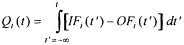
or, in the case of an initial inventory at time t' = 0, subsequently altered by inflows and outflows,
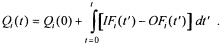
Let us consider some examples relevant to the sorts of options we consider in the report for WPu disposition.
Storage
Consider storage of pits as an example. Imagine that, starting at a time denoted t = 0, pits begin entering storage from the dismantling process at a rate of 10,000 kilograms per year (kg/yr), which continues for five years until the nominal 50,000 kg of surplus WPu is in this form. Suppose there is no further change in this inventory for another five years, whereafter pits are removed at a rate of 5,000 kg/yr to be converted into plutonium oxide. After 10 years at the
latter rate, no more pits will remain in storage. In this situation Q(t), in units of kilograms, is given by
|
Q(t) |
=0 |
t < 0 |
|
|
= 10,000 × t |
0 < t < 5 yr |
|
|
= 50,000 |
5 < t < 10 yr |
|
|
= 50,000- 5,000 × t |
10 < t < 20 yr |
|
|
=0 |
t > 20 yr. |
The integrated inventory associated with this storage is then

= 125,000 + 250,000 + 250,000 = 625,000 kg-yr,
equivalent to an average inventory of 31,250 kg over the 20-year duration of the pit-storage phase of the campaign. The generalization to cases in which material is being added and removed at the same time is obvious.
Processing Steps
Storage of material taking place at a processing site would be treated in the manner just described. If, however, the characteristics of the process more than the characteristics of the site produce security risks that make it desirable to characterize separately the actual in-process integrated inventory, this can be done by calculating the average in-process inventory from
avg inventory = avg throughput (kg/day) × residence time (days),
where "residence time" means the average time a kilogram of material spends in processing. Then the integrated inventory is given by
IT = avg inventory (kg) × duration of processing activity (yrs).
Transport Steps
Transport steps are treated in a manner analogous to that for processing steps. That is, if there are significant storage operations associated with transport on either end of the trip, these are treated in the manner described above for storage, while the integrated inventory for the actual trips is calculated, as for a process, by first determining the average "underway" inventory as
underway inventory (kg) = annual transport (kg/yr) × trip duration (days/365)
and then calculating the integrated inventory as
IT = underway inventory (kg) × duration of transport activity (yr).
Ultimate Disposition
It would be fairly straightforward to calculate also an integrated inventory figure for the final phase of a plutonium disposition campaign, in which for example the plutonium is embedded in spent fuel or vitrified high-level waste that remains indefinitely in engineered storage or a geologic repository. In that case, the integrated inventory would be the initial inventory in this form multiplied by the radiologic mean-life of the plutonium, which is the half-life divided by the natural log of 2. Complications are presented by the circumstance that different plutonium isotopes have different half-lives, so that the calculation must be carried out isotope by isotope, and also by the circumstance that the decay daughter of the most important plutonium isotope, plutonium-239, is uranium-235, which is also a nuclear explosive and has a half-life of some 700 million years. We do not think, however, that an integrated inventory figure for ultimate disposition would be an informative index of security hazard even if corrected for these complications—certainly it could not be compared meaningfully with the far smaller integrated inventories associated with the earlier, much shorter phases of plutonium disposition—in part because material in this final phase would probably be much less attractive to would-be bomb-makers than would be plutonium or uranium-235 in other forms and locations, and in part because, even if it were or might be attractive, we know of no persuasive prescription for weighing a hazard distributed over so long a time period against hazards that would be experienced in the near future. Thus, while we characterize, for comparison with other phases and for comparisons among disposition options, the barriers to weapons use of the plutonium in its ultimate disposition form, we do not calculate an integrated inventory figure for this phase.
APPENDIX B:LEVELIZED ANNUAL COSTS AND NET DISCOUNTED PRESENT VALUE
If the real cost of money is r (a pure number obtained by dividing the annual percentage rate by 100), it is easy to show that the levelized constant-dollar annual payment needed to retire an initial investment of I dollars over a period of n years is equal to

This is the size of the annual payment—levelized in the sense of being constant in constant dollars throughout the n-year period—needed to "make whole," at the end of the period, an investor of the initial sum I who has the option of putting the money in a secure savings account with real rate of return r. (Of course, if the investment in question is less secure than a savings account, the rational investor will insist on a "risk premium" in the form of a higher real rate of return than the one that corresponds to the savings account.)
The term,

is called the (real) capital recovery factor (CRF). The nominal—as opposed to real—CRF is calculated from the same formula with r replaced by r' = r + i, where i is the annual rate of inflation. The product, CRF × I, accounts for both interest and the repayment of principal (equivalent to depreciation)13. The levelized annual capital charges (LACC) associated with a project are given by the sum of the interest and depreciation term, CRF × I, with any other annual payments that are proportional to capital investment (e.g., property taxes and insurance). The fixed charge rate (FCR) is the factor that, when multiplied by the capital investment as calculated at the beginning of operation, gives the LACC:
LACC = FCR × I.
FCR = CRF + property taxes, insurance, etc., as an annual fraction of capital investment.
The total levelized annual costs (LAC) of a project are the sum of the LACC plus levelized annual operating costs (LAOC) such as fuel, spare parts, and labor for operation and maintenance:
LAC = LACC + LAOC = FCR × I + LAOC.
The procedure for levelizing operating costs that occur nonuniformly over the operating life of the project is straightforward; it is analogous to the way the
The procedure for levelizing operating costs that occur nonuniformly over the operating life of the project is straightforward; it is analogous to the way the capital investment is converted into an equivalent annual payment. Other streams of payments that occur before or after the period of operation, such as the costs of decommissioning and costs of long-term waste management, are customarily accounted for by appropriate adjustments in the calculation of I and LAOC. (For example, preoperational costs other than construction—such as research and development and licensing costs—can be readily incorporated into the calculation of I, while decommissioning and long-term waste costs are customarily converted into an increment to LAOC, based on the annual contributions needed to an interest-bearing account in order to yield, at the end of the n-year period of operation, the sums estimated to be needed for these activities.)
The LAC approach to economic evaluation answers the question, "If all of the costs of a project, including the time-value of the money needed for all phases of the project's implementation, are to be recovered through a stream of identical constant-dollar payments made annually during the operating life of the project, what must be the size of that annual payment?" This approach is customarily used in situations where one wishes to know the monetary value to attribute to (or how much to charge for) a product or service that will be delivered more or less continuously during the life of the project (e.g., electricity from a power plant) or where a set of uniform annual payments is a convenient way for the beneficiaries to pay for something they would have difficulty buying outright (e.g., a home mortgage).
The discounted present value (DPV) of an expenditure or income of C dollars at a time n years into the future is given by PV = C / (1 + d)", where d is the real discount rate (usually taken to be the same as the real cost of money, r), and DPV and C are both expressed in constant dollars of a specified year. (This need not be the same year as the one chosen as the "present" for the present-value calculation; that is, one can perfectly well calculate the present value in the year 2000 of an expenditure in the year 2020, measured in 1992 dollars.) The DPV of a stream of expenditures Ci in years i = 0 to n, where 0 refers to the year chosen as the "present," is then
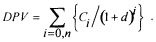
The net discounted present value (NDPV) of a project is the difference between the net present value (NPV) of the revenues or benefits from the project and the NPV of the costs associated with it, hence
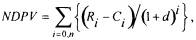
where R, is the revenue in the ith year and C, is the expenditure, all expressed in constant dollars. In contrast to the LAC calculation, the n in this NDPV formula does not necessarily correspond to the end of the project's useful life but is instead the last year in which either revenues or costs associated with the project arise. The formula can be generalized to include costs and revenues that arise earlier than year 0—i.e., before the "present" in the present-value calculation— simply by letting i take on negative values.
The NDPV approach to economic evaluation answers the question, "What lump sum of money should a rational economic actor be willing to pay at a specified "present" time in order to acquire a project's future net income (NDPV positive) or to avoid its future net loss (NDPV negative)?" This approach is customarily used to compare the economics of alternative ways to accomplish a given task in a given time frame14—the way that has the highest (most positive) NDPV is the best.
APPENDIX C:AVOIDED COST AND ASSOCIATED PITFALLS
The avoided-cost idea is clear in concept, but choosing a figure for the avoided cost poses problems. Consider the case of a new nuclear-power plant built by the government for the purpose of plutonium disposition. On what basis should the avoided-cost credit for its electricity output be calculated? All of the obvious choices are problematic.
-
The national-average or even regional-average price of electricity to consumers would not be a satisfactory basis, because such prices must cover the costs of transmission and distribution as well as of generation.
-
Using the national-average or regional-average cost of electric utility generation ("busbar" cost) would avoid the extraneous inclusion of transmission and distribution, but would still be problematic in that the average cost typically is lower than the avoided cost (because the new source replaces the costliest of the existing ones).
-
Calculation of actual avoided costs in a given service region, although widely practiced in connection with determinations by public utility commissions of how much must be paid by electric utilities to independent power producers, entails complicated considerations of capacity credits and energy credits that are highly dependent on the circumstances of individual service regions as well as on the characteristics of the new source; thus this approach does not lend itself to use in a preliminary, national-scope assessment of the sort we are undertaking here.
The foregoing approaches also suffer from uncertainty about the future: Will other electricity costs have gone up or down by the time that reactors are in operation using WPu?
A further problem that can arise with these approaches is the misleading impression produced when avoided-cost estimates based on private-sector generating costs are credited against the costs of plutonium disposition options assumed to have been financed at the low cost of money associated with government borrowing. The result is an artificially low net cost-or an artificially high net revenue-that arises from nothing other than the government's capacity to borrow money for power-plant construction at lower rates than the private sector can borrow. The apparent net gain to a government project from this discrepancy in private versus public cost of money is real in the sense that the government could, in principle, actually collect electricity revenues from its project that are based on the private-sector avoided costs, and in this way could reduce the apparent net costs of the project; but it is artificial and misleading in the
sense that government borrowing at lower-than-private-sector rates amounts to a public subsidy which, while regarded as appropriate for strictly governmental functions in the common interest, is regarded as inappropriate, in our society, for activities that compete with the private sector. (That is why the Office of Management and Budget (OMB) insists that economic evaluations of government projects that interact in any way with the private sector should assume a real cost of money comparable to private-sector rates rather than the lower cost of money associated with government borrowing.)
The foregoing problem is largely avoided if the government project is costed based on OMB's recommended real cost of money of 7 percent per year, approximating a private-sector rate. The fact that government projects do not pay for property taxes or insurance, however, can be considered a further subsidy, which, accordingly, confers an additional artificial economic benefit on a government project that is credited with private-sector avoided costs.15 As noted above, we here calculate fixed charges based on 7-percent per year real cost of money, both with and without an increment of 2 percent per year of initial investment for property taxes and insurance.
With the private-versus-public cost of money pitfall circumvented in this way, a temptingly simple prescription for calculation of the avoided-cost credit would be to assume that the avoided cost is that associated with an identical nuclear reactor using low-enriched uranium (LEU) rather than mixed-oxide (MOX) fuel. This assumption would reduce the new facility, multipurpose case (lower right in Table 3-9) to the preexisting facility, multipurpose case (lower left in Table 3-9), for which it is only necessary to calculate the incremental costs associated with substituting MOX for LEU. This approach would escape most of the region-specific complexity of the usual avoided-cost calculations, and it would have the further benefit of reducing the associated uncertainties about the future to a relatively circumscribed set of questions attached to the future economics of MOX and LEU. It would actually be realistic, moreover, for any region in which there is a plausible case that (1) new baseload generating capacity will be needed in the time frame at issue for plutonium disposition and (2) nuclear energy would be a reasonable choice to meet this need.
The first of these conditions—a plausible need for new baseload generating capacity over the next 5-10 years—is satisfied for most places in the United States where plutonium disposition might be contemplated. The weakness in the case for using the same-reactor-but-with-LEU approach to avoided cost is in the second condition: few analysts today would argue that nuclear plants would be likely to be chosen, in the absence of the plutonium disposition mission, for new
capacity needs in the United States in the next 5-10 years. And to the extent that the options more likely to be chosen would have electricity costs lower than those of nuclear plants using LEU, basing the avoided-cost estimates on the nuclear case would overestimate those avoided costs and thus lead to an underestimate of the true cost of plutonium disposition using the MOX option.
These considerations point to the conclusion that the best way to estimate avoided costs for our purposes is to project the cost of the electricity generated by the options most likely to be chosen in the next decade for new baseload capacity, in the absence of a plutonium disposition program, in the regions where new (or newly completed) reactors for plutonium disposition would operate. These are the electricity sources on which reliance would be reduced by electricity generation in connection with plutonium disposition.16
The problem of predicting what electricity-generation technologies will be chosen for new baseload capacity becomes more difficult, obviously, the further in the future is the time frame in which one is interested. For the period 5-10 years hence, however, in which plutonium disposition using newly built (or newly completed) reactors of existing types could begin, a rather good case can be made that the baseload-generation technology of choice in most parts of the United States is likely to be combined-cycle, natural-gas-fired power plants.17
When the cost of electricity from such plants in the period 2000-2030 is estimated using the approaches and assumptions described in this section, with allowance for uncertainties in the future price of natural gas, the result of the levelized annual cost approach is $0.04-$0.06 per kilowatt-hour (kWh);18 a range of $0.05-$0.08/kWh appears in a recent review of mostly rather small projects for combined-cycle gas-fired baseload electricity generation (Kahn et al. 1993), but a recent analysis of the economic prospects of operating pluto-
|
16 |
The avoided-cost estimates obtained in this way will of course differ from those that would be obtained by the same-reactor-but-with-LEU method only insofar as the projected generation costs of the expected new capacity differ from those projected for plutonium disposition reactors using LEU instead of MOX. |
|
17 |
See Kahn et al. (1993), Hudson (1993), USDOE (1993b). This is what is planned, for example, in Washington state, which would be a leading contender for exercising the MOX option for plutonium disposition by virtue of the location there of a partially completed MOX fabrication facility as well as two partially completed nuclear reactors potentially available for the plutonium disposition mission. |
|
18 |
A figure of $0.047/kWh follows from Hudson's (1993) estimate of $600 (1992 dollars) per kWe total overnight capital cost for a combined-cycle gas-fired power plant, interest during construction at r = 0.07 for 4.5 years yielding a multiplier of 1.2 (interpolated in Table 3-7), capacity factor of 0.75, fixed charge rate = 0.1006/yr (corresponding to r = 0.07, n = 30 years, and property tax and insurance assessment of 0.02/yr), natural gas cost in 2015 of $4.25 (1992 dollars) per million Btu (British thermal unit) (USDOE 1993b), heat rate 7,600 Btu/kWh, and nonfuel operation and maintenance costs of 0.004 1992 dollars/kWh (Hudson 1993). Sensitivities: natural gas price ±30 percent yields ±$0.01/kWh; overnight construction cost 30 percent higher adds $0.003/kWh: real cost of money r = 0.10 adds $0.004/kWh (actual cost of money employed by firms in the wholesale electricity market may be higher still). |
nium disposition reactors in the Northwest United States uses a range of $0.037-$0.043/kWh for gas-fired combined-cycle baseload power generation in that region (SAIC 1993); the DOE PDS analysis uses $0.030/kWh for the reference revenue from electricity sales and explores sensitivity to a range from $0.022/kWh to $0.060/kWh (USDOE 1993a). (All figures have been converted to 1992 dollars. For our analysis we choose a reference value of $0.050/kWh with a judgmental 70-percent confidence interval of ±$0.015/kWh.
APPENDIX D:PREDICTED DAMAGES FROM THE DOSES PERMITTED BY STANDARDS
The dose limits are all below the levels that produce symptoms of acute radiation sickness, which are seen only at 0.5-1 sievert (Sv) (50-100 rem) and above. The potential consequences of exposures not exceeding these limits are therefore confined to the so-called “latent" effects, of which the ones of greatest concern are increased incidence of cancer and genetic defects. The dose-response relations governing the magnitudes of the increases to be expected from doses in the indicated ranges have been the subject of much study—and an equal amount of controversy—extending over the past half-century. The source of the controversy is that at dose rates close to those received by everyone from natural background radiation, which are in the range of 1 mSv (100 mrem) per year to the whole body, the increased incidences of cancer and genetic defects predicted from downward linear extrapolation of incidences observed at higher dose rates are too small to be unambiguously detected either in animal experiments of practical scale or in human epidemiological studies with their inescapable array of confounding factors.
Virtually all of the national and international regulatory and advisory bodies dealing with radiation hazards have taken the position for many years, however, that standards and policy should be based on the assumption that increases in the incidence of cancer and genetic defects persist in linear proportion to the dose, down to the lowest doses and dose rates experienced (the "linear hypothesis").19 The most recent comprehensive review of this subject by the National Research Council's Committee on Biological Effects of Ionizing Radiation (National Research Council 1990, p. 4, hereinafter BEIR V) underscores this position, finding that the latest data "do not contradict the hypothesis, at least with respect to cancer induction and hereditary genetic defects, that the frequency of such effects increases with low-level radiation as a linear, nonthreshold function of dose." The report gives the dose-response relation for cancer as a population weighted lifetime excess risk of death of cancer of 0.8 percent (90-percent confidence interval 0.6-1.2 percent) from a whole-body dose of 0.1 Sv, quickly delivered, and indicates that some reduction in this risk—"possibly by a factor of 2 or more"—is to be expected for gamma and beta (but not alpha and neutron) radiation that is slowly delivered. 20
Expressed in terms of population dose (the product of the size of the exposed population and the average dose in that population, measured in person-sieverts or person-rem), the best-estimate dose-response relations are 800 excess cancer deaths per 104 person-Sv (million person-rem) for gamma and beta radiation at high dose rates or neutron and alpha irradiation at any dose rate, and 400 excess cancer deaths per 104 person-Sv for gamma and beta radiation at low dose rates. The incidence of excess genetic defects induced by radiation is considerably more uncertain, but the estimates given in the BEIR V report are equivalent to 30-70 excess genetic defects per 104 person-Sv—an incidence rate some 10 times less than that of excess cancer deaths, and spread over a considerably longer (multigeneration) period. We focus, then, on the cancer deaths as the dominant latent consequence.
The once-in-a-lifetime emergency dose limit of 0.25 Sv, whole body, to a member of the public would correspond, at the dose-response relation of 0.8-percent chance of cancer death per 0.1 Sv (appropriate to rapid delivery of the dose, as could be the case for an individual near a reactor at the time of an accidental release of radioactivity), to a 2-percent chance of dying of cancer. If the dose is delivered slowly (as from ground contamination at a greater distance from an accidental release) and consists mainly of gamma and beta radiation, use of the factor of 2 credit for dose protraction gives a 1-percent chance of dying of cancer from this dose. These figures can be compared to the 20- to 25-percent chance of dying of cancer, in industrial societies, from the sum of all causes. The increase in the chance of cancer death from the allowable one-time emergency dose, then, is in the range of 4 to 10 percent of the preexisting chance. (Of course, the probability that any given individual in a society will actually experience such an emergency dose in his or her lifetime is very low, and this would be the case even if the probabilities of reactor accidents were much higher than we believe them to be.)
A dose-rate limit of 1 mSv per year, whole body, to members of the public from routine releases of radioactivity in various contexts appears in NRC, EPA, and IAEA regulations (see "Some Relevant Standards Limiting Doses and Emissions" on p. 94). Taking the dose-response relation to be 0.4- to 0.8-percent chance of cancer death per 0.1 Sv (the lower figure for gamma and beta radiation, with credit for dose protraction, and the higher one for alpha particles and neutrons, where no such credit is applied), the added chance of cancer death experienced by an individual receiving this dose rate would be 0.004-0.008 percent per year of such exposure. The chance of death from all causes in the U.S. population is about 0.9 percent per year and the chance of death from cancer is about 0.2 percent per year (US Dept of Commerce 1992). The chance of dying eventually of cancer is currently about 19.5 percent in the U.S. popula-
tion, a figure that would be increased to 20.0-20.5 percent21 by continuous lifetime exposure at the 1-mSv/yr limit (National Research Council 1990). At the 0.1-mSv/yr limit allowable in NRC and EPA regulations for exposures received by an individual member of the public from a single facility, the predicted incremental probabilities of death from cancer would of course be 10 times smaller.
The occupational dose limit of 0.05 Sv per year would correspond, at 0.40.8 percent probability of cancer death per 0.1 Sv, to an extra chance of cancer death of 0.2-0.4 percent per year. Exposure to this dose rate continuously from the age of 18 to the age of 65 would produce an extra probability of cancer death of 15 percent-raising the preexisting probability of death from cancer from about 20 to 35 percent-according to the best estimate of the BEIR V report based on a calculation accounting for age- and gender-specific susceptibilities in a working population of half men and half women. Actual average doses in the nuclear industry are, fortunately, about 10 times lower than permitted by the standard. Downward revision of this standard is under consideration.
REFERENCES
APS 1978: American Physical Society, Study Group on Nuclear Fuel Cycles and Waste Management. "Report to the APS." Reviews of Modern Physics 50(1) Part II, January 1978.
APS 1985: American Physical Society, Study Group on Radionuclide Release from Severe Accidents at Nuclear Power Plants. "Report to the APS." Reviews of Modern Physics 57:S1-S154, 1985.
Brodsky et al. 1993: R. S. Brodsky, D. Okrent, F. P. Baranowksi, P. J. Turinsky, and T. L. Neff. Peer Review Report, U.S. Department of Energy Plutonium Disposition Study. Office of Nuclear Energy, U.S. Department of Energy, Washington, D.C., June 30, 1993.
Budnitz and Holdren 1976: Robert J. Budnitz and John P. Holdren. "Social and Environmental Costs of Energy Systems." Annual Review of Energy 1:553-580, 1976.
Burns and Roe 1992: Burns and Roe Corporation. Study of the Cost of Replacing NIS Nuclear Plants with Fossil Fired Plants. Oradell, N.J.: Burns and Roe Corporation, September 1992.
CEA 1993: Council of Economic Advisors. Economic Report of the President. Washington, D.C.: U.S. Government Printing Office, January 1993
Delene and Hudson 1993: J. G. Delene and C. R. Hudson II. Cost Estimate Guidelines for Advanced Nuclear Power Technologies. ORNL/TM10071/R3. Oak Ridge, Tenn: Oak Ridge National Laboratory, May 1993.
EESI 1993: Energy and Environmental Study Institute. Briefing Book on Environmental and Energy Legislation. Washington, D.C.: EESI, 1993.
Hohenemser et al. 1983: C. Hohenemser, R.W. Kates, and P. Slovic. "The Nature of Technological Hazard." Science 220:378-384, 1983.
Hohenemser et al. 1990: C. Hohenemser, R. Goble, and P. Slovic. "Institutional Aspects of the Future Development of Nuclear Power." Annual Review of Energy 15:173-200, 1990.
Holdren 1982: John P. Holdren. "Energy Risks: What to Measure, What to Compare." Technology Review 85(3):32-38, 74-75, 1982.
Holdren et al. 1983: John P. Holdren, Kent Anderson, Peter Deibler, Peter Gleick, Irving Mintzer, and Gregory Morris. "Health and Safety Impacts of Renewable Geothermal, and Fusion Energy." Pp. 141-208 in C. Travis and E. Etnier, eds., Health Risks Associated with Energy Technologies. Boulder, Colo.: Westview Press, 1983.
Hudson 1993: C. R. Hudson. "Calculation of Revenues for Plutonium Disposition Reactors" Unpublished manuscript, Oak Ridge National Laboratory, Oak Ridge Tennessee, April 5, 1993.
IAEA 1982: International Atomic Energy Agency. Basic Safety Standards for Radiation Protection. Safety Series No. 9. Vienna: IAEA, 1982.
IAEA 1986: International Atomic Energy Agency. Definition and Recommendations for the Convention on the Prevention of Marine Pollution by Dumping of Wastes and Other Matter in the Ocean, 1972. Safety Series No. 78. Vienna: IAEA, 1986.
IAEA 1986: International Atomic Energy Agency. Principles for Limiting Releases of Radioactive Effluents into the Environment. Safety Series No. 77. Vienna: IAEA, 1986.
IAEA 1987: International Atomic Energy Agency. IAEA Safeguards Glossary. Vienna: IAEA, 1987.
IPPNW/IEER 1992: International Physicians for the Prevention of Nuclear War and Institute for Energy and Environmental Research. Plutonium: Deadly Gold of the Nuclear Age. Cambridge, Mass.: International Physicians Press, 1992.
Kahn et al. 1993: Edward Kahn, Adele Milne, and Suzie Kito. The Price of Electricity from Private Power Producers. LBL-34578. Energy and Environment Division, Berkeley, Calif.: Lawrence Berkeley Laboratory, October 1973.
NAS 1979: National Academy of Sciences, Committee on Science and Public Policy and Committee on Literature Survey of Risks Associated with Nuclear Power. Risks Associated with Nuclear Power: A Critical Review of the Literature. Summary and Synthesis Chapter. Washington, D.C.: The Academy, 1979.
NAS 1994: National Academy of Sciences, Committee on International Security and Arms Control. Management and Disposition of Excess Weapons Plutonium. Washington, D.C.: National Academy Press, 1994.
National Research Council 1980: National Research Council, Committee on Nuclear and Alternative Energy Systems . Energy in Transition 1985-2000. San Francisco: W.H. Freeman, 1980.
National Research Council 1989: National Research Council. The Nuclear Weapons Complex: Management for Health, Safety, and the Environment. Washington, D.C.: National Academy Press, 1989.
National Research Council 1990: National Research Council, Committee on the Biological Effects of Ionizing Radiation. Health Effects of Exposure to Low Levels of Ionizing Radiation (BEIR V). Washington, D.C.: National Academy Press, 1990.
National Research Council 1992: National Research Council, Committee on Future Nuclear Power Development. Nuclear Power: Technical and Institutional Options for the Future. Washington, D.C.: National Academy Press, 1992.
OECD 1976: Organization for Economic Co-operation and Development, Nuclear Energy Agency. Estimated Population Exposures from Nuclear Power Production and Other Radiation Sources. Paris: OECD, 1976.
OFR 1992a: Office of the Federal Register. U.S. Code of Federal Regulations: Title 10 (Energy), Chapter I (Nuclear Regulatory Commission). Washington, D.C.: U.S. Government Printing Office, 1992.
OFR 1992b: Office of the Federal Register. U.S. Code of Federal Regulations: Title 40 (Protection of Environment), Chapter I (Environmental Protection Agency). Washington, D.C.: U.S. Government Printing Office, 1992.
OFR 1992c: Office of the Federal Register. U.S. Code of Federal Regulations, Title 10, Part 73, "Nuclear Regulatory Commission: Physical Protection of Plant and Materials." Washington, D.C.: U.S. Government Printing Office, 1992.
OMB 1992: Office of Management and Budget. "Guidelines and Discount Rates for Benefit-Cost Analysis of Federal Programs." OMB Circular A-94. Washington D.C., October 29, 1992.
OTA 1984: Office of Technology Assessment. Nuclear Power in an Age of Uncertainty. OTA-E-216. Washington, D.C.: U.S. Government Printing Office, 1984.
SAIC 1993: John R. Honekamp, Vice President, Science Applications International Corporation. "Isaiah Project Proposal Economic Analysis." Letter to Matthew Bunn, Staff Director of the Committee on International Security and Arms Control plutonium study, National Academy of Sciences, Washington, D.C., November 9, 1993.
US Dept. of Commerce 1992: U.S. Department of Commerce, Bureau of the Census. Statistical Abstract of the United States, 112th ed. Washington, D.C.: U.S. Government Printing Office, 1992.
USDOE 1988: U.S. Department of Energy. Nuclear Energy Cost Data Base—A Reference Data Base for Nuclear and Coal-Fired Power Plant Generation Cost Analysis . DOE/NE 0095. Washington, D.C.: U.S. Department of Energy, September 1988.
USDOE 1993a: U.S. Department of Energy, Office of Nuclear Energy. Plutonium Disposition Study: Technical Review Committee Report, 2 Vols., Washington, D.C., July 2, 1993.
USDOE 1993b: U.S. Department of Energy, Energy Information Administration. Annual Energy Outlook 1993. DOE/EIA-0383(93). Washington, D.C.: U.S. Department of Energy, 1993.
USDOE 1993c: U.S. Department of Energy. "Control and Accountability of Nuclear Materials." Order 5633.3A. U.S. Department of Energy, Washington, D.C., February 12, 1993.
USEPA 1973: U.S. Environmental Protection Agency, Office of Radiation Programs. Environmental Analysis of the Uranium Fuel Cycle. Washington, D.C.: Environmental Protection Agency, 1973.
USNRC 1975: U.S. Nuclear Regulatory Commission. Reactor Safety Study: An Assessment of Accident Risks in U.S. Commercial Nuclear Power Plants.
WASH-1400 / NUREG-75/014. Springfield, Va.: National Technical Information Service, October 1975.
USNRC 1976: U.S. Nuclear Regulatory Commission. Final Generic Environmental Statement on the Use of Recycle Plutonium in Mixed Oxide Fuel in Light-Water Cooled Reactors. NUREG-0002. Springfield, Va.: National Technical Information Service, August 1976.
USNRC 1987: U.S. Nuclear Regulatory Commission. Reactor Risk Reference Document. NUREG-1150. Springfield, Va.: National Technical Information Service, February 1987.
USNRC 1989: U.S. Nuclear Regulatory Commission. Severe Accident Risks: An Assessment for Five U.S. Nuclear Power Plants. NUREG 1150. Springfield, Va.: National Technical Information Service, June 1989.


