
6
Criterion 2: The Soundness and Safety of the Program
Our second criterion for evaluating the outcomes of obesity treatments addresses the soundness and safety of the program. Insofar as the vast majority of dieters are self-helpers or joiners of weight-loss services, there is an almost total absence of controls for the efficacy and safety of weight-loss methods as actually practiced throughout the population. Because the personal choices that govern weight-loss efforts may be uninformed or misinformed about the health risks that attend obesity and the process of losing weight, we believe that all programs should meet some minimum expectations. Specifically, we recommend that four critical areas be addressed by all weight-loss and weight-management programs:
-
assessment of physical health and psychological status of the client (including assessment of client's knowledge and attitudes related to weight and a periodic assessment to determine if the client is still committed to losing weight and learning the facts and skills to succeed);
-
attention to diet;
-
attention to physical activity; and
-
ensuring program safety.
Issues and guidance within each of these four areas are discussed in this chapter.
ASSESSMENT OF PHYSICAL HEALTH AND PSYCHOLOGICAL STATE
Individuals considering a do-it-yourself or nonclinical program to lose weight should have some basic knowledge about their overall state of health before they begin. This is important not only because we believe that all adults should assume some responsibility for their health care, but because this self-assessment should help them determine which programs might be best for them. Many nonclinical programs screen potential clients by measuring height and weight and asking questions about health status. Ideally, however, obese individuals should have a physician review their health history and provide a physical examination, with particular attention to obesity comorbidities prior to beginning a program. Individuals are almost always assessed by physicians as part of a clinical program. Since weight-management programs provide a service that can potentially improve or worsen the health of their clients, nonclinical or clinical programs that do not provide screenings of some kind should not be considered acceptable.
At a minimum, a person beginning a do-it-yourself program should measure body weight and height to calculate body mass index (BMI) and measure waist and hip circumference to obtain the waist-to-hip ratio. A nonclinical program should take these measurements and provide the client with the results. If a patient is being treated for obesity by a health-care provider, standards of acceptable medical practice should be followed. Weight-reduction efforts should not be made a prerequisite for treating a patient for conditions associated with obesity except for some types of elective surgery where obesity would compromise substantially the chance of success. A physical examination of the obese individual should include the standard components (e.g., measurements of weight and height; assessment of vital signs), as well as measurements of blood pressure and blood glucose and cholesterol concentrations, which indicate the status of comorbid conditions. The health-care provider should also conduct some type of psychological evaluation, perhaps using one or more of the scales, questionnaires, and other assessment instruments described in Appendix A. Screening for bulimia, binge eating, and depression is important because all require special attention if identified.
Certain questions should be posed by or to individuals before they begin any weight-management program. For a person interested in undertaking either a do-it-yourself or a nonclinical program, the answers will help him or her to determine which of the programs in these two categories are most likely to be successful or whether evaluation and advice from a health-care provider is called for first. A health-care provider should ask these questions as part of the patient assessment, and a
"counselor" at a nonclinical program is likely to ask the potential client some of these questions as well. The questions include, but are not limited to, the following:
-
What is my/your overall state of health?
-
Do I/you have any weight-related comorbidities?
-
Are there risk factors in my/your family history that would indicate high risk of obesity-associated problems and/or comorbidities in the future?
-
Do I/you have any medical problems that should be resolved before attempting weight loss?
-
Is it an appropriate time for me/you to lose weight (some contraindications include pregnancy, lactation, recent medical problems or surgery, and other significant issues in life that will interfere with the effort required for weight loss)?
-
Do I/you have an eating disorder (e.g., binge eating or bulimia)? Am I/are you able to perform normal activities of daily living, including food selection and preparation and moderate exercise?
-
What are my/your capacities and opportunities for restructuring my/your personal environment to succeed at weight loss?
-
What are my/your short- and long-term weight-loss goals?
-
Am I/are you ready to make a long-term commitment to a new lifestyle of healthful eating and regular physical activity?
Individuals will maximize their chances for success if conditions in their lives are right when they begin their obesity-treatment program. Readiness to change includes motivation, commitment, life circumstances, and other factors suggesting that this is or is not the time to start treatment. One useful instrument that individuals might complete before deciding their course of action is the Dieting Readiness Test (Brownell, 1990). This test can help individuals self-assess six areas associated with long-term success or failure: (1) their goals and attitudes, (2) hunger and eating cues, (3) control over eating, (4) binge eating and purging, (5) emotional eating, and (6) exercise patterns and attitudes. Although the test has not been validated and reliability has not been established, this tool can serve as a first step in assessing readiness to change.
We believe that physicians and other health-care providers should learn more about obesity and its treatment options. Although internists daily see patients whose medical care could be improved with weight reduction, little attention has been given to the education of physicians. One example of this lack of attention is found in the most recent edition of the American College of Physicians' Medical Knowledge Self-Assessment Program (MKSAP IX, 1991), which provides physicians with up to
144 Category 1 continuing medical education credits. MKSAP IX does not have a separate section on obesity. Fortunately, MKSAP X (1994) will contain a small section.
DIET
How much one eats (and, to some extent, what one eats) is a major determinant of body weight. Therefore, food intake should play a central role in all weight-management efforts. The overall goal in obesity treatment is to obtain a negative energy balance, because this is the only way to lose weight and body fat (see box titled ''Energy Balance"). Negative energy balance is established by reducing energy intake (i.e., eating less), increasing energy expenditure (i.e., performing more physical activity), or preferably both. All individuals need to alter their eating and activity patterns to lose weight. Programs that promise results without dieting and physical activity will surely be ineffective over the long term. This section focuses on diet, followed by a section on physical activity.
It is commonly believed that the obese overeat, but studies have not been able to make this connection consistently. Although obese subjects often underreport energy intake and overestimate physical activity (Lichtman et al., 1992), one cannot assume that all individuals with weight problems eat more than those of healthy weights. Energy requirements vary considerably among individuals, based on genetics, physiology, and metabolism, state of health, and, of course, factors such as level of physical activity, age, sex, body weight, and body composition. In experimental animals, genetically obese rodents have increased energy intake and decreased expenditure during development (Johnson et al., 1992). When obese rats (fafa) are pair-fed to their lean controls, weight gain is slower, but obese rats are still fatter than comparably fed lean rats (Cleary et al., 1980). At 6 months of age, obese rats (fafa) and lean rats have comparable energy intakes.
Although it is difficult to determine accurately an individual's food intake (from which the approximate energy and nutrient composition can be calculated), dietary assessment tools are available that can be self-administered or used by providers. These include diet histories, food records for varying lengths of time, repeated 24-hour recalls, food frequency questionnaires, and checklists. Many of these tools have been computerized for easy administration and more rapid interpretation. Appendix A discusses the major dietary assessment instruments used in obesity treatment.
A nutritionally adequate dietary pattern that provides all the essential nutrients and other important food constituents in the proper proportions and amounts is essential to good health. Today's dietary recommendations
|
ENERGY BALANCE Energy balance refers to the difference between energy intake and expenditure. Both are usually measured in terms of kilocalories per day. Consistent with the principles of thermodynamics, loss of body-fat stores can be achieved only by establishing a negative energy balance (energy expenditure exceeds energy intake). Conversely, a positive energy balance (energy intake exceeds energy expenditure) will result in storage of energy in the body (accumulation of body fat). Individuals with the metabolic problems of a low rate of fat oxidation (Sheppard et al., 1991; Swinburn and Ravussin, 1993), and hyperinsulinemia (Bray, 1993b) and the metabolic and/or behavioral problems of low energy expenditure (Ravussin and Swinburn, 1992) are at special risk of weight gain and obesity. Total energy intake is evaluated by adding the calorie content of all the food and drink consumed over the course of a day. Total energy expenditure (TEE) is evaluated by measuring three major components: (1) resting energy expenditure or REE (approximately 60–70 percent of TEE); (2) physical activity (15–20 percent of TEE, for a typical sedentary adult); and (3) the thermic effect of food (10 percent of TEE). REE varies among individuals according to age, sex, weight, genetics, and other factors. Control of REE is not well understood, but it is determined primarily by lean body mass. There seems to be little impact of physical activity or fitness level on REE. Other behaviors such as cigarette smoking may have a small effect on REE. However, small changes in REE, accumulated over time, can amount to a substantial number of calories and lead to alterations in body weight. Energy expenditure due to voluntary physical activity is the most variable component of TEE. Whereas variations in REE are unlikely to account for more than about 200 kcal/day, energy expenditure from physical activity may range from a few hundred kilocalories per day in sedentary individuals to some 3,000 kcal/day for athletes in training or for workers engaged in heavy manual labor. Energy expenditure associated with voluntary physical activity thus has the potential to have the greatest impact on TEE. Simple questionnaires can be used to obtain a rough assessment of energy expended by being active. In contrast, assessing REE and the thermic effect of food requires relatively sophisticated laboratory measurements and is not feasible in most settings. However, formulas are available to predict REE, and the thermic effect of food can be approximated, as stated earlier, to be 10 percent of caloric intake. Energy balance, while simple in concept, is a complex phenomenon, so the mathematical approach of estimating energy balance deficits often results in errors. Given that 1 pound of fat is equivalent to approximately 3,500 kcal, one can calculate that a caloric deficit of 500 kcal/day should result in a 1-pound loss of body weight per week. (However, one can lose a pound of water, which is equivalent to 0 kilocalories.) In fact, the predicted weight loss is often an overestimate of actual experience, owing to the influences of such subtle factors as changes in REE, hydration, and other metabolic and hormonal factors that may change with weight loss. |
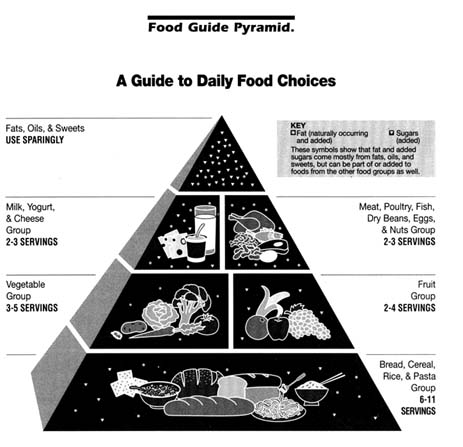
emphasize eating a variety of foods from a relatively low-fat diet, including grain products, vegetables, legumes, fruits, low-fat dairy products, and, if desired, meat, poultry, and fish. The Food Guide Pyramid, the latest dietary guidance plan from the federal government, is considered by many to be one of the most useful educational tools for helping individuals meet dietary recommendations (see Figure 6-1). For each of the five basic food groups, the pyramid provides recommended numbers of servings. Individuals who follow these guidelines are likely to have a dietary pattern that meets or exceeds all nutrient requirements and over the long term reduces their risks of developing chronic degenerative diseases, such as cardiovascular disease and cancer. The Food Guide Pyramid is flexible enough for use by people of varied ethnic groups.
Other dietary guidance tools that complement the pyramid are the Recommended Dietary Allowances (RDAs) (NRC, 1989b) and one or more of several sets of dietary guidelines (e.g., those promulgated by the federal government [USDA/DHHS, 1990], the Institute of Medicine [IOM, 1992], and the National Cholesterol Education Program [NCEP, 1993]). The RDAs provide recommended intakes of vitamins, minerals, energy, and protein for population groups. The various sets of dietary guidelines advise that individual adults and children from age 2 consume a diet supplying no more than 30 percent of calories from fat and less than 10 percent from saturated fat; some (IOM, 1992; NCEP, 1993) also advise limiting cholesterol intake to no more than 300 mg/day.
Obese individuals using the Food Guide Pyramid should eat fewer servings from the food groups to reduce overall food (and therefore energy) intake. Table 6-1 provides recommendations for using the pyramid on a 1,200-kcal/day diet. Calories can be spared by even further limiting consumption of fats, simple sugars, and foods high in these components. Many dieting individuals can develop sound eating patterns with the help of the pyramid. In addition, a precalculated food exchange system developed by the American Diabetes Association and the American Dietetic Association (ADA and ADA, 1989) is a useful and practical tool that can help dieters eat a varied and nutritionally adequate diet while controlling energy intake.
Effects of Diet Composition and Meal Size and Frequency
There is debate about the role of dietary fat in the development and maintenance of obesity and in weight loss. Some experimental studies, such as those by Miller et al. (1990), show that the obese eat a greater percentage of energy in the form of fat than the nonobese. When fat
What Is a Serving?
Bread Group: 1 slice of bread; 1 ounce of ready-to-eat cereal; and 1/2 cup cooked cereal, rice, pasta.
Vegetable Group: 1 cup of raw leafy vegetables; 1/2 cup of other vegetables cooked or chopped raw; and 3/4 cup of vegetable juice.
Fruit Group: 1 medium apple, banana, orange, etc.; 1/2 cup of chopped, cooked, or canned fruit; and 3/4 cup of fruit juice.
Milk Group: 1 cup of milk or yogurt; 1.5 ounces of natural cheese; and 2 ounces of processed cheese.
Meat Group: 2-3 ounces of cooked lean meat, poultry, or fish. Each 1/2 cup of cooked dry beans, 1 egg, or 2 tablespoons of peanut butter counts as 1 ounce of lean meat, poultry, or fish.
FIGURE 6-1 SOURCE: USDA, 1992.
TABLE 6-1 An Example of Modifying the Food Guide Pyramid for Purposes of Weight Loss
|
Food Group |
|
|
Bread group |
6c |
|
Vegetable group |
3 |
|
Fruit group |
2 |
|
Milk group |
2d |
|
Meat group (ounces) |
4e |
|
a Not recommended for pregnant or lactating women, children (depending on age), or those who have special dietary needs. At or below this low level of kilocalorie intake, it may not be possible to obtain recommended amounts of all nutrients from foods; therefore, it is important to make careful food choices, and the need for dietary supplements should be evaluated. b This plan allows up to 1 teaspoon (4 grams) of added sugar and 5 grams of added fat. c For maximum nutritional value, make whole-grain, high-fiber choices. d Choose skim milk products. The discretionary 5 grams of added fat can be used here to select low- or reduced-fat dairy products. e Select lean meat and use cooking methods that do not require added fat. SOURCE: Adapted from USDA, 1992. |
|
intake is increased or decreased, there are often comparable changes in body weight. However, not all obese individuals have an elevated fat intake. The evidence linking fat with increased weight gain and obesity is clearest in experimental animals where it is possible to control diet composition and measure food intake precisely. Under these conditions, a very-high-fat diet is associated with increased body fat, fat-cell size, and fat-cell number in normally lean rats (Faust et al., 1978). In one human study, male prisoners who were voluntarily overfed gained weight more readily when overfed a diet high in fat compared to a mixed diet (Danforth, 1985).
Studies on the amount of energy necessary to maintain body weight produce variable results. For example, Prewitt et al. (1991) reported that a lower energy intake was sufficient to maintain body weight over a 20-week period on a diet with 37 percent of energy from fat than with 21 percent of energy from fat. In contrast, Leibel et al. (1992) found no difference in the energy intake required to maintain body weight when fat in the diet was varied from 0 to 70 percent. The different results might be
explained by the length of time each study was conducted. Leibel and colleagues studied their subjects for 15 to 56 days in a metabolic ward. Prewitt and colleagues, however, found that it took approximately 17 to 20 weeks for energy intakes to be significantly different in nonobese subjects between diets, whereas it took only 5 to 8 weeks in obese subjects. Studies demonstrating changes in nutrient oxidation rates in response to a high-carbohydrate diet (representing 60 percent of energy) compared to a high-fat diet (60 percent of energy) suggest that over long periods of time, the high-fat diet can be more energy efficient and facilitate increases in body fat. A fat-balance equation (rate of change of fat stores equals the rate of fat intake minus the rate of fat oxidation) has been developed to emphasize the importance that some place on utilizing low-fat diets for weight loss and more physical activity to increase fat oxidation (Swinburn and Ravussin, 1993).
The effect of the size and frequency of meals on adiposity is also important to consider. Isocaloric increases in meal frequency from one to two meals per day to four or more were correlated with lower cholesterol concentrations in a sample of 2,034 white men and women in California, aged 50–89 years (Edelstein et al., 1992). Similarly, increasing the frequency of feeding from three traditional meals to 17 eating occasions with similar macronutrient and energy content was associated with lower blood concentrations of cholesterol, apolipoprotein B, and insulin (Jenkins et al., 1989). These findings suggest that the efficiency of metabolism of food and its components varies on the basis of the amount consumed at one time and the frequency of consumption. These findings are important since they suggest that eating one major meal per day, which supplies the bulk of calories consumed, might increase the difficulties involved in losing weight. However, while it may be advantageous to consume smaller amounts of food more frequently, this approach can cause problems if the choices are not moderate or low in fat and energy content. It seems prudent to recommend that dieters try to consume at least three small meals per day. Breakfast in particular is an important meal for weight loss, as supported by observations showing that dieters who ate breakfast, compared to those who did not, had more healthful dietary patterns overall (Wingard et al., 1982).
Dietary Recommendations
Dietary recommendations are similar for all healthy people, irrespective of weight. Those wishing to lose weight need to focus on creating an energy deficit by decreasing their total energy intake, utilizing, as much as possible, a variety of foods. Decreasing alcohol intake, foods of minimal nutritional value, and fats and simple sugars is a good strategy for
reducing energy intake without eliminating essential nutrients. A weight-reduction diet should contain adequate protein to maintain nitrogen balance and limit the loss of lean body mass. Diets that avoid any major food group or that attribute special weight-loss benefits to a specific food, group of foods, or vitamin or mineral supplement are fundamentally unsound and may have undesirable long-term consequences to health.
Energy intakes of less than 1,200 kcal/day may not meet nutrient requirements, and a dietary supplement may be needed. Individuals consuming such low-calorie diets should seek the advice of a health-care provider (such as a physician or dietitian). A health-care provider knowledgeable about obesity and its treatment and the physiology of weight loss can help an individual develop a nutritionally adequate diet plan tailored to his or her weight-loss goals and appropriate to factors such as gender, age, dietary preferences, and level of physical activity (see box titled "Links Between Diet and Physical Activity").
Regarding dietary interventions, programs should (1) be held accountable for their claims about overall energy intake and predicted weight loss; (2) provide medical monitoring when appropriate (e.g., when using very-low-calorie diets [VLCDs]); (3) provide accurate descriptions of the composition of prescribed diets, with emphasis on their fat and carbohydrate content; (4) give attention to normalizing eating patterns in clients over the long term; and (5) ensure that the meal patterns and eating patterns promoted are sensitive to factors that affect individual success, such as age, gender, body weight, and ethnicity.
PHYSICAL ACTIVITY
One's body weight is influenced to a substantial degree by the level of physical activity. Therefore, as with diet, activity level should play a central role in all weight-management efforts. As explained earlier, the goal in treating obesity is to obtain a negative energy balance because this is the only way to lose body fat (see box titled "Energy Balance"). Tools for assessing physical activity are described in Appendix A. Several simple questionnaires can provide helpful information on level of physical activity to individuals trying to lose weight.
Physical activity can lead to weight loss, but it is a slow process. One problem is that obese individuals are unable to expend many calories in an exercise session because they are not physically fit enough to sustain activity over several minutes. It may take several weeks or months of exercise training for these individuals to be able to increase their energy expenditure significantly. Nonetheless, controlled randomized clinical trials of the effect of exercise on weight loss show the benefits of increased activity (Wood et al., 1988, 1991).
|
PHYSICAL ACTIVITY IN THE UNITED STATES Approximately 25 percent of men and women in this country are essentially inactive (DHHS, 1991). These individuals have sedentary jobs, do no heavy house or yard work, do not participate in any sports or fitness programs, have no active recreational pursuits, and avoid physical activity during routine daily activities by taking elevators and escalators, driving short distances instead of walking, and searching for the closest parking place to their destination. Less than 20 percent of adults can be considered vigorously physically active (DHHS, 1991). Data on physical activity habits from repeated surveys on representative samples of U.S. adults are available from the past 30 years. Unfortunately, variations in survey questions and the inherent difficulty of measuring physical activity habits limit conclusions that can be drawn regarding possible changes in physical activity levels over time. The most likely interpretation is that activity levels increased from about the late 1960s to the mid 1980s. There has apparently been little change since then (Stephens, 1987). It seems reasonable to assume that in the early part of the twentieth century, before automobiles came into common use and before the advent of the now ubiquitous labor-saving devices at home and at work, most adults had higher levels of total energy expenditure than they do today. The per-capita disappearance of calories from the food supply is lower today than in 1900, which supports the hypothesis that the population is less active now. There are variations in activity levels across population subgroups. For example, younger individuals tend to be more active than older ones, men are more active than women, whites are more active than blacks and Hispanics, and those with higher levels of educational attainment are more active than the less well educated (Caspersen and Merritt, 1992; Caspersen et al., 1986, 1987; DiPietro and Caspersen, 1991; Schoenborn, 1986; Stephens et al., 1985). These variations are not large, however, and there is a high prevalence of inactivity in all population subgroups. |
Physical activity may also be effective in preventing weight regain after a weight-loss program (Blair, 1993b). However, to provide additional support for this hypothesis, more studies are needed, especially those with randomized prospective designs. Studies suggest that individuals who have lost weight are much less likely to regain it if they are physically active (Kayman et al., 1990; Pavlou et al., 1989). Recommended programs should be safe and should identify the client for whom the program is intended. Restrictions or precautions, if any, and expected benefits in terms of weight loss and fitness should be addressed.
Physical activity has benefits for overweight individuals beyond the specific impact of energy expenditure during the activity. Overweight persons who are regularly physically active have better blood chemistry profiles (Tremblay et al., 1991) and a lower risk of morbidity and mortality (Blair et al., 1989b; Helmrich et al., 1991; Manson et al., 1991; Morris et
al., 1990) than their overweight, sedentary peers. Other possible benefits of physical activity in obese individuals include increases in resting metabolic rate, fat oxidation, postexercise oxygen consumption, the thermic effect of food, and feelings of well-being. In addition, physical activity tends to preserve lean body mass during weight loss.
Physical activity is relatively safe for most individuals, and we do not recommend routine screening for most people before they begin a moderate exercise program. However, there is a transient increase in risk of cardiac arrest during the activity session, and this risk is higher for habitually sedentary individuals than for those who are regularly active. The absolute risk of cardiac arrest during exercise is small, and for those who establish a regular activity program, their overall mortality risk is substantially lower than that of sedentary people (Kohl et al., 1992).
There are few data on activity injury rates in the obese, but it seems reasonable to assume that these sedentary persons might be at a higher risk than comparable people of healthy weight. Overall injury rates in active individuals are somewhat higher than rates for those who are sedentary, but the difference is not as great as is commonly assumed. One population-based study reports that injuries severe enough to require a visit to a physician were only about 5 percent higher in active compared with sedentary individuals (Blair et al., 1987). Employees participating in a work-site health-promotion program had net injury rates of approximately 10 to 15 percent per year (Blair et al., 1987). Thus, some injuries can be expected with physical activity interventions, but most are not serious. Risk of orthopedic injury may be higher for obese individuals than for those of desirable weight, but no data are available for direct comparison. One study reports no difference in injury rates by body mass index, although there were few, if any, obese individuals in this population (Macera et al., 1989).
Dislike of vigorous exercise and lack of time are two key barriers to participation in physical activity for many people (see box titled "Physical Activity in the United States"). The traditional exercise prescription emphasizes a single exercise session per day at relatively high intensity. New evidence casts doubt on the validity of these recommendations. Three 10-minute exercise sessions per day appear to produce comparable changes in functional capacity as the same amount of exercise done in one 30-minute bout (Debusk et al., 1990). Recent exercise recommendations by groups such as the American Heart Association, the American College of Sports Medicine, and the Centers for Disease Control and Prevention stress the beneficial health and functional effects of the accumulation of moderate-intensity physical activity (Fletcher et al., 1992). These newer approaches to physical activity intervention may make increasing activity levels less intimidating and more inviting for sedentary persons.
|
LINKS BETWEEN DIET AND PHYSICAL ACTIVITY Recent reviews of studies that included both diet and exercise suggest that the combined interventions produce an approximately 2-kg greater weight loss compared to diet alone (King and Tribble, 1991). For example, Wood and colleagues (1991) studied the effect of a 1-year diet and activity intervention on weight in modestly overweight men and women. The interventions included diet alone and diet plus exercise. The men and women in the latter group sustained greater reductions of body weight, fat weight, and waist-to-hip ratio than those in the diet-only group. Recently, Bouchard et al. (1994) demonstrated in men that exercise is an efficient way to lose weight if subjects do not increase their food intake. The amount of energy necessary to maintain a stable body weight was determined in a group of young men isolated in a forestry camp. When the men consumed this amount of energy each day over 93 days but expended an additional 1,000 kcal/day in physical activity, they lost approximately 75 percent of the amount of weight predicted from the calculated energy deficit. Unfortunately, energy intake and expenditure are difficult to measure with precision, which complicates assessment of energy balance in free-living individuals (see Appendix A). Consequently, several published studies show no relation of baseline energy intake (as estimated by a dietary assessment) or energy expenditure (as estimated by physical activity questionnaires) to subsequent weight change (Haffner et al., 1991; Klesges et al., 1992; Williamson et al., 1993). Some population-based studies show that increases in physical activity are associated with weight loss and decreases with weight gain (Klesges et al., 1992; Williamson et al., 1993). Interpreting these results is complicated by study designs in which activity and weight were measured at the same time, making it difficult to establish the temporal sequence of the changes. One recent report includes data from 530 women and 3,736 men who received three clinical examinations (Blair, 1993b). The average interval between the first and second examination was approximately 1.5 years, and the average interval between the second and third examination was approximately 4.5 years. Increases in fitness (assessed by a maximal exercise test) during the first interval were associated with decreases in body weight and skinfolds by the time of the third examination. Declines in fitness and reductions in self-reported physical activity from the first to the second examination were associated with weight gain at the third examination. These results held after multivariate adjustment for age and smoking habits. Body-fat stores accumulate only as a result of a positive energy balance, and obesity usually develops from a small positive energy balance over the long term. Although programs may focus on diet or physical activity alone, emphasis should be placed on both energy expenditure and energy intake. |
This may increase the probability that obese men and women can incorporate more activity into their lives, which is crucial for long-term success at weight management. Perhaps another barrier to exercise is the fact that many people believe myths about it, for example, that one needs to exercise hard or that a little bit of food more than makes up for the energy expenditure during exercise.
Because most obese persons are inactive, physical activity interventions in this group should be approached with low starting levels and slow progression to higher levels of activity. The ideal level of physical activity for a person is not known, but as a general rule, some activity is better than none at all and more is better than less. Therefore, we recommend that a gradual reshaping of a participant's physical activity pattern over time be the focus of intervention, rather than providing a strict, regimented, and specific dose of activity in an exercise prescription.
The most feasible mode of activity for most adults is walking. It can be done anywhere and requires no equipment other than a pair of comfortable shoes, and the intensity is not aversive for most obese persons. It is tempting to recommend a specific amount of activity for obese individuals, but we believe that it is better not to give a universal target for all. Each person should develop a realistic goal for increasing activity, perhaps with professional guidance, which can be modified over time as activity levels increase. It is reasonable to suggest a gradual progression up to 1 hour of moderate-intensity activity (such as brisk walking) each day (Bouchard et al., 1993). It is important to stress that this amount of activity does not need to be obtained in a single session, but can be accumulated over the course of a day. Those who cannot achieve this level of physical activity should remember that some activity is better than none at all. As participants become more physically fit, they will be capable of more activity; they may ultimately engage in more vigorous activities such as cycling, jogging, or other vigorous sports or recreational activities and thereby achieve their caloric-expenditure goals in a shorter period of time. Selection of activity goals and the type of activities to be used are highly individualized matters. Persons should be encouraged to find what works for them and should evaluate different approaches until a sustainable activity plan is developed.
PROGRAM SAFETY
Generally, the more restrictive the diet, the greater are the risks of adverse effects associated with weight loss. Do-it-yourself and nonclinical programs must be safe for their clients. Clinical programs must also be as safe as reasonably possible, given that they are likely to be treating the very obese with comorbidities and health problems. Programs must insist that clients with one or more obesity-related comorbidities be monitored. A client should expect a program to provide detailed information about any potential risks that could occur. Special attention must be paid to the safety of programs for children, pregnant women, and the elderly. In general, no children or adolescents should be placed on a weight-management program without first consulting their pediatrician or family
physician about the appropriateness of the program. Children or adolescents participating in a weight-management program should have their growth and development monitored by their physician.
There are a variety of minor and major risks associated with dieting. For example, there is an increase in the risk of gall bladder disease among people who lose weight rapidly. Two safety issues of interest in connection with weight loss—gallstones and psychological distress leading to depression or binge eating—are described below. Risks to health from weight loss vary with the individual and the type of program.
Gallstones
Obese individuals produce bile with a higher concentration of cholesterol and are therefore at higher risk for gallstone formation. While their risk decreases after they reduce, it is highest during the period of weight loss, when the lithogenicity of their bile is increased further (Bennion and Grundy, 1975, 1978). Three-quarters of severely obese individuals who underwent gastric surgery had gallstones as determined by oral cholecystography an average of 1 year later (Wattchow et al., 1983). Several studies show that about 25 percent of patients on VLCDs have evidence of gallstones (Broomfield et al., 1988; Liddle et al., 1989). However, a study by Nunez and colleagues (1992) reported no increased incidence of gallstone formation among patients receiving a more liberal 1,200-kcal/day, 30 percent fat diet for 16 weeks. The prospective, longitudinal Nurses' Health Study found that the BMI-adjusted relative risk for cholecystectomy or unremoved gallstones was 1.27 to 1.66 among those who lost 4.0 to 9.9 kg in the previous 2 years and 1.57 to 2.4 in those losing 10 kg or more (Stampfer et al., 1992).
Psychological Distress
Probably the best-studied psychological consequence of dieting is depression. As early as 1957, Stunkard reported on instances of ''dieting depression" characterized by weakness, irritability, nervousness, and even psychotic manifestations occurring in obese persons in the course of their efforts at weight reduction (Stunkard, 1957). His review in 1974 summarized additional reports of depression during weight loss that had occurred during the intervening 17 years (Stunkard and Rush, 1974). In 1984, however, Wing and colleagues reported that, on average, obese individuals showed positive changes in mood during weight reduction programs (Wing et al., 1984), a finding confirmed by Wadden and Stunkard (1986) and Wadden et al. (1994).
The discrepancy in psychological state during weight loss depends
in large part on the nature of the sample studied and the methods used to assess the psychological effects (Smoller et al., 1987). Early reports were based largely on observations by psychiatrists of obese patients undergoing psychodynamic psychotherapy; this sample of health-care providers was undoubtedly biased toward psychopathology. Furthermore, the psychiatrists' reports were based on observations made over the entire course of treatment. The later reports of positive changes in mood with weight loss were based largely on patients undergoing behavioral weight control. Also, these patients were assessed by paper-and-pencil tests usually administered only before and after treatment, so any shorter-term emotional disturbances would not be measured. Wadden et al. (1986) confirmed the hypothesis that the differences in reports were based on the method of assessment. In their study of 28 women who lost 19.2 kg, a significant decrease in pre- to post-measures of depression coexisted with a significant increase (often to clinically significant levels) in the level of depression during the course of treatment among half of the patients.
Dieting has been linked with the onset of binge eating, and anecdotal reports have linked rigid and restrictive VLCDs to an increased risk for binge eating (Spitzer et al., 1992; Wilson et al., 1993). The problem in validating this proposition is the very high prevalence of dieting, making it difficult to find people who binge who have not already dieted.
CONCLUDING REMARKS
All weight-loss and weight-management programs should provide (or mandate or encourage) an assessment of the potential client's physical health and psychological status, attend to improvements in diet and increases in physical activity, and ensure that the program is at least reasonably safe. It is reasonable to expect that individuals have some basic knowledge about their overall state of physical health and psychological status that will help them determine if they are ready to try to lose weight and, if so, identify which programs might be best for them. Health-care providers as well should learn more about obesity and the treatment of this disease.
Because improvements in the quality of the diet and especially the amounts of food consumed are important to weight loss, as is modifying one's lifestyle to incorporate reasonable physical activity, any weight-loss program must attend to these two components, providing the participant with necessary information and, ideally, skills. Since dieting is not entirely risk free, programs must also make efforts to ensure that they are as safe as possible; this is of special importance to do-it-yourself and nonclinical programs where some participants may not be receiving any medical care or monitoring throughout the weight-loss attempt.


