
Introduction
The volume of space surrounding the Earth has never been empty. Even before the 1957 launch of Sputnik, a rain of particles of various sizes passed constantly through near-Earth space. The hazard to functional spacecraft from such naturally occurring meteoroids, however, is low; simple shielding techniques can protect against the vast majority of these predominantly small particles, and the chance of a spacecraft colliding with a meteoroid large enough to cause serious damage is remote.
Since the beginning of space flight, however, the collision hazard in Earth orbit has steadily increased as the number of artificial objects orbiting the Earth has grown. More than 4,500 spacecraft have been launched into space since 1957; nearly 2,200 remain in orbit. Of these, about 450 are still functional; the rest can no longer carry out their missions and are considered debris. Nonfunctional spacecraft, however, constitute only a small fraction of the debris orbiting the Earth. They share Earth orbit with spent rocket bodies; the lens caps, bolts, and other "mission-related debris" released into space during a spacecraft's deployment and operation; aluminum oxide particles from the exhaust of solid rocket motors; paint chips from space object surfaces; and the numerous fragmentary objects generated by the more than 120 spacecraft and rocket body breakups that have occurred in orbit. Figure 1 depicts the range of objects in space, including various types of debris.
It is clear that this artificial orbital debris can potentially endanger functional spacecraft. In orbits near the Earth, colliding objects typically will have a relative velocity of more than 10 km/s. At these speeds,
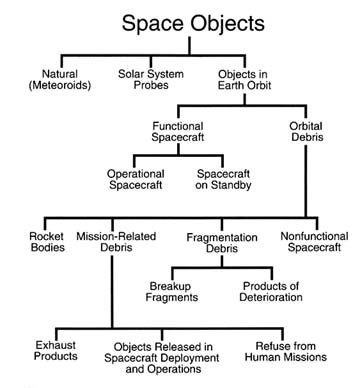
FIGURE 1 Classes of space objects.
collision with objects as small as a centimeter in diameter could damage or prove fatal to most spacecraft, depending on where the impact occurs. Impacts with the much more numerous debris particles that are a millimeter or less in diameter can damage optics, degrade surface coatings, or even crack windows.
There have not yet been any confirmed incidents in which collision with orbital debris has severely damaged or destroyed a spacecraft, but there have been a number of spacecraft malfunctions and breakups that might have been caused by impacts with debris. Smaller debris particles have certainly pitted windows (of the U.S. Space Shuttle and the Salyut and Mir space stations) and marred the surfaces of spacecraft such as the Solar Maximum Mission spacecraft (Solar Max) and the Long Duration Exposure Facility (LDEF). This type of low-grade damage is probably very widespread in low Earth orbit (LEO), but much of it goes undetected, because most spacecraft are not returned to Earth for examination.
Since the late 1970s, studies of the debris population using modeling techniques have predicted that the hazard from orbital debris is likely to
grow in time unless deliberate actions are taken to minimize the creation of new debris. This predicted increased hazard will force spacecraft designers and operators to take countermeasures against the threat of debris or to face a heightened risk of losing spacecraft capability due to impacts. Projected future increases in the debris hazard already have had an effect on the design of LEO spacecraft (such as the International Space Station) that are large and have long projected functional lifetimes and, thus, a significant probability of colliding with damaging debris.
Concern about the orbital debris hazard has grown in the last decade. A number of events, including the breakup of several rocket upper stages and the replacement of Shuttle windows after impacts by small particles, helped to increase awareness of the problem, as did the need to factor space debris considerations into the design of Space Station Freedom. Reports by the American Institute of Aeronautics and Astronautics (AIAA), the European Space Agency (ESA), the U.S. Interagency Group on Space, the International Academy of Astronautics (IAA), and the Japan Society for Aeronautical and Space Sciences also served to define the problem better and to offer some suggestions on its mitigation.
Knowledge about orbital debris also has grown over the last few years. New data on the debris population have been gathered from a multitude of sources, ranging from LDEF, the European Retrievable Carrier (EURECA), and Mir—all of which collected data from the impacts of small debris in space—to the Haystack radar, which collected data on previously undetectable medium-sized debris. These new data have served to improve the models used to estimate the current characteristics and predicted growth of the overall debris population.
Despite these efforts, there remains much that we do not know about orbital debris. The primary reason is the fundamental difficulty of studying small, fast-moving, often dark objects orbiting hundreds or thousands of kilometers above the Earth. Our knowledge also is limited because
|
BOX 1 Other Effects of Orbital Debris In addition to presenting a collision hazard to space operations, orbital debris can also have other detrimental effects. For example, debris can affect astronomical observations by leaving light trails on long-exposure photographs with wide fields of view. In addition, debris reentering the atmosphere can potentially harm people and property on the ground. In the past, this has been a minor hazard, since most reentering debris objects burn up completely in the atmosphere. However, there have been some exceptions (e.g., Kosmos 954, Skylab, and Salyut-7/Kosmos 1686), and the exact number of objects surviving reentry is unknown. |
much of the data on debris to date have been collected as a by-product of non-debris-related investigations that have covered limited ranges of debris size and altitude for limited time frames. As a result, there are gaps in our understanding of the debris population: for example, estimates of the important population of LEO debris with diameters in the range of 1 mm to 10 cm still vary by a factor of two or more; we know that breakups have occurred in geosynchronous Earth orbit (GEO) only because telescopes happened to be looking at spacecraft when they broke up; most debris experts were surprised when LDEF data suggested the existence of a significant population of small debris in elliptical orbits; and there are no meaningful measurements of debris smaller than 1 mm at altitudes higher than 600 km.
Although there is still a great deal of work to be done in defining the current and future debris environment, enough data have been gathered and analyses performed that we are beginning to understand better the overall magnitude of the orbital debris problem. In addition, the broader space community is becoming aware that debris is a serious issue, and a consensus is building that actions must be taken now to preserve the space environment for the future. The challenge that we now face is to implement an appropriate set of actions to respond to the issues raised by orbital debris. This is not a simple problem, and it will not have a simple solution. A responsible approach to orbital debris will require
-
continuing measurement and modeling efforts to increase our knowledge of the current and future debris population;
-
the development of tools to aid spacecraft designers in protecting their spacecraft appropriately against the existing debris hazard; and
-
widespread implementation of appropriate measures to minimize the creation of additional debris.
This report seeks to provide some guidance on how to achieve these goals.
BACKGROUND REFERENCES
AIAA (American Institute of Aeronautics and Astronautics). 1992. Orbital Debris Mitigation Techniques: Technical, Economic, and Legal Aspects. SP-016-1992. Washington, D.C.: AIAA.
AIAA (American Institute of Aeronautics and Astronautics). 1981. Space Debris: An AIAA Position Paper. AIAA Technical Committee on Space Systems. Washington, D.C.: AIAA.
ESA (European Space Agency). 1988. Space Debris. ESA SP-1109. Paris: ESA.
Interagency Group (Space). 1989. Report on Orbital Debris. Washington, D.C.: National Security Council.
International Academy of Astronautics Committee on Safety, Rescue, and Quality. 1992. Position Paper on Orbital Debris. August 27. Paris: International Academy of Astronautics.
JSASS (Japan Society for Aeronautical and Space Sciences). 1993. Summary of Space Debris Study Group Report. JSASS Space Debris Study Group. March 19. Tokyo: JSASS.
Simpson, J.A. 1994. Preservation of Near Earth Space for Future Generations. New York: Cambridge University Press.
U.S. Congress, House of Representatives, Committee on Science, Space, and Technology, Subcommittee on Space Sciences and Applications. 1988. Orbital Space Debris. Washington, D.C.: U.S. Government Printing Office.
U.S. Congress, Office of Technology Assessment. 1990. Orbiting Debris: A Space Environmental Problem—Background Paper OTA-BP-ISC-72. Washington, D.C.: U.S. Government Printing Office.
U.S. General Accounting Office. 1990. Space Debris a Potential Threat to Space Station and Shuttle GAO/IMTEC-90-18. Washington, D.C.: U.S. Government Printing Office.


