
7
Techniques to Reduce the Future Debris Hazard
There are many possible means of reducing the debris hazard to future space operations. These include actions taken as a spacecraft enters orbit (e.g., tethering rather than jettisoning lens caps and despin devices), during operations (e.g., reducing the amount of refuse ejected from crewed missions), and after its functional lifetime (e.g., depleting energy sources or moving the spacecraft into a disposal orbit). Some methods would cost very little, whereas others might be economically prohibitive for some missions. Their effectiveness also will vary, not only from method to method but also in how well a particular method will work in different orbital regions and with different space systems.
Methods to reduce the future growth in the debris population can be divided into two major categories: those that reduce only the short-term hazard and those that are also capable of reducing the long-term hazard. Measures that reduce the number of objects in orbit without reducing the total mass are effective only in diminishing the short-term hazard, because such measures do not reduce the total kinetic energy in orbit. It is this kinetic energy that constitutes the long-term collision hazard (Kessler and Loftus, 1994), so reductions in the long-term collision hazard require reducing the amount of mass in orbit. (This topic is discussed in greater detail in Chapter 8 .)
There are two fundamental factors to consider when assessing methods to minimize the creation of new debris. The first is how much the method will actually reduce the debris hazard to space operations. The number of objects a particular method will prevent from being generated, the mass of those objects, and the threat those objects will pose to valuable orbital regions must all be considered. The second factor is the difficulty
and cost of implementing the debris reduction method. This includes not only the development cost of any new hardware, but also the ''opportunity cost" of any revenue lost or performance sacrificed in implementing the method. The choice of which methods to implement, when to implement them, and in what orbital regions they should be implemented typically involves a trade-off between these two factors.
MINIMIZING THE REALEASE OF MISSION-RELATED OBJECTS
As described in Chapter 1, there are three main types of mission-related debris: (1) objects released in spacecraft deployment and operations, (2) refuse from crewed missions, and (3) rocket exhaust products. Each of these debris types has very different orbital characteristics and size distributions. Together, they make up 13% of the total cataloged space object population; most of these objects are (as shown in Figures 3-4 and 3-5) located in orbital regions used by spacecraft. In addition, as discussed in Chapter 3, a large population of uncataloged mission-related debris also exists. Although ending the release of mission-related debris will obviously prevent the hazard from these objects from growing and further endangering future space operations, the balance between the costs and benefits of reduction actions varies greatly for the different types of mission-related debris.
Reducing the amount of mission-related debris released in spacecraft deployment and operations (e.g., clamps, covers for lenses or sensors, de-spin devices, pyrotechnic release hardware, wraparound cables) may be one of the easier ways of decreasing the future debris hazard to space operations. These objects make up the great majority of the cataloged mission-related debris population and typically have the longest orbital lifetimes of any mission-related debris. In the past, the practice has often been to simply jettison such items at separation from the launch vehicle or during appendage deployment. By using tethers or other simple devices, however, the release of most of these items can be avoided. Similarly, explosive bolts, which are commonly used to separate rocket upper stages, can be designed to not release large amounts of debris when activated. Because the parent spacecraft or rocket body would retain most objects, however, implementing such measures would not reduce the total mass of debris in orbit. (Chapter 8 discusses the significance of reducing mass in orbit.)
Measures to retain debris created during spacecraft deployment and operations are typically fairly easy to implement without affecting spacecraft operations. (Since the early 1980s, many such methods have been used on U.S. and other spacecraft.) The release of some types of mission-
related debris during spacecraft deployment, however, may be more difficult to avoid. One example is dispensers for multiple spacecraft (e.g., the forward payload adapter on the Titan III and the SPELDA device used with the Ariane launch vehicle). Methods for retaining or deorbiting such items have not yet been developed, but development of such methods does not seem to be an inherently intractable problem.
Reducing the amount of mission-related debris created during the course of crewed space activities will have little effect on the overall debris hazard to space operations. Since human activities in space currently take place at low altitudes, the debris they release (mostly from intentional refuse dumping and extravehicular activities) experiences rapid orbital decay and does not contribute to the long-term debris population. Although there are a number of possible methods to further reduce the hazard to space operations from such debris (e.g., bringing the refuse back to Earth during scheduled crew rotations or attaching a drag augmentation device to speed its orbital decay), implementing such methods will not reduce the overall long-term debris hazard. However, since this debris contributes to the short-term hazard in an area containing valuable spacecraft, the use of low-cost methods of debris reduction (if such methods are available) appears to be worthwhile.
Curtaining the release of exhaust products of solid rocket motors will also do little to reduce the debris hazard to space operations. As discussed in Chapter 3, solid rocket firings produce a vast number of very small (<10-micron) debris, but their orbital lifetimes are fairly short due to the strong effect of perturbing forces such as solar radiation pressure; less than 5% will remain in orbit after a year. In addition (as described in Chapter 4), the surface degradation these particles can cause is not a major hazard to functional spacecraft.
The only methods of meaningfully reducing this population would be either to restrict solid rocket motor firings in orbit or to alter the composition of solid rocket motor fuel. Because either action would impose cost increases or performance reductions on many space activities, and the lifetime of these exhaust particles and the potential damage that they can cause to functional spacecraft are so small, it seems clear that neither step is yet warranted at present. It is not yet clear, though, whether anything should be done to limit the population of 1-cm and larger pieces of slag (discussed in Chapter 1) that are also believed to be ejected during solid rocket burns. Whereas the larger size and longer orbital lifetimes of these particles may make them a greater hazard to spacecraft than the small aluminum oxide particles, too little is currently known about them (in particular, how many are typically produced in a solid rocket motor firing) to determine if there is any need to search for ways to prevent their creation.
SAFEGUARDING THE PHYSICAL INTEGRITY OF ROCKET BODIES AND SPACECRAFT
Reducing the Creation of Debris from Explosions
Fragmentation debris makes up 42% of the cataloged space object population and probably a much larger fraction of the uncataloged population. Since there have been only two confirmed space object breakups to date due to collisions (both intentional military tests), the vast majority of this debris is believed to have been created in explosive breakups of spacecraft and rocket bodies. This population of debris spans all size ranges and is distributed widely, although concentrated near the orbits in which it was created. Figure 7-1 projects how a typical explosion in LEO (producing 300 cataloged objects) could moderately increase the spatial density of cataloged objects in orbits hundreds of kilometers above.
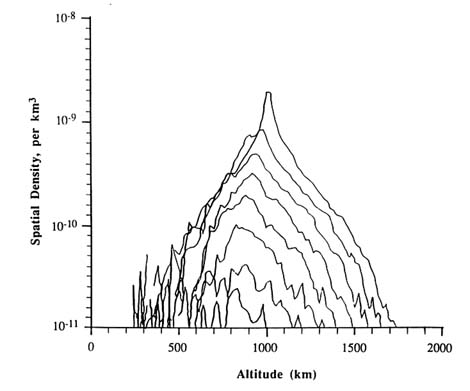
FIGURE 7-1 Predicted effect of satellite breakup at 1000 km. Top curve is initial spatial density distribution with altitude. Time interval between lower curves is 400 years. SOURCE: Kessler, 1991.
and below the breakup altitude. This increase in spatial density can persist for long periods of time; the higher the altitude, the longer will the spatial density remain elevated. Since explosions can produce a considerable amount of large and medium-sized debris with potentially long orbital lifetimes, reducing the creation of debris from explosions will clearly have a major effect in containing future growth in the debris hazard. A reduction in the frequency of explosions can be achieved by passivating spacecraft and rocket bodies.
Passivation of Spacecraft
Debris from spacecraft explosions makes up about 12.5 percent of the cataloged space object population. Spacecraft can explode both during and after their functional lifetime for a wide variety of reasons, including propellant tank explosions, thruster malfunctions, tank failures due to the impact of small debris, battery ruptures, accidentally induced high rotation rates, other degradations of the structure, or deliberate explosions. There are correspondingly many possible measures to prevent spacecraft breakups. There is no one single remedy, and there is probably no possible way to avoid all future spacecraft breakups: despite safeguards, a residual number of spacecraft breakups will continue to generate debris, if at a reduced level.
However, spacecraft designers can take a general system-level approach to prevent accidental spacecraft breakups. The approach is (1) to determine all potential sources of stored energy remaining on a spacecraft late in its active life; (2) for each source, to provide a method of dissipating the stored energy in a benign manner; and (3) to activate these means at the end of the spacecraft's functional lifetime (i.e., "passivate" the spacecraft). Protecting the spacecraft from debris impact damage, as well as other methods to increase spacecraft survivability, can help ensure that the spacecraft is capable of carrying out passivation measures at its EOL.
The "passivation" approach described above can be applied to numerous spacecraft subsystems. For example, spacecraft batteries are sources of stored energy believed responsible for a few breakups. To prevent such breakups, designers can implement a battery management system that ensures that the batteries will be left in a completely discharged state at the end of the spacecraft's functional lifetime and will be short-circuited to prevent recharging. Implementation of this system would prevent inadvertent overcharging, which can lead to battery rupture and potentially break up spacecraft. Another example of this approach would be to ensure that all residual propellants and stored pressurized gas in the spacecraft are vented at the end of the spacecraft's
functional lifetime—if possible, in a manner that moves the spacecraft into an orbit that reduces its long-term contribution to the debris hazard.
Ending or reducing deliberate spacecraft breakups would also, of course, reduce the spacecraft fragment population. Historically, spacecraft have been broken up deliberately for structural testing, to destroy sensitive equipment so that it would not be recovered by hostile forces, and in antisatellite weapons tests (Johnson and McKnight, 1991). Deliberate breakups are believed to account for slightly more than one-third of all spacecraft breakups. Another 20 percent of all spacecraft breakups may be due to the unintentional detonation of on-board self-destruction systems. Combined, these types of breakups are the source of approximately 6 percent of the current cataloged space object population. Deliberate breakups of spacecraft about to reenter the atmosphere do not contribute greatly to the debris hazard; the debris created in such events is typically ejected into orbits that decay rapidly. Fragments from intentional breakups at high altitudes (>600 km) can, however, remain in orbit for thousands of years or more. Ensuring that any future deliberate spacecraft breakups are not carried out in high orbits would help contain the future debris hazard.
Passivation of Rocket Bodies
Debris generated through the explosive breakup of liquid-fueled rocket bodies after they have completed their missions makes up 25 percent of the cataloged space object population, and probably a large fraction of the uncataloged large and medium-sized debris population. Rocket body breakups are believed to be caused most often by the residual propellant (as much as several hundred liters) that may remain in the rocket body's fuel and oxidizer tanks at the end of a mission. Explosions that break up rocket bodies are caused most often by accidental mixing of the components of this residual propellant or by physical factors such as overpressure.
Accidental mixing occurs most commonly in rocket bodies that store fuel and oxidizer in thin tanks with a common bulkhead. During ground handling and launch, a positive pressure difference exists between the oxidizer tank and the fuel tank, but after spacecraft separation, this pressure difference can vanish due to leaks in pipes and valves, resulting in damage to the bulkhead. Fuel and oxidizer are then able to mix through the damaged bulkhead, leading to an explosion. The bulkhead also can rupture from corrosion or thermal stress; thermal stressing of a fuel tank bulkhead may have led to the breakup of seven Delta rocket bodies. Fragmentations caused by accidental fuel mixing can be extremely energetic, because of the large amount of fuel that may be involved.
Rocket body explosions also can be generated by nonchemical means, such as overpressure leading to propellant tank rupture. Overpressure may occur for a number of reasons, including propellant heating and failure of pressure relief valves. Explosions caused by nonchemical means are often less energetic than those caused by propellant mixing. Since explosions caused by overpressure cause no transient stresses, theoretically the propellant tank will tear along lines of weakness, generating few, if any, fragments, and the additional velocity imparted to any fragments should also be low (Fucke, 1993). However, the 1986 explosion of an Ariane third stage, which is believed to have been caused by overpressurization, produced a record number of cataloged fragments, and explosions generated by nonchemical means probably caused seven of the ten largest fragmentation events recorded (all with more than 225 cataloged fragments).
Launch vehicle builders have developed a number of methods to reduce a rocket body's potential for explosion. In general, the methods involve either (1) depletion burns after the rocket body separates from the spacecraft or (2) venting of residual propellant. Although these passivation measures will not eliminate propulsion-related breakup events (i.e., breakups that occur during rocket ignition and propulsion), such events are rare for orbital rocket bodies.
In depletion burns, the engine is reignited after completion of the staging process and operated under normal conditions until its propellant is depleted. In principle, depletion burns can shorten the rocket body's orbital lifetime, although past burns of some rocket bodies have increased orbital lifetime. (See the discussion of orbital lifetime reduction later in this chapter.) Such a maneuver typically requires using the rocket body's battery for power and its auxiliary thrusters for attitude control. To gain the maximum lifetime reduction from such a maneuver, the depletion burn should be carried out near the orbit's apogee; to prevent the contamination of nearby spacecraft, some rocket bodies may have to retain the capability to make such burns for several hours after staging. Currently, some rocket bodies are capable of performing depletion burns for a short time after spacecraft delivery, and most other rocket bodies would require only minor modifications to be able to perform depletion burns.
Venting of residual propellant can be achieved either by blowing the propellant out through valves or by evaporating and venting it. To vent residual propellant, a rocket body generally requires pressure relief valves (usually activated by firing pyrotechnic devices) and venting pipes. The advantage of venting is that it does not require reignition or auxiliary thrusters. The Ariane rocket bodies (see Box 7–) now vent their residual propellant.
Residual propellant from the main rocket engines is not the only
|
BOX 7-1 Ariane Passivation The Ariane 1 through Ariane 4 are three-stage launch vehicles with cryogenic third stages. The third-stage liquid-oxygen and liquid-hydrogen tanks use a common bulkhead. On average, 120 kg of liquid hydrogen and 160 kg of liquid oxygen remain after third-stage engine cutoff. Passivation measures for the third stage ensure full depletion of the residual propellant. Venting of the tanks begins when pyrotechnic devices fire to activate the pressure relief valves and venting pipes that were installed for this procedure. Depletion is timed so that the pressure difference between the two tanks meets the bulkhead design requirement throughout the procedure. |
cause of rocket body breakup. In several cases, debris has been generated by the explosion of residual propellant for the auxiliary engines used to maintain three-axis control during transfer orbit segments and to provide axial acceleration prior to rocket body reignition. Propellant venting and depletion burns also can be used to avert such explosions. Finally, batteries and other pressurants rocket bodies are sources of energy that can lead to breakups. These can be passivated in the same manner as they would be on spacecraft.
Reducing the Creation of Debris from Degradation
The products of spacecraft surface deterioration include paint flecks and other surface materials that come loose from a space object under the influence of the space environment. Very few of these items are large enough to be cataloged; the vast majority are small. The few cataloged objects believed to be released due to surface degradation have had high ratios of cross-sectional area to mass and have experienced relatively rapid orbital decay. The vast numbers of small particles released due to surface degradation are also suspected to have high ratios of cross-sectional area to mass and thus fairly short orbital lifetimes (as discussed in Chapter 3). However, since a typical paint fleck may have a mass of only 10-6 gram, the deterioration of even minor amounts of surface material can rapidly replenish the orbiting population. As discussed in Chapter 4, these particles can cause surface degradation and can also potentially damage unprotected spacecraft components such as optics, windows, and tethers.
Much has been learned from LDEF and other experiments about the
effect of the space environment on various substances; thermal coatings and treatments that reduce surface charge buildup and have other long-life properties are now generally available. Although spacecraft designers commonly avoid using paint or other surface materials that significantly deteriorate during the spacecraft's functional lifetime, they generally do not require that the surface coatings survive intact long after the spacecraft's functional lifetime. The situation is similar for rocket bodies, although in this case the surface materials may be required to remain intact in space only for a few hours or days (although they must survive in the often harsh environment of the launch pad for long periods of time). Education of spacecraft and rocket body designers about the hazards caused by surface degradation and the preventive measures available may be an inexpensive means of reducing the creation of this type of debris.
REDUCING THE CREATION OF DEBRIS FROM COLLISIONS
Two main approaches could theoretically be employed to reduce the long-term creation of debris from collisions. These are (1) to decrease the number of collisions by employing collision avoidance techniques or (2) to remove objects capable of causing collisions away from crowded orbital regions. (Limiting the number of objects in orbit without reducing mass is not sufficient to reduce the long-term potential for collisions, because such reductions do not affect the total kinetic energy in orbit available to cause collisions.) The problem with the first approach is that, as discussed in Chapter 6, current collision warning systems are ineffective, and the development of effective systems would be both technically challenging and costly. Even if an effective collision warning system were implemented, it would probably not be of use in preventing breakups of either nonfunctional spacecraft or other debris (because such objects are incapable of maneuvering to avoid a collision). Consequently, removing debris from crowded orbits may be the only practical alternative.
There are four techniques that can move debris from heavily trafficked orbits: (1) deorbiting (the deliberate, forced reentry of a space object into the Earth's atmosphere by application of a retarding force, usually via a propulsion system) at EOL; (2) orbital lifetime reduction (accelerating the natural decay of spacecraft and other space objects to reduce the time that they remain in orbit) at EOL; (3) moving objects into less populated "disposal" orbits at the end of their functional lifetime; and (4) active removal of debris from orbit.
Deorbiting/Lifetime Reduction
Although breakup fragments outnumber all other types of orbital debris, rocket bodies and (to a lesser degree) spacecraft have by far the largest fraction of mass and cross-sectional area in orbit. Most collisions, therefore, will involve these objects. The abandonment of rocket bodies and spacecraft in Earth orbits—especially in long-lifetime orbits such as GEO, circular orbits higher than 800 km, some GTOs, and some Molniyatype orbits—greatly increases the long-term potential for future collision. Possible techniques for deorbiting or accelerating the decay of these objects include the use of retrograde propulsion, natural perturbing forces, and drag augmentation devices.
Retrograde propulsion burns can be performed with dedicated small rocket thrusters or, as previously discussed, through a depletion burn of excess on-board fuel with existing rockets. A retrograde burn can be used either (1) to achieve a controlled deorbit, in which the rocket body or spacecraft is directed to impact (or burn up during reentry) at a predetermined location over an ocean or another uninhabited area, or (2) to maneuver the rocket body or spacecraft to an orbit with a lower perigee, which will lead to a shorter orbital lifetime followed by uncontrolled atmospheric reentry and burnup.
Both spacecraft and rocket bodies may require some modifications to carry out deorbiting or lifetime reduction maneuvers. Some spacecraft may not have attitude or orbit control systems capable of performing EOL burns; such systems are necessary to execute reorbiting or lifetime reduction maneuvers. Rocket bodies may need enhanced batteries, attitude control, and command systems in order to remain functional long enough to perform the retarding thrust maneuver. (This is particularly important for rocket bodies in orbits near the spacecraft they have just released into orbit; such rockets must often perform the retarding thrust
|
BOX 7-2 Examples of Lifetime Reduction Maneuvers Although the Soviet Union deorbited many of its space stations and other large spacecraft, these maneuvers were not performed to reduce the hazard to other spacecraft but rather to avoid creating a hazard to people and property on the ground. Spacecraft in planned LEO constellations, such as those being developed by the Iridium and Teledesic organizations, may become the first spacecraft to carry out lifetime reduction maneuvers specifically to reduce the debris hazard. Current Iridium plans are to use retrograde propulsion burns to accelerate the orbital decay of the spacecraft from their initial 780-km orbits. |
maneuver several hours after separation from the spacecraft.) Both rocket bodies and spacecraft would require sufficient fuel to perform these maneuvers.
Figure 7-2 shows the change in velocity (ΔV) and propellant mass fraction required to perform a deorbiting or lifetime reduction maneuver from various circular low Earth orbits. (The propellant mass fraction is the mass of the propellant divided by the total mass of the space vehicle, including propellant.) As can be seen, the mass of fuel required to deorbit a spacecraft or rocket body is greater than the amount needed to reduce its orbital lifetime. A rocket body with a ratio of cross-sectional area to mass of 0.01 m2/kg in an 800-km circular orbit, for example, would require about half the amount of propellant to reduce its orbital lifetime to 10 years than it would require to deorbit. Performing either maneuver would remove a large, long-lived (up to hundreds of years) hazard from LEO, but the extra fuel required for either maneuver would directly reduce the launch vehicle's or spacecraft's payload capacity, making it less capable and putting it at a disadvantage with competitors that are not carrying out such maneuvers.
Natural perturbing forces can sometimes be used to reduce rocket body orbital lifetimes. Atmospheric drag is obviously a perturbing force with a major effect on the orbital lifetimes of objects that pass through low-altitude regions. Figure 1-6 illustrates how initial altitude can affect the orbital lifetime of various space objects in circular orbits. Figure 7-3 illustrates how orbital lifetimes for objects in elliptical orbits can vary even more sharply, depending on their initial perigee altitude. Clearly, rocket bodies launched into transfer orbits with low perigees experience much more rapid orbital decay than those launched into orbits with higher perigees; when possible, this can be a very effective means of limiting the orbital lifetimes of rocket bodies in highly elliptical orbits.
More subtle gravitational perturbations can also affect the orbital lifetime of objects in geostationary transfer orbits with perigees below about 300 km. Careful selection of the orbit's orientation with respect to the Sun and Moon (by launching at a particular time of day) can cause lunarsolar perturbations to lower the orbit's perigee. Figure 7-4 shows how the orbital lifetime of a rocket body varies depending on the initial sun angle. This technique could be a low-cost option to accelerate orbital decay from certain missions, but it can require major design changes for other missions; a comprehensive analysis is needed for each particular mission to examine possible conflicts with other requirements.
Finally, drag augmentation devices can be used to accelerate the orbital decay of rocket bodies or spacecraft. Drag augmentation, which would be effective only in low-altitude orbits, would involve deploying a device to increase the surface area, and thus the drag, of a space object. Figures
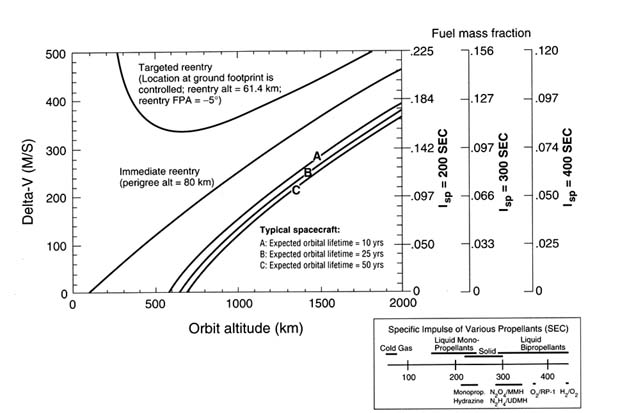
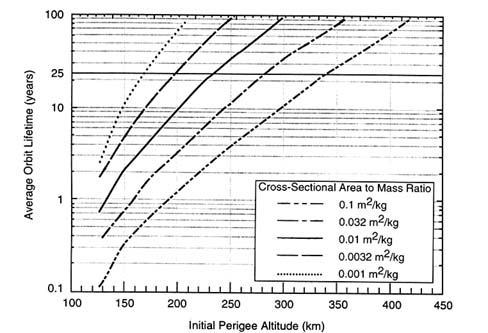
FIGURE 7-3 Average orbital lifetime for GTO, inclination = 27.5 degrees. Random choice for initial argument of perigee and right ascension of ascending node of orbit plane. SOURCE: National Aeronautics and Space Administration.
1-6 and 7-3 showed how increasing an object's ratio of cross-sectional area to mass can greatly reduce its orbital lifetime. Most drag augmentation concepts involve inflatable balloons, which are fairly simple to deploy and can produce a large surface area without a great mass penalty. One problem with balloon devices is that they will rapidly be punctured by small debris; this problem might be solved, however, if a proposed method involving post inflation solidification could be implemented. Alternatively, a non-balloon drag augmentation device, which might be more complex to deploy, could be used. Perhaps a greater problem with these methods is that while they reduce an object's orbital lifetime, they also increase the object's cross-sectional area; the effect may be that the total exposure to collisions is not significantly reduced.
Disposal Orbits
Deorbiting or meaningfully accelerating the orbital decay of spacecraft or rocket bodies from most widely used high-altitude orbital re-
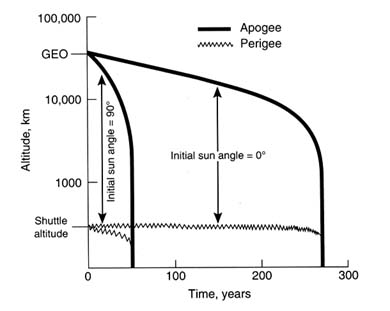
FIGURE 7-4 Shuttle-launched LEO to GEO transfer stage lifetimes. Initial sun angle is the angle between the transfer stage's original orbit and the sun. SOURCE: Loftus et al., 1992.
gions would be prohibitively costly. One means of removing objects from these regions is to reorbit them into ''disposal orbits" at the end of their functional lifetime. This leaves the objects in Earth orbit but removes them from regions where they would pose a direct collision hazard to functional spacecraft. Disposal orbits must typically be far enough from the initial orbit that orbital perturbations do not take the reorbited objects back through their initial orbit, although stable disposal orbits within widely used orbital regions have also been proposed. Reorbiting into a disposal orbit typically requires two propulsive burns at the end of a spacecraft's or rocket body's functional lifetime.
Disposal orbits have been proposed for GEO and other orbital regions, including higher LEO orbits and semisynchronous orbits. A considerable number of GEO spacecraft and some spacecraft in semisynchronous orbits have already performed reorbiting maneuvers to reduce the future debris hazard in those orbits. Spacecraft in the semisynchronous Global Positioning System constellation have performed end-of-life reorbiting maneuvers to disposal orbits from approximately 220 to 810 km above or 95 to 250 km below their initial orbits. In GEO, spacecraft owned by many nations and organizations have carried out
reorbiting maneuvers; Figure 7-5 shows the approximate number of GEO reorbiting maneuvers compared to the number of spacecraft launched to GEO by year. These reorbiting maneuvers have typically placed spacecraft in orbits from 50 to 1,000 km above GEO, though a few spacecraft have been reorbited to orbits below GEO.
Moving a space object into a disposal orbit reduces the collision hazard in the object's initial orbital region, but increases the collision hazard in its new orbital region. Objects moved to disposal orbits can still contribute to the debris hazard in their original orbit, however, since debris generated through collisions or explosions that take place in disposal orbits may intersect the original orbit. (Increased implementation of passivation measures should, however, result in fewer explosions in future disposal orbits.) This is particularly important in high-altitude regions, where an explosion or collision can send a large number of fragments far above and below their initial orbital altitude. Figure 7-6 shows a prediction of the effect of a spacecraft breakup in GEO on the large object flux in nearby altitudes. (This figure should not be compared with the GEO flux depicted in Figure 4-5 because that figure depicts only the flux due to cataloged [typically larger than 1 m in diameter] objects.) Clearly, the
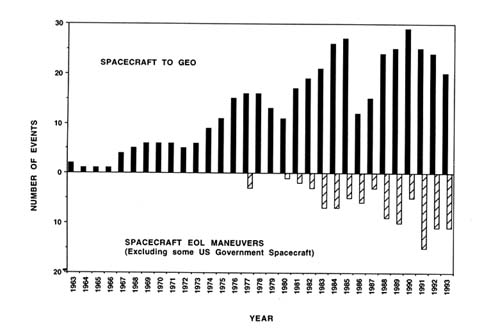
FIGURE 7-5 GEO spacecraft reorbiting maneuvers. SOURCE: Kaman Sciences Corporation.
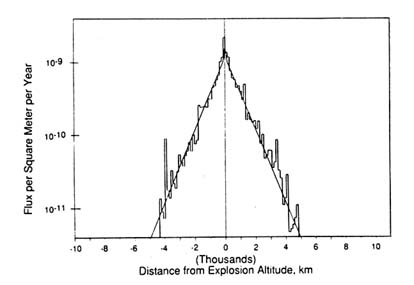
FIGURE 7-6 Calculated flux of 500 debris fragments >10 cm from a satellite breakup near GEO altitude. SOURCE: Friesen et al., 1992.
farther the disposal orbit is from the original orbit, the smaller will be the amount of debris generated in the disposal orbit that intersects the original orbit.
The "cost" of reorbiting to a disposal orbit is usually measured by the amount of fuel required to perform the maneuver. For rocket bodies, this fuel translates into reduced payload capacity; for spacecraft, it means that less mass is available for either payload or (more typically) for station-keeping fuel. The fuel required to move to a disposal orbit a certain distance above the initial orbit decreases with increasing initial orbital altitude. Figure 7-7 shows the change in velocity required to reach disposal orbits from three orbital regions. (This figure also explains why fragments from explosions at high altitudes become more widely distributed than fragments from explosions at low altitudes: given the same ejection velocity, the fragments at high altitudes will travel farther.) Of course, in addition to fuel, the spacecraft or rocket body must have the necessary propulsion and attitude-control capabilities to perform this maneuver.
For each disposal orbit, the reduction of the debris hazard to functional spacecraft should be balanced against the cost of moving objects to the disposal orbit at the end of their functional lifetimes. In addition, use of a disposal orbit should also be weighed against other possible debris reduction methods that may remove the object entirely from orbit. Within
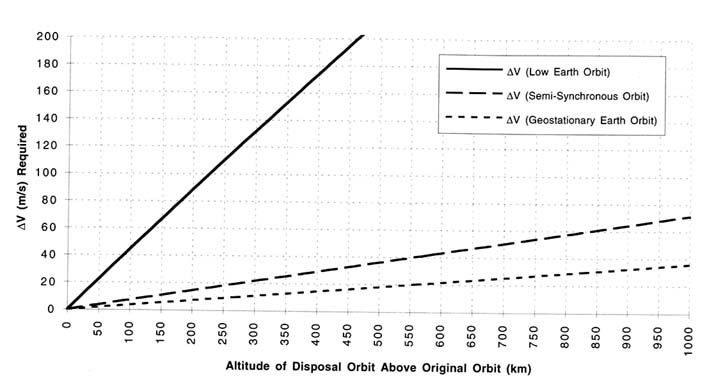
LEO, where it is often feasible to deorbit or accelerate the orbital decay of spacecraft or rocket bodies at EOL and where there is a lack of sufficiently unpopulated regions, disposal orbits do not seem to be a viable option. In GEO, however, where deorbiting and orbital lifetime reduction are infeasible, disposal orbits may be a viable option.
A number of potential GEO disposal orbits that would not require significant EOL maneuvering have been proposed. One concept is to group non-functional spacecraft at the "stable points" of the geostationary ring (above 75°E and 105°W longitude). Theoretically, objects at these locations will not drift along the geostationary ring and thus will not endanger spacecraft elsewhere in GEO. This disposal scheme, however, renders the stable points unusable for functional spacecraft and may not effectively reduce the overall debris hazard in GEO. In addition, the stable points are only mildly stable; a velocity change of only about 1.5 m/s is enough to send objects at the stable points moving along the geostationary arc. In addition, spacecraft at the stable points still experience the 15-degree GEO inclination variation cycle (as described in Chapter 3), and may develop high velocities relative to other spacecraft at the stable points.
Another idea has been to launch spacecraft to the 7.3-degree-inclination GEO "stable plane." The major perturbing forces on spacecraft in this orbit cancel each other, so spacecraft orbiting in the stable plane tend to remain in that plane (Friesen et al., 1993) and collision velocities between uncontrolled spacecraft in the plane would be only a few meters per second. In addition, spacecraft in the stable plane would not require station-keeping propellant to prevent north-south oscillations (which normally account for 95% of a geostationary spacecraft's propellant expenditure). However, objects in the stable plane move at velocities of close to 400 m/s relative to objects in geostationary orbit. Use of the stable plane would thus significantly reduce the debris hazard only if most GEO objects were in the stable plane. However, since spacecraft in the stable plane would not be geostationary and thus would not have the advantages of remaining above a particular point on the Earth, it seems unlikely that the majority of spacecraft operators would move their spacecraft to the stable plane. Even if all new GEO spacecraft were launched to the stable plane, they would still face a collision hazard from the objects that currently exist at other inclinations at the GEO altitude, although the overall collision hazard would be lower than if current practices were continued.
Since major problems exist in schemes to reorbit within the GEO altitude, the reorbiting of GEO spacecraft into disposal orbits with altitudes above or below GEO is the only practical method of removing mass from GEO. Although orbits above GEO may eventually decay into
GEO, the time frame for such a decay is believed to typically be on the order of tens of thousands of years or more. Objects reorbited below GEO, however, would pose an immediate (if low-level) hazard to objects in transfer orbits to GEO. Analysis of the long-term stability of orbits beyond GEO is still under way, but preliminary analysis shows that the use of orbits 300 km above GEO appears to be a minimum for effectively reducing the debris hazard (Chobotov, 1990; Yoshikawa, 1992). The 300-km figure is a minimum to ensure that (1) uncontrolled spacecraft do not physically interfere with controlled spacecraft in GEO and (2) functional spacecraft can change their operational longitude without interference. The use of disposal orbits a minimum of 300 km above GEO was recently recommended by the Ad Hoc Expert Group of the International Academy of Astronautics (International Academy of Astronautics, 1992).
There are disagreements even among experts about the value of using GEO disposal orbits. It is clear that (1) use of a disposal orbit will reduce the amount of mass in GEO and will thus reduce the GEO collision probability; (2) the hazard from objects that are not removed from GEO will persist for millennia; and (3) transfer to a disposal orbit above GEO is a simple maneuver requiring only as much propellant as is typically required by spacecraft for three months' station keeping. However, it is also true that (1) removing objects a few hundred kilometers above GEO only moves the hazard to a slightly wider band; it does not completely and permanently eliminate the hazard the object poses to spacecraft in the geostationary band; and (2) the hazard from simply leaving a spacecraft or rocket body in the geostationary orbit appears to be extremely low at the present time.
Active In-Orbit Debris Removal
The active removal of large debris (such as nonfunctional spacecraft and rocket bodies) from orbit has often been proposed as a means of reducing the debris hazard. The removal of large objects would require some kind of space vehicle dedicated to this purpose; all indications are that the cost of such a vehicle would be prohibitive, especially when the small reduction in the debris hazard that it could achieve is considered. (One study predicted a best-case cost of more than $15 million for each piece of debris in LEO removed, not counting the cost of developing an orbital maneuvering vehicle [Petro and Ashley, 1989].) Even ingenious schemes involving the use of tethers to deorbit large objects would likely be very costly.
A number of on-orbit active removal schemes for small debris also have been proposed, including the removal of small debris with "debris sweepers" (large foam balls or braking foils that impact with smaller
debris) and the ground- or space-based laser evaporation of debris surface material to deorbit small debris. The sweeper scheme seems technically difficult, demonstrably inefficient, hazardous to functional spacecraft, and risks producing more small objects than it eliminates. The laser concept, although interesting, requires costly new technology, and its feasibility has not yet been proven. In general, there is currently no technology able to remove small debris efficiently, and any foreseeable schemes look very costly.
FINDINGS
Finding 1: The future debris hazard can be significantly ameliorated without exorbitant costs by ending or sharply reducing the number of breakups of spacecraft and rocket bodies and, to a lesser extent, by reducing the amount of mission-related debris released in spacecraft deployment and operations. Methods to achieve both these goals exist, are relatively inexpensive, and have been proven in orbit. While implementing these methods will reduce the total number of objects in orbit, it will not, however, significantly reduce the total mass of objects in orbit.
Finding 2: Deorbiting or accelerating the orbital decay of spacecraft and rocket bodies at the end of their functional lifetimes can reduce the total amount of mass and cross-sectional area in orbit. The difficulty and cost of such maneuvers vary depending on the initial orbit, the capabilities of the space vehicle involved, and the desired reduction in orbital lifetime. In general, significant reductions in orbital lifetime can be achieved with much less fuel than deorbiting would require.
Finding 3: Reorbiting spacecraft and rocket bodies into disposal orbits can reduce the debris hazard in their original orbit, but it is not a permanent solution since the debris remains in Earth orbit. Decisions to use a disposal orbit must balance the reduction in the long-term hazard to functional spacecraft against the cost of the maneuver, including the cost of carrying the required fuel and/or the need for premature shutdown. Disposal orbits are not a useful alternative within LEO; opinion within both the committee and the space debris community is divided as to whether they should be used by all spacecraft and rocket bodies in GEO.
Finding 4: The active removal of debris will not be an economical means of reducing the debris hazard in the foreseeable future. Design of future spacecraft and launch vehicles for autonomous deorbiting, lifetime reduction, or reorbiting is a far more economical means of reducing the collision hazard.
REFERENCES
Chobotov, V.A. 1990. Disposal of spacecraft at end-of-life in geosynchronous orbit. Journal of Spacecraft and Rockets 27(4):433–437.
Friesen, L.J., A.A. Jackson IV, H.A. Zook, and D.J. Kessler. 1992. Results in orbital evolution of objects in the geosynchronous region. Journal of Guidance, Control, and Dynamics 15(1):263–287.
Friesen, L.J., D.J. Kessler, and H.A. Zook. 1993. Reduced debris hazard resulting from a stable inclined geosynchronous orbit. Advances in Space Research 13(8):231–241.
Fucke, W. 1993. Fragmentation experiments for the evaluation of the small size debris population. Pp. 275–280 in Proceedings of the First European Conference on Space Debris, Darmstadt, Germany, 5–7 April 1993. Darmstadt: European Space Operations Center.
International Academy of Astronautics Committee on Safety, Rescue, and Quality. 1992. Position Paper on Orbital Debris. August 27. Paris: International Academy of Astronautics.
Johnson, N.L., and D.S. McKnight. 1991. Artificial Space Debris. Malabar, Florida: Krieger Publishing Company.
Kessler, D.J. 1991. Collision cascading: The limits of population growth in law Earth orbit. Advances in Space Research 11(12):63–66.
Kessler, D.J., and J.P. Loftus, Jr. 1994. Orbital debris as an energy management problem. Paper presented at the 31st Plenary Meeting of the Committee on Space Research (COSPAR), Hamburg, Germany, July 14. To be published in Advances in Space Research.
Loftus, Joseph P., Jr., D.S. Kessler, and P.D. Anz-Meador. 1992. Management of the orbital environment. Acta Astronautica 26(7):477–486.
Petro, A., and H. Ashley. 1989. Cost estimates for removal of orbital debris. Pp. 183–186 in Progress in Astronautics and Aeronautics: Orbital Debris from Upper-Stage Breakup, Vol. 121, J.P. Loftus, ed. Washington D.C.: American Institute of Aeronautics and Astronautics.
Yoshikawa, M. 1992. Long-term analysis for the orbital changes of debris. Pp. 2403-2408 in 18th International Symposium on Space Technology and Space Science (ISTS), Kagoshima, Japan, May 17-23. Tokyo: ISTS.


