
1
Space Operations and the Space Environment
SPACE OPERATIONS
In the 37 years since the launch of Sputnik 1, space operations have become an integral component of the world's economy, scientific activities, and security systems. Orbital debris is inextricably linked with these operations: debris is created in the course of these operations and is important because it poses a potential threat to future operations. Understanding some of the characteristics of historical, current, and future space operations is thus essential to understanding the overall debris problem.
Today, spacecraft owned by 23 nations and several international organizations (representing more than 100 countries) support a wide variety of important missions, including communications, navigation, meteorology, geodesy and geophysics, remote sensing, search and rescue, materials and life sciences, astrophysics, and national security. A broad spectrum of simple and sophisticated functional spacecraft, with masses ranging from tens of kilograms to tens of metric tons and operational lives ranging from one week to more than ten years are employed to carry out these space activities.
These spacecraft are placed into orbit by a wide variety of launch vehicles. These launch vehicles, which may be either solid or liquid fueled, use multiple stages (some of which may themselves go into orbit) to place spacecraft into their desired orbit. Some spacecraft retain the stage used to perform their orbital insertion maneuver, and most spacecraft have some propulsive capability for attitude control and performing or-
|
BOX 1-1 Examples of Heavily Used Orbital Regions Low Earth Orbit (LEO): A majority of the world's spacecraft operate in LEO because these orbits have characteristics that are advantageous for a wide array of missions. First, less energy (and thus a smaller launch vehicle) is required to launch a spacecraft into LEO than to put it into any higher orbit. Second, proximity to Earth allows remote sensing missions to receive higher resolution images. Finally, the Earth's magnetic field protects spacecraft in some LEOs from cosmic radiation and solar flares; this is of particular importance for human operations in space. Sun-Synchronous Orbit: These LEOs precess in such a way that they do not experience changes in Sun angle due to the movement of the Earth around the Sun. This means that the lighting conditions for points on the Earth as the spacecraft passes overhead do not change over the course of a year—a useful feature for some remote sensing missions. Sun-synchronous orbits have inclinations greater than 90 degrees (the exact inclination varies with altitude). Although spacecraft can occupy Sun-synchronous orbits at most altitudes, for a number of reasons the altitudes near 900 and 1,500 km are the most widely used. Geosynchronous Earth Orbit (GEO): GEOs are circular with orbital periods of approximately 1,436 minutes (about 24 hours), so spacecraft in them remain above roughly the same longitude on the Earth throughout their orbit. A special type of GEO is the geostationary Earth orbit, which has an inclination close to zero degrees. From the surface of the Earth, spacecraft in geostationary Earth orbits appear to be fixed in the sky. Communications with the spacecraft are thus simplified—both because the spacecraft is in view at all times and because ground antennas do not have to follow the spacecraft's movement. Inclined GEOs are also useful for some missions, although they require ground stations that are able to track a spacecraft's north-south as well as its apparent east-west movement. |
bital corrections. These spacecraft are placed into orbits from which they can accomplish their particular mission effectively, resulting in a highly nonuniform distribution of spacecraft about the Earth. Box 1-1 lists three heavily used orbital regions and some of the reasons why they are used. (Additional information about these and other orbital regions is contained in the Glossary.) A few spacecraft each year are launched out of Earth orbit and into interplanetary space; the hazard to future space operations from these probes is utterly negligible.
The distribution of spacecraft around the Earth at the start of 1994 is displayed in Figure 1-1. This distribution is not static; as missions, technologies, and available launch vehicles change, the distribution of functional spacecraft also changes. For example, over the past three decades, the annual percentage of new space missions to orbits above LEO has been increasing; in 1993, High Earth Orbits (HEOs) were the final desti-
nation of 42 percent of successful launchings worldwide. Proposed future constellations of communications spacecraft in LEO may reverse this trend.
Figure 1-1 reveals a few characteristics of the current spacecraft population. Most spacecraft reside in LEO, but there are three significant concentrations in higher orbits. There is a concentration of spacecraft (performing Earth observation and communications missions) in GEO. A second concentration in and near circular semisynchronous orbits is made up of spacecraft from the U.S. Global Positioning System (GPS) and the Russian Global Navigation Satellite System. There is also a significant population of spacecraft in highly elliptical Molniya-type orbits, including Commonwealth of Independent States (CIS) early warning and communications constellations. (In this report, we will refer to pre-1992 space activities of the former USSR as ''Soviet" and those of 1992 and later as either "Russian" or of the CIS, as appropriate.) In LEO, notable peaks exist around 1,400 to 1,500 km (due in part to a constellation of Russian communication spacecraft and debris from three breakups of Delta rocket bodies) and 900 to 1,000 km (due in part to Sun-synchronous remote sensing and navigation spacecraft and their associated debris).
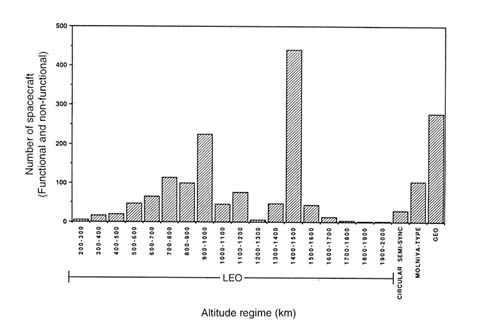
FIGURE 1-1 Spacecraft population in Earth orbit, 1994. SOURCE: Prepared by Kaman Sciences based in part on U.S. Space Command Satellite Catalog.
Most space activities involving humans occur below about 600 km; there are currently few spacecraft in these low orbits because atmospheric drag at these altitudes causes fairly rapid orbital decay.
TYPES OF ORBITAL DEBRIS
The more than 3,600 space missions since 1957 have left a legacy of thousands of large and perhaps tens of millions of medium-sized debris objects in near-Earth space. Unlike meteoroids, which pass through and leave the near-Earth area, artificial space debris orbit the Earth and may remain in orbit for long periods of time. Of the 23,000 space objects officially cataloged by the U.S. Space Surveillance Network (SSN) since the beginning of the space age, nearly one-third remain in orbit about the Earth; the majority of these are expected to stay in orbit for tens or hundreds of years. The increasing population of cataloged space objects is represented in Figure 1-2. It is imperative to note that this figure shows only the objects large enough to be repeatedly tracked by ground-based radar. The vast majority of debris is too small to be tracked and is not represented in the figure.
Objects in Earth orbit that are not functional spacecraft are consid-
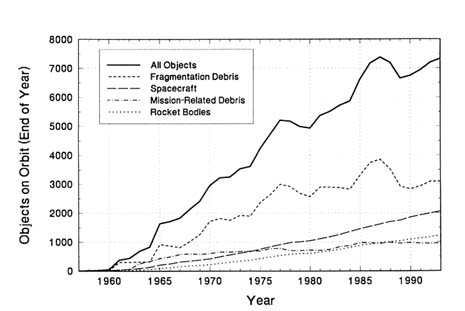
FIGURE 1-2 On-orbit cataloged population (corrected for delayed cataloging). SOURCE: Prepared by Kaman Sciences Corporation based in part on U.S. Space Command Satellite Catalog.
|
Box 1-2 Debris Size Conventions This report uses three general size ranges to categorize debris.
|
|||||||||||||||||||||||||
ered debris. Spacecraft that are passive, serving as platforms for laser ranging experiments, atmospheric density measurements, or calibration of space surveillance sensors are considered functional, as are spacecraft that are currently in a reserve or standby status and may be reactivated in the future to continue their mission. Each other type of object in Earth orbit may be classified as belonging to one of four types of debris: nonfunctional spacecraft, rocket bodies, mission-related debris, and fragmentation debris. Figure 1-3 indicates the relative numbers of cataloged functional spacecraft and debris as of March 1994. More than 90% of these cataloged space objects are of U.S. or Soviet/CIS origin, while the remainder belong to nearly 30 other countries or organizations.
Nonfunctionally Spacecraft
Functional spacecraft represent only about one-fifth of the spacecraft population in Earth orbit—the large majority of orbiting spacecraft are
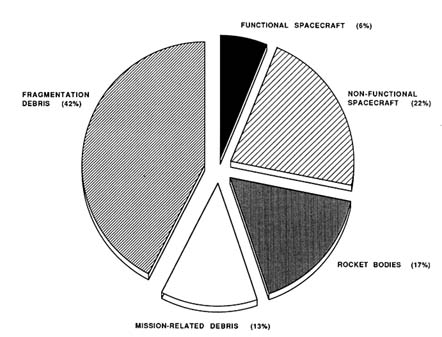
FIGURE 1-3 Cataloged space objects by category, 1994. SOURCE: Prepared by Kaman Sciences Corporation based in part on U.S. Space Command Satellite Catalog.
nonfunctional. With very few exceptions, functional spacecraft that reach their end of life (EOL), through either termination or malfunction, are left in their former orbit or are transferred to slightly higher or lower altitudes (i.e., are reorbited). Typically, EOL reorbiting maneuvers are performed only by geosynchronous or semisynchronous spacecraft and by LEO spacecraft carrying nuclear materials. Historically, these EOL maneuvers have almost always resulted in longer orbital lifetimes. Only crewed vehicles and a few other spacecraft (e.g., reconnaissance or space station related) in very low orbits are normally returned to Earth at the conclusion of their missions.
|
BOX 1-3 Museum Piece in Orbit The oldest nonfunctional spacecraft in orbit is the 1.5-kg Vanguard 1 spacecraft, which was launched by the United States on March 17, 1958, and ceased to function in 1964. Vanguard 1 now resides in an elliptical orbit of 650 km by 3,865 km. This orbit may not decay completely for another 200 years or more. |
Rocket Bodies
The majority of functional spacecraft are accompanied into Earth orbit by one or more stages (or "rocket bodies") of the vehicles that launched them. Usually only one rocket body is left in orbit for missions to LEO, but the launch vehicle of a high-altitude spacecraft such as GOES (Geostationary Operational Environmental Satellite) may release up to three separate rocket bodies in different orbits along the way to its final destination. Relatively few spacecraft types (e.g., the U.S. National Oceanic and Atmospheric Administration and Defense Meteorological Satellite Program meteorological spacecraft and Soviet nuclear-powered ocean reconnaissance spacecraft) are designed to retain their orbital insertion stages and leave no independent rocket bodies. Figure 1-4 depicts the rocket bodies and other large debris placed into various orbits in the course of a Proton launch vehicle's delivery of a payload to GEO.
The presence of rocket bodies in orbit is of particular importance to the future evolution of the Earth's debris population due to their characteristically large dimensions and to the potentially explosive residual propellants and other energy sources they may contain. Although the largest stages, which are generally used to deliver spacecraft and any additional stages into LEO, usually reenter the atmosphere rapidly, smaller stages used to transfer spacecraft into higher orbits and insert
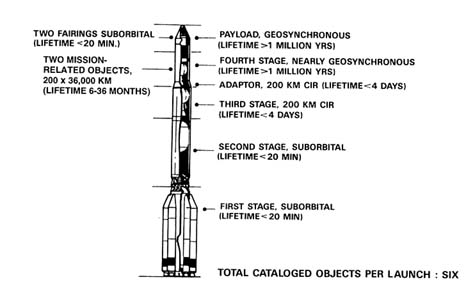
FIGURE 1-4 Typical debris produced in a Proton launch to GEO.
SOURCE: Teledyne Brown Engineering.
them into those orbits may remain in orbit for long periods of time. Many of these rocket bodies are in orbits that intersect those used by functional spacecraft.
Mission-Related Debris
Other space objects, referred to as mission-related debris, may be released as a result of a spacecraft's deployment, activation, and operation. Parts of explosive bolts, spring release mechanisms, or spin-up devices may be ejected during the staging and spacecraft separation process. Shortly after entering orbit, the spacecraft may release cords securing solar panels and other appendages or eject protective coverings from payload and attitude control sensors. The amount of debris released can be quite large; a detailed study of the debris released by one Russian launch mission revealed that 76 separate objects were released into orbit from either the launch vehicle or the spacecraft. Numerous debris may also be created during a spacecraft's active life. For example, during the first eight years of its operation, more than 200 pieces of mission-related debris linked with the Mir space station were cataloged. Although the occasional item accidentally dropped by a cosmonaut or astronaut may be newsworthy, the majority of this type of debris is intentionally dumped refuse. Since mission-related debris are often relatively small, only the larger items can be detected and cataloged by present-day ground-based surveillance networks.
Another type of mission-related debris comes from the operation of solid rocket motors normally used as final transfer stages, particularly on GEO missions. Current solid rocket fuel usually employs significant quantities of aluminum mixed with the propellant to dampen burn rate instabilities. However, during the burning process, large numbers of aluminum oxide (Al2O3) particles are formed and ejected through a wide range of flight path angles at velocities up to 4 km/s. These particles are generally believed to be no larger than 10 microns in diameter, but as many as 1020 may be created during the firing of a single solid rocket motor, depending on the distribution of sizes produced. While the orbital lifetimes of individual particles are relatively short, a considerable average population is suggested by examinations of impacts on exposed spacecraft surfaces. More than 25 solid rocket motor firings were conducted in orbit during 1993.
More recently, attention has been drawn to another side effect of solid rocket motors. Ground tests indicate that in addition to the large number of small particles, a smaller number of 1-cm or larger lumps of Al2O3 are also ejected during nominal burns. The only indication of the existence of such objects are data from ground tests carried out at
Marshall Space Flight Center, Alabama, and the Arnold Engineering and Development Center (Siebold et al., 1993). These medium-sized particles, which have lower characteristic ejection velocities and smaller area-to-mass ratios than the smaller particles, may also be longer-lived than the small particles and could pose a long-term hazard to other Earth-orbiting space objects.
Fragmentation Debris
Fragmentation debris—the single largest element of the cataloged Earth-orbiting space object population—consists of space objects created during breakups and the products of deterioration. Breakups are typically destructive events that generate numerous smaller objects with a wide range of initial velocities. Breakups may be accidental (e.g., due to a propulsion system malfunction) or the result of intentional actions (e.g., space weapons tests). They may be caused by internal explosions or by an unplanned or deliberate collision with another orbiting object.
Since 1961, more than 120 known breakups have resulted in approximately 8,100 cataloged items of fragmentation debris, more than 3,100 of which remain in orbit. Fragmentation debris thus currently makes up more than 40 percent of the U.S. space object catalog (and undoubtedly represents an even larger fraction of uncataloged objects). The most intensive breakup on record was the 1987 breakup of the Soviet Kosmos 1813, which generated approximately 850 fragments detectable from the Earth. The fragmentation debris released from a breakup will be ejected at a variety of initial velocities. As a result of their varying velocities, the fragments will spread out into a toroidal cloud that will eventually expand until it is bounded only by the limits of the maximum inclinations and altitudes of the debris. This process is illustrated in Figure 1-5. The rate at which the toroidal cloud evolves depends on both the original spacecraft's orbital characteristics and the velocity imparted to the fragments; in general, the greater the spread of the initial velocity of the fragments, the faster will the evolution occur.
In contrast, debris fragments that are the product of deterioration usually separate at low relative velocity from a spacecraft or rocket body that remains essentially intact. Products of deterioration large enough to be detected from Earth are occasionally seen—probably such items as thermal blankets, protective shields, or solar panels. Most such deterioration is believed to be the result of harsh environmental factors, such as atomic oxygen, radiation, and thermal cycling. During 1993 the still-functional COBE (Cosmic Background Explorer) spacecraft released at least 40 objects detectable from Earth—possibly debonded thermal blanket segments—in a nine-month period, perhaps as a result of thermal shock.
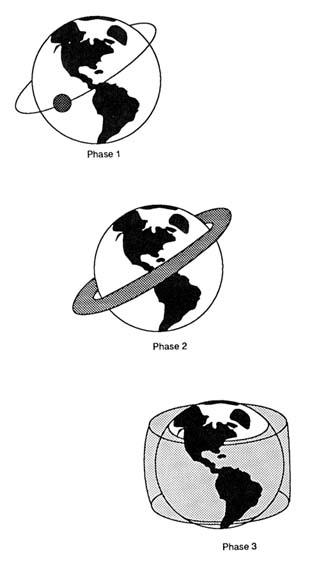
FIGURE 1-5 Evolution of a debris cloud.
SOURCE: Kaman Sciences Corporation.
Another serious degradation problem involves the flaking of small paint chips as a space object ages under the influence of solar radiation, atomic oxygen, and other forces. Paint, which is used extensively on both spacecraft and rocket bodies for thermal control reasons, can deteriorate severely in space, sometimes in a matter of only a few years. The potential magnitude of the problem was not fully recognized until the 1983 flight of the STS-7 Space Shuttle mission, when an impact crater on
|
Box 1-4 Degradation Debris From LDEF A variety of small and medium-sized debris is known to have been created by the degradation of surfaces on the LDEF spacecraft. Several multilayer insulation (MLI) blankets on the space-facing end came partially loose when the Kapton tape holding them to the spacecraft became brittle in the ultraviolet light exposure. Subsequent shrinking of the top face sheets of the MLI blankets stressed the embrittled Kapton tape and caused it to crack, partially releasing the MLI blankets (See et al., 1990; Adams et al., 1991). Several solar array specimens (each of which was approximately 5 cm by 10 cm) also came loose from LDEF. These specimens were mounted on Kapton substrates that were eroded by atomic oxygen exposure. (Whitaker and Young, 1991). The astronauts on board the shuttle visually identified (and filmed) one of the released solar array specimens as they approached LDEF during its retrieval mission. The films from this mission also show a cloud of small particles surrounding LDEF. |
an orbiter window was apparently caused by a paint chip smaller than a millimeter in diameter. Subsequent analyses of spacecraft components returned from LEO have confirmed the presence of a large population of paint particles, even though the orbits of individual particles decay quite rapidly.
PERTURBATION FORCES AFFECTING SPACE OBJECTS
Once in orbit, debris is affected by perturbing forces that can alter its trajectory and even remove it completely from orbit. Other than the gravitational attraction of the Earth, the primary forces acting on a space object in lower orbits (below about 800 km) are atmospheric drag and gravitational perturbations from the Earth. These gravitational perturbations, however, although affecting some orbital parameters, do not generally strongly affect orbital lifetime. For space objects in higher orbits, solar and lunar gravitational influences become more important factors. Small debris can also be affected by solar radiation pressure, plasma drag, and electrodynamic forces, although the effects of plasma drag and electrodynamic forces are typically dwarfed by the effects of solar radiation pressure.
The rate at which a space object loses altitude is a function of its mass, its average cross-sectional area impinging on the atmosphere, and the atmospheric density. Although the Earth's atmosphere technically extends to great heights, its retarding effect on space objects falls off rapidly with increasing altitude. Atmospheric density at a given altitude,
however, is not constant and can vary significantly (particularly at less than 1,000 km) due to atmospheric heating associated with the 11-year solar cycle. This natural phenomenon has the effect of accelerating the orbital decay of debris during periods of solar maximum (increased sunspot activity and energy emissions). During the last two peaks in the solar cycle, the total cataloged space object population actually declined, because the rate of orbital decay exceeded the rate of space object generation via new launches and fragmentations.
Figure 1-6, which displays the predicted orbital lifetimes for a number of different objects in circular LEOs at different periods in the solar cycle, illustrates the importance of cross-sectional-area-to-mass ratio, altitude, and solar activity in determining orbital lifetimes in LEO. First, objects with low ratios of cross-sectional area to mass decay much more slowly than objects with high area-to-mass ratios. Second, objects at low altitude experience more rapid orbital decay than objects at high altitude. Finally, objects decay much more rapidly during periods of solar maximum than during the solar minimum.
Solar-lunar gravitational perturbations primarily affect the orbital lifetimes of space objects in highly elliptical orbits (e.g., Molniya-class or Geostationary Transfer Orbits [GTO]). Depending on the alignments of the space object's orbital plane with the Moon and the Sun, these forces can either accelerate or decelerate the orbital decay process substantially. For example, a GTO rocket body could reenter the Earth's atmosphere within a few months or remain in orbit for more than a century, depending on the position of the Sun and the Moon at the time of its injection into transfer orbit. GEO missions launched by the CIS routinely take advantage of these forces to limit the lifetime of GTO debris to less than three years, with many objects decaying in less than six months.
Solar radiation pressure normally induces a noticeable effect on a space object's orbit if that object possesses a large area-to-mass ratio. These effects can lead to an increase in the eccentricity of the orbit, which in turn leads to more rapid decay if the resulting lower perigee exposes the space object to significantly greater atmospheric density levels. Insulation materials and inflatable space objects are often strongly affected by solar radiation pressure. Debris from the ruptured Pageos balloon, for example, exhibited strong orbital perturbations due to solar radiation pressure, as has some debris from more conventional fragmentations.
The combination of all of these forces has caused approximately 16,000 cataloged objects to reenter the atmosphere since the beginning of the space era. In recent years, an average of two to three space objects large enough to be cataloged (as well as numerous smaller debris particles) reenter the Earth's atmosphere each day. Over the course of a year, this amounts to hundreds of metric tons of material. This material is
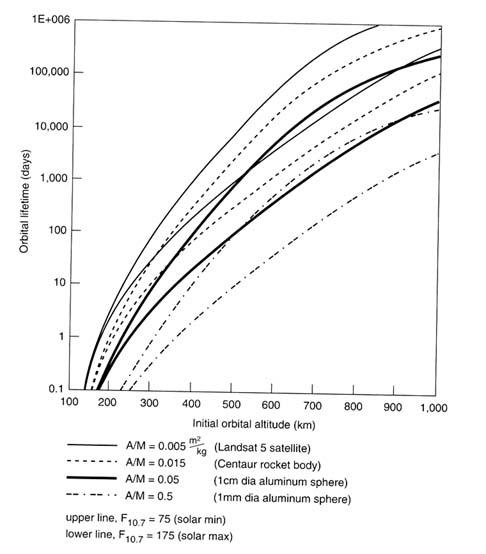
FIGURE 1-6 Orbital decay time versus altitude.
SOURCE: National Aeronautics and Space Administration.
composed primarily of large objects that were launched into low orbits (most of the mass is in the form of large multiton rocket bodies) and small objects with high cross-sectional-area-to-mass ratios. Seldom do any large objects initially placed into orbits higher than 600 km reenter the atmosphere.
FINDING
Finding 1: Orbital debris travels in a variety of orbits and is affected by various perturbation forces, including the effects of the Earth's atmosphere, gravitational perturbation effects, and solar radiation pressure. As orbital altitude increases, the effect of the atmosphere in accelerating orbital decay becomes small, and typical large objects in orbits higher than approximately 600 km can remain in orbit for tens, hundreds, or even thousands of years.
REFERENCES
Adams, J.H., L.P. Beahm, and A.J. Tylka. 1991. Preliminary results from the heavy ions in space experiment. P. 377 in NASA Conference Publication 3134, LDEF—69 Months in Space: Proceedings of the First Post-Retrieval Symposium, Kissimmee, Florida, June 2–8. A.S. Levine, ed. Hampton, Virginia: NASA Langley Research Center.
See, T., M. Allbrooks, D. Atkinson, C. Simon, and M. Zolensky. 1990. Meteoroid and Debris. Impact Features Documented on the Long Duration Exposure Facility: A Preliminary Report. NASA JSC #24608. Houston, Texas: NASA Johnson Space Center.
Siebold, K.H., M.J. Matney, G.W. Ojakangas, and B.J. Anderson. 1993. Risk analysis of 1-2 cm debris population for solid rocket motors and mitigation possibilities for geotransfer orbits. Pp. 349–351 in Proceedings of the First European Conference on Space Debris, Darmstadt, Germany, April 5–7. Darmstadt: European Space Operations Center.
U.S. Space Command. 1994. U.S. Space Command Satellite Catalog. Cheyenne Mountain Air Force Base, Colorado: U.S. Space Command.
Whitaker, A.F., and L.E. Young. 1991. An overview of the first results on the Solar Array Materials Passive LDEF Experiment (SAMPLE), A0171. P. 1241 in NASA Conference Publication 3134, LDEF-69 Months in Space: Proceedings of the First Post-Retrieval Symposium, Kissimmee, Florida, June 2–8. A.S. Levine, ed. Hampton, Virginia: NASA Langley Research Center.


