
3
Debris Population Distribution
As discussed in Chapter 2, a variety of techniques have been developed to characterize the orbital debris environment, but a high level of uncertainty remains in our understanding of the debris population. While extensive data have been acquired on the cataloged population, cataloged objects represent only a small fraction of the debris in orbit; estimates of the populations of uncataloged debris are based on a limited number of sampling measurements tied together with models. Any estimates of the overall debris population are thus uncertain; they are likely to change as new data are acquired. Figure 3-1 presents one estimate of the total number of objects of various sizes in LEO, based on various measurements. Table 3-1 estimates the total orbital debris population in each size range and the fraction of the total mass in orbit contributed by objects in each size range.
LARGE DEBRIS
The best-known segment of the debris population is the population of cataloged large debris. Figure 3-2 is a "snapshot" depiction of the location of all cataloged debris at a particular moment in time. Some features of the distribution of the cataloged debris population can already be seen in this figure, including the concentrations in the GEO ring and in LEO. Figure 3-3 quantifies Figure 3-2 by portraying the approximate spatial density of cataloged objects at various altitudes. Clear concentrations can be seen at less than 2,000-km altitude (LEO), around 20,000 km (semisynchronous orbit), and at 36,000 km (GEO).
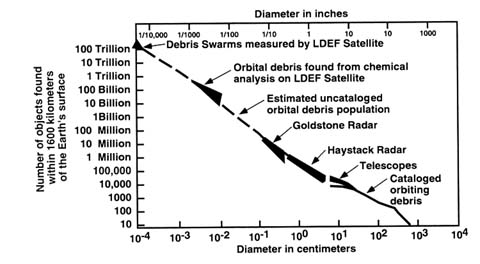
FIGURE 3-1 Number of objects in LEO as estimated from various measurements.
SOURCE: National Aeronautics and Space Administration.
These concentrations of higher spatial density are due to large numbers of objects in near-circular orbits at or near these altitudes. The lower background level of spatial density visible in Figure 3-3 at altitudes up to 40,000 km is due to objects in highly elliptical orbits with perigees in LEO and apogees up to 40,000 km. This background spatial density also exists in LEO, where most highly elliptical orbits have their perigee. Most objects in highly elliptical orbits are either rocket bodies that placed spacecraft in semisynchronous orbit or GEO or objects in Molniya-type orbits. Few objects are cataloged in orbits higher than 40,000 km.
Figures 3-4 and 3-5 indicate the distribution of different types of cataloged space objects by mean altitude. At less than 2,000 km, the majority of cataloged objects are fragmentation debris, but at altitudes between 2,000 and 16,000 km, mission-related debris represents the largest frac-
TABLE 3-1 Approximate Orbital Debris Population by Size
|
Orbital Debris Size Range |
Number of Objects |
Percentage of Objects >1 mm |
Percentage of Total Mass |
|
Large (>10 cm) |
>10,000 |
<0.5 |
>99.95 |
|
Medium (1 mm-10 cm) |
Perhaps tens of millions |
>99.5 |
<0.05 |
|
Small (<1 mm) |
Trillions |
<0.01 |
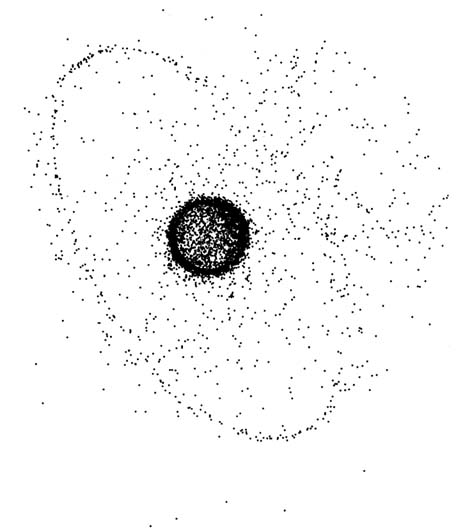
FIGURE 3-2 Cataloged orbital debris. SOURCE: Kaman Sciences Corporation.
tion of cataloged objects; at more than 16,000 km, spacecraft and rocket bodies constitute the majority. This distribution may, however, be due more to the reduced capabilities of Earth-based sensors to detect smaller objects at high altitudes than to any changes in the composition of the debris population. Within the region below 2,000 km, the distribution of cataloged objects by altitude is highly nonuniform, with peaks around 900 to 1,000 km and 1,400 to 1,500 km. Although objects in the lowest-
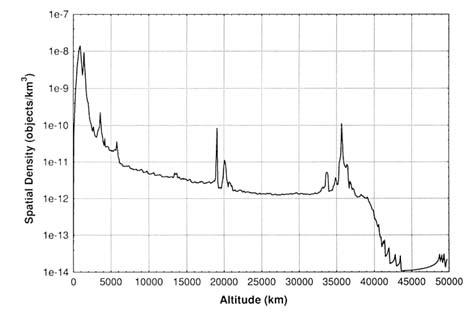

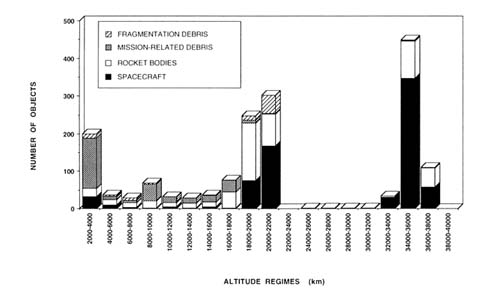
FIGURE 3-5 High altitude space object population by semi-major axis, 1993.
SOURCE: Prepared by Kaman Sciences Corporation based on U.S. Space Command Satellite Catalog.
altitude orbits eventually reenter the atmosphere, this population is augmented by objects from decaying higher-altitude orbits.
Except for those in GEO, most cataloged objects are in orbits with fairly high inclinations. This means that relative collision velocities for these objects will be generally higher than orbital velocity. (Collision velocities are discussed in detail in Chapter 4.) Differing orbital inclinations also cause asymmetric distributions in the LEO satellite population by latitude. For example, objects in low-inclination orbits do not contribute to the apparent congestion or bunching of objects in the higher temperate zones, and since few objects are in truly polar orbits (with inclinations of 90 degrees), ''holes" in the space object swarm appear over the Earth's poles. (This does not, however, mean that high-inclination orbits will have a lower collision probability; any two circular orbits at the same altitude will intersect at two points, irrespective of their respective inclinations.) Figure 3-6 shows the inclination distribution of cataloged space objects.
Above LEO, spacecraft in orbits at a particular altitude often have similar missions, so both they and the debris associated with them (e.g., rocket bodies, mission-related debris, fragmentation debris) tend to have similar inclinations. These high-altitude, high-inclination orbits include Molniya-type orbits, which typically have inclinations of 63 to 65 degrees
|
BOX 3-1LEO Communications Constellations Large constellations of LEO communications spacecraft have been proposed by a number of companies and organizations. These include the Iridium system of 66 spacecraft, the Globalstar constellation of 48 spacecraft, and the Teledesic constellation of 840 spacecraft, among others. Launches of spacecraft for these constellations could begin in the middle to late 1990s. If these constellations are developed, they will add significantly to the population of large objects in LEO. |
(though objects in these orbits experience inclination changes of ±5 degrees) and the orbits near semisynchronous altitude, where inclinations are about 55 degrees for U.S. spacecraft and 65 degrees for CIS spacecraft. Space objects in GEO orbits are originally placed in near-zero inclination orbits, but once stationkeeping stops, the inclination of a GEO object's orbit will vary with time.
Most spacecraft in GEO actively maintain inclinations close to zero degrees and remain stationary above a given longitude. However, the orbital planes of nonfunctional spacecraft and other debris, will (due to
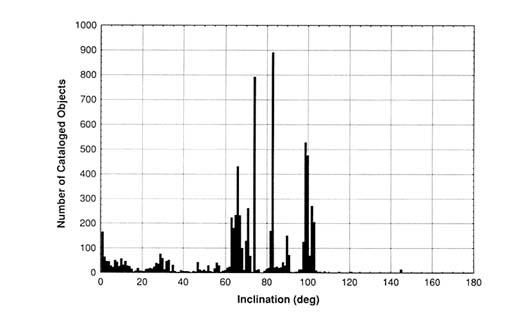
FIGURE 3-6 Inclination distribution of cataloged population.
SOURCE: Prepared by Kaman Sciences Corporation, based in part on U.S. Space Command Satellite Catalog, July 1994.
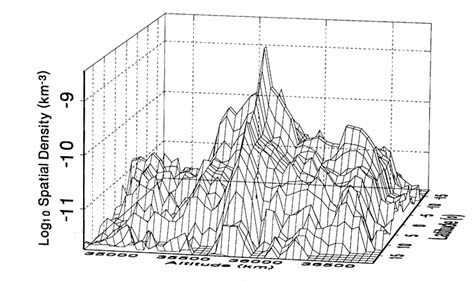
FIGURE 3-7 Geosynchronous spatial density by altitude and latitude.
SOURCE: Prepared by Kaman Sciences Corporation based on U.S. Space Command Satellite Catalog, August 1993.
the Earth's oblateness and third-body gravitational perturbations of the Sun and Moon) oscillate around a plane tilted 7.3 degrees from the equator, causing orbital inclination to vary with an amplitude of 14.6 degrees over a period of about 53 years. In addition, the ellipticity of the Earth's equator will cause debris in GEO to drift away from their initial longitudinal position and oscillate around the nearest stable position (either above 75°E or above 105°W) with a period of more than two years. As a result of these forces, the current population of debris in GEO has a mix of inclinations ranging from 0 to 15 degrees (though fragmentation debris from breakups near GEO may have even higher inclinations) and orbital planes that intersect throughout the entire geostationary ring. Figure 3-7 shows the current spatial density of cataloged objects near GEO.
The main distinction between the populations of cataloged and uncataloged large debris is more a product of sensor capabilities than of any inherent differences in the objects. For example, a fragment 30 cm in diameter that would almost certainly be cataloged if it were in LEO would not be cataloged if it were in GEO. However, because spacecraft and rocket bodies in Earth orbit are generally large enough to track, the uncataloged large debris population is composed primarily of mission-related and fragmentation debris. As discussed in Chapter 2, there is known to be a population of uncataloged large debris even in LEO, and
the fraction of objects that are not cataloged generally increases with altitude. It is possible that the total uncataloged population of large orbital debris could be as numerous as, or more numerous than, the cataloged population.
MEDIUM-SIZED DERBIS
The population of medium-sized (approximately 1 mm to 10 cm in diameter) debris is not nearly as well known as the population of large debris. As described in Chapter 2, the only measurements of the medium-sized debris population come from sampling of lower-altitude, higher-inclination LEO orbital regions with ground-based sensors. All other estimates of the size and characteristics of the medium-sized debris population are based entirely on extrapolations.
To a first approximation, it might be expected that medium-sized debris would be found in about the same orbits as large debris, since most medium-sized debris originates from large objects. However, all large objects may not contribute equally to the medium-sized debris population; some types of large object (such as rocket bodies that have been a source of explosive fragmentation) may produce much more debris than others. In addition, as described in Chapter 1, perturbing forces affect different sizes of debris differently. Medium-sized debris, which often has a higher ratio of cross-sectional-area to mass than large debris, will often be more strongly affected by atmospheric drag and thus will experience more rapid orbital decay.
Although there are no measurement data proving the origins of medium-sized debris, most likely the population is composed of fragmentation debris and mission-related objects (since nonfunctional spacecraft and rocket bodies are obviously large debris). The number of medium-sized debris objects detected is large compared to the number of large objects. Since it is generally believed that the majority of this population cannot be mission-related objects, they are most likely fragmentation debris. Consequently, breakup models can be useful tools in estimating some characteristics of the medium-sized debris population. Although there are large uncertainties in predictions of both the number and the initial velocities—and thus orbital parameters—of medium-sized objects ejected in a breakup (as described in Chapter 2), it is known that medium-sized fragments will generally be ejected from a catastrophic breakup with a greater range of initial relative velocities than large breakup fragments; this will place them into orbits with a wider range of altitudes, inclinations, and eccentricities (Johnson, 1985)
Ground-based sensors, particularly the Haystack radar, have provided the most detailed information to date on the population of me-
dium-sized debris objects. Figure 3-8 shows the estimated population distribution of objects detected by the Haystack radar when parked vertically, as compared with the population distribution of objects in the U.S. catalog. Interestingly, the data show that for the region measured, the altitude distribution of medium-sized objects is similar to that of the larger objects included in the U.S. catalog. There are, however, two significant differences: (1) below about 1,000 km the population of medium-sized objects detected by Haystack declines with decreasing altitude faster than the population of large cataloged objects; and (2) around 900 to 1,000 km there is a large peak in the population of medium-sized objects detected by Haystack with no corresponding peak in the population of large cataloged objects. The first difference is consistent with the expectation that medium-sized pieces of debris are more strongly affected by atmospheric drag than larger debris. The peak in the medium-sized population around 900 to 1,000 km, however, points to a source of debris other than previously recorded breakups.
The eccentricity and inclination of many of the medium-sized objects detected by Haystack can also be determined. The data on inclination versus altitude for the objects detected by the Haystack radar are depicted in Figure 3-9. These measurements show that medium-sized de-
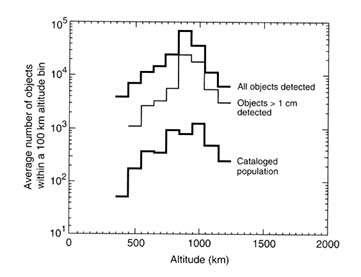
FIGURE 3-8 Estimate of LEO mid-sized orbital debris population from Haystack radar sampling (90 degrees, 547.6 hours), compared to the U.S. Space Command population of cataloged objects.
SOURCE: National Aeronautics and Space Administration.
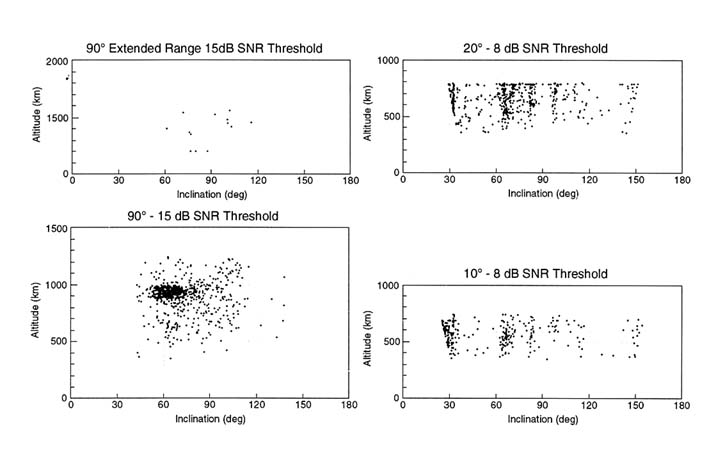
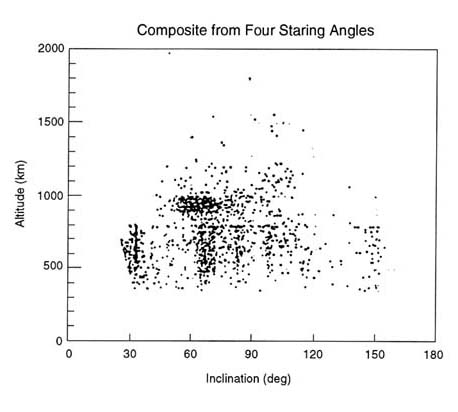
bris is more frequently found in low inclination and eccentric orbits than cataloged large debris and that the large number of objects detected between 900 and 1,000 km are in near-circular orbits with inclinations around 65 degrees (Stansbery et al., 1994). The reported detection of objects with inclinations greater than 110 degrees may be a result of the high uncertainty in determining inclination for objects that are barely detectable (as described in Chapter 2).
As mentioned previously, the Haystack data suggest that there may be major sources of centimeter-sized orbital debris other than previously recorded breakups. The large number of objects in orbits between 900 and 1,000 km with orbital inclinations between 60 and 70 degrees suggests that there is a significant source of debris in this area. If this source were breakups, however, the debris would have been spread over a much wider area than is evidenced by the data. It thus seems possible that some of this debris may be the result of a previously unmodeled source. This possibility is supported by the polarization data from Haystack, which suggests that the objects have relatively smooth and spherical shapes, rather than the irregular shapes that would typically be created in a breakup. A combination of orbital and physical characteristics can be interpreted to suggest that these objects may be tens of thousands of 0.6-2.0 cm diameter liquid droplets of a sodium/potassium coolant leaking from the nonfunctional cores of Russian Radar Ocean Reconnaissance satellites (Stansbery et al., 1995; Kessler et al., 1995). Less evidence exists to suggest the sources of other concentrations of debris not predicted by models (such as the concentration of medium-sized objects detected by Haystack with inclinations between 25 and 30 degrees—another region in which few breakups have been observed [Kessler, 1993]).
SMALL DEBRIS
There is an extremely numerous population of small (<1 mm in diameter) debris particles in Earth orbit. Knowledge of the distribution of these particles comes, as described in Chapter 2, primarily from the examination of returned spacecraft material from such spacecraft as Solar Max and the LDEF and a few active measurements made on the LDEF, the Salyut and Mir space stations, EURECA, and the U.S. Space Shuttle. Since the returned materials and active measurements are all from spacecraft in orbits of 600 km altitude or less, uncertainty remains on how to extrapolate these data to higher altitudes. Some models predict that because of the lessening influence of atmospheric drag, the spatial density of debris smaller than 1 mm should increase with altitude up to at least 1,000 km.
Like medium-sized debris, small debris is all either mission-related
objects (e.g. aluminum oxide particles expelled from solid rocket motors) or fragmentation debris (the product of either breakups or surface deterioration). Aluminum oxide particles from solid rocket motor exhaust are generally believed to be approximately spherical in shape with a maximum diameter of about 10 microns. These particles are initially ejected from rocket bodies at velocities from about 1.5 to 3.5 km/s, depending on the particle size (smaller particles are generally ejected faster). Most of these particles rapidly reenter the Earth's atmosphere, while others (typically larger particles) are typically sent into a variety of elliptical orbits, depending on where the rocket was fired. Paint chips and similar products of deterioration are usually much larger than the aluminum oxide particles, averaging hundreds of microns in diameter. Such debris particles are released from spacecraft or rocket bodies with virtually no initial ejection velocities and thus initially share nearly identical orbits with their parent object. Finally, the products of breakup span the entire range of small (as well as medium and large) debris sizes and exhibit a variety of shapes. Small breakup fragments likely experience a larger range of ejection velocities than medium or large fragments, placing them in a wider range of initial orbits.
Perturbing forces affect the orbits of small debris even more strongly than the orbits of medium-sized debris. In particular, the typically larger ratios of cross-sectional-area to mass of small debris means they are more strongly affected by solar radiation pressures and atmospheric drag. Analyses conclude that less than 5% of aluminum oxide particles produced in solid rocket exhaust will remain in orbit after a year (Muller and Kessler, 1985; Akiba et al., 1990), whereas larger particles produced in breakups or from deterioration may remain in orbit for a few years.
Active measurements made during the first year of the LDEF's 1984 to 1990 orbital lifetime first indicated the highly dynamic nature of the small orbital debris environment (though it has since been confirmed by an experiment on the HITEN spacecraft [Münzenmayer et al., 1993]). LDEF's Interplanetary Dust Experiment (Mulholland et al., 1991), which was the only experiment on LDEF that measured the time of impact, showed that most impacts were associated with "orbital debris swarms." That is, the sensors would detect a very large increase in flux (three to five orders of magnitude) lasting for a few minutes. In most cases, these swarms were detected again at nearly the same point in the LDEF orbit. These points slowly changed with time (a characteristic of orbital precession rates), allowing the orbital characteristics of the swarms to be determined. The existence of these swarms suggests that the six-year "average" flux measured by the passive LDEF experiments may in fact be very time dependent, especially for very small debris, of which these swarms mostly consist.
A number of possible sources of these debris swarms have been suggested. One is that the swarms may consist of aluminum oxide particles expelled from solid rocket motors. However, as discussed, such particles experience rapid orbital decay and could not produce swarms lasting for several months, such as those observed by LDEF. It has also been suggested that a spent rocket stage might slowly release sufficient dust to produce the long-lasting swarms (Kessler, 1993). Another possible source might be paint removed by atomic oxygen erosion from objects in highly elliptical orbits. Less than a gram of paint per year removed from a spacecraft would produce a swarm like those detected by LDEF (Kessler, 1990). A final possibility is that the swarms are the result of undetected breakups, perhaps even of a collision. It has been pointed out (Potter, 1993) that the small particles ejected from a hypervelocity impact between a medium-sized debris object and a large object could create a debris cloud having the size distribution of the swarms detected by LDEF.
FINDINGS
Finding 1: The natural meteoroid environment does not pose a serious hazard to most spacecraft in Earth orbit. However, there are orders of magnitude more large orbital debris than large meteoroids in Earth orbit. Although measurements of the medium-sized debris environment are sparse, the population of medium-sized orbital debris also appears to be larger than the population of medium-sized micrometeoroids in the regions of LEO where measurements have been made.
Finding 2: In the limited regions where measurements of the medium-sized debris population have been made, the altitude distribution of the medium-sized objects shows a strong similarity to that of large cataloged objects (except at low altitudes where the influence of atmospheric drag is strong). Measurements of the small debris population, which have been made only at lower altitudes, are so limited that no conclusions about their altitude distribution can yet be drawn.
Finding 3: Because (1) the populations of medium and small debris may change relatively rapidly and (2) our knowledge of these populations comes largely from extrapolations based on a few measurements and models, learning more about the sources of medium and small debris (and improving models with this knowledge) will provide more long-term information about the debris environment than will determining the current spatial density in every orbital region of interest. This is particularly true for the small debris population that (due to short orbital lifetime) may experience drastic changes in a short period of time.
REFERENCES
Akiba, R., N. Ishii, and Y. Inatani. 1990. Behavior of Alumina Particles Exhausted by Solid Rocket Motors. AIAA 90-1367. AIAA/NASA/DOD Orbital Debris Conference, Baltimore, Maryland, April 16–19. Washington, D.C.: American Institute of Aeronautics and Astronautics.
Johnson, N.L. 1985. History and consequences of on-orbit breakups. Advances in Space Research 5:11–19 .
Kessler, D.J. 1990. Collision probability at low altitudes resulting from elliptical orbits. Advances in Space Research 10(3-4):393–396 .
Kessler, D.J. 1993. Orbital debris environment. Pp. 251–262 in Proceedings of the First European Conference on Space Debris, Darmstadt, Germany, 5–7 April 1993. Darmstadt: European Space Operations Center.
Kessler, D.J., R.C. Reynolds, and P.D. Anz-Meador. 1995. Current Status of Orbital Debris Environment Models. Paper Presented at 33rd Aerospace Sciences Meeting and Exhibit, Reno, Nevada, January 9-12. AIAA 95-0662. Washington, D.C.: American Institute of Aeronautics and Astronautics.
Mulholland, J.D., S.F. Singer, J.P. Oliver, J.L. Weinberg, W.J. Cooke, N.L. Montague, J.J. Wortman, P.C. Kassel, and W.H. Kinard. 1991. IDE spatio-temporal impact fluxes and high time-resolution studies of multi-impact events and long-lived debris clouds. NASA Conference Publication 3134, LDEF–69 Months in Space: Proceedings of the First Post-Retrieval Symposium, Kissimmee, Florida, June 2–8. A.S. Levine, ed. Hampton, Virginia: NASA Langley Research Center.
Muller, A.C., and D.J. Kessler. 1985. The effects of particulates from solid rocket motors fired in space. Advances in Space Research 5(2):77–86 .
Münzenmayer, R., H. Iglseder, and H. Svedham. 1993. The Munich dust counter MDC — An experiment for the measurement of micrometeoroids and space debris. Pp. 117–123 in Proceedings of the First European Conference on Space Debris, Darmstadt, Germany, 5–7 April 1993. Darmstadt: European Space Operations Center.
Potter, A.E. 1993. Early detection of collisional cascading. Pp. 281–285 in Proceedings of the First European Conference on Space Debris, Darmstadt, Germany, 5–7 April 1993. Darmstadt: European Space Operations Center.
Stansbery, E.G., D.J. Kessler, T.E. Tracy, M.J. Matney, and J.F. Stanley. 1994. Haystack Radar Measurements of the Orbital Debris Environment. JSC-26655. Houston, Texas: NASA Johnson Space Center.
Stansbery, E.G., D.J. Kessler, and M.J. Matney. 1995. Recent Results of Orbital Debris Measurements From the Haystack Radar. Paper Presented at 33rd Aerospace Sciences Meeting and Exhibit, Reno, Nevada, January 9-12. AIAA 95-0662. Washington, D.C.: American Institute of Aeronautics and Astronautics.
U.S. Space Command. 1994. U.S. Space Command Satellite Catalog. Cheyenne Mountain Air Force Base, Colorado: U.S. Space Command.


