
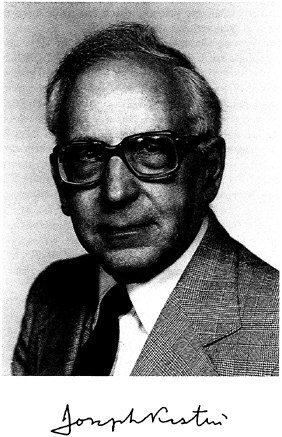
JOSEPH KESTIN
1913–1993
BY DANIEL C. DRUCKER
JOSEPH KESTIN, professor of engineering at Brown University, died on March 16, 1993, of acute leukemia. Founder and first director of the university's Center for Energy Studies, he continued his high level of activity and productivity in research until the very end. Throughout his long and distinguished academic career, in which both experimental and theoretical research played so important a role, Professor Kestin was a superb teacher of undergraduate students. They, along with the host of other readers of his texts on thermodynamics, appreciated greatly his fundamental and challenging approach to the understanding as well as the use of thermodynamic principles.
Born on September 18, 1913, in Warsaw, Poland, Professor Kestin received his Dipl. Ing. degree from the Technical University there in 1937 and then began graduate study at Kings College, London. Soon after his return to Warsaw for a visit in late summer 1939, he was sent to a Russian prisoner-of-war camp and was not released to serve with the Allies until 1941. He was then able to resume his graduate studies at Imperial College, London, and completed his doctoral thesis on ''High Speed Flow of Gases Through Channels'' under the direction of Sir Owen Saunders.
Following World War II the Polish University College, as a transient arrangement to permit the many expatriate Poles to complete their education, became a unit of the University of
London with Professor Kestin as the head of its Department of Mechanical Engineering. In 1952 he came to the United States to begin his long and fruitful association with Brown University.
Professor Kestin's many awards and honors predate and postdate his election to the National Academy of Engineering (NAE) in 1982. He was a recipient of the James Harry Potter Gold Medal of the American Society of Mechanical Engineers (ASME) for his contributions to thermodynamics, a D.Sc. from the University of London for his eminent research contributions; the Water Arbitration Prize of the Institution of Mechanical Engineers, London; an Alexander von Humboldt-Stiftung Senior U.S. Scientist Award; a Fulbright Lecturer of the Technical University of Lisbon; and an honorary doctorate from Claude Bernard University in Lyon, France. In addition he was elected a foreign member of the Polish Academy of Sciences, a fellow of the Institute for Advanced Study in Berlin, and a fellow of Imperial College. He served as visiting professor at a number of universities in the United States as well as at the University of Paris at Sorbonne, the Claude Bernard University, Imperial College, the universities of Stuttgart and Bochum in Germany, the Norwegian Technical University in Trondheim, the Technical University in Lisbon, and the University of the Armed Forces in Munich.
As appropriate in each situation, he taught courses and delivered many keynote lectures at national and international conferences in French or German or in elegant and impeccable, slightly British, English. Joseph and his wife, Alicja, maintained their fluency in their native language by often speaking Polish at home.
Professor Kestin's publications number well over 250, including five books on thermodynamics. They include seminal contributions to the thermodynamics of inelastic solids as well as fluids. He also translated into English important texts by E. Schmidt, A. Sommerfeld, and H. Schlichting to bring their work into the mainstream of our thinking.
Professor Kestin served the engineering profession in a variety of other ways. In collaboration with many colleagues from this country and abroad, he developed the oscillating-body
viscometer into the remarkably precise tool required for the accurate measurement of the properties of steam and other fluids of great industrial importance. This led to his positions as the chief U.S. delegate to and then president of the International Association for the Properties of Steam. He served as one of two coeditors of the ASME Journal of Applied Mechanics for fifteen years, as a member of the Executive Committee and chair of the Applied Mechanics Division of ASME, and as a member of the Peer Committee for Mechanical Engineering of the NAE. He also served on numerous editorial boards, advisory boards, and panels of the Department of Energy, National Science Foundation, National Bureau of Standards, and National Research Council as well as a number of other groups. In recognition of his broad contributions to the field of energy, Professor Kestin received a special citation from the governor of Rhode Island.


