
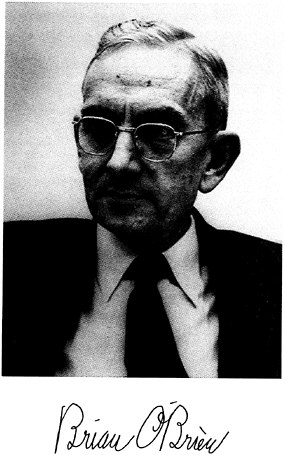
BRIAN O'BRIEN
1898–1992
WRITTEN BY WALTER P. SIEGMUND SUBMITTED BY THE NAE HOME SECRETARY
BRIAN O'BRIEN died July 1, 1992, at his home in Woodstock, Connecticut. He was a leader in the fields of optics and physical sciences as teacher, research scientist, engineer, consultant, and administrator. He received many awards during his career, including the Medal for Merit, the nation's highest civilian award, for his work on optics in World War II.
He began his formal education at the Chicago Latin School and continued at Yale University, where he received his degree in electrical engineering in 1918 and the Ph.D. in physics in 1922. From 1922 to 1923 he served as a research engineer with Westinghouse Electric Company in Pittsburgh, Pennsylvania. While much of his work consisted of scientific research in physiology, human vision, and several fields of optics, he always applied his training and disciplines as an engineer to the many projects he undertook.
In his studies of the biological effects of solar radiation on tuberculous at the J. N. Adams Memorial Hospital in Perrysburg, New York, in the 1920s, he developed special arc lamps for producing enhanced ultraviolet radiation of the desired therapeutic wavelengths, as well as a unique process for irradiating milk in order to produce vitamin D. One of his devices made possible the ultraviolet irradiation of milk on a production basis using a continuous, flowing, cylindrical curtain both of water, as a shield, and of the milk surrounding the ultra
violet source, an elegant solution to a difficult production problem.
In 1930 O'Brien went to the University of Rochester as research professor of physics and optics. He stayed on for twenty-three years, becoming director of the Institute of Optics in 1938. To many of his students of those years, Dr. O'Brien ''was" the institute. His dynamic presence and enthusiasm were infectious for both his students and his staff.
During World War II, he led an enormous growth in the institute under section 16.2 of the National Defense Research Committee (NDRC) program. One of the primary activities was the development of many military optical systems, including night vision devices, a field he was again to contribute to in the 1950s and 1960s through his instigation of the early work on fiber optics. The World War II devices included the Metascope, a night vision device using infrared phosphors, and ultra-fast Schmidt optical systems requiring the development of aspheric optics on a production scale. Once again, O'Brien was to use his engineering skills to guide the development of both the instruments themselves and the special processes for their manufacture.
Quite possibly the most ambitious engineering program that he undertook began after an unlikely meeting with Michael Todd, the Broadway producer. Todd hoped to interest O'Brien in the development of the dramatic new motion picture process to rival "Cinerama," then playing to enthusiastic audiences in New York City. When O'Brien joined American Optical Company (AO) in Southbridge, Massachusetts, in 1953, Todd contracted with AO to develop his system, which became known as Todd-AO. This system called for both a new concept in wide-field projection on a deeply curved screen, which O'Brien invented, and the development of an array of special equipment to accommodate the 65–70-mm film. A truly unique aspect of the undertaking was the film printing process for correcting the inevitable distortion produced when projecting a picture on a curved screen from an elevated projection booth. In all this, he directed a large group of optical and mechanical engineers (and a few research types) to ac
complish this daunting task. The high technical level of wide-film, wide-screen motion picture presentations today can be thought of as derived from the Todd-AO process.
In the midst of this program, O'Brien also initiated a pioneering project on fiber optics at American Optical. Before leaving Rochester, he had discovered the key to efficient light transmission in optical fibers, namely, the use of a low refractive index coating on the fiber "core." With this basic concept, fiber optics began to take on a practical technology, which ultimately resulted in a major industry centered around the Southbridge area. One of the most important applications of fiber optics proved to be in the form of windows (faceplates) for military night vision intensifier tubes.
O'Brien retired from AO in 1958, but continued his career as a consulting physicist until within just a few years of his death. During this period, he served as chairman of the Division of Physical Sciences of the Nation Research Council in Washington, D.C., a member of the Yale University Council, and chairman of the advisory committee to the Metrology Division of the National Bureau of Standards.
In 1962, at the request of General Ben Schriever, he formed the Air Force Studies Board of the National Research Council to furnish scientific advice and guidance for the Air Force Systems Command. He was also a member of the Science Advisory Board to the U.S. Air Force from 1959 to 1970, and was awarded the Air Force's Exceptional Civilian Service Award twice, in 1969 and 1973.
In 1970 he was asked by the National Aeronautics and Space Administration (NASA) to form the Space Program Advisory Council to advise NASA on future programs. He was also a member of the Space Science Board of the National Research Council. He was awarded the Distinguished Pubic Service Medal by NASA in 1972.
O'Brien was a fellow of the Optical Society of America (OSA), the American Physical Society, and the Institute of Electrical and Electronics Engineers. He served as OSA president from 1951 to 1953. In 1951 he received the society's highest award, the Frederic Ives Medal, for his distinguished work in optics.
In recognition of his lifelong activities not only in science but also in engineering, he was elected to the National Academy of Engineering in 1981.
O'Brien died quietly in his sleep, in full possession of his remarkable mental capacities. Though suffering in later years from some physical disability, he had been extremely fortunate never to have had an extended serious illness or hospitalization, even in those later years.
Brian O'Brien had an encyclopedic knowledge of science and technology. This was combined with an exquisite ability to understand and work with mechanical and electromechanical systems. The combination stood him in good stead throughout his scientific career and no doubt was a key to the ongoing demand for his services as a consultant both to industry and to high levels in government.
This tribute is based, in part, on "Brian O'Brien—Pioneer in Optics," written by Walter P. Siegmund and F. Dow Smith, which appeared in the Optical Society of America's Optics and Photonics News, March 1993.


