
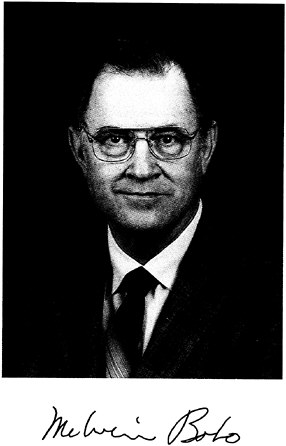
MELVIN BOBO
1924–1993
BY FRANK E. PICKERING
MELVIN BOBO, a retired chief engineer for General Electric (GE) Aircraft Engines, died on October 27, 1993, at the age of sixty-nine.
Mr. Bobo was born in Blair, Texas, on February 13, 1924. He served as an infantry medical aide in Europe during World War II. He received his B.S. degree in mechanical engineering in 1949 from Texas Tech University, where he was also elected to the engineering honor society, Tau Beta Pi. He became a registered professional engineer in the state of Ohio in 1954.
Mr. Bobo joined the General Electric Company in 1949 and went on to devote his entire career to the design and development of GE aircraft engines. He retired in 1991.
For over four decades, Mr. Bobo was at the forefront in the design and development of aircraft engines, which powered many of the nation's most advanced military and commercial aircraft.
As a young engineer, Mr. Bobo made important contributions to the designs of the turbines and compressor for the supersonic J79 engine, which set new standards of performance and reliability with a wide range of military applications, including the B-58 bomber, the F-104 fighter, and the famed F-4 "Phantom" fighter. The J79 core was later produced as the gas generator for the CJ805 commercial turbojet, which powered the Convair 880, and the CJ805-23, one of the first
U.S. turbofan engines, which entered commercial service on the Convair 990 in the early 1960s.
In the early 1960s Mr. Bobo managed turbine design engineering for small engines and later led the design of an advanced T58 turboshaft engine for military and commercial helicopters. These engines were greatly enhanced by his innovative application of advanced cooled turbine technology for small engines.
In the late 1960s Mr. Bobo designed the turbine and managed the engine design of the GE4, which was a prototype for a supersonic transport engine. Although this program never reached the production stage, significant technology advances developed and demonstrated by the GE4 benefited the design and development of other future high-performance engines.
In 1971, as manager of CFM56 engineering for General Electric, he collaborated with the CFM56 engineering team at SNECMA of France to establish the design of the coventure CFM56 commercial turbofan engine. The CFM56 program went on to anchor a very substantial and successful French/American coventure with a family of engines, which now power aircraft for more than 175 operators all over the world.
During the next ten years, Mr. Bobo led engineering design teams at General Electric focused on the design and development of the turbomachinery of the CFM56 and CF6 engine models and the engine design of the advanced CF6 models, the CF6-80A and CF6-80C engines. These engines set new standards and are major contributors to the reliability and economy of modern air transportation.
From 1985 until his retirement in 1991, Mr. Bobo, as chief engineer at GE Aircraft Engines, provided oversight for the engineering excellence of all of General Electric Aircraft Engine products and developments as well as for its flight safety and engine certification activities. In this capacity he made important technical contributions and also provided leadership, guidance, and training to a host of aircraft engine design engineers. After retiring, Mr. Bobo continued to serve GE Aircraft Engines from time to time as an expert engine design consultant.
Over his entire career, Mr. Bobo contributed significantly to the design and development of advanced gas turbine engines and made many lasting contributions to the technology and design concepts for modern turbomachinery engines. He was awarded more than thirty-five patents, and he was a leader in the advancement of the design of reliable, high-temperature, high-performance turbomachinery. He made several unpublished presentations, including "Designing Safety and Ruggedness into Aircraft Engines" at the ATA (Air Transport Association) Engineering and Maintenance Forum in 1986 and "The Evolution of Kevlar Containment Systems" at the Society of Automotive Engineers Aerotech Conference in 1987. He was a member of the AIA (Aerospace Industries Association) Aviation Division Committee on Aging Aircraft. In addition to his industry affiliations, Mr. Bobo was also involved in civic and church activities and was a member of the board of directors of the Midwest Children's Home.
Mr. Bobo was widely recognized and honored by his associates in the engineering community. He received the GE Aircraft Engine Engineering Award for community service in 1972, the prestigious General Electric Steinmetz Award for distinguished engineering accomplishments in 1981, the Distinguished Engineer Award by the Texas Tech University in 1988, and the GE Gold Medallion Patent Award for his many inventions. Mr. Bobo was elected to the National Academy of Engineering in 1991 and was inducted posthumously into the GE Aircraft Engines Hall of Fame in 1993.
Mr. Bobo loved his family, his work, and the industry he served so well. He contributed a vast amount to the conception, design, development, and engineering of advanced aircraft engines while, at the same time, effectively leveraging his excellent capability through the setting of high technical and ethical standards and the giving of himself to the guidance, motivation, and leadership of others.


