
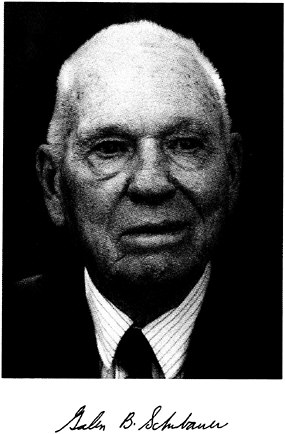
GALEN B. SCHUBAUER
1904–1992
BY HANS W. LIEPMANN
GALEN B. SCHUBAUER was born in Sparrows Point, Maryland, on July 7, 1904, and died in Lanham, Maryland, on November 24, 1992, of a heart condition. He is survived by his wife of fifty-five years, Marian; his four daughters, Sally Carter, Nancy Doyle, Mary Thulin, and Betsy de Vergilio; and eight grandchildren.
Dr. Schubauer, known affectionately as "Schubi" in professional circles, began his academic education at Pennsylvania State College and completed it with an M.S. degree from the California Institute of Technology and a Ph.D. from the Johns Hopkins University. He spent his entire professional career at the National Bureau of Standards (NBS), starting as a "junior physicist" in 1929 and retiring as chief of the Fluid Mechanics Branch in 1968. During this time he was author or coauthor of some twenty-five publications, a modest number by present standards. But among these papers are a number that set standards in their field. In particular, the famous Schubauer-Skramstad experiments on laminar instability are one of the most important contributions to modern fluid dynamics.
In every profession, an individual may be highly valued by outsiders and much less so by colleagues intimately acquainted with his specific work. On the opposite end of the scale, an individual may not be well known to distant colleagues and people outside a particular profession but extremely highly rated by experts in the field. Schubi was a prime example of
the latter. His relatively late election to the National Academy of Engineering in 1980, almost forty years after his most important work was done, is certainly related to this fact.
The group at NBS was formed and originally guided by Hugh L. Dryden. Dryden, today remembered mostly for his leadership in both the National Advisory Committee for Aeronautics (NACA) and the National Aeronautics and Space Administration (NASA), established at NBS a center for experimental research in fluid mechanics with particular emphasis on turbulence. I believe that the need to understand more about fluid turbulence arose from the task of precision calibration of anemometers. The rapid development of aeronautics and the resulting need for aerodynamic testing required wind tunnels with well-defined flow properties simulating flight in the free atmosphere. The necessity of defining and measuring the characteristics of turbulence thus became of great importance, and the development of turbulence-measuring instrumentation and the design of wind tunnels with low turbulence level became an important task for the NBS group. By the late 1930s the NBS group had become well known both in the United States and abroad. Indeed, in 1939 when as a fresh Ph.D. I came to the United States to join the great von Kármán at Pasadena, he ordered me to proceed first to Washington and the NBS ''to get acquainted with the research of the best experimental group in the U.S." It was then that I first met and learned to appreciate Schubi and his unassuming competence and depth of understanding. When Dryden was appointed research director of NACA, Schubi took over the leadership of the group until his retirement in 1968.
During the war years, research in fluid mechanics was driven hard by the near explosive development of aircraft from subsonic through transonic to supersonic speeds; by the need to increase range by minimizing drag; and, in the later development of missiles, by the urgent need to control aerodynamic heating. All of these problems are intimately related to flow in the boundary layer. The dominant problems were—and are—transition to turbulence and boundary-layer separation. The instability of laminar flow is an old problem, but the question
whether flow in the boundary layer and plane poiseuille flow were stable was still considered sufficiently important and difficult in the 1920s. Therefore, Arnold Sommerfeld gave it as a Ph.D. thesis subject to one of his most promising students, Werner Heisenberg. Heisenberg confirmed by detailed and complex analysis, an earlier—and at the time suprising—conjecture by Ludwig Prandtl that viscosity could have a destabilizing effect. Finally, Walter Tollmien in 1929 obtained the first theoretical value for a critical Reynolds number and mapped out the complete instability region. However, the laminar instability theory was mathematically quite complex, open to criticism, and apparently at odds with all experimental evidence.
When Schubi decided to confront the problem in 1940 it looked like a dead end. In a relatively short time, his work with H. K. Skramstad confirmed the theory in all important aspects. Using a better wind tunnel, better diagnostics, a completely novel method for exciting the perturbations, and in particular a much better understanding of the physics of the problem, the two produced a classical contribution to fluid mechanics. They realized fully the important difference between the onset in instability and the onset of turbulent flow, and they developed new techniques to study the laminar instability waves, which only eventually result in turbulent flow. It is not easy today to appreciate the difficulties faced in doing this type of experimental research in the early 1940s when straight configuration testing dominated. Unfortunately, the impact of this work was at first limited, simply because experiments related to laminar-turbulent transition were at the time classified. The publication of the results in open literature had to wait until 1947, but for experimentalists in fluid dynamics, the approach and execution of the Schubauer-Skramstad experiments had an immediately profound impact. Having been one of them, I can vouch for that! The aeronautical community did appreciate the work, and the authors received the Reed Aeronautics Award from the American Institute of Aeronautics and Astronautics (AIAA) in 1947.
The research on laminar instability is unquestionably the largest contribution Schubi made to the state of the art.
However, at least three more of his papers had a lasting effect. These were "Investigation of Separation of the Turbulent Boundary Layer," published in 1950, and "Contributions on the Mechanics of Boundary-Layer Transition," published in 1956, both coauthored with P. S. Klebanoff and the 1960 paper "Forced Mixing in Boundary Layers," coauthored with W. G. Spangenberg. The experiments reported in these papers all show the traditional care and competence of the NBS group as well as their ability to select problems of fundamental scientific importance with great impact on engineering applications.
Schubi was a fellow of the American Physical Society, the American Institute of Aeronautics and Astronautics, and the Washington Academy of Sciences and a member of the Philosophical Society of Washington.
In addition to being elected to the National Academy of Engineering and awarded the Reed Aeronautics Award of the AIAA, Schubi's honors included the 1944 Washington Academy of Sciences' Award for Scientific Achievement in engineering sciences and the 1988 Fluid Dynamics Prize of the American Physical Society.
Dr. Schubauer was a superb star in the NBS constellation Dryden-Schubauer-Klebanoff. His death is a great loss for all of us in the science and engineering community.


