
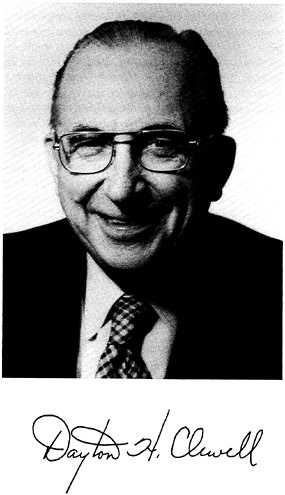
DAYTON H. CLEWELL
1912–1992
BY S. L. MEISEL
DAYTON H. CLEWELL, retired senior vice-president for Mobil Oil Corporation's research and engineering portfolio, was born December 15, 1912, in Berwick, Pennsylvania, and died November 11, 1992, in San Gabriel, California.
Elected to the National Academy of Engineering in 1976, Dr. Clewell was recognized for his accomplishments in petroleum research and development as well as his public role as a defender of the energy industry.
Dr. Clewell's career, which spanned an era of great changes in society and in the energy industry, is filled with technological and managerial achievement—from his invention of a gravity meter used for oil prospecting to his general direction of the massive research effort that produced the first commercial zeolite catalyst for the refining industry.
The Great Depression was not easy on young Dayton Clewell's family, but a wealthy philanthropist recognized Dayton's potential and loaned him the money to study at the Massachusetts Institute of Technology (MIT), where his talents in both science and communications took root. He served as managing editor of MIT's newspaper while earning his B.S. in physics in 1933, and as science correspondent to the Boston Globe until he obtained his Ph.D. in physics in 1936.
His first job, in optical research for a paint company in Pennsylvania, turned out to be ''interesting but not glamorous.''
Consequently in 1938 he accepted a research position with Magnolia Petroleum Company (a former affiliate of Mobil) in Dallas, Texas, attracted to the oil business by the romance of prospecting for oil.
By then the nation was experiencing economic rebirth, and facing the prospects of a second global war and a mounting need for fossil fuel energy. While other scientists at Magnolia worked on methods of getting more high-octane gasoline from crude oil, Dr. Clewell built a gravity meter sensitive enough to track changes in the earth's structure, yet rugged enough to use in field work. The company secured a patent on the young physicist's invention, which proved to be useful as a detector of potential oil deposits.
In 1952 Dr. Clewell became director of Magnolia's Field Research Laboratory in Dallas, and in 1956 general manager of Mobil's Research Department, which included both the Field Research Laboratory and the Process and Products Research Laboratory in Paulsboro, New Jersey. In 1964 he was elected senior vice-president for research and engineering, a position he held until his retirement in 1977.
Dr. Clewell directed Mobil's technology efforts during a period of great creativity and achievement by the company's scientists and engineers. To encourage and focus that creativity, he installed a dual-ladder career system to provide greater opportunity for technical people to be recognized and rewarded; established a central research laboratory in Princeton, New Jersey, to work on longer range technology goals; and developed large-project management capabilities within Mobil's engineering organization. These and other strategies paid off handsomely for Mobil and for society.
Under Dr. Clewell's leadership, Mobil researchers developed a number of synthetic zeolites, which have enabled refiners and petrochemical processors to produce more high-value product at less cost. The first was the zeolite cracking catalyst, which when commercialized in 1962 increased the amount of gasoline produced from each barrel of crude oil by as much as 40 percent.
Upstream technologies also advanced as Dr. Clewell's researchers pioneered the application of digital data recording
to seismic exploration in the 1960s, greatly improving the ability to "image" potential oil-bearing structures in the earth. And in the 1970s, they were industry leaders in using so-called bright spots on seismic records to pinpoint gas reservoirs in the Gulf of Mexico, and the first to use massive hydraulic fracturing as a means of improving the flow of oil from U.S. reservoirs.
With America's attention beginning to focus on its growing air pollution problems, Dr. Clewell played a key role in establishing and leading an interindustry research program formed in 1967 by Mobil and the Ford Motor Company to reduce automotive emissions. This program demonstrated the inter-relationships between fuel composition, engine design, and the catalytic converter—and anticipated much of the emission control technology found on today's automobiles.
In 1973, when the oil embargo dramatically demonstrated to the United States the risks of dependence on Middle East oil, Dr. Clewell directed his researchers to step up their efforts to develop synthetic fuels and energy-conserving products. One result was the commercialization of Mobil 1, the first nationally marketed energy-efficient synthetic motor oil for passenger cars, in early 1976.
Another result was the discovery that one of Mobil's new zeolite catalysts converted methanol, readily made from coal or natural gas, into high-octane gasoline. This was the first new synthetic fuels process since the pioneering work in Germany half a century earlier. Recognizing the potential importance of this breakthrough for that future time when oil would become too scarce or too expensive, Dr. Clewell began development efforts in the mid-1970s that would culminate a decade later in a commercial plant in New Zealand that could convert natural gas to gasoline.
Believing that the nation would sooner or later require alternative energy sources, Dr. Clewell was instrumental in the creation of the Mobil-Tyco Solar Energy Corporation. This corporation was formed in 1975 to develop a method of "growing" thin sheets of silicon crystal, which would be fabricated into solar cells for converting sunlight to electricity. Mobil later obtained 100 percent interest in Mobil-Tyco, renamed the
Mobil Solar Energy Corporation, which is now manufacturing solar panels for utility companies.
In 1976, to ease the shortage of oil in America and Europe, the massive concrete-based Beryl A production platform—designed and constructed under the management of Dr. Clewell's engineers—began producing 100,000 barrels of oil a day in the stormy North Sea. Towed into position a year earlier, the 500-foot-high, 320,000-ton structure was at that time the largest object moved by man and was hailed on both sides of the Atlantic as a technological marvel in terms previously reserved for accomplishments in space.
Meanwhile, Dr. Clewell continued to apply his communication skills, authoring numerous papers and articles—ranging from experimental physics and geophysics to the general subject of managing research. In addition, he was tireless in his endeavors to tell the public about the oil industry's efforts to safeguard and improve the environment while maintaining an abundant supply of energy at reasonable cost.
He gave speeches to public interest groups, appeared on radio and television talk shows, and testified before a number of congressional committees in Washington. The congressional committee members were often hostile toward the energy industry—at one point in the 1970s several hundred bills had been introduced to break the oil companies into smaller pieces. Nevertheless, Dr. Clewell's good humor and objectivity contributed immeasurably to both the legislative and the public understanding of the issues.
In recognition of his technical leadership in areas vital to society, he was appointed in 1971 by President Nixon to a two-year term as a member of the National Advisory Council on Oceans and Atmosphere. He was also a member of the U.S. Navy Oceanographic Advisory Committee, the Marine Petroleum and Minerals Advisory Committee reporting to the secretary of the Department of Commerce, and the Patent Advisory Panel of the U.S. Energy Research and Development Administration.
Further, he served as a director of the Coordinating Research Council and the Industrial Research Institute. He also served on New York City's Science and Advisory Council, the American
Petroleum Institute's Committee on Environmental Affairs, and the board of directors of the MIT Corporation.
Dr. Clewell maintained membership in several professional societies, among them the Society of Automotive Engineers, the American Physical Society, the American Association of Petroleum Geologists, and the Society of Exploration Geophysicists. He was also a fellow of the Institute of Electrical and Electronics Engineers.
Dr. Clewell received the Environmental Conservation Distinguished Service Award from the American Institute of Mining, Metallurgical, and Petroleum Engineers in 1974.
Retiring from Mobil in 1977, Dr. Clewell remained involved in the direction of energy research, promoting coordinated efforts to develop a technology base to meet the energy needs of twenty-first century civilization. "It's still such a challenging industry," Dr. Clewell remarked not long after retirement. "There are many technological advances to be made to decrease the risks . . . although it's those very risks that make this business an adventure."


