
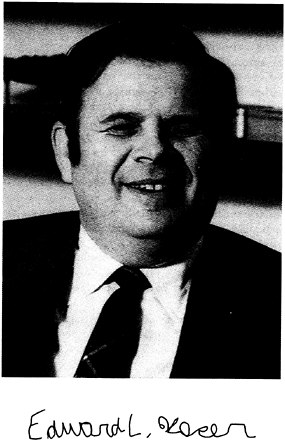
EDWARD L. GLASER
1929–1990
PREPARED WITH THE ASSISTANCE OF THE NAE MEMBERSHIP OFFICE SUBMITTED BY THE NAE HOME SECRETARY
EDWARD L. GLASER, a superb computer systems designer and implementation manager, died December 5, 1990. He possessed a unique overall systems view, which included both hardware and software, and an uncanny ability to lead people in the right direction.
Born on October 7, 1929, in Evanston, Illinois, Ted, as he was known to his family and friends, became totally blind at the age of eight. He faced this misfortune by cultivating a buoyant and witty spirit and a first-class mind. As a boy, he pursued interests in science, mathematics, and music. Year after year he stood at the top of all three fields for his age and grade. As a child, for instance, he became a pianist of virtually concert quality. At the distinguished North Shore Country Day School in Winnetka, Illinois, he established a record as an outstanding student.
In 1951 he graduated Phi Beta Kappa from Dartmouth College with an A.B. degree in physics. Hoping to capitalize on his mathematical abilities, Glaser at first sought work in the actuarial; side of the insurance business. Computers, however, were then just beginning to be produced commercially, and their promise was obvious to a man who, perforce, had to learn to do complex calculations in his head.
In successive connections with various computer firms, Glaser concentrated at first on the hardware aspects—that is,
the complex physical circuits and peripheral equipment—of computers. Then he became interested in the computer system as a whole, including the software—compilers, assemblers, languages—and its human users. In pursuit of these interests, Glaser always asked himself how things could be made better and, as a result, held more than fifty patents. Among these were patents for an automatic printer, computer control circuitry, word field selection, magnetic tape, whole data processing systems, stored programs systems, and time-sharing systems. Some of these, of course, were held jointly as Glaser could not see or operate a computer. These inventions were only the tip of the iceberg, however. Many other contributions by Glaser raised the state of the art in the production of the modern computer.
Glaser worked first, from 1951 to 1955, at IBM. In 1955 he became consultant to the director of engineering at Electro Data Corporation, a division of Burroughs Corporation, in Pasadena, California; then in 1960 he became manager of the Systems Research Department of Burroughs in Paoli, Pennsylvania. From 1963 to 1967 he was an associate professor of electrical engineering at the Massachusetts Institute of Technology (MIT), and he then became director of the Andrew R. Jennings Computing Center, and professor of computer engineering and department chairman at Case Western Reserve University (CWRU). From 1975 until 1978 he was manager of the Product Development and Engineering Department at System Development Corporation in Santa Monica, California. He then became vice-president and chief technical officer of the Commercial Products Division, System Development Corporation. From 1979 to 1981 he was director of Advanced Computer Systems Technology, Memory Products Division, Ampex Corporation in El Segundo, California. In 1982 he cofounded—with Ray Sanders—IRI, Inc., in Santa Monica, California, and Glaser became its president. IRI, Inc., was renamed Nucleus International Corporation, and Galser's last position was as cochairman and chief technical officer of Nucleus.
Throughout his career, Glaser always maintained an association with an outstanding university where he had the free
dom to think about the information and computing sciences untrammeled by the necessity of short-run payoffs. Thus, while employed by Burroughs in Pasadena, California, he taught computer systems design for the University of California, Los Angeles, extension school in Pasadena. While a valued consultant in industry, he was associated with Project MAC at MIT, helping to establish one of the world's first time-shared computer systems.
At Case Western Reserve University, Glaser wore three hats. He was chairman of the Department of Computing and Information Science, head of the Computer Engineering Division of the School of Engineering, and director of the Jennings Computing Center, which distributed the services of a UNIVAC 1108 campuswide. The center also housed a PDP-10/50 computer for specialized work by the faculty, graduate students, and undergraduate majors in the division and department.
Doing the work of three people, however, was only par for Glaser. It was he who conceived Project LOGOS, the central research program in the information sciences at Case. Project LOGOS was a design project intended to establish and implement the computer-aided design of foolproof, certifiable computer systems that would perform exactly as instructed—no more and no less. No modern, large-scale computer was certifiable in that sense.
While at CWRU Glaser also conceived the Education Engineering Laboratory. The Olin Foundation agreed to equip that laboratory at a cost of $1 million. The laboratory was intended to establish an experimental instructional laboratory that emphasized the use of electronic and computing equipment; provided competitive, computer-umpired gaming in various fields of business, economics, applied research, defense, space, and diplomatic strategies; and facilitated the production of computer-animated film with sound for use at various educational levels and subject-matter segments.
During the last fifteen years of his life, Glaser concerned himself with the development of hardware and software systems capable of directly storing and processing nonnumerical data. He felt that using numerical computing machines to store
and process textual and graphical data was a poor solution. To that end, while at CWRU he designed an innovative data storage and compression scheme, which was sold to System Development Corporation. Later he cofounded his own research and development company, Nucleus International, to bring a revolutionary hardware-based relational database system to market.
Elected a member of the National Academy of Engineering in 1977, Glaser was a fellow of the Institute of Electrical and Electronics Engineers and a member of that organization's committees on Cybernetics, Data Acquisition and Transformation, and Computer Systems. For the Defense Science Board, he was chairman of the Technical Panel of its Committee on Computer Security. He served on the U.S. Air Force's Computer Security Committee; as the computer member of the Department of Transportation's Alexander Committee on Traffic Control; as a trustee of Seeing Eye, Inc., the Sensory Aids Foundation, and the Interuniversity Council; and as a member of the National Academy of Sciences' Division of Engineering, Subcommittee on Sensory Aids of the Committee on Prosthetics Research and Development. He also served on the Science Advisory Board of the National Security Agency.
In 1974 Glaser was named Computer Man of the Year by the Data Processing Management Association and in 1980 received an honorary D.Sc. degree from Heriot-Watt University in Edinburgh, Scotland.
Glaser's friends and colleagues considered him a rare system designer/engineer who understood intimately both hardware and software ideas and exhibited great originality in both. As an engineer he understood great detail without losing an overall perspective of a project's goals. Moreover, he was an excellent judge not only of technical ideas but also of people.


