
4
Demographics
This chapter presents general demographic trends within the space physics community and relates them to the funding trends discussed in Chapter 3. To assess the health of the field, the committee sought data that might indicate trends in the number of scientists studying space physics, the age distribution of these scientists, and the kinds of projects they are engaged in. Of course, scientists in the various disciplines that fall under the purview of the Committee on Solar-Terrestrial Research and the Committee on Solar and Space Physics are not conveniently listed in a central registry, but they do tend to belong to certain professional societies. One particular organization—the American Geophysical Union (AGU)—has elements of all the subdisciplines and should therefore give a good overall indication of the field's growth. Figure 4.1 shows the membership of the AGU and its Space Physics section (now called Space Physics and Aeronomy) from 1974 to 1991. Very steady growth is seen for both the union and its space physics component. During the 1980s, both grew at a much faster rate than in the 1970s, with the space physics fraction growing slightly more slowly than the parent organization. The number of graduate student members in the AGU also is shown in Figure 4.1. Although this number may be a less reliable measure of the actual population, it does show similar growth trends.
A similar rapid growth during the 1980s is seen in the membership of the American Astronomical Society's Solar Physics Division (AAS/SPD). Figure 4.2 shows a steady increase in division membership, with some 50 percent more members in 1991 than in 1981. It is of interest to compare both the AGU space physics membership and the AAS/SPD membership growth with the funding trends presented in Chapter 3. We show this comparison in Table 4.1 for two
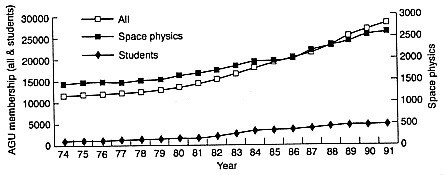
FIGURE 4.1 Growth of space physics community within the American Geophysical Union.
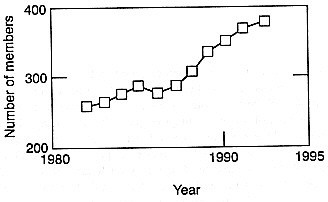
FIGURE 4.2 Growth of American Astronomical Society's Solar Physics Division membership.
Source: Karen Harvey, AAS/SPD Treasurer.
time intervals over which data are available. The data on percentage growth for federally funded basic research, for the National Aeronautics and Atmospheric Administration's (NASA) Office of Space Science and Applications (OSSA) research funding, and for the National Science Foundation's (NSF) research funding are taken directly from Chapter 3, Figure 3.1, and Table 3.1. Table 4.1 shows that the growth in the size of the space physics field occurred at essentially the same rate as the funding increases experienced over the past 10 to 20 years.
The growth in AGU membership presented above is also reflected in levels of activity over the same period. Figure 4.3 shows the total attendance at national AGU meetings, together with the number of abstracts submitted. The number
TABLE 4.1 Percentage Growth in Real-Dollar Funding and in the Size of the Space Physics Research Field
|
|
Percentage Growth |
|
|
Item |
1974-1990 |
1981-1989 |
|
AGU Space Physics Community |
90 |
50 |
|
AAS Solar Physics Community |
— |
40 |
|
Federally funded basic research |
100 |
55 |
|
NASA/OSSA research funding |
— |
45-60* |
|
NSF research funding |
— |
30 |
|
* See Table 3.1. |
||
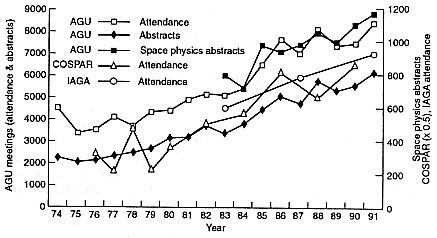
FIGURE 4.3 Measures of space physics growth.
of space physics abstracts is also shown for the last nine years. The meeting attendance increased from 1974 to 1991 by the same factor of two that describes the growth in AGU membership (Figure 4.1) with the number of abstracts increasing by an even greater factor of about three. Figure 4.3 also shows the attendance at meetings of two prominent international scientific organizations that include space physics as a major element of their activities—the Committee
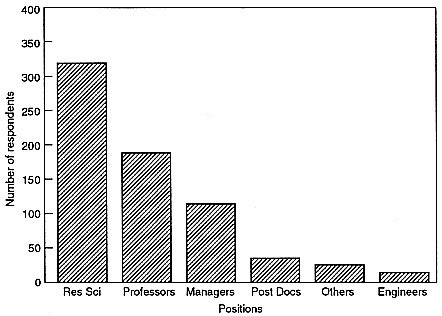
FIGURE 4.4 Space physics community survey positions of primary responsibility.
on Space Research (COSPAR) and the International Association of Geomagnetism and Aeronomy (IAGA).
NASA's Space Physics Division [5] recently attempted to gather additional information concerning the demographics of the U.S. space physics community. A questionnaire was sent to 1,770 members of the community on January 2, 1991, and 686 replies were received. While no attempt was made to ensure a representative sample, and the response rate was only about 39 percent, it is instructive to look at the trends that emerge. Figure 4.4 shows the breakdown by position of the respondents. The responses were dominated by persons categorizing themselves as research scientists, followed by university professors.
The 1991 National Science Board (NSB) study [11] of science and engineering indicators noted that ''the average age of academic researchers increased in the past decade, continuing a trend that began in the early 1970s. The median age of academic researchers rose from 38.7 years in 1973 to 39.7 years in 1979; it was 43.8 years in 1989.'' (The impact on these results of university hiring practices, such as limits to tenure-track appointments, is not known.) This conclusion is consistent with the results of the NASA survey [5]. The age distribution of the respondents to the NASA survey is shown in Figure 4.5. The median age falls into the 46-to 50-year bracket, almost the same age as for the academic researchers addressed by the NSB study. The age distribution for each of the
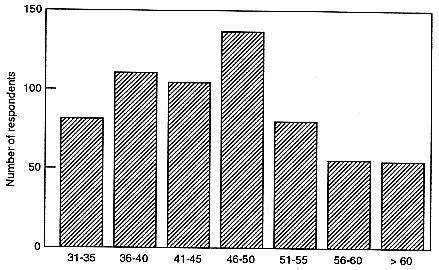
FIGURE 4.5 Space physics community survey age distribution.
pertinent subdisciplines of research (cosmic and heliospheric physics; ionospheric, thermospheric and mesospheric physics; magnetospheric physics; and solar physics) is quite similar. As a whole, the median age is a few years higher than that of the AAS membership, largely due to the greater number of respondents over age 50. This trend is particularly noticeable for NASA employees, who represent some 10 percent of those under age 40, some 15 percent of those in the median 40 to 50 bracket, and some 20 percent of those over age 50.
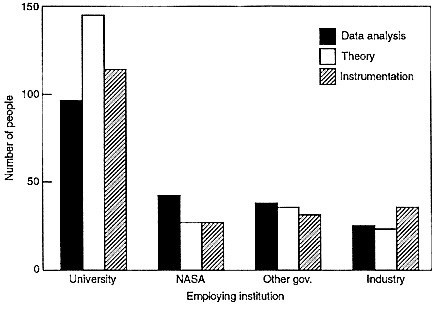
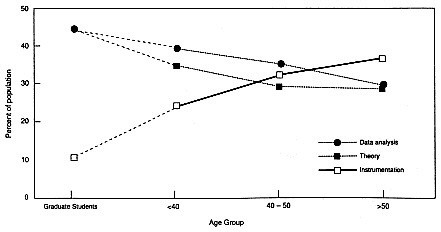
Figure 4.6 shows the survey breakdown by research technique and institution. Other than a slightly larger fraction of theoretical research in universities, the three research subdiscipline areas appear to be fairly evenly distributed in each research environment. A disturbing trend is illustrated, however, in Figure 4.7, which shows the fraction of each age group involved in the subdiscipline techniques of data analysis, theory, and instrumentation. The fraction of each group represented by experimentalists increases dramatically with age.
This of course leads to the question: Are we training a sufficient number of new experimentalists? A partial answer can be gleaned from the results of a separate NASA questionnaire completed by 130 graduate students. These results are also shown on Figure 4.7. Only about 10 percent of graduate student respondents are involved in instrumentation. The remainder are split approximately equally between theory and data analysis. One can speculate that the ever-increasing time scales associated with experimental research (see Chapter 6) are driving experimentally oriented students toward dissertations primarily involving theory or data analysis.
Graduate students represent the future of the field, and it is important to assess whether enough are being trained and are remaining in the field. Once again, precise data are difficult to obtain, but the committee has assembled some interesting indicators.
In responses to the NASA survey [5], 185 professors indicated that they were advising 342 graduate students working toward space physics dissertations. (These numbers refer only to graduate students who have started their research and do not include first-and second-year graduate students not yet committed to a space physics dissertation topic.) Half of those students were supported by funds from NASA's Space Physics Division; nearly 80 percent received some form of government funding.
Data available from the University of California at Los Angeles and the University of Chicago show that of 28 space physics graduates in the years 1964-1969, 12 are still in the field (43 percent); seven of these are university faculty members (25 percent). The corresponding numbers for the 1970-1979 period are 50 graduates, with 20 still in the field (40 percent) and 11 faculty members (22 percent). For 1980-1989 there were 29 graduates, with 23 still in the field (79 percent) and five faculty members (17 percent). Very few students (nine out of a total of 107 graduates) moved abroad after graduation. (It is interesting to compare these numbers to results of the NASA survey, where three out of four graduate student respondents indicated that they expected to remain in the field after graduation.) The high ratio of 1980-1989 graduates still in the field may be due to the increase in funding in the 1980s (Figure 3.1, Table 3.1). On the other hand, it may simply be a recent phenomenon, requiring a substantial input of fresh funds to retain these people in permanent jobs and make their current soft money positions available to the graduates of the 1990s.
The number of graduates that in time become faculty members indicates that "zero population growth" (ZPG) of faculty would occur for a lifetime number of around five students graduated per faculty member. The NASA survey [5] response showing an average of two graduate students supported per faculty member at a given time in space physics appears to be well above this ZPG level, consistent with the growth trends presented earlier in this chapter.
SUMMARY
The size of the space physics community has grown along with the funding increases of the past two decades, as discussed in Chapter 3. The percentage growth in funding levels and in various measures of the size of the field are similar.
The average age of the field is increasing. More significantly, a decreasing proportion of young researchers are entering the experimental side of the field. In a field as empirically driven as space physics, this is an ominous trend.


