
Paint-Remover Hazard
Richard D.Stewart, MD, MPH, Carl L.Hake, PhD
• The in-home use of paint removers containing methylene chloride results in the absorption of this solvent, which is metabolized to carbon monoxide. Exposure for two to three hours can result in the elevation of carboxyhemoglobin (COHb) to levels that stress the cardiovascular system. The metabolic formation of COHb continues following the paint-remover exposure, doubling the duration of the cardiovascular stress produced by a comparable COHb level after exposure to CO. Patients with diseased cardiovascular systems may not be able to tolerate this unexpected stress.
(JAMA 235:398–401, 1976)
THE REMOVAL of old paint from wood by applying a liquid paint stripping formulation, long regarded as a laborious, messy task, has not been considered particularly hazardous to health. However, recent research has shown that the main ingredient in most paint removers, methylene chloride (dichloromethane, CH2Cl2), is rapidly metabolized to carbon monoxide.1–6 The amount of CO formed in the body is directly related to the amount of CH2Cl2 absorbed during the paint stripping operation and can be sufficient to produce a substantial stress on the cardiovascular system.
The first case illustrates the tragedy that can occur when a patient with coronary heart disease is exposed to a paint and varnish remover containing CH2Cl2 and the solvent, is metabolized to a toxic amount of CO. The second case is the one in which the in vivo metabolism of CH2Cl2 to CO was first observed.
REPORT OF CASES
CASE 1.—A 66-year-old man with no prior history of heart disease was admitted to the coronary care unit with severe, crushing retrosternal pain of two hours’ duration that radiated to his shoulder and left arm. The patient was a recently retired executive who had chosen furniture refinishing as a hobby. Six hours prior to admission he had applied a commercial liquid gel paint and varnish remover to part of a large wooden chest of drawers. He had worked at this task for three hours in his basement workshop, which was a room measuring 10.7×6.1×2.7 meters and was heated with hot air from a gas furnace. One hour after leaving the basement, he experienced the onset of his chest pain.
The patient related the history of the paint stripping to the attending physician who examined the paint and varnish remover container. The label cautioned that the product contained 80% methylene chloride by weight and was to be used only with adequate ventilation. No causal relationship between the inhalation of the paint remover vapor and the acute anterior myocardial infarction was made.
The patient had an uncomplicated hospital course, and two weeks following discharge he elected to strip the remaining paint from the chest of drawers. He again applied the paint remover, working for three hours in his basement workshop. The severe retrosternal pain developed again, and he was readmitted to the coronary care unit. His hospital course during this second acute myocardial infarction was complicated by cardiogenic shock, dysrhythmia, and heart failure. The patient survived, and six months after discharge returned once again to his basement workshop to complete the paint stripping operation. Assisted by his wife, he worked slowly for two hours. Two hours later he experienced chest pain, collapsed, and died before the arrival of the ambulance.
CASE 2.—A 35-year-old male cardiologist, who was enjoying excellent health, volunteered to participate in a research project, the purpose of which was to correlate the subject’s carboxyhemoglobin (COHb) level
Reprinted with permission from JAMA 235(4):398–401, Copyright 1976, American Medical Association.
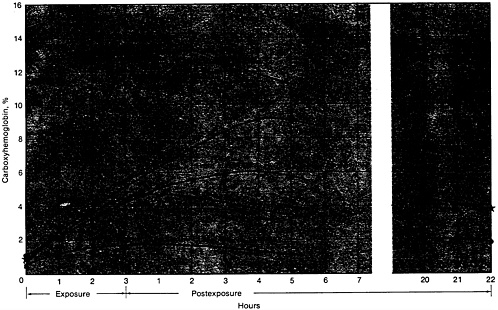
Short exposures to methylene chloride result in formation of carboxyhemoglobin (COHb) that continues to increase after exposure before slowly returning to normal levels. The presence of methanol further prolongs period of COHb elevation and cardiovascular stress.
with the air pollution in his section of Milwaukee. This nonsmoker was discovered to have a COHb saturation of 6%, and of 8% on each of the two mornings following a two-hour exposure the previous evening to paint-and-varnish-remover vapors. After a fruitless search to discover the exogenous source of CO, the cardiologist was exposed for one hour to a low concentration of methylene chloride vapor in a controlled-environment chamber.2 The subject’s COHb level rose from a preexposure level of 0.4% to 2.4%. Because there was no evidence of a hemolytic process, it was presumed that the CO was a metabolite of CH2Cl2. To confirm this isolated observation, a series of experiments were conducted in which 21 male and nine female volunteers were exposed to CH2Cl2 vapor concentrations of 50, 100, 250, 500, and 1,000 ppm for varying periods of time. A prompt elevation of COHb was observed in each subject exposed to CH2Cl2.2,7
EXPERIMENTAL PROCEDURE
Paint Remover Exposure.—To investigate the potential of paint and varnish removers that contain CH2Cl2 to elevate COHb to toxic levels, four three-hour paint stripping operations were carried out in a controlled-environment chamber where the ventilation rate could be regulated, the CH2Cl2 vapor concentration accurately monitored, and careful medical surveillance of the four volunteer participants was possible. Two individuals participated in each experiment. One actively applied the paint remover and did the stripping while the second subject remained sedentary, making it possible to assess the effect of alveolar ventilation on absorption. Three room-ventilation rates were studied. The first simulated the air turnover commonly encountered in home basements, while the other two simulated the higher rates of air turnover that could be encountered in industrial settings. In each three-hour experiment, one quart of a liquid gel paint remover was applied to a baby crib with a paint brush and later, scraped off. The volatile components of the paint remover were 80% CH2Cl2 and 20% methanol by weight.
Subjects.—Four healthy men ranging in age from 19 to 47 years volunteered for the study after the purpose, procedure, and risks of the investigation had been fully explained. None of the subjects used drugs or consumed alcohol during the 24-hour periods preceding and following each experiment. One subject, who was a smoker, abstained for 12 hours prior to the experiment and was not permitted to smoke until a final COHb determination had been made.
Exposure Chamber.—The four experiments were conducted in an 817-cu m (2,680-cu ft) controlled-environment chamber.2,7 Air flow was adjusted so that the half-life of the CH2Cl2 vapor would range from 33 to 11 minutes. Air temperature was 22.3 to 23.3 C and the relative humidity was 55%.
Analysis of Exposure Chamber Atmosphere.—The CH2Cl2 vapor concentration in the breathing zone of the subjects was continuously recorded by an infrared spectrometer equipped with a 10-meter path-length gas cell. This gas cell was continuously supplied with air drawn from the subject’s breathing zone through a polyethylene tubing that measured 0.635 cm in diameter.2,7 The absorbance of 13.3µ
Table 1.—Concentration of Solvents in Breathing Zone During Paint Stripping
|
|
Breathing Zone CH2Cl2Concentration, ppm |
|
|||
|
Experiment |
Ventilation Rate, cu m/hr* |
 |
Breathing Zone Methanol Concentration, ppm |
||
|
Mean |
Range |
SD |
|||
|
1 |
70.28 |
788 |
0–1277 |
354 |
… |
|
2 |
70.28 |
654 |
0–1278 |
358 |
186 |
|
3 |
210.84 |
368 |
0–576 |
122 |
115 |
|
4 |
147.11 |
216 |
0–379 |
101 |
77 |
|
*Chamber Volume=75 cu m (2,680 cu ft). |
|||||
Table 2.—Carboxyhemoglobin Levels During and Following Paint-Remover Exposure
|
|
Exposure Hours |
Hours Postexposure |
||||||||||
|
Subject |
 |
 |
||||||||||
|
0 |
1 |
2 |
3 |
1/2 |
1 |
2 |
3 |
4 |
5 |
20 |
22 |
|
|
Experiment 1* |
||||||||||||
|
1 |
0.8 |
2.6 |
3.6 |
4.6 |
5.3 |
5.7 |
7.2 |
8.2 |
9.1 |
9.0 |
4.4 |
3.8 |
|
2 |
1.0 |
2.0 |
2.8 |
4.4 |
4.6 |
5.2 |
5.5 |
5.8 |
6.0 |
5.6 |
2.0 |
1.8 |
|
Experiment 2* |
||||||||||||
|
3 |
1.0 |
2.3 |
3.3 |
4.0 |
… |
5.2 |
6.1 |
6.7 |
6.9 |
6.5 |
3.0 |
2.5 (21 hr post) |
|
4 |
2.2 |
2.8 |
3.8 |
4.1 |
… |
5.0 |
5.5 |
5.9 |
5.9 |
5.5 |
3.0 |
2.6 (21 hr post) |
|
Experiment 3 (forced ventilation [11.1 min to turn over 50% of air]) |
||||||||||||
|
1 |
0.9 |
2.8 |
4.0 |
4.8 |
6.0 |
6.8 |
7.3 |
6.5 |
3.1 |
2.9 |
|
|
|
2 |
1.3 |
2.3 |
3.4 |
4.3 |
5.5 |
5.8 |
5.5 |
4.8 |
1.9 |
1.5 |
|
|
|
Experiment 4 (forced ventilation [15.3 min to turn over 50% of air]) |
||||||||||||
|
3 |
0.9 |
1.2 |
1.9 |
2.9 |
3.4 |
3.4 |
3.3 |
3.2 |
1.8 |
1.6 |
|
|
|
4 |
1.5 |
2.0 |
2.7 |
3.7 |
4.3 |
4.3 |
3.7 |
3.5 |
1.5 |
1.6 |
|
|
|
*Normal home-basement ventilation (33 min to turn over 50% of air). |
||||||||||||
through a path length of 2.25 meters was measured. The infrared signal to the recorder was monitored each second by an on-line computer that displayed the mean vapor concentration, as compared to standards for each 30-second interval of exposure, and calculated the time-weighted average exposures. During the final five minutes of each hour of exposure, additional breathing zone samples were collected in large saran bags for methanol analysis.
Medical Surveillance.—Each subject was given a medical examination prior to exposure. This examination included a history, physical examination, and the following laboratory studies: complete blood cell count, 18-factor automated chemical analysis survey panel, and a 12-lead electrocardiogram. Prior to each day’s exposure, the subjects were given a repeat medical examination. During exposure, the subjects were under continual surveillance by a physician, and lead II of each subject’s EGG was continuously monitored by means of telemetry. Serial venous blood samples were obtained for COHb determination during and after the use of the paint remover (Figure).8 The 18-factor automated chemical analysis and 12-lead electrocardiogram were repeated the morning following each exposure.
RESULTS
The use of the paint-remover formulation under the three ventilation rates produced the breathing zone CH2Cl2 and methanol concentrations listed in Table 1. The higher ventilation rates significantly reduced the breathing zone concentrations of the two solvents.
Each subject’s COHb level began to increase shortly after exposure had begun (Figure). These COHb levels steadily increased during the exposure, continued to rise for several hours following cessation of exposure, and then very slowly returned to normal (Table 2). The more active volunteer in each experiment absorbed larger quantities of CH2Cl2, which resulted in higher COHb levels.
In contrast to the usual pattern of COHb formation following CH2Cl2 exposure, with peak COHb level elevations occurring one hour after exposure, the COHb level in those exposed to paint-remover vapors continued to increase for several hours following exposure. This suggested that the methanol was altering the usual metabolic degradation of CH2Cl2.
No untoward responses occurred during the 24-hour period following each exposure. None of the four subjects found the paint-remover vapors to be irritating to their eyes, nose, or throat. All described the odor as mild and not objectionable. No abnormalities in the ECGs or blood chemical values were recorded.
COMMENT
The use of a paint remover containing CH2Cl2 in a large interior room results in the absorption of a significant amount of solvent, its prompt metabolism to CO, and an elevation of blood COHb level. The greater the minute-respiratory volume or the poorer the room ventilation, the greater the absorption of CH2Cl2 and the higher the COHb level elevation. Use of the paint remover for a period of three hours, following the directions on the label, can easily produce a COHb saturation of 5% to 10%. Exposure for periods longer than those investigated or under conditions of poorer ventilation would result in even higher COHb elevations.
It has been well documented that elevation of COHb level to saturations greater than 5% can adversely affect patients with angina pectoris or cardiovascular disease.9–12 Exercise tolerance is decreased and anginal pain is of longer duration. Yet paint stripping for furniture refinishing purposes has become extremely popular with older persons.13 Until recently, a prominent Milwaukee hospital introduced paint stripping and furniture refinishing to coronary vein bypass patients in the early convalescent period.
The COHb resulting from the metabolism of CH2Cl2 is additive to the COHb level resulting from exposure to other exogenous sources of CO.7 For example, a paint-remover exposure that results in a 10% COHb saturation level when added to a heavy smoker’s preexisting COHb level of 10% will produce headache and nausea in the healthy, and sufficient car-
diovascular stress in the patient with coronary heart disease to be dangerous.9–12
The elevated COHb level resulting from CH2Cl2 exposure has a biological half-life twice that of COHb produced from exposure to CO. This occurs because the absorbed CH2Cl2 is released slowly from storage in body tissues and then is metabolized to CO over a protracted period of time. Thus, because it is so sustained following exposure, the cardiovascular stress produced by elevated COHb levels, derived from CH2Cl2 metabolism, is greater than that resulting from equally high COHb levels derived from CO. The addition of methanol to paint-remover formulations extends the biologic half-life of COHb derived from CH2Cl2 (Figure), further prolonging the period of cardiovascular stress.
The ethical responsibility for informing the public about the potential hazard of CH2Cl2 in paint removers lies with the manufacturer who is obliged to market a product that can be used safely. This is the purpose of the label. It should warn the susceptible segment of the population of the CO hazard. The manufacturers of paint removers have been cognizant of the problem since 1972, yet product labels make no mention of CO. Only one manufacturer of paint removers has acted positively. This Racine, Wis, firm has withdrawn its product from the market.
The legal responsibility for protecting the public currently rests with the Consumer Product Safety Commission. It has remained mute, as did the governmental agency originally responsible, the Environmental Protection Agency, when in 1971 the CH2Cl2 hazard was formally called to its attention.
The medical responsibility for protecting patients unable to tolerate the cardiovascular stress of elevated COHb levels must rest with the physician until the general public is made aware of the CH2Cl2 hazard and all paint-remover formulations are appropriately labeled. This is a critical duty because one sixth of the 180 million kg of CH2Cl2 produced in the United States is being consumed in the rapidly expanding paint-remover market.13
This investigation was supported in part by contract HSM-99–72–84 from the National Institute of Occupational Safety and Health.
Anthony Wu, PhD, and Sally A.Graff provided technical assistance.
References
1. Stewart RD, Fisher TN, Hosko MJ, et al: Carboxyhemoglobin elevation after exposure to dichloromethane. Science 176:295–296, 1972.
2. Stewart RD, Fisher TN, Hosko MJ, et al: Experimental human exposure to methylene chloride. Arch Environ Health 25:324–348, 1972.
3. Kubic VL, Anders MW, Engel RR, et al: Metabolism of dihalomethanes to carbon monoxide. Drug Metabolism and Disposition. 2:53–57, 1974.
4. Ratney RS, Wegman DH, Elkins HB: In vivo conversion of methylene chloride to carbon monoxide. Arch Environ Health 28:223–226, 1974.
5. Fodor GG, Prajsnar D, Schlipkoter H: Endogenous CO formation by incorporated halogenated hydrocarbons of the methane series. Staub Reinhaltung der Luft 33:260–261, 1973.
6. DiVincenzo GD, Hamilton ML: Fate and disposition of methylene chloride in the rat. Toxicol Appl Pharmacol 32:385–393, 1975.
7. Stewart RD, Hake CL, Forster HV, et al: Methylene chloride: development of a biologic standard for the industrial worker by breath analysis, report No. NIOSH-MCOW-ENVM-MC-74–9. Cincinnati, National Institute of Occupational Safety and Health, 1974.
8. Stewart RD, Baretta ED, Platte LR, et al: Carboxyhemoglobin levels in american blood donors. JAMA 229:1187–1195, 1974.
9. Aronow WS, Harris CN, Isbell MW, et al: Effect of freeway travel on angina pectoris. Ann Intern Med 77:669–676, 1972.
10. Aronow WS, Isbell MW: Carbon monoxide effect on exercise-induced angina pectoris . Ann Intern Med 79:392–395, 1973.
11. Anderson EW, Andelman RJ, Strauch JM, et al: Effect of low-level carbon monoxide exposure on onset and duration of angina pectoris: A study in ten patients with ischemic heart disease. Ann Intern Med 79:46–50, 1973.
12. Scharf SM, Thames MD, Sargent RK: Transmural myocardial infarction after exposure to carbon monoxide in coronary artery disease: Report of a case. N Engl J Med 291:85–86, 1974.
13. Paint-remover sales take off. Chemical Week 65–66, Oct 20, 1971.


