

34 Ionizing Radiation
|
Environmental ALERT…
|

This monograph is one in a series of self-instructional publications designed to increase the primary care provider’s knowledge of hazardous substances in the environment and to aid in the evaluation of potentially exposed patients. See page 35 for more information about continuing medical education credits and continuing education units.
|
Guest Technical Editor: |
Niel Wald, MD |
|
Peer Reviewers: |
John Ambre, MD, PhD; Charles Becker, MD; Jonathan Borak, MD; Joseph Cannella, MD; Alan Ducatman, MD; Alan Hall, MD; Richard J.Jackson, MD, MPH; Howard Kipen, MD, MPH; Harrison McCandless, MD; Jonathan Rodnick, MD; Jerry C.Rosen, MS, CHP; Gregg Wilkinson, PhD |

U.S. DEPARTMENT OF HEALTH & HUMAN SERVICES
Public Health Service
Agency for Toxic Substances and Disease Registry
Case Study
Radiation contamination caused by a transportation accident
You are a physician on duty in the emergency department of a hospital in a community of approximately 40,000 residents. At 7:45 A.M. you receive notification of a vehicular accident about 4 miles northeast of the city. A truck carrying radioactive material struck a guard rail and rolled 200 feet down an embankment. The truck, which came to rest at a point about 15 feet from the river bank, is on fire. The driver of the truck has minor burns on his hands and a deep laceration of the scalp; he is conscious but somewhat confused and incoherent. His assistant, a passenger in the truck, has second-degree burns on his hands and a simple fracture of his lower left leg.
A member of the highway patrol, who was first on scene and noticed the radioactivity placard on the truck, contacted a health physicist from the regional office of the Department of Energy. The health physicist found that the driver of the truck and his assistant are externally contaminated with the radioactive material, which is emitting beta and gamma radiation. The health physicist also detected radioactive contamination along the truck’s path as it rolled down the embankment. Three ruptured containers of radioactive material were found near the truck; it is believed that their contents may have entered the river. The community you serve relies on the river for drinking water, as well as for recreational activities.
State police have rerouted traffic and placed road blocks at all points within a 3-mile radius of the accident. However, a young boy whose family is vacationing on a houseboat about 20 yards from the site where the truck came to rest, is known to have approached the scene immediately after the accident occurred. The highway patrol is attempting to locate the boy.

(a) Where could you obtain consultation on treatment and management of persons contaminated with radioactivity?
_________________________________________________________________
(b) Describe appropriate initial management of the driver and his assistant.
_________________________________________________________________
(c) Is the young boy who has not been located in danger? Explain. Are the other occupants of the houseboat at risk as a result of the accident?
_________________________________________________________________
(d) If the radioactive material entered the river and consisted of aqueous potassium iodide, what steps could be taken to protect the residents of your community who rely on the river for drinking water? Would these steps differ if the radioactive waste consisted of cesium-137 in solution?
_________________________________________________________________
Answers to the Pretest can be found on pages 31–32.
Introduction
❑ Radiation is of two types: ionizing and nonionizing.
❑ The nature of ionizing radiation is participate (e.g., alpha or beta radiation) or wave-like (e.g., X or gamma radiation).
The nuclear reactor accidents at Three Mile Island in Pennsylvania in 1979 and at Chernobyl in the USSR in 1986 have increased the public’s concern about exposure to radiation. Awareness of the potential health effects of elevated levels of radon in homes has intensified that concern. The purpose of this document is to help clinicians answer patients’ questions about the early and long-term effects of radiation exposure, the risks of radiation in diagnostic and therapeutic medical procedures, and the potential dangers of radiation to the fetus and future generations.
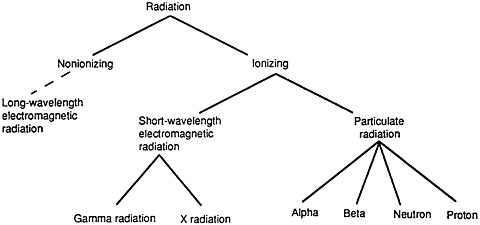
Events just before the turn of the century, which included Roentgen’s discovery of X rays and Becquerel’s recognition of natural radioactivity, allowed us to understand how radiation is produced and how it interacts with matter. Radiation may be of two types, ionizing or nonionizing (Figure 1). Ionizing radiation is capable of physically disrupting neutral atoms by dislodging orbital electrons, thus forming an ion pair consisting of the dislodged electron and the residual atom. Ion pairs are chemically reactive and may produce toxic agents in the cell (e.g., free radicals from water), which can interfere with normal life processes. Nonionizing radiation, on the other hand, does not dislodge orbital electrons or destroy the physical integrity of an impacted atom. The health effects of nonionizing radiation are not addressed in this document.
Figure 1. Types of Radiation
Adapted from: Leach-Marshall JM. Analysis of radiation detected from exposed process elements from the krypton-85 fine leak testing system, page 50. Semiconductor Safety Association Journal 1991;5(2):48–60.
Ionizing radiation exists as either particles or electromagnetic waves. Particulate radiation (e.g., alpha particles, beta particles, neutrons, and protons) has finite mass and may or may not carry a charge. Electromagnetic radiation, on the other hand, has no mass or charge; it consists of electric and magnetic forces that move at the speed of light in consistent patterns of various wavelengths. The continuum of wavelengths constitutes the electromagnetic spectrum. The shorter wavelengths—gamma radiation and X radiation—have high energies, and like particulate radiation, are capable of ionizing matter. The longer wavelengths of the electromagnetic spectrum, which include radio waves; microwaves; and infrared, visible, and ultraviolet radiation have relatively low energies and are nonionizing.
Not all forms of ionizing radiation have the same biologic effects. Generally speaking, for directly ionizing particles, the ion density along the path of low-energy radiation is greater than that along the path of high-energy radiation; low-energy radiation moves slower and has more time to interact. However, the total pathway of low-energy radiation is usually shorter, so the total number of interactions may well be less than with high-energy radiation. Similarly, the ion density toward the end of the radiation path is greater than at the beginning because the velocity of the radiation is less and the probability of interaction is greater. Alpha particles are capable of producing the highest specific ionization (i.e., greatest number of ion pairs per unit length of path), followed in order by beta particles and electrons. X radiation and gamma radiation interact with matter by transferring energy to electrons. (For more information, see Appendix I, Forms of Ionizing Radiation.)
The units that have evolved to measure ionizing radiation are the result of its many facets. Radiation units (Table 1) may characterize the (1) energy, (2) radioactive decay rate, (3) effect in air, (4) ability to be absorbed by matter, or (5) biologic effect. Units may be modified by prefixes such as milli (indicating thousandths of the base unit), micro (millionths), pico (billionths), kilo (a thousand times), or mega (a million times).
The units used most commonly in this document are rad (radiation absorbed dose) and rem (roentgen equivalent in man or mammal). The rad describes the dose of radiation in terms of the amount of energy absorbed by a given mass, for example, of water or tissue. The absorption of 100 ergs of ionization energy in 1 gram of water has a value of 1 rad.
Use of the rem takes into account the biologic effectiveness of the various types of radiation. The rem is numerically equal to the rad multiplied by a Radiation Weighting Factor (formerly “quality factor”). The Radiation Weighting Factor (RWF) reflects differences in the amount of each type of radiation necessary to produce the same biologic effect. For beta, gamma, and X radiation, RWF is 1.0, making their effect on tissue equivalent. The RWF for alpha particles is 20, indicating its biologic effect is 20 times greater than the effect of beta, gamma, or X radiation.
Table 1. Units of radiation measurement
|
Characteristic |
Unit |
Description |
|
Energy |
electron volt (eV) (also ergs, joule) |
Kinetic energy of an electron as it moves through a potential difference of 1 volt. |
|
Rate of radioactive decay |
curie (Ci) |
Radioactivity emitted per unit of time (1 Ci=3.7×10¹⁰ disintegrations per second). |
|
Air exposure |
roentgen (R) |
Amount of X and gamma radiation that causes ionization in air. One roentgen of exposure will produce about 2 billion ion pairs per cubic centimeter of air. |
|
Absorbed dose |
rad |
Dose resulting from one roentgen of ionizing radiation deposited in any medium, typically water or tissue. One rad results in the absorption of 100 ergs of ionizing radiation per gram of medium. |
|
Biologic effectiveness |
rem |
Dose of any form of ionizing radiation that produces the same biological effect as 1 roentgen; 1 rem=1 rad x Radiation Weighting Factor (RWF), where the value of RWF depends on the type of radiation as follows: X radiation=1.0 gamma radiation=1.0 beta=1.0 alpha=20 neutrons=5 to 20, depending on their energy |
A new System Internationale (SI) nomenclature has been adopted, which is used by international, as well as many domestic, professional organizations and journals (Table 2).
Table 2. Equivalency of international units
|
Unit |
Symbol |
Equivalency |
|
Gray |
Gy |
1 Gy=100 rad |
|
Sievert |
Sv |
1 Sv=100 rem |
|
Becquerel |
Bq |
1 Bq=2.7×10⁻¹¹ Ci (or 1.0 disintegration per second) |
|
(1) A health physicist from the state health department calculates that the young boy at the scene of the accident in the case study potentially received a maximum radiation dose of so millirads (mrad). Express this dose in millirems (mrem) and Sieverts (Sv). _________________________________________________________________ _________________________________________________________________ (2) What dose of X radiation would produce the same biologic effect as so mrad of gamma or beta radiation? If the radioactive material in the case study had been an alpha-emitter instead of a beta and gamma emitter, would the biologic effects be greater? Explain. _________________________________________________________________ _________________________________________________________________ |

Exposure Pathways
❑ Our environment includes continual irradiation from both cosmic and terrestrial sources; this natural radiation background is significantly affected by altitude and geology.
❑ In addition to natural background, an individual’s radiation exposure can be increased by factors such as lifestyle (e.g., smoking), geography (e.g., location of residence) and health requirements (e.g., medical diagnosis and therapy).
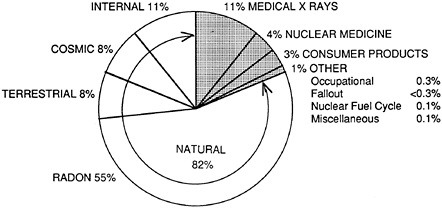
Humans receive an average radiation dose of 300 to 450 mrems per year from both natural (about 82%) and man-made (about 18%) sources. Natural radiation background (Figure 2) is from terrestrial sources and from high-energy particles emanating from stars (including our sun) and other bodies in outer space. Cosmic radiation consists mostly of protons (about 90%), with the remainder being alpha particles, neutrons, and electrons; only about 1/1000 of cosmic radiation penetrates to the earth’s surface.
Near sea level, cosmic radiation results in an average dose of ionizing radiation to U.S. residents of about 30 mrem/year. At higher elevations, such as in the Rocky Mountains, where there is less atmosphere to act as a shield, exposures due to cosmic radiation increase by a factor of about two. An even greater increase is experienced during high-altitude air travel; however, passengers of commercial flights are airborne at high altitudes for only a few hours at a time and do not receive significant exposures from this source.
Figure 2. Sources of ionizing radiation exposure for the U.S. population (Average annual effective equivalent dose)
Adapted with permission from Health effects of exposure to low levels of ionizing radiation: BEIR V. Copyright 1988 by the National Academy of Sciences. Courtesy of the National Academy Press, Washington, DC.
Terrestrial radiation comes from radioactive elements (radionuclides) that were present at the time the earth was formed, and that continue to decay, forming additional radionuclides in the process. Unusual soil composition has increased background radiation twenty-fivefold or more in a few areas in the world. Locations with high background due to naturally occurring radioactive elements in the soil, most of which are derived from the decay of uranium, include the Rocky Mountains (100 mrem/year); Kerala, India (1300 mrem/year); coastal regions of Brazil (500 mrem/year); granite rock areas of France (265 mrem/year); and the northern Nile Delta (350 mrem/year). In the United States, the lowest radiation dose rates are attributed to the sandy soils of the Atlantic and Gulf coastal plains.
One of the products formed during the decay of uranium is radon-222, an alpha-emitting radionuclide. Radon-222 contributes an average equivalent whole-body dose of about 200 mrem/year. Studies of uranium miners and other populations have indicated that inhalation of radon-222 increases the risk of lung cancer, especially in smokers. (See Case Studies in Environmental Medicine: Radon Toxicity.) Residents of homes built on abandoned uranium mine and mill tailings or near uranium mines, such as in the Southwest United States (e.g., Mesa County, Colorado) or in areas in Czechoslovakia, have increased internal radiation exposure due to inhalation of radon, as well as increased external radiation exposure due to uranium in the soil.
Construction materials such as wood, granite, and brick bring terrestrial radioactive sources into closer proximity. The dose rate that is attributable to the naturally occurring radionuclides in wood frame buildings is typically less than 10 mrem/year; occupants of masonry structures receive a dose rate of about 13 mrem/year. The dose rate varies not only with the material, but also with ventilation, room size, room location within the structure, season of the year, and other factors.
Potassium is essential to health, and one of its isotopes, potassium-40, is radioactive. Potassium-40 makes its way into the body through foods (e.g., bananas) and through inhaled fossil-fuel combustion products (e.g., fly-ash particulates). Because potassium deposits in muscle tissue, potassium-40 is widely distributed throughout the body. We receive an annual internal dose to all organs of approximately 18 mrem from this radionuclide.
Radiation background from man-made sources includes fallout from aboveground atomic weapon detonations (about 1 mrem/year for U.S. inhabitants), nuclear fuel production and nuclear reactors (less than 1 mrem/year), medical devices (about 50 mrem/year), and various consumer products. Although the United States and the former USSR have stopped aboveground atomic detonations, the dose rate from atomic weapons testing will continue into the next century because of the long-lived isotopes formed during previous tests and the continued aboveground testing carried out by China and France.
As of 1990, 113 nuclear power plants were operating in the United States. In addition, 75 nuclear reactors were being used for training and research, while about 70 reactors were operating at U.S. Department of Energy (DOE) facilities, and at least 100 were used to power military submarines, cruisers, and aircraft carriers. Supporting these reactors are mines, mills, processing plants, and storage sites for spent fuel, all of which are potential sources of radiation exposure. The current deposits of radioactive waste generated by production and use of atomic weapons and nuclear power reactors will remain a potential exposure hazard for 10,000 years or more.
Radiation exposure incurred for medical reasons can contribute the greatest dose from artificial sources. Worldwide, more than 1 billion medical diagnostic X-ray examinations, more than 300 million dental X-ray examinations, and about 4 million radiation therapy procedures or courses of treatment are performed annually. In the United States, over half of the population is exposed to X radiation each year, and more than half of these are diagnostic procedures, including dental diagnosis. The rest experience X radiation during fluoroscopy, radiation therapy (Table 3), and nuclear medicine (Table 4).
Table 3. Common diagnostic X-ray doses*
Table 4. Common radionuclides used in nuclear medicine
|
Examination |
Agent |
mCi* |
Whole body (mrem)* |
Target Organ (mrem) |
|
|
Lung |
Technetium-99† |
3 |
10 |
Lung—1000 |
|
|
Lung |
Xenon-133 gas |
15 |
3 |
Lung—150 |
|
|
Heart |
Thallium-201 chloride |
1.5 |
360 |
Kidney—2200 |
|
|
Heart |
Technetium-99¶ |
15 |
200 |
Blood—300 |
|
|
Liver |
Technetium-99§ |
3 |
60 |
Liver—1000 |
|
|
Bone |
Technetium-99** |
20 |
200 |
Bone—450 |
|
|
Kidney |
Technetium-99†† |
10 |
233 |
Kidney—500 |
|
|
*mCi=millicurie, mrem=millirem †Radionuclide delivered in microspheres of human serum albumin ¶Radionuclide incorporated in red blood cells §Radionuclide delivered as sulfur colloid **Radionuclide incorporated in methylene diphosphonate ††Radionuclide incorporated in diethylenetriaminepentaacetic acid (DTPA) Adapted with permission from the August, 1987; volume 36, number 2, issue of American Family Physician, published by the American Academy of Family Physicians. |
|||||
In contrast to environmental exposures, medical procedures usually restrict radiation to local areas. However, during the course of exposing only a small fraction of the body, relatively large doses may be delivered to the bone marrow, which, in comparison to other parts of the body, is very sensitive to radiation. Although the risks due to
radiation exposure are small for patients undergoing medical treatments, the cumulative risk to medical and dental personnel who are present is greater. In addition, staff who are not properly protected may receive whole-body, rather than localized, exposures. Procedures that can be used to protect health care personnel include limiting the time of exposure, maintaining an adequate distance between the X-ray beam and personnel, and providing adequate shielding.
A number of natural and artificially produced radioactive materials are used in consumer products. Of these, tobacco products probably represent the single greatest radiation hazard to smokers. Tobacco smoke contains polonium-210 and lead-210, alpha-emitting radon decay products. These radionuclides may be deposited and retained on the large, sticky leaves of tobacco plants or may derive from the uranium naturally present in the phosphate fertilizers used on the plants. When the tobacco in a cigarette is lit, the radioactive materials are volatilized and enter the lungs. The bronchial lining of the lungs of a person who smokes 1.5 packs of cigarettes per day may receive as much as 16,000 mrem/year (Table 5). The radiation from tobacco smoke may contribute to the carcinogenicity associated with active and passive cigarette smoking.
Although radiation values for dental porcelain and eyeglasses (Table 5) are large, these sources are not a health hazard because the radiation they produce is distributed over a few millionths of an inch in comparatively insensitive tissues; the total contribution of dental porcelain and eyeglasses as an equivalent whole-body dose is less than 5 mrem/year.
Table 5. Background radiation from consumer products
|
Product |
Local Dose (mrem/year) |
Portion of Body Considered |
|
Coal combustion (fly ash) |
0.03–0.3 |
lungs |
|
Oil combustion (soot) |
1.6 |
lungs |
|
Gas ranges (natural gas) |
5 |
lungs |
|
Tobacco products* |
16,000 |
lungs |
|
Dentures and crowns† |
700 |
superficial layers of tissue in contact with teeth |
|
Ophthalmic glass¶ |
4,000 |
cornea |
|
Smoke detectors |
0.008 |
whole body |
|
*Dose for cigarette smokers only; does not include doses experienced by those subjected to passive smoke. †Due to the uranium present in glazed dental porcelain. ¶Applies to eyeglasses tinted with uranium or thorium. Adapted from: National Council on Radiation Protection and Measurements (NCRP). Radiation exposure of the U.S. population from consumer products and miscellaneous sources. Bethesda, Maryland: NCRP, 1988. NCRP Report No. 95. |
||
|
(3) List at least five potential sources of radiation unrelated to the workplace to which the truck driver in the case study may be exposed. Compare the annual dose from each of these sources. _________________________________________________________________ _________________________________________________________________ |
Who’s at Risk
❑ Workers in the nuclear energy and defense industries are at greatest risk of exposure to ionizing radiation.
❑ Accidental releases of radiation can occur while producing, using, storing, or transporting radionuclides.
❑ Long-term sequelae of acute high-level or low-level radiation (i.e., cancer and genetic effects) are difficult to assess for a number of reasons.
Important data about human effects from exposure to ionizing radiation come from survivors of the atomic bomb detonations in Hiroshima and Nagasaki. Additional evidence comes from inhabitants of the Marshall Islands who experienced fallout from thermo-nuclear testing on Bikini Atoll, radium dial painters, pioneer radiologists, and patients receiving radiation therapy (e.g., patients who were irradiated in the 1950s as treatment for ankylosing spondylitis). Effects of high-level exposure include acute radiation sickness and fatalities. The major long-term health risks of ionizing radiation are cancer, birth abnormalities (from in utero irradiation), infertility, and genetic abnormalities, which are discussed in Physiologic Effects, page 13.
Risk of radiation-induced cancer in human populations is difficult to calculate for four reasons: (1) the total number of known radiation-induced cases is too small and the doses too high to allow accurate extrapolation to low doses; (2) cancer from other causes is a prevalent disease (the incidence of cancer morbidity in the U.S. population is 30% to 35%), making incremental incidences due to radiation exposure difficult to detect; (3) radiation-induced cancer cannot be distinguished from cancer due to other causes (although investigators using new molecular biology techniques are attempting to make this distinction possible); and (4) the interval between radiation exposure and cancer appearance may be several decades.
Exposure to low-level ionizing radiation occurs mostly in the workplace. Workers at risk are those involved in the following activities: operating nuclear power plants, other nuclear industrial facilities, or nuclear-powered naval vessels; purifying, enriching, and fabricating uranium for nuclear reactor fuel and for weapons production and use; and working at radionuclide storage sites. In addition, medical technicians; researchers; uranium miners and other underground
miners, cave guides, and spelunkers exposed to radon; industrial radiographers; and geologists using radiologic devices to measure pressure in wells are at risk of radiation exposure.
Criticality accidents (due to uncontrolled nuclear fission) have occurred at Los Alamos, New Mexico, in 1958; Oak Ridge, Tennessee, in 1958; Hanford Works, Richland, Washington, in 1962; and Wood River Junction, Rhode Island, in 1964. In addition, two early experiments (in 1945 and 1946) at the Los Alamos site resulted in uncontrolled nuclear fission. These accidents caused three early fatalities of workers closest to the nuclear reactions; the 22 other workers in the vicinity of the accidents were irradiated at doses less than 465 rem, and all survived for at least 5 years. The radiation from these accidents would have affected a larger area and a greater number of people if conditions during criticality had also resulted in the explosive release of large amounts of energy, which they did not.
The general public can be exposed to radiation through industrial or mining waste streams that contaminate air and drinking water. Releases of iodine-131 to air and water occurred at nuclear power plants in Hanford, Washington, during the period from 1943 to the 1960s and at Three Mile Island in 1978. The release of radioactivity at the Three Mile Island nuclear power plant resulted in an average radiation dose to the surrounding population of about 8 mrem over a radius of 10 miles and about 2 mrem over a radius of 50 miles from the reactor. These doses are conservatively expected to cause an additional 0.7 cancer deaths in the population living within the affected 50-mile radius. (By contrast, the number of cancer deaths estimated to occur from all other causes during the lifetime of this population of 2 million persons is about 390,000.)
Accidental releases of radioactive materials may also occur during transport of radionuclides or at sites storing them. Currently, low-level radioactive waste can be accepted at two commercial storage sites: Barnwell, South Carolina, and Hanford, Washington. The storage site at Beatty, Nevada, no longer accepts shipments of radioactive waste. No repository has yet been designated as a permanent storage site for high-level radioactive waste such as spent fuel from nuclear reactors.
Biologic Fate
❑ Depending on their physical state, radionuclides may enter the body by ingestion, inhalation, or by absorption through the skin. They may also enter the body through breaks in the skin.
❑ Distribution, metabolism, and excretion depend on the radionuclide and its chemical form.
❑ Radium and transuranic radionuclides may remain in the liver and bone for years.
Exposure to ionizing radiation can result from internal sources (i.e., radionuclides deposited within the body), external contamination (i.e., radionuclides deposited on the body surface), and irradiation by an external source. Internally deposited radionuclides frequently produce nonuniform radiation to proximate organs and tissues, depending on the radionuclide’s distribution and metabolic characteristics. In many respects, internal contamination can be viewed as chronic exposure.
Radioactive substances can enter the body via inhalation, ingestion, skin absorption or through a contaminated wound. Inhalation is the most common route of internal contamination. Depending on particle size, aerosols may penetrate beyond the self-cleansing mucocilliary system of the central airways. For insoluble aerosols, such as oxides of plutonium and other transuranic elements (elements having an atomic number greater than uranium), the biologic fate usually includes transfer of the radionuclide by macrophages to regional lymph nodes and partial solubilization, with entry into the circulatory system. Heavy nuclides remain in the liver and bone for prolonged periods, typically years.
Hundreds of radioactive nuclides exist, but only a few are extensively used or produced and have the potential to cause significant internal contamination. The radionuclides in the environment of greatest potential concern are cesium-137, iodine-131, plutonium-239, radon-222, strontium-90, tritium, and uranium-238. A brief discussion of the biologic fates of each of these radionuclides can be found in Appendix II.
|
Additional information for the case study: The radioactive material has been identified as an aqueous solution of potassium iodide, which was prepared from iodide-131. The cargo was being delivered to a repository for storage of low-level radioactive waste. (4) Several hours after the accident occurred, a fireman who was first-on-scene is brought to the emergency room complaining of mild chest pain. He asks you if this pain could be caused by radioactivity in the smoke. Considering the biologic fate of iodide-131, is this a likely cause of the patient’s chest pain? Explain. _________________________________________________________________ _________________________________________________________________ |
Physiologic Effects
❑ Rapidly dividing cells are the most sensitive to ionizing radiation.
❑ Hemopoietic changes become observable at exposure levels of about 25 to 100 rem. Changes in the function of most other cells or immediate cell death occurs at exposure levels greater than 100 rem.
❑ DNA repair mechanisms likely influence the effects of radiation exposure that has occurred over an extended period of time.
The immediate effect of exposure to high-level ionizing radiation is cytotoxicity, which results in changes in cellular function or direct cell death. Changes in cellular function may include delays in certain phases of the mitotic cycle (mitotic inhibition), disrupted cell growth, permeability changes, and changes in motility.
A suggested mechanism for radiation cytotoxicity involves the formation of ions, which interact with water and create inhibitory toxic chemicals (e.g., hydrogen peroxide) and free radicals that destroy the integrity of proteins, DNA, or other cellular constituents. The body’s response to ionizing radiation depends on several factors, including the type and quality of radiation, dose, dose rate, and homogeneity of dose. If a cell receives a sublethal dose of radiation, cellular repair processes may be activated. Repair mechanisms are most likely responsible for the ability of the body to tolerate a higher total dose when exposure occurs over an extended period of time (i.e., at a low dose rate).
Cytotoxicity from radiation varies among cell types and tissues. In general, rapidly dividing cells that are poorly differentiated are most radiosensitive. For example, lymphocytes, primitive stem cells of the bone marrow, mucosal crypt cells of the gastrointestinal tract, spermatogonia, and granulosa cells of the ovary are particularly affected by radiation. Endothelial cells of the microcirculation and epithelial cells of many organs have an intermediate sensitivity. Muscle cells, neurons, erythrocytes, and polymorphonuclear granulocytes are relatively resistant to radiation. In most cases, maximum organ damage becomes evident as injured progenitor cells fail to replace the lost mature cells.
Cancer
❑ Large doses of ionizing radiation will significantly increase the incidence of cancer in a population. However, at low doses, the incidence of radiation-induced cancer is difficult to detect.
The largest body of evidence in support of the ability of ionizing radiation to produce cancer derives from studies of the survivors of the atomic detonations during World War II. The increased rates of various cancers in those persons are consistent with the increased rates for comparable cancers in other irradiated populations. A radiation dose of 100 rem causes about a 5% increase in the risk for developing a fatal cancer. Risk of some cancers (e.g., female breast cancer and multiple myeloma) more than doubles with exposure doses greater than 100 rem. A reasonable estimate of additional cancer mortality risk from a one-time whole-body dose of 1 rem is 1 to 5 fatal cancers in 10,000 persons so exposed (0.01% to 0.05%). This risk is in addition to the cancer mortality risk in the general U.S. population of about 1950 fatal cases in 10,000 persons (19.5%).
The first radiation-induced malignancy to appear in the atomic bomb survivors was leukemia. The latent period between radiation exposure and clinical recognition of leukemia ranged from 2 to 15 years.
The risk to the survivors of developing this disease varies with the type of leukemia and the age at the time of exposure. For example, the incidence of chronic lymphocytic leukemia (CLL) is not measurably affected by the radiation level or dose, whereas the incidence of all other types of leukemia has been reported to increase with dose, and the risk is greater to those who were exposed at a younger age.
In the Japanese survivors, increased incidences for solid cancers appeared considerably later than the excess of leukemia. Carcinoma of the thyroid was the first of the solid tumors noted. An increased incidence of multiple myeloma and cancers at the following sites was also found: breast (female), lung, stomach, esophagus, small intestine, colon and rectum, brain and nervous system, ovary, uterus, urinary tract, and salivary glands. In populations irradiated occupationally or primarily for medical reasons, an increased incidence of cancers at these sites has also been reported, as well as at other specific sites including liver [due to internally deposited radionuclides], skeleton, and skin. Current medical reagents and procedures in nuclear medicine are designed to minimize residual radionuclides in the body and adverse side effects.
As with leukemia, the risks for solid tumors in the Japanese survivors are greater in persons who were younger at the time of exposure. The latency period for solid tumors due to radiation exposure is generally one or more decades. Interestingly, an increase in pancreatic cancer, the fourth leading type of fatal cancer in the United States, was not observed in atomic bomb survivors and has been observed inconsistently in other irradiated human populations (i.e., no clear relationship to dose or time after exposure could be identified).
Developmental Effects
❑ The fetus, with its rapidly dividing cells, is especially radiosensitive.
Exposure of pregnant women to ionizing radiation has been studied in several populations including survivors of the atomic bomb detonations in Japan. Preimplantation radiation exposure (i.e., within 2 weeks after conception) has not been found to produce anomalies in the fetus. If preimplantation damage occurs, it is likely that spontaneous abortion ensues. In women exposed during pregnancy, increased incidences of miscarriages, stillbirths, and neonatal deaths have been reported. Children exposed in utero have shown an excess of congenital defects.
In children born to survivors of the atomic bomb detonations, a pronounced association exists between gestational age at the time of exposure and the risk of neurodevelopmental effects. Exposure occurring during the first 7 weeks of gestation did not result in increased risks for mental retardation, reduced IQ, or seizure disorders. Exposures greater than 50 rad during gestational weeks 8 to 15, when nerve development and migration are greatest, showed linear dose-effect relationships for each of the above three endpoints and for microcephaly. This gestational period (i.e., 8 to 15 weeks) is recognized
as the most sensitive for the development of fetal neurologic effects (see Case Studies in Environmental Medicine: Reproductive and Developmental Hazards). A no-effect threshold for adverse neurodevelopmental effects during this gestational period could not be determined.
Exposures that occurred during 16 to 25 weeks of pregnancy also resulted in an increased risk of adverse neurodevelopmental effects, but to a lesser degree than during the period of peak sensitivity. Irradiation during the 16th to 25th week did not produce a linear relationship between dose and effect. In fact, a threshold for mental retardation appeared to exist. After 25 weeks of gestation, radiation exposures generally cause stunting of growth in the fetus, resulting in a newborn who has reduced physical size but remains normal in other ways.
Genetic Effects
❑ Genetic effects due to ionizing radiation are well documented in animals and other nonhuman forms of life.
❑ Although inheritable defects have not been evident in atomic bomb survivors, no reason exists to assume that humans are exempt from radiation-induced genetic effects.
In nonhuman forms of life, the developmental and genetic effects of ionizing radiation are well documented. Radiation exposure in these life forms results in congenital abnormalities and mutations that are transmitted to immediate and remote offspring. In experimental animals, the frequency of genetic effects due to radiation exposure generally increases as a linear-nonthreshold function of dose.
An epidemiologic study in Japan compared 38,000 children conceived after one or both parents were exposed to radiation from atomic detonations with 37,000 children whose parents were not exposed. No statistically significant differences were found in stillbirths, birth weight, infant mortality, or sex ratio. Among children of the exposed parents, there was also no effect seen on electrophoretic variants of 28 proteins of blood plasma and erythrocytes. These results may be due to relevant factors that were not controlled in the study. Although this study was negative, it does not prove that humans are exempt from radiation-induced genetic effects.
The dose needed to double the mutation rate in humans has been calculated to be higher than 100 rem, which is twice the average gonadal dose received by the atomic bomb survivors. Although the children of the survivors exhibited no inherited chromosomal abnormalities, the survivors themselves showed a dose-dependent increase in chromosomal abnormalities in somatic cells (i.e., circulating blood lymphocytes), which has also been detected in other populations exposed to ionizing radiation.
Some studies involving women who have had medical X-ray exposures suggest an association between maternal preconception exposure to ionizing radiation and the incidence of Down syndrome, while others do not. Thus, the studies are inconclusive. A similar paternal radiation effect has not been noted. Children whose parents
received preconception exposures of greater than 1 rem at Hiroshima and Nagasaki have not exhibited increased incidences of Down syndrome, leukemia, or non-Hodgkin’s lymphoma.
|
Additional information for the case study: The boy is located with friends several hours after the accident and taken to the emergency department of the local hospital. He says he did not come in contact with the radioactive material. (5) Is the boy a hazard to those with whom he has come in contact since the accident? Explain. _________________________________________________________________ _________________________________________________________________ (6) Is the boy, the truck driver, or his assistant at increased risk of cancer? Explain. _________________________________________________________________ _________________________________________________________________ |
Clinical Evaluation
Acute Radiation Syndrome
❑ No immediate symptoms occur from acute doses of whole-body radiation below about 100 rem.
❑ The acute radiation syndrome consists of subsyndromes involving the hematopoietic, gastrointestinal, and neurovascular systems.
Approximately half of those receiving a radiation dose of 500 rem will die within 30 days if untreated. Below 1000 rem, deaths are attributable to failure of the hematopoietic system. For doses between 1000 and 10,000 rem, death occurs due to ulceration and bleeding in the gastrointestinal tract. Doses above 10,000 rem immediately affect the cells of the nervous system. Depending on the exposure dose, these subsyndromes (i.e., hematopoietic, gastrointestinal, and neurovascular), which make up the acute radiation syndrome, may be discrete or overlapping (Table 6).
Table 6. Acute effects of whole-body doses of ionizing radiation
|
rem* |
|
|
0–25 |
No detectable clinical effects; small increase in risk of delayed cancer and genetic effects |
|
25–100 |
Temporary reductions in lymphocytes and neutrophils; sickness not common; long-term effects possible |
|
100–200 |
Minimal symptoms; nausea/vomiting/diarrhea/fatigue in a few hours; reduction in lymphocytes and neutrophils, with delayed recovery; possible bone growth retardation in children |
|
200–300 |
Nausea and vomiting on first day; following latent period of up to 2 weeks, symptoms (loss of appetite and general malaise) appear but are not severe; hematopoietic subsyndrome; recovery likely in about 3 months unless complicated by previous poor health |
|
300–600 |
Nausea, vomiting, and diarrhea in first few hours, followed by latent period as long as 1 week with no definite symptoms; loss of appetite, general malaise, and fever during second week, followed by hemorrhage, purpura, inflammation of mouth and throat, diarrhea, and intestine destruction in third week; some deaths in 2–6 weeks; possible eventual death to 50% of those exposed |
|
600–1000 |
Vomiting in 100% of victims within first few hours; diarrhea, hemorrhage, and fever toward end of first week; rapid emaciation; almost certain death |
|
1000–5000 |
Vomiting within 5–30 minutes; 100% incidence of death within 2–4 days |
|
>5000 |
Vomiting immediately; 100% incidence of death within a few hours to 2 days |
|
Also |
|
|
>15 |
In men yields temporary sterility |
|
>300 |
In women yields permanent sterility |
|
*rem=rad equivalent in man or mammal Adapted from: Goldman M. Ionizing radiation and its risks. In: Occupational disease—new vistas for medicine. West J Med 1982;137:540–7. |
|
Acute radiation illness begins with a prodromal period manifesting within hours or a few days. Prodromal symptoms include anorexia, nausea, vomiting, and diarrhea. A latent period of 5 to 7 days then occurs during which the patient appears to have recovered. Within 2 weeks after exposure, the patient will manifest illness that requires aggressive therapy; this critical period may last up to 4 weeks. Generally, the higher the absorbed dose, the shorter the latent period and the more rapid the onset and severity of illness during the critical period.
At levels above 100 rem whole-body dose, radiation-sensitive stem cells in the bone marrow and lymphoid tissues are destroyed or mitotically impaired. The more radio-resistant mature elements normally circulating in the blood cannot be replaced promptly, and fatal hemorrhage can result from platelet loss. Infection from decreased production of granulocytes and other cells can also occur. Recovery has been reported after exposure to 300 to 600 rem when intensive supportive care was provided. Erythrocyte production is also decreased, but in the absence of bleeding, anemia develops only slowly and in modest severity because erythrocytes have a long life span.
Acute radiation doses exceeding 600 rem to the abdomen or whole body usually result in significant damage and reproductive impairment of rapidly proliferating crypt stem cells, thus producing the gastrointestinal tract subsyndrome. The existing mucosa is shed, preventing normal absorption and causing the gut to leak electrolytes and blood. The denuded mucosa becomes a portal of entry for intestinal bacteria; severe diarrhea, shock, and sepsis occur. Although medical therapy may delay death from these causes, the patient usually succumbs.
Acute doses of more than 3000 rem cause damage to capillaries, resulting in a more immediate neurovascular subsyndrome. Within 1 hour after exposure, neurologic symptoms of confusion, prostration, and loss of balance develop. Diarrhea, respiratory distress, intractable hypotension, and central nervous system (CNS) collapse rapidly ensue. Massive damage to the microcirculation probably is responsible for the cerebral edema that causes brain damage. The initial hypotension may be due to release of histamine by the granulated mast cells. At this radiation dose, medical efforts are futile, and death occurs within 48 hours after exposure.
Local Radiation Injury
❑ Contact with a radioactive source can result in burns that are worse than is immediately apparent.
❑ Most local radiation injuries involve the hands.
In a radiation accident, high local exposures may complicate whole-body exposures. Since 1945, about 300 radiation accidents have occurred in the United States, the majority of which have involved industrial devices containing cobalt-60 or iridium-192. Injury to the skin depends on the type of radiation, as well as the strength of the source and duration of the contact. For example, beta radiation typically produces a shallow injury, whereas gamma radiation penetrates more deeply. Both cobalt-60 and iridium-192 are gamma emitters and can produce contact doses that result in immediate and severe third-degree burns. Third-degree contact burns are generally painless and actual skin damage may be worse than is immediately apparent. Most local injuries involve the hand; other common sites are the thighs and buttocks when radioactive sources are carried in pants’ pockets. The acute radiation syndrome may also be present in patients who have severe local contact injury.
The intensity of radiation from a source decreases as the distance from the source increases, in accordance with the “inverse square” rule. For example, a dose of 1024 rads at 1 meter from a source is reduced to 256 rads at 2 meters and 64 rads at 4 meters. If the immediate signs and symptoms after a local radiation exposure include erythema of skin and severe pain, the local absorbed dose is probably in excess of 1000 rads. Evidence of transepithelial injury and dry desquamation may follow. At doses above about 2000 rads, blistering and a wet radiodermatitis may ensue. Later, tissue necrosis due to secondary vascular impairment may occur. These injuries are similar to thermal burns in appearance. In radiation cases, erythema may increase during the first week after exposure and fade during the second week but may recur. A feeling of tenderness and itching usually persists.
Laboratory Evaluation
External Indicators
❑ An accurate assessment of radiation dose is a useful, though not essential, confirmatory aid to clinical judgment in treating severely affected patients.
Instruments used to measure radiation levels in the environment are generally of two types: area survey meters and personnel dosimeters. If either dosimetry is available, contact a health physicist for interpretation. These radiation experts are employed at local or state departments of health, universities, and the Radiation Emergency Assistance Center/Training Site (REAC/TS) at Oak Ridge Institute for Science and Education (see Other Sources of Information, page 29).
Internal Indicators
❑ Lymphocytes are a biologic marker for radiation exposure.
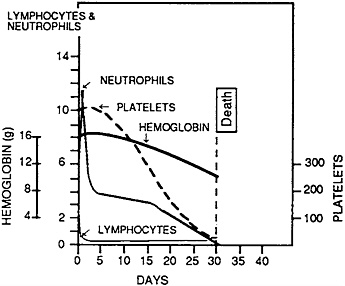
If whole-body radiation has occurred, several hematologic parameters can be used to predict biologic effects, as well as to estimate physical dose. The earliest indicator is a fall in the lymphocyte count, which may reach its nadir within 48 hours (Figure 3). At doses up to
300 rad, the rate of fall in circulating lymphocytes is related directly to dose. At doses greater than 300 rad, profound lymphocytopenia occurs, and lymphocyte count becomes unreliable for dose estimation.
Figure 3. Typical hematologic response* to a whole-body radiation dose of 450 rads
*Lymphocyte, neutrophil, and platelet values should be multiplied by 1000. Hemoglobin values are in grams per deciliter.
Adapted from: Goldman M. Ionizing radiation and its risks. In: Occupational disease—new vistas for medicine. West J Med 1982;137:540–7.
Unlike lymphocytes, granulocytes (represented by neutrophils in Figure 3) are not directly lysed by radiation and provide another indication of dose. At whole-body doses of 200 to 500 rads, a brief rise in the peripheral granulocytic count typically occurs in the first few days after exposure. The rise, which is a nonspecific stress response, is followed by a progressive fall, an abortive rise or plateau, and another fall, the true nadir of which is reached within 30 days after exposure. Doses greater than 500 rads cause increasingly earlier and more severe granulocytopenia. The severity of thrombocytopenia (see platelets in Figure 3) is also an indicator of dose.
A useful and sensitive biomarker for dose estimation in acute whole-body radiation exposures, as well as to predict the long-term health risks in large populations exposed to low levels of radiation, is the chromosome aberration assay. Radiation induces several nonspecific but characteristic chromosomal abnormalities, particularly dicentric chromosomes. By scoring the frequency of these abnormalities in lymphocytes in the peripheral blood or bone marrow and comparing the frequency to aberrations
produced by irradiating peripheral blood in vitro, a relatively accurate estimation of radiation dose can be made. Chromosomal aberrations are visible within hours after radiation exposure, and the optimum time to perform the assay is within the first few weeks after exposure. Details of sample preparation and the names of laboratories able to perform cytogenetic assays for radiation exposure can be obtained from REAC/TS (telephone: [615]–576–3131 [day]; [615] 481–1000 [24-hour hotline]).
Indicators of internally deposited radionuclides will depend on the biologic fate and the biologic half-life of the radioactive substance. If the metabolic pathway and biologic and physical half-lives are known, an estimate of dose to the target organ can be made by bioassay. Methods for measuring the amount of radioactivity in the body include urinalysis, fecal analysis, whole body scans, and thyroid scans for exposure to radioactive iodine.
Cytogenetic assays may also be used to detect damage from internally deposited radionuclides. However, these data are not useful in estimating dose to the target organ because internal radionuclides are seldom distributed uniformly within the body. This uneven distribution can affect the radiation received by the circulating lymphocytes and even their survival.
|
(7) About 36 hours after arriving at the emergency department, the driver in the case study and his assistant experience nausea and vomiting. What is the prognosis for these patients? _________________________________________________________________ _________________________________________________________________ (8) In the emergency room you have an opportunity to examine the young boy. What history or other information will help you determine his prognosis? _________________________________________________________________ _________________________________________________________________ (9) One month later, the boy’s parents ask you to perform a test that will prove the boy was exposed to radiation. Is this possible? Explain. _________________________________________________________________ _________________________________________________________________ |
Treatment and Management
❑ An important consideration in decontamination is to prevent the spread of radioactive materials.
❑ The psychologic effects of actual or potential radiation exposure are often overlooked.
Early Considerations—Decontamination
If radioactive materials are present in a workplace, it is important to have decontamination materials available and a written plan for their utilization. Radiation detection equipment is used to identify a worker contaminated with radioactive liquids or solids (e.g., dusts), as well as the body area that is contaminated.
The first step in decontamination is removal of contaminated clothing, then careful washing of the areas around eyes, nose, and mouth with a washcloth. Showering should be avoided when external contamination is localized because showering can spread radionuclides to clean areas. Mild soap and water are frequently all that is needed to emulsify and remove contamination. Gentle brushing or use of a mildly abrasive soap will help dislodge contamination physically held by skin protein. Harsh abrasives should be used cautiously because they may open a path through the keratinized layer of the skin and allow internal contamination. Addition of a chelating agent to the wash water may help by binding the radionuclide in a complex. Contaminated wash water must be collected and disposed of properly. Instructions for disposal can be obtained from REAC/TS (telephone: [615]–576–3131 [day]; [615] 481–1000 [24-hour hotline]).
Radiation monitoring of the cleaned, dried skin should be done between washings. If repeated washings do not totally remove contamination, the material is probably fixed in skin, which will normally be shed; a frequently changed bandage over the area will prevent spread of contamination via the sloughed skin. In stubborn cases where contamination is localized in the thick horny layers, such as palms and soles of feet, sticky tape or a high-speed abrasive wheel can be used. However, if these techniques are not used properly, they can lead to skin cuts or increased percutaneous absorption. It may be necessary to remove contaminated hair by using clippers or an electric razor. All potentially contaminated material, including hair, debrided tissue, and, if internal contamination has occurred, vomitus and excretion products, must be collected in plastic bags for proper disposal.
If the contaminated worker is physically traumatized, the emergency department plan for management of radiation-accident casualties should be executed. Lifesaving medical care takes precedence over decontamination procedures. After emergency care has been administered, gross decontamination should be conducted on site. Further decontamination can occur at the medical facility. The patient should be wrapped in blankets to prevent the spread of contamination during transport. If the medical facility is not prepared for radiation decontamination and does not have an appropriate decontamination room, the patient should be decontaminated outside or away from areas
where normal activities occur. Care must be taken to prevent the spread of radioactivity within the facility.
The general public perceives the risk of death or injury from radiation as greater than do scientists. Dealing with the fear and mental stress caused by an accident is a significant part of emergency management. Techniques for combatting this anxiety include educating the public before an emergency occurs, efficiently disseminating factual information using a single credible source during the emergency, and presenting evidence that a plan to manage the emergency is in place and working.
Acute Radiation Syndrome
❑ Bleeding and infections, which are the primary causes of morbidity and mortality in patients acutely exposed to radiation, should be promptly treated by specialists.
Patients who have received acute total body radiation of 500 rads or more will develop severe pancytopenia and will require aggressive supportive measures. Patients developing aplastic anemia are at risk for systemic bacterial, fungal, and viral infections; infections and bleeding are the major causes of morbidity and mortality. Clinicians are encouraged to consult a hematologist, radiation oncologist, health physicist, or other radiation specialist knowledgeable about acute radiation illness and its treatment. Some referral sources are given in Other Sources of Information, page 29. A general treatment scheme for acute radiation injury is presented in Figure 4.
Local Radiation Injury
❑ Treatment depends on the area of the burn and the depth of radiation penetration.
Radiation exposures that produce only erythema (300–1000 rad) can be treated as first-degree burns. Burns that result in desquamation (1000–2000 rad) are transepidermal and are similar to second-degree burns. Large surface-area burns may require systemic hydration. Skin grafting may be useful, but success depends on the depth of radiation penetration and the vascular status of the underlying tissues. Third-degree burns are produced by doses greater than 3000 rad. Third-degree burns heal by scarring; as a result, contraction and loss of function may occur, particularly if extremities are involved. Extensive plastic surgery may be required to prevent or limit loss of function. Amputation may be necessary.
Internal Contamination
❑ Generally, treatment strategies involve reducing internal absorption and enhancing elimination.
Two strategies exist for treatment of a patient who is internally contaminated (i.e., cases where radioactive material is incorporated in the body via inhalation, ingestion, or through skin or wounds). The first strategy depends on reducing both the internal absorption and deposition of radioactive material (“blocking”); the second strategy depends on enhancing the elimination and excretion of the radioactive material (“decorporation”).
Figure 4. Treatment scheme for patients receiving an acute high-dose radiation exposure
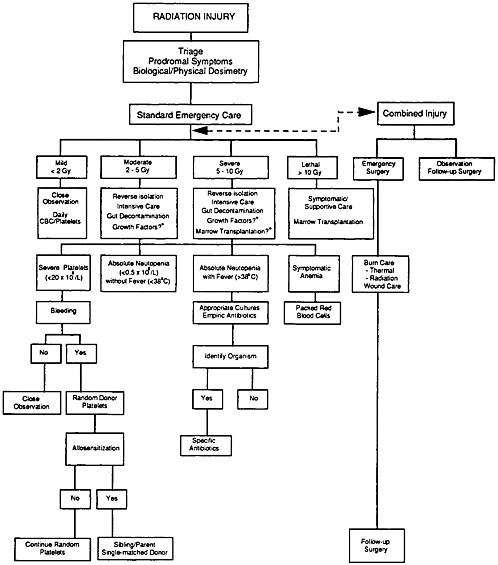
*Whole-body exposures greater than 4 Gy may require bone marrow transplantation or administration of colony-stimulating factors or other hematopoietic growth factors that stimulate proliferation of hematopoietic stem cells. However, few data exist to support firm recommendations about the use of these treatments for radiation victims.
Adapted from: Browne D, Weiss JF, MacVitlie TJ, Pillai MV. Treatment of radiation injuries. New York: Plenum Press, 1990.
❑ Treatment of a patient who is internally contaminated is specific to the contaminating radionuclide and chemical form.
In radiation accidents, the identity of the radionuclide contaminant and its chemical and physical state must ultimately be determined. Radio-nuclides present at a workplace are usually known, and shipping documents and load manifests detail the hazardous contaminants at transportation accidents. Sometimes it will not be clear whether internal contamination has occurred. Samples collected during external decontamination will provide clues about possible internal contamination. Skin wipes, nasal swabs, urine, and feces should be collected for analysis at a laboratory capable of detecting and identifying radionuclides. Local and whole-body counting can be done at specialized facilities. As mentioned above, gentle mechanical cleansing of wounds and skin and the areas around mouth and nose will prevent further ingestion and absorption of radioactive materials.
Chelation with diethylenetriaminepentaacetic acid (DTPA) accelerates the urinary excretion of some transuranic metals (e.g., plutonium, californium, americium, and curium) and some rare earth ions (e.g., cerium, yttrium, lanthanum, promethium, and scandium). DTPA is an investigational drug available from REAC/TS (see Other Sources of Information, page 29). DTPA can be administered intravenously or as an inhaled aerosol according to treatment protocols established by investigators at REAC/TS. In rare cases of massive pulmonary deposition of very hazardous aerosolized radionuclides, lung lavage may be of value. Appendix II is a treatment summary for selected elements.
|
(10) How will you manage and treat the truck driver and his assistant in the case study? Assuming the young boy has experienced no immediate effects from the irradiation, what follow-up is appropriate for him? _________________________________________________________________ Additional information for the case study: An hour after the accident, the concentration of radioactivity at the point where the material entered the river was measured at 20 picoCuries per liter (pCi/L) of river water. The town switched to an alternate source of drinking water. Two weeks later, the state public health department declared the river water safe, and the town resumed using the river as its source of drinking water. (11) You continue to receive calls from your patients, expressing fear and concern about exposure to radioactivity. One of these patients insists that a rash that developed on his arm yesterday is caused by showering with “radioactive water.” A patient who is pregnant fears that her unborn child will be malformed or have cancer as a result of her drinking water from the river. How will you respond? _________________________________________________________________ |
Standards and Regulations
During the period 1900 to 1930, standards for radiation protection were informal and set quite high (approximately 60 R/year). They reflected concern for acute effects of exposure. When concerns over the long-term effects of radiation exposure began to develop (1930 to 1950), protection standards were formalized. The recommendation in 1934 of the U.S. Advisory Committee on X-Ray and Radium Protection (now the National Council on Radiation Protection and Measurements [NCRP]) was to restrict whole-body exposures to less than 0.1 R/day. From 1950 to 1960, attention centered on genetic effects of radiation exposure, and recommendations were proposed to limit exposure to the equivalent of 5 rem/year, which applied to both the general public and workers. Because any amount of radiation exposure poses some risk, all standards now employ a philosophy that radiation exposures should be limited to levels that are as low as reasonably achievable (ALARA) and consistent with the benefits of radiation to society.
Regulatory agencies in the United States that are involved in radiation control include the Nuclear Regulatory Commission, Department of Transportation, Food and Drug Administration, Occupational Safety and Health Administration, and the General Accounting Office. EPA has also established a standard for drinking water of 5 pCi/L, which applies to radioactivity from radium-226 and radium-228 combined. A new drinking water standard of 20 pCi/L each for radium-226 and radium-228 has been proposed.
Many states and cities also have regulations concerning the use of and protection from radiation. NCRP, established in 1964 to advise Congress on issues related to radiation, and the International Commission on Radiological Protection (ICRP) recommend the standards in Table 7.
Table 7. Summary of recommendations for ionizing radiation
|
Dose Limits for Workers* |
|
|
|
|
ICRP, 1991† |
NCRP, 1993¶ |
|
Based on stochastic effects§ (e.g., cancer and genetic damage) |
5 rem (50 mSv) annual effective dose limit and 10 rem (100 mSv) as 5-year cumulative effective dose limit |
5 rem (50 mSv) annual effective dose limit and 1 rem (10 mSv) times age in years cumulative effective dose limit |
|
Based on nonstochastic effects§ (e.g., lens cataracts and fertility impairment) |
15 rem (150 mSv) equivalent dose limit to lens of eye and 50 rem (500 mSv) annual equivalent dose limit to skin, hands, and feet |
15 rem (150 mSv) annual equivalent dose limit to lens of eye and 50 rem (500 mSv) annual equivalent dose limit to skin, hands, and feet |
|
Dose Limits for the Public* |
|
|
|
|
ICRP, 1991 |
NCRP, 1993 |
|
Based on stochastic effects |
0.1 rem (1 mSv) annual effective dose limit, and, if needed, higher values provided that the annual average over 5 years does not exceed 0.1 rem |
0.1 rem (1 mSv) annual effective dose limit for continuous exposure and 0.5 rem (5 mSv) annual dose limit for infrequent exposure |
|
Based on nonstochastic effects |
1.5 rem (15 mSv) annual equivalent to lens of eye and 5 rem (50 mSv) annual equivalent dose limit to skin, hands, and feet |
5 rem (50 mSv) annual equivalent dose limit to lens of eye, skin, and extremities |
|
Embryo-fetus |
0.2 rem (2 mSv) equivalent dose to the woman’s abdomen once pregnancy has been declared |
0.05 rem (0.5 mSv) equivalent dose limit in a month once pregnancy is known |
|
*The dose limits for both workers and the public exclude medical and natural background exposures. Note that the dose limits for the public are lower, in general, than those for workers. Workers, by virtue of the ability to work, tend to be a healthier population than the public, which includes susceptible populations, the elderly, and children. †International Commission on Radiological Protection. 1990 Recommendations of the International Commission on Radiological Protection, ICRP Publication 60, Annals of the ICRP 21. Elmsford, New York: Pergamon Press, 1991. ¶National Council on Radiation Protection and Measurements (NCRP). Limitation of exposure to ionizing radiation. Bethesda, Maryland: NCRP, 1993. NCRP Report No. 116. §Stochastic effects are those effects for which the probability of occurrence, rather than the magnitude of the effect, is proportional to dose. Not all irradiated persons show such effects; however, the probability that they will can be described by a dose-response curve that extends to zero with no threshold. Nonstochastic effects are proportional in severity to the magnitude of the absorbed dose; they probably have a threshold below which no effect will be observed because simultaneous injury to many cells is required. |
||
Suggested Reading List
Acute High-Level Exposure
Finch SC. Acute radiation syndrome. JAMA 1987;258:664–8.
Gale RP, Butturini A. Medical response to nuclear and radiation accidents. In: Wilkinson GS, ed. The nuclear energy industry. Occup Med: State Art Rev 1991;6(4):581–96.
Hendee WR, Doege TC, Wheater RH, eds. Proceedings of the international conference on non-military radiation emergencies, November 19–21, 1986. Chicago: American Medical Association, 1987.
MacLeod GK, Hendee WR, Schwarz MR. Radiation accidents and the role of the physician: a post-Chernobyl perspective. JAMA 1986;256:632–5.
Mettler FA, Jr., Moseley, RD, Jr. Medical effects of ionizing radiation. New York: Grune & Stratton, Inc., 1985.
Miller AB, Howe GR, Sherman GJ, et al. Mortality from breast cancer after irradiation during fluoroscopic examinations in patients being treated for tuberculosis. N Engl J Med 1989;321:1285–9.
Saenger EL. Radiation accidents. Ann Emerg Med 1986;9:1061–6.
Schull WJ, Otake M, Neel JV. Genetic effects of the atomic bombs: a reappraisal. Science 1981;213:1220–7.
Sever LE. Parental radiation exposure and children’s health: are there effects on the second generation? In: Wilkinson GS, ed. The nuclear energy industry. Occup Med: State Art Rev 1991;6(4):513–28.
Upton AC. Hiroshima and Nagasaki: forty years later. Amer J Ind Med 1984;6:75–85.
Low-Level Exposure
Adelstein SJ. Uncertainty and relative risks of radiation exposure. JAMA 1987;258:655–7.
American Medical Association. Health threat with a simple solution. A physician’s guide to radon. Chicago: American Medical Association, 1990.
Au WW. Monitoring human populations for effects of radiation and chemical exposures using cytogenetic techniques. In: Wilkinson GS, ed. The nuclear energy industry. Occup Med: State Art Rev 1991;6(4):597–612.
Brill AB, Adelstein SJ, Saenger EL, et al. Low-level radiation effects: a fact book. New York: The Society of Nuclear Medicine, 1985.
Dohrenwend BP, Dohrenwend BS, Warheit GJ, et al. Stress in the community: a report to the President’s Commission of the accident at Three Mile Island. Ann NY Acad Sci 1981;365:159–74.
Hendee WR, ed. Health effects of low-level radiation. East Norwalk, Connecticut: Appleton-Century-Crofts, 1984.
Howe GR. Risk of cancer mortality in populations living near nuclear facilities. JAMA 1991;265:1438–9.
Jablon S, Hrubek Z, Boice JD, Jr. Cancer in populations living near nuclear facilities. JAMA 1991;265:1403–8.
Upton AC, Shore RE, Harley NH. The health effects of low-level ionizing radiation. Annu Rev Publ Health 1992;13:127–50.
Samet JM. Indoor radon and lung cancer—estimating the risks. West J Med 1992;156:259.
Wilkinson GS. Epidemiologic studies of nuclear and radiation workers: an overview of what is known about health risks posed by the nuclear industry. In: Wilkinson GS, ed. The nuclear energy industry. Occup Med: State Art Rev 1991;6(4):715–24.
Treatment
Butturini A, DeSouza PC, Gale RP, et al. Use of recombinant granulocyte-macrophage colony-stimulating factor in the Brazil radiation accident. Lancet 1988;2:471–5.
Gale RP. Immediate medical consequences of nuclear accidents: lessons from Chernobyl. JAMA 1987;258:625–8.
International Commission on Radiological Protection. Principles for handling emergency and accidental exposures of workers. ICRP Publication 28, Annals of the ICRP vol. 2, number 1. Elmsford, New York: Pergamon Press , 1978.
Kastenberg WE. Radiation accidents and nuclear energy: medical consequences and therapy. Ann Intern Med 1988;109:730–44.
Ricks RC, Berger ME, O’Hara F, eds. The medical basis for radiation accident preparedness. III: psychological perspective. New York: Elsevier, 1991.
Wald N. Diagnosis and therapy of radiation injuries. Bull NY Acad Med 1983;59:1129–38.
Wald N. Acute radiation injuries and their medical management. In: Mossman KL, Mills WA, eds. The biological basis of radiation protection practice. Philadelphia: Williams & Wilkins, 1992.
Government Publications
Jablon S, Hrubec Z, Boice JD, Jr, Stone BJ. Cancer in populations living near nuclear facilities. Bethesda, Maryland: Public Health Service, US Department of Health and Human Services, 1990. NIH publication 90– 874.
National Academy of Sciences Advisory Committee of the Biological Effects of Ionizing Radiation (BEIR). Health effects of exposure to low levels of ionizing radiation. Washington, DC: National Academy Press 1972, 1980, 1990.
National Academy of Sciences. Medical implications of nuclear war. Washington, DC: National Academy Press, 1986.
Other Sources of Information
More information on the adverse effects of ionizing radiation and the treatment and management of radiation-exposed persons can be obtained from ATSDR, your state and local health departments, and university medical centers. For clinical consultation and assistance, physicians and other health care providers are urged to contact
Radiation Emergency Assistance Center/Training Site (REAC/TS)
Telephone: (615)–576–3131 (day); (615) 481–1000 (24-hour hotline)
c/o Oak Ridge Institute for Science and Education, P.O. Box 117,
Oak Ridge, Tennessee, 37831–0117.
Information and assistance may also be obtained from the Nuclear Regulatory Commission (202) 492–7000 and CHEMTREC ([800] 424–9300; 24-hour hotline) or from the offices listed below.
The United States Department of Energy (DOE) regional coordinating offices should be notified for radiological assistance as soon as possible. At the request of a patient or the attending physician, a DOE radiologic assistance team physician may give advice regarding hospitalization and further definitive treatment. The physician may also make available special DOE medical facilities for the diagnosis and treatment of radiation injury. DOE’s geographical areas of responsibility are listed below. Through this single contact, the resources of thirteen federal agencies will be made available.
Department of Energy Regional Offices
Region 1 (Connecticut, Delaware, Maine, Maryland, Massachusetts, New Hampshire, New Jersey, New York, Pennsylvania, Rhode Island, and Vermont)
Brookhaven Area Office
(516) 345–2200
Upton, Long Island
New York, NY 11973
Region 2 (Arkansas, Kentucky, Louisiana, Mississippi, Missouri, Puerto Rico, Tennessee, Virginia, Virgin Islands, and West Virginia)
Oak Ridge Operations Office
(615) 576–6833 or (615) 525–7885
PO Box E
Oak Ridge, TN 37831
Region 3 (Alabama, Canal Zone, Florida, Georgia, North Carolina, and South Carolina)
Savannah River Operations Office
(803) 824–6331 , ext. 3333
PO Box A
Aiken, SC 29802
Region 4 (Arizona, Kansas, New Mexico, Oklahoma, and Texas)
Albuquerque Operations Office
(505) 844–4667
PO Box 5400
Albuquerque, NM 87115
Region 5 (Illinois, Indiana, Iowa, Michigan, Minnesota, Nebraska, North Dakota, Ohio, South Dakota, and Wisconsin)
Chicago Operations Office
(312) 972–5731 or (312) 972–4800
9800 S Cass Avenue
Argonne, IL 60439
Region 6 (Colorado, Idaho, Montana, Utah, and Wyoming)
Idaho Operations Office
(208) 526–1515
PO Box 2108
Idaho Falls, ID 83401
Region 7 (California, Hawaii, and Nevada)
San Francisco Operations Office
(510) 273–4237
333 Broadway
Oakland, CA 94612
Region 8 (Alaska, Oregon, and Washington)
Richland Operations Office
(509) 842–7381
PO Box 550
Richland, WA 99352
Answers to Pretest and Challenge Questions
Pretest questions are on page 1. Challenge questions begin on page 5.
Pretest
-
Consultation for treatment of persons exposed to radiation may be obtained from REAC/TS at (615) 576– 3131 (day) or (615) 481–1000 (24-hour hotline) or from other sources listed on page 29.
-
Ideally, decontamination should be performed immediately at the site of the accident. Attending personnel must be properly protected to prevent secondary contamination. After emergency care for life-threatening trauma has been administered, the patients’ contaminated clothing should be removed and double-bagged. The patients’ skin and hair should be flushed with water, and the contaminated water should be caught in a child’s play pool or other device for later disposal. A mild soap may be used to remove oily or adherent material. Monitoring the clean, dried skin with a beta-gamma counter between flushings will indicate the effectiveness of the decontamination procedure.
If the accident occurs in inclement weather or at a site where washing facilities are unavailable or if the patient is in need of immediate medical care, decontamination may have to be delayed. In that case, care must be taken to prevent the spread of contamination during transport by wrapping the patient in blankets. If the hospital or other medical facility is not prepared to handle a patient who is externally contaminated with radioactivity, a temporary decontamination station can be set up at the medical care facility. It should be located outside, but if that is not feasible, it should be far removed from normal activity and other patient care areas. If decontamination is performed indoors, ventilation should be suspended so that no radioactivity escapes the room. Butcher paper taped to the floor and other surfaces is an effective barrier. All potentially contaminated material, including debrided tissue, must be collected in plastic bags for proper disposal. Attending personnel must be properly attired with disposable jumpsuits, gloves, or other protective equipment to avoid contamination through contact.
-
The potential health consequences will depend on the boy’s interaction with the radioactive material. For example, it is not known whether the boy contacted the material and subsequently ingested radioactive material through hand-to-mouth activity, which would result in an internal contamination hazard. An external radiation hazard could exist if the boy contacted the material and is carrying radionuclides on his skin. Finally, the boy may have only approached the source, but may have been close enough to be exposed to beta and gamma radiation.
Assuming no contact occurred and the boy’s proximity to the source were known, a radioactivity counter could provide dosimetric information that would aid in estimating his exposure. Maximum potential dose can also be calculated based on the characteristics of the source and the presumed location of the boy. The intensity of radiation decreases as the distance from the source increases, in accordance with the “inverse square” rule.
It is unlikely that the occupants of the houseboat would be affected by beta radiation, which has a relatively short range and can usually be stopped by a few feet of air. Gamma radiation has greater penetration than beta radiation; therefore, gamma radiation could have reached the houseboat about 20 yards from the source. However, shielding by the houseboat or other structures could reduce the radiation. A gamma counter might be used to obtain direct dosimetric information inside the houseboat.
-
In this case, it is unlikely that any steps will be required to protect the members of the community who rely on the river for drinking water; however, a public health official will make that determination. Iodide-131 has a radiation half-life of 8 days. In just 32 days (4 half-lives) the amount of radioactivity will be one-sixteenth of what it was originally. Dilution by the river will also reduce the concentration of radioactivity.
-
Should the radioactivity level be of concern, an alternate source of water can be supplied to the community during the time required for the radioactive material to decay to a level that is considered to be safe by a health physicist. The antidote for radioactive iodide is early administration (within about 2 hours of ingestion of radioactive iodine) of SSKI (supersaturated potassium iodide [KI] solution) or iodide tablets. Stable iodide blocks absorption of iodide-131 in the thyroid. Oral administration of stable iodide is an effective and relatively inexpensive means to protect exposed residents of a community.
Cesium-137 has a 30-year radiologic half-life. It would take 120 years for the radioactivity from this source to decay to one-sixteenth of its original value. The water could remain unusable for a prolonged period depending on the concentration of cesium-137 and the characteristics of the river (e.g., volume and flow rate).
Cesium is distributed uniformly throughout the body and is rapidly eliminated by the kidneys. The experimental antidote for cesium is oral administration of ferric cyanoferrate (II). Commonly referred to as Prussian blue, this antidote binds the cesium ions that are enterically cycled and prevents their reabsorption from the gastrointestinal tract. The effectiveness of the antidote depends on the length of treatment and how soon after exposure it is started. However, Prussian blue is not approved by the Food and Drug Administration for general use or as an antidote for radioactive cesium. A radiation specialist at REAC/TS should be consulted before the antidote is administered.
Challenge
-
The RWF for beta or gamma radiation is one; therefore, a dose of 50 mrads of beta or gamma radiation is equivalent to 50 mrem or 0.05 rem. One Sievert equals 100 rem; therefore, 0.05 rem equals 0.0005 (5×10⁻⁴) Sv.
-
The RWF for X radiation is also one; therefore, a dose of so mrads of X radiation would produce the same biologic effect as 50 mrads of gamma or beta radiation.
Iodide-131 is not an alpha-emitter; however, if the radioactive material was emitting alpha particles and the material was ingested, the biologic effectiveness would be greater. The RWF for alpha particles is 20, which indicates a given dose of alpha radiation is twenty times more biologically effective than the same dose of beta or gamma radiation.
-
Potential sources of radiation for the truck driver, as well as the general public, are as follows:
-
Cosmic radiation and terrestrial radiation each produce an average dose rate of 30 mrem/year. Radon exposure provides an additional dose of about 200 mrem/year.
-
Potassium-40 naturally present in human tissue contributes an average dose rate of about 65 mrem/year.
-
Building and construction materials contribute variable dose rates. Occupants of wood frame buildings typically receive less than 10 mrem/year; occupants of masonry structures receive about 13 mrem/year.
-
Atmospheric fallout provides an exposure dose rate of about 5 mrem/year.
-
Consumer products, including tobacco, contribute a dose rate of less than 5 mrem/year when expressed as whole-body exposure.
-
Medical diagnostic and therapeutic radiation is variable and generally applied locally; the average dose rate due to medical procedures is estimated to be 100 mrem/year.
-
It is not likely that the radioactivity is the direct cause of the chest pain. If the iodide-131 vaporized and was inhaled, it would be absorbed from the lungs into the bloodstream and concentrated in the thyroid. However, this action would cause the patient no immediate discomfort. The cause of the chest pain must be sought elsewhere.
-
If the boy had no physical contact with the radioactive material and was only irradiated by the gamma and beta energy, he is not a radiation hazard to others. Had the boy contacted the waste and radioactive material was transferred to his skin or clothing, then he would be a hazard because the residue would continue to emit radiation and irradiate those nearby, or he could secondarily contaminate others through contact.
-
All three of these persons are at increased risk of cancer, and the risk increases in proportion to the dose of radiation received. If the boy did not contact the radioactive material, he presumably received less radiation than the driver and his assistant, and therefore, would be at much less risk. A small proportion of persons exposed to radiation will develop cancer as a result; if exposed persons do develop cancer, it may never be certain whether the cancer was the result of radiation exposure or other causes. (A carcinoma induced by radiation is histologically indistinguishable from other carcinomas).
-
Acute radiation syndrome is characterized by nausea and vomiting, which begins within 1 to 4 hours after exposure and may last as long as 48 hours, with the extent of symptoms related to the severity of exposure. The onset of vomiting for these patients is delayed, occurring about 36 hours after exposure; therefore, it is unlikely that these symptoms are directly due to radiation exposure. The cause must be sought elsewhere (e.g., anxiety). If the onset of nausea and vomiting was as late as 4 hours after exposure, the hematopoietic subsyndrome would likely ensue, and illness due to bleeding and infection could develop. In either case, with appropriate supportive care, the driver and his assistant should recover.
-
Pertinent clinical history includes proximity to the source and duration of the exposure. Whether gastrointestinal symptoms (nausea, vomiting, and diarrhea) have occurred is important because the time of onset of these symptoms can be inversely correlated with the severity of exposure. A complete blood count, including a lymphocyte count, can also help to estimate the severity of exposure; these tests should be repeated several times during the first few days after exposure.
-
A useful and sensitive biomarker for radiation exposure in general is the chromosome aberration assay. Radiation induces several characteristic but nonspecific chromosomal abnormalities, particularly dicentric chromosomes, in peripheral blood lymphocytes. The optimum time to perform the assay is within hours to a few weeks after exposure. Only a few laboratories are prepared to perform and interpret this radiation cytogenetic assay; call REAC/TS at (615)–576–3131 (day) or (615) 481–1000 (24-hour hotline) for further information.
-
Assuming the truck driver and his assistant experienced no internal contamination, treatment is supportive and symptomatic. See page 24 for a treatment scheme that is based on the degree of irradiation.
During the next week, the boy’s lymphocyte count should be periodically checked; no other immediate follow-up is required. An ongoing medical surveillance program is unwarranted unless the clinical evidence contradicts the health physicist’s original estimate of maximum radiation exposure indicated in Challenge question 1. A whole-body dose of 50 mrads is similar to doses received in some medical diagnostic procedures.
-
Fear is a natural reaction when people feel they may have been exposed to radiation. Reassurance is needed to alleviate the emotional and psychologic stresses that are caused when an accident involving radioactivity occurs. (See Ricks et al., 1991, in Suggested Reading List, page 29, for a discussion of the psychologic aspects of radiation exposure.)
You could point out that the levels of radioactivity initially found in the river soon after the accident were low (i.e., 20 pCi/L). Depending on the dynamics of the river, the radioactivity level is likely to be even lower now. The proposed drinking water standard for iodine-131 is 108 pCi/L.
-
To further reassure these patients, you could suggest that they have their water tested for radioactivity. You or the health physicist could also calculate the potential maximum amount of radiation exposure and compare this to information in the literature (e.g., Table 6, page 17). No immediate clinical symptoms have been associated with the amount of radiation these patients were likely to have received by ingesting or contacting the contaminated water, and the additional long-term risk of cancer at these radiation levels is negligible.


