
1
Introduction
Both radioisotopes and enriched stable isotopes are essential to a wide variety of applications in medicine, where they are used in the diagnosis and treatment of illnesses. In addition, extensive application of isotopes in biomedical research finds wide parallel uses in research in chemistry, physics, biology, and geosciences, with additional needs existing in the commercial sector. Isotopes provide tools to do certain jobs better, easier, quicker, more simply, or more cheaply than any other method. In some cases the job could not be done at all without the use of isotopes. They are ideal tools for making measurements: a single atom can be detected using radioactive isotopes, whereas chemical methods often require a million or more atoms for detection. Because radiation detection can be done at a distance, measurement and analyses of processes, biological, chemical, or mechanical can be done ''on-line" without disturbing the process itself. Although this report focuses primarily on medicine and the life sciences, Table 1-1 illustrates the breadth of isotope applications and conveys the importance of the topics addressed for nearly every field of modern science. Nonmedical applications of radioisotopes have also become an integral part of the daily life of every American and countless people around the world (Table 1-2). Among such prevalent uses and applications of radioisotopes are, in smoke detectors; to detect flaws in steel sections used for bridge and jet airliner construction; to check the integrities of welds on pipes (such as the Alaska pipeline), tanks, and structures such as jet engines; in equipment used to gauge thickness of paper and plastic; to control the density of mixtures as diverse as ice cream or concrete; to assess the degree of filling of cans and bottles in manufacturing lines; to sterilize contact lens cleaning solution, diapers, cosmetics, powders, ointments, medical instruments, and bandages; to scan luggage to detect explosives or weapons; and to detect lead in paint.
TABLE 1-1 Examples of Common Isotope Applications
|
Field |
Selected Applications |
|
Food and agriculture |
• Improve nutritional status and health of plants and animals • Maximize optimal crop production • Reduce food-borne diseases and increase food preservation |
|
Biochemistry, biology, biotechnology, chemistry, physics, physiology |
• Molecular studies • Metabolic and biological tracers |
|
Cosmology |
• Exploration and understanding of the universe |
|
Earth sciences: geochemistry, geology, geophysics, hydrology, and marine, sciences |
• Exploration and preservation of natural resources • Study of water resources and maintaining a safe and abundant water supply |
|
Ecological and environmental research |
• Environmental chemistry and measurements • Environmental pollution studies: occurrence, cause, and remedy |
|
Health care |
• Diagnostic nuclear medicine such as cardiological diagnosis • PET research and applications • Radionuclide treatment of disease such as cancer • Radiopharmaceuticals • Drug research (uptake, binding, metabolism, clearance) |
|
Industrial manufacturing and research |
• Materials sciences • Radioisotope thickness gauges for steel plate or paper production • Computer chip production |
|
Nutrition |
• Disease prevention and health promotion research (cancer, heart disease, obesity, osteoporosis, etc.) • Energy metabolism in humans and animals • Tracer techniques to determine nutrition requirements |
|
Toxicology |
• Risk assessment • Soil and water exposure studies |
|
SOURCE: International Atomic Energy Agency, 1990. |
|
Historically, the U.S. Department of Energy (DOE) and its predecessors, the Atomic Energy Commission and the Energy Research and Development Agency, have supported the development and application of isotopes. This area of science has been a stellar example of technology transfer, even before such a term was used. The molybdenum/technetium generator, the mainstay of modern nuclear
TABLE 1-2 International Research Programs That Use Isotopes
|
Program |
Number of Participating Countries |
|
Crop production in salt-affected soils |
9 |
|
Improving pasture management |
16 |
|
Nitrogen fixation studies |
17 |
|
Radiation-induced mutation studies |
28 |
|
Improving animal production |
43 |
|
Insect sterilization techniques |
17 |
|
Pesticide studies |
18 |
|
Food irradiation |
20 |
|
Radioimmunoassay reliability studies |
4 |
|
Radioimmunoassay studies for thyroid-related hormones |
12 |
|
Studies of respiratory diseases with radio-aerosols |
10 |
|
Immunodiagnosis of tuberculosis |
3 |
|
Immunodiagnostic techniques for human schistosomiasis |
10 |
|
Nuclear techniques for malaria research and control |
9 |
|
Diagnostic reagents for communicable diseases |
5 |
|
Determination of absorbed drug dose |
5 |
|
Sterilization of medical supplies and equipment |
18 |
|
Radiation treatment of sewage |
7 |
|
Radiation fermentation studies |
12 |
|
Environmental pollution studies |
26 |
|
Study of pollutant transport in the environment |
11 |
|
Human intake of important trace elements |
13 |
|
Assessment of toxic elements in foodstuffs |
10 |
|
Human nutrition research |
5 |
|
Exploration of natural resources |
10 |
|
Soil and water studies |
7 |
|
Polymer radiation treatment for medical and industrial uses |
6 |
|
Radiation applications in medicine and biotechnology |
4 |
|
Analysis of agro-industrial products and foods |
10 |
|
Exploration of geothermal resources |
9 |
|
Analysis of neutron emission spectra |
8 |
|
Fast neutron data calculations for structural materials |
14 |
|
Nuclear data for neutron therapy |
6 |
|
Waste estimates in fusion reactor technology |
5 |
|
Data for radiotherapy |
7 |
|
Gamma-ray calibration of generators |
7 |
|
SOURCE: International Atomic Energy Agency, 1990. |
|
medicine; the Anger scintillation camera, which is the imaging device used in the majority of the U.S. hospitals; thallium-201, the first practical agent used to determine the viability of heart muscle; positron emission tomography (PET); and the radiopharmaceutical 2-deoxy-2-[18F]fluoro-D-glucose, the agent most widely used in combination with PET scanners, were all developed with support from DOE or its predecessors.
These technologies have been transferred to the private sector and have allowed the development of both the radiopharmaceutical and nuclear medicine instrumentation industries. It has been estimated that sales of isotopes and related commodities generate $257 billion in revenues annually and are responsible directly or indirectly for 3.7 million jobs (Management Information Services, Inc., 1994). One of every three hospitalized patients in the United States undergoes a nuclear medicine procedure, with a total value estimated at $7 billion to $10 billion per year. Radioisotopes are administered to patients for diagnostic purposes by inhalation, ingestion, or intravenous or intraarterial injection. The short-lived radionuclides typically employed emit photons that are then used to image body organs, tumors, or other pathologies, or to study normal and abnormal functions. In some cases a radioisotope is administered, biological samples such as blood, urine, or breath are later collected, and the radioactivity in those samples is used to quantify some aspect of the patient's physiological functioning. In still other cases a radioisotope is added to a biological sample itself and is used to quantify specific constituents of that sample. More than 36,000 diagnostic medical procedures that use radioisotopes are performed daily in the United States, and close to 100 million laboratory tests that use radioisotopes are performed each year (Holmes, 1991; Society for Nuclear Medicine, 1986). Radionuclides are also used to deliver radiation therapy to a growing number of patients each year. In 1990 the Nuclear Regulatory Commission staff estimated that approximately 100,000 patients received such therapy from an external cobalt-60 source, that an additional 50,000 patients had a sealed container of a radioisotope inserted into tissue or a body cavity in close proximity to a cancer, and that 30,000 patients had received an unsealed radiopharmaceutical for a similar purpose (e.g., radioiodine treatment of Graves' disease) (Nussbaumer et al., 1993). All of these imaging studies, therapeutic procedures, and laboratory tests use radioisotopes to diagnose or treat a wide variety of diseases, including those responsible for the majority of deaths in the United States, such as heart disease, cancer, and stroke, as well as such conditions as complications of AIDS. The medical use of radioisotopes offers a less invasive alternative to traditional means of diagnosis and treatment and can result in more effective patient management, substantial benefits to the patient, and significant savings to the health care system (Blaufax, 1993; Patton, 1993; Specker et al., 1987). For example, radionuclide studies can identify metabolic and perfusion abnormalities that may occur prior to the development of anatomic abnormalities that would be detected by computed tomographic imaging or magnetic resonance imaging. Tumor imaging studies with radionuclides can result in the avoidance of unnecessary and expensive biopsies or surgery, whereas nuclear cardiology studies can result in the avoidance of unnecessary cardiac catheterization procedures.
In recent years as the very success of nuclear medicine and the increased use of stable and radioactive isotopes have combined with the end of the Cold War to bring DOE to an important crossroad. Since its inception, isotope production at
the various multipurpose DOE laboratories has been a "parasitic" activity. This unfortunate choice of terms is meant to indicate that isotope production has traditionally been a secondary mission that has been started and stopped to meet the needs of the laboratories' primary missions of basic and applied research in nuclear and particle physics, nuclear weapons, and nuclear power production. Support for all three of these areas has declined precipitously in the past decade, even as demand for isotopes has increased. The concerns of U.S. clinicians and researchers about the continuing availability of enriched materials and radionuclides have increased sharply since 1989, when DOE departing from its previous policy of providing partial financial support, began operating its isotope program on a legislatively mandated full cost recovery basis (the Energy and Water Development Appropriations Act of 1990 [Public Law 101-101]). DOE Prices have jumped particularly for low-demand products still in the early stages of research and development, and aggressive competition from Canada in radioisotopes and from the former Soviet Union in stable isotopes and radioisotopes threatens to cut DOE out of the market altogether. The nuclear medicine community in particular has been highly vocal in its concern that the needs of the various users in the United States will not be adequately met in a future market controlled by one or two foreign sources.
Many of the needs and uses of isotopes were discussed in a 1982 report from the National Research Council, Separated Isotopes: Vital Tools for Science and Medicine (National Research Council, 1982). The need for a dedicated source of accelerator-produced radioactive isotopes for biomedical research and clinical practice, a National Biomedical Tracer Facility (NBTF), was argued in the Proceedings of the DOE Workshop on the Role of a High-current Accelerator in the Future of Nucler Medicine, held at Los Alamos National Laboratory, August 16-17, 1988 (Moody and Peterson, 1989), and the National Biomedical Tracer Facility Planning and Feasibility Study, prepared in 1991 by the National Biomedical Tracer Facility Task Force for DOE (Holmes, 1991). Further support for an NBTF was presented in the 1992 report from a workshop held at Purdue University (Kliewer and Green, 1992). Those reports emphasized that the United States could not maintain its leading role in the research and development of new tools in medicine without a dedicated source or sources of isotopes for its research scientists.
On February 20–21, 1992, the Institute of Medicine, in collaboration with the Board on Chemical Sciences and Technology, convened a workshop at the National Academy of Sciences entitled, Availability of Isotopically Enriched Materials. The workshop brought together isotope users (in fields ranging from nuclear medicine, nutrition, and pharmacology to nuclear chemistry, nuclear physics, chemistry, geoscience, and environmental science) and isotope producers from both the private sector and government facilities. Workshops discussions crystallized the widespread sense of urgency about the availability of adequate future supplies of isotopes in the United States. Participants heard anecdotal
reports of U.S. users seeking potential suppliers of isotopes in Canada, Europe, and Russia. Other reports indicated that the isotopes needed for key radiopharmaceuticals were sometimes unavailable for diagnostic studies and therapeutic procedures, and that scientists had been forced to abandon promising lines of research because the necessary isotopes were no longer available. The workshop participants urged the National Research Council to carry out a full study of isotope needs and availability.
In response to this urging by the workshop participants and with the realization that changing national and scientific priorities would reduce the funding for the accelerator-based facilities at Los Alamos National Laboratory (Los Alamos Meson Physics Facility) and Brookhaven National Laboratory (Brookhaven Linac Isotope Producer), DOE turned to the Institute of Medicine for assistance in verifying the need for and scope of NBTF. Thus, the Health Sciences Policy Board of the Institute of Medicine recommended that a committee be convened to undertake an intensive examination of isotope production and availability, including the education and training of those who will be required to sustain the flow of radioactive and stable materials from their sources to laboratories and bedsides.
CHARGE TO THE COMMITTEE
This document is the report of the committee formed to examine these matters and to provide recommendations for action to DOE. The committee was asked:
-
To assess current methods and systems for producing and distributing isotopically enriched material and to consider possible alternatives for ensuring adequate supplies of isotopes for a broad range of clinical and biomedical research applications.
-
To examine the relative merits of current and developing technologies for isotope production and the need for new technologies over the long term.
-
To assess the relative needs for involvement of the Department of Energy and private sector in isotope production and distribution. As part of this assessment, the committee was also asked to conduct an in-depth review of national needs for the high-energy accelerator-produced radionuclides to be produced at an NBTF in relation to other requirements in the nuclear medicine and biomedical isotope sectors.
-
To evaluate the comprehensive research and educational components that have been proposed for NBTF in relation in total personnel needs in the these areas.
In its deliberations, the committee was asked to address the following specific questions: What are the current needs for both radioactive and enriched stable isotopes in the United States? What needs can be anticipated for the future on the basis of recent and expected technological improvements? What is the
current U.S. capability for radioisotope production and stable isotope separation in both the public and the private sectors? Is the current supply of the radioisotopes adequate for research, diagnostic applications, and patient care in the United States? Is the supply of the enriched stable isotopes in the United States likely to remain reliable? Should existing DOE facilities be maintained or should new facilities to be constructed for the isolation and production of both radioactive and enriched stable isotopes? What strategies can be developed for meeting U.S. needs for isotopic materials? How can the capabilities of the public and private sectors best be utilized?
PLAN OF THE REPORT
From its earliest discussions it became clear to the committee that any consideration of a national isotope policy would have to deal with several distinct, but interrelated, parts. First was the continued supply of enriched stable isotopes. Useful in their own right for studies in both the physical and life sciences, enriched stable isotopes are also needed as targets for both reactor-produced and accelerator-produced radionuclides. The technology for producing or, more accurately, separating stable isotopes has been a spinoff of nuclear weapons manufacture and, until recently, a monopoly of DOE, both in maintaining current facilities (World War II vintage "calutrons," which use massive electromagnets to separate isotopes according to their masses) and the developing new separation techniques. With the end of the Cold War, the inventory and capabilities of the former Soviet Union have now been added to those of the United States, but the size of the combined pool is unknown, and the supply from the former Soviet Union may be unreliable. Decisions need to be made on the disposition of the aging calutrons at the Oak Ridge National Laboratory that are now on standby status and how much to invest in newer technologies promising simpler and more cost-effective separations.
Important decisions also face DOE in regard to the continued production of radioactive isotopes by neutron bombardment of targets in nuclear reactors. For nuclear medicine, the greatest present need is for molybdenum-99, which is used in the production of generators of technetium-99m, the most commonly used radionuclide in clinical medicine (more than 80 percent of all in vivo nuclear medicine procedures employ technetium-99m). Nearly all of the U.S. supply is currently produced by a Canadian facility. Questions have been raised about the reliability of the supply and whether there should be a producer in the United States both to ensure the supply and to provide a profit base for the unprofitable production of other isotopes to be used in research. In addition, the most basic isotopes used in modern biomedical research laboratories (hydrogen-3, carbon-14, phosphorus-32/33, sulfur-35, iodine 125) are produced in reactors. Lastly, some isotopes used for cancer and thyroid treatments (strontium-89, yttrium-90, iodine-131) are also produced in this manner. Support for U.S.-based reactors is
uncertain, leaving neutron-dependent isotope production facing large incremental costs as other reactor users cut back their use of reactors. DOE will have to make major decisions about the need, desirability, and manner of its involvement in the production of these isotopes.
The third piece of the isotope problem involves radionuclides made for nuclear medical practice by charge-particle bombardment. Thallium-201, iodine-123, gallium-67, and indium-111 are made with commercial accelerators with maximum energies of 30–40 million electron volts (MeV). The production of many new and promising radionuclides for medical diagnosis and therapy requires particle accelerators of higher energy. These include strontium-82 (the parent of rubidium-82, the only pharmaceutical used in PET scanners to date granted status as a new drug under a new drug application by the U.S. Food and Drug Administration), copper-67, and xenon-122. The latter two are being investigated for use in both diagnosis and therapy and can be produced only with such a machine. It is the production of these and other radionuclides that has been the focus of the NBTF initiative. Such a facility could provide a locus for other activities as well, including the training of scientists needed for radionuclide production and radiopharmaceutical formulation and as a center for isotope research and development.
The report addresses these three classes of isotope production in turn, attempting in each case to sort out the issues of production of commercially viable products from those of research and development on future products. It also addresses related matters: research missions appropriate for a medical isotope facility, requirements for education and training in relation to isotope production facilities, and the possibilities for collaboration between industry and the national laboratories as a means of meeting future requirements and opportunities. Appendix A examines an increasingly important practical issue related to isotope production and delivery, waste management, and Appendix B provides some of the legal background relevant to the problems addressed and the solutions offered. The acronyms and abbreviations used in the report and a table of the elements are provided in Appendixes C and D, respectively. A glossary is also provided in Appendix E.
REFERENCES
Blaufax, M.D.1993. Cost-Effectiveness in Nuclear Medicine Procedures in Renovascular Hypertension. Seminars in Nuclear Medicine19:116–121.
Holmes, R.A.1991. National Biomedical Tracer Facility Planning and Feasibility Study. New York, N.Y.: Society of Nuclear Medicine.
International Atomic Energy Agency. 1990. Isotopes in Everyday Life. Report IAEA/PI/A6E. Vienna, Austria.
Kliewer, K.L., and M.A. Green, eds. 1992. Proceedings of the Purdue National Biomedical Tracer Facility Workshop. West Lafayette, Ind.: Purdue University.
Management Information Services, Inc.1994. The Untold Story: Economic and Employment Benefits of the Use of Radioactive Materials. Report prepared for Organizations United for Responsible Low-Level Radioactive Waste Solutions. Washington, D.C.
Moody, D.C., and E. J. Peterson, eds. 1989. Proceedings of the DOE Workshop on the Role of a High-Current Acceleration in the Future of Nuclear Medicine. Report LA-11579-C. LosAlamos, N.M.: Los Alamos National Laboratory.
National Research Council. 1982. Separated Isotopes: Vital Tools for Science and Medicine. Washington, D.C.: National Academy Press.
Nussbaumer, D., C. Wiblin, and L. Welch. 1993. Health and Safety Impacts from Discrete Sources of Naturally-Occurring and Accelerator-Produced Radioactive Materials (NARM). NUREG/CR-5962. Washington, D.C.: U.S. Nuclear Regulatory Commission.
Patton, D. D.1993. Cost-Effectiveness in Nuclear Medicine. Seminars in Nuclear Medicine23:9–30.
Society for Nuclear Medicine. 1986. Survey of Nuclear Medicine Physicians, Scientists, and Facilities—1986. Journal of Nuclear Medicine30:1–10.
Specker, B. L., E. L. Saenger, C. R. Buncher, and R.A. McDevitt. 1987. Pulmonary Embolism and Lung Scanning: Cost-Effectiveness and Benefit: Risk. Journal of Nuclear Medicine28:1521–1530.
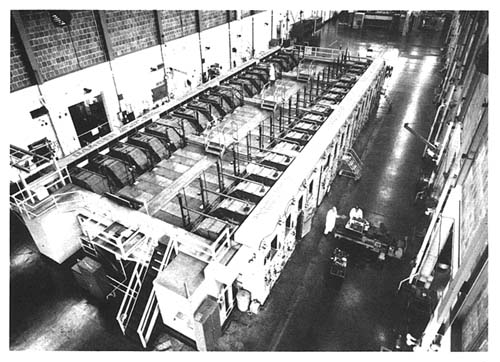
An overhead view of the electromagnetic isotope separators (calutrons) at Oak Ridge National Laboratory. The calutrons are used to divide a wide range of elements into their constituent isotopes, providing scientists and radioisotope manufacturers with concentrated (enriched) samples of specific stable isotopes. SOURCE: Oak Ridge National Laboratory.


