
2
Definition of Needs and Statement of Requirements
As discussed in the Introduction, the United States is alone in issuing paper currency bills in which all denominations are of identical size and color. The numbers on the corners of the bills are small and of low contrast, making them difficult to read by people with impaired vision. For everyday transactions, U.S. paper currency possesses no nonvisual identifying features, rendering it impossible for blind people to denominate bills without assistance. The lack of distinctive visual features and the total absence of nonvisual features for the common user constitute a hindrance to commerce and daily living for millions of visually disabled people. In addition, the lack of distinctive features results in problems of denomination for a much wider population with mild visual impairments, including those impairments acquired during the normal aging process, and for anyone in a poorly lit environment.
The goal of this report is to recommend features for inclusion in U.S. banknotes that will enhance denomination and authentication of bills by the entire population. Because currency transactions occur every day and are critical to full participation in society, it is essential that the currency be usable by everyone. Currency identification should be ''user friendly,'' that is, it should be effective across the widest possible range of circumstances.
In this chapter, the committee describes the affected population and the practical nature and extent of the problem. The specific needs for currency identification among subgroups of the affected populations are outlined, along with existing solutions. Requirements that should be satisfied by future improvements to the banknotes are indicated.
From the user's point of view, key objectives of currency identification include accuracy, speed, and confidentiality across a wide range of lighting conditions and for both new and worn banknotes. Under all conditions, users would like to have fast and nearly effortless transactions; features that slow down transactions, such as the need for specialized equipment, or features that require extended effort of scrutiny or comparison run counter to this objective. In addition, users want to identify currency independently with their own senses (possibly assisted by such everyday aids as eyeglasses or hearing aids).
A benchmark of effectiveness for new features is to make banknotes as identifiable as coinage. U.S. coins can be identified rapidly, effortlessly, and independently by almost everyone, in a wide range of conditions. Coins do this by using a combination of features that include graduated size, weight, color (base material), and textured edges; they thus are identifiable by touch and by vision.
Target Population
Many terms have been used to refer to visual impairment. For consistency, the committee will rely primarily on "visual disability," "low vision," ''blindness," and "mild visual impairment" as defined below and in the glossary.1
It has been estimated by the National Advisory Eye Council (1993) that there are more than three million people in the United States who are visually disabled. "Visually disabled" refers to those who are blind or have low vision. There are approximately 200,000 people who are blind; they have no useful pattern vision, but some may retain light perception. The remaining people in the visually disabled category have low vision. Low vision is often defined as best-corrected letter acuity less than 20/60 in the better eye (World Health Organization, 1966) or the inability to read regular newsprint with optimal reading glasses.2 Some people with severe peripheral-field loss are classified as having low vision even though their letter acuity may be higher than the 20/60 criterion. The estimated number of people with low vision and blindness in the United States divided by age group is given in Table 2-1 and is also shown in Figure 2-1.3 The data in this table were generated by applying the data analysis technique explained in Genensky (1978) to the 1990 U.S. Census data (Genensky, 1994). According to these data, there are approximately 3.7 visually disabled Americans.
The leading causes of low vision and blindness are diseases that are common in old age: age-related maculopathy, cataract, glaucoma, diabetic retinopathy, and optic nerve atrophy. According to data from the Health Interview Survey, more than two-thirds of all people with low vision are 65 years of age or older, coming to an estimated total of 2.9 million people in 1990 (Nelson and Dimitrova, 1993). It is estimated that more than 25 percent of all people over 85 years of age are visually disabled (Genensky, 1994). As the geriatric population grows, the number of people with low vision and other age-related disabilities will increase.
The two traditional clinical measures of low vision are acuity and visual field. A recent detailed discussion of the measurement of visual acuity and visual field has been provided by the National Research Council Committee on Vision (NRC, 1994).
Table 2-1
Estimated 1990 U.S. Population with Low Vision and Blindness by Age Category, as Number of People and as Percentage of the Age Group Populationa
|
Age |
Estimated Number of People |
|
Percentage of Age Group |
||
|
|
Low Visionb |
Blindc |
U.S. Population |
Low Visionb |
Blindc |
|
0 - 4 |
6,200 |
800 |
18,354,400 |
0.03 |
0.004 |
|
5 - 19 |
117,200 |
12,200 |
53,067,900 |
0.22 |
0.02 |
|
20 - 44 |
390,600 |
29,100 |
99,674,700 |
0.39 |
0.03 |
|
45 - 64 |
463,600 |
30,300 |
46,371,000 |
1.00 |
0.07 |
|
65 - 74 |
805,400 |
28,200 |
18,106,600 |
4.45 |
0.16 |
|
75 - 84 |
964,700 |
48,600 |
10,055,100 |
9.59 |
0.48 |
|
85 & older |
775,800 |
37,700 |
3,080,200 |
25.19 |
1.22 |
|
total |
3,523,500 |
186,900 |
248,709,800 |
1.42 |
0.08 |
|
Source: Genensky, 1978, 1994. a Data concerning persons 0-64 years old were analyzed by S. Genensky, and data concerning persons 65 years old or older were analyzed by C. Kirchner. b "Low vision" for this table is defined as corrected visual acuity of no better than 20/70 in the better eye or a maximum diameter of visual field of no more than 30 degrees. The low-vision category does not include blind individuals. c "Blind" for this table and this report refers to persons with no useful pattern vision, who are referred to as "functionally blind" in the original reference. |
|||||
Acuity is measured by finding the smallest letters a person can read at a standard distance (traditionally, 20 feet) and expressing the result as the ratio of this distance to the distance at which a "normal" observer can read the same letters. For example, a person with 20/60 can just read letters at 20 feet that a person with 20/20 acuity can read at 60 feet. People with low vision have acuities ranging from less than 20/60 to 20/2000. The denominator of the fraction in visual acuity notation can also be thought of as the letter size. This size is defined as the distance at which the observer must stand for the letter to subtend an angle of 5 minutes of arc. For example, a letter size indicating 20/20 visual acuity is equivalent to 5 minutes of arc; 20/200 to 50 minutes; etc.
Feature size, viewing distance, and the user's acuity put boundary conditions on the identification of banknotes. The large comer digits on the portrait side of $1 and $10 U.S.
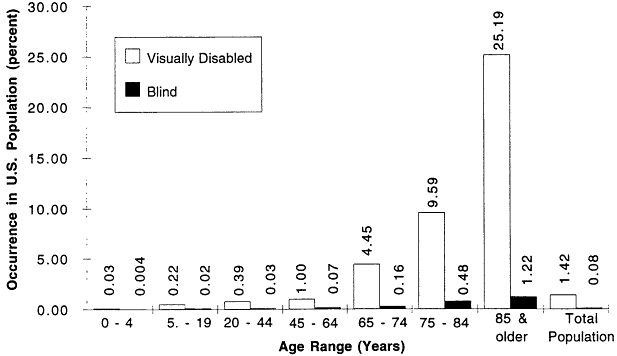
Figure 2-1
Percentage by age group of 1990 U.S. population with visual disabilities.
banknotes would be at the visual limit for someone with 20/400 letter acuity, if they were viewed at a normal reading distance of 16 inches (40 cm). Suppose the viewing distance is increased to 40 inches (1 m), roughly the distance from the eye to a bill on a checkout counter. The comer digits would now be at or beyond the acuity limit of people with about 20/160 vision. Identification at the acuity limit is slow and requires optimal viewing conditions, including good lighting and 100 percent black/white numeral contrast, which is not true even of crisp, new currency bills. Conservatively, symbols should be at least a factor of two larger than the acuity limit for practical use. Only people with acuity better than about 20/80 would meet this more stringent "factor of two" criterion for viewing the currency digits on a bill on the counter. Following this informal argument, most people with low vision (acuity less than 20/60) experience difficulty recognizing the large digits on present banknotes in a common cash transaction.
It should be noted that clinical definitions of acuity are based on controlled tests conducted under ideal viewing conditions—bold black letters on a pure white background (near 100 percent contrast), good illumination, no distracting symbols, and no time pressure. By comparison, the letters and numbers on U.S. money bills are of much lower contrast (discussed later in this chapter), are closely surrounded by distracting abstract designs, and are often viewed under low illumination with little time for prolonged scrutiny. As a result, direct extrapolation from acuity testing to feature recognition on bills is likely to underestimate the number of people who will experience difficulty.
Visual-field size refers to the range of visual directions, centered on the line of sight, over which a standardized test target can be detected. Field loss results from damage to portions of the retina, resulting in blind regions in the visual field. The various scenarios shown in Figure 2-2 illustrate the effects of different types of visual-field loss and are discussed in detail below.
Age-related macular degeneration (AMD) afflicts many older people and is the leading cause of low vision. Because vision is lost in the high-resolution central portion of the visual field, afflicted individuals must rely on sight in their low-resolution peripheral vision. Figure 2-2 shows the same photo of New York City's Metropolitan Opera House a number of times—once in sharp focus (Figure 2-2a) and then as it would be seen with various types of visual impairment (figures 2-2b through 2-2e). Figure 2-2b shows the picture with the central field completely blocked, illustrating a severe case of age-related macular degeneration. Typically, reading is impaired, and individuals afflicted with this degeneration require large letters (high magnification) to read.
Some diseases, such as advanced glaucoma or retinitis pigmentosa, can result in the loss of almost all peripheral vision. Only a small island of central vision remains (tunnel vision). Figure 2-2c illustrates vision with this type of impairment. Individuals with this form of low vision may have fairly high acuity, but they experience great difficulty in mobility (walking or driving), and they have problems in visual search tasks (e.g., finding signs, page numbers, or currency digits). Other diseases, such as diabetic retinopathy, can result in patchy vision with losses in a number of areas within the visual field, as illustrated in Figure 2-2d. Since it is impossible to accurately portray what vision loss is like for a person with low vision, the illustrations in these figures are meant only to demonstrate the types of vision loss that might occur with various diseases and impairments. However, it should be remembered that the scotomatous (blind) areas in these simulations would move with the eye, so, for example, a person with age-related macular degeneration will always have a centrally located blind spot when viewing different areas of the picture.
In addition to low acuity and reduced field, a third kind of visual deficit, intensively studied in recent years, is reduced contrast sensitivity (see illustration in Figure 2-2e). Figure 2-3 demonstrates the effects of this type of visual impairment; imagine reading text printed with contrasts of 60 percent ("he made plans"), 30 percent ("to go camping"), 13 percent ("and hiking in"), and 6.5 percent ("the mountains"). Many types of eye disease, such as cataract, can cause a reduction in retinal-image contrast or a loss of sensitivity to contrast by retinal neurons. The consequence is an effective reduction in the contrast (difference between light and dark areas) of images. People with normal vision have a substantial tolerance to contrast reduction for many visual tasks. In the case of reading, print contrast can be quite low (down to 10 percent) before there is much effect on reading speed (Legge et al., 1987). For many people with low vision, however, and for those with normal aging vision, there is much less tolerance to poor contrast. For such people, even rather small reductions in print contrast can adversely affect reading (Rubin and Legge, 1989).
Two aspects of contrast are relevant to currency design. Contrast polarity specifies whether the letters are light and the background dark, or vice versa. The contrast polarity of
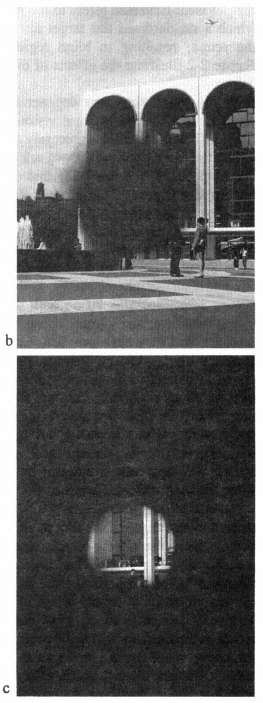
Figure 2-2
Illustrations of various types of visual impairment using photos of New York's Metropolitan Opera House: (a) normal vision; (b) central field loss; (c) peripheral field loss; (d) patchy vision loss; (e) reduced contrast.
Source: The Jewish Guild for the Blind, 1992.
alphanumeric symbols usually has little effect on recognition for people with normal vision. For some people with low vision (especially those with ocular light scatter due to cataracts), acuity and reading performance are better for the light-on-dark polarity, which is a property of present U.S. banknotes.
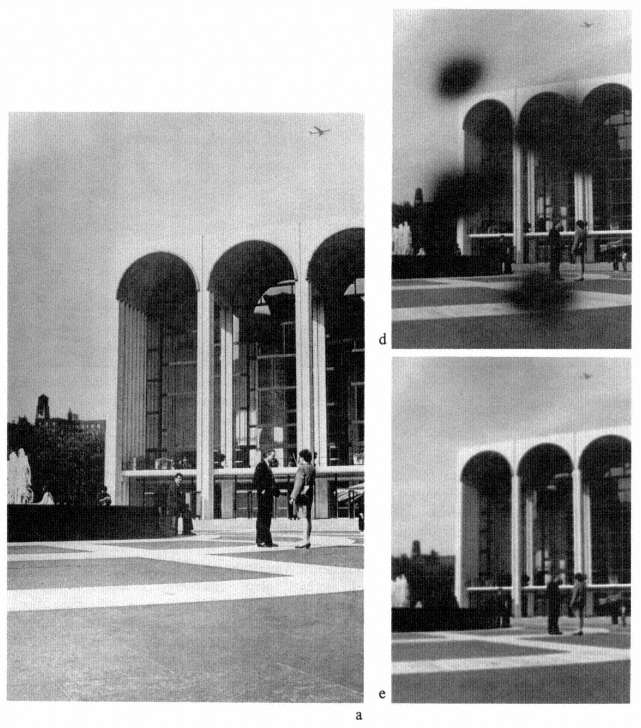
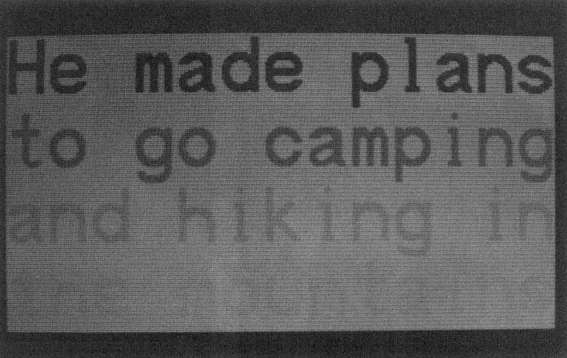
Figure 2-3
Lines of text in decreasing contrast demonstrating visual effects of loss of contrast sensitivity. Reprinted from Legge, 1993, courtesy of Massachusetts Institute of Technology Press.
notes indicated contrasts of 60 percent (new crisp bill) and 30 percent (worn bill).4 The reduction from 100 percent contrast undoubtedly has an adverse effect on recognition for many people with low vision, even under optimal viewing conditions. Under conditions of poor visibility (especially low lighting and long viewing distance), the suboptimal contrast will also take its toll on recognition by normally sighted people.
In addition to the 3.7 million visually disabled Americans, there are many people with mild visual impairment due to peripheral field deficits, glare sensitivity, or losses in contrast sensitivity. Estimates of the number of Americans with mild forms of visual impairment, referred to here as visually impaired, extend to nearly 9 million (Benson and Marano, 1994).
When viewing conditions are bad (often the case for poorly lit indoor settings or at night), the portion of the population likely to have difficulty identifying U.S. banknotes is much larger. Under poor lighting conditions, the visual acuity of persons with "normal" vision is compromised, while the visual capabilities of those with mild visual impairments due to disease or the natural cause of aging are further reduced.
Even in the absence of disease, aging eyes are particularly disadvantaged in recognition tasks in poor illumination. For example, the reduced pupil size of an average 80-year-old
compared with that of a 20-year-old will allow only one-quarter as much light to enter the eye (Pitts, 1982). This diminished light is then diffused and scattered by opacities in the optical media (which increase with age) before it reaches the retina, which is likely to be reduced in its ability to detect low contrast features. The net result is a severe reduction in visual performance under adverse lighting conditions for older people.
The committee notes also that special difficulties are encountered by individuals with multiple disabilities. New currency features relying on sound would not be accessible to people who are both hearing and visually disabled, for example, the 10,000 individuals with Usher syndrome in the United States (RPFFB, 1994). Also, individuals with decreased tactile sensitivity accompanying visual impairment (e.g., from diabetes) may not benefit from subtle tactile features (Cholewiak, 1994).
It is important to note that normally sighted Americans would clearly benefit in ease of use, especially in conditions of adverse visibility, from most features intended for use by visually disabled people.
Some who are working for the full integration of blind people in American society have expressed opposition to certain special features (such as obvious "braille" markings), for fear that these markings would be a ubiquitous signal that special accommodations are required for blind people (Maurer, 1994). The committee evaluated prospective features with respect to their ability to enhance the recognition of the currency by all users.
Currency Identification Needs
The currency identification needs of our target population can be conveniently divided into commercial and daily-living categories. A commercial need for currency identification arises for those who are engaged in any kind of retail or other trade in which ability to identify currency is a necessary part of the job. Lack of suitable banknote identification features raises obstacles to employment in such jobs. Daily activities include using currency in many situations, such as purchasing groceries and using public transportation.
Significant experience and insight comes from visually disabled workers who operate cafeterias or vending stands, usually in government-owned buildings, under the Randolph Sheppard Act Business Enterprises Program. In 1992, there were almost 3,500 people employed under this program, doing more than $395 million in business (Abbott, 1994; RSVFP, 1993). Such workers must accept bills rapidly and give out accurate change as a routine part of the job. A blind cashier cannot independently identify bills in a transaction and must rely on the customer.5 This arrangement may result in fraud or costly mistakes.
Visually disabled people face problems in identifying U.S. banknotes in broader daily living situations. For blind individuals, the overwhelming need is for denomination without dependence on a sighted person. For people with low vision, needs vary according to the nature
of the visual deficit and the ambient lighting conditions as discussed earlier in this chapter. An older person with macular degeneration may have relatively little difficulty in identifying bills at a well lit checkout counter but may be unable to identify bills in a dimly lit restaurant or in a taxi at night.
Although denomination of banknotes is the committee's primary focus, it is frequently useful to know the orientation of a bill. Specific orientation of bills is required by some money-changing machines and for stacking purposes by banks. A currency feature that conveys bill orientation would be useful for such purposes.
In both commercial and daily-living situations, successful currency transactions require rapid and accurate denomination of banknotes without the need for lengthy inspection or thought. To achieve this goal, specification of new or enhanced features should not be aimed at minimal levels of recognition performance (i.e., threshold levels) but should strive for sufficient differentiation to permit rapid, effortless performance. For example, research on reading has shown that letter sizes should be three to five times larger than acuity values in order to achieve comfortable and rapid reading (Legge, 1991). Similar consideration should be applied to currency identification features.
Discrimination Versus Absolute Judgment
This chapter has focused on the difficulties encountered by visually disabled people in currency identification. The design of new visual, tactile, or other features for banknote identification should take into consideration perceptual limitations on discrimination and absolute judgment that limit performance by everyone. The challenge is to design features that can code six denominations of bills ($1, $5, $10, $20, $50, and $100) in a way that circumvents these perceptual limitations.
Discrimination refers to the perceptual ability to compare two physical magnitudes (e.g., weights, light intensities, tonal frequencies, lengths, etc.) and tell them apart. The smallest difference that can be reliably discriminated is called the difference threshold. For perceptual discrimination on many physical dimensions, the difference threshold is constant (or nearly constant) in percentage terms across the range of that dimension. This constancy is termed Weber's Law, and is expressed as: 
where D is the difference threshold, D' is the physical magnitude, and k is a constant (the Weber fraction). Several examples are shown in Table 2-2. As an example, according to this table, two weights can be discriminated if they differ by more than 4.3 percent. The discrimination of length by the sense of touch alone is a very complicated experimental problem because of the variety of sensory inputs a human being uses when trying to identify an object by touch. It is not clear that this simple form of Weber's law is applicable to the task of distinguishing length by the sense of touch.
Some possible features for coding currency denomination, such as size or roughness, can be analyzed in terms of their difference thresholds. In designing a code:
- The magnitude of change between denominations should always exceed the difference thresholds.
- Perceptual discrimination is typically slow when operating near the threshold value. For this reason, it is prudent to have step sizes several times larger than the difference threshold.
- Assuming Weber's law applies to variations in length, differences between the sizes of successive denominations should probably be constant in percentage terms, not linear terms.
- For some dimensions, the difference threshold may increase in old age.
Inherent in discrimination is a comparison between two stimuli. In the case of banknote identification, the comparison may be between two bills (based on size, weight, etc.) or between a bill and a measuring gauge.
A second kind of perceptual judgment, called absolute judgment, may be more important to currency identification. Absolute judgment refers to the ability to identify any one of N distinct values along a physical dimension. For example, imagine having N different weights, or N light intensifies, or N loudness levels of a given tone, etc. A human subject has to learn to attach labels to these stimuli so they can be identified when presented on their own. Miller
Table 2-2
A Summary of Weber Fractions
(1956) summarized many findings on absolute judgment. He showed that when N is 4 or less, people tend to be accurate in absolute judgment. When N rises to about 7 (plus or minus 2), people begin to make errors. There is some variation across stimulus dimensions. The key point is that if banknotes are coded as six points along a single physical dimension (such as length, roughness, thickness), people are likely to make some errors in absolute judgment when a single cue is present. That is, if presented with a single bill (with no measuring gauge or other bill for comparison), some errors are likely to be made. Recognizing that humans are limited to sets of less than seven in their ability to make absolute judgments is a case for limiting the number of denominations of banknotes in general circulation to no more than the present six, and even fewer would be preferable.6 In the same article, Miller reviewed evidence that accuracy of absolute judgment can be increased if two or more independent dimensions are used to code information. In the context of currency identification, this means that accuracy in identification of six denominations is likely to be improved if two dimensions are used for coding (e.g., length and texture, or length and edge profile as in coinage). This likelihood was confirmed in a demonstration experiment conducted by the committee, which is briefly described in Chapter 4 in connection with the size feature.
To summarize the research into discrimination and absolute judgment: (1) Data on perceptual discrimination can provide lower bounds on the step sizes for coding denomination along a physical dimension. (2) Coding six items (denominations) on a single physical dimension (e.g., length) is likely to result in some errors of absolute judgment. (3) Accuracy can be improved by using two independent dimensions for coding the six items.
Existing Currency Denomination Techniques
Many visually disabled people must trust others to inform them about the denomination of bills received. Once identified, these bills must be sorted for accurate retrieval later. Due to the absence of tactual or other identifying features in the present bills, many blind individuals employ a system of folding to assist in this process. Different denominations, once identified by a trusted sighted person, are folded in different ways (diagonally, crosswise, etc.) according to denomination. Sometimes, people with low vision forego visual identification and revert to techniques used by people who are blind.
Under good lighting conditions, persons with low vision identify bills by holding them close to the eye. An optical magnifier may be necessary for focus. The ease of identification depends on a host of factors, including the level and direction of lighting and the nature of visual impairment.
Machines are available that can denominate and to some extent authenticate banknotes for blind individuals. The smallest of these, costing approximately $400, is 6 × 3 × 1 inches in size,
can be carried in a pocket or purse, and provides a talking output denominating the bill that is inserted. However, the devices are not always reliable, especially on crumpled and dirty bills, and are relatively slow. Audio output in the form of synthetic speech is not usually private, although an earphone can be used if desired. In commercial situations, blind vendors sometimes use nonportable automatic currency identifiers retailing for approximately $900. This device is intended to provide more-reliable authentication abilities than smaller, less expensive devices and provides a series of auditory ''beeps'' as output, enhancing privacy compared with synthetic speech. It is possible to integrate some of these devices with the cash register. However, reports provided to the committee by a representative of the approximately 3,500 Randolph Sheppard vendors indicated that these machines significantly slow down transactions and are usually bypassed in favor of asking the customer what denomination is handed to the vendor (Abbott, 1994). The devices, as currently available, do not yet fully meet the needs of users for fast and confidential banknote identification. In addition, their bulk and high cost are barriers to widespread use. Development of these devices by groups not associated with the banknote designers (e.g., The American Foundation for the Blind) is limited by their having to determine denomination-distinctive features and patterns around which to design sensors. A major cost of developing these devices is in determining these features and patterns (Schreier, 1994). A discussion of the criteria for an ideal denominating device is contained in Chapter 3.
Existing approaches in other countries (see Appendix D) that can be used by visually disabled people to denominate banknotes include the use of bills of varying sizes and colors. The use of varying sizes reportedly allows a blind individual to denominate bills accurately using a simple, inexpensive plastic guide. With practice, discrimination between various bills can be made without the guide. The use of different sizes also provides a redundant cue for sighted individuals when sorting money bills, allowing, for example, a $1 note to be selected from a group of bills carried inside a pocket without withdrawing the entire group. The ease of using different-sized coins indicates that this method of differentiating value becomes second nature once a person becomes familiar with the size/value correlation.
Most other countries also use different predominant colors for each denomination. The simple detection of color is faster than finding and reading printed numbers, especially for those with poor letter acuity. It should be noted, however, that many people with low vision have difficulty in discriminating subtle shades of color and that color cues are generally less obvious at low levels of illumination. Consequently, any added color features should use clearly distinguishable colors.
Some foreign currencies, including the new series of Canadian notes introduced in 1986, also contain numerals of much larger size and higher contrast than those found on U.S. banknotes to facilitate identification for people with normal and low vision.
There are also several countries using tactile denomination symbols, such as printed bars or shaped grids of small dots, on their banknotes, and visually disabled people in these countries can use these marks to recognize and denominate the banknotes.
User Needs and Requirements
All the user groups discussed require a means of currency denomination that can be summarized briefly as follows:
- The method of denomination ideally should be rapid, easy, and confidential.
- The method should not require special devices or equipment, other than everyday aids such as eyeglasses.
Based on these general user considerations and other considerations of the technical implementation of such features, the committee developed an evaluation system for the different possible banknote features under consideration (see Chapter 3).
Summary
It is clear that a major need exists for a better means of banknote denomination for the 3.7 million Americans with visual disabilities, with the goal of giving this population the full access to currency handling available to the rest of society and to visually disabled people in other countries. In addition, due to the increasing number of older individuals with impaired vision due to minor eye disease or the normal aging process, such features would be of great benefit to a far wider population than that represented by the current statistics on blindness and low vision. Certain new features, such as color and size, and enhanced existing features, such as larger numerals of higher contrast, would also benefit those with normal vision by making denomination more rapid and convenient for all.
References
Abbott, G. 1994. Presentation to the Committee on Currency Features Usable by the Visually Impaired. March 30, 1994.
Benson, V., and M.A. Marano. 1994. Current estimates from the National Health Interview Survey. National Center for Health Statistics, January 1994. Vital and Health Statistics Series 10(189):95.
Cholewiak, R. 1994. Presentation to the Committee on Currency Features Usable by the Visually Impaired. March 30, 1994.
Genensky, S. 1978. Data concerning the partially sighted and functionally blind. Journal of Visual Impairment and Blindness 72(5):177-180.
Genensky, S. 1994. Personal communication to the Committee on Currency Features Usable by the Visually Impaired. March 30, 1994.
Jewish Guild for the Blind, The. 1992. Photos taken from visual impairment poster. New York: The Jewish Guild for the Blind.
Laming, D. R. J. 1986. Sensory Analysis. San Diego, California: Academic Press.
Legge, G.E. 1991. Glenn A. Fry Award Lecture 1990: Three perspectives on low-vision reading. Optometry and Vision Science 68:763-769.
Legge, G.E. 1993. The role of contrast in reading: Normal and low vision. Pp. 269-287 in Contrast Sensitivity, R.M. Shipley and D.M.-K. Lam, eds. Cambridge, Massachusetts: Massachusetts Institute of Technology Press.
Legge, G.E. 1994. Presentation to the Committee on Currency Features Usable by the Visually Impaired. February 23, 1994.
Legge, G.E., G.S. Rubin, and A. Luebker. 1987. Psychophysics of reading. V. The role of contrast in normal vision. Vision Research 27:1165-1171.
Maurer, M. 1994. Presentation to the Committee on Currency Features Usable by the Visually Impaired. March 29, 1994.
Miller G. 1956. The magical number seven plus or minus two: Some limits on our capacity for processing information. Psychological Review 63(2):81-97.
National Advisory Eye Council. 1993. Vision Research—A National Plan: 1994-1998. National Institutes of Health Publication No. 93-3186.
NRC (National Research Council). 1994. Measurement of Visual Field and Visual Acuity for Disability Determination. National Research Council Committee on Vision, NRC. Washington, D.C.: National Academy Press.
Nelson, K. A., and E. Dimitrova. 1993. Severe visual impairment in the United States and in each state, 1990. Journal Visual Impairment and Blindness 87(3):80-85.
Pitts, D. G. 1982. The effects of aging on selected visual functions: Dark adaptation, visual acuity, stereopsis, and brightness contrast . Pp. 131-159 in Aging and Human Visual Function, R. Sekuler, D. Kline, and K. Dismukes, eds. New York: Alan R. Liss, Inc.
RPFFB (RP Foundation Fighting Blindness). 1994. Information about Usher Syndrome. Baltimore, Maryland: National Retinitis Pigmentosa Foundation, Inc., RP Foundation Fighting Blindness.
RSVFP (Randolph-Sheppard Vending Facility Program). 1993. Annual Report, Fiscal Year 1992. Washington, D.C.: Office of Special Education and Rehabilitative Services, U.S. Department of Education.
Rubin, G.S., and G.E. Legge. 1989. Psychophysics of reading. VI. The role of contrast in low vision. Vision Research 29:79-91.
Schreier, E. 1994. Presentation to the Committee on Currency Features Usable by the Visually Impaired. March 30, 1994.
Tielsch, J.M., A. Sommer, K. Witt, J. Katz, and R.M. Royall. 1990. Blindness and visual impairment in an American urban population: The Baltimore eye survey. Archives of Ophthalmology 108:286-290.
World Health Organization. 1966. Blindness Information Collected from Various Sources. Epidemiology and Vital Statistics Report 19:427-511.


