
PAUL HUGH EMMETT
September 22, 1900–April 22, 1985
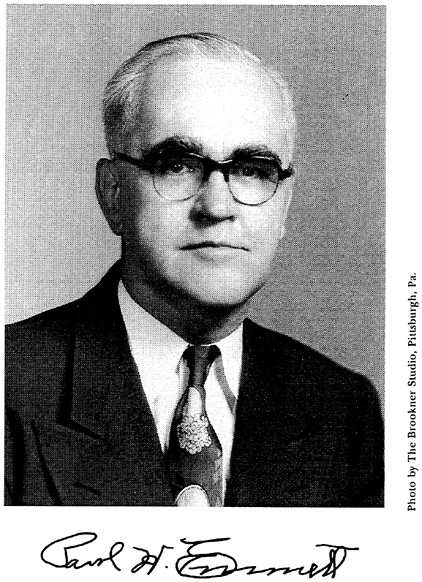
BY WALTER S. KOSKI
PAUL HUGH EMMETT was an outstanding investigator in the field of heterogeneous catalysis. His work is distinguished by the use of highly ingenious experimental methods to probe the basic mechanisms in catalytical processes. His studies on the adsorption of gases on solids led to a method of measurement of the surface area of catalysts and laid the foundation for the Brunauer-Emmett-Teller theory of adsorption, which has been of fundamental significance in the field of heterogeneous catalysis.
Emmett was born in Portland, Oregon. His father worked in various jobs associated with railroad construction. His mother kept house, and in the summer months she frequently cooked for a crew of ten to forty workers who might have been working under his father's supervision. Both parents had a limited education, but they provided Paul with a happy home with all the feeling of security a growing boy could want. They were determined that their son should go as far in school as his interests and ability permitted. All of Emmett's pregraduate school training took place in Oregon. He attended Washington High School in Portland. He was a good student but disliked that portion of high school English that required oral presentation. He had a fear of
public speaking. He overcame this fear by active participation in both high school and college debating, and, when he attended the California Institute of Technology, A. A. Noyes asked him to help out with coaching the debating team. After these experiences, Paul had no difficulty with addressing an audience so long as he had something to say.
Emmett's interest in chemistry was sparked by an English teacher who served as a part-time vocational counselor. She noticed his high grades in mathematics and languages, and she insisted that he take chemistry and physics when he was a senior in high school. Paul was further influenced by an inspiring high school chemistry teacher, William Green, and by J. F. G. Hicks at Oregon State College. After graduating from Oregon State at Corvallis, where he received a bachelor of chemical engineering degree in 1922, he went on to the California Institute of Technology for graduate training.
His selection of catalytic work as a major interest was due largely to the influence of A. F. Benton who had just arrived at CalTech fresh from Princeton University, where he obtained his degree under H. S. Taylor. The work that Benton was doing appealed most to Emmett, and he spent two years working with him on the catalysis of the hydrogen-oxygen reaction to form water over nickel catalysts and on the kinetics of the reduction of nickel oxide by hydrogen. Emmett also worked with Linus Pauling on the crystal structure of barium sulfate. He received his Ph.D. degree from CalTech in physical chemistry in 1925. After graduation he spent a year teaching at Oregon State College and then accepted a position at the Fixed Nitrogen Research Laboratory in the U.S. Department of Agriculture in Washington, D.C. There he launched a successful research career in adsorption and catalysis. In 1937 he accepted an appointment to organize the chemical engineering department at Johns Hopkins
University. Here he continued his research in the field of adsorption. During World War II Emmett worked on the Manhattan Project under Harold Urey on the development of barrier materials suitable for the diffusional separation of U-235 and U-238. He continued as a consultant to the Atomic Energy Laboratory at Oak Ridge, Tennessee, for the rest of his career. In December 1944 he joined the Multiple Petroleum Fellowship at the Mellon Institute as a senior fellow and carried on a long series of experiments directed toward the understanding of catalytic processes using radioactive tracers. In July 1955 he was appointed the W. R. Grace Professor of Chemistry at Hopkins, where he carried on a combined teaching and research program in catalysis. Also at this time he became a lifetime consultant to the Davison Chemical Division of the W. R. Grace Company. He retired from Hopkins in 1970 and returned to Portland, Oregon, where he accepted a position as visiting research professor of chemistry at Portland State University. He taught a course in catalysis, directed research, and wrote papers until his final illness.
When Emmett joined the staff at the Fixed Nitrogen Research Laboratory in 1926, he was involved in a program that was attempting to find the mechanism by which iron catalysts caused hydrogen and nitrogen to combine and form ammonia and why some catalysts were more effective than others. It became increasingly clear that a method was needed for determining the surface area of the iron catalyst. Benton had already published an adsorption isotherm for nitrogen on iron at -191°C, and he suggested that certain breaks in the adsorption isotherm were probably related to the formarion of one or two layers of adsorbed nitrogen. Emmett initiated research to follow Benton's suggestions, and the effort culminated in the development of what has come to be called the Brunauer-Emmett-Teller (BET) method for
measuring the surface areas of finely divided or porous solids. This approach was widely accepted, and it represents Emmett's most important contribution to the field. The experimental aspects of the investigation were carried out by Brunauer. Edward Teller, who had just recently joined the faculty at George Washington University, was responsible for the theoretical portion of the study. Throughout his career Emmett tried to obtain independent evidence for confirming the values for surface areas as deduced from the BET method. He and his colleagues, for example, applied it to nonporous finely divided carbon blacks whose size could be estimated from electron microscope measurements and to virgin glass spheres whose size and surface area could be estimated by direct microscopic measurements. All of these checks tended to confirm the validity of the surface-area measurements by low-temperature gas adsorption. The method was found to be applicable to all sorts of solids, including ethylene and propylene polymers and ethylene-butane copolymers.
A second aspect of Emmett's research that should be cited is the use of radioactive and stable isotopes to elucidate the mechanism of catalytic reactions. He and his co-workers pioneered the use of 14C as a tracer in investigating catalytic reactions. This activity stemmed from the interest during World War II in the synthesis of hydrocarbons and other products from carbon monoxide-hydrogen mixtures by iron and cobalt catalysts through a modification of the original Fischer-Tropsch process. At the time, two mechanisms were in contention. In one case it was felt that the reaction proceeded through the formation of metallic carbides as intermediates. On the other hand, the intermediates could be oxygenated complexes on the catalytic surface. The work started in the spring of 1945 when 14C became available. This experimental study of the Fischer-Tropsch process soon
demonstrated that the carbide mechanism was untenable and that it was more likely that the complexes formed by CO and H2 were similar to those formed by chemisorption of primary alcohols. The final experiments showed that successive addition of carbon atoms occurred on that carbon of the intermediate oxygen complex to which an OH group was attached. Since then, these results have been repeated and confirmed by other investigators.
Tracer work was also applied to cracking catalysts with the objective of determining to what extent olefins, paraffins, and aromatic products of the cracking process undergo secondary reactions before exiting from the catalytic reactor. It was established that once paraffins are formed, they change very little on passage through the remainder of the catalyst bed. Olefins higher than ethylene, on the other hand, build up into higher molecular weight hydrocarbons by polymerization, alkylation, and cyclization. They are responsible for the high aromatic content of products from the cracking of straight chain reactants.
Stable isotopes were also used in some studies. For example, the exchange of nitrogen between 28N2 and 30N2 to form 14N-15N over ammonia catalysts was investigated. Deuterium was used to study hydrogen chemisorption by metallic catalysts, and heavy water was used to study the nature of active sites on silica-alumina catalysts. In connection with their many catalytic studies, Emmett and his co-workers measured the equilibria involved in a number of catalytic systems. These involved ammonia-hydrogen mixtures in contact with Fe-Fe4N, Fe4N-Fe3N, and Fe3N-Fe2N; the equilibrium of water vapor-hydrogen with Fe-FeO, Fe-Fe3O4, FeO-Fe3O4, Co-CoO, and SnO-SnO2; and the equilibrium of carbon monoxide-carbon dioxide mixtures with Co-CoO and the equilibrium of CH4-H2 mixtures with Fe-Fe2C, Fe-Fe3C, Ni-Ni3C, CO-CO2C, Mo-Mo2C, and Mo2C-MoC. These equi-
libria and free energy values have proved to be of considerable value in catalytic work. An important by-product of these studies was the demonstration played by the phenomenon of thermal diffusion on equilibria measurements. Specifically, they showed that most of the equilibrium data in the then-existing literature for the Fe-FeO, Fe-Fe3O4, and FeO-Fe3O4 systems in contact with H2O vapor were in error by as much as 40 percent. They showed that this error was the result of the thermal diffusion phenomenon and that proper procedures could eliminate it.
Emmett and his group devoted a significant amount of their effort to studying the mechanism of ammonia synthesis over iron catalysts. This program included a study of the solid iron nitride-iron-nitrogen system from a thermodynamic and phase rule approach; a study of the chemisorption of nitrogen, hydrogen, oxygen, carbon monoxide, and carbon dioxide; an examination of the poisoning of iron catalysts by water vapor; a study of the distribution of promoters on the surface of the reduced catalyst; and a study of the kinetics of ammonia synthesis and decomposition. The solid nitride studies furnished equilibrium data for the first time for the ratio NH3/H2 in equilibrium with Fe-Fe4N, Fe-Fe3N, and Fe3N-Fe2N systems. It showed conclusively that several thousand atmospheres of N2 would be needed to convert iron to Fe4N at synthesis temperatures, and it established that synthesis did not occur through the alternate formation and reduction of the bulk nitride. The nitrogen chemisorption measurements indicated that the rate of adsorption of nitrogen was probably the slow step in the synthesis. Nitrogen seemed to be adsorbed in atomic rather than in molecular form at synthesis temperature. They were able to confirm that one of the functions of alkali promoters was to prevent the retention at high temperatures of inhibiting NH and NH2 groups, which clearly were present
in the catalyst containing only aluminum oxide as a promoter. Although not all aspects of the mechanism were clarified, the study revealed a number of important factors that influenced the synthesis and gave deep insight into the detailed mechanism of ammonia synthesis.
Paul's years of association with work on iron catalysts for ammonia synthesis led him to explore the behavior of iron for hydrogenation of molecules such as olefins, hydrogenation of CO to higher hydrocarbons, and hydrogenation of benzene to cyclohexane. Interest gradually spread to hydrogenation over other metals such as Pt, Rh, Pd, and Ni. After the announcement by Dowden of the importance of d-band vacancies in catalytic metal hydrogenation, Emmett's group turned its attention to the behavior of Ni and its alloys. Dowden suggested that filling all the d-bands in Ni by alloying it with Cu would destroy the catalytic activity of the metal. Indeed, it did in the hydrogenation of styrene; however, this generalization did not hold for the case of ethylene. Emmett's group helped to clarify a number of questions related to this field and pointed out that many questions still remained to be answered.
In a research program, frequently new apparatus or techniques are developed, and one associated with Emmett's group that should be cited is the microcatalytic-chromatographic approach for studying catalysts. This technique, which was suggested by R. J. Kokes, involved putting a small catalyst tube in series with a chromatographic column. The latter was used to identify the amounts of products formed on injection of micro quantities of reactants into the stream of carrier gas. This has proved to be a valuable approach and is now widely used.
The outstanding nature of Paul Emmett's work was recognized by many awards, including membership in the National Academy of Sciences (1955); honorary doctorates of
science from Oregon State College (1939), the University of Lyon (1964), and Clarkson College (1969); and an honorary doctor of laws from the University of Hokkaido (1976).
Emmett was married three times. His first marriage was to Leila Jones, who died in 1968. He had a brief second marriage that ended in divorce. His third marriage was to Pauline Pauling Ney, who survived him.
Personally, Paul was a kind individual who greeted his friends with a pleasant smile and a twinkle in his eyes. He enjoyed discussing science and was a pleasure to interact with.
THE WRITER OF THIS biographical memoir expresses his appreciation to the archives of Johns Hopkins University, to Alfred S. Levinson of Portland State University, and to John M. Kopper of Johns Hopkins University for much of the information reported here.
SELECTED BIBLIOGRAPHY
1924 With A. F. Benton. The reduction of nickelous and ferric oxides by hydrogen. J. Am. Chem. Soc. 46:2728-37.
1925 With L. Pauling. The crystal structure of barite. J. Am. Chem. Soc. 47:1026-30.
1929 With J. F. Shultz. Equilibrium in the system Co-H2O-CoO-H2. Free energy changes for the reaction CoO + H2 ? Co + H2O . J. Am. Chem. Soc. 51:3249-62.
1930 With S. B. Hendricks and S. Brunauer. The dissociation pressure of Fe4N. J. Am. Chem. Soc. 52:1456-64.
1931 With S. Brunauer, M. E. Jefferson, and S. B. Hendricks. Equilibria in the iron-nitrogen system. J. Am. Chem. Soc. 53:1778-86.
1933 With J. F. Shultz. Gaseous thermal diffusion—the principal cause of discrepancies among equilibrium measurements on the systems Fe3O4-H2-Fe-H2O, Fe3O4-H2-FeO-H2O and FeO-H2-Fe-H2O. J. Am. Chem. Soc. 55:1376-95.
1934 With S. Brunauer. The adsorption of nitrogen by iron synthetic ammonia catalysts. J. Am. Chem. Soc. 56:35-41.
1935 With S. Brunauer. The use of van der Waals adsorption isotherms in determining the surface area of iron synthetic ammonia catalysts. J. Am. Chem. Soc. 57:1754-55.
1938 With S. Brunauer and E. Teller. Adsorption of gases in multimolecular layers. J. Am. Chem. Soc. 60:309-19.
1943 With N. Skau. The catalytic hydrogenation of benzene over metal catalysts. J. Am. Chem. Soc. 65:1029-35.
1944 With J. B. Gray. The hydrogenation of ethylene, propylene and 2-butane on iron catalysts . J. Am. Chem. Soc. 66:1338-43.
1948 With J. T. Kummer and T. W. DeWitt. Some mechanism studies on the Fischer-Tropsch synthesis using 14C. J. Am. Chem. Soc. 70:3632-43.
1950 With L. C. Browning and T. W. DeWitt. Equilibria in the systems Fe2C-Fe-CH4-H2 and Fe3C-Fe-CH4-H2. J. Am. Chem. Soc. 73:4211-17.
1951 With J. T. Kummer, H. H. Podgurski, and W. B. Spencer. Mechanism studies of the Fischer-Tropsch synthesis, the addition of radioactive alcohol. J. Am. Chem. Soc. 73:564-69.
With T. Hill and L. G. Joyner. Calculation of thermodynamic functions of adsorbed molecules from adsorption isotherm measurements: Nitrogen on graphon. J. Am. Chem. Soc. 73:5102-7.
1953 With J. T. Kummer. Fischer-Tropsch synthesis mechanism studies. The addition of radioactive alcohols to the synthesis gas . J. Am. Chem. Soc. 75:5177-82.
1955 With R. J. Kokes and H. Tobin, Jr.New microcatalytic-chromatographic techniques for studying catalytic reactions. J. Am. Chem. Soc. 77:5860-62.
1958 With W. K. Hall. The hydrogenation of benzene over copper-nickel alloys. J. Phys. Chem. 62:816-21.
1961 With R. J. Kokes. Adsorption studies on Raney nickel. J. Am. Chem. Soc. 83:29-31.
1954-1960 Editor . Catalysis, vols. I-VII. New York : Reinhold Publishing.
1962 With W. A. Van Hook. Tracer studies with carbon-14. I. Some of the secondary reactions occurring during catalytic cracking of n-hexadecane over a silica-alumina catalyst. J. Am. Chem. Soc. 84:4410-21.
1967 With J. S. Campbell. Catalytic hydrogenation of ethylene on nickel-copper and nickel-gold alloys. J. Catal. 7:252-62.
1969 With A. Solbakken. Equilibrium measurements in the molybdenum-carbon-hydrogen system . J. Am. Chem. Soc. 91:31-34.
1976 With J. L. Bordley, Jr.Carbon-14 tracer studies of the secondary reactions in the cracking of hexadecane over zeolite catalysts. J. Catal. 42:367-75.
1986 With M. J. Phillips. Iron as a catalyst for the hydrogenation of benzene. J. Catal. 101:268-72.


