
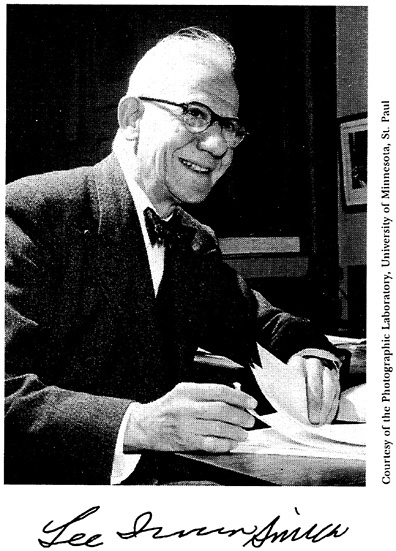
LEE IRVIN SMITH
July 22, 1891–March 29, 1973
BY VIRGIL BOEKELHEIDE
LEE IRVIN SMITH played an important role in the development of organic chemistry in the United States following World War I. During this period he was a leader in the development of the Chemistry Department of the University of Minnesota, especially its Organic Chemistry Division, to a position of prominence. In the course of training sixty-nine graduate students (thirteen M.S. and fifty-six Ph.D. degree recipients) and thirteen postdoctoral fellows, he pioneered research in many areas, including studies of the Jacobsen rearrangement; polyalkylated benzenes; reactions of quinones with metal enolates; the chemistry and synthesis of vitamin E; and the synthesis, structure, and properties of cyclopropanes. Smith was concerned for the success of not only his own students but for all of the students in the Organic Chemistry Division at Minnesota. Although small in stature, Smith was a born leader, had great energy, a large capacity for work, and the outstanding characteristic of insisting on excellence in every enterprise with which he was associated.
EARLY LIFE AND EDUCATION
Lee Irvin Smith was born in Indianapolis, Indiana, the
son of Edgar Poe Smith (a piano maker and salesman) and Susie Louise (Amberg) Smith and was the oldest of three boys. His maternal grandmother's name was Irvin and she was Pennsylvania Dutch. When Smith was seven, his family moved to Columbus, Ohio, where he received his elementary and secondary education. In describing his early life Smith related that his home environment was pleasant but their circumstances were modest. Since his father made and sold pianos, Smith took piano lessons and developed a lifelong interest in music. At the age of eleven Smith became interested in photography, which also became a lifelong interest and provided an important source of income during his high school and college days.
Smith attended Ohio State University, and, after taking the beginning course in chemistry with Professor William Lloyd Evans, he was stimulated to undertake a bachelor's degree in chemistry. At the same time he was interested in engineering and the practical applications of chemistry. This led him to continue at Ohio State University and complete a master of arts degree in industrial chemistry, a version of chemical engineering popular at that time.
During his final year at Ohio State University, Smith became acquainted with a young professor from Harvard named Shipley, who persuaded Smith to enroll at Harvard in 1915 to study with Theodore Richards in physical chemistry. However, almost immediately after arriving at Harvard, Smith was inspired by the great teacher and scholar E. P. Kohler and changed his major to organic chemistry. When Professor Kohler became ill, Smith was selected to give his lectures in beginning organic chemistry, a course that, in those days and for many years afterward, was known affectionately as “Chem 5.” It was probably during this period with Kohler that Smith developed his love for teaching and gained much of his insight into teaching methods that served him
so well at Minnesota. In 1917 Smith received an M.A. degree from Harvard and was appointed an instructor there for continuing his graduate studies. Among the graduate students studying organic chemistry at Harvard at that time were Roger Adams, James Bryant Conant, Henry Gilman, Nathan Drake, and Ralph Helmkamp.
With the advent of World War I, Smith became a lieutenant in the Chemical Warfare Service and was involved in a project at Harvard on the war gas Lewisite. In March 1918 the group at Harvard working on Lewisite was transferred to the Chemical Warfare Service Laboratory at American University in Washington, D.C. The top people at this laboratory were E. P. Kohler, Roger Adams, and James Bryant Conant. With the end of the war Smith returned to Harvard, where he completed his doctorate with Kohler in 1920. In the same year he began an appointment as instructor in chemistry at the University of Minnesota.
BUILDING ORGANIC CHEMISTRY AT MINNESOTA
At that time the University of Minnesota was a relatively small institution, and the primary function of the Chemistry Department was providing instruction. Professor William Hunter was chief of the Division of Organic Chemistry, and Lee Smith, as an instructor, was the only other staff member. Despite his heavy teaching load, Smith immediately began an active program of research. Promotions to assistant professor and associate professor followed fairly quickly. After Hunter's death in 1931, Smith became a full professor and, then, chief of the Division of Organic Chemistry. Walter M. Lauer was the second staff member in the division at that time.
During these years Smith's closest friend was Frederic King Butters, professor of botany, who, like Smith, was a bachelor. Butters had a large family home in Minneapolis
and Smith accepted his invitation to join him there. Later, Smith's widowed mother joined them to become housekeeper of the establishment. Smith and Butters were both very interested in horticulture and mountain climbing. Butters, Smith, and Smith's mother spent many summers in Estes Park, Colorado, enjoying these avocations.
In 1932 the opportunity arose to enlarge the staff of the division by two new appointments. The two appointments made by Smith were C. F. Koelsch and Paul D. Bartlett, and these appointments showed how exceptionally astute Smith was in judging promising young scientists. After receiving his doctorate at the University of Wisconsin, Koelsch had been a National Research Council fellow at Harvard. Within two years after his appointment to the University of Minnesota, Koelsch was the winner of the prestigious Langmuir Award (precursor to the American Chemical Society Award in Pure Chemistry). Likewise, Paul Bartlett, who received his doctorate with Conant at Harvard and who, after only two years at Minnesota, returned to a position at Harvard, also received the ACS Award in Pure Chemistry in 1938. When Bartlett resigned his post at Minnesota, Smith chose Richard T. Arnold as his successor, who in turn kept the tradition alive by receiving the ACS Award in Pure Chemistry in 1949. Smith truly had a remarkable insight into evaluating young people and their potential for leadership.
As Stan and Ann Tarbell have pointed out in their book, History of American Organic Chemistry, 1875-1955, the period between World War I and World War II was a time of change and development for organic chemistry in the United States. As they state, “The atmosphere of provincialism and scientific colonialism clearly discernible in American work before 1914 gradually disappeared, and by 1939 the best organic chemistry in the United States was plainly equal to the outstanding work in other countries.” In large measure
this development was spearheaded by midwestern universities. At the University of Illinois, Roger Adams led the Organic Chemistry Division to the forefront, and he was followed by Smith at Minnesota, McElvain at Wisconsin, Gomberg and Bachmann at Michigan, and Whitmore at Pennsylvania State University, who brought organic chemistry at their respective institutions to positions of leadership. It should be recognized, though, that E. P. Kohler at Harvard had been very influential in the training of Adams, Smith, and Whitmore.
During his forty-year tenure at Minnesota, Lee Smith was involved in many consulting, advisory, and editorial activities. As a consultant to the chemicals industry, he held long-term appointments with Merck and Company and with General Mills, Inc. Smith was a member of the Board of Editors of the Journal of Organic Chemistry (1936-45), the Journal of the American Chemical Society (1939-49), and Organic Syntheses (editor-in-chief of volumes 22 and 23). He was president of the Association of Harvard Chemists (1939), chairman of the Organic Division of the American Chemical Society (1941-42), and president of the Minnesota Academy of Sciences (1945-46). Aside from the American Chemical Society, Smith was a member of the Chemical Society of London, Deutschen Chemischen Gesellschaft, Swiss Chemical Society, American Biological Chemists, American Association for the Advancement of Science, and the American Alpine Club.
Lee Smith remained as chief of the Organic Chemistry Division at Minnesota until 1958, when he resigned to prepare for an orderly transition to accompany his retirement in 1960. He was succeeded in 1958 by William E. Parham, who began his career at Minnesota in 1946 after receiving his doctorate with Reynold C. Fuson at the University of Illinois.
Smith made significant contributions to the development
and growth of the University of Minnesota. He gave valuable counsel on many important decisions of university policy, as well as in recruiting and making appointments to fill key vacancies. In describing Smith's role in committee work, a colleague stated, “He has a mind like a knife, dissecting away all unimportant material to reach the core of the discussion.” When the Institute of Technology was first formed at Minnesota, Lee Smith was asked to serve as administrator of the School of Chemistry. After serving one term, he decided that he didn't care for this level of administration and returned to his post as chief of the Organic Chemistry Division.
In June 1972, at a special ceremony, the main building of the Chemistry Department at the University of Minnesota, in which Smith had spent his career, was named L. I. Smith Hall.
PERSONAL QUALITIES
The above remarks constitute an overall summary of L. I. Smith's life, accomplishments, and activities. Let us turn now to what it was that made Smith such a special person. A careful reading of his published work discloses much more than just the imagination to conceive these investigations and the accumulated knowledge and skill to carry them through to a satisfactory conclusion. The quality that sets them apart is the passionate insistence on excellence of method and scrupulous attention to accuracy in every detail. Lee Irvin Smith didn't publish until he was satisfied that the work, which he was committing to record, was done not just adequately but elegantly. When Smith published, the work was as he said it was and could be reproduced in any laboratory of organic chemistry.
This same passionate devotion to excellence characterized his teaching, both in and out of the classroom. His
reputation in the classroom was unrivaled, because he had a priceless gift for communicating, even to a large class, not only his encyclopedic knowledge of organic chemistry but also, and more importantly, the fascination it held for him. He prepared for every classroom lecture with the same driving thrust toward perfection that characterized all of his activities. Despite his many years as a teacher, Lee Smith confided once that he never faced a class before beginning a lecture without suffering stage fright. He gave his students only the best he had to offer, and he demanded that they in turn give him their best. It was a rare student who failed to respond.
As a supervisor of doctoral thesis research and of postdoctoral research, Lee Smith brought to the task the same qualities that made him outstanding as a scientist, a teacher, and as someone decidedly mortal but nevertheless superior. He gave his students plenty of room to use their own imagination and ingenuity in the solution of a chemical problem. Smith was very concerned that the writings of his students were of high quality, using proper grammar and rhetoric. He insisted on diligence in pursuit of the objective, on scientific fidelity of the highest order, and on a certain style and elegance. Lee Smith knew the capabilities of the young people who worked with him, and he would tolerate nothing but the best performance of which each was capable. Smith would register his displeasure with a slovenly performance in terms that left the recipient with his hair singed and his skin reddened. No one wanted to experience a second such reprimand.
Lee Smith recognized the vital and delicate relationship between the training of graduate students and the scientific accomplishments such training produces. He never lost sight of the fact that he was a professor and his primary obligation was to foster the process of converting graduate stu-
dents and postdoctoral fellows into thoughtful, knowledgeable, independent investigators. To him research was important, indeed essential, but it was nonetheless a by-product of the training process. Smith understood that, if a professor does a proper job of training a graduate student, good research will be produced. However, the converse is not necessarily true.
It should also be noted that Smith followed the careers of his former students after their graduation and was always ready with help and support if they were faced with a difficult decision or a crisis.
For those of us who were privileged to be students at Minnesota at the time that its Organic Chemistry Division was emerging from relative obscurity to become a leading department, we recognized what was occurring and that Lee Smith was the central figure in this development. He knew what a fine department should be and how to build it. He persuaded and cajoled, and he led and drove colleagues, students, and the administration until the amorphous mass crystallized into an outstanding center of organic chemistry. Smith was never satisfied with the state of the Organic Chemistry Division, the department, or the university, for the pursuit of excellence for him was endless and there was always something more to be done to achieve the desired objective.
It is true that Lee Smith demanded from students a disciplined and devoted effort in doing chemistry. Those who were unwilling to measure up to his standards certainly found him forbidding. However, Smith understood that anyone devoting himself strongly to chemistry must also have time for fun and enjoyment, if he is to have the balanced judgment necessary for creating outstanding research accomplishments. Thus, he had a fine sense of humor and knew
instinctively the proper time for a story or a joke to relieve tension.
During Smith's tenure at Minnesota, all of the graduate students (usually about forty) who were doing experimental research in organic chemistry worked in one huge laboratory, known as the 490 Lab. Most of the students were teaching assistants who had various duties and classes during the day. It was at night that the laboratory was filled with activity. An obvious disadvantage of having so many students in one room was that a serious accident would put a large number of people at risk. However, there were also real advantages. A beginning student seeking knowledge about a reaction, a procedure, or a technique had a large pool of experienced investigators immediately available to him.
The morale and companionship in the 490 Lab were very good. It was a sociable place where all sorts of topics could be discussed in an intelligent and educated manner. Although Smith did not normally come to the department in the evenings, except on seminar nights, most of the organic chemistry staff would be in their offices in the evenings and so students could consult with them about ongoing experiments in the laboratory. Lee Smith enjoyed visiting the 490 Lab, though, and his influence was important in setting the tone of the laboratory. Each spring, in a tradition started by C. F. Koelsch, the organic staff would invite all the members of the 490 Lab to a party at a downtown hotel. These were very special affairs and included skits put together by the students after much preparation.
Lee Smith's hobbies included mountain climbing, horticulture (particularly growing orchids), photography, and music. He was a chain smoker of cigarettes, which was made conspicuous by his long cigarette holder. In his later years
he developed chronic emphysema and died from its complications.
HIGHLIGHTS OF SMITH'S RESEARCH
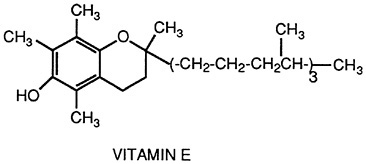
Undoubtedly, the outstanding research accomplishment for which Smith is best known is his work on tocopherol derivatives and his synthesis of vitamin E, whose structure is shown below. Altogether Smith published forty-seven papers on his experimental work related to vitamin E and the tocopherols. This research played an important role in his election to membership in the National Academy of Sciences in 1944.
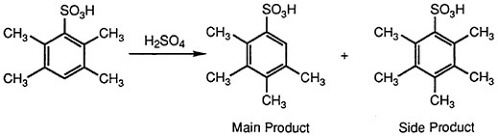
Related, but prior, to his work on the tocopherols, Smith was very interested in polyalkyl and polysubstituted benzenes in general. This led to an intensive investigation of the Jacobsen rearrangement, which is summarized in a series of nine publications. As illustrated in the example on the following page, the Jacobsen rearrangement occurs when polyalkyl- or polyhalobenzenesulfonic acid is allowed to stand in sulfuric acid and involves the intramolecular or intermolecular migration of one or more alkyl or halo substituents.
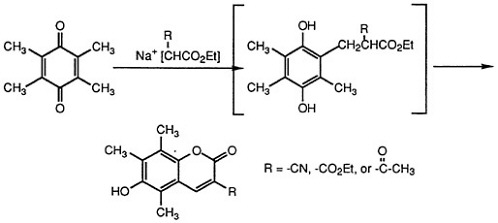
Similarly, in work related to the tocopherols and to polyalkylated hydroquinones, Smith studied in extensive detail both polyalkylated benzenes and the reaction of
benzoquinone derivatives and metal enolates. Ultimately, this led to his publishing a series of thirty-five papers on polyalkylated benzenes and twenty-five papers on the reaction of benzoquinones with metal enolates. An example of his studies on the reaction of benzoquinones with metal enolates is shown below.
During the course of his doctoral dissertation, Lee Smith became interested in cyclopropanes. In his program at Minnesota he explored this interest further by synthesizing cyclopropanes containing functional groups and studying the chemical behavior of such derivatives. His accomplishments in this area are recorded in a group of twenty-two publica-

tions. As an example of Smith's work in this area, he synthesized the nitro(bicyclopropyl) ketone shown above, the first bicyclopropyl ketone ever to be made. Both possible racemates were formed, and each was isolated in a pure crystalline state. Each of these racemates, when treated with sodium methoxide, gave the same enolic ether, shown above, as the only product.
THE AUTHOR THANKS Robert B. Carlin and Wayland E. Noland for help and valuable information.
SELECTED BIBLIOGRAPHY
(From a list of 245 publications including twenty-two patents)
1922 With E. P. Kohler. The reaction between alkalies and nitrocyclopropane derivatives. J. Am. Chem. Soc. 44:624-34.
1926 With F. J. Dobrovolny. The reaction between duroquinone and sodium malonic esters. I. J. Am. Chem. Soc. 48:1693-1709.
1929 With A. R. Lux.Studies on the polymethylbenzenes. I. A study of the Jacobsen reaction of pentamethylbenzene and preparation of prehnitene. J. Am. Chem. Soc. 51:2994-3000.
1934 The reaction between duroquinone and sodium malonic esters. II. The synthesis and reactions of 2,5-dimethoxy-3,4,6-trimethylbenzaldehyde . J. Am. Chem. Soc. 56:472-74.
With P. O. Tawney. Studies on the polymethylbenzenes. IX. Addition of ethyl diazoacetate to durene. J. Am. Chem. Soc. 56:2167-69.
1937 With W. B. Pings. The action of diazomethane upon a,ß-unsaturated ketones. I. Benzalacetophenone . J. Org. Chem. 2:23-28.
1938 With H. E. Ungnade and W. W. Prichard. Chemistry of vitamin E. I. The structure and synthesis of a-tocopherol . Science 88:37-38.
1939 With C. L. Agre, R. M. Leekley, and W. W. Prichard. The reaction between diphenylketene and certain dienes. J. Am. Chem. Soc. 61:7-11.
With H. E. Ungnade. The chemistry of vitamin E. IV. The synthesis of tocopherols. J. Org. Chem. 4:298-304.
With H. E. Ungnade, J. W. Opie, W. W. Prichard, R. B. Carlin, and E. W. Kaiser. The chemistry of vitamin E. VIII. Chloromethylation of polymethylhydroquinones and their derivatives. Cleavage of hydroquinone ethers. J. Org. Chem. 4:323-33.
1940 With E. W. Kaiser. The reaction between quinones and metallic enolates. XI. Duroquinone and the enolates of cyanoacetic ester and of ß-diketones. J. Am. Chem. Soc. 62:138-40.
With H. H. Hoehn and A. G. Whitney. The chemistry of vitamin E. XXIII. A new synthesis of 5-hydroxy-2,4,6,7-tetramethylcoumaran and of 2-methyl-5-hydroxycoumaran. Oxidation products of the tetramethylcoumaran . J. Am. Chem. Soc. 62:1863-69.
1941 With S. Wawzonek and H. C. Miller. The chemistry of vitamin E. XXVI. 5-hydroxy-4,6,7-trimethylcoumaran, 5-hydroxy-2,2,4,6,7-pentamethylcoumaran, 6-hydroxy-2,2,5-trimethyl-7,8-benzochroman and 5-hydroxy-2,4-dimethyl-6,7-benzocoumaran. J. Org. Chem. 6:229-35.
With J. W. Opie. The reaction between quinones and metallic enolates. XIII. Trimethylethylquinone and sodium malonic ester. J. Am. Chem. Soc. 63:932-36.
1942 With H. H. Hoehn. The reaction between diphenylketenes andarylacetylenes. VI. Mechanism . J. Am. Chem. Soc. 63:1181-84.
With R. B. Carlin. The structure of the chloromethylation product of trimethylhydroquinone diacetate. J. Am. Chem. Soc. 64:524-27.
1943 With J. A. King. The chemistry of vitamin E. XL. Synthesis and properties of 2-isopropyl-4,6,7-trimethyl-5-hydroxycoumaran . J. Am. Chem. Soc. 65:441-44.
1944 With R. W. H. Tess. Vitamin E. XLV. Synthesis of 2,2,7,8-tetramethyl-5-benzyl-6-hydroxychroman, and its behavior upon oxidation. J. Am. Chem. Soc. 66:1526-31.
1946 With P. F. Wiley. The reaction between quinones and metallic enolates. XXI. Second paper on bromotrimethylquinone and sodio malonic esters. J. Am. Chem. Soc. 68:887-93.
1948 With W. M. Schubert. Polyalkylbenzenes. XXXIV. The reaction between polymethyl-p-methoxyanilines and formaldehyde. J. Am. Chem. Soc. 70:2656-61.
With G. A. Boyack. Vitamin E. XLVII. The coumaran isomers of a-tocopherol. J. Am. Chem. Soc. 70:2690-95.
1949 With V. A. Engelhardt. Cyclopropanes. II. An aliphatic 2-nitro-1-cyclopropyl ketone. Mechanism of the reaction between nitrocyclopropyl ketones and alkali. J. Am. Chem. Soc. 71:2676-81.
1950 With W. J. Dale. The reaction between quinones and metallic enolates. XXV. Trimethylquinone and the enolates of cyanoacetic ester, cyanoacetamide, benzyl cyanide, oxaloacetic ester, and the acetal of diacetyl. J. Org. Chem. 15:832-40.
1951 With E. R. Rogier. Cyclopropanes. V. Cylopropyl nitrocyclopropyl ketones, and their behavior toward alkaline reagents. J. Am. Chem. Soc. 73:3831-37.
1952 With J. S. Showell. Cyclopropanes. XII. The action of bases upon tertiary nitrocyclopropyl ketones. J. Org. Chem. 17:827-35.
1956 With E. D. Holly. Cylopropanes. XVII. 1-p-bromobenzoyl-2-nitro-3-phenylcyclopropane: Action of acidic reagents . J. Am. Chem. Soc. 78:1475-80.
1957 With J. S. Swenson. Synthesis and properties of an allenic nitrile. J. Am. Chem. Soc. 79:2962-66.


