
9
Tempo and Mode in Human Evolution
Henry M. McHenry
In the 50 years since the publication of Simpson's Tempo and Mode in Evolution (Simpson, 1944) the paleontological record of Hominidae has improved more than a 100-fold. The improvements include precise geological dating and rich collections of well-preserved fossil hominids. Particularly valuable are newly discovered postcranial remains of early species that permit body-size estimation (McHenry, 1992; McHenry 1994b; Ruff and Walker, 1993). These new data show that the pattern of morphological change in the hominid lineage was mosaic. Different parts of the body evolved at different times and at various rates. This report focuses on hominid phylogeny and the tempo and mode of evolution of bipedalism, the hominid dental configuration, and encephalization.
Species, Clades, and Phylogeny
Views differ on the definitions of fossil hominid species and their phylogenetic relationships for many reasons but especially because of 1) the difficulty in identifying paleospecies (Kimbel and Martin, 1993; Tobias, 1991a; Walker and Leakey, 1993; Wood, 1991) and 2) the pervasiveness of homoplasy (Skelton and McHenry, 1992). One view (Skelton and McHenry, 1992) consists of five species of Australopithecus
Henry M. McHenry is professor of anthropology at the University of California, Davis.
(A. afarensis, A. aethiopicus, A. africanus, A. boisei, and A. robustus ) and three of Homo (H. habilis, H. erectus, and H. sapiens). Table 1 presents the geological dates and the estimated body, brain, and tooth sizes of these species and apes.
Analysis of the states of 77 craniodental characters in these species of Australopithecus and H. habilis (Skelton and McHenry, 1992) reveals that the cladogram in Figure 1A is the most parsimonious (tree length = 12,796, consistency index = 0.72). The two late ''robust" australopithecines, A. robustus and A. boisei are the most highly derived and form a sister group with early Homo. This branch links with A. africanus to form a clade containing A. africanus, A. robustus, A. boisei, and early Homo. A. aethiopicus branches from this clade next with A. afarensis as a sister species to all later hominids.
Figure 1B displays the phylogenetic tree implied by the most parsimonious cladogram. This phylogeny implies that A. afarensis is the most primitive hominid and that all later hominids shared a common ancestor that was more derived than A. afarensis. This post-afarensis hypothetical ancestor may someday be discovered. Its morphology can be reconstructed by observing the many ways A. aethiopicus resembles later hominids (especially A. africanus) and not A. afarensis. For example, the canine eminences of the face are prominent in the outgroup and in A. afarensis but are reduced or absent in all other species of hominid, which implies that the common ancestor of all post-afarensis species had canine eminences that were also reduced. This hypothetical ancestor would have a strongly developed metaconid on the lower first premolar. It would not, however, resemble A. aethiopicus in traits related to masticatory hypertrophy (heavy chewing), nor would it resemble any other post-afarensis species because they are all too derived in flexion of the base of the skull, orthognathism (flat faced), and encephalization to have been the ancestor of A. aethiopicus. After the divergence of A. aethiopicus, this phylogeny depicts a common ancestor of A. africanus, A. robustus, A. boisei, and Homo that resembled A. africanus in its development of anterior dentition, basicranial flexion, orthognathism, and encephalization. A second hypothetical common ancestor appears in Figure 1B to account for the numerous derived traits shared by A. robustus, A. boisei, and early Homo that are not seen in A. africanus. This ancestor would have the degree of basicranial flexion and orthognathism seen in early Homo and the amount of encephalization seen in A. robustus and boisei. This phylogeny proposes a third hypothetical ancestor that would be at the root of the lineage leading to A. robustus and A. boisei. This ancestor probably resembled A. robustus in traits related to heavy chewing.
Although the most parsimonious cladogram implies this phylogeny, other cladograms are possible but less probable. A cladogram linking A. aethiopicus to A. boisei and robustus as one branch and A. africanus /early Homo as another requires more evolutionary steps (tree length = 13332;
TABLE 1 Species of Australopithecus, Homo, and modern African apes with geological ages, estimated body weights, brain volumes, relative brain sizes (EQ), cheek-tooth area, and relative cheek-tooth area (MQ)
|
|
|
Body weight, kga |
Brain volume,b |
Tooth area, |
|||
|
Species |
Dates, (My) |
Male |
Female |
(cc) |
EQc |
dmm2 |
MQe |
|
A. afarensis |
4–2.8 |
45 |
29 |
384 |
2.2 |
460 |
1.7 |
|
A. africanus |
3–2.3 |
41 |
30 |
420 |
2.5 |
516 |
2.0 |
|
A. aethiopicus |
2.7–2.3 |
|
|
399 |
|
688 |
|
|
A. boisei |
2.1–1.3 |
49 |
34 |
488 |
2.6 |
756 |
2.5 |
|
A. robustus |
1.8–1.0 |
40 |
32 |
502 |
2.9 |
588 |
2.2 |
|
H. habilisf |
2.4–1.6 |
52 |
32 |
597 |
3.1 |
502 |
1.7 |
|
Early H. erectus |
1.8–1.5 |
58 |
52 |
804 |
3.3 |
377 |
1.0 |
|
Late H. erectus |
0.5–0.3 |
60 |
55 |
980 |
4.0 |
390 |
1.0 |
|
H. sapiens |
0.4–0 |
58 |
49 |
1350 |
5.8 |
334 |
0.9 |
|
Pan paniscus |
0 |
38 |
32 |
343 |
2.0 |
227 |
0.9 |
|
Pan troglodytes |
0 |
49 |
41 |
395 |
2.0 |
294 |
0.9 |
|
Gorilla gorilla |
0 |
140 |
70 |
505 |
1.7 |
654 |
1.0 |
|
a See refs. (McHenry, 1992 and 1994). b Endocranial volume is transformed into brain volume by formula 4 in ref (Aiello and Dunbar, 1993). c EQ is the ratio of brain volume and expected volume. Expected brain volume is 0.0589 (species body weight in g)0.76; see ref. (Martin, 1981). d Tooth area is the sum of the md × bl diameters of P4, M1, and M2 ; see ref. (McHenry, 1984). e MQ is the ratio of observed tooth area and expected area; expected area is 12.15 (species body weight in kg)0.86. See ref. (McHenry, 1988). f Two species may be represented in this sample. Using Wood's 1988 classification, I calculate the values for H. habilis sensu stricto and Homo rudolfensis as follows: male body weight, 37 and 60 kg; female body weight, 32 and 51 kg; brain volume, 579 and 709 cm3; EQ, 3.5 and 3.0; tooth area, 478 and 570 mm2; MQ, 1.9 and 1.5 kg; see ref. (McHenry, 1994b). |
|||||||
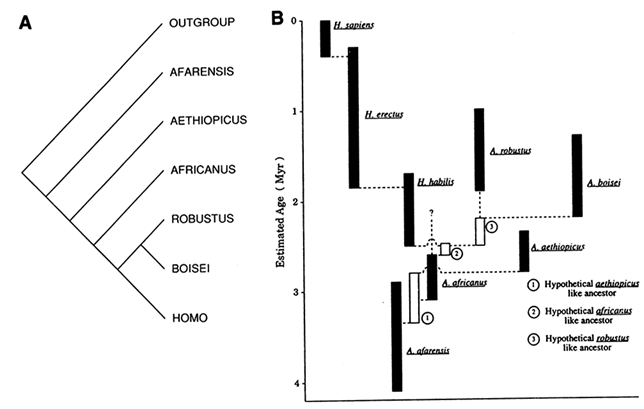
Figure 1 (A) The most parsimonious cladogram using all 77 traits or using summary scores from the analyses of five functional complexes or seven anatomical regions. Tree length is 12,796 and consistency index is 0.722. (B) The phylogeny implied by the most parsimonious cladogram. Three hypothetical ancestors are predicted.
consistency index = 0.69) because the later "robusts" resemble early Homo in so many features. These features include many aspects of basicranial flexion, loss of prognathism (muzzle), changes in the anterior dentition, and encephalization. The postcrania, although not included in this analysis, support the view that at least A. robustus and early Homo are monophyletic relative to other species of early hominid.
Whatever the true phylogeny is, and there can be only one, the fact remains that homoplasy is commonplace. Some resemblances appeared independently and not because of evolution from a common ancestor that possessed the same feature. Either adaptations for heavy chewing evolved twice or basicranial flexion, orthognathism, reduced anterior dentition, and encephalization each evolved more than once.
Bipedalism and the Postcranium
However the specific phylogeny of Hominidae is reconstructed, the important point is that these species are closely related to H. sapiens , and, in general, the more recent in time the species is, the more derived features it shares with our species. The earliest species, A. afarensis, is the most primitive in the sense that it shares the fewest of these derived traits and retains a remarkable resemblance to the common ancestor of African apes and people in many craniodental features. Its postcranium, however, is highly derived (McHenry, 1994a). It is fundamentally reorganized from the form typical of apes to that specific to Hominidae (McHenry, 1982, 1986, 1991, 1994a; Berge, 1993; Johanson et al., 1982; Latimer, 1991; Latimer and Lovejoy, 1989, 1990a, 1990b; Lovejoy, 1978, 1988).
Figure 2A presents features in which the postcranium of A. afarensis differs from African apes and approaches the condition characteristic of humans. The most significant features for bipedalism include shortened iliac blades, lumbar curve, knees approaching midline, distal articular surface of tibia nearly perpendicular to the shaft, robust metatarsal I with expanded head, convergent hallux (big toe), and proximal foot phalanges with dorsally oriented proximal articular surfaces. A commitment to bipedalism in A. afarensis is also shown by the 3.5 million year (Myr) Laetoli footprints, which show very human-like proportions, arches, heel strike, and convergent big toes (McHenry, 1991; Leakey and Hay, 1979; Tuttle, 1987; White, 1980).
The nature of A. afarensis implies that bipedalism evolved well before the appearance of most other hominid characteristics. The appearance of bipedalism is sudden in the sense that it involved a complex alteration of structure in a relatively short period of time. Unfortunately, the fossil record does not yet include hominid postcrania predating
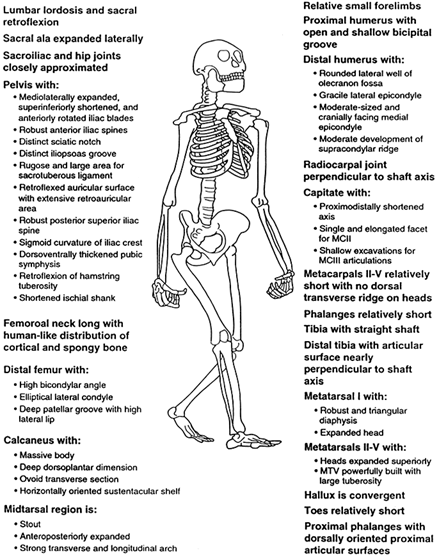
4.0 Myr that would document the transition from ape-like to hominid locomotion. The fundamental changes had already taken place in A. afarensis.
These bipedal alterations seen in A. afarensis are incomplete relative to modern H. sapiens, however (McHenry, 1983, 1986; Deloison, 1991; Jungers, 1982, 1988; Senut, 1981, 1991; Schmid, 1983, 1991; Senut and Tardieu, 1985; Stern and Susman, 1983; Susman, et al., 1984; Tardieu, 1983; Tuttle, 1981). Figure 2B presents traits in which this species differs in its postcranium from later species of Hominidae. These plesiomorphies probably imply that the bipedalism of A. afarensis was kinematically and energetically different from modern humans and may imply that they were more efficient tree climbers than modern humans. This arborealism would have been different from ape-like tree climbing, however, because the hindlimb was specialized for bipedality and had lost essential climbing adaptations such as hallucial divergence.
The pattern of change in these traits in later species of Hominidae is complex. Most of the postcranial elements that can be directly compared reveal a period of stasis with no change between A. afarensis and A. africanus (McHenry, 1986, 1983). This is particularly striking in the capitate bone in the wrist and pelvis. Both have the identical combination of modern pongid, modern human, and unique characteristics. In the metacarpals and hand phalanges, however, A. africanus has some Homo-like features absent in A. afarensis (Ricklan, 1987, 1990). The distal thumb phalanx of A. africanus, for example, is very human-like with its broad apical tuft that contrasts sharply with the relatively narrow, chimp-like tufts of the distal phalanges of A. afarensis. Limb proportions remain similar to A. afarensis in all species until the appearance of H. erectus at 1.7 Myr (McHenry, 1992). Even H. erectus retains some primitive characteristics relative to H. sapiens (Walker and Leakey, 1993). The most conspicuous of these is the relatively small cross-sectional area of the lumbar and sacral bodies (Latimer and Ward, 1993). Narrow pelvic inlets and long femoral necks are characteristic of A. afarensis, A. africanus, and H. erectus and are probably related to parturition of smaller-head neonates (Berge et al., 1984; Lovejoy, 1978, 1988; McHenry, 1975a, 1975b; McHenry, 1975a, 1975b; Tague and Lovejoy, 1986; Walker, 1993; Walker and Ruff, 1993).
Body size remains relatively small in all species of Australopithecus , including the surprisingly petite bodies of the "robust" australopithecines (McHenry, 1992, 1994b; Ruff and Walker, 1993, Table 1, column 3). Sexual dimorphism in body size decreases from A. afarensis to A. africanus to A. robustus. Specimens attributed to H. habilis vary enormously in size and may imply (with other evidence) the existence of two species (McHenry, 1994a, 1994b, n.d.; Wood, 1992). A sudden change
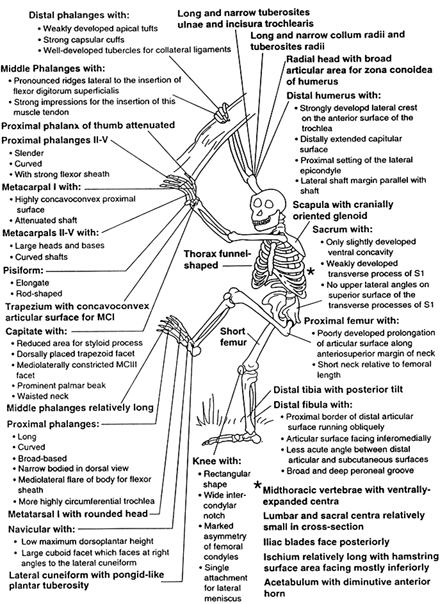
occurs at 1.8 Myr with the appearance of H. erectus with body weights as high as 68 kg and a substantial reduction in sexual dimorphism. There is no evidence of a gradual trend of increased body weight through time, as might be expected from Cope's law.
Mastication
The distinction between the hominid and pongid dental pattern was sharply delineated before the discovery of A. afarensis (Clark, 1967), but that species bridged the gap (Johanson and White, 1979; White et al., 1981). Overall, the dentition of the earliest species of hominid is more similar to the inferred last common ancestor than it is to H. sapiens. Most notable primitive traits include large central and small lateral upper incisors, projecting upper canine with marginal attrition facets, small metaconid of the lower first premolar and parallel or convergent tooth rows. The positions of the masticatory muscles are also primitive, particularly the posterior placement of the main fibers of the temporalis. But there are numerous derived features shared with later hominids as well. The most conspicuous of these is the reduced canines with apical wear.
Hominid species postdating A. afarensis lose this species' primitive dental characteristics. A. africanus is variable in size and shape of its anterior teeth, but some specimens are more Homo-like (Kimbel and Martin, 1993; White et al., 1981). Its lower first premolar is decidedly bicuspid. The mass of the temporalis muscle has moved forward into a more Homo-like position. Prognathism is reduced. The primitive dental features of A. afarensis are lost in hominid species postdating the appearance of A. africanus.
One unexpected characteristic of all early hominid species is postcanine megadontia and associated features related to heavy chewing (Skelton and McHenry, 1992; Aiello & Dean, 1990; Grine, 1988; McHenry, 1984; Rak, 1983; Tobias, 1967, 1991b; Turner and Wood, 1993; Walker et al., 1986; Wood, 1988; Wood and Chamberlain, 1987). Relative to body size, the cheek-teeth of A. afarensis are 1.7 times larger than expected from that seen in modern species of Hominoidea (Table 1, column 8). Relative cheek-tooth size is higher in A. africanus (2.0) and higher still in A. robustus (2.2) and A. boisei (2.5). The appearance of Homo is marked by a reduction to 1.7. From the earliest Homo species to H. erectus to H. sapiens there has been dental reduction. Presumably the masticatory hypertrophy within species of Australopithecus is related to diet and to the amount of grit entering the mouth. Reduction of tooth size in Homo may reflect dietary change, but also it is probably related to the use of tools in preparing food.
The phylogeny presented in Figure 1B implies traits related to heavy chewing evolved by parallel evolution in two lineages. One of these is the lineage from A. afarensis to A. aethiopicus. The second is the lineage from A. afarensis to A. africanus to the late "robust" australopithecines, A. robustus and A. boisei. This is a surprising result because A. aethiopicus and A. boisei share a suite of unique character states such as extreme anterior projection of the zygomatic bone, huge cheek teeth, enormous mandibular robusticity, a heart-shaped foramen magnum, and temporoparietal overlap of the occipital at asterion (at least in males).
All of these traits, except for the heart-shaped foramen magnum, are related to the functional complex of heavy chewing. The huge cheekteeth and robust mandibles of both species are obviously part of masticatory hypertrophy. The anterior projection of the zygomatic bones brings the masseter muscles into a position of maximum power. The encroachment by the root of the zygomaticoalveolar crest obscures the expression of the anterior pillars and upper canine jugae. Even the morphology of the temporoparietal overlap with occipital is related to the function of the forces generated by the chewing muscles (Skelton and McHenry, 1992).
Theoretically, it is understandable how such detailed similarity could be due to parallel evolution. These species are closely related and share "… so much in common in their constitution" (Darwin, 1872) that similar selective forces produce similar morphologies. The selective forces in this case are related to a feeding adaptation that is associated with a specialized ecological niche. As Mayr (1969, p. 125) points out "… most adaptations for special niches are far less revealing taxonomically than they are conspicuous. Occupation of a special food niche and the correlated adaptations have a particularly low taxonomic value." In fact, many of the same traits characteristic of A. aethiopicus and the other "robust'' australopithecines reappear in distantly related species adapted to heavy chewing. Expansion of the cheek-teeth, shortening of the muzzle, and anterior migration of the attachment areas of the chewing muscles are seen in other primates whose diet requires heavy chewing (e.g., Hadropithecus, Theropithecus, probably Gigantopithecus, and Ekmowehashala).
Encephalization
Table 1, column 5 presents brain sizes in species of Hominidae. Absolute brain volume has more than tripled from A. afarensis to H. sapiens , and relative size has more than doubled (Tobias, 1991a; Wood, 1991; Walker, 1993; Aiello and Dunbar, 1993; Begun and Walker, 1993; Blumenberg, 1983; Falk, 1987; Foley, 1992; Godfrey and Jacobs, 1981;
Gould, 1975; Hofman, 1983; Holloway and Post, 1982; Holloway, 1983; Jerison, 1973; Leigh, 1992; Martin, 1981, 1983; McHenry, 1974, 1975a, 1975b, 1982; Parker, 1990; Passingham, 1985; Pilbeam and Gould, 1974; Shea, 1987; Tobias, 1971). Given the very human-like postcranium of A. afarensis, it is interesting that this species has a relative brain size very close to that of modern chimpanzees. Lamarck, Huxley, Haeckel, and Darwin speculated that bipedalism preceded encephalization, but they had no fossil proof (McHenry, 1975b). The early species of Australopithecus confirm their prediction.
Both absolute and relative brain size increase through time in the series from A. afarensis [384 cc, 2.2 ratio of brain volume and expected volume (EQ)] to A. africanus (420 cc, 2.5 EQ) to A. boisei (488 cc, 2.6 EQ) to A. robustus (502 cc, 2.9 EQ). Superficially, this increase through time appears to be by gradual increments, but samples are small and body weight determinations are inexact (McHenry, 1992). The sample of endocasts of A. afarensis consists of three specimens and of these, all are fragmentary, and one is the estimated adult size from a 2.5-yr-old child (Falk, 1987). Although there are six endocasts of A. africanus, three of these needed substantial reconstruction (Holloway, 1983). There is only one endocast of A. robustus, four of A. boisei, seven of H. habilis, five for early H. erectus, and five for late H. erectus. Body weight estimates may be off the mark, but the sample of postcranial specimens is sufficient to show that body weight remained at about the same relatively small size in all species of Australopithecus. This result implies that the apparent increase in brain size through time in species of Australopithecus is not due merely to an increase in body size. Body size and brain size are variable in specimens attributed to H. habilis with individuals as small as 32 kg and 484 cc and others as large as 57 kg and 709 cc. Although there are reasons to keep H. habilis as a single species (Tobias, 1991a), dividing the sample into two species is justifiable (Wood, 1991, 1992). With either taxonomy, the absolute brain sizes of these early Homo specimens lie between Australopithecus and H. erectus, although relative brain sizes of early members of H. erectus overlap the range of the smaller-bodied specimens of H. habilis. The relative brain size of early H. erectus is surprisingly small because body size is so large. By 1.7 Myr, individuals attributed to H. erectus grew to >180 cm, and by 1.5 Myr one individual (KNM-WT 15000) may have stood 185 cm and weighed 68 kg as an adult (Ruff and Walker, 1993). Despite the fact that the average early H. erectus brain was >200 cc larger than the average brain of H. habilis, the relative brain sizes are only slightly different (EQ = 3.1 and 3.3).
The pattern of encephalization since early H. erectus is difficult to interpret because geological dates are less accurate, variability is high, and body weights are difficult to establish. Figure 3 plots brain size
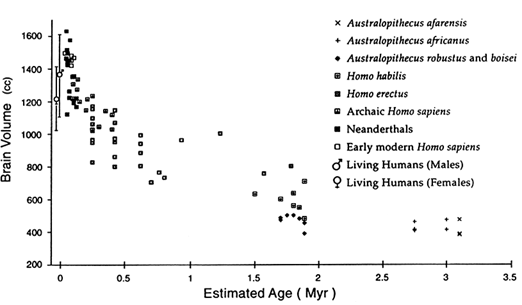
against time. For its first million years, H. erectus has absolute brain volumes that do not increase through time and therefore represent a period of stasis (Rightmire, 1990). It is difficult to establish whether relative brain sizes increased because there are very few postcranial fossils of H. erectus after 1.5 Myr from which to estimate body size. The few femora that are known are similar in size to those from early H. erectus. When taken over its entire range, the current sample of H. erectus does show a weak, but significant, positive increase in brain size through time (Leigh, 1992). The sample of archaic H. sapiens (0.4–0.125 Myr) shows a strong positive trend (Leigh, 1992). Variability is high. Many specimens as old as 0.4 Myr are within the modern human range of variation, and after 0.25 Myr all specimens are within this range. The average for the Neanderthals is 1369 cc compared with 1462 cc for early modern H. sapiens.
Stasis, Punctuation, and Trends
It is useful to regard evolutionary change in the hominid lineage from the point of view of Mayr's peripatric theory of speciation (Gould and Eldredge, 1993). Presumably, most of our samples derive from central populations of species and not from the small, isolated, and peripheral groups that are the most likely source of new species. When one of these peripheral isolates becomes reproductively isolated from the central species and its geographical range expands, it may overlap with the parent species, resulting in the coexistence of ancestral and descendant species. As depicted in Figure 1B, ancestral species overlap in time with descendants in most cases in hominid evolution, which is not what would be expected from gradual transformations by anagenesis (MacFadden, 1992). Trends through time observed in the fossil record are not necessarily the result of gradual change but rather "… an accumulation of discrete speciation events" (Gould and Eldredge, 1993; p. 223).
These events can be obscured by defining paleospecies too broadly, however. For example, it is conventional to define H. erectus as including specimens from deposits as old as 1.8 Myr and as young as 0.2 Myr (Rightmire, 1990). There is a slight trend in brain-size increase in this series (Leigh, 1992), but the earliest and smallest brained specimens are regarded by some as a separate species, Homo ergaster (Wood, 1992; Groves, 1989; Wood, 1993). Another example is the inclusion of specimens into H. sapiens that date back to perhaps 0.5 Myr, despite their decidedly archaic features. By this attribution, there is a strong positive trend in brain size through time (Leigh, 1992). An argument can be made, however, that this sample consists of several species (Stringer, 1994).
This view does not exclude the presence of change through time within species, however. As the original proponents of the theory of punctuated equilibrium point out (Gould and Eldredge, 1993), this view concerns the relative frequency of stasis, punctuation, and phyletic gradualism. Even within the multiple-species hypothesis of Middle to Late Pleistocene Homo (Stringer, 1994), all change through time does not occur at speciation events. For example, brain size and cranial morphology change from early to late specimens referred to Homo neanderthalensis . It is interesting, however, how little change occurs within most hominid species through time.
Summary
The quickening pace of paleontological discovery is matched by rapid developments in geochronology. These new data show that the pattern of morphological change in the hominid lineage was mosaic. Adaptations essential to bipedalism appeared early, but some locomotor features changed much later. Relative to the highly derived postcrania of the earliest hominids, the craniodental complex was quite primitive (i.e., like the reconstructed last common ancestor with the African great apes). The pattern of craniodental change among successively younger species of Hominidae implies extensive parallel evolution between at least two lineages in features related to mastication. Relative brain size increased slightly among successively younger species of Australopithecus, expanded significantly with the appearance of Homo, but within early Homo remained at about half the size of Homo sapiens for almost a million years. Many apparent trends in human evolution may actually be due to the accumulation of relatively rapid shifts in successive species.
I thank the organizers of this symposium and particularly Francisco Ayala and Walter Fitch for the invitation to contribute this paper. I am indebted to my colleague, R. R. Skelton, with whom I did the phylogenetic analysis reported here. I thank all those whose work led to the discovery of the fossils and especially M. D. Leakey, R. E. Leakey, F. C. Howell, D. C. Johanson, Tadessa Terfa, Mammo Tessema, C. K. Brain, P. V. Tobias, the late A. R. Hughes, and T. White for many kindnesses and permission to study the original fossil material. I thank the curators of the comparative samples used in this study. Partial funding was provided by the Committee on Research of the University of California, Davis.
References
Aiello, L. & Dean, C. (1990) An Introduction to Human Evolutionary Anatomy (Academic, London).
Aiello, L. C. & Dunbar, R. I. M. (1993) Neocortex size, group size, and the evolution of language. Curr. Anthropol. 34, 184–193.
Begun, D. & Walker, A. (1993) The endocast. In The Nariokotome Homo erectus Skeleton, eds. Walker, A. & Leakey, R. (Harvard Univ. Press, Cambridge, MA), pp. 326–358.
Berge, C. (1993) L'Évolution de la Hanche et du Pelvis des Hominidés: Bipedie, Parturition, Croissance, Allometrie (Presses du CNRS, Paris).
Berge, C., Orban-Segebarth, R., & Schmid, P. (1984) Obstetrical interpretation of the australopithecine pelvic cavity. J. Hum. Evol. 13, 573–587.
Blumenberg, B. (1983) The evolution of the advanced hominid brain. Curr. Anthropol. 24, 589–623.
Clark, W. E. L. (1967) Man-Apes or Ape-Men (Holt, Rinehart & Winston, New York).
Darwin, C. (1872) The Origin of Species (Random House, New York), 6th Ed.
Deloison, Y. (1991) Les Australopitheques marchaient-ils comme nous? In Origine(s) de la Bipédie chez les Hominidés, eds. Coppens, Y. & Senut, B. (Presses du CNRS, Paris), pp. 177–186.
Falk, D. (1987) Hominid Paleoneurology. Annu. Rev. Anthropol, 16, pp. 13–30.
Foley, R. A. (1992) Evolutionary ecology of fossil hominids. In Evolutionary Ecology and Human Behaviour , eds. Smith, E. A. & Winterhalder, B. (de Gruyter, New York), pp. 131–164.
Godfrey, L. & Jacobs, K. H. (1981) Gradual, autocatalytic and punctuational models of hominid brain evolution. J. Hum. Evol. 10, 255–272.
Gould, S. J. (1975) Allometry in primates, with emphasis on scaling and the evolution of the brain. Contrib. Primatol. 5, 244–292.
Gould, S. J. & Eldredge, N. (1993) Punctuated equilibrium comes of age. Nature (London) 366, 223–227.
Grine, F. E., ed. (1988) Evolutionary history of the robust australopithecines: a summary and the historical perspective. In Evolutionary History of the Robust Australopithecines (de Gruyter, New York), 509–510.
Groves, C. P. (1989) A Theory of Human and Primate Evolution (Clarendon, Oxford).
Hofman, M. A. (1983) Encephalization in hominids: evidence for the model of punctuationalism. Brain Behav. Evol. 22, 102–177.
Holloway, R. L. (1983) Human paleontological evidence relevant to language behavior . Hum. Neurobiol. 2, 105–114.
Holloway, R. L. & Post, D. G. (1982) The relativity of relative brain measures and hominid mosaic evolution. In Primate Brain Evolution: Methods and Concepts, eds. Armstrong, E. & Falk, E. (Plenum, New York), pp. 57–76.
Jerison, H. (1973) Evolution of the Brain and Intelligence (Academic, New York).
Johanson, D. C. & White, T. D. (1979) A systematic assessment of early African hominids. Science 203, 321–330.
Johanson, D. C., Taieb, M. & Coppens, Y. (1982) Pliocene hominids from the Hadar Formation, Ethiopia (1973–1977): Stratigraphic, chronologic, and paleoenvironmental contexts, with notes on hominid morphology and systematics. Am. J. Phys. Anthropol. 57, 373–402.
Jungers, W. L. (1982) Lucy's limbs: skeletal allometry and locomotion in Australopithecus afarensis. Nature (London) 297, 676–678.
Jungers, W. L. (1988) Relative joint size and hominoid locomotor adaptations with implications for the evolution of hominoid bipedalism. J. Hum. Evol. 17, 247–266.
Kimbel, W. H. & Martin, L. B. (1993) in Species, Species Concepts, and Primate Evolution, eds. Kimbel, W. H. & Martin, L. B. (Plenum, New York), pp. 539–553.
Latimer, B. (1991) Locomotor adaptations in Australopithecus afarensis : the issue of arboreality. In Origine(s) de la Bipédie chez les Hominidés,
Latimer, B. & Lovejoy, C. O. (1989) The calcaneus of Australopithecus afarensis and its implications for the evolution of bipedality. Am. J. Phys. Anthropol. 78, 369–386.
Latimer, B. & Lovejoy, C. O. (1990a) Hallucal tarsometatarsal joint in Australopithecus afarensis. Am. J. Phys. Anthropol. 82, 125–134.
Latimer, B. & Lovejoy, C. O. (1990b) Metatarsophalangeal joint of Australopithecus afarensis. Am. J. Phys. Anthropol. 83, 13–23.
Latimer, B. & Ward, C. V. (1993) The thoracic and lumbar vertebrae. In The Nariokotome Homo erectus Skeleton, eds. Walker, A. & Leakey, R. (Harvard Univ. Press, Cambridge, MA), pp. 266–293.
Leakey, M. D. & Hay, R. L. (1979) Pliocene footprints in the Laetolil beds at Laetoli, Northern Tanzania. Science 278, 317–323.
Leigh, S. R. (1992) Cranial capacity evolution in Homo erectus and early Homo sapiens. Am. J. Phys. Anthropol. 87, 1–13.
Lovejoy, C. O. (1978) A biochemical view of the locomotor diversity of early hominids. In Early Hominids of Africa, ed. Jolly, C. J. (St. Martins, New York), pp. 403–429.
Lovejoy, C. O. (1988) Evolution of human walking. Sci. Am. 259, 118–126.
MacFadden, B. J. (1992) Fossil Horses: Systematics, Paleobiology, and Evolution of the Family Equidae (Cambridge Univ. Press, Cambridge, U.K.).
Martin, R. D. (1981) Relative brain size and basal metabolic rate in terrestrial vertebrates. Nature (London) 293, 57–60.
Martin, R. D. (1983) Human Brain Evolution in an Ecological Context (American Museum of Natural History, New York).
Mayr, E. (1969) Principles of Systematic Zoology (McGraw–Hill, New York).
McHenry, H. M. (1974) How large were the Australopithecines? Am. J. Phys. Anthropol. 40, 329–340.
McHenry, H. M. (1975a) Biomechanical interpretation of the early hominid hip. J. Hum. Evol. 4, 343–356.
McHenry, H. M. (1975b) Fossils and the mosaic nature of human evolution. Science 190, 425–431.
McHenry, H. M. (1982) The pattern of human evolution: studies on bipedalism, mastication and encephalization. Annu. Rev. Anthropol. 11, 151–173.
McHenry, H. M. (1983) The capitate of Australopithecus afarensis and Australopithecus afrcanus. Am. J. Phys. Anthropol. 62, 187–198.
McHenry, H. M. (1984) Relative cheek-tooth size in Australopithecus. Am. J. Phys. Anthropol. 64, 297–306.
McHenry, H. M. (1986) The first bipeds: a comparison of the Australopithecus afarensis and Australopithecus africanus postcranium and implications for the evolution of bipedalism. J. Hum. Evol. 15, 177–191.
McHenry, H. M. (1988) New estimates of body weights in early hominids and their significance to encephalization and megadontia in "robust" australopithecines . In Evolutionary History of the "Robust" Australopithecines . ed. Grine, F. E. (Aldine de Gruyter, New York), pp. 133–148.
McHenry, H. M. (1991) First Steps? Analyses of the postcranium of early hominids. In Origine(s) de la Bipédie chez les Hominidés, eds. Coppens, Y. & Senut, B. (Presses du CNRS, Paris), pp. 133–142.
McHenry, H. M. (1992) Body size and proportions in early hominids. Am. J. Phys. Anthropol. 87, 407–431.
McHenry, H. M. (1994a) Early hominid postcrania: Phylogeny and function. In
Integrative Pathways to the Past: Paleoanthropological Papers in Honor of F. Clark Howell, eds. Corruccini, R. S. & Ciochon, R. L. (Prentice-Hall, Englewood Cliffs, NJ), pp. 251–268.
McHenry, H. M. (1994b) Behavioral ecological implications of early hominid body size. J. Hum. Evol. 27, pp. 77–87.
McHenry, H. M. (n.d.) Sexual dimorphism in fossil hominids and its socioecological implications. In Power, Sex, and Tradition: The Archaeology of Human Anestry, eds. Shennan, S. & Steele, J. (Routledge & Kegan Paul, London), in press.
Parker, S. T. (1990) Why big brains are so rare: Energy costs of intelligence and brain size in anthropoid primates. In "Language" and Intelligence in Monkeys and Apes, eds. Parker, S. T. & Gibson, K. R. (Cambridge Univ. Press, Cambridge, U.K.), pp. 129–154.
Passingham, R. E. (1985) Rates of brain development in mammals including man. Brain Behav. Evol. 26, 167–175.
Pilbeam, D. R. & Gould, S. J. (1974) Size and scaling in human evolution. Science 186, 892–901.
Rak, Y. (1983) The Australopithecine Face (Academic, New York).
Ricklan, D. E. (1987) Functional anatomy of the hand of Australopithecus africanus. J. Hum. Evol. 16, 643–664.
Ricklan, D. E. (1990) The precision grip in Australopithecus africanus : Anatomical and behavioral correlates. In From Apes to Angels: Essays in Honor of Phillip V. Tobias, ed. Sperber, G. H. (Wiley-Liss, New York), pp. 171–183.
Rightmire, G. P. (1990) The Evolution of Homo erectus (Cambridge Univ. Press, Cambridge, U.K.).
Ruff, C. B. & Walker, A. (1993) Body size and body shape. In The Nariokotome Homo erectus Skeleton, eds. Walker, A. & Leakey, R. (Harvard Univ. Press, Cambridge, MA), pp. 234–265.
Schmid, P. (1983) Eine Rekonstruktion des skelettes von A.L. 288-1 (Hadar) und deren Konsequenzen. Folia Primatol. 40, 283–306.
Schmid, P. (1991) The trunk of the Australopithecines. In Origine(s) de la Bipédie chez les Hominidés, eds. Coppens, Y. & Senut, B. (Presses du CNRS, Paris), pp. 225–234.
Senut, B. (1981) L'Humérus et Ses Articulations chez les Hominidés Plio-Pléistocene (Presses du CNRS, Paris).
Senut, B. (1991) Origine(s) de la bipedie humaine: Une approche paleontologique. In Origine(s) de la Bipédie chez les Hominidés, eds. Coppens, Y. & Senut, B. (Presses du CNRS, Paris), pp. 245–258.
Senut, B. & Tardieu, C. (1985) Functional aspects of Pilo-Pleistocene hominoid limb bones: implications for taxonomy and phylogeny/In Ancestors: The Hard Evidence, ed. Delson, E. (Liss, New York), pp. 193–201.
Shea, B. T. (1987) Reproductive strategies, body size, and encephalization in primate evolution. Int. J. Primatol. 8, 139–156.
Simpson, G. G. (1944) Tempo and Mode in Evolution (Columbia Univ. Press, New York).
Skelton, R. R. & McHenry, H. M. (1992) Evolutionary relationships among early hominids. J. Hum. Evol. 23, 309–349.
Stern, J. T. & Susman, R. L. (1983) The locomotor anatomy of Australopithecus afarensis. Am. J. Phys. Anthropol. 60, 279–318.
Stringer, C. B. (1994) in Issues in Hominid Evolution, ed. Howell, F. C. (California Acad. Sci., San Francisco).
Susman, R. L., Stern, J. T. & Jungers, W. L. (1984) Arboreality and bipedality in the Hadar hominids. Folia Primatol. 43, 113–156.
Tague, R. G. & Lovejoy, C. O. (1986) The obstetric pelvis of A.L. 288-1 (Lucy). J. Hum. Evol. 15, 237–255.
Tardieu, C. (1983) L'articulation du Genou. Analyse morpho-fonctionelle chez les primates et les hominides fossiles. (Presses du CNRS, Paris).
Tobias, P. V. (1971) The Brain in Hominid Evolution (Columbia Univ. Press, New York).
Tobias, P. V. (1991a) Olduvai Gorge Volume 4: The Skulls, Endocasts and Teeth of Homo habilis (Cambridge Univ. Press, Cambridge, U.K.).
Tobias, P. V. (1991b) Man, culture, and environment. In Evolution of Life Fossils, Molecules, and Culture, eds. Osawa, S. & Honjo, T. (Springer, Tokyo), pp. 363–377.
Turner, A. & Wood, B. (1993) Comparative palaeontological context for the evolution of the early hominid masticatory system. J. Hum. Evol. 24, 301–318.
Tuttle, R. H. (1981) Evolution of hominid bipedalism and prehensile capabilities. Philos. Trans. R. Soc. London B 292, 89–94.
Tuttle, R. H. (1987) Kinesiological inferences and evolutionary implications from Laetoli bipedal trails G-1, G-2/3 and A. Laetoli: A Pliocene Site in Northern Tanzania, eds. Leakey, M. D. & Harris, J. M. (Clarendon, Oxford), pp. 503–523.
Walker, A. (1993) Perspectives on the Nariokotome discovery. In The Nariokotome Homo erectus Skeleton, eds. Walker, A. & Leakey, R. (Harvard Univ. Press, Cambridge, MA), pp. 411–430.
Walker, A. & Leakey, R. (1993) The Nariokotome Homo erectus Skeleton , eds. Walker, A. & Leakey, R. (Harvard Univ. Press, Cambridge, MA).
Walker, A. & Ruff, C. B. (1993) The reconstruction of the pelvis. In The Nariokotome Homo erectus Skeleton, eds. Walker, A. & Leakey, R. (Harvard Univ. Press, Cambridge, MA), pp. 221–233.
Walker, A., Leakey, R. E. F., Harris, J. M. & Brown, F. H. (1986) 25 MYR Australopithecus boisei from west of Lake Turkana, Kenya. Nature (London) 322, 517–522.
White, T. D. (1980) Evolutionary implications of pliocene hominid footprints. Science 208, 175–176.
White, T. D., Johanson, D. C. & Kimbel, W. H. (1981) Australopithecus africanus: its phylogenetic position reconsidered. S. Afr. J. Sci. 77, 445–470.
Wood, B. A. (1993) Early Homo: How many species? In Species, Species Concepts, and Primate Evolution, eds. Kimbel, W. H. & Martin, L. B. (Plenum, New York), pp. 485–522.
Wood, B. A. (1988) Are robust australopithecines a monophyletic group? In Evolutionary History of the "Robust" Australopithecines, ed. Grine, E. F. (de Gruyter, New York), pp. 269–284.
Wood, B. A. (1991) Koobi Fora Research Project IV: Hominid Cranial Remains from Koobi Fora (Clarendon, Oxford).
Wood, B. A. (1992) Origin and evolution of the genus Homo. Nature (London) 355, 783–790.
Wood, B. A. & Chamberlain, A. T. (1987) The nature and affinities of the "robust" australopithecines: a review. J. Hum. Evol. 16, 625–642.


