
Appendix A—
Enrollment and Employment Trends in Geography
The Association of American Geographer's (AAG's) Employment Forecasting Committee1 prepared the following analysis of present and future enrollment and employment trends for geographers at the request of the Rediscovering Geography Committee. The Employment Forecasting Committee's analysis was published in the August 1995 issue of the Professional Geographer and is reprinted here with the permission of the AAG and Blackwell Publishers.
Employment Trends in Geography, Part 1: Enrollment and Degree Patterns *
Patricia Gober
Arizona State University
Amy K. Glasmeier
Pennsylvania State University
James M. Goodman
National Geographic Society
David A. Plane
University of Arizona
Howard A. Stafford
University of Cincinnati
Joseph S. Wood
George Mason University
This paper is the first in a series of three papers dealing with the current and future labor market for geographers. It is based on a report prepared by the Association of American Geographers' (AAG) Employment Forecasting Committee to the National Research Council's (NRC) Rediscovering Geography Committee. This report provides a data-based analysis of the past and future supply of geographers, the current labor market conditions in the field, and the factors likely to influence the future demand for geographers (faculty hiring, geographic education initiatives, trends in private sector jobs, etc.).
Each year some 4,000 individuals receive degrees in geography from America's institutions of higher education. They, or some portion of them, make up the new supply of geographers entering the labor market. In the near future (up to five years), the availability of new geographers is related to the number of geography students now in the educational pipeline. Their current specialties, and the specialties of the programs from which they come, tell us about the types of skills and the kinds of interests to be held by future labor force entrants. In the longer term (five to ten years), the number of new geographers will be influenced by geographic education initiatives at the precollegiate level. More and better geographic instruction in elementary and secondary schools will expose more students to geography as a field of study and as a potential career path. The purposes of this paper are to (1) review degree and enrollment trends in geography, (2) assess the "trickle-up" effects of geographic education initiatives at the precollegiate level, and (3) investigate the characteristics of future supply as evidenced by the types of occupations for which geography departments are now preparing students.
Background
Previous attempts to examine employment trends in geography focused on the academic job market (Hart 1966, 1972; Hausladen and Wyckoff 1985; Suckling 1994; Miyares and McGlade 1994) or relied exclusively on AAG membership data (Goodchild and Janelle 1988; Janelle 1992). Early "manpower" studies by John Fraser Hart matched predictions of the future supply of new doctorates in geography with estimates of new teaching jobs in colleges and universities and developed scenarios of surplus and deficit in the academic labor market. Hausladen and Wyckoff examined age profiles of topical and areal specialties from the 1982 AAG Directory with an eye toward predicting the effects of future retirements on the field. More recent investigations by Suckling and by Miyares and McGlade focused on the demand side of the employment equation and examined changes in the number, rank, location, and specialties of jobs advertised in Jobs in Geography.
Michael Goodchild and Donald Janelle analyzed trends in the intellectual structure of the discipline as manifest in AAG specialty group membership and topical proficiencies. Goodchild and Janelle's findings provided valuable insights into changes in the nature of geographic thought and training. Technical expertise and interest in geographic information systems (GIS) were burgeoning, especially among young geographers, while regionally oriented
specialties were shrinking. Reliance on AAG membership data, however, limits the applicability of these studies to college and university professors and their students—individuals who make up about two-thirds of the AAG's membership but a relatively small share of the total number of new geographers entering the labor market.
Degree and Enrollment Trends
The National Center for Education Statistic's (NCES) annual Digest of Education Statistics is the most accurate guide to the number of degrees granted in geography in the United States. Published continuously since 1948-1949, these data are compiled from questionnaires returned by each institution of higher education in the United States. Geography is listed as a separate field within the larger category of the "social sciences." Although not all individuals who receive degrees in geography directly enter the labor market for geographic skills (some go on to graduate school and others seek employment in occupations unrelated to geography), this series is the most sensitive barometer available of the supply of new geographers.
The NCES series reveals a surge in geography degrees granted in the late 1960s and early 1970s as the first wave of the baby boom generation began to graduate from colleges and universities, as a higher proportion of young people sought access to higher education, and as amendments to the National Defense Education Act (NDEA) in 1964 bolstered graduate enrollments (Fig. 1). Possible factors specific to geography include curricular reforms in the form of the High School Geography Project and Commission on College Geography and emerging technological advances in remote sensing and quantitative techniques that created opportunities for geographers outside of education. The number of bachelor's degrees peaked in 1971-1972 at 4,300, the number of master's one year later at almost 800, and Ph.D.s one year after that at 217.
From their high point in the early 1970s, the number of geography degrees declined slowly but steadily. At their nadir in 1987-1988, the number of new geographers entering the labor market was just two-thirds what it had been 15 years earlier. This downward pattern was not due to trends in higher education as a whole, as the total numbers of bachelor's, master's, and doctoral degrees in the United States grew steadily during the late 1970s and early 1980s,
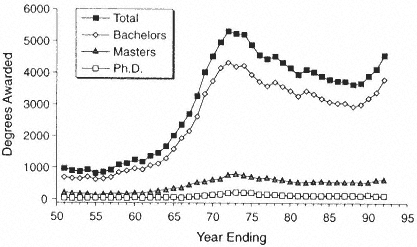
Figure 1:
Geography degrees awarded, 1951-1992.
despite declines in the traditional college-age population (NCES 1993a).
A turnaround in the number of geography degrees conferred at the undergraduate and masters levels began in 1988. Subsequently, the discipline has outpaced higher education as a whole in the increase in bachelor's and master's degrees granted. Between 1988-1989 and 1990-1991, the number of bachelor's degrees in geography grew by 13% compared with 7% for all fields. The number of master's degrees in geography grew at a rate of 14% compared with 9% for all fields. New Ph.D. holders in geography remained steady while the number of doctorates overall increased by 10% (NCES 1993a). The most recent figures for 1991-1992 show explosive growth at the bachelor's level and continued growth at the master's. Several factors are probably responsible for the renewed vigor in geography's degree production at the bachelor's and master's levels. They include rising public concern with environmental and international problems, greater attention to geographic education at the precollegiate and collegiate levels, and technological advances in GIS that provide new geographers with highly marketable skills.
Increases in the number of geography degrees are broadly consistent with trends in the social sciences, where the number of degrees fell consistently and dramatically from the early 1970s through the mid-1980s (Fig. 2). After 1987, degrees conferred in the social sciences in addition to geography, including anthropology, economics, political science, and sociology, rose sharply. Recent growth in the social sciences has been linked to the shift away from business majors, rising concern over the environment and crime, the growing elderly and homeless populations, and the increasingly competitive global economy (Bureau of Labor Statistics 1994, 120). The increased presence of women and minorities on university campuses also has been associated with the growth in social science fields (NCES 1993a). In the late 1980s female-dominated fields like education, psychology, and the social sciences experienced faster-than-average growth while slower-than-average growth occurred in traditionally male-dominated areas such as business
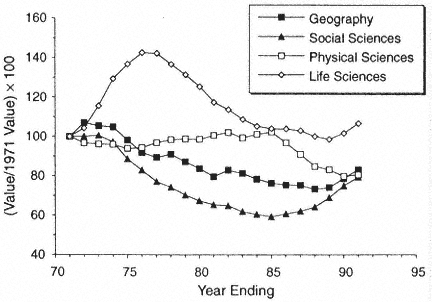
Figure 2:
Degrees in geography, social sciences, physical sciences, and life sciences, 1971-1991.
and management, engineering, and the physical sciences.
The physical sciences, including the closely related fields of geology and meteorology in addition to astronomy, chemistry, and physics, experienced steady degree production throughout the 1970s and early 1980s. The number of graduates sharply declined after 1985, especially at the bachelor's level (Fig. 2). The decline in new degree holders has been attributed, in part, to the fact that students are not obtaining in the high schools the demanding math and science background that is necessary for pursuing a university degree in the physical sciences (National Science Board 1993). The life sciences grew rapidly during the early and mid-1970s, declined steadily during the 1980s, and then turned upward in the late 1980s, at about the same time that the number of degrees in geography began to rise.
Geography's pattern of degree production during the past 20 years reflects, in part, the patterns of its closely related fields. Geography's early losses were similar to, but not as severe as, those for the social sciences as a whole. The discipline's upturn during the late 1980s is mirrored in both the social and life sciences categories. Ironically, the experience of the physical sciences correlates with geography's but in an inverse fashion. The physical sciences grew slightly during the late 1970s and early 1980s at the same time that geography declined. They reached their peak at about the time that geography reached its low point in the late 1980s. In recent years, the number of geography degrees has increased while the number of physical science degrees has declined.
Enrollments in geography programs provide another picture of labor supply conditions in the field, although the connection between supply and enrollment is less direct than the association between supply and degrees granted. Enrollment figures are unreliable, particularly at the undergraduate level. Some students are forced by institutional rules to declare their majors before they have settled on a career path. Others change majors, but these changes are not reflected in institutional accounting systems. As a result, enrollment figures are best seen as a general guide to current and future trends in the field.
The most complete record of graduate enrollments in geography programs comes from the NSF (1993). These data reveal that graduate enrollments in geography dipped about 10% from 1981 through 1985 but rose steadily thereafter (Fig. 3). This pattern fits with trends in geography graduate degrees, which bottomed out three years later in 1988 but are now on the rise. It also suggests that the upturn in master's degrees, from 555 in 1990 to 622 in 1991 and 639 in 1992, is not an aberration but the harvest of healthy enrollment growth during the late 1980s.
Geography's pattern is roughly parallel to that of the social science category, although the discipline's early-decade decline in enrollments was less severe and its late-decade rebound was more pronounced. Predictably, trends for the social sciences are smoother because they even out the ebbs and flows of individual disciplines. Graduate enrollments in the environmental sciences, including the atmospheric sciences, the geosciences, and oceanography, rose steadily until mid-decade, declined during the late 1980s, and began to climb again after 1989.
Geography's late-decade burst in enrollments was unmatched by individual fields in the social and environmental sciences. From their low point in 1985, graduate enrollments in geography grew by almost one-third by 1991 (Table 1). Student interest in sociology, anthropology, and political science was strong but not equal to the rise in geography. Enrollments in economics changed little. The poor performance of the category of environmental sciences between 1985 and 1991 was primarily the result of the dismal performance of the geosciences (geology), which comprises more than one-half of the enrollment in the environmental sciences category. Declines in the domestic oil and gas industry and mineral exploration drastically reduced the demand for geologists. The U.S. Geological Survey, the major government employer of geologists, and individual state surveys also downsized during this period.
Recent increases in graduate geography enrollments should translate into an increasing supply of highly trained geographers entering the labor market in the near future. Indeed, because 1991 is the most recent year for which
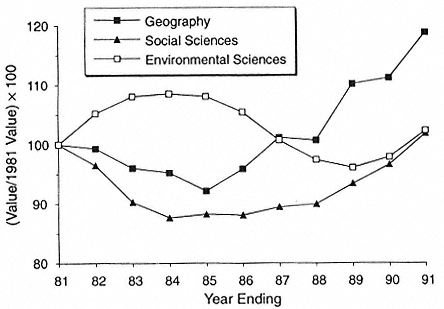
Figure 3:
Graduate enrollment in geography, social sciences, and environmental sciences, 1981-1991.
we have graduate enrollment data, that added supply of graduate-level geographers probably is occurring already.
To obtain information about trends in undergraduate enrollments and, hence, the future supply of bachelor's-level geographers, we examined the number of "students in residence" in the Guide to Programs of Geography in the United States and Canada from 1986-1987 through 1993-1994. We eliminated those schools for which we were unable to obtain a complete record of enrollment data because we wanted to conduct a longitudinal investigation of how a constant set of schools performed through time rather than to obtain a series of cross-sectional studies of an ever-changing mix of programs. This elimination process reduced the number of schools to 174 from the 239 listed in the 1993-1994 Guide. The list of 174 includes 51% of all bachelor's-granting departments, in 1993-1994, 88% of the master's departments, and 85% of the doctoral programs; thus, the experience of graduate departments will be overrepresented in the overall tallies. The average bachelor's-granting department contained 71 undergraduate students in residence, master's departments had 93, and doctoral departments had 104. If the missing cases display the same size patterns as the schools for which we have continuous data, they contain about 33% of the enrollment in undergraduate geography programs nationwide, and the 174 departments that form the basis of the study contain approximately two-thirds of geography's undergraduate enrollment.
The number of undergraduate students in residence in the 174 departments for which continuous data are available grew by 47% from 1986-1987 to 1993-1994. When these enrollment figures are normalized to their 1986-1987 levels and then viewed alongside the undergraduate degree figures discussed earlier, the two patterns are highly consistent (Fig. 4). Given that enrollments, as reported by the 174 schools in our study set, are a
Table 1 Graduate Enrollments in Geography and Related Fields, Fall 1985 to Fall 1991
|
Field |
1985 |
1991 |
Percent Change 1985–1991 |
|
Geography |
2,836 |
3,785 |
33.4% |
|
Social Sciences |
70,450 |
81,279 |
15.3 |
|
Anthropology |
5,631 |
6,695 |
18.8 |
|
Economics |
12,430 |
12,709 |
2.2 |
|
Sociology |
6,567 |
8,314 |
26.6 |
|
Political Science |
27,012 |
31,929 |
18.8 |
|
Environmental Sciences |
15,591 |
14,747 |
–5.4 |
|
Atmospheric Sciences |
964 |
968 |
.4 |
|
Geosciences |
10,294 |
7,626 |
–25.9 |
|
Oceanography |
2,081 |
2,293 |
10.2 |
|
Source: National Science Foundation, Division of Science Resources Studies. Academic Science/Engineering: Graduate Enrollment and Support, Fall 1991. |
|||
reasonably accurate guide to degrees granted in geography, it is logical to expect the accelerated enrollment in geography programs after 1992 to translate into higher degree production in 1992-1993 and 1993-1994.
Enrollment gains varied in a predictable fashion by region (Table 2). They were slower than the national average of 47% in the Northeast and Midwest, regions experiencing sluggish population growth and slow growth in student enrollments generally. Faster-than-average growth in enrollments was recorded in the South and West, areas of rapid population growth, net domestic in-migration, and immigration from abroad. The latter two regions accounted for almost two-thirds of the increase in geography enrollments nationwide.
Enrollment data also reveal that geography programs in Ph.D.-granting departments were the biggest generators of undergraduate enrollment increases. Between 1986-1987 and 1993-1994, enrollments increased by a stun
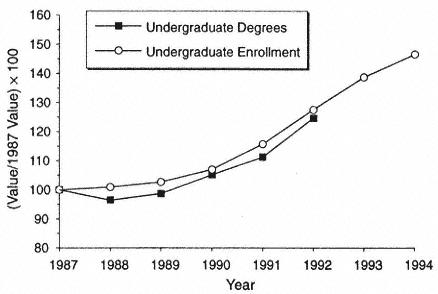
Figure 4:
Normalized undergraduate geography enrollments and degrees, 1987-1994.
Table 2 Undergraduate Enrollments by Region and Type of Geography Program
|
|
1986–1987 |
1993–1994 |
1986–1987 to 1993–1994 |
|
Total enrollment |
10,743 |
15,752 |
46.6% |
|
Region |
|||
|
Northeast |
1,839 |
2,453 |
33.4 |
|
Midwest |
3,057 |
4,261 |
39.4 |
|
South |
2,662 |
4,169 |
56.6 |
|
West |
3,185 |
4,869 |
52.9 |
|
Type of program |
|||
|
Undergraduate |
2,224 |
3,339 |
50.1 |
|
Masters |
5,196 |
7,095 |
36.5 |
|
Doctoral |
3,323 |
5,318 |
60.0 |
|
Source: Authors' calculations based on analysis of AAG Guide to Programs of Geography in the United States and Canada (1986-1987 to 1993-1994). |
|||
ning 60% in Ph.D. departments, compared with 50% in undergraduate departments and 37% in master's programs. This finding probably reflects the growing emphasis on undergraduate education in major research universities nationwide.
The NCES has projected rates of growth in the number of degrees for higher education as a whole to the year 2002-2003 (NCES 1993b). Applying these rates to geography assumes that the discipline will reflect the trends prevalent in all of higher education. Our track record relative to these national norms, unfortunately, is not good. The number of degrees granted in geography declined throughout most of the 1970s and 1980s even though the total number of degrees granted by all fields grew. Moreover, since geography began its rebound in 1988, it has outpaced higher education as a whole in the number of degrees granted. NCES projects aggregates rather than individual disciplines or areas (social sciences, education, engineering, physical sciences, etc.) for precisely this reason. Some fields grow while others stagnate. Students "vote with their feet," moving easily and quickly among fields in response to changing labor market conditions, social values, and personal preferences (i.e., the recent experience of geology). Projections using 1985-1986 as a base year would have, for example, seriously overestimated degrees and enrollments in the physical sciences and underestimated those in the social sciences.
Nevertheless, we applied projections for higher education as a whole to geography (Table 3). We envision these projections as a benchmark against which we can assess the discipline's future performance rather than as hard-and-fast expectations. The numbers of undergraduate degrees in higher education are expected to rise until the mid-1990s, hold steady until 2000, and then increase again early in the next decade. Applying these projections to geography anticipates an increase in undergraduate degrees from 3,397 posted in 1990-1991 to 4,080 in 2002-2003.
The previous discussion of degree and enrollment trends in the field, however, suggests much faster growth in the number of geography undergraduate degrees. The figure for 1991-1992 was already above 3,800. Furthermore, if 13,701 "students in residence" in geography programs generated 3,808 degrees in 1991-1992, then the undergraduate enrollment figure of 15,752 in 1993-1994 should translate into 4,378 bachelor's degrees in that year, far more than higher education trends indicate for the entire projection period extending to 2002-2003.
Higher education projections are also problematic at the graduate level because more undergraduate degrees filter up through the system and generate more master's and Ph.D. degrees. Throughout the 1980s, the ratio of bachelor's to master's degrees hovered between 5 and 6 (Fig. 5). Assuming this ratio holds firm (and we have a long historical record to suggest that it will), we expect that the number of master's degrees will rise to 800 in 1993-1994, again a far larger figure than an extrapolation of higher education trends would indicate.
Because of their relatively small number, Ph.D. degrees vary more from one year to the next. Since 1980, the ratio of bachelor's to Ph.D. degrees has ranged from 22 to 29, averaging 25 (Fig. 5). Using this average ratio of
Table 3 Projections of Bachelor's, Master's, and Doctoral Degrees in Higher Education and Geography, 1990–1991 to 2002–2003
|
Bachelor's Degrees |
|||
|
|
Higher Education |
|
Geography |
|
1990–1991 |
1,084,000 |
|
3397 |
|
|
(+86,000) |
7.93% |
(+270) |
|
1995–1996 |
1,170,000 |
|
3667 |
|
|
(+15,000) |
1.28% |
(+46) |
|
1999–2000 |
1,186,000 |
|
3714 |
|
|
(+117,000) |
9.86% |
(+366) |
|
2002–2003 |
1,303,000 |
|
4080 |
|
Master's Degrees |
|||
|
|
Higher Education |
|
Geography |
|
1990–1991 |
337,000 |
|
622 |
|
|
(+17,000) |
5.05% |
(+31) |
|
1995–1996 |
354,000 |
|
653 |
|
|
(–1,000) |
–.28% |
(–2) |
|
1999–2000 |
353,000 |
|
651 |
|
|
(+12,000) |
3.40% |
(+22) |
|
2002–2003 |
365,000 |
|
673 |
|
Doctoral Degrees |
|||
|
|
Higher Education |
|
Geography |
|
1990–1991 |
40,000 |
|
119 |
|
|
(+1,100) |
2.72% |
(+3) |
|
1995–1996 |
41,100 |
|
122 |
|
|
(+500) |
1.22% |
(+1) |
|
1999–2000 |
41,600 |
|
123 |
|
|
(+200) |
.48% |
(+1) |
|
2002–2003 |
41,800 |
|
124 |
|
Source: Gerald, D.E., and W.J. Hussar, 1993. Projections of Education Statistics to 2003. National Center for Education Statistics. |
|||
25 and an estimated 4,378 bachelor's degrees, we expect the number of Ph.D. degrees to be 175 in 1993-94.
To confirm the validity of these expectations, we asked departmental chairs, individuals who are at the front lines of enrollment management in colleges and universities, to assess past and future trends in numbers of undergraduate degrees. We heard back from 214 of the 376 chairs to whom we sent questionnaires, for a response rate of 57%. This overall response rate was composed of rates of 76% for institutions offering the Ph.D. in geography, 58% for schools offering master's degrees, and 49% for other institutions. Included in the latter category are some two-year institutions and schools without full-fledged geography departments. Many are part of a bureaucratic unit whose chair or director is probably not a geographer and, thus, far less likely to respond to highly specific questions about the training and occupational prospects of geography students. Our sample, therefore, under-represents the views of the chairs whose programs account for a small proportion of the total number of geographers produced by institutions of higher education in the United States.
Chairs reaffirmed the sizable increases in degrees granted during the last five years (Table 4). Some 58% noted some increase in degrees over the last five years. Moreover, a majority of chairs were bullish about the prospects for future growth. When asked to assess the change in the number of geography degree graduates 6-10 years from now, 45% predicted increases between 10 and 25% and another 16% envisioned increases of more than 25%.
Departmental chairs also anticipate growth in the size of their graduate student bodies. Compared with the 1993-1994 academic year, chairs anticipated that graduate enrollments would climb 3% at the master's level and 9% at the doctoral level by 1998-1999.
Geographic Education Initiatives
To gain yet another perspective on the future supply of geographers, we asked several key Geographic Alliance Coordinators to com-
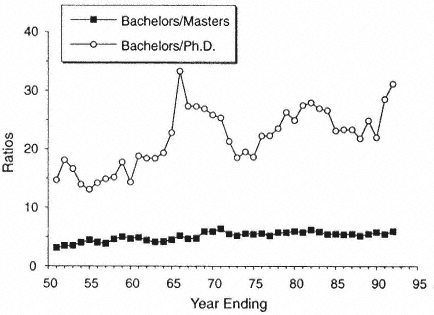
Figure 5:
Ratios of bachelor's to master's degrees and bachelor's to doctoral degrees in geography, 1951-1992.
ment on the ''trickle-up" effects of geographic education initiatives. To what extent, in other words, has the enhanced visibility of geography at the precollegiate level translated into more collegiate geography majors who will, in turn, constitute the future supply of new geographers? Interviews with A. David Hill from Colorado, Sidney R. Jumper from Tennessee, and Richard G. Boehm from Texas helped us to develop both a quantitative and a qualitative picture of these trickle-up effects. Keep in mind we are working from case studies of the success stories—states where Alliance efforts have been in place for some time, where geography is required for admission to the state's flagship universities (Colorado and Tennessee) or where it is part of the recommended high school program (Texas), and where the overall visibility of the discipline is high.
Tennessee provides us with a quantitative picture of what happened to high school geography enrollments in an environment that was favorable to geographic education. In 1982-1983, 5,535 students took world geography courses in Tennessee high schools. In 1986 the Tennessee Geographic Alliance was formed, and in 1989 the University of Tennessee added a "world geography or world history" admission requirement. By 1989-1990 world geography enrollments had soared to 18,487, and by 1992-1993, the last year for which we have data, they reached 28,733. Sidney Jumper, Geographic Alliance Coordinator and departmental chair at the University of Tennessee, reports that the increased presence of geography at the secondary level has affected the University of Tennessee's Department of Geography in a number of important ways. First, the department has gone from no incoming freshman majors each year to eight in 1992-1993 and four in 1993-1994. Second, undergraduate courses (service courses as well as those in the major) are oversubscribed. Third, the quality of students in the undergraduate program has improved, not so much as a result of better preparation, but from the fact that better students are now choosing geography as a field of study. And finally, the department
Table 4 Chairs' Estimates of Past and Future Changes in the Number of Geography Degree Graduates
|
|
Change in Last 5 Years |
Change 6-10 Years from Now |
||
|
Large increase (more than 25%) |
37 |
(18.7%) |
32 |
(15.8%) |
|
Modest increase (10–25%) |
77 |
(38.9%) |
91 |
(45.0%) |
|
Fairly stable (+/–10%) |
71 |
(35.9%) |
41 |
(20.3%) |
|
Modest decrease (10–25%) |
9 |
( 4.5%) |
9 |
( 4.5%) |
|
Large decrease (more than 25%) |
3 |
( 1.5%) |
1 |
( .5%) |
|
Unable to say |
1 |
( .5%) |
28 |
(13.9%) |
|
Total |
198 |
(100.0%) |
202 |
(100.0%) |
|
Source: Departmental chairs' survey. |
||||
was the only unit in the University's College of Arts and Sciences to gain a new position in 1993-1994. Jumper attributes this in part to the department's ability to demonstrate community outreach in the form of geographic education activities.
The story is similar in Colorado. Although high school enrollments are not available there, we do know that 78 of 150 school districts in the state instituted geography classes in the past five years, many in response to the inclusion in 1988 of a geography requirement in the University of Colorado's admission standards. Effects at the university level were an increase in the number of incoming freshmen geography majors, more undergraduate majors overall (from 107 in 1988 to 175 in 1992), an avalanche of new students (1,000 per semester) in an introductory geography course used to fulfill the admissions deficiency in geography, and a new faculty line targeted to provide instruction in this introductory course.
Texas Geographic Alliance Coordinators also describe an increase in majors and in freshmen taking geography courses. At Southwest Texas State University (SWTSU) the number of incoming freshmen geography majors, a barometer of geography's presence in high schools, increased from zero in the fall of 1983 to 29 in the fall of 1993. The number of incoming freshmen taking geography courses also increased over the same period, from 30 to 250. According to Richard Boehm, chair of the SWTSU geography department, the preparedness of these new students has not changed appreciably. What has changed is their heightened awareness of geography as a field of study and as a potential career path. Trickle-up effects also extend to the graduate level at SWTSU, as Boehm reports recruiting ten geography teachers into the department's master's program.
These case studies suggest that college and university geography departments will feel the effects of geography's higher profile at the precollegiate level. From a labor market perspective, more enrollment leads to more majors (the vast majority of geography majors come indirectly to the discipline after taking and enjoying an introductory geography course), more majors mean more degrees, and more degrees generate an ever-larger pool of people with geography backgrounds seeking employment.
Before we extrapolate these forces to all states and all geography departments, however, it is important to remember that we picked several of the most active and successful Alliance departments. In addition, the widespread adoption of the Geography National Standards, the key to diffusing these success stories nationally, is anything but assured. In the most optimistic scenario, the standards will be widely adopted and implemented, and the Tennessee, Colorado, and Texas success stories will diffuse across the nation, stimulating continued growth of new majors and, eventually, new geographers entering the work force. In the less optimistic scenario, other states will be unable to repeat these experiences, adoption of the National Standards will be limited, and the number of future geographers will level off.
Future Supply Characteristics
Numbers alone do not tell the full story of future supply conditions in geography. What types of skills and interests do students now in the educational pipeline have? We asked departmental chairs about tracks or specializations in their undergraduate programs and the types of occupations for which their students were being prepared. Of the 212 geography
chairs who responded to our survey, 139, or 65%, reported that their departments had at least one specialization. These specializations were led by programs in environmental/resource management, techniques (GIS, cartography, and remote sensing), and urban planning. These tracks appear to be designed to prepare students for the occupations in which geographers traditionally have found work rather than to develop their interests in regional geography or the systematic specialties like urban, economic, or physical geography that have traditionally formed the core of the academic discipline.
We also asked chairs to indicate the specific occupations for which students were being prepared (Table 5). The occupations indicated by the highest numbers of departments were (1) GIS/remote sensing specialist, (2) secondary school teacher, (3) cartographer, (4) environmental manager/technician, and (5) urban/regional planner. When chairs were asked to estimate the percentage of students in their programs who were preparing for particular occupations, a slightly different set of occupations emerges. Although GIS was by far the most popular occupational trajectory (involving almost 11% of students enrolled in programs offering GIS training), it was followed by environmental manager/technician and urban/regional planner. Although training as a secondary school teacher and cartographer, two of geography's long-standing career paths, were offered in a larger number of departments, these occupations involved a smaller share of currently enrolled students. In other words, whereas future teachers and cartographers are being trained in most departments, relatively few departments have high percentages of students preparing for these occupations.
Summary and Conclusions
Analysis of degree and enrollment trends in geography reveals the discipline's up cycle from the mid-1960s to the mid-1970s, its down period from the mid-1970s to around 1988, and its current rejuvenation. Data from a wide range of sources tracking a variety of indicators point consistently to significantly larger numbers of undergraduate majors and degrees and graduate majors and degrees during the early 1990s. To the extent that the number of geography majors and geography degree recipients correlates closely with labor force entrants, it is clear that the supply of new geographers has risen dramatically in recent years.
The evidence also supports continued growth in the supply of new geographers. The increasing numbers of students currently en
Table 5 Occupations for which Geography Students are Being Prepared (As Reported by Departmental Chairs)
|
Occupation |
Number of Programs Preparing Students for This Occupation |
Median Percent of Program's Students |
|
GIS/Remote Sensing Specialist |
172 |
11% |
|
Teacher-Secondary |
157 |
6 |
|
Cartographer |
156 |
7 |
|
Environmental Manager/Technical |
153 |
8 |
|
Planner—Urban/Regional |
152 |
8 |
|
Planner—Environmental |
148 |
8 |
|
Earth Scientist |
124 |
6 |
|
Teacher—Collegiate |
122 |
4 |
|
Teacher—Primary |
119 |
4 |
|
Climatologist/Meteorologist |
118 |
2 |
|
Community Development Specialist |
116 |
1 |
|
International Specialist |
109 |
3 |
|
Planner—Transportation |
106 |
2 |
|
Aerial Photo Interpreter |
102 |
2 |
|
Ecologist |
98 |
4 |
|
Land Economist/Real Estate Professional |
98 |
1 |
|
Marketing Analyst |
95 |
1 |
|
Administrator/Manager |
88 |
4 |
|
Soil/Agricultural Scientist |
86 |
1 |
|
Writer/Journalist/Editor |
82 |
1 |
|
Other |
33 |
12 |
rolled in undergraduate geography programs should translate into larger graduate enrollments and degrees granted. Widespread implementation of the Geography National Standards would mean more incoming geography majors, a heightened awareness of geography as a field of study, and generally more students taking geography courses. It appears that the discipline is doing a very successful job attracting new students who have come to see geography as a stepping stone to a satisfying and productive career. The obvious next question involves the extent to which these students are, in fact, finding work in the field. The second article in this series describes current labor market conditions for new geographers. •
Literature Cited
Bureau of Labor Statistics. 1994. Occupational Outlook Handbook. Bulletin 2450. Washington, DC: U.S. Government Printing Office.
Goodchild, M.F., and D.G. Janelle. 1988. Specialization in the structure and organization of geography. Annals of the Association of American Geographers 78:1-28.
Hart, J.F. 1966. Geographic Manpower: A Report on Manpower in American Geography. Commission on College Geography Report 3. Washington, DC: Association of American Geographers.
Hart, J.F. 1972. Manpower in Geography: An Updated Report. Commission on College Geography Report 11. Washington, DC: Association of American Geographers.
Hausladen, G., and W. Wyckoff. 1985. Our discipline's demographic futures: Retirements, vacancies, and appointment priorities. Professional Geographer 37:339-43.
Janelle, D.G. 1992. The peopling of American geography. In Geography's Inner World, eds. R.F. Abler, M.G. Marcus, and J.M. Olson, 363-90. New Brunswick, NJ: Rutgers University Press.
Miyares, I.M., and M.S. McGlade. 1994. Specializations in "Jobs in Geography." Professional Geographer 46:170-77.
National Center for Educational Statistics. 1993a. Digest of Education Statistics: 1993. NCES 993-292. Washington, DC: U.S. Government Printing Office.
National Center for Educational Statistics. 1993b. Projections of Education Statistics to 2003. Washington, DC: U.S. Government Printing Office.
National Center for Education Statistics. 1994. Digest of Education Statistics: 1994. NCES 94-115. Washington, DC: U.S. Government Printing Office.
National Science Board. 1993. Science and Engineering Indicators: 1993. Washington, DC: U.S. Government Printing Office.
National Science Foundation. 1993. Academic Science/Engineering: Graduate Enrollment and Support, Fall, 1991. Washington, DC: U.S. Government Printing Office.
Suckling, P.W. 1994. National and regional trends in "Jobs in Geography." Professional Geographer 46:164-69.
Employment Trends in Geography, Part 2: Current Demand Conditions*
Patricia Gober
Arizona State University
Amy K. Glasmeier
Pennsylvania State University
James M. Goodman
National Geographic Society
David A. Plane
University of Arizona
Howard A. Stafford
University of Cincinnati
Joseph S. Wood
George Mason University
This paper, the second in a series dealing with employment trends in geography, focuses on current labor market conditions. Two windows on the current labor market are (1) the employment experiences of recent graduates of geography programs and (2) the activities of the Association of American Geographers Convention Placement Services (CoPS). The former provides a perspective primarily on the nonacademic labor market in geography and includes bachelor's, master's, and doctoral recipients of geography degrees. The latter covers both academic and nonacademic jobs but focuses on geographers who hold advanced degrees.
Recent Graduates
Very little is known about the interface between postsecondary education and the labor market in geography. There is not a definite point where people leave the university and enter the work force. Many students work full- or part-time while they attend the university, others continue their educations after receiving an undergraduate degree, and still others take time off before they begin their professional careers or work in occupations completely unrelated to their undergraduate degree program. Complicating matters further, in geography, direct paths into the labor force are not as evident as in disciplines like nursing, accounting, engineering, and other professional fields. The vast majority of geographers work in occupations that do not carry the title "geographer."
Recognizing how little we know about the labor market for individuals with bachelor's and master's in geography, we queried recent graduates of a random sample of geography programs about their labor market experiences. Are they finding work? What types of occupations are they engaged in and for what kinds of employers do they work? Are they making effective use of the skills obtained in their geography programs? Whenever possible, we linked the results of the survey to national datasets on educational outcomes in order to provide a contextual and comparative perspective for geography's experience.
We chose a random sample of U.S. geography programs from the Guide to Programs of Geography in the United States and Canada stratified by region (Northeast, Midwest, South, and West) and type of department (bachelor's, master's, and doctoral). One bachelor's, master's, and doctoral department was chosen from each of the four major regions for a total of 12 geography programs.1 Departmental chairs provided us with lists of all graduates for calendar years 1990 through 1993. We mailed questionnaires to all 1,239 individuals on the lists and sent follow-up reminder postcards to those we had not heard from in two weeks. Our efforts yielded a total of 623 replies, 460 of them bachelor's recipients, 132 master's, 25 doctoral, and 6 unknown. Adjusting our population by the 38 questionnaires that could not be delivered by the U.S. Postal Service and for 16 respondents who turned out to be pre-1990 graduates, the overall response rate was a very respectable 53% (Table 1). The numbers in
Table 1 Response Rates by Geography Program
|
|
Surveys Sent |
Undeliverable/ Pre–1990 Graduates |
Valid Responses |
Response Rate |
|
Dartmouth |
77 |
0 |
44 |
57.1% |
|
Towson State |
146 |
2 |
70 |
48.5 |
|
Rutgers |
85 |
8 |
50 |
64.1 |
|
IPUPI |
33 |
3 |
16 |
53.3 |
|
Miami (Ohio) |
63 |
4 |
30 |
50.1 |
|
Iowa |
124 |
6 |
51 |
43.2 |
|
Jacksonville |
36 |
2 |
14 |
41.2 |
|
SWTSU |
392 |
11 |
200 |
52.5 |
|
George Mason |
92 |
8 |
53 |
63.1 |
|
Sonoma State |
54 |
4 |
29 |
58.0 |
|
Montana |
44 |
2 |
27 |
64.3 |
|
Hawaii |
93 |
4 |
43 |
47.7 |
|
Total |
1239 |
54 |
623 |
52.6 |
the subsequent tables may not sum to 623 because not all of the respondents answered all of the questions.
We asked graduates about their current employment status and determined that 416 (68.7%) were working full-time, 37 (6.0%) were working part-time, 12 (2.0%) were in the military, 96 (15.6%) were going to school and working, 19 (3.1%) were going to school and not working, 19 (3.1%) were unemployed, and 9 (1.5%) were out of the labor force. Compared to national norms that apply to bachelor's recipients only, geography's recent bachelor's graduates were somewhat less likely to be engaged in full-time employment and more likely to be in school. We view this comparison with considerable caution, however, because the National Center for Educational Statistics' (NCES) employment categories are different from ours (NCES 1993). The NCES puts teaching and research assistants into a category called "enrolled in school" and considers them not to be in the labor force. This rule assumes that a student's primary activity is going to school. Moreover, it assumes that the jobs held by students are available only to those attending school and not to the labor force in general. Our categories allowed students (including graduate assistants) to specify whether they worked or not, thus acknowledging that individuals can be students and labor force members simultaneously. Although our categories are more complicated, they better reflect the increasingly fuzzy distinction between educational and employment status.
Among bachelor degree recipients, we discovered that more of the earlier than later graduates were employed full-time, fewer were employed part-time, and fewer were unemployed (Table 2). The trend in the percent in school is quite typical. There is an initial surge by those who go directly from a bachelor's to a master's program, then a falling off followed by an increase about two years out. This is a big decision point for many, and a commitment to return to school comes at about this time. The small numbers of unemployed may be deceiving because the hard-core unemployed are unlikely to respond to a survey such as ours.
Overall, these results suggest that geography graduates, like many of their counterparts in the arts and sciences, experience a period of transition and adjustment between the time they receive their undergraduate degrees and the point at which they settle into stable, full-time employment. This period is characterized by the pursuit of additional education, part-time employment, and internships. A typical career path for the new graduate in today's job market may involve temporary, contractual employment on a project-by-project basis during which the individual makes contacts with local planning agencies and consulting firms. Experiences gained through a series of these temporary or contractual arrangements often lead to full-time employment within several years. Although verification of this hypothesis awaits careful longitudinal analysis that follows a panel of recent graduates through their early work careers, our data are suggestive of such a pattern.
Differences in employment status by year of graduation probably do not result from varying labor market conditions. College graduates throughout the study period faced equally
Table 2 Employment Status of Bachelor's Degree Recipients by Year of Graduation
|
|
Total (N=423) |
1990 (N=85) |
1991 (N=94) |
1992 (N=115) |
1993 (N=127) |
|
Percent employed |
76.1% |
83.6% |
76.6% |
78.3% |
69.3% |
|
Full time |
68.6 |
76.5 |
72.3 |
67.8 |
62.2 |
|
Part time |
4.7 |
1.2 |
3.2 |
7.0 |
6.3 |
|
Military |
2.8 |
5.9 |
1.1 |
3.5 |
.8 |
|
Percent in school |
19.7 |
15.3 |
20.2 |
15.6 |
25.3 |
|
And working |
15.4 |
12.9 |
14.9 |
13.9 |
18.9 |
|
And not working |
4.3 |
2.4 |
5.3 |
1.7 |
7.1 |
|
Percent unemployed |
3.1 |
1.3 |
1.1 |
4.3 |
3.9 |
|
Percent not in labor force |
1.2 |
0 |
2.1 |
1.7 |
.8 |
|
Source: Recent graduates survey. |
|||||
harsh employment prospects. If anything, conditions improved somewhat for the 1993 graduates. Nonetheless, this group was less settled than earlier cohorts into long-term careers. Nor is it likely that the recent increase in geography graduates described in the first article in this series has tightened the competition for jobs in the field to any measurable extent. The growth in degree holders is geographically widespread, and geographers represent but a small minority of applicants in any of the submarkets in which they compete.
To evaluate the occupational structure of geography degree recipients, we developed a list of 21 occupations with which we believed most geographers would identify and asked the respondents to indicate which occupation best applied to them. We also gave the option of an "other" category to accommodate those whose occupations were not well described by any of the items on our list. We judiciously recorded geographically oriented occupations from the "other" category into the categories into which we thought they best fit so that we would be left with an "other'' category that contained only those occupations that are far removed from the field. For the most part, these jobs were professional in nature, including minister, social worker, insurance underwriter, financial analyst, lawyer, and pilot, but they also included less-skilled positions such as van driver, waiter, and secretary. For all degree recipients (bachelor's, master's, and doctoral), approximately one-third of those who were employed and who listed an occupation were engaged in jobs that are not closely identified with geography. The fact that two-thirds of the respondents were employed in fields directly related to geography is an encouraging figure in an era when many college graduates are working in occupations that do not even require a college degree and the vast majority of social science graduates are employed outside their areas of study.
The proportion of new geographers at the bachelor's level holding positions in closely related fields is high by social science standards. During the early 1990s, only 16% of social science bachelor's degree recipients nationwide were employed full-time in jobs closely related to their fields of study one year after graduation (NCES 1993). Among our 1993 graduates, this figure was 38%, and for many of them, a full year had not elapsed since graduation. Our estimate of geography's figure was higher than for arts and sciences disciplines as a whole (26%) but lower than the norm for professional and technical fields (48%) (NCES 1993).
Much of the preceding discussion isolated the experience of bachelor's degree recipients in order to draw connections to national datasets. The subsequent analysis grouped together all degree levels. Even with 623 respondents, we do not have a sufficient sample size to allow meaningful disaggregation by degree levels. At this point, we seek a general understanding of the types of jobs that geographers hold irrespective of their degrees.
Among those who were employed and listed occupations closely related to geography, respondents clustered into five predictable occupations: teacher (15.6%), environmental manager/technician (12.9%), GIS/remote sensing specialist (10.5%), cartographer (8.2%), and planner (6.7%) (Table 3). The categories correspond quite closely to the most common occupations for which current students are preparing (as reported in the survey of departmental chairs in Part 1 of this series), although GIS/remote sensing specialist ranked higher on the list of occupations for which current
Table 3 Recent Graduates (All Levels) by Occupation
|
|
Number |
Percent |
|
Aerial photo interpreter |
5 |
.9% |
|
Administrator/manager |
15 |
2.7 |
|
Cartographer |
46 |
8.2 |
|
Community development specialist |
2 |
.4 |
|
Demographer/population researcher |
7 |
1.2 |
|
Earth scientist |
14 |
2.5 |
|
Ecologist |
8 |
1.4 |
|
Environmental manager/technician |
73 |
12.9 |
|
GIS/remote sensing specialist |
59 |
10.5 |
|
International specialist |
5 |
.9 |
|
Land economist/real estate professional |
6 |
1.1 |
|
Marketing analyst |
11 |
2.0 |
|
Planner—environmental |
16 |
2.8 |
|
Planner—urban/regional |
14 |
2.5 |
|
Planner—transportation |
8 |
1.4 |
|
Teacher—primary |
17 |
3.0 |
|
Teacher—secondary |
26 |
4.6 |
|
Teacher—collegiate |
45 |
8.0 |
|
Writer/journalist/editor |
3 |
.5 |
|
Other |
184 |
32.6 |
|
Total |
564 |
100.0 |
|
Source: Recent graduates survey. |
||
students are preparing than on the list of where recent graduates are working. These five categories (or aggregates of categories in the case of teaching and planning) accounted for 54% of the respondents who listed their occupations and 80% of those who chose from the list of geographically oriented occupations.
In terms of employers, the breakdown was 34% in government (local, state, and federal), 40% in the private sector, 17% in educational institutions, and the remainder in nonprofit organizations (Methodist Church, NAACP, health and social services, environmental groups, etc.) and as self-employed consultants and small-business owners (Table 4). When respondents were disaggregated by how directly their work relates to geography, the private sector emerged as the dominant employer of those working at the margins and outside of the field. Still, some 45% of those respondents reported an occupation closely related to their geographic training. Graduates working in government and education were the most likely to be involved in geographic occupations.
We cross-classified type of employer by occupation to gain a clearer picture of kinds of work geographers do for different types of employer (Table 5). Cartographers were concentrated in the federal government and, to a lesser extent, in private industry. Environmental managers worked in state government, supervising the myriad new environmental regulations, and in the private sector for environmental consulting firms that have been established to meet these regulations. Some 44% of the GIS/remote sensing specialists worked in the private sector. Planners were strongly clustered in local and, to a lesser extent, in state government. Not surprisingly, teachers were employed in educational institutions. Our residual category of other geographic professions was more concentrated in the federal government, nonprofit organizations, and self-employed settings than the respondents as a whole.
The strong association between the "other" category and the private sector can be interpreted in three ways. The standard interpretation is that some geographers are unable to find work or are uninterested in working in the field after graduation and therefore seek out or settle for private sector positions not traditionally associated with the discipline. A second perspective is that we have defined the notion of geographic occupations much too narrowly. Individuals who can use, display, and analyze geographic information to solve spatial and environmental problems can find jobs in all kinds of businesses, many with job titles that have not traditionally been associated with the field. Geography plays to the creativity, diversity, and flexibility of the contemporary labor market as much as it fills the standard niches of cartographer, planner, environmental manager, GIS/remote sensing specialist, and
Table 4 Recent Graduates (All Levels) by Employer
|
|
Number |
Percent of Total |
Percent In Closely Related Fields |
|
Local government |
54 |
9.5% |
79.6% |
|
State government |
60 |
10.6 |
85.0 |
|
Federal government |
78 |
13.8 |
77.9 |
|
Private industry/business |
227 |
40.0 |
44.9 |
|
Educational institution |
96 |
16.9 |
90.6 |
|
Nonprofit organization |
22 |
3.9 |
72.7 |
|
Consultant/self–employed |
30 |
5.3 |
73.3 |
|
Total |
567 |
100.0 |
67.4 |
|
Source: Recent graduates survey. |
|||
teacher. Many of our respondents saw themselves as performing geographic jobs even though this was not reflected in their job titles.
A third interpretation is that individuals working in fields other than those traditionally considered geographic find work in areas in which they have prior experience. Since our analysis neither holds constant the respondent's age nor classifies individuals on the basis of prior education or professional experience, we do not know the extent to which our survey is picking up prior preparation or work experience that leads to a nontraditional employment experience.
Greater confidence in our hypotheses about the recent labor market experiences of geographers requires more in-depth study of individual work experiences during the early- to mid-career years. Longitudinal analysis can verify the existence of a period of transition and adjustment when students move from part-time, temporary employment to full-time positions closely connected to their geographic training. Content analysis can decipher the potential relevance of the educational experience of students receiving degrees to tasks performed on the job. What if, for example, field-defined skills such as GIS, remote sensing, air photo interpretation, and cartography are not as important as the students' problem solving and decision making abilities? From a curricular standpoint, greater emphasis on professional practice, demeanor, and real world work experience may be more important than adding technical courses to academic curricula.
Convention Placement Service (CoPS)
A second glimpse at current labor market conditions in geography comes from the AAG's Convention Placement Service (CoPS). Held at the AAG's annual meeting, CoPS seeks to match job applicants with employers. Since 1989, the first year for which data are available, there has emerged a growing mismatch between the number of applicants and the number of interviews granted to these applicants (Fig. 1). In 1994, the 259 job seekers registered with CoPS attended only 156 interviews—an average of less than one interview per applicant.
Employers and job applicants who register with CoPS select from among a number of job
Table 5 Graduates (All Levels) by Employer and Occupation
|
Employer |
Cartographer (N=46) |
Environmental Manager/ Technician (N=73) |
GIS/Remote Sensing Specialist (N=59) |
Planner (N=38) |
Teacher (N=88) |
Other Geographic Professions (N=76) |
Other (N=184) |
|
Local government |
8.7% |
5.5% |
13.6% |
50.0% |
3.4% |
6.6% |
6.1% |
|
State government |
8.7 |
27.4 |
10.2 |
23.7 |
3.4 |
11.8 |
4.9 |
|
Federal government |
41.3 |
13.7 |
20.3 |
7.9 |
1.1 |
19.7 |
9.2 |
|
Private industry/ business |
26.1 |
42.5 |
44.1 |
15.8 |
1.1 |
32.9 |
67.4 |
|
Educational institution |
4.3 |
2.7 |
5.1 |
0 |
86.4 |
5.3 |
4.9 |
|
Nonprofit |
2.2 |
1.4 |
1.7 |
0 |
3.4 |
13.2 |
3.3 |
|
Consultant/self-employed |
8.7 |
6.8 |
5.1 |
2.6 |
1.3 |
10.5 |
4.3 |
|
Source: Recent graduates survey. |
|||||||
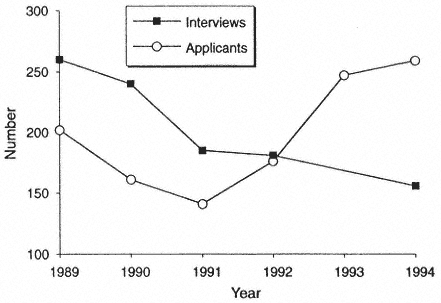
Figure 1:
Number of Applicants and Interviews Recorded by the AAG Convention Placement Service.
Note: The data point for interviews in 1993 is not available. The box containing 1993 interview records was lost in the mail between Atlanta and the AAG office in Washington.
categories. Many applicants and some employers list in more than one category. In 1994, 259 applicants accounted for some 556 listings, and 38 employers listed a total of 51 positions. Academic positions are included in two categories: an unfortunately large and heterogeneous physical/environmental/techniques group and a human/regional group. At the 1994 meeting, academic categories accounted for 43% of employment listings and one-third of the applicant listings (Table 6).
Applicants and employers for nonacademic jobs choose among four categories: physical/environmental (climatology, meteorology, geomorphology, hydrology, soils, biogeography, conservation, resources, ecology, environmental impact), planning (urban, transportation, land use, recreation, housing preservation, health, population), marketing/site selection/area studies (market research, real estate, public relations, advertising, regional expertise, travel consulting), and technical (cartography, remote sensing, photogrammetry, information systems, statistical and mathematical modeling). Applicants registered with CoPS were spread fairly evenly across the employment categories, but employers were concentrated in the nonacademic technical category—a sign of the strong link between GIS expertise and entry into the nonacademic labor market for geographers. There were a total of only six positions listed in the physical/environment, planning, and marketing/site selection/area studies classifications. While there were far more job applicants than positions even in the nonacademic technical category, the ratio of job seekers to positions was much lower than in the other nonacademic areas. For planning jobs, the ratio of applicants to jobs was more than 50 to 1!
Given the fact that these data apply only to individuals registered at the AAG annual meeting and employers attending this meeting, we make no claims that they are indicative of the
Table 6 Applicants and Employers Registered with the AAG's Career Opportunities and Placement Service in March 1994
|
|
Applicant Listings |
Employer Listings |
Ratio Applicants/Employers |
|
Academic |
|||
|
Physical/environmental/techniques |
85 (14.8%) |
14 (27.5%) |
6.1 |
|
Human/regional |
111 (19.3%) |
8 (15.7%) |
13.8 |
|
Nonacademic |
|||
|
Physical/environmental |
98 (17.7%) |
2 ( 3.9%) |
49.0 |
|
Planning |
107 (18.6%) |
2 ( 3.9%) |
53.5 |
|
Marketing/site selection/area studies |
71 (12.3%) |
2 ( 3.9%) |
35.5 |
|
Technical |
104 (18.1%) |
23 (45.1%) |
4.5 |
|
Source: Number of applicants and interviews recorded by the AAG Convention Placement Service. Physical/environmental: climatology, meteorology, geomorphology, hydrology, soils, biogeography, conservation, resources, ecology, environmental impact, etc. Planning: urban transportation, land use, recreation, housing, preservation, health, population, etc. Marketing/site selection/area studies: market research, real estate, public relations, advertising, regional expertise, travel consulting, etc. Technical: cartography, remote sensing, photogrammetry, information systems, statistical and mathematical modeling, etc. |
|||
total labor market for geographers. They do suggest a tighter labor market for new geographers at the master's and doctoral levels, and they signal the strong interest in techniques by potential employers of geographers.
Summary and Conclusions
The survey of recent graduates confirmed the continued importance of the five occupations in which geographers traditionally have been employed: cartographer, environmental manager/technician, GIS specialist, teacher, and urban/regional planner. These occupations accounted for slightly more than one-half of the respondents who reported their occupations. The strong association between "other" occupations and the private sector indicates that the private sector is the major destination of individuals who are not explicitly using their geographic training or are using it in occupations not traditionally associated with the field.
Results also revealed the quasi-professional position of geography relative to other social science fields. While only 16% of social science majors nationally were employed full-time in jobs closely related to their fields of study one year after graduation, this figure was 38% among the recent geography graduates in our survey. Geographers, although well placed by social science standards, fell below the norms of professional degree recipients, 48% of whom were employed in closely related fields.
Another finding involves the recent trend in the national labor market toward temporary, part-time employment as firms seek to reduce overhead costs and gain flexibility in managing the flow of work. Although our results need to be verified by careful longitudinal analysis, we picked up this trend in the experiences of recent geography graduates. Many newcomers to the labor market appear to face a period of transition between the time they receive their undergraduate degrees and the point at which they settle into stable, full-time employment. Geography programs can assist students in this transition period by encouraging or requiring internship experiences while in school, offering a senior seminar on the transition into the labor market, integrating more real-life experiences into the curriculum, and simply making students more aware of the challenges they will encounter in today's labor market.
Analysis of CoPS data suggested a tighter labor market for new geographers at the master's and doctoral levels and pointed to the strong link between GIS and other technical expertise and entry into the nonacademic labor market. Of the 29 nonacademic positions listed with CoPS in 1994, 23, or 79%, were in technical areas. Firms that participated in the 1994 national meetings appeared to be especially interested in graduate-level geographers with strong technical skills such as cartography, remote sensing, GIS, statistics, and mathematical modeling. Most geographers do not, however, learn these technical skills in an intellectual vacuum but in the context of the discipline's
systematic specialties. The third in this series of articles explores the specializations and skills that will be demanded of geography graduates in the near future.
Note
Literature Cited
National Center for Education Statistics. 1993. Digest of Education Statistics: 1993. NCES 993-292. Washington, DC: U.S. Government Printing Office.
Employment Trends in Geography, Part 3: Future Demand Conditions
*Patricia Gober
Arizona State University
Amy K. Glasmeier
Pennsylvania State University
James M. Goodman
National Geographic Society
David A. Plane
University of Arizona
Howard A. Stafford
University of Cincinnati
Joseph S. Wood
George Mason University
The third and final article in this series about employment conditions in geography addresses the issue of future demand in both academic and nonacademic settings. To gain an understanding of future demand conditions in colleges and universities, we projected the retirement of AAG members by topical specialty and then matched these retirement trends with a profile of new faculty searches as reported by geography department chairs. We assessed the likely future demand for geography teachers at the precollegiate level through a survey of Geography Alliance Coordinators about teacher certification requirements and the education environments in their respective states. We speculated on how the kinds of jobs geographers do will be affected by changes now underway in the national and global economies. And finally, we conducted a small telephone survey of AAG corporate sponsors to determine how future business trends will affect the demand for geographers.
Academic Job Market
Retirements
The majority of new academic jobs in geography will involve replacements on existing lines rather than new lines. Of the 340 "likely" searches during the next five years reported by the departmental chairs who responded to our survey (See Part 1 in this series for a more complete discussion of this survey), 240 (72%) will involve replacement lines. Only 95 (28%) will entail new positions. Replacements occur when faculty members change jobs, leave the academy, retire, and die. In this section our goal is to focus on retirement—to estimate how many geographers will retire in the next five to ten years, to determine their likely specialties, and to access how the discipline will change as a result of their retirement.
One of the universal laws of demography, not to mention nature, is that every individual grows older one year at a time. This inexorable
process allows demographers to estimate with a high degree of accuracy how many people will be born, die, migrate, marry, and divorce each year. Processes that are sensitive to age, like retirement, can be accurately predicted by examining the size and characteristics of the cohort entering ages when retirement is likely. We applied this logic to AAG membership data and focused on geographers 50 years of age and older.
As of January 1, 1994, the cohort older than 50 years was predominantly male. Only 13% of this group was female compared with 27% of all AAG members and 33% of those under 50 years. Another perspective is afforded by examining AAG topical specialties by age of members. The AAG's 51 proficiency categories were collapsed to 25 groups. Members were permitted to indicate up to three topical proficiencies; some indicate three, some two, some one, and some did not record any specialty. We used only the first proficiency indicated by each member in our tabulations. If there is a systematic bias toward members first reporting their main topical specialty, then this counting procedure captures this bias. If there is no bias, this simplification provides an accurate sample of specialties of AAG members. Multiple counting of topical specializations would have overstated the number of persons in each category expected to retire.
The most popular specialties overall (with more than 200 members claiming them first) were cultural/historical, economic, cartography/photogrammetry, conservation/land use, GIS, applied/planning, climatology/meteorology, physical, urban, and geomorphology (Table 1). In comparing the number of individuals born before 1940 (those likely to retire in the next ten years) with those born after 1959 (likely to replace retiring members), the biggest discrepancy occurs in the GIS specialization. Only 18 individuals with a GIS specialization were born before 1940, while 182 geographers born after 1959 claim this as their first topical specialty. In addition, more younger than older geographers associate with cartography/photogrammetry, conservation/land use, and the more specialized subfields of physical geography such as biogeography, climatology, and geomorphology. More older than younger geographers claim specializations in cultural/historical geography, agricultural/rural geography, regional geography, geographic thought, and geographic education.
Table 1 AAG Membership by Year of Birth and Topical Specialty
|
|
Birth Year |
|||||
|
|
After 1959 |
1950–1959 |
1940–1949 |
Before 1940 |
Total |
After 1959– Before 1940 |
|
Agricultural/Rural |
26 |
48 |
37 |
45 |
156 |
–19 |
|
Applied/Planning |
64 |
75 |
101 |
62 |
302 |
2 |
|
Biogeography |
62 |
78 |
38 |
18 |
196 |
44 |
|
Cartography/Photogrammetry |
166 |
151 |
99 |
81 |
497 |
85 |
|
Remote Sensing |
40 |
45 |
24 |
18 |
127 |
22 |
|
Climatology |
82 |
93 |
61 |
45 |
281 |
37 |
|
Conservation/Land Use |
151 |
127 |
110 |
91 |
477 |
60 |
|
Cultural Ecology |
42 |
34 |
30 |
18 |
124 |
24 |
|
Cultural/Historical |
135 |
124 |
190 |
182 |
631 |
–47 |
|
Economic |
152 |
201 |
159 |
118 |
630 |
34 |
|
Geographic Education |
27 |
29 |
30 |
33 |
119 |
–6 |
|
GIS |
182 |
118 |
67 |
18 |
385 |
164 |
|
Geographic Thought |
2 |
6 |
1 |
14 |
23 |
–12 |
|
Geomorphology |
58 |
86 |
50 |
30 |
224 |
28 |
|
Physical |
66 |
72 |
75 |
54 |
267 |
12 |
|
Political |
40 |
42 |
38 |
36 |
156 |
4 |
|
Population |
17 |
30 |
39 |
23 |
109 |
–6 |
|
Quantitative |
8 |
8 |
15 |
6 |
37 |
2 |
|
Recreation/Tourism |
10 |
12 |
12 |
13 |
47 |
–3 |
|
Social |
34 |
35 |
20 |
12 |
101 |
22 |
|
Transportation/Communications |
14 |
16 |
22 |
11 |
63 |
3 |
|
Urban |
53 |
57 |
71 |
51 |
232 |
2 |
|
Water Resources |
19 |
30 |
14 |
14 |
77 |
5 |
|
Other |
20 |
18 |
37 |
39 |
114 |
–19 |
|
Regional |
6 |
10 |
11 |
17 |
44 |
–11 |
|
Source: 1993 AAG membership data. |
||||||
It is increasingly difficult to predict retirement rates for college and university faculty members or for any occupation because Congress, in amending the Age Discrimination in Employment Act in 1986, abolished the concept of a mandatory retirement age. Higher education was given special treatment in the sense that the act's protection did not apply to faculty over 70 years of age, but this provision was phased out in 1993 (Swan 1992). Today college and university faculty members have a great deal of latitude in the decision about when and under what conditions to retire. We used recent patterns of retirement in the AAG to predict the number of members who would retire in the near future. Retirement rates for 1993 AAG members were calculated by dividing the number of members reporting themselves as retired by the total number of members in each age class. These rates were then used to estimate the number of new retirees (a) during the period 1994-1998 and (b) for the period 1994-2003.
The percentages already retired were calculated using the 1993 data for the entire membership, by five- and ten-year age groups. The difference in retirement percentage between one age group and the next younger age group was multiplied by the number in the younger age group. This produces the number of new employment exits as each group progresses through the next five or ten years of their work careers. The 1993 retirement rates for the entire membership were applied to each of the subgroups. We assumed, therefore, that members of gender and specialty subgroups will retire at rates comparable to the AAG as a whole.
We estimate that 256 AAG members working at the start of 1994 will retire in the next five years and 617 in the next ten years. Most of the retirees will be male: 225 (88% of the total) in the next five years and 535 (87%) in the next ten years.
Not surprisingly, the cultural/historical category will account for more retirees than any other category (Table 2). Other specialties with many potential retirees are economic, conservation/land use, cartography/photogrammetry, applied/planning, physical, urban, climatology, and agricultural/rural.
New Faculty Hiring
Geography departments may or may not choose to replace retirees with individuals who have similar expertise. To gain an understanding of the expected future hiring practices of geography departments, we asked departmental chairs to indicate the specialty of new faculty hires. We used the same categories as
Table 2 Retirement Projections by Topical Specialty
|
|
Next 5 Years |
Next 10 Years |
|
Agricultural/Rural |
9 |
21 |
|
Applied/Planning |
14 |
32 |
|
Biogeography |
4 |
10 |
|
Cartography/Photogrammetry |
15 |
37 |
|
Remote Sensing |
3 |
10 |
|
Climatology |
8 |
22 |
|
Conservation/Land Use |
18 |
42 |
|
Cultural Ecology |
4 |
9 |
|
Cultural/Historical |
36 |
86 |
|
Economic |
24 |
58 |
|
Geographic Education |
8 |
18 |
|
GIS |
3 |
13 |
|
Geographic Thought |
3 |
6 |
|
Geomorphology |
6 |
16 |
|
Physical |
11 |
27 |
|
Political |
8 |
16 |
|
Population |
5 |
12 |
|
Quantitative |
2 |
4 |
|
Recreation/Tourism |
2 |
8 |
|
Social |
2 |
6 |
|
Transportation/Communications |
2 |
6 |
|
Urban |
8 |
23 |
|
Water Resources |
2 |
7 |
|
Other |
8 |
20 |
|
Regional |
3 |
6 |
|
Source: Projections based on 1993 AAG membership data. |
||
Table 3 Demand for Faculty Specialty Areas as Reported by Departmental Chairs and Specialties of Retiring AAG Members
|
Specialty |
Number of 5–Year Retirees (a) |
Percent of Total (b) |
Number of Likely Searches (c) |
Percent of Total (d) |
Ratio (d)/(b) |
|
Agricultural/Rural |
9 |
4.4 |
3 |
.5 |
.1 |
|
Applied/Planning |
14 |
6.8 |
25 |
4.8 |
.7 |
|
Biogeography |
4 |
2.0 |
13 |
2.5 |
1.3 |
|
Cartography/Photogrammetry |
15 |
7.3 |
37 |
7.1 |
1.0 |
|
Climatology/Meteorology |
8 |
3.9 |
28 |
5.3 |
1.4 |
|
Conservation/Land Use |
18 |
8.8 |
51 |
9.8 |
1.1 |
|
Cultural Ecology |
4 |
2.0 |
6 |
1.1 |
.6 |
|
Cultural/Historical |
36 |
17.6 |
26 |
5.0 |
.3 |
|
Economic |
24 |
11.7 |
36 |
6.9 |
.6 |
|
Geographic Education |
8 |
3.9 |
13 |
2.5 |
.6 |
|
GIS |
3 |
1.5 |
89 |
17.0 |
11.7 |
|
Geographic Thought |
3 |
1.5 |
5 |
1.0 |
.7 |
|
Geomorphology |
6 |
2.9 |
12 |
2.3 |
.8 |
|
Physical |
11 |
5.4 |
41 |
7.9 |
1.5 |
|
Political |
8 |
3.9 |
11 |
2.1 |
.5 |
|
Population |
5 |
2.4 |
9 |
1.7 |
.7 |
|
Quantitative |
2 |
1.0 |
17 |
3.3 |
3.3 |
|
Recreation/Tourism |
2 |
1.0 |
11 |
2.1 |
2.2 |
|
Remote Sensing |
3 |
1.5 |
30 |
5.7 |
3.9 |
|
Social |
2 |
1.0 |
7 |
1.3 |
1.4 |
|
Transportation/Communications |
2 |
1.0 |
7 |
1.3 |
1.4 |
|
Urban |
8 |
3.9 |
19 |
3.6 |
.9 |
|
Water Resources |
2 |
1.0 |
19 |
3.6 |
3.7 |
|
Other |
8 |
3.9 |
7 |
1.3 |
.3 |
|
Total |
205 |
100.0 |
522 |
100.0 |
|
for the retirement study so that we could compare the specializations of likely retirees with those of likely searches (Table 3). Unlike the retirement analysis of AAG members, department chairs were allowed to indicate more than one desired specialty area for "likely" searches (those with an estimated probability of approval of greater than 50%).
Of all the likely searches, the most common specialty desired will be GIS (17%), followed by conservation/land use/resource management/environmental/hazards (10%), physical (8%), cartography/photogrammetry (7%), and economic/economic development/regional development/location theory/medical (7%) (Table 3). The cultural/historical category, which has the most retirees, is expected to be advertised for in only 5% of the likely searches in the next five years. The intended GIS hires will reflect a significant shift in emphasis area for many departments since so few of the likely AAG-member retirees list it as their primary field of interest.
The ratio of the percentage of likely searches in a given specialty to the percentage of retirees in that specialty is a rough indicator of the extent to which that specialty will increase or decrease its representation in geography departments as a result of faculty turn-over (Table 3 and Fig. 1). A large ratio shows that a specialty is more highly demanded in the current market for new faculty than it is represented in the upcoming batch of new retirees. The highest ratios demonstrate the strength of technical specialties like GIS (11.7), remote sensing (3.9), and quantitative (3.7) and of physical geography (1.5) and its subspecialties of water resources (3.6), climatology/meteorology (1.4), and biogeography (1.3). The lowest ratios are in agricultural/rural (.1), cultural/historical (.3), political (.5), economic (.6), cultural ecology (.6), and geographic education (.6). While the hiring practices of collegiate geography departments appear to be highly responsive to the changing technical nature of the discipline, chairs of those departments indicated relatively little interest in hiring new faculty with explicit expertise in geographic education.
Precollegiate Geography Teachers
To gauge the future demand for geography teachers at the precollegiate level, we asked Geography Alliance Coordinators to respond to a series of questions about teacher certification requirements and the education environment of their states. We received replies from
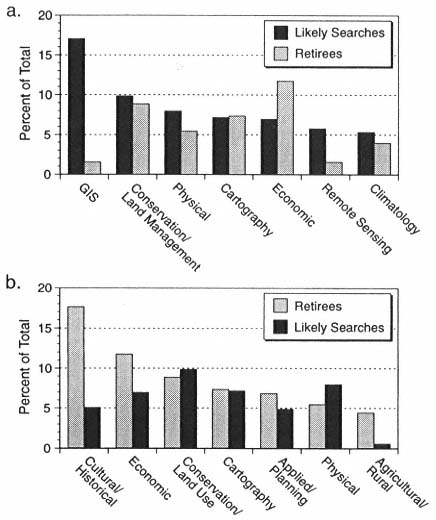
Figure 1:
Topical specialties of projected retirees and future faculty searches.
coordinators in 37 of 50 states and the District of Columbia for a response rate of 73%. The crux of our questions involved state-level certification requirements. The extent to which geography courses are required and the rigor with which these requirements are enforced will influence the number and character of geography teachers demanded in the future.
What we discovered first is that education remains, as it was intended by Thomas Jefferson, a local matter. We received, quite literally, 37 different responses to our questions about certification and the local education environment. The Alliance Coordinators told us, in essence, that the future demand for geography teachers depends upon whether local school
districts require geography courses, indeed, whether they offer any geography courses at all; whether the state mandates a geography requirement; whether universities require geography for admission (the Universities of Colorado and Tennessee as well as the Minnesota State University System do); whether there is a separate certification for geography or whether geography falls only under the umbrella of the social sciences; whether individual universities impose geography requirements over and above state standards; how individual universities choose to apply state requirements; and how many (if any) geography courses are required for certification. Should it occur, the full implementation of the National Geography Standards will be played out across a highly disparate landscape of geographic education, and it is onto that landscape that we must gauge the future demand for geography teachers.
Acknowledging the different settings in which the Alliance coordinators work, we did discover some common ground with respect to the future demand for geography teachers. We asked coordinators to ''evaluate the present education environment in your state with respect to the future employment of geography teachers" over the next three and ten years. Responses reflected a cautious optimism about future demand (Table 4). Two-thirds of the coordinators anticipated some increase in the demand for geography teachers within the three-year horizon and 72% within the ten-year time frame. For the latter period, 35 of the 36 respondents who answered this question anticipated some increase, either modest or large.
But when coordinators were asked to express their expectations about the future demand for geography teachers in an open-ended question about the "key factors" affecting the future demand for geography teachers, a more qualified picture emerges. With a few notable exceptions, the coordinators do not expect large increases in the number of trained geographers teaching geography classes at the precollegiate level. Three interrelated themes underlie their qualifications. First, many argue that we should not view geography as a free-standing subject but as part of an integrated social studies curriculum. The demand for geography teachers will not change significantly. What will change is the idea that geography is part of the core of the training of every elementary teacher and secondary social studies teacher.
In one way or another, many of the coordinators also acknowledged the realities of the certification structure (that often little geography course work is required to teach geography) and the lack of connection between someone who teaches geography in the schools and someone who holds a degree in the field. In the short-term, increased demand for geography in the schools will result in the transfer of teachers from other disciplines or grade levels; it will not result in large increases in the demand for individuals who hold degrees in geography or even have significant course work in the discipline. In the long run, if the National Geography Standards are widely accepted, there will be sustained improvement in the preparation of people teaching geography, and the separation between teachers of geography and geography degree holders will gradually disappear. We picked up the difference in the coordinators' long- and short-term perspectives when greater optimism was expressed at the ten than at the three-year time horizon.
And finally, some coordinators mentioned the age structure of teachers and the institutional framework of local school districts as
Table 4 Geography Alliance Coordinators' Assessment of the Future Employment Prospects for Geography Teachers
|
Response |
Next 3 Years |
Next 10 Years |
|
Large increases |
2 ( 5.6%) |
9 (25.0%) |
|
Modest increases |
24 (66.7%) |
26 (72.2%) |
|
No change |
9 (25.0%) |
1 ( 2.8%) |
|
Modest reductions |
1 ( 2.8%) |
1 ( 0%) |
|
Large reductions |
0 ( 0%) |
0 ( 0%) |
|
Source: Summary of Geography Alliance Coordinators' responses to the question: "How would you evaluate the present education environment in your state with respect to the future employment of geography teachers? Over the next three years? Over the next ten years?" |
||
factors affecting the future demand for geography teachers. In one district in Minnesota, three-quarters of the secondary social studies teachers are in their 50s and are looking forward to early retirement. In other areas, the demographics do not allow for rapid turnover of the work force. A related concern among many coordinators is that institutional inertia will not permit rapid growth. Their perception is that social studies education traditionally has been dominated by historians who would not readily cede control of personnel and curriculum to geographers.
On the basis of this survey, we do not expect that the demand for geography degree holders will increase significantly in the short and midterm, as a result of geographic education initiatives. Geographic Alliance activities, along with national-level geographic education initiatives, will almost certainly result in a higher visibility for geography within the curriculum and in more geography courses being offered, but most of this material and most of the courses will be taught, at least in the short run, by transfers from other fields. The full and widespread implementation of the National Geography Standards, if it occurs, would have a deeper and more long-lasting effect on the long-term labor market for geography teachers.
Bureau of Labor Statistics Projections
The Bureau of Labor Statistics (BLS) forecasts employment change to the year 2005 by occupational and industrial classifications. Unfortunately, geographers do not fit easily into the established classification systems. BLS separates teachers into elementary, secondary, and college and university faculty but does not distinguish among academic disciplines or even between sciences and social sciences. The category of urban and regional planners captures geographers who are urban and regional planners and transportation planners, but environmental planners are grouped, for statistical purposes, with architects. GIS/remote sensing specialists are put into a large group of systems analysts and computer scientists. Cartographers are classified with surveyors but comprise a small proportion of the total category. Environmental managers/technicians are poorly defined by the very heterogeneous categories of "other physical scientists" (for managers) and "other engineering technicians" (for technicians).
Nevertheless, we looked at the BLS data to gain a broad understanding of future employment trends in those job classifications in which geographers are clustered (Table 5). BLS forecasts total employment growth between 1992 and 2005 using low, moderate, and high employment growth scenarios. For the national economy as a whole, moderate projections call for all occupations to grow by 22%. Professional and technical jobs involving high levels of skill and education are expected to grow faster than average. There is an enormous range in projected growth in the job classes frequented by geographers. That the class of systems analysts and computer scientists will experience the fastest growth fits with all the other evidence that we have collected pointing to GIS as a high-growth specialty within geography. In contrast, the class of surveyors, which contains cartographers, is expected to grow slowly, although it is questionable whether geographer/cartographers, who are much more closely related to GIS graduates than to surveyors, are truly represented in this category.
Projected employment growth is higher than average in the "other physical science" category in which our environmental managers are classified. Environmental legislation such as the Clean Air Act, Clean Water Act, Superfund Act, Resource Conservation and Recovery Act, and National Environmental Policy Act spawned new environmental regulations. These regulations, in turn, promulgated a new industry of environmental regulators working at various levels of government and environmental consultants helping the private sector to meet the regulations. At the same time, the number of urban and regional planners and architects is expected to grow at about the national average.
Higher than average growth is predicted for secondary teachers as a whole, and geography's favorable position relative to national education trends implies that this may be another growth area for new geographers. We need, however, to temper any optimism in this regard with all the caveats raised by Geographic Alliance Coordinators in assessing the future
Table 5 Employment Projections to 2005 by Occupation
|
|
|
1992-2005 Employment Change Percent |
||
|
|
1992 Number ('000) |
Low |
Moderate |
High |
|
All Occupations |
121,099 |
15 |
22 |
28 |
|
Professionals |
16,592 |
30 |
37 |
43 |
|
Architects |
96 |
19 |
25 |
41 |
|
Surveyors |
99 |
6 |
13 |
28 |
|
Computer systems analysts |
455 |
96 |
110 |
120 |
|
Urban and regional planner |
28 |
16 |
23 |
29 |
|
Other physical scientists |
30 |
37 |
46 |
54 |
|
Elementary teachers |
1,456 |
16 |
21 |
26 |
|
Secondary teachers |
1,263 |
30 |
37 |
42 |
|
College and university faculty |
812 |
20 |
26 |
31 |
|
Technicians |
4,282 |
24 |
32 |
38 |
|
Other engineering technicians |
392 |
7 |
16 |
25 |
|
Source: Silvestri, G.T. 1994. Occupational Employment: Wide Variations in Growth. The American Work Force: 1992-2005. Bureau of Labor Statistics, Bulletin 2452. |
||||
demand for geography teachers at the secondary level.
The demand for collegiate-level faculty and elementary teachers is expected to grow at rates about average for the economy as a whole. Geography's ability to make inroads at the collegiate level depends upon the discipline's ability to compete with related fields for a share of very limited budgets. The majority of vacant positions will result from replacements on existing lines rather than from new lines.
The BLS occupational projections for 1992-2005 are based on extrapolations of past labor market trends. The period immediately preceding these projections was characterized by a national recession with productivity levels down, part-time employment growing, savings levels persistently low, and medical and health care expenditures rising as a share of the gross domestic product (GDP). Since these occupational projections were announced, a number of these trends have changed (Kutscher 1993). The national economy is no longer in recession, although job growth is slow by historic standards. Productivity is on the rise, but this is partly due to the fact that firms are reducing labor forces while maintaining the same level of output. Part-time employment continues to grow and is becoming prevalent in sectors other than retail services. The share of GDP spent on health care appears to have peaked, yet the current debate in Congress renders moot almost any projection on longer-term impacts. Given the volatility of the current situation, coupled with the poor fit of geographers to BLS job categories, the BLS projections provide only the most general barometer of future labor market conditions for geographers.
National Economic Trends
We speculate on the way geographers will be affected by a number of important changes underway in the national economy. The trend toward increasing computerization continues to hold. Entry-level jobs assume computer literacy beyond simple word processing and data management. At the same time, basic input activities are increasingly being automated with the help of scanning technology and other innovations. Employers want employees to be able to use data for analysis, not just for information compilation (Farnham 1993).
Geography graduates will also be influenced by the growing trend toward part-time employment and contingent labor contracts (Fierman 1994). We noted earlier the tendency for recent graduates to be employed part-time immediately after receiving the bachelor's degree. Departmental chairs further verified the growing connection between geography graduates and part-time employment. When queried about the future hiring of part-time faculty, 37% thought the demand for such faculty in their departments would increase during the next five years. Only 13% predicted that they would be less reliant on temporary or part-time faculty.
Part-time employment provides flexibility and reduces overhead costs for firms and or-
ganizations. While once primarily the purview of firms in the retail sector, part-time work is increasingly found in sectors other than services. Corporations are downsizing and subcontracting activities formerly performed inside the corporation. Downsizing and subcontracting are occurring at all levels, including blue-collar, administrative, and executive-level jobs. Thus, a person's first job may not be permanent or even full-time. Moreover, it is less likely to require skills specific to the firm. By implication, firms are looking for people with strong general backgrounds, a range of skills, and the ability to work efficiently in many different settings.
Another important trend with the potential to affect geographers is the growing tendency for private sector firms to use pools of labor found around the world to undertake such service activities as software design and computer programming (Martin 1992). For example, a corporation may hire skilled workers in low-cost countries such as India and Ireland to perform tasks that have heretofore been conducted on shore. Companies currently hiring graduates with GIS training may be able to find cheaper, equally skilled workers in other English-speaking countries. Lest we think this trend cannot have an impact on our field, keep in mind that major software companies use English-speaking labor forces around the world to answer user problems and to provide technical assistance. Companies like Texas Instruments and International Business Machines and construction companies such as Bechtel have established white-collar technical support staff in developing countries to take advantage of skilled labor at low cost.
The labor market for geographers may be affected by the continued decline in the defense sector, which is thrusting thousands of engineers and technicians into a very weak aerospace labor market. Consequently, these highly skilled, computer-literate individuals with significant problem solving capabilities may compete for jobs formerly held by geographers with computer skills. Much like the 1970s, when the end of the Vietnam War put thousands of technical workers out of jobs, displaced defense workers have filtered into the public sector, running data processing and other technical operations. The extent to which these workers compete for geographers' jobs depends on their ability to gain necessary skills. Given significant federal government funding for the retraining of aerospace workers (on the order of $100 million), there is a strong likelihood of a growing supply of technical job seekers, some of whom will get jobs that geographers might have filled.
Also relevant to geography are privatization trends in government employment. Government at all levels is contracting for services, particularly services that require high-cost, in-house staff. The flip side of contracting is the growth in private sector firms providing technical services. Data are too aggregate to discern whether consulting firms use contingent workers on government contracts; however, given that government contracts are in all likelihood small in size and short-term in nature, part-time work may be one means by which contract firms manage the flow of jobs.
What do these trends mean for the future employment of geographers? Geographers, like other highly skilled workers, increasingly are competing in highly volatile and uncertain labor markets. Moreover, the cohort of new geographers who will enter the labor market in the next decade will be forced, by their sheer size and by privatization trends in the public sector, to seek out positions in the private sector not previously associated with or held by geographers. Success in the current labor market seems to be tied to computer skills, a solid generalist background, and the ability to adapt to a wide range of job tasks and employment situations.
AAG Sponsors
We conducted a small survey of employers of geographers through structured interviews with AAG sponsors. These sponsors include book publishers, map and atlas publishers, geographic applications software developers, and geographic research applications specialists. In a written letter we invited representatives of the AAG's 12 corporate sponsors to communicate their views about the future demand for geographers and, more specifically, about the types of expertise that will be required for geographers to keep up with the ever-changing demands of their businesses. We were successful in conducting telephone interviews with
eight of the 12 corporate sponsors. Each respondent was asked the following questions:
- In what types of work, if any, do you employ geographers?
- What are your impressions of the strengths and weaknesses of the training these individuals receive?
- What are the major trends in your business that will affect the demand for geographers, and what forces generate these trends?
- How can geographic training be improved to accommodate demands generated by these trends?
Not all corporate sponsors hire geographers. Yet each has a vested interest in the vitality of the discipline and was optimistic about the future demand for geographers. Corporate sponsors employ geographers in three ways broadly characterized as applications, customer service, and training. Applications geographers, the largest number, may be technicians, analysts, or managers. They are hired to provide geographic information in the form of vast datasets and maps and often to analyze this information using imagery analysis, GIS, cartography, photogrammetry, and spatial modeling. Corporate sponsors also hire geographers to train others and provide customer services for addressing such applications questions.
Sponsors prefer candidates who can act as decision makers, not just technicians. Knowing how to employ data is considered more important than knowing the technical specifications of data sources, software, or hardware. Sponsors repeatedly told us that they could hire engineers for such technical expertise. Geographers are valued for their mix of technical skills with a broad-based, multidisciplinary background. Geographers bring expertise in environmental and spatial problem solving, and they are adaptable to a wide range of employment situations.
In the view of corporate sponsors, the primary trends affecting the future demand for geographers are the continued and widespread adoption of GIS technologies and the explosive growth in global positioning systems (GPS). Both have a variety of applications, including transportation design and development and utility planning, suggesting the need for geographers to take more courses in civil engineering. Other sponsors noted the need for geographers to merge GIS technology with visualization technologies.
While recognizing the pivotal role of GIS in driving the future demand for geographers, the sponsors expressed concern that GIS will lose its geographical identity—that applications will become less geographical and more like information processing. They also worry that increased technological capacity, such as hyper-spectral and high-resolution spatial imagery, will bog down systems. Geographers able to understand appropriate uses, not simply more sophisticated uses, will be in demand.
Two themes emerged in response to our question about the weaknesses in the training of geographers. Some sponsors felt they were getting too many "button pushers" who know "cookbook" applications but are unable to work through a problem from start to finish. A related theme involves poor writing skills. It is clear that geographers' niche in the labor market comes from the ability to combine technical expertise with a broad training in the liberal arts stressing decision making, communication, and critical thinking.
We make no claims that the views of eight sponsors are indicative of the private sector as a whole. Instead, we offer this information as one more piece in the very complicated puzzle of future labor market conditions in the field. We note the consistency in the theme of GIS as the handle with which new geographers gain access to the labor market.
Summary and Conclusions
This scan of future demand conditions questions whether there will be sufficient jobs for the explosion of new geography majors currently in the educational pipeline (see Part 1 in this series). Positions at the collegiate level will be primarily replacement lines. In the short turn, it is unlikely that large numbers of new geographers will be needed at the secondary level, although this situation may change depending upon the success and comprehensiveness of the new National Geography Standards. The demand for geographers also may be dampened by larger trends in the national economy, including the privatization of government jobs, the traditional backbone of ge-
ographers' employment; the displacement of aerospace workers with complementary skills; and economic globalization, which carries the potential for substituting foreign for domestic workers. During the 1980s, the discipline did a phenomenal job of attracting new students who came to see geography as the steppingstone to a satisfying and productive career. Our challenge for the 1990s is in identifying new niches of employment for the students we have so successfully attracted to the field, in marketing ourselves to potential employers as effectively as we have to potential students, and in helping students make the difficult transition to a highly volatile, competitive, and uncertain labor market.
Our interviews with AAG corporate sponsors have implications for the undergraduate curriculum. The debate over geography as a broad-based liberal arts discipline or as a technical, semiprofessional field ignores the realities of the current labor market. Sponsors told us that they want employees who can combine technical skills with a broad-based background. Geography's comparative advantage over other social sciences lies in its ability to combine technical skills with a more traditional liberal arts perspective. Successful geography programs will be those that are able to find the appropriate balance of field-based technical skills like GIS, cartography, and air photo interpretation with competence in literacy, numeracy, decision making, problem solving, and critical thinking.
The effects of geographic education initiatives on the labor market for geographers will be played out over a geographically disparate landscape of teacher certification requirements, high school geography requirements, and university entrance requirements. Because education, including geographic education, is largely a local matter, local geographers are best equipped to keep tabs on state certification requirements and their effects on the demand for geography teachers, university requirements and their effects on precollegiate geography training, and the trickle-up effects of the implementation of National Geography Standards. •
Literature Cited
Farnham, A. 1993. Out of college, what's next? Fortune July 12:58-64.
Fierman, J. 1994. The contingency workforce. Fortune January 23:30-36.
Kutscher, R.E. 1993. Historic trends, 1950-1992, and current uncertainties. Monthly Labor Review 116(110):3-10.
Martin, J. 1992. Your new global workforce. Fortune December 14:52-60.
Swan, P.N. 1992. Early retirement incentives with upper age limits under the Older Workers Benefits Protection Act. Journal of College and University Law 19:53-72.
PATRICIA GOBER is Professor of Geography at Arizona State University, Tempe, AZ 85287-0104. Her areas of interest are population and urban geography.
AMY GLASMEIER is Associate Professor of Geography and Regional Planning at Pennsylvania State University, University Park, PA 19802. Her areas of expertise include economic and industrial geography, public policy, and trade and technology.
JAMES M. GOODMAN is Geographer-in-Residence at the National Geographic Society, 1145 17th Street NW, Washington, DC 20036-4688. His areas of interest are geography alliance management, outreach programs in geographic education, and American Indian lands and resources.
DAVID PLANE is Professor and Head of the Department of Geography and Regional Development at the University of Arizona, Tucson, AZ 85721. His areas of interest are population geography and regional science.
HOWARD STAFFORD is Professor of Geography at the University of Cincinnati, Cincinnati, OH 45221-0131. His areas of interest are industrial location and regional economic development.
JOSEPH WOOD is Associate Professor and Chair in the Department of Geography and Earth Systems Science at George Mason University, Fairfax, VA 22030-4444. He studies and writes on the American settlement landscape, from colonial New England villages to contemporary suburbs, and is presently investigating the increasing Vietnamese presence in northern Virginia.


