
A Scalar Approach to Ecological Constraints
Bryan G. Norton
Environmental Problems In Perspective
Environmental problems arc basically problems of scale. This is especially true of environmental problems that involve ecological constraints as important elements. This chapter considers scale in a broad social sense. In particular, it examines the effect of social values on the scale at which we experience the world; conversely, it explores the role of objective determinations of scale in shaping social values. These two aspects of scale apparently represent a complex and highly interactive dynamic. We can think of these interactions as posing problems in the phenomenology of space—the study of space as experienced, which is itself an important, if somewhat neglected, branch of geography (Seamon and Mugerauer, 1989; Tuan, 1971, 1977). This approach emphasizes sense of place values and sentiments, recognizing that all people value objects from a particular perspective; further, the scale of space that people perceive as their sphere of action imposes a shape on their consciousness and their valuations.
The "objective" concept of space that is favored in the modernist, Newtonian perspective has fallen on bad times in this century; in the postmodernist period, time and space have been relativized and complexified in ways that could not be imagined within the Newtonian tradition (Prigogene and Stengers, 1984). Our conceptions of space and time are undergoing rapid flux as it has become clear that one cannot think of space as a unified, continuous plenum on which events can be unambiguously located. It turns out, on the contrary, that there are many— possibly incommensurable—correct characterizations of spatial relationships, depending on the perspective specified and the scale chosen. The world as described from the viewpoint of a mite that lives on a beetle differs fundamen-
tally from a description of the world as viewed by large-bodied mammals such as ourselves. If our descriptions of multiscalar natural systems inevitably involve a choice regarding the perspective from which, and scale on which, to measure and monitor natural systems, how can we avoid the apparent implication that our human values and perspectives may influence the scales we observe and describe in nature? If this implication is accepted, it seems also to follow that the "descriptive" models we use to characterize natural processes actually express, in a less explicit but nevertheless profound sense, the values we pursue and the actions we take in pursuing them.
While a full exploration of this less objectivist approach to scale would be beyond the scope of this paper, these general ideas set the background for the more particular explorations undertaken here. I believe that conservation biology, restoration ecology, and ecological engineering are all "normative sciences" and that choices of models to understand interactions between humans and nature are either explicitly or implicitly based on value considerations. One of the important ways—perhaps the most important way—in which values affect science is in our choice of scales on which to characterize and address ecological risks and problems. For this reason I undertake, with some trepidation, an examination of scalar aspects of human values as my contribution to the discussions of engineering and ecological constraints central to this volume.
This paper addresses three important aspects of scalar problems in environmental values and policy. First, I explore the idea that the nonnative disciplines of conservation biology, restoration ecology, and ecological engineering use a "scientific" language that must have normative as well as descriptive content. Further, I believe that this valuational element is often embodied in decisions regarding the scale we choose to employ and the scale of the models we construct in our observation and manipulation of our environment. Second, building on empirical and theoretical work by Holling (1978, 1992, 1994, and in this volume), I propose a multiscalar analysis of social values and argue for a pluralistic approach to environmental policy. This approach recognizes multiple, irreducible values derived from nature by humans, seeks to associate particular values and classes of values with specific natural dynamics that are dominant on various scales of the environment, and organizes human values according to scale, providing multiple criteria of good management guided by multiple values. Finally, I will offer a series of devices called risk decision squares, which help to sort decisions affecting the environment according to an ecologically—that is, spatially and temporally—sensitive typology of risks involved in a given decision.
Environmental Problems As Scalar Problems
One important consequence of the rise of modernism and the Newtonian, objectivist model of the physical universe is that choices of scale and perspective become an essential element in every description of nature. Observation is nec-
essarily from some place, and the relevant scale must be specified. These general conclusions follow from relativity theory (Prigogene and Stengers, 1984). But ecological processes, especially, can also be described on countless alternative scales (Levin, 1992). How do we know the scale on which to model an environmental "problem" and measure our progress toward solving it? Pure ecology cannot be the only guide because the descriptions of nature it provides are too numerous and also incommensurate because of the differing scales they embody. An important goal of environmental ethicists and policy analysts should therefore be to ascertain which natural dynamics are associated with important social values. What is needed is a more encompassing, interdisciplinary discussion of environmental values and goals. Of course such a discussion must be based on the best science, but establishing crucial links between ecological processes and environmental policy can be understood only in conjunction with a process of articulating important social values. In the process, the boundary between theoretical ecology and applied disciplines, such as restoration ecology and ecological engineering, will no doubt be blurred.
Determining which dynamics require special protection is an evaluative task that can only be done from a perspective; and identifying scales and bifurcation points is on this view a crucial aspect of management. All of this is part of defining what is a healthy system and when a system maintains its integrity.1 Scale is at the heart of all these problems, but we cannot choose appropriate scales to focus on until we understand both how ecological functions and processes work at various levels and how these functions and processes are associated with social values. Fully understanding this point will require that we reconsider the assumptions of "value-neutral science." In the modern, Cartesian-Newtonian period, and especially in the positivist era of science since 1900, description and evaluation have been regarded as separable steps in the process of understanding and acting in nature. It has been thought that natural systems and their products can first be described and that evaluations can then be applied to these "objective" descriptions as a separable step in the process of judgment and choice of actions. What we know now is that our choice of descriptive concepts shapes our perceptions (Kuhn, 1962; Quine, 1960). Even more important, conceptual and theoretical choices are colored by our values because we choose our theories in the process of accomplishing conscious or unconscious goals through action.
The recognition that some of our concepts embody both factual and evaluative content is really only a special case of a much more general phenomenon— description and prescription are so entwined in our use of language that it is often impossible to separate them in ordinary discourse (Nelson, 1995; Williams, 1985). This interpenetration of values and facts in ordinary discourse can be cited as one of the reasons scientific disciplines create more precise vocabularies; but, however useful an introduced special vocabulary, such formalistic languages cannot ultimately achieve pure description and at the same time be rich enough to guide
behavior, as Nelson argues. Every choice of a vocabulary to describe nature requires an exclusion of other facets of reality. Every choice to measure features x or y involves a choice not to measure some other features, w and z. Languages are in this sense more like spotlights than floodlights (Norton, 1991). They highlight certain aspects of our experience and push other aspects into the unmeasured shadows. Thus, while measurements of aspects of nature might be carried out with precision and "objectivity," the choice to measure one aspect and ignore others nevertheless reflects an implicit or explicit evaluation of the comparative importance of the aspects.
In this sense, the emergence of an ecological approach to environmental management embodies a shift in language and hence a resolution to pay attention to different aspects of nature as we examine management options. Because nature is irreducibly complex and there exist countless correct descriptions of nature, we focus on only a few of these as helpful in deciding how to live. These choices to focus on a particular dynamic to measure involve, however subtly, value judgments, which are embodied in our decisions regarding what variables to monitor. Let us begin our exploration of values implicit in scalar decisions with a well-known example—attempts to protect the Chesapeake Bay—that will illustrate how social values and physical scale interact in the formulation and response to an environmental problem. In the 1960s, a number of observers declared that unhealthy changes were taking place in Chesapeake Bay. Early alarms were expressed in many different vocabularies. One state legislator, for example, decried the fact that he could no longer see his toes when standing in waist-deep water (Horton, 1987). These varied expressions of concern did not yet amount to a well-formulated environmental problem because the problems of bay water quality had not yet been characterized and modeled with sufficient precision to allow a description and evaluation of changing trends. In the wake of a major U.S. Environmental Protection Agency study (1983), public and scientific opinion united behind a "model" of the problem of bay water quality as affected by nutrient loading from stationary and nonpoint sources. In the course of focusing on the processes affecting bay water quality, an important scalar, boundary issue was also resolved: management attention moved from the bay stem and tributaries to the widespread lands that form the watershed. The formulation of the "problem" with the Chesapeake involved important choices about what processes were crucial for defending social values, as well as scientific attempts to measure and monitor those important processes.
While this example represents a complex process of problem articulation in simplified form, it illustrates how a society, by focusing on certain trends as environmental problems, implicitly builds important value judgments into its choice of scales. The complex process of formulating environmental problems is diagrammed in Figure 1. The triangle must embody both evaluative and empirical inputs. The horizontal bar represents the point at which a full-blown environmental problem can be addressed.
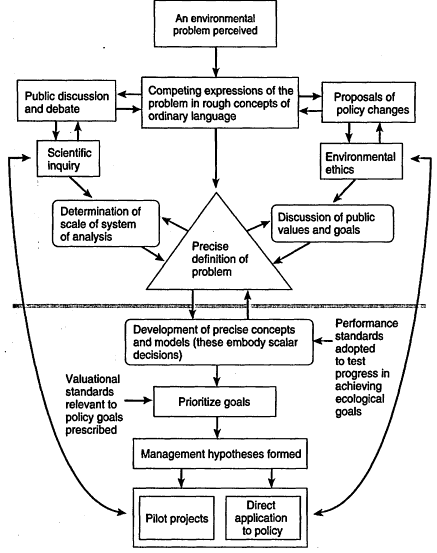
FIGURE 1
The environmental policy process. Environmental problems are not clearly formulated when they first emerge in public discourse. Determination of the proper scale at which a problem should be ''modeled'' requires an interactive, public process in which public values guide scientific development of models. Once the problem is precisely defined and models developed, the process of experimentation with solutions can begin. Source: Reproduced from Norton and Ulanowicz (1992) by permission of Amnbio.
Consider another, even more schematic, "environmental problem"—Garrett Hardin's tragedy of the commons (1968). Hardin's parable, while introduced as applicable to human reproductive decisions and human population, is remarkable in its broad applicability to virtually every environmental problem. Hardin's parable achieves such generality because environmental quality is so often a public good that must be achieved in spite of individual interest, rather than because of it. No matter how large a finite commons, the unfettered exercise of individual, self-oriented values will lead eventually to its destruction; as the "herd" is expanded by individual choice, the individual-scale decisions will add up to a total effect too great for the carrying capacity of the commons. Individuals, motivated by short-term profits, will not adequately consider the longer-term consequences of their actions, because these are delayed and diffused throughout the community—they exist on another scale in time and space. Unless individual action is limited by mutually agreed-upon constraint, the public interest will be destroyed by individual choices. Hardin's scenario is our scenario, because we are at that point in history at which human population and industrial growth are approaching or surpassing the carrying capacities of many systems. In this unprecedented situation, even the functioning of ecosystems essential to regional economies and communities become public goods. They represent resources that cannot be owned—they are available to everyone if they are available to anyone—and they can be destroyed by aggregate action in which each individual actor seeks his or her self-interest exclusively. Hardin's parable, by modeling environmental problems as community-scale problems resulting from individually motivated decisions, therefore illustrates in general terms how environmental problems are most basically problems of scale.
Holling's World
Recent groundbreaking work by Holling has hypothesized, and provided significant empirical evidence, that the dynamics of natural systems "are controlled and organized by a small set of key plant, animal, and abiotic processes." He further argues that "the geometry of landscapes and ecosystems is organized into a small number of quanta with distinct architectural attributes," attributes that are especially relevant from a human perspective (Holling, 1992, p. 449; also see Allen and Starr, 1982; Norton and Ulanowicz, 1992; O'Neill et al., 1986).
Holling's work supports, both theoretically and empirically, a broadly hierarchical approach to understanding physical and ecological processes, suggesting that the human tendency to understand complex systems hierarchically (noted by Allen and Hoekstra, 1992; Allen and Starr, 1982) is not adventitious. It is a structural aspect of natural systems as they are experienced by human observers. Indeed, Holling's evidence suggests that all mammals of roughly human body size must perceive the world as organized according to similar scalar properties. Holling concludes that "The landscape is structured hierarchically by a small
number of structuring processes into a small number of levels, each characterized by a distinct scale of 'architectural' texture and of temporal speed of variables" (Holling, 1992, p. 484). This hypothesis, if verified by further research, may have important consequences for the way we think about environmental values as well. Holling's model suggests (a) that environmental values are shaped, perhaps even genetically, within an architecturally structured natural world; (b) that human valuation may therefore exhibit scientifically describable scalar characteristics; and (c) that an examination of scalar aspects of environmental valuation may illuminate the perplexing problems of intertemporal evaluation.
Further, these theoretical ideas can be developed into a general approach to managing ecological systems as developed in Holling's contribution to this volume. Holling argues that, since systems exhibiting these characteristics can function in more than one equilibrium, and since changes in these structural features can occur abruptly, switching systems into alternative equilibria, it will be necessary to modify traditional engineering approaches to stability. As a system is controlled (to maximize production of a particular species, for example) it becomes more brittle, setting it up for pathologies and "flips" into a new steady state. He concludes that in the face of such flips and pathologies, near-equilibrium behavior and control (engineering resilience) seems irrelevant and the prescriptive goal shifts from questions of maximizing constancy of yield to one of designing interrelations between people and resources that are sustainable in the face of surprises and the unexpected. On this view, management attention "shifts to determining the constructive role of instability in maintaining diversity and persistence and to designs of management that maintain ecosystem function in the face of unexpected disturbances" (in this volume, p. 38). This general approach is sometimes referred to as ''adaptive management" (Holling, 1978; Lee, 1993; Walters, 1986). Holling's ideas, and those of others who are exploring similar approaches, may usher in a new era in thinking about environmental management, an era that is more concerned with processes, functions, and thresholds, and less concerned with system behavior near equilibrium.
And yet (as I think Holling realizes), there is a confounding paradox at the heart of this new and promising approach to management. Where do human values and choices fit into this complex system of analysis? Can humans, by managing their own behaviors, shaping them consciously in response to ecological information, "choose" to forbear from certain actions to protect processes crucial to ecological structure and function. Since most applications of hierarchical organizational structures emphasize that control and constraints flow down spatiotemporal systems, with the larger and slower-changing processes constraining the behavior of individuals at lower levels, hierarchical reasoning is therefore best suited to treat human choices as effects of natural changes. And yet humans are today, without question, important, even dominant, actors in every "natural" hierarchy. Looked at in this way, it is often the accumulation of many individual human choices (based in human "values") that drives changes in ecosystem states.
It is possible to characterize this dual nature of human activity—as free choices of individuals on one level and as reaction to constraints imposed from the above level—in terms of hierarchical organization (Koestler, 1967; Simon, 1969).
Hierarchy theory embodies two formative assumptions. First, it is perspectival; every measuring or modeling effort takes place from some specified viewpoint, and a scale must be specified from that viewpoint. Second, as noted above, hierarchy theory correlates spatial and temporal scale, positing that smaller subsystems change more rapidly than do the larger systems in which they are embedded. Hierarchy in ecology also assumes that the dynamics of nature are sufficiently distinct that different levels can be described in relatively discrete terms. Hierarchy theory therefore provides a useful formalization of spatiotemporal relationships in complex systems such as natural and managed systems. Humans act freely on the scale of individual choice; and yet these choices are constrained by environmental conditions imposed from above. Freedom occurs within constraints imposed by ecological and physical systems that change more slowly. Free action is also, of course, constrained by political and culturally based rules.
What is unusual about my approach is the use of hierarchical thinking to inform an explicitly value-laden search for models that will help us to understand and manage natural systems to support important social values. This search requires a normative science, and I think conservation biology and restoration ecology should be understood within an activist, normative context. The search is for models of natural and physical systems that illuminate the interactions of human choices and policies with larger features of a landscape. And, to the extent these models can reflect human values in the structural hierarchies they posit, they are intended as "prescriptively" adequate as well as descriptive and informational.
Taking perspective seriously may require that, from a management perspective, the hierarchy will be constructed from many local perspectives. Hannon (1994) has therefore proposed that we understand human values as "discounted" across space as well as time; this concept may make it possible to measure more precisely the relationship of location and intensity of valuation, encouraging a more empirical study of the spatial scale on which social values are experienced and articulated. In this context, Hannon's result suggests that environmental values will be highly place-relative and that the perspective and valuations of one community may differ significantly from values as expressed in another community.
If Holling and Hannon are correct, humans have evolved special sensitivities to patterns perceived in nature. Holling's version sees the individual, human perspective as organized on three environmental scales. For an organism of human size and longevity, the microscale (centimeters to tens of meters in space and days to years) is dominated mainly by processes that determine vegetative structure and by immediate structures (including artificial ones) that shape individual behavior. At the macroscale (from hundreds to thousands of kilometers and centuries to millennia), the system is structured by slow geomorphological
processes that define the basic edifice and topographic structure. Processes on this level are normally so slow that they can be considered constants from the perspective of human choices. The middle, or mesoscale (tens of meters to hundreds of kilometers and years to decades), is dominated by natural processes such as outbreaks of fire and plant disease and by human decisions and policies such as grazing and forestry. The mesoscale is therefore of crucial importance to human habitation; but it is also this scale that exhibits the crucial discontinuities identified by Holling as changes in ecosystem organization.
Clearly, human choices now shape the environment in countless ways; one of the consequences of Holling's argument is that it emphasizes not just the constraints that work their way down natural hierarchies—the limits on searching procedures available to specimens of an animal species of a given body size, for example—but also on the impacts that work their way up the hierarchy, such as the cumulative effects of many clear-cuts by many agents on crucial variables such as regional hydrology. Humans, who make conscious choices and who are armed with technology and stored fossil energy, can disrupt processes and rapidly introduce discontinuities into the crucial mesoscale systems. The question is whether human societies will be able to adapt and thrive when the ecological context in which they have evolved changes ever more rapidly. Technological optimists accept the disturbance-response cycle as inevitable, seeking to ameliorate unexpected negative outcomes of accelerating environmental change through investment. But Holling's conclusions seem to imply that ecological systems can be "swamped" by human impacts on productive cycles that will gradually become more brittle and collapse; his view is therefore more supportive of technological pessimism than optimism (Holling, 1994).
Be that as it may, the point here is that our perception of scale represents a curious mix of imposed, "objective" structure on the one hand and of "human" construction on the other. Hierarchy theory provides a powerful tool for characterizing natural systems as architecturally structured, nested dynamics that fall into discrete portions of temporal and spatial possibilities. This aspect provides structure both to physical space as studied by scientists and to space as it is experienced by conscious human actors. But this "objective" treatment of space and time is only one side of the story. It is also true that humans have, within this fixed structure, consciously developed, formulated, and pursued values—embodied in actions and goals—that create a mental or phenomenological representation of physical structures in their experience. I now turn to a brief discussion of the other side of the story.
Are Human Values Scaled?
In this section, I explore the possibility that human values are "scaled" in the sense that different human values have distinctive "natural habitats" in somewhat different contexts and scales. A scalar theory of human valuation has as its goal
the illumination of choices that are made in different time contexts. If we can make sense of shifting temporal contexts in decision making, we may be on the way toward a rational means of setting priorities by deciding which human values are appropriately emphasized in different temporal situations. It will be useful to introduce this idea by contrasting scaled values with the nonscalar values that form the basic building blocks of the value theory of mainstream economics. There is an interesting sense in which the welfare values of mainstream economists are nonscalar—all values that will be experienced in the future are expressed in a present-preference system of value (Norton, 1994). The process of discounting costs and benefits across time, in essence, reduces all future values to present equivalents. The protection of values that will be experienced in the future is expressed as the willingness of present consumers to forgo consumption today to improve the welfare of future generations. The methodological advantages of this reduction are unquestionable—comparing present values is all we can do if we must make a decision in the present. Discounting also provides a general explanation of the widespread human behavior of favoring present consumption over future consumption and delay of unpleasant consequences.
But a case can be made that, while values can only affect present decisions if they are experienced in the present, some values are experienced multigenerationally in the present. These values express themselves in evaluations of characteristics that emerge across multiple generations in a culture. Different human values come to the forefront as the context of decision making shifts. Consider, for example, a country that solemnly undertakes a constitutional convention (Page, 1977; Toman, 1994). In the ideal situation, delegates to a constitutional convention are able to step outside daily cares of the present and consider the consequences of various activities and policies on their social and civil life over longer periods of time, over multiple generations. If the constitutional convention is successful, it is because the delegates have adopted a more timeless perspective. The point of the example is that we do, quite naturally, shift time scales and emphasize shifting motives as we consider different questions in different contexts. Neither the present-value model of the economist nor the timeless deliberations of constitutional delegates is appropriate in every situation. As our motives shift, we vary the scale of our decision making.
Thinking about sustainability may be more like thinking about constitutions—multigenerationally—than it is like thinking about immediate consumer choices in free markets. Preliminary evidence suggests that individuals, in considering large-scale decisions affecting the landscape, tend to react as "citizens" rather than as "consumers" (Common et al., 1993; Sagoff, 1988). Varying the temporal scale, or horizon, of a decision shifts the focus of discussion, emphasizing some values and focusing on different dynamics; different information becomes relevant in this shift. If environmental problems are problems of scale, it seems reasonable to expect that there is a subtle interplay between human values and the temporal and spatial horizons we construct to bound our experienced
space. If environmental problems are problems of scale, it makes sense to think explicitly about how we construct mental models of the space in which we value nature.
In this spirit, I emphasize the horizon of concern expressed in environmental problems as setting a rough context for understanding and interpreting data in the search for a more harmonious relationship with ecological and physical systems. Horizons of concern are temporal scaling devices. Our operating assumption here is that, if Holling is correct, we should be able to construct an objective model of crucial ecological processes as viewed from the perspective of an animal of human lifespan and body size. Could we (a) define a set of dynamic, physical models that describe nature from a human perspective and then (b) choose that subset of possible spaces that reflect human values. This process of analysis, if successful, might result in an "association" of important social values with particular temporal horizons, and in turn an association of temporal horizons with physical dynamics of a particular scale. For example, Norton and Ulanowicz (1992) have shown, using a hierarchical analysis, that the protection of biodiversity is best modeled and pursued at the landscape ecosystem level. This follows from the temporal horizon of the goal of biodiversity protection—to protect biological resources for many human generations into the future.
But we have now deserted traditional "pure" and "value-free" science; we have recognized that the choice of boundaries for our physical models can express values and concerns that are shaped by our value-laden experience of space. The goal of this examination is to think more explicitly about this interaction between values and modeling and the ways in which our representations of natural processes and environmental problems embody spatial aspects of an action-oriented model for articulating environmental policy problems (a process that is represented abstractly in Figure 1).
Since it is a goal of model building in environmental management that the models inform environmental decision making to improve communication between scientists and the public, we conclude that any model for this purpose must be fairly simple in structure. It must, that is, be a simple enough representation of multiscaled natural processes to serve as an aid in public discussion of the goals of a forest management plan or a plan for ecological restoration of a river system. Our prescriptive, multiscalar models must provide a publicly useful vocabulary for discussing environmental goals. We can in this way shape our models of management by associating them with the temporal and spatial scales of the natural dynamics that generate the values guiding our choice of goals. In this sense we are searching for a spatiotemporally organized, and ecologically informed, phenomenology of the space in which individuals formulate and pursue personal and environmental values.
To initiate discussion, I suggest three basic scales, each of which corresponds to a temporally distinct policy horizon: (1) locally developed values that express the preferences of individuals, given the established limits and rules—
physical laws, governmental laws, and market conditions, for example—within which individual transactions take place; (2) a longer and larger community-oriented scale on which we hope to protect and contribute to our community, which might be taken to include the entire ecological community; and (3) a global scale with essentially indefinite time scales on which humans express a hope that their own species, even beyond current cultures, will survive and thrive. Table 1 exhibits these scales and shows how they correlate with different dynamics in the social and physical world.
On the first scale, which unfolds in the relatively short and local space in which individuals make economic choices, the economics of costs and benefits, if supplemented with a sense of individual justice and equity, can provide a useful model. The middle scale, in which we feel concern for our cultural connection to the past and the future, is especially important for two reasons. Viewed socially, this mesoscale, multigenerational level is the one on which we protect, develop, and nurture our sense of who we are as a culture.2 It is on this level that a society decides what kind of a society it will be. These decisions are expressed in art, in religion and spirituality, and in governing political institutions such as a constitution. It is on this scale that concern emerges regarding a culture's interaction with the ecological communities that form its context. The second scale is doubly important because it corresponds roughly to the ecological time scale on which multiple generations of human individuals, organized into communities, must relate to populations of other species that share our habitat. It also corresponds to the mesoscale of ecological organization emphasized by Holling. It is this scale that is crucial in understanding interactions between humans and nature on landscape scales.
The point of this paper has been to suggest that, in addition to single-scale valuation systems such as the one offered by economists, there exists an alternative, scale-sensitive framework in which to evaluate human actions that reshape the landscape. That approach attempts to associate a triscalar conception of human valuation with Holling's triscalar landscape, suggesting that we can sort
TABLE 1
Correlation of Human Concerns and Natural System Dynamics at Different Temporal Scales
|
Temporal Horizon of Human Concern |
Time Scales |
Temporal Dynamics in Nature |
|
Individual and economic concerns |
0-5 years |
Human economies |
|
Community, intergenerational bequests |
Up to 200 years |
Ecological dynamics; interaction of species in communities |
|
Species survival and our genetic successors |
Indefinite time |
Global physical systems |
environmental problems and decisions according to the temporal and spatial scale of the impacts of those decisions. Since the system is pluralistic and the spatial levels are governed by relatively discrete dynamics, the features of the mesoscale landscape that are important to humans on intergenerational scales may depend on protecting processes at different scales. The injunction not to change natural processes irreversibly into new equilibria that are unproductive, or otherwise undesirable from a human perspective, represents a commitment to conceive management ecologically.
Modern ecological knowledge forces us to conclude that we must act as members of natural communities as well as the human social community; it follows also that we must pay attention to the context in which our values are formulated and acted on. That context is best understood as the interaction between a culture and its habitat that is described in the natural history of a place. That natural history must reach back into time and project itself creatively into the future. Good management requires, in the immortal words of Leopold, learning to "think like a mountain," on the scale of time, that is, in which wolves, deer, and hunters interact as populations on a mountainside (Leopold, 1949; Norton, 1991). Thinking intergenerationally apparently requires that we pay special attention to the mesoscale of the landscape, the scale at which human populations interact as parts of ecological communities.
A Metamodel For Decision Making In A Discontinuous And Uncertain World
In this paper more questions have been raised than answered. I hope only that they are fruitful questions and that answers may begin to point toward a more systematic, scientific, and value-sensitive approach to the difficult problems of scale and human valuation. This last section offers a practical proposal in the form of a series of devices—I call them risk decision squares—which purport to represent in a general and abstract way the decision space encountered by decision makers in the uncertain and discontinuously changing physical space that humans necessarily encounter when they contemplate, and alter, their multiscalar environment.
If I cut one tree and plant another in its place, have I changed the natural world in a way that might be held blameworthy by some member of a future generation? In most cases of cutting and replacing one tree, I think I have not harmed the future—at least not in any morally significant way. At least two features of this simple scenario suggest the cutting of the tree is an intertemporally blameless act. First, I have taken immediate steps to replace the tree, thereby initiating restoration and ensuring, insofar as I could, that my damage would be reversed in the course of nature's time. Second, the description of my act was to cut a single tree, which apparently limits the scale of my destruction to a single, specifiable locale.
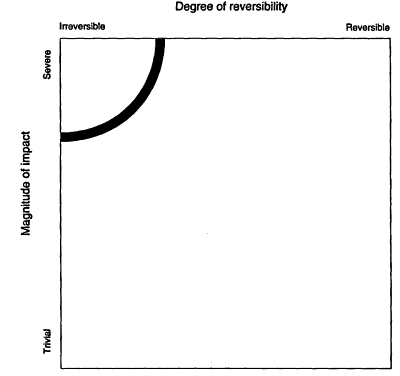
FIGURE 2
Risk decision square: neutral version. Source: Norton (1995a).
Let us build on these two ideas that the moral gravity of an action affecting the environment is determined by the irreversibility of its effects and by the spatial scale of those effects. We can do so by introducing a decision space defined by two continua, each of which ranks possible outcomes of a policy or action—one ranks the impacts according to how long natural processes will require to "heal" negative alterations to the environment, and the other ranks the spatial scale of the impact. These two scales are combined in Figure 2. Decisions with quickly reversible impacts and decisions affecting small scales probably do not raise questions of intergenerational moral importance. They fall in the northeast, the southeast, or the southwest quadrants of our decision space; they can be decided on normal, individualistic criteria of economic efficiency, balanced, we hope, by considerations of interpersonal equity. Ecological economists and environmental managers should, according to this analysis, categorize environmental problems according to the irreversibility and scale of the risks involved as a first step in any problem analysis, because this categorization determines the horizon of concern involved in the decision.
Note that the first continuum calibrates the temporal scale of our actions— the temporal horizon of possible impacts of an action helps us to define the outer limits of our responsibility. The second continuum locates decisions according to the potential spatial scope of their effects. This ensures that we distinguish between the act of cutting down and replacing one tree and a case in which cutting and replanting that tree is one incident in an ongoing process that will result in the clear-cutting of a whole watershed. In this latter case, we must consider the scale of the act not as that of cutting a single tree, but as part of a larger-scaled action—clear-cutting a whole watershed—which is sure to affect an entire ecosystem.
We can dramatize the difference between the decision model of economists and that of Holling and the ecologists by comparing Figures 3 and 4. Because they measure all values as present values, economists treat every possible loss as potentially compensable, which is justified if every resource has a suitable substitute.3 The decision space of economists is therefore confined to the dimension-less present, resulting in an economists' version of the decision space. Exploiting hierarchy theory's organizing assumption—that large spatial scale of a system is
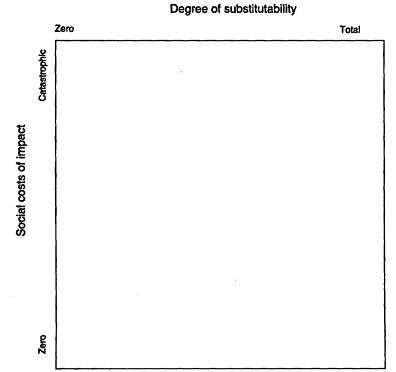
FIGURE 3
Risk decision square: economists' version. Source: Norton (1995a).
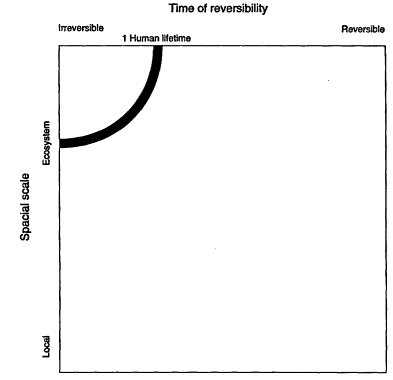
FIGURE 4
Risk decision square: ecologists' version. Source: Norton (1995a).
correlated with relatively slower rates of change—we can superimpose a hierarchical model on the decision space landscape, allowing us to locate risks on an ecologically defined decision space. One way to take scale seriously in environmental problems is to employ models such as this to identify risk decisions according to their ecological and social significance. These are both most difficult tasks.
I believe Holling's models take us a long way toward identifying ecologically significant processes to monitor and protect when he introduces the idea of ''keystone processes," which he defines as processes that structure the landscape at different scales (Holling, 1992, p. 478; also see Harwell et al., 1994). And he describes the crucial variables in the decision of what to protect, and how: "The question for issues of human transformation from the scale of fields to the planet, therefore, is how much change does it take to release disturbances whose intensity and extent are so great that the renewal capital is destroyed or regeneration of the existing plant species is prevented" (Holling, 1992, p. 482). This poses the question of ecological significance in a way that allows us to specify in general
terms what we mean by ''ecologically sustainable activities." The difficult questions remaining on the ecological side are therefore to verify and refine Holling's results and to begin to specify the limits of risk to ecological communities consistent with a sustainable use of ecological resources for specific systems, because Holling's result implies that limits will be different in every locale.
But despite offering progress in defining ecologically significant change, Holling's model is not designed to address the other crucial variable in decisions regarding what natural processes to protect—the role of human values in the transformation of evolving landscapes. Besides determining whether an action is "ecologically significant" in Holling's sense, we must also make judgments regarding which near-equilibrium states are desirable, which may require balancing advantages and disadvantages of various policy proposals across multiple scales. I have suggested that humans may experience their world on roughly three scales: the individual, short-term scale; the intergenerational, community scale; and a global scale. It is useful to understand environmental management as occurring within such a three-tiered phenomenological space. I have also suggested that distinct and irreducible human values are supported on different levels of the hierarchical system. It may be possible to conceptualize environmental decision making within such a phenomenological space and also to improve on our mental representations—make them more sound, ecologically—by superimposing Holling's "natural" hierarchy on the hierarchy of human values. This description of the new focus of ecologically informed management points toward a new research program—determining which social values are associated with particular ecological dynamics. The triscalar system of human value may prove useful in organizing this research program.
This pluralistic value analysis of course implies that there will sometimes be conflicts among values that are experienced on different levels (as well as conflicts, such as value conflicts among human individuals, which take place on one level); for example, our first choice as an economic policy, as measured by its expected impact on social welfare in the short-term, may cause rapid alteration of a key ecosystem process, threatening longer-term well-being on a larger and longer scale. The proposed policy has negative impacts on ecological structure, posing an apparent conflict. But the scalar analysis, while it cannot resolve all these conflicts, does offer a constructive means to address them. There will be a class of policies that will improve individual welfare by improving economic efficiency, another class of policies that will improve the functioning of ecological communities, and another that will have no impact on the stable, geomorphological features of the landscape that, in normal times, provide the stable background for economic, cultural, and genetic evolution and adaptation.
A wise policy can be described as one that has positive impacts on some levels and negative impacts on none of the levels, a criterion I call the Scalar Pareto Optimality criterion (Norton, 1995b). The Pareto Optimality criterion, when applied by economists to individual participants in an economic choice,
insists that an action is good if it helps some individuals and harms nobody. But applying this policy criterion results in no action if any individual is harmed by a proposed policy. Because there are in fact few, if any, policies that harm nobody, the Pareto Optimality criterion, applied at the individual level, has therefore been honored not in practice but only in principle, because it would result in policy gridlock. By abstracting from individuals—treating the individuals on level one as "representative" individuals and resolving their disagreements according to traditional ethical concepts—and by applying the Pareto Optimality criterion in a scalar fashion, it is possible to define a good environmental policy as one that has a positive impact on socially desired variables at some levels of the spatiotemporal hierarchy, and negative impacts on none of those socially desirable variables. This formulation of the decision criterion is equivalent, I believe, to the outcome that would occur if "representative" individuals of each community applied, from their own local perspective, the three-tiered decision space outlined in the ecologists' version of the risk decision space. Risk decision squares therefore provide a methodology for relating impacts of human choices on the landscape to dynamics that are associated with important social values.
Notes
|
1. |
See Karr (in this volume) and Costanza et al. (1992) for further discussion of these concepts. |
|
3. |
See Norton and Toman (1995) for a discussion of the importance of views on substitutability of resources in determining policy concerns. |
References
Allen, T. F. H., and T. W. Hoekstra. 1992. Toward a Unified Ecology. New York: Columbia University Press.
Allen, T. F. H., and T. B. Starr. 1982. Hierarchy: Perspectives for Ecological Complexity. Chicago, Ill.: University of Chicago Press.
Common, M. S., R. K. Blarney, and B. G. Norton. 1993. Sustainability and environmental valuation. Environmental Values 2:299-334.
Costanza, R., B. Norton, and B. Haskell, eds. 1992. Ecosystem Health: New Goals for Environmental Management. Washington, D.C.: Island Press.
Hannon, B. 1994. Sense of place: Geographic discounting by people, animals and plants. Ecological Economics 10:157-174.
Hardin, G. 1968. The tragedy of the commons. Science 162(December 13):1243-1248.
Hatwell, M., J. Gentile, B. Norton, and W. Cooper. 1994. Ecological Significance. EPA/630/R-94/ 009. Issue paper prepared for the Risk Assessment Forum, U.S. Environmental Protection Agency, Washington, D.C.
Holling, C. S., ed. 1978. Adaptive Environmental Assessment and Management. London: John Wiley.
Holling, C. S. 1992. Cross-scale morphology, geometry, and dynamics of ecosystems. Ecological Monographs 62(4):447-502.
Holling, C.S. 1994. An ecologist's view of the Malthusian conflict. In K. Lindahl-Kiessling and H. Landberg, eds. Population, Economic Development, and the Environment. New York: Oxford University Press.
Horton, T. 1987. Bay County. Baltimore, Md.: Johns Hopkins University Press.
Koestler, A. 1967. The Ghost in the Machine. New York: Macmillan.
Kuhn, T. 1962. The Structure of Scientific Revolutions. Chicago, Ill.: University of Chicago Press.
Lee, K.N. 1993. Compass and Gyroscope: Integrating Science and Politics for the Environment. Covelo, Calif.: Island Press.
Leopold, A. 1949. A Sand County Almanac and Sketches Here and There. London: Oxford University Press.
Levin, S.A. 1992. The problem of pattern and scale in ecology. Ecology 73(6):1943-1967.
Nelson, J. L. 1995. Health and disease as "thick" concepts in ecosystemic contexts. Environmental Values:
Norton, B.G. 1989. Intergenerational equity and environmental decisions: A model using Rawls' veil of ignorance. Ecological Economics 1(2): 137-159.
Norton, B. G 1991. Toward Unity Among Environmentalists. New York: Oxford University Press.
Norton, B.O. 1994. Economists' preferences and the preferences of economists. Environmental Values 3:311-322.
Norton, B.G. 1995a. Evaluating ecosystem states: Two competing paradigms. Ecological Economics 14:113-117.
Norton, B.G. 1995b. Reduction or integration: Two approaches to environmental values. In Environmental Pragmatism, A. Light and E. Katz, eds. London: Routledge & Kegan Paul.
Norton, B. G., and M. A. Toman. 1995. Sustainability: Ecological and Economic Perspectives. Background paper for Colloquium on Sustainability, organized by Environmental Law Institute, Washington, D.C., January 10, 1995.
Norton, B., and R. E. Ulanowicz. 1992. Scale and biodiversity policy: A hierarchical approach. Ambio 21(3)(June):244-249.
O'Neill, R. V, D. L. DeAngelis, LB. Waide, and T. F. H. Allen. 1986. A Hierarchical Concept of Ecosystems. Princeton, N.J.: Princeton University Press.
Page, T. 1977. Conservation and Economic Efficiency. Baltimore, Md.: Johns Hopkins University for Resources for the Future.
Prigogene, I., and I. Stengers. 1984. Order Out of Chaos: Man's New Dialogue with Nature. Toronto, Ontario: Bantam Books.
Quine, W.V.O. 1960. Word and Object. Cambridge, Mass.: MIT University Press.
Rawls, J. 1971. A Theory of Justice. Cambridge, Mass.: Harvard University Press.
Sagoff, M. 1988. The Economy of the Earth: Philosophy, Law and the Environment. Cambridge, England: Cambridge University Press.
Seamon, D., and R. Mugerauer. 1989. Dwelling, Place, & Environment: Towards a Phenomenology of Person & World. New York: Columbia University Press.
Simon, H. A. 1969. The Sciences of the Artificial. Cambridge, Mass.: The MIT Press.
Toman, M.A. 1994. Economics and 'Sustainability': Balancing Tradeoffs and Imperatives. Land Economics 70(4) (November):399-413.
Tuan, Y.F. 1971. Man and Nature. Commission on College Geography, Association of American Geographers.
Tuan, Y.F. 1977. Space and Place: The Perspective of Experience. Minneapolis, Minn.: University of Minnesota Press.
U.S. Environmental Protection Agency. 1983. Chesapeake Bay: A Profile of Environmental Change. Washington, D.C.: U.S. Environmental Protection Agency.
Walters, C. 1986. Adaptive Management of Renewable Resources. New York: Macmillan.
Williams, B. 1985. Ethics and the Limits of Philosophy. Cambridge, Mass.: Harvard University Press.


