
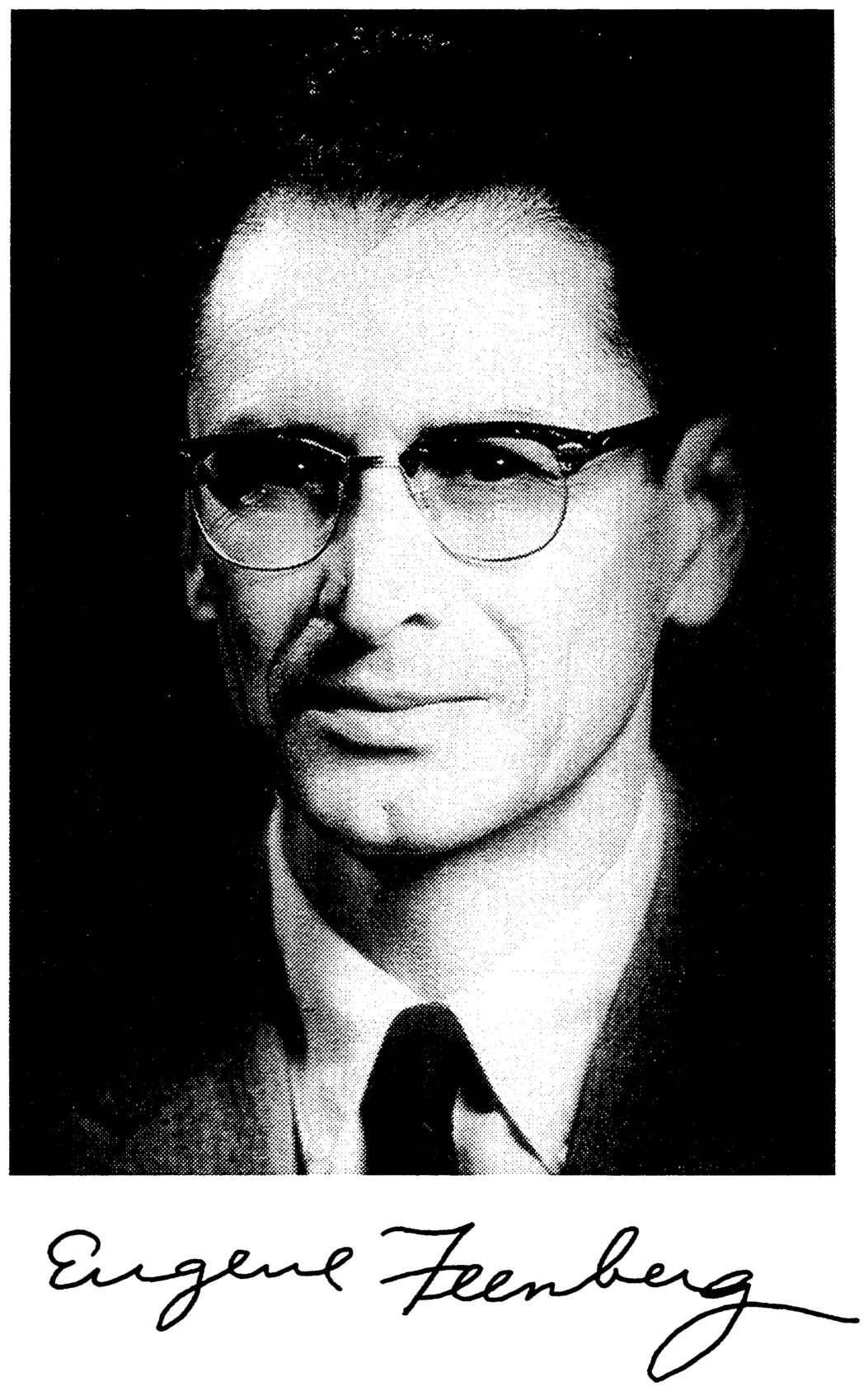
EUGENE FEENBERG
October 6, 1906–November 7, 1977
BY GEORGE PAKE
THROUGHOUT HIS LONG, PRODUCTIVE career Eugene Feenberg demonstrated a steadfast dedication to theoretical physics. His pursuit of research served not only to advance the science of many-body physics, but it also was for him a great source of fulfillment and inner contentment. He pioneered in applying non-relativistic quantum mechanics to realistic microsystems. Through proficient development and application of approximation methods, he advanced nuclear theory and contributed importantly to the theory of quantum fluids. Quiet, warm, and conscientious, he was an inspiration to his students and colleagues.
Among the young American-Jewish theoretical physicists who contributed so much to U.S. physics in the 1930s and 1940s, Gene Feenberg was somewhat unique in his western rather than urban eastern U.S. origins. He was born on October 6, 1906, in Fort Smith, Arkansas, to Polish emigrant parents, Louis and Esther Feenberg. Louis came to the United States in 1883, later returning to New York for a visit during which he met and married Esther Siegel. The Feenbergs had moved to Texas and then to Fort Smith from South Dakota. Gene was the first graduate of Fort Smith High School to attend college. He went to the University of Texas at Austin, where he majored in mathematics and phys-
ics. After only three years he graduated first in his class in 1929. Upon the urging of one of his professors, C. P. Boner, Gene applied to Harvard University, where he studied for a doctorate in physics under E. C. Kemble.
Gene's graduate student career was not routine. With the Great Depression settling upon the United States, his father found himself unable to provide financial support for his son's graduate study. Kemble and other professors helped Gene find part-time employment in a Raytheon laboratory in Cambridge—the first of his two experiences with industrial physics.
In 1931 Harvard awarded Gene a Parker Traveling Fellowship with which he studied in Europe for a year and a half. During the summer of 1931 he worked at Raytheon. At this time his father became ill and died. Gene then left for Europe in the fall. Although he later said that he probably was not mature enough to take full advantage of the European study opportunity, Gene spent some time in Munich with Sommerfeld's group, in Zurich with Pauli's institution, and in Rome with Fermi's group. In 1933 he went to Leipzig for a few months, just as the Nazis were seizing power. I have been particularly moved by a copy of a 1933 letter Gene wrote to Professor Kemble in which he described his observations of Nazi anti-Semitic violence in the streets. Over the nearly thirty years I knew Gene Feenberg, fifteen of them as a faculty colleague, I never saw this quiet, peaceful, and reasonable man angry. He was the epitome of thoughtful, tranquil, and balanced wisdom. Yet we all know, from the unfolding of history, how thoroughly justified was the indignation Gene expressed over Nazi violence and persecution when he wrote to Edward Kemble from Leipzig on April 4, 1933, “I walked the crowded streets Saturday boiling with anger; violent emotions visible on my face, I suppose, for passers whispered to be calm.” An American fel-
low student had persuaded Gene, somewhat against his better judgment, to go out into the streets. Understandably, the events in Germany led Harvard to recall Gene to the campus. There he completed his thesis for Kemble, treating the problem of the quantum scattering of slow electrons by neutral atoms. An important element of this work was the first statement and proof of the quantum optical theorem.
Upon completion of his Ph.D., Gene took an instructorship at Harvard for two years. During this period he began pursuing (“in a relaxed way,” he later said) some calculations on nuclear forces. Van Vleck recalled that his own interest in the binding energies of hydrogen and helium isotopes led him to suggest that Gene pursue some neutron-proton force calculations using Gaussian functions. Upon hearing this suggestion, Gene reached into his desk drawer and produced for Van Vleck the calculations he had already made. Gene expressed some doubt that the work was worth publishing, but Van Vleck convinced him that it was. Here we have a prime example of a Eugene Feenberg trait: extreme modesty concerning his own achievements and the value of his work.
In 1935 Gene went to the University of Wisconsin for a year and continued work on nuclear structure and energy levels. In 1936 he collaborated with Gregory Breit in a significant publication noting the charge independence of nuclear forces. At Wisconsin he met Eugene Wigner, with whom he collaborated and helped prepare their 1937 paper on the structure of nuclei between helium and oxygen, showing the importance of the symmetry of the wave function in binding p-shell nuclei. Gene characterized his year at Wisconsin as one of “solid achievement. I got deeply committed to the strong interactions between the like particles.”
When Gene moved to the Institute for Advanced Study at Princeton for a two-year fellowship (1936-38) he continued research on the p-shell with Melba Phillips and worked on energy-level spacing in collaboration with John Bardeen and Lloyd Motz. In 1938, on the recommendation of such leading lights in physics as I. I. Rabi, Edward Kemble, and Eugene Wigner, New York University hired Gene for its Washington Square College, where he rose to the rank of associate professor. During World War II, although sought for work at Los Alamos, he took leave of absence to work on radar research at the Sperry Gyroscope Company and advanced the theory of klystron tubes.
In 1946 Gene joined the faculty of Washington University in St. Louis. There he drew on the background of his studies of isomerism and nuclear structure, of assigning orbital configurations based upon spins and moments, and the nature of nuclear beta-decay transitions to provide the foundations for building a modern shell theory of the nucleus. His research in this field led to his book Shell Theory of the Nucleus, which was published in 1955.
His first book, however, was Notes on the Quantum Theory of Angular Momentum (1953), which I co-authored. When I arrived as a junior faculty member of the Washington University Physics Department in 1948 I found that the department followed the custom of assigning incoming graduate students, however inexperienced in physics they might be, immediately to a research group. Consequently, about eight new graduate students were waiting for me to launch them in nuclear magnetic resonance research even though no such research was yet in place there.
My approach to this problem was to institute a series of seminars for my new research students in which we began to explore this accelerating research activity, then confined mostly to Harvard, Stanford, and Oxford universities. A chal-
lenge inherent in this situation was that these students scarcely knew any classical mechanics or electromagnetic theory, to say nothing of the rudiments of quantum theory. But some of the experiments we were planning required an understanding—or at least an awareness—of the energy levels of nuclear magnetic dipoles and nuclear electric quadrupoles in laboratory magnetic fields and in crystalline electric fields. The standard quantum mechanics course of that day generally would not develop those energy level calculations, which derive from the quantum properties of angular momentum, and many treatments of the topic resorted to group theory (again, not a ready tool brought by beginning students).
I do not recall precisely how Gene became aware of my dilemma in trying to bring my crew of graduate students sufficiently up to speed in their physics to be able to understand and describe the experimental program we were launching in nuclear magnetic resonance. Perhaps in the brown bag lunch sessions I used to have with Gene and Henry Primakoff (who then shared an office) I may have described my predicament and my frustration with the problem of tutoring the students to a suitable level of understanding. In any event, Gene came to me one day and offered to present a series of lectures in my seminar on the quantum theory of angular momentum, culminating in developing the nuclear moment energy level expressions. This was a real answer to our needs.
Over a period of several weeks Gene presented a seminar series of lectures that succinctly worked out the quantum theory of angular momentum, ending in a session (the final chapter of the subsequent little book) on the applications to nuclear moments and transition probabilities. I took very careful notes during those seminars. Then, to have a little “text book” for future students who would be recruited
to the group, I wrote up the lecture notes and reproduced them in mimeographed form. The local roving representative of a publishing company must have seen or heard about those lecture notes, because he dropped by my office one day and suggested that his company might like to publish them. Gene was agreeable, and in 1953, our fifty-six-page booklet appeared—hard cover and all. Later, because the demand exhausted the first printing, Addison-Wesley permitted the Stanford University Press to reprint the book in paperback.
Gene's voluntary effort to help me and my new research students with his seminar presentations is a perfect example of his generosity and human interest in others. The efficiency of his formulation and presentation of the material was characteristic of his sharp mind and his tendency to get right to the heart of the matter. His physics was direct, clear, and concise—truly elegant!
In 1955, shortly after the appearance of our little book, Gene published Shell Theory of the Nucleus, building on his extensive research of this topic. Then he began to concentrate on bound-state perturbation theory. Some of this research is treated in volume two of Morse and Feshbach's Methods of Theoretical Physics. He also produced another set of mimeographed notes under the title Notes on Approximation Methods in Elementary Quantum Theory. These notes appeared in the early 1960s, but this time no publishing house volunteered its services and they have remained unpublished.
The next major thrust of his research was application of the method of correlated basis functions (CBF) to describe the ground state and lower excited states of strongly interacting many-particle systems. CBF theory is useful for nuclear matter and for the helium liquids. Gene focussed on the latter, and a decade of this work led to his Theory of Quantum Fluids (1969). It is fitting that the CBF methods he
pursued for the helium fluids were subsequently applied with success by others to nuclear problems, the domain to which he had earlier contributed so much through his shell theory research. Gene also had a pedagogical interest in the theory of special relativity and he occasionally published on the topic.
In his family life he was a devoted husband and father. He married the former Hilda Rosenberg; their two sons, Andrew and Daniel, both have successful professional careers, for which their father not only provided encouragement but also served as a superb role model. Gene was equally effective as a professional example to his research students, who became something of an extended family for him. His students developed a great respect for his incisive approach to physics and for his personal integrity; they readily acquired a deep affection for him. For his students as well as his collaborators, colleagues, and friends, Eugene Feenberg was a sympathetic source of sensible counsel.
When I became chairman of his department at the age of twenty-eight, I could always rely on him for balanced, sane advice. Although he strictly adhered to teaching and research, his keen observation of administrative and political matters and his high ethical standards conferred admirable wisdom, and he imbued his students with a sense of responsibility for the greater social good. It is interesting to note a few of his students who went on to larger responsibilities. George Trigg became the editor of Physical Review Letters. Chia-Wei Woo is the president of the new Hong Kong University of Science and Technology. Walter Massey has just completed service in the directorship of the U.S. National Science Foundation.
Gene exercised the highest standards of excellence and integrity, both in his professional work and in his personal life. He was a quiet, self-disciplined man, who used words
economically but with great precision, elegance, charm, and wit. If he had any fault at all, I would say he was modest to excess. In closing this brief biography, I affirm and commend to you the thoughts of four colleagues1 who wrote in 1979:
Secure in his family and in himself, he was guided in all relationships by a profound sense of the importance of individual human dignity. He cared deeply for his many students, who remained close to him long after they left St. Louis, and for the many talented collaborators and colleagues which a rich career brought to him. To all who were fortunate enough to know him, Eugene Feenberg was a very special human being.
NUMEROUS INDIVIDUALS AND SOURCES assisted me in preparing this brief biography. Chief among those is Mrs. Hilda Feenberg, who supplied me with many materials. Among the resources upon which I drew heavily were the transcript of an oral history interview of Eugene Feenberg by Spencer R. Weart of the Center for the History of Physics, and an introductory forward to the April 1979 issue of Nuclear Physics, which was designated a Feenberg commemorative issue. Mr. Herbert Weitman furnished the photograph and Professor John W. Clark contributed substantial help on a number of factual matters.
NOTE
1. K. A. Brueckner, C. E. Campbell, J. W. Clark, and H. Primakoff. Nuclear Physics A317:iv (1979).
PERSONAL HISTORY
Born October 6, 1906
B.A. and M.A., University of Texas, 1929
Ph.D., Harvard University, 1933
Instructor, Harvard University, 1933-35
Lecturer, University of Wisconsin, 1935-36
Fellowship, Institute for Advanced Study, 1936-38
Assistant professor, then associate professor, New York University (Washington Square College), 1938-46
Engineer, Sperry Gyroscope Company (on leave from NYU), 1941-45
Associate professor, then professor, Washington University, 1946-75
Visiting Higgins Professor of Physics, Princeton University, 1953-54
Wayman Crow Professor of Physics, Washington University, 1964-75
Visiting professor of physics, The State University of New York at Stony Brook, spring semester 1969
Lecturer at Escuela Latino Americana de Fisica, Universidad Nacional Autonoma de Mexico, July 1-19, 1974
Elected to the National Academy of Sciences, 1975
Professor emeritus, Washington University, 1975-77
Died November 7, 1977
SELECTED BIBLIOGRAPHY
1932 Scattering of slow electrons by neutral atoms. Phys. Rev. 40:40 42:17.
1935 Born-Infeld field theory of the electron. Phys. Rev. 47:148.
Neutron-proton interaction. Phys. Rev. 47:850, 857.
With J. K. Knipp. Intranuclear forces. Phys. Rev. 48:906.
1936 A lower limit to the normal state eigenvalue of the nuclear three-body problem. Phys. Rev. 39:273.
Does the alpha-particle possess excited states. Phys. Rev. 49:398.
With S. S. Share. An approximate solution of nuclear three- and four-particle eigenvalue problems. Phys. Rev. 50:253.
On relativity corrections in the theory of the deuteron. Phys. Rev. 50:674.
With G. Breit. The possibility of the same form of specific interaction for all nuclear particles. Phys. Rev. 50:850.
1937 With E. P. Wigner. On the structure of the nuclei between helium and oxygen. Phys. Rev. 51:95.
With M. Phillips. On the structure of light nuclei. Phys. Rev. 51:597.
On the saturation property of nuclear forces. Phys. Rev. 51:777 52:667.
A note on the Thomas-Fermi statistical method. Phys. Rev. 52:758.
1938 With J. Bardeen. Symmetry effects in the spacing of nuclear energy levels. Phys. Rev. 54:809.
With L. Motz. The spacing of energy levels in light nuclei. Phys. Rev. 54:1055.
1939 On the shape and stability of heavy nuclei. Phys. Rev. 55:504.
The detonation of nitrogen iodide by nuclear fission. Phys. Rev. 55:980.
1941 A note on the density and compressibility of nuclear matter. Phys. Rev. 59:149.
Non-uniform particle density in nuclear structure. Phys. Rev. 59:593.
Theory of nuclear surface energy. Phys. Rev. 60:204.
1942 With E. P. Wigner. Symmetry properties of nuclear levels. Rep. Prog. Phys. 8:274.
1946 Elementary treatment of longitudinal bunching in a velocity modulation system. J. Appl. Phys. 17:852.
Relation between nodal positions and standing wave ratio in a composite transmission system. J. Appl. Phys. 17:530.
With D. Feldman. Theory of small signal bunching in a parallel electron beam of rectangular cross section. J. Appl. Phys. 17:1025.
The representation of single particle operators in two-particle form Phys. Rev. 70:768.
With G. Goertzel. Theory of nuclear coulomb energy. Phys. Rev. 70:597.
With H. Primakoff. Possibility of “conditional” saturation in nuclei. Phys. Rev. 70:980.
1947 Semi-empirical theory of the nuclear energy surface. Rev. Mod. Phys. 19:239.
1948 With H. Primakoff. Interaction of cosmic ray primaries with sunlight and starlight. Phys. Rev. 73:449.
A note on perturbation theory. Phys. Rev. 74:206.
Theory of scattering processes. Phys. Rev. 74:664.
1949 Nuclear shell structure and isomerism. Phys. Rev. 75:320.
With K. Hammack. Nuclear shell structure. Phys. Rev. 75:1877.
With F. Shull. Interpretation of K42 radioactivity. Phys. Rev. 75:1768.
With K. C. Hammack and L. W. Nordheim. Note on proposed schemes for nuclear shell models. Phys. Rev. 75:1968.
Notes on the j-j coupling shell model. Phys. Rev. 76:1275.
1950 With G. Trigg. The interpretation of comparative half-lives in the Fermi theory of beta-decay. Rev. Mod. Phys. 22:399.
Nuclear shell models. Phys. Rev. 77:771.
1951 Excitation energy difference in Li7-Be7. Phys. Rev. 81:644.
With K. C. Hammack. Note on Rainwater's spheroidal nuclear model. Phys. Rev. 81:285.
1952 With G. Trigg. A symmetry principle in the Fermi theory of beta-decay. Phys. Rev. 82:982.
With T. Ahrens. First forbidden beta-decay matrix elements. Phys. Rev. 86:64.
With T. Ahrens and H. Primakoff. Pseudoscalar interaction in the theory of beta-decay. Phys. Rev. 87:663.
Recent developments in the theory of nuclear structure. Ann. Rev. Nucl. Sci. 1:43.
1953 With J. Davidson. Deviations from LS coupling in the spheroidal core nuclear model. Phys. Rev. 89:856.
With G. E. Pake. Notes on the Quantum Theory of Angular Momentum. Addison-Wesley (reissued by Stanford University Press, 1959)
1955 With M. Bolsterli. Matrix elements in superallowed transitions. Phys. Rev. 97:736.
Superallowed beta-transitions in the N-Z=3 series. Phys. Rev. 99:71.
Shell Theory of the Nucleus. Princeton University Press.
1956 With M. Bolsterli. Perturbation procedure for bound states of nuclei. Phys. Rev. 101:1349.
With P. Goldhammer. Refinement of the Brillouin-Wigner perturbation method. Phys. Rev. 101:1233.
Invariance property of the Brillouin-Wigner perturbation series. Phys. Rev. 103:1116.
1957 With P. Goldhammer. Refinement of the Brillouin-Wigner perturbation method. Phys. Rev. 105:750.
With L. C. Biedenharn and R. C. Young. Continued fraction approximants to the Brillouin-Wigner perturbation series. Phys. Rev. 106:1151.
With J. D. Robinson. Time dilatation and Doppler effect. Am. J. Phys. 25:490.
1958 With H. Primakoff. On the reaction n± → n0 + e± + µ + 8mec2. Philosophical Mag. 3:328.
Analysis of the Schrödinger energy series. Ann.Phys. 3:292.
1959 With J. W. Clark. Simplified treatment for strong short-range repulsions in N-particle systems (1). General theory Phys. Rev. 113:388.
With J. D. Robinson. Time dilatation and Doppler effect. Am. J. Phys. 27:190.
1960 Orbit to the Sun. Am. J. Phys. 28:497.
Inertia of energy. Am. J. Phys. 28:565.
With F. Y. Wu. Ground state of liquid helium (mass 4). Phys. Rev. 122:739
1961 With H. W. Jackson. Perturbation method for low states of a many-particle boson system Ann. Phys. 15:266.
1962 With F. Y. Wu. Theory of the fermion liquid. Phys. Rev. 128:943.
With H. W. Jackson. Energy spectrum of elementary excitations in helium II. Rev. Mod. Phys. 34:686.
1964 Notes on the radial distribution function of a quantum fluid. Lectures in Theoretical Physics. Volume 7C. Edited by W. E. Britten. University of Colorado Press : 160.
With C.-W. Woo. Correlated basis functions in the theory of uniform fermion systems Comptes Rendus du Congrès International de Physique Nucléaire (CNRS, Paris). II:283.
1965 With C.-W. Woo. Matrix elements of a fermion system in a representation of correlated basis functions. Phys. Rev. 137:A391.
With D. K. Lee. Ground state and low excited states of a boson liquid with applications to the charged boson system. Phys. Rev. 137:A731.
Necessary condition on the radial distribution function. J. Math. Phys. 6:658.
1967 With F. Y. Wu and H. T. Tan. Necessary condition on radial distribution function. J. Math. Phys. 8:864.
With D. K. Lee and H. W. Jackson. Notes on the three-particle distribution function of an extended uniform system. Ann. Phys. 44:84.
1968 With T. Davison. The variance of H in the Bijl-Feynman description of an elementary excitation. Phys. Rev. 171:221.
With H. T. Tan. Low excited states and statistical and transport properties of liquid He3. Phys. Rev. 176:370.
1969 With T. B. Davison. Tree-phonon vertex in the description of the ground state of liquid He4. Ann. Phys. 53:559.
With T. Davison. Theory of a He3 atom in liquid He4 at T=0. Phys. Rev. 178:306.
With T. Davison. Addendum to theory of a He3 atom in liquid He4 at T=0. Phys. Rev. 182:364.
With C. E. Campbell. Paired-phonon analysis for the ground state and low excited states of liquid helium. Phys. Rev. 188:396.
Theory of Quantum Fluids. Academic Press.
1970 Microscopic quantum theory of the helium liquids. Am. J. Phys. 38:684.
Comment on “dispersion of phonons in liquid 4He”. Phys. Rev. A2:2158.
1971 Comments on longwavelength excitations and structure functions in the theory of liquid 4He at T=0. Phys. Rev. Lett. 26:301.
With D. Hall. Sum rules, dynamic form factor and elementary excitations in liquid 4He. Ann. Phys. 63:335.
1972 Comments on the theory of quantum fluids. Statistical Mechanics: New Concepts, New Problems, New Applications Edited by S. A. Rice K. F. Freed and J. C. Light. Chicago: University of Chicago Press.
Density matrix of liquid 4He at low temperatures. Ann. Phys. 70:133.
1973 Nonorthogonality corrections in the method of correlated basis functions Ann. Phys. 81:154.
1974 Conventionality in distant simultaneity. Found. Phys. 4:121.
Ground state of an interacting boson system. Ann. Phys. 84:128.
Approach to a uniform theory of the liquid and solid phases of 4He at absolute zero. J. Low Temp. Phys. 16:125.


