
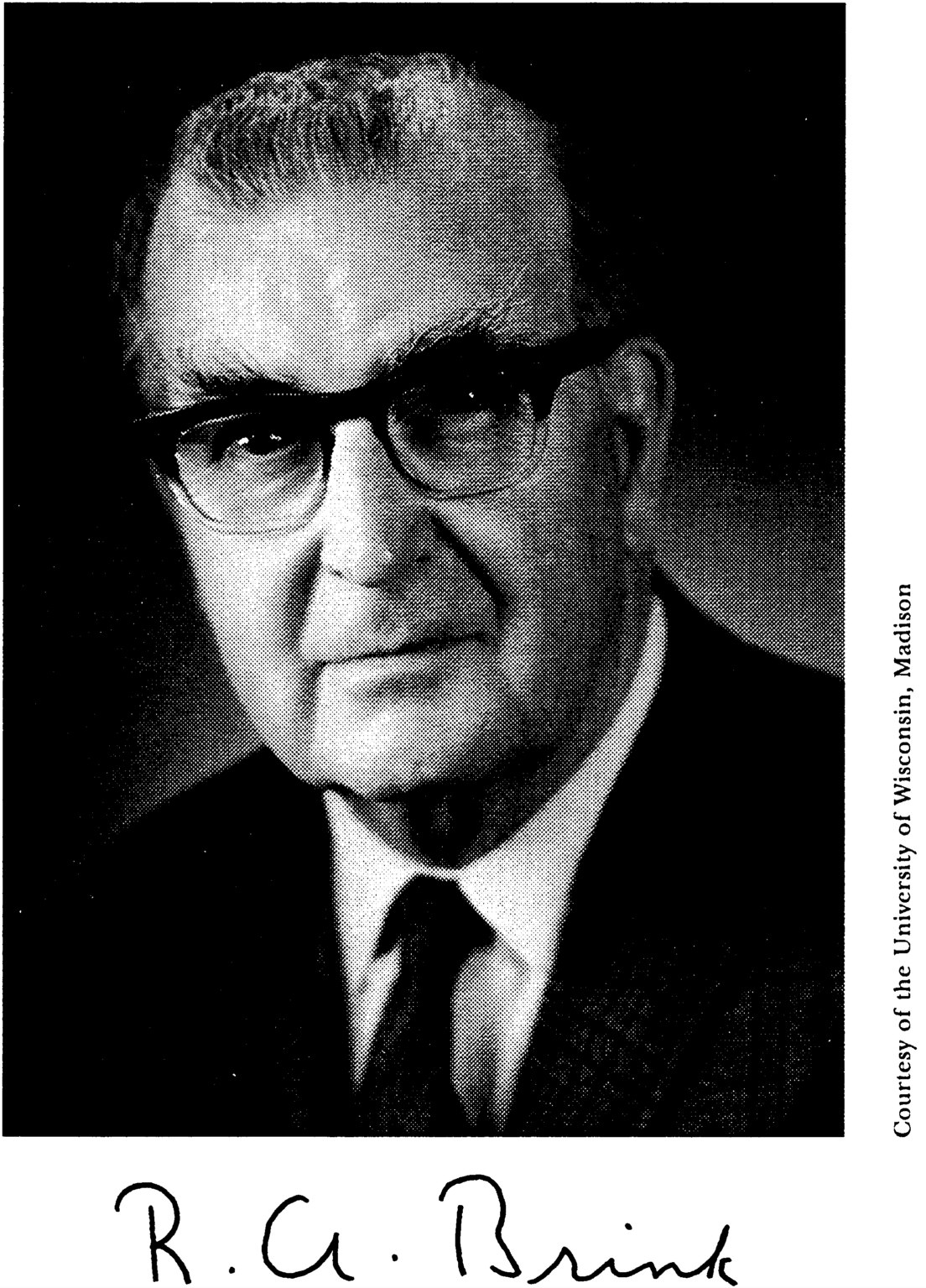
ROYAL ALEXANDER BRINK
September 16, 1897–October 2, 1984
BY OLIVER E. NELSON, JR., AND RAY D. OWEN
ROYAL ALEXANDER BRINK, over a long career, was a major contributor to the development of genetics and to the improvement of major crop plants through the application of genetic principles. He is best remembered for his last major contribution, the identification and investigation of paramutation in maize—a fascinating phenomenon that contradicts the genetic axiom that contrasting alleles always segregate unaltered from their association in a heterozygous individual.
His basic contributions to genetics began with his appointment to the faculty at the University of Wisconsin in 1922 and continued for many years after his retirement in 1968. Using maize as his principal experimental organism, Alex Brink and his students demonstrated that a gene could be expressed postmeiotically in the pollen grain, reported the first explanation for semi-sterility, and mapped many mutants. In investigations of seed failure in interspecific crosses, Brink and D. C. Cooper demonstrated the critical role of the endosperm in normal seed development.
His laboratory also made early and important contributions to the study of transposable elements by showing that the unstable P-vv allele of maize resulted from the insertion of a transposable element, Mp, in a functional P allele
and that Mp was the same element reported earlier by Barbara McClintock and designated as Activator (Ac).
Alex Brink also had an abiding interest in agricultural productivity and the improvements that genetics could provide. He preferred to refer to these efforts as adaptive rather than applied research. Soon after his arrival as a young faculty member at the University of Wisconsin, he started the hybrid corn breeding program for the state. Subsequently, research with colleagues resulted in the breeding of a nonbitter (coumarin-free) sweet clover and the production of the first reliably winter-hardy alfalfa, Vernal, which has had great economic importance for the northern states. On the day of his death, October 2, 1984, sixteen years after his formal retirement from the faculty of the University of Wisconsin, he had spent the morning in his experimental plots endeavoring to identify the corn mutant lines that would best serve for homegrown supplementation to enhance desirable fermentation in alfalfa-hay silage. His report of this venture was posthumously published in Maydica (1984).
Over the sixty-three years following the publication of his first paper (1921), he made numerous other important research and conceptual contributions to basic and applied genetics. But his clear-sightedness, uncompromising standard of excellence, and leadership found equally profound expression in other spheres as well. It was his influence, more than any other, that guided the development of the Department of Genetics at Wisconsin to its early and continuing preeminence (he was chairman from 1939 to 1951), and he served the broader university community as well. He was a memorable teacher, not the kind whose disorganization and obfuscation of the subject are effective because they force students to work out confusing matters for themselves, but clear, firm, concise and thoughtful, encouraging
students to extend their perceptions and knowledge on the basis of understanding he had helped them to achieve at the start.
He was a statesman in the external world of science, too, and he served genetics in many ways, for example as president of the Genetics Society of America in 1957, as president of the American Society of Naturalists in 1963, and as managing editor of Genetics (1952–57). He was elected to the National Academy of Sciences in 1947 and to the American Academy of Arts and Sciences in 1960. He became professor emeritus at Wisconsin in 1968. That was not, for him, a signal that he had retired, but that he had more time for intense research. At one point he wrote, “One of my reactions to advancing age has been an increasing reluctance to sacrifice a diminishing future by becoming preoccupied with the past.” He participated in the meetings of the genetics societies of America and Canada in Vancouver in August 1984 —less than two months before his death—and, upon receiving the Morgan Medal there, he delivered a brief statement in part relating his work, begun some thirty-five years earlier, to the still-challenging problem of “the meaning of transposable elements for make-up of the chromosomes.”
Born of generations of farming people on a dairy farm near Woodstock in Ontario, Canada, Alex attended a one-room country school and, at age eleven, passed the selective written entrance examination for high school, the Collegiate Institute in Woodstock, a school with a rigid curriculum and exacting standards. Up early to help with milking and farm chores, he walked to the railroad for the five-mile ride to school. After school he headed back to the farm, where chores left him drowsy and fatigued. He neglected his homework, and his instructors' disfavor took the form mainly of ignoring him.
At the end of the first year he failed the final test and
dropped out of school to work on the farm. He was then only twelve years old. Fortunately, promotion in school was not based on attendance or term work, but on passing final exams in each subject at the end of the year. When he reentered high school, his father excused him from morning and evening chores two weeks before the examinations, and he crammed for the tests. He regularly passed them. To the surprise of his instructors, he gained first-class honors in the provincial examinations at the end of both the second and fourth years. “There was no joy and little satisfaction in my high school experience, ” he wrote later. “I was taking it for granted that eventually I would enter college, although no one was encouraging me to do so.”
He registered at the Ontario Agricultural College in Guelph in 1914, just after the start of World War I and near his seventeenth birthday. Many of his classmates enlisted in the Canadian army in their freshman year, but in November 1914 he contracted typhoid fever, which was misdiagnosed at first as appendicitis. He barely survived the mistaken surgery and acute infection when thrombosis in his left leg kept him on crutches for a slow recovery and physically unfit for military service.
He returned to Guelph in February 1915, managed to catch up, and completed his freshman year. He graduated in 1919 in chemistry and physics, ranking second in a class of twenty-four.
During the summer, he worked for the Chemistry Department at a soil experiment station, for the Physics Department surveying farms for tile drainage, and as an assistant to two county agricultural representatives in northern Ontario. In his spare time during the last summer before his senior year he made, on his own initiative, a field study of the glacial geology and soils of the Kaministikwai valley. During Christmas vacation he visited Cornell University to
inquire about graduate work in soil science. Members of the staff encouraged him to apply, but the university ruled that his undergraduate degree would not qualify him for full graduate admission. He was in debt and could not afford to make up an academic deficiency. Following a summer course in the milling and baking laboratory of Ontario Agricultural College, he took a job in the testing laboratory of Western Canada Flour Mills in Winnipeg.
At Winnipeg he was given charge of mapping the milling and baking quality of the wheat crop in Manitoba, Saskatchewan, and Alberta, and was responsible for quality control of the 5,000 barrels of flour made daily. The work was “interesting, instructive, and rather well paid,” but he felt it “unlikely that it would continue to be satisfying as the cycle of operations was repeated with each successive wheat crop.” Besides, his desire for further academic study continued, and he had developed a compelling interest in plant physiology and genetics. He concluded that the University of Illinois had the courses he wanted. Illinois would accept the Ontario Agricultural College degree, and there was no out-of-state tuition fee, an important consideration because he had only his salary savings, and the Canadian dollar was heavily discounted in the United States.
He registered in 1920 in agronomy, with C. F. Hottes, a plant physiologist in the Department of Botany, as his professor. He developed a close association that year with J. A. Detlefesen, a Harvard graduate who had studied with W. E. Castle and who taught genetics in the Animal Husbandry Department at Illinois. Brink remembered Detlefesen as “a superb teacher. His first semester course in general genetics was one of the most informative and stimulating in my experience. ” In his second semester he did research with Detlefesen on selection for heritable change in frequency of recombination in Drosophila and decided that plant ge-
netics was to be his field. Detlefesen wrote to E. M. East at Harvard about him, and Alex accepted “with alacrity” an appointment as an Emerson Fellow with “a stipend that exceeded Harvard's annual tuition fee by $50.00.”
He entered East's laboratory at the Bussey Institution as a candidate for a Harvard D.Sc. degree in June 1921, and he worked there through the summer and the following academic year and summer. Developing methods for the cultivation of pollen on artificial media, he applied his techniques to the study of physiological effects of the waxy gene in corn and its action as an agent of control in development. His D.Sc. degree was awarded in 1923.
In 1922 he accepted an appointment as an assistant professor of genetics at Wisconsin. In the same year, he married Edith Margaret Whitelaw. The couple had one son, Andrew W. Brink, now a professor of English at Trinity College, University of Toronto, and an adopted a daughter, Mrs. Margaret Alexandra Ingraham. Following the death of Mrs. Brink in 1961, Alex Brink married Joyce Hickling in 1963.
Very soon after his arrival at Wisconsin, Brink became aware of some disappointment with the Department of Genetics on the part of others at the university. The department had been founded in 1910 in a college devoted to the principle of fostering science in the interest of agriculture. It was to be a core department contributing to, as well as using, a broad pool of knowledge of the developing science of heredity—the first department of its kind in the United States. L. J. Cole, its first professor, had served alone from 1910 to 1919, when E. W. Lindstrom joined the faculty as a plant geneticist. Lindstrom left to found a new department at Iowa State, and Brink was his replacement.
Devoted as he was to the highest standards of basic research, Brink recognized that the other aspect of the de-
partment's obligation, use of a broad pool of knowledge in the interest of agriculture, was not being competently served. He knew, from earlier associations with East, G. F. Shull, and D. F. Jones, about the promise of hybrid corn, a technology that was beginning to find application elsewhere in the Midwest, but had been resisted at Wisconsin. “I resolved in 1923,” he wrote later, “to give first priority to getting a hybrid field corn breeding program started at Madison.” He achieved the close cooperation of the departments of agronomy and, later, plant pathology, and by 1925 the program was well under way, funded by a grant from the Purnell Act. N. P. Neal, who as a graduate assistant under Brink had become associated with the program, was given leadership in 1931, and Brink left the successful project in his competent hands. This program profoundly affected Wisconsin agriculture and forever dispelled doubts about the ability of genetics to serve farm interests. An informative and interesting narrative of the Wisconsin development can be found in The Hybrid Corn Makers (1947).
In 1926 Brink initiated a program of alfalfa breeding that was to absorb much of his attention for a quarter of a century. It had been widely recognized that if dairy farmers could grow a high-protein roughage like alfalfa, their feeding cost could be reduced substantially. But the crop was unreliable, mainly because of winter killing; in 1928, for example, two successive severe winters had reduced the hay acreage by more than one-third from the 1926 level. With his background in soil science and a concern for soil conservation that continued throughout his life, Brink felt strongly that a productive sod crop like alfalfa was a primary requirement in any general scheme to conserve Wisconsin farm soils. He joined a group stimulated by the passage of the Soil Conservation Act during the Roosevelt administration, which was seeking to open the way to a new
era in land use practices. In addition, attention had to be given to the development of bacterial wilt-resistant strains of alfalfa. Brink had earlier been impressed with the amount of genetic variability in available varieties. Little real genetic work had been done with the plant, however. Later he wrote, “The application of genetic principles to breeding alfalfa for greater winter hardiness and disease resistance gave promise not only of contributions to the solution of a major agricultural problem, but also of providing opportunity for exploratory efforts in basic plant genetics research. The balance would be shifted toward the latter if the preliminary attempts to establish myself in the field were encouraging.”
His efforts proved conspicuously successful in every respect. There was a series of papers on the genetics of alfalfa—resistance to bacterial wilt, the mechanism of pollination, embryo mortality in relation to seed formation, and differential survival of strains under an ice sheet. It was from the survivors of this icy encapsulation that the breeding material was selected for the program that culminated in the release for seed increase in 1953 of the winter-hardy, wilt-resistant variety, Vernal. It was soon widely grown in the north-central United States and in Canada and by 1971 had added a yearly average of $20 million to the value of alfalfa in Wisconsin. Further development by Dale Smith, of the Department of Agronomy, made three cuttings regularly possible per year, and the total gain to Wisconsin's farmers from Vernal alfalfa in the interval between 1954 and 1971 was about $1 billion. Vernal became a leading variety of alfalfa in Canada as well as in northern United States and represented, in Brink's own mind, his major direct contribution to agriculture.
There was another important, nongenetic consequence of this period of dedication to alfalfa improvement. In 1932
the dean of the College of Agriculture, C. F. Christiansen, invited his faculty to propose projects that could use federal unemployment funding to accomplish objectives useful to Wisconsin agriculture. Brink, aware through his alfalfa breeding of a need throughout Wisconsin for liming soil on which alfalfa could be grown, suggested that the college sponsor a work relief program through which agricultural lime could be made available at cost to farmers. The suggestion was taken up with enthusiasm; projects were set up in 1933, but very shortly they encountered legal obstacles. District attorneys ruled that counties could not engage in business in competition with private industry.
In the face of some administrative reluctance to “rock the boat,” Brink on his own initiative obtained the help of Paul Raushenbush, then an administrative officer for the Wisconsin unemployment compensation program, in arranging for the drafting of a bill to be submitted to the state legislature to authorize county boards to engage in the production and sale of agricultural lime as an unemployment relief measure. The bill passed and became law in June 1933. A statewide program was then inaugurated; by 1934 more than one thousand projects had been approved, and nearly ten thousand workers were employed in the production of lime and marl and in the hauling of paper mill sludge. By 1935 about 840,000 tons of these materials had been made available to farmers at less than half the usual cost. With further extensions about thirty million tons of agricultural lime were distributed in Wisconsin under the Federal Emergency Relief Administration and the Works Progress Administration relief measures, and county programs continued after the work relief support had been discontinued. The contribution of these programs to the productivity of Wisconsin agriculture is immeasurable.
In the early 1930s sweet clover could be recognized as a
potentially useful forage crop that had, however, two compelling disadvantages. First, it was relatively unpalatable, with a bitter, stinging taste; second, it was often poisonous when “spoiled.” In 1933 Brink discovered a nonbitter strain in a species from China (Melilotus dentata), which although markedly deficient in its adaptation to Wisconsin conditions, became involved as the starting point in two major lines of sweet clover research at Wisconsin. One line of investigation, of which W. K. Smith became leader, aimed to incorporate the nonbitter trait into the more useful forage species, M. alba. This was accomplished, although not without difficulty, since the seedlings resulting from the interspecific cross were chlorophyll-deficient and soon died. Grafts of these seedlings onto plants of a third species, M. officinalis, allowed one scion to progress to the flowering stage so that it could be backcrossed by M. alba. One of the seven plants resulting from this backcross proved to be heterozygous for the nonbitter trait, so a strain of M. alba that was homozygous for this characteristic could be established.
The other line of research had its origin in somewhat earlier observations by others: that spoiled sweet clover hay produced a blood-clotting deficiency in animals that ate it. In 1938 Brink and Smith published the results of a study showing that bitterness of the fresh forage and toxicity of spoiled sweet clover hay had a common basis in coumarin (1938). It was in following up that clue that K. P. Link and his associates in biochemistry were able to isolate the hemorrhagic agent Dicumarol and to implement its application in such diverse contexts as an anticoagulant in human surgery and, through a derivative trade-named Warfarin, as a rat poison. Link was a colorful and dynamic personality, often dramatic in his oral presentations. As a result, some popular misconceptions about the origins of this aspect of
the research became prevalent in the public press; Link's Harvey Lecture (1944) is more accurate.
Over the same interval that his contributions to adaptive research and service were coming to fruition, Brink's explorations at the forefront of basic genetic knowledge also proceeded at a remarkable pace. There followed, during 1924–29, a series of pioneering papers on gene expression in, and environmental effects on, the development of the pollen grain, especially in corn, including the demonstration (contemporaneously with M. Demerec) that the Wx allele was activated postmeiotically (1924). Several of the major papers were published in Genetics; his review provides a clear and thoughtful summary (1929). In 1927 he described the first case of semi-sterility in maize. C. R. Burnham, who had taken his Ph.D. with Brink, observed in 1930 that the semi-sterility involved a reciprocal translocation. Brink and Cooper (1931) confirmed the cytological observation, identified markers for the linkage groups involved in the translocation, located the translocation breakpoints, and characterized the recombinants in terms of their cytological and genetic behavior. Early in 1935 they published a confirmation of the 1931 reports by Creighton and McClintock in corn and Stern in Drosophila of the relationship between genetic crossing over and physical exchange between homologous chromosomal segments (1935).
Over the years Brink, his students, and collaborators contributed substantially to the building up of linkage maps in corn. With his long-standing interest in the developmental genetics of seeds, it was natural for him to make use of the advantages of species other than corn. One was, of course, alfalfa. He became interested in the phenomenon of frequent early seed collapse, especially in relation to self-pollination as compared with cross-pollination. Careful study indicated that this type of seed failure was attributable to
inadequacy in what emerged as an essential role of the endosperm. The angiosperm ovule, characteristically low in food reserves at fertilization, depends on the translocation of nutritive materials in which the endosperm plays an essential role. The generality of seed failure owing to abortion of the endosperm was established in studies of a large number of plant genera. The work, done mainly with Cooper, culminated in a large, historic monograph on The Endosperm in Seed Development (1947). Extending the techniques he had earlier invented for the cultivation of pollen in vitro, Brink and his collaborators set out to cultivate immature excised embryos on artificial media. The work with barleyrye hybrid embryos was especially rewarding. The hybrid embryos regularly died during ordinary development, but when they were dissected from the seeds and grown on an artificial nutrient medium they could survive through the seedling stage to maturity. They found provocative indications, too, of at least one “embryo factor” that, when added to the medium, promoted the growth of otherwise abortive immature embryos.
As early as 1948 Brink had initiated studies on unstable alleles, especially variegated pericarp P-vv in corn, and in 1952 he interpreted the instability as resulting from a discrete element, Modulator (Mp), that inhibits pigment formation when present at the P locus, with mutation involving transposition of Mp away from the P locus and its assortment to offspring as a unit separate from that locus (1952). The postulated process was similar to that reported by McClintock in 1950 for the Ac/Ds transposable element family, and two years later Barclay and Brink (1954) reported that Mp was operationally indistinguishable from McClintock's Ac. In the 1950s detailed and elegant analyses of P-vv showed that when Mp excised from the P locus, it was most frequently reinserted in the same chromosome and at a loca-
tion closely linked to P. From these closely linked locations reinsertions of Mp into P at apparently different sites can easily be isolated, thus constituting in effect almost a locus-specific mutagenic system. Greenblatt and Brink (1969) then showed that the locations of transposed Mp's were in accord with the hypothesis that an Mp excised from P during replication of the P locus moved to an unreplicated portion of the same chromosome and then was replicated in phase with that segment of the chromosome.
During the late 1950s the focus of the laboratory shifted almost entirely to a study of the intriguing phenomenon of paramutation at the r locus in maize, which Brink first reported in 1956. A functional allele at the r locus is required for the production of anthocyanin pigments in the aleurone layer of the endosperm and in some tissues of the plant. In paramutation, R alleles of one class (e.g., the standard R-r allele) are predictably and markedly reduced in their pigmenting potential following recovery from heterozygotes with a second class of R alleles of which the unstable R-st allele is a prime example. The R-st allele is completely unaffected. The affected alleles (paramutant or R' alleles) can revert partially toward their original pigmenting potential under certain conditions, hemizygosity or heterozygosity with a null allele. As in the case of P-vv a meticulous series of investigations by Brink and his students elucidated many of the genetic aspects of paramutation. A 1973 review by Brink summarized these investigations.
Alex Brink lived to see the first results of investigations into the molecular structure and behavior of the transposable elements, and he followed these with interest. It will not be long before there are also molecular explanations for paramutation.
On leave in 1960 to work at University College, London, and at Oxford, Brink collected and expressed his thoughts
on a broader developmental-genetic subject in a remarkable review titled “Phase Change in Higher Plants” (1962). The primary phenomenon reviewed was the abrupt switch in potential of perpetually embryonic meristems from a juvenile to an adult type of growth. One observes such changes in the needles of juniper trees and the shape of ivy leaves.
Phase change in higher plants involves an alteration during development whereby one type of growth along an axis is succeeded more or less sharply by another that contrasts sharply with the first. . . . This is not a unique ontogenic phenomenon; similar distinctive alterations, manifested in a wide variety of ways, also occur among animals and other classes of plants. . . . There are significant reasons of a general nature for thinking that the chromosomes embody an apparatus for the primary regulation of gene action during development. . . . The point of view here developed leads to the suggestion that the chromosome characteristically serves what may be called a paragenetic, as well as a genetic, function. . . . The chromosome, assumed to carry an unchanging complement in somatic cells, also possesses other, more labile components by which gene action is regulated during development. . . . The “individuality” of a somatic cell is implicit in the paragenetic state of the chromosomes present. . . . Future investigation will show whether the assumption of an additional link, involving chromosome substances with paragenetic properties, and the beginning of the chain between gene and end product, will aid in reversing the trend recognized as separating the study of heredity from that of development, and so putting the two disciplines on convergent paths.
These thoughts were too far ahead of their time to be widely appreciated, and in any case, their realization depended on later definition in molecular terms by others. His use of the term “paragenetic” here was meant to cover a broader context than “paramutation,” which he coined to define a specific phenomenon.
Over much of this period he was devoting time and effective attention to the development and guidance of his department and to the affairs of the university. The accomplishments in this context, of which he was most proud in
the end, were the recruitment of young Joshua Lederberg to his faculty, the subsequent formation of the Department of Medical Genetics, and the eventual unification of the departments of genetics and medical genetics into the Laboratory of Genetics. Fifty-seven students over the years completed their Ph.D. training under him, some of them as joint majors with other faculty members. He described the deepest satisfaction in his academic life as seeing “a graduate student effectively launched on a rewarding professional career,” and a good many students in addition to those who claimed him as their major professor had him to thank for that concern.
WE HAVE MADE EXTENSIVE use of a brief autobiography written by Alexander Brink in the last years of his life. A copy of this autobiography was given to each of us by Dr. Brink. We are indebted also to Mrs. Joyce Brink for other information.
REFERENCES AND BIBLIOGRAPHY
1921 The genetic basis for improvement in self-fertilized crops. Sci. Agric. 2:83-86.
1924 Brink, R. A., and J. H. MacGillivray. Segregation for the waxy character in maize pollen and differential development of the male gametophyte. Am. J. Bot. 11:465-69.
Demerec, M. A case of pollen dimorphism in maize. Am. J. Bot. 11:461-64.
1929 Studies on the physiology of a gene. Q. Rev. Biol. 4:520-43.
1931 With D. C. Cooper. The association of semisterile-1 in maize with two linkage groups Genetics 16:595-628.
1932 Are the chromosomes aggregates of groups of physiologically interdependent genes? Am. Nat. 66:444-51. (Cited by E. B. Lewis, 1967 Genes and gene complexes. pp. 17, 27. In Heritage from Mendel. Proceedings of the Mendel Centennial Symposium sponsored by the Genetics Society of America, Fort Collins, Colorado. University of Wisconsin Press [1965]).
1935 With D. C. Cooper. A proof that crossing over involves an exchange of segments between homologous chromosomes. Genetics 20:22-35.
1938 With W. K. Smith. The relation of bitterness to the toxic principle in sweet clover J. Agric. Res. 57:145-54.
1944 Link, K. P. The anticoagulant from spoiled sweet clover hay. Harvey Lect. 39:162-216.
1947 With D. C. Cooper. The endosperm in seed development. Bot. Rev. 13:423-541.
Crabb, A. R. New empire—in the north. InThe Hybrid Corn Makers. New Brunswick: Rutgers University Press.
1952 With R. A. Nilan. The relation between light variegated and medium variegated pericarp in maize. Genetics 37:519-44.
1954 Very light variegated pericarp in maize. Genetics. 39:724-40.
With P. C. Barclay. The relation between Modulator and Activator in maize. Proc. Natl. Acad. Sci. USA 40:1118-26.
With I. M. Greenblatt. Diffuse, a pattern gene in Zea mays. J. Hered. 65:47-50.
1956 A genetic change associated with the R locus in maize which is directed and potentially reversible. Genetics 41:872-99.
1958 A stable somatic mutation to colorless from variegated pericarp in maize. Genetics 43:435-47.
1960 Brink et al. Locus dependence of the paramutant r phenotype in maize. Genetics 45:1297-1312.
With D. F. Brown. Paramutagenic action of paramutant Rr and Rg alleles in maize. Genetics45:1313-16.
1962 Phase change in higher plants and somatic cell heredity. Q. Rev. Biol. 35:120-37.
With I. M. Greenblatt. Twin mutations in medium variegated pericarp maize. Genetics 47:489-501.
1964 Genetic repression in multicellular organisms. The American Naturalist 118:193-211.
1968 With E. D. Styles and J. D. Axtell. Paramutation: Directed genetic change. Science 159:161-70.
1973 Paramutation. Ann. Rev. Genet. 7:129-52.
With E. Williams. Mutable R-Navajo alleles of cyclic origin in maize. Genetics. 73:273-96.
1984 Maize endosperm mutants affecting soluble carbohydrate content as potential additives in preparing silage from high protein forages Maydica XXIX:265-86.


