
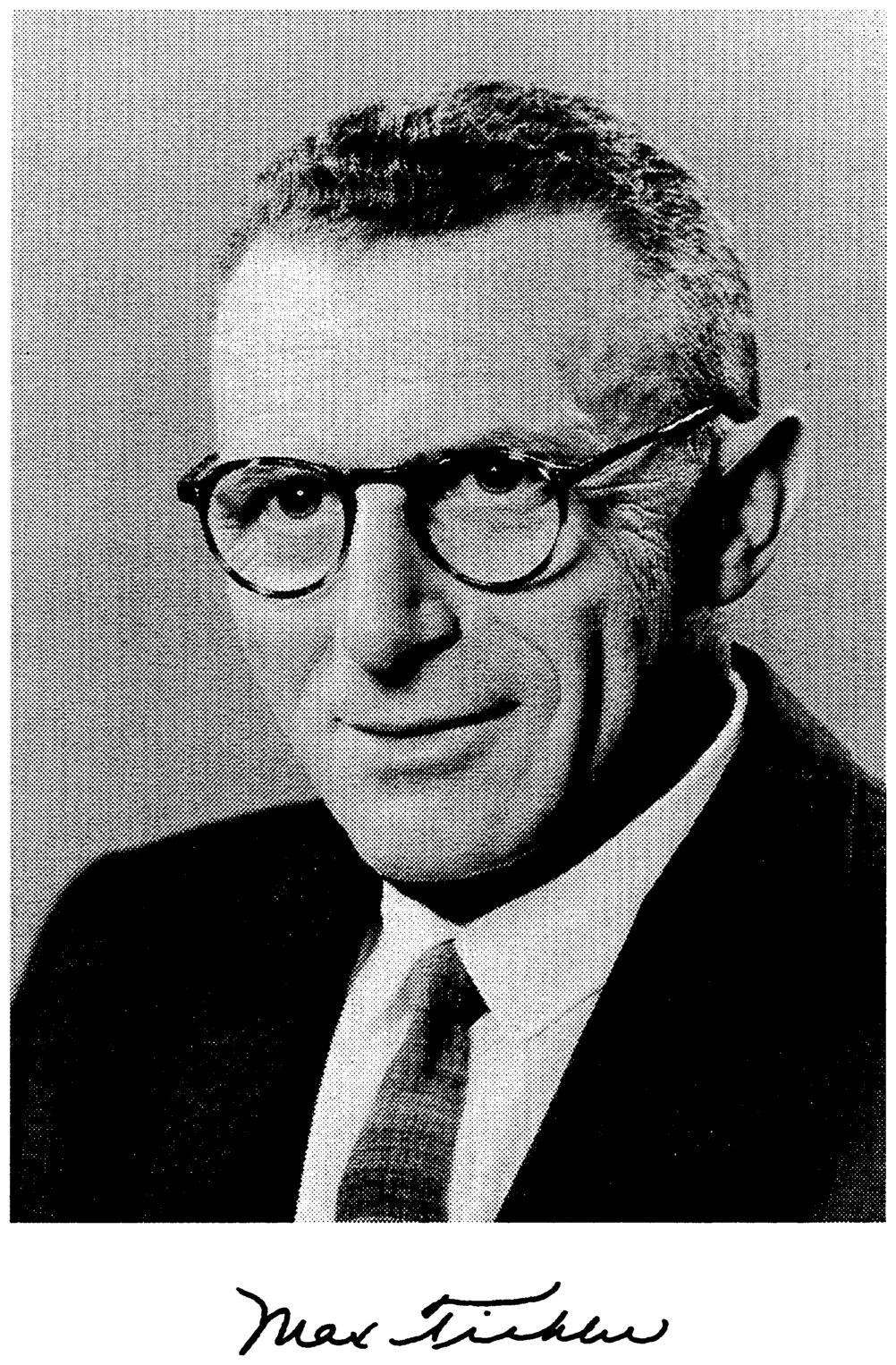
MAX TISHLER
October 30, 1906–March 18, 1989
BY LEWIS H. SARETT AND CLYDE ROCHE
MAX TISHLER WAS AN ILLUSTRIOUS SCIENTIST, a chemist, who— unlike most of his Harvard associates—elected to join the ranks of industry. After a thirty-two-year career of remarkable scientific productivity and leadership at Merck & Co., Inc., the world's largest prescription drug company, he returned to academe. As professor of chemistry at Wesleyan University in Connecticut he carved out yet another distinguished career.
At Merck he led research teams whose work was of enormous importance for human health, resulting in practical processes for synthesizing ascorbic acid, riboflavin, cortisone, miamin, pyridoxin, pantothenic acid, nicotinamide, methionine, threonine, and tryptophan. He also led a microbiological group that developed fermentation processes for actinomycin D, vitamin B12, streptomycin, and penicillin. In addition, his invention of the animal-health drug sulfaquinoxaline, the first coccidiostat, made possible a great expansion of the poultry industry and created overnight a new field for research—an event of great magnitude for agriculture.
As a result of such leadership Tishler in 1957 became the first president of the Merck Sharp & Dohme Research Laboratories Division of Merck & Co., Inc. In 1987 when Presi-
dent Reagan presented Tishler with the National Medal of Science, the citation described him as “a giant on the chemical scene these past fifty years. . . . The importance of Dr. Tishler's specific contributions to the nation's health can scarcely be exaggerated. ”
Max Tishler embodied the classic American ideal of success. Born in Boston in 1906, he was the fifth of six children of European immigrants. His father, a cobbler, left the family when Max was only five years old. As Max grew up he worked to help support his family. He held jobs as a baker's delivery boy, a newspaper seller, and a telephone answerer.
After all this his career took a crucial turn when he got a job as a pharmacist's assistant with duties that included tending the soda fountain as well as—what is more important— packaging and delivering drugs. The influenza epidemic of 1918 found Max delivering drugs in his native Boston. The ill and dying were everywhere. Deeply touched, he resolved to make a career in some place where he could contribute to health care.
An outstanding scholastic record in high school earned Max a scholarship to Tufts College (now Tufts University), where he was accorded a B.S. magna cum laude in chemistry in 1928. There he met Elizabeth M. Verveer, a freshman in his chemistry laboratory, who became a talented pianist and sculptor. They married in 1934 and their union was a source of joy and stability for Max all his life. Their two sons—Peter V., a physician and genetics researcher, and Carl L., a clinical psychologist—added to his happiness.
From Tufts Max went directly to graduate school at Harvard, where he came under the stimulating influence of Elmer P. Kohler and James Bryant Conant, later president of Harvard. Max earned his M.A. in chemistry in 1933 and his Ph.D. in organic chemistry under Kohler in 1934. For his doctoral dissertation he accomplished the first-ever
resolution of an allene, a landmark confirmation of organic chemical theory. He later described Kohler as “a great experimentalist from whom I learned a lot of laboratory techniques.” Conant was “a great teacher, very stimulating,” whom Max got to know much better in 1939, when he helped Conant revise his textbook Chemistry of Organic Compounds.
Both these distinguished educators helped Max at another critical turning point in his career when, with academic appointments scarce, he sought an opportunity in industry. Kohler spoke on his behalf to Randolph T. Major, director of the budding research program at Merck. Conant recommended Max as the outstanding chemist to go through Harvard in a generation.
So, in 1937, Max received an offer to join Merck, which was then just a small company making fine chemicals in Rahway, New Jersey. It was a good time to join that company and that industry. George W. Merck, president of the firm and son of its founder, was a gentleman whose resources matched his high aspirations. Thus, he was able to use the Merck sales base—chemical commodities such as iodine, silver nitrate, ether, and chloroform—as a platform for building a more innovative organization.
George Merck's ambition was to convert a company making fine chemicals into one creating new therapeutic agents for humanity. To this end he had launched in 1933 a program to greatly expand the company's scientific research organization and laboratories and to broaden the scope of its effort to include basic research.
This ambitious expansion project required a variety of capabilities new to Merck. It called for the building of communications with the world's medical research community, where findings in basic research were laying the groundwork for new drugs. Further, expertise in isolation of active principles from natural products was needed. To lead this
effort Karl Folkers was brought in from Yale. With success in isolating natural products that proved medically useful— vitamins and hormones —there arose a need for process development: the conversion of laboratory procedures for preparing mere milligrams of a therapeutic substance into full-scale manufacturing processes. This was the basis for Max Tishler's joining Merck as a process development chemist.
The task that challenged Max was worthy of all his skills. The chemistry of the vitamins and hormones was far more intricate than anything the pharmaceutical industry had ever worked with before. His first assignment at Merck was to develop a new, practical synthesis for riboflavin (vitamin B2), which is essential for growth and normal health. He worked out an economical, large-scale production process that greatly increased the yield and thus permitted the first use of riboflavin to enrich white bread.
I (Lewis Sarett) doubt whether Max Tishler was surprised by this first of many successes, because he was nothing if not confident. I vividly recall how, when he was in charge of development, he used to tell the basic research staff, “Don't worry about the complexity of the compounds you synthesize. If something is medically promising, we'll find a way to manufacture it.”
No substance offered more of a challenge to these bold words than cortisone. The synthesis of the first 16 milligrams of this hormone in 1944 opened a slender path through which, in principle, practical quantities could be made. One hundred grams were eventually synthesized —enough to distribute to various clinicians for experimental studies. In 1948 Philip Hench at the Mayo Clinic discovered that cortisone had a unique effect on inflamed joints in an arthritic patient. Suddenly, a pressing public demand for thousands of
kilograms exploded within the tranquil setting of the little company in New Jersey.
An awesome challenge confronted Max Tishler. On the one hand the existing process could yield only small amounts of cortisone—and those at a high cost. On the other hand, concerns voiced in the U.S. Congress carried the implicit threat that the government might move to take over cortisone as a national project. George Merck had responded by assuring the Congress that his company was fully capable of meeting its obligation to the countless patients who might benefit.
The burden of fulfilling that pledge fell squarely on Max's shoulders. The yield from deoxycholic acid as starting material was minuscule—a fraction of 1 percent. The supply of this starting material, a component of cattle bile, was insufficient for the projected demand. Another of the many problems was that osmium, which was used in the original synthesis, would have been required in quantities exceeding the available supply in the United States and perhaps even the world.
Under intense pressure from the medical community— not to mention the U.S. government—Max Tishler put together, first, a team of capable and strongly motivated synthetic chemists; and second, within an astonishingly short time, a practical process for large-scale production of the desperately needed hormone. As a result, the black-bordered insert expressing regret at the limited availability of cortisone that accompanied Merck's first announcements of the compound's medical utility, gradually disappeared. Max Tishler and his team came through with the most complex manufacturing process ever undertaken in the pharmaceutical industry.
Watching all this from up close, I (Lewis Sarett) learned
more about pharmaceutical research from Max than from anybody else. I've never known anyone like him. He was born with an energy level that was like an avalanche and a brain that was incandescent, just scintillating. The combination of energy and ability was extraordinary. Partly because of that, and partly because Max worked really incessantly —from very early in the morning fill late at night—he was able to do things that other people couldn't do. He had a fertile imagination and whatever he was interested in, he managed to do.
Even so, Max sometimes had to deal with the frustration and adversity that is part of any sustained research project. A longtime associate has told how he responded to such challenges:
Max was driven to do things well, and he could not tolerate problems not being solved. That made it all exciting. He was utterly fearless in the face of trouble and actually impatient to hear all the bad news—all the failures of good ideas, or setbacks from whatever source. Unlike most of us, who seem to need a little time to face up to reversals, he never even blinked. To sweep the bad news under the rug, even briefly, simply was not in him. This wholly admirable trait caused not a little grief to those of us with enough pride to want to clean up our own disasters, but it sure taught us to do it quickly!
But Max's successes far outweighed the reverses and brought him broad scientific recognition. This was symbolized by his election in 1953 to the National Academy of Sciences, an unusual distinction for a scientist in industry.
Also, inevitably, his achievements brought him a series of promotions. In 1957 he was chosen to head Merck's entire research and development effort. John T. Connor, then president of Merck, recalls that event:
As I saw it, what we needed was a research director who would manage the whole research program, not doing much research work directly himself, but setting up projects and putting people in charge of those projects in a
great variety of fields, and giving general guidance and supervision and ideas for their work as it went along. Our choice was Max Tishler. . . . Max turned out to be the consummate leader. He was inspirational, he was aggressive, he was brilliant, he was helpful to his research associates—altogether unbelievable.
So, Max had to adjust to becoming primarily an administrator, not an easy transition for most hands-on scientists. He knew—and each of the chemists in his organization knew—that when he delegated a task, he could carry out that task better and faster himself. I (Lewis Sarett) do believe Max tried to delegate as far as he could, but it came very hard to him. He thought so fast about so many things that he could work out the answer almost as soon as he assigned a problem to somebody.
That made him a tough man to work for—not patient. But though he might blow up at a colleague's shortcomings, then in the afternoon or evening he would call up and apologize. Anyway, the criterion I had for doing a job for Max was to ask myself, “If Max were doing this, would he do it better than I'm doing it?” and I always had to answer, “Yes.” So that kept me from boiling over.
But Max generally resisted any temptation to micromanage. Looking back over the years, one of his associates had this to say about his management style:
Max made very fundamental decisions about what to do and what not to do, but I don't think he ever dictated any of the details on what to do. He just might say, “Now, you are going to work on streptomycin. You're going to get it out. You are going to make 1,000 kilograms and you're going to have it by November 1.”
To offset his demanding style Max had a personal relationship with almost everyone he dealt with. He was interested in children, domestic problems, and so on in a way that very few people were. Even when he had as many as
1,800 people under his direction, he used to say, “I have to think about 1,800 families.”
A top Merck executive, who knew him for many years, remembers: “Max Tishler had more one-on-one relationships with people at all levels of the research laboratories than would have seemed believable to an outsider.”
It truly might be said that Max's main interest was not chemistry, but chemists. Thus, he was able to bring out the best in his fellow scientists—now by a word of encouragement, now by suggesting a change of course, now by his compassionate concern for personal problems, and always by listening.
If scientists were growing discouraged over repeated research failures, Max would help them—not necessarily by finding the solution to the problem, but perhaps by causing them to think of a new way to look for it. If a parent wanted help for a son or daughter seeking admission to college, Max did what he could. When a Merck scientist's spouse or other relative had a serious medical problem, Max would learn about it somehow. Then he gave wise counsel, made phone calls, and took whatever other action might be necessary to provide support and hope.
While his disregard for textbook administrative practices endeared Max to the scientists concerned, it put severe demands on his time. It also put a premium on concise presentations. Visitors to his office would find that unless they covered the ground quickly, Max would glance pointedly—and disconcertingly—at his wristwatch, knowing that several consultees were awaiting their turns.
Professor Donald Cram, who spent a short period in the Merck research laboratories working on the penicillin project, has quoted from his first interview with Max (Chemtech, December 1986, p. 712):
Tishler: So you're interested in doing research? What can you do?
Cram: In my master's work at Nebraska, I worked on rearrangements of. . . .
Tishler: What is the base-catalyzed condensation of benzaldehyde and acetophenone?
Cram: Benzalacetophenone—I made a ton. . . .
Tishler: Why are you here without your Ph.D.?
Cram: My draft board told me to leave school and get a job to aid the war effort. I fully intend to return to. . . .
Tishler: As far as I am concerned, you are hired.
This vignette, presented by Cram as part of Max's eightieth birthday celebration, was absolutely typical. He seemed to anticipate what chemists were going to say before they could get the words out.
With other, less familiar disciplines, however, he was simply filled with intense curiosity. One evening a Merck executive was seated at a ceremonial dinner next to an eminent professor of pharmacology. As the meal continued, the executive found himself falling behind the other guests. The reason was that as he lifted his fork to his mouth his neighbor kept asking question after question. Eventually the professor relented and explained. He was simply doing to this Merck executive what Max Tishler had done to him earlier that year.
As the reader may have gathered, Max Tishler was uniquely curious, gifted, and impatient. As such, he was sympathetic to kindred souls. He did not care for the usual round of polite interviews, striving to determine how well a candidate scientist might fit into the organization. The recommendation most compelling to Max would seem to be: “Although this man gets along with almost no one, he is the brightest scientist we've seen in some years.”
Max had intense, one might say puritanical, views on right and wrong. He preferred black and white to shades of gray. Thus, more than thirty years ago, when the scientific and therapeutic achievements of the pharmaceutical industry were called in question by a few witnesses who appeared before the Kefauver Committee, Max—like many other scientists —was outraged by what he felt was unfair criticism based on distortion of the facts. Feeling that objective and unimpeachably authoritative observers would agree with him, he conceived the idea of asking such observers to recognize publicly the contributions the industry had made to saving life and protecting health.
Max had a proposed statement lettered on a scroll and hand-carried by a personal courier to fourteen Nobel Prize winners in medicine and chemistry. The scroll, which all of them signed, resides to this day in the Merck archives. It says, in part:
The scientists in the laboratories of the pharmaceutical industry have in fact become partners in the total research effort, frequently initiating fundamental research, still more frequently associating with scientists in universities and elsewhere in a joint endeavor. We find in these men true collaborators. . . . We believe it is important to record publicly our recognition of the many significant contributions made by the research laboratories and scientists of this industry to the progress of medicine.
It was remarkable for such eminent scientists to become involved in the highly politicized healthcare debates of those days. Their willingness to do so is a striking example of the scientific community 's respect for Max Tishler.
The same moral commitment to defend scientific truth as he saw it gave birth to a 1973 book co-edited by Max and his friend and fellow chemist Milton Harris, Chemistry in the Economy. Here again, by setting forth the benefits that chemistry confers, he sought to counterbalance the intense criti-
cism that chemistry was receiving for various sorts of toxicity.
Max's career kept rising, and in 1962 he was elected to the Merck board of directors. His research budgets continued to rise as valuable new products emerged from the laboratories. Under Max Tishler's overall leadership, Merck chemists, biologists, and clinical investigators discovered, developed, and obtained regulatory approval for a series of drugs and vaccines, which in many respects revolutionized the practice of medicine and healthcare throughout the world. Among these were many vitamins essential to life and growth; cortisone and other steroids; drugs effective against high blood pressure and congestive heart failure sure as chlorothiazide, hydrochlorothiazide, and later methyldopa; indomethacin, the first clinically important non-steroidal anti-inflammatory agent; antidepressants; vaccines against measles, mumps, and rubella; and animal health drugs such as the coccidiostat sulfaquinoxaline and the anthelmintic thiabendazole.
Max's career took a new turn in 1969 when he was promoted from the research division to the newly created corporate position of senior vice-president for science and technology. But, isolated from his many personal research projects and the scientists who headed them, he began to feel out of his element and restless.
Thus, in 1970, eighteen months before mandatory retirement, he accepted an invitation to become professor of chemistry at Wesleyan University in Middletown, Connecticut. There, Max found himself again in the midst of scientists, students, and research ideas. He played a leading role in developing a Ph.D. program in chemistry, which added a new dimension to the Chemistry Department. He took on graduate students and was a mentor—in the best sense of the word—to them and countless other younger scientists.
In addition, he created and organized the annual Peter A. Leermakers Symposium in Chemistry. This has become a major event in the American chemical community, bringing internationally renowned chemists and an audience of hundreds of scientists to the Wesleyan campus each spring. In his spare time he continued his lifelong hobby of growing many species of cacti, orchids, and other exotic plants.
Before long he became University Professor of the Sciences and chairperson of the Chemistry Department. Even after reaching emeritus status in 1975 he taught courses in medicinal chemistry and remained extraordinarily active in research. Until only a few weeks before his death he was involved in all phases of departmental activities and continued to advise and encourage graduate and undergraduate students, with whom he was enormously popular.
Remarkably, in the midst of all his university activity, he found a way to contribute another pharmaceutical product to Merck. One of Max's students had been Satoshi Omura, now professor and executive director of the Kitasato Institute in Tokyo. The institute's microbiologists produced certain fermentation broths and, at Max's suggestion, these were screened at Merck for possible antiparasitic activity. Activity was indeed detected, and this quickly led to the avermectin family of compounds, which have proved effective not only against a wide variety of internal and external parasites of animals but also against the fly-borne parasite that causes onchocerciasis (river blindness) in people in many tropical countries, primarily in Africa.
Many honors came to Max. Besides those previously mentioned, he received the Priestley Medal (the American Chemical Society's highest honor) and the Eli Whitney Award for Inventions. He was elected president of the American Chemical Society in 1972, during a critical period in the organization's history.
Introducing him at his induction into the Inventor's Hall of Fame in 1982, I (Lewis Sarett) pointed out:
One might say that Max Tishler invented the term “developmental research.” Early in his career at Merck, he recognized that there was a need for basic chemical studies in process development. He put “research ” into “development.” Although this is common practice today, it was a new concept at the time and had a profound impact on biomedical and pharmaceutical research.
This memoir has described how Max Tishler earned his secure, honored, and enduring place as a true pioneer in the history of chemistry. But, it was typical of the man that he preferred to measure his accomplishments by their impact on people. Interviewed some years ago, he answered a question about what he considered the most important contributions that Merck—and Max personally—had made to society:
I think we saved the lives of a lot of people, contributed to the control of disease, and made life more pleasant. That has given me the greatest pleasure. I can't say which development was the greatest thrill for me: cortisone development, streptomycin development, or penicillin development. That would be like choosing which of your twelve children you like best. Each one has had an impact on me.
Consider, for example, a commercially unimportant drug that I helped to develop—namely actinomycin, an organism that Dr. Selman A. Waksman discovered. This turned out to be an important compound useful for treating a very rare form of cancer, called Wilms' tumor, which afflicts children. The number of cases that occur each year is not large, but for the individual children and their families the drug is vitally important. The late Dr. Sidney Farber, a great pathologist who set up the Dana Farber Institute in Boston, once invited me to come up and see some of the children who had been getting actinomycin. He introduced me to half a dozen who had been treated with actinomycin five years earlier. They looked robust, and were considered to be permanently cured. . . . It makes everything worthwhile when you see things like that.
Even with so many good things to reminisce about, Max was never
one to dwell in the past. In the same interview he went on to say, “I wish I were twenty-five years younger. I think there's great excitement ahead.” That is the questing, ever-curious Max whom I will remember best.
Max Tishler was eighty-two when he died, of complications of emphysema, in Middletown, Connecticut. One of his friends at Merck summed up the feeling of many who had known him: “I think about Max frequently. He was such a nice combination of very gifted, very conscientious, and very human.”
SELECTED BIBLIOGRAPHY
1935 With E. P. Kohler and J. T. Walker. The resolution of an allenic compound. J. A. C. S. 57:1743.
1939 With E. P. Kohler, H. Potter, and H. T. Thompson. The preparation of cyclic ketones by ring enlargement. J. A. C. S. 61:1057.
With W. L. Sampson. Antihemorrhagic activity of simple compounds. J. A. C. S. 61:1057.
1941 With L. F. Fieser, and W. L. Sampson. Vitamin K activity and structure. Journal of Biological Chemistry 137:659.
With H. M. Evans. Vitamin E activities of some compounds related to α-tocopherol. Journal of Biological Chemistry 139:241.
1942 With S. A. Waksman. The chemical nature of actinomycin, an anti-microbial substance produced by Actinomyces antibioticus. Journal of Biological Chemistry 142:519.
1944 With J. Weijlard and A. E. Erickson. Sulfaquinoxaline and some related compounds J. A. C. S. 66:1957.
1945 With J. W. Wellman and K. Ladenburg. The preparation of riboflavin. III The synthesis of alloxazines and isoalloxazines. J. A. C. S. 67:2165.
1948 With E. H. Pierson and M. Giella. Synthesis of DL-methionine. J. A. C. S. 70:1450.
1949 Production and isolation of streptomycin. Reprinted from Streptomycin. Edited by Dr. S. A. Waksman Chapter 4 p. 32.
With N. L. Wendler and H. L. Slates. Synthesis of vitamin A. J. A. C. S. 71:3267.
1950 With N. L. Wendler, P. R. Graber, and R. E. Jones. Synthesis of 11-hydroxylated cortical steroids 17(α)-hydroxycorticosterone. J. A. C. S. 72:5793.
1951 With K. Pfister, A. P. Sullivan, and J. Weijlard. Sulfaquinoxaline. II. A new synthesis of 2-aminoquinoxaline. J. A. C. S. 73:4955.
1952 With N. L. Wendler, P. R. Graber, and R. E. Jones. The synthesis of 11-hydroxylated cortical steroids. 17-hydroxycorticosterone. J. A. C. S. 74:3630.
1953 With E. M. Chamberlin, W. V. Ruyle, A. E. Erickson, J. M. Chemerda, L. M. Aliminosa, R. L. Erickson, and G. E. Sita. Synthesis of 11-keto steroids. J. A. C. S. 73:3477.
1954 With J. Weijlard and G. Purdue. Improved synthesis of biocytin. J. A. C. S. 76:2505.
1955 With R. F. Hirschmann, R. Miller, R. E. Beyler, and L. H. Sarett. A new biologically potent steroid: 1-dehydro-9α-fluorohydrocortisone acetate. J. A. C. S. 77:3166.
With M. Sletzinger, D. F. Reinhold, J. Grier, and M. Beachem. The synthesis of pteroylglutamic acid. J. A. C. S. 77:6365.
1959 Role of the drug house in biological and medical research. Bull. of the N. Y. Academy of Medicine 35:590.
1960 Impact of research on the growth of medicine. J. of Chem. Education 37:195.
Research key to drug industry's growth. Journal of Commerce September 12
1963 The government's role and the future of discovery. S. C. I. American Section, Chemical Industry Medal Address. Houston, Texas. September 26, 1963. Chemistry and Industry. October 12, 1963 p. 1632.
1964 Molecular modification in modern drug research. Advances in Chemistry Series 45:1.
Perspectives in pharmaceutical research. TVF—Journal of Scientific Technical Research 36:37. Annual chemistry lecture presented December 7, 1964, to the Royal Swedish Academy of Engineering Sciences.


