
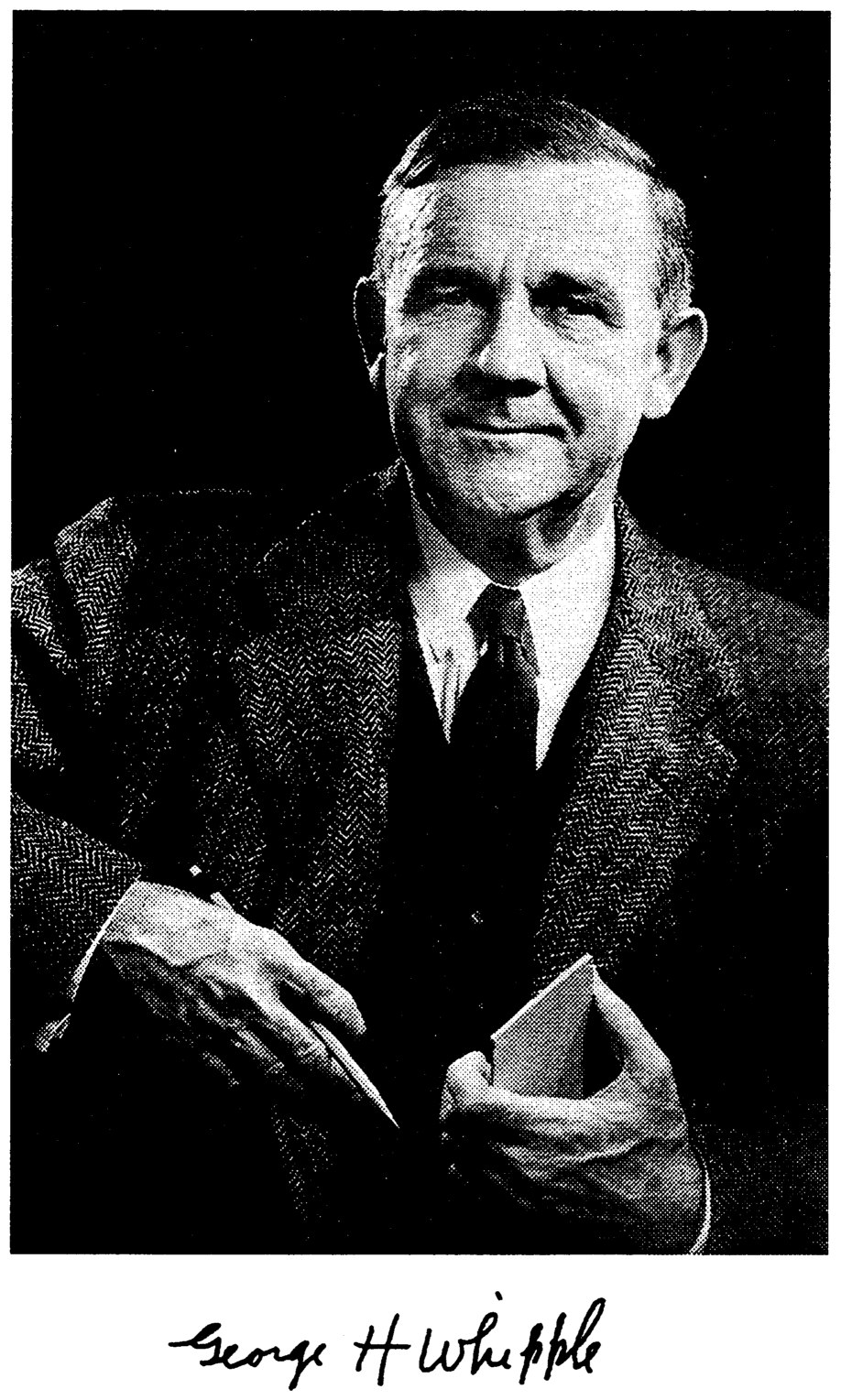
GEORGE HOYT WHIPPLE
August 28, 1878–February 2, 1976
BY LEON L. MILLER
IFIRST MET GEORGE H. WHIPPLE in December 1938 when he interviewed me for the position of research fellow biochemist to work with him and other members of the Department of Pathology. I was impressed by his soft-spoken, taciturn manner and by his air of friendly reserve. Although I spent more than eight years in Whipple's laboratory working with him and others in many of the ongoing research problems, I came to realize that I had learned very little about Whipple personally. During department conferences or in small research meetings he stuck closely to the case discussions at hand or the research data being presented. He did not encourage wide-ranging discussion or sharp differences of opinion that might provoke controversy. However, he never discouraged a young worker from doing an experiment to test his own ideas.
To learn some little about Whipple's personal life and feelings one must read the definitive biography, George Hoyt Whipple and his Friends, published in 1963 and written by George W. Corner after more than fifty years of close association and friendship. Whipple's autobiography in Perspectives in Biology and Medicine (1959) leaves one with the feeling that he did not enjoy talking or writing about himself. I
cannot recall a single instance where Whipple spoke in praise of his own work or ideas.
Whipple invited familiarity neither from junior colleagues nor research collaborators; nor was he given to small talk unless it touched on hunting, fishing, or baseball. Corner said Whipple saw no fun or value in talking about something he could not expertly comprehend.
George Hoyt Whipple was a pathologist who managed to combine in one lifetime the activities of three careers of distinction—one as founder and longtime dean of the School of Medicine and Dentistry at the University of Rochester, another as a devoted and inspiring teacher of medical students and as mentor of young pathologists, and a third as an internationally recognized medical researcher who made substantial contributions to several areas of research in experimental medicine. Best known perhaps for his studies in experimental anemia, he was honored with George Minot and William Murphy as co-winner of the Nobel Prize in Medicine or Physiology in 1934. In spite of these and many other honors, George Whipple in his brief autobiography said, “I would be remembered as a teacher.”
THE EARLY YEARS (1878-1900)
Born in 1878 in the village of Ashland, New Hampshire, George Hoyt Whipple was the only direct male descendent of two New Hampshire country doctors, Solomon Mason Whipple, his grandfather, and Ashley Cooper Whipple, his father. When George was only two years old, his father suffered an untimely death from pneumonia; George and one small sister were left to be raised by his mother Frances Anna Hoyt Whipple and his maternal grandmother Frances Moody Hoyt. They indelibly impressed upon him the virtues of thrift, frugality, modesty, and work. They were largely responsible for insuring that George received a sound early
education and preparation for college at Phillips Andover Academy. There he showed an aptitude for the sciences and mathematics, but came to regard languages, including Greek and Latin, as necessary but uninspiring drudgery.
As a boy, George learned to love the great outdoors and developed a fondness for hunting and fishing, which remained with him for the rest of his life. During the summer vacations of his prep school and college years he worked at a variety of jobs, mostly providing help and service to summer tourists and campers on Squam Lake and Lake Winnepesaukee in New Hampshire. That work afforded him opportunities for dealing responsibly with people and yielded earnings, which he carefully husbanded for his college and medical school expenses.
As far back as he could remember George Whipple tacitly anticipated that, like his paternal forebears, he would become a physician. Apparently his mother encouraged him in this ambition, adding some financial support from a small inheritance and influencing his choice of Yale as the college for his premedical studies.
As an undergraduate at Yale, George distinguished himself not only as an outstanding student of the sciences, but also as a prize-winning gymnast and oarsman. In his senior year Whipple fell under the influence of the nutritionist Russel H. Chittenden1 and the physiological chemist Lafayette B. Mendel.
In his autobiography Whipple refers to Mendel as “an unusual man who exerted a strong influence on me. Work with him was exciting and never to be forgotten.” Whipple's potential as a researcher was recognized by his election while at Yale to membership in Sigma Xi and by his graduation in 1904 with senior honors.
Realizing that he did not have enough money to pay for his planned medical education, Whipple took a year off to
work at Dr. Holbrook's Military School in Ossining, New York, where he taught mathematics and science and served as athletics coach.
In choosing Johns Hopkins as the school for his medical education George Whipple was significantly influenced by his mother. She had learned about the university's outstanding teachers, who were interested in research, and how unique Hopkins was in that respect. It had an excellent library and an associated hospital organized to foster clinical teaching. Furthermore, Hopkins was the only medical school in the United States that required a bachelor's degree and a knowledge of Greek, Latin, French, and German for admission.
JOHNS HOPKINS YEARS (1901-14)
In his first year at Hopkins, Whipple's comparatively extensive training in physiological chemistry at Yale qualified him to apply for a student teaching assistantship in John J. Abel's Department of Physiological Chemistry. This not only afforded him some much needed financial support, but gave him an opportunity to savor the excitement and general spirit of zealous interest in the new developments in medicine in which Johns Hopkins had become the leader in America.
As a medical student at Hopkins, Whipple was typical in being self-motivated to study and work hard and to follow Osler's advice “to keep their hearts on ice” and avoid amorous distractions. His performance in his first year anatomy course was outstanding enough to win him a second-year appointment as a student instructor in anatomy. During that year Whipple's training was dominated by his introduction to pathology, which fascinated him in all its aspects. The exemplary leadership of William Welch, Eugene Opie, and William McCallum—inspiring teachers and scientists who correlated clinical illness and disease and the findings
at autopsy and under the microscope—all engaged Whipple's lasting interest. At the same time he was deeply impressed by the array of unsolved problems, some of which would later incite him to firsthand research.
Standing fourth in his class of fifty-four students, Whipple was eminently qualified for one of the choice internships in medicine, which included pediatrics; however, fate intervened when a junior member of the Pathology Department was about to leave Hopkins, and McCallum, acting as Welch's agent, offered the post to Whipple, presumably to concentrate on pediatric pathology. That year in pathology was supposed to prepare Whipple for an anticipated career in clinical pediatrics, however Whipple was so thoroughly entranced by his experience in all aspects of the work in pathology that he sought a second year 's appointment from Welch. Welch gladly accepted him and ventured to predict that a second year in pathology would inevitably lead him to a career in pathology.
Corner characterized Whipple in his youth as “a tall, handsome young man, respected by all his acquaintances. With his reserve and plain speaking went fair dealing and courtesy. He held his own views without vanity or arrogance, but with tenacity, and was not to be jostled from his place by authority.” Corner adds that Whipple “did not make friends easily, but the friendships he made lasted for life.” Corner quotes Peyton Rous, who, while both were at Hopkins, said in comparing Whipple with himself, “George had a granitic aspect and repose, whereas I was overactive and a volatile talker.”
In 1907 after two years of assistantship Whipple embarked on his career as a pathologist and was encouraged to undertake research in descriptive or experimental pathology. In those first two years he proved in two papers that he had developed his skills as a keen and careful observer. In the
first paper he compared the apparent role of the lungs and the lymphatics with that of the gastrointestinal tract in the spread of the tubercle bacillus, as observed in a long series of autopsies of humans dead of tuberculosis. In the second paper he described in detail the results of an autopsy on a thirty-seven-year-old physician dead of a previously undescribed condition that Whipple designated lipodystrophia intestinalis, characterized by the accumulation of granular material (staining for fatty acids) in the walls of the small intestine and lymph nodes. Later observers recognized the novelty of Whipple's observations and named it Whipple's disease. They characterized his original description as “a classic of clarity, objectivity, and completeness.”
In 1908 with the encouragement of Welch, Whipple went to the Gorgas Hospital in Panama to work for a year with Samuel Darling, the resident pathologist. This broadened Whipple's experience to include the ravages of tropical disease and provided him an opportunity to study and report some of his observations on the massive hemolysis of black-water fever. The salary for the work in Panama allowed him to travel to Europe before returning to Hopkins. He spent several months at Heidelberg in the laboratories of Krehl and Morawitz, where he saw a first-class European laboratory in action, and participated briefly in some studies involving the experimental production of anemia in rabbits.
Upon his return to Hopkins in 1909, Whipple focused his efforts on the pathologic disturbance of function such as that associated with acute chloroform poisoning and liver injury in the dog, as described by Howland and Richards. Although Whipple and King failed to produce experimental cirrhosis in the dog by inflicting repeated episodes of chloroform liver injury and necrosis, they observed and recorded the increased bleeding tendency and jaundice and measured decreases in fibrinogen levels in their dogs. Fur-
thermore, they correlated these changes with the severity of histologically demonstrable liver injury and necrosis and they were quick to suggest that the liver was the site of fibrinogen synthesis.
Whipple's early interest in the pathogenesis of jaundice led him to submit An Essay on the Pathogenesis of Icterus in the blind competition for the Warren Triennial Prize of the Massachusetts General Hospital; Whipple was declared the winner of the prize in April 1910. This immensely pleased his department chairman Welch and added considerably to Whipple's growing renown. Soon thereafter he was offered professorships at the University of Pennsylvania and the University of California schools of medicine. He chose to turn them down and in 1911 was appointed an associate professor of pathology at Hopkins.
Whipple spent the spring and summer of 1911 in Vienna in the laboratory of Professor Hans Meyer; there he learned how to produce the experimental porto-caval shunt in the dog known as the Eck fistula. Using this technique in later years Whipple was able to study the effects of totally diverting the hepatic portal vein blood flow on a number of hepatic functions in the dog.
During the period 1907-14 of his professional maturation as a pathologist, Whipple's research interests clearly shifted from studies primarily concerned with histopathologic anatomy to problems in which altered functions could be studied with the tools of biochemistry and physiology. Thus, during the last several years at Hopkins with the collaboration of Charles W. Hooper,2 Whipple started a long series of studies in dogs on the origin and excretion of bile pigment and on icterus as one manifestation of impaired hepatic function. These studies were briefly interrupted in the spring of 1914 when Whipple, at age thirty-four, married Katherine Waring and accepted an offer to become
professor of experimental medicine and head of the newly established Hooper Foundation for Medical Research at the University of California School of Medicine in San Francisco.
THE SAN FRANCISCO YEARS (1914-21)
In spite of the many difficulties of establishing a totally new laboratory Whipple with the continuing collaboration of C. W. Hooper, who accompanied him in the move from Hopkins, managed to continue his research on bile pigment metabolism, culminating in a series of twelve publications between 1915 and 1917. Altogether these studies established the following important facts concerning the origin and excretion of bile pigments:
-
That the bile pigment bilirubin was derived not only from the breakdown of red cell hemoglobin, but also from muscle hemoglobin.
-
That neither the bilirubin in fed bile nor the bilirubin derivable from the heme of fed hemoglobin gave rise to a measurable increase in the bile pigment secreted in bile fistula in dogs. These studies finally refuted any speculation that bile pigment might be reabsorbed and reutilized in the production of new red cells.
-
That the heme moiety of hemoglobin could be converted to bilirubin in both the pleural and peritoneal cavities as well as in the liver.
-
Reemphasized that normal liver function was essential for the excretion of bilirubin.
In the course of studying bile pigment metabolism and recognizing that blood red cells were the major normal source of bilirubin, Whipple and Hooper studied the effects of acute hemorrhagic anemia and diet composition
on bilirubin excretion and shifted the emphasis of their research to the study of the regeneration of red blood cells in simple anemia. In 1918 they published the first of a long series of papers in which the curve of red blood cell regeneration was described as influenced by dietary factors. This was followed by a second report on the curve of regeneration as influenced by starvation, sugar, amino acids, and other dietary factors. Concurrently, with the collaboration of W. H. Kerr and S. H. Hurwitz, Whipple was making the first of what would become a long series of studies on the regeneration of the blood serum proteins and they recorded the effects of fasting on the curve of protein regeneration. This was followed by studies on the influence of diet on the curve of regeneration after plasma depletion.
Although these early studies on blood and plasma protein regeneration pointed to dietary factors having important influences on quantitative changes in blood and plasma protein regeneration, it became apparent that accurate reproducible measures of blood and plasma volumes would be essential before accurate estimates of the total circulating mass of blood and plasma proteins could be made. This led to the development by Hooper, Smith, Belt, and Whipple of reproducible dye dilution methods for the quantitative estimation of plasma volume.
In 1921, two years after Whipple had been appointed dean at the University of California School of Medicine in San Francisco, he received an offer from the president of the University of Rochester to come to Rochester, New York, to plan, organize, and lead a new school of medicine as dean and as chairman and professor of pathology. With his research program in full swing, Whipple was reluctant to leave California, but Rush Rhees was not to be deterred. He went to San Francisco personally to encourage Whipple to reconsider. As dean at Berkeley, Whipple was not happy
with the physical separation of the faculty and students during the first two preclinical years in Berkeley from the clinical staff and hospital in San Francisco. Whipple was finally won over by recognizing that Rhees' offer was a rare opportunity to create a medical school from the ground up, with a full-time faculty in a physical setting conducive to easy exchange between clinical and preclinical disciplines. In addition, Rhees reassured him that in Rochester he would not be expected to participate actively in the social life or community service, which might detract from his total commitment to the teaching and research functions of the medical school.
Whipple's ongoing research programs at the Hooper Institute continued, with the friendly cooperation of all concerned at Berkeley, without interruption until late in 1922, when the first building was completed at the new medical school in Rochester.
THE ROCHESTER YEARS (1921-77)
When Whipple's research technician Frieda Robscheit-Robbins arrived in Rochester in December 1922 with forty of her special strain of dogs, their research studies were soon resumed and between 1921 and 1925 there were published several series of papers dealing with:
-
Determination of circulating plasma and hemoglobin volumes;
-
Dietary and other factors affecting bile salt production and secretion;
-
Measurement of blood fibrinogen and the effects of diet, hemorrhage, liver injury, and other factors on plasma fibrinogen levels;
-
Roentgen ray intoxication in dogs (these papers with Stafford Warren were regarded twenty-five years later as clas-
-
sical descriptions of the anatomic and functional effects of radiation injury);
-
Blood regeneration following simple anemia (a series of six papers sought to evaluate the effects of varying diet composition on hemoglobin regeneration in simple hemorrhagic anemia and demonstrated that blood hemoglobin levels in the dog could be completely controlled by diet).
Because there were large differences in responses of different dogs Whipple and Robscheit-Robbins were able to obtain quantitatively more consistent results by establishing more rigorously standardized control conditions. These involved the use of:
-
Their specially bred strain of Dalmatian-English bull dogs, which, though not genetically pure, were closely similar in appearance;
-
Prior bleeding to produce a standard anemia of about 40-45 percent of normal, which could be maintained for weeks at this level with minimal further bleeding while the dogs were fed a basal diet, adequate to maintain their weight and health, but affording only a variably small hemoglobin regeneration of 1-3 grams per week;
-
Systematic and accurate measurements of hemoglobin levels and circulating volume in response to diet supplements of specific foods, inorganic salts, or drugs.
Thus, in 1925 Whipple and Robscheit-Robbins published the first of what was to become a series of eighteen papers on “Blood Regeneration in Severe Anemia.” G. W. Corner, Whipple's biographer, commented on the second of these papers covering the favorable influence of liver, heart, and skeletal muscle in diet: “This report with its unequivocal emphasis on liver feeding is the most important single pa-
per as regards George H. Whipple's world reputation as a scientist, in the whole of his immense lifetime list of more than 300 publications.” That report, clearly establishing the superior potency of fed liver in promoting the regeneration of hemoglobin in the anemic dog, caught the attention of George Minot in Boston; he and William Murphy were preoccupied with the treatment of humans afflicted with pernicious anemia for which there was at the time no known cure. In a relatively short time they were able to demonstrate conclusively that a diet containing large amounts of raw or cooked beef liver produced phenomenal sustained remissions of pernicious anemia. The effectiveness of liver feeding in the successful treatment of pernicious anemia was soon widely confirmed and recognized internationally.
Between 1925 and 1930 Whipple and Robscheit-Robbins published a total of twenty-one papers describing the use of the standard anemic dog to test a lengthy array of foods of animal and vegetable origin. In general, foods derived from animal tissues as a group were much more potent than foods of plant origin, with one notable exception; cooked apricots were found to be the most potent food of plant origin, surpassing beef heart and beef skeletal muscle in stimulating hemoglobin regeneration. Much effort was also devoted to comparing the effects of fed whole foods with the effects of feeding the corresponding inorganic ash derived from the combustion of the foods. It became clear that the potency of various food supplements was roughly paralleled by their iron content; however, the effects of feeding iron salts alone, or the iron-containing ash of foods, resulted in at most 40-50 percent of the hemoglobin regeneration seen after feeding the whole food supplement.
Several of the twenty-one papers described attempts to fractionate liver chemically by the relatively crude methods then available, with limited success; with the collaboration
of the laboratories of the Eli Lilly Company, a liver fraction corresponding to 3 percent of the liver weight showed 65-75 percent of the potency of whole beef liver in the standard anemic dog. Another liver fraction (Eli Lilly Company fraction 343 NNR) tested and found by Minot and Murphy to be potent in treating human pernicious anemia had only 10-20 percent of the potency of whole liver in the response of the standard anemic dog. These observations clearly indicated that the liver factors effective in treating human pernicious anemia were not the same as those responsible for the large hemoglobin response in the standard anemic dog. Thus, there remained the troubling, unanswered question of whether whole liver contained a factor other than iron (in some unusually assimilable form), copper, and other trace metals, which, when fed, may stimulate hemoglobin production in the standard anemic dog.
THE ROCHESTER YEARS (1930-40)
The news of the award in 1934 of the Nobel Prize for Medicine or Physiology to George Minot, William P. Murphy, and George H. Whipple came as a stunning surprise to Whipple, who accepted it with quiet modesty. In explaining the basis for the honor, Professor I. Holmgren speaking for the award committee said, “Of the three prize winners, it was Whipple who first occupied himself with the investigations for which the prize is now awarded. . . . Whipple's experiments were planned exceedingly well, and carried out very accurately, and consequently their results can lay claim to absolute reliability. These investigations and results of Whipple's gave Minor and Murphy the idea that an experiment could be made to see whether favorable results might also be obtained in the case of pernicious anemia, an anemia of quite different type, by making use of the foods of the kind that Whipple had found to yield favor-
able results in his experiments regarding anemia from loss of blood. ”
George H. Whipple's life in Rochester was dominated by total commitment and devotion to his work as dean, as department head, as teacher of pathology, and as medical researcher. During the work week he was always available and he routinely appeared in the pathology laboratories on Saturday and Sunday mornings. After he became well known he frequently declined invitations to travel and talk at other institutions or meetings. However, he found time to serve as a member of the board of trustees of the Rockefeller Foundation from 1997 to 1943. There his presence was described as quiet and unobtrusive, but his quietly voiced opinions were highly regarded and respected. His contributions to the board were so highly valued that he was invited to join the trustees of the general education board of the Rockefeller Foundation, on which he served from 1936 to 1943. In 1936 after declining the directorship of the Rockefeller Institute for Medical Research, he was elected a trustee and member of the board of scientific directors of that institute (1936-43).
During this decade Whipple continued to use the standard anemic dog to explore several questions bearing on the metabolism and synthesis of hemoglobin. By taking advantage of the infection-free bile fistula dog, William B. Hawkins and Whipple were able to resolve previous inconclusive observations about the reutilization of the pigment moiety of parenterally administered dog hemoglobin in the production of new red blood cells. It became clear that even in the standard anemic dog, with its maximal stimulus for hemoglobin production, the pigment moiety of parenterally given hemoglobin was not reutilized; rather it was excreted in the bile as completely in the form of bilirubin as in the comparable nonanemic state.
In 1937 Hawkins and Whipple used the bile fistula dog to determine the average life span of the red blood cell in the dog by timing the large increase in bile pigment that occurred at about 124 days after the acute massive regeneration of red cells in response to the massive hemolysis induced by the administration of phenylhydrazine. Interestingly, Whipple in 1926 was aware of the estimate of 110 to 140 days for the life span of the red cell made by A. Lichtenstein and A. J. L. Verwer, which was based on quantitative measurements of urobilin excretion; however, Whipple categorically stated, “This accuracy (in measuring urobilin) was praiseworthy but they contributed nothing to our knowledge of the life cycle of red cells. . . .”
In another study with F S. Daft and Robscheit-Robbins published in 1935 Whipple compared hemoglobin production in the fasting state with production during feeding of sugar only. These studies were documented by measurements of urinary nitrogen partition and nitrogen balance. The results supported the view that, even during total starvation, small but significant amounts of hemoglobin were produced and that hemoglobin production was substantially improved by sugar feeding associated with a marked reduction in urinary nitrogen excretion. In discussing their results the authors repeated an idea expressed by Davis and Whipple fifteen years earlier, when they sought to explain the occurrence of extensive liver cell regeneration during the starvation or sugar feeding after chloroform-induced liver necrosis, viz. that those results pointed “to intriguing possibilities of exchange between various body proteins and hemoglobin or other proteins according to the physiological needs of the moment.”
In the early 1930s Whipple also returned to the object of his work with Kerr and Hurwitz described in 1918, viz. the regeneration of the plasma proteins, and initiated a long
series of studies utilizing a standardized hypoproteinemic dog (with total plasma protein level of 4.0 grams) maintained on a standard low protein diet of known composition with plasma protein levels controlled by routine plasmapheresis (the bleeding of known measured volumes of blood followed by the intravenous return of the removed red cells after their separation by centrifugation and washing). Measurement of the plasma volume and total plasma protein removed was used to determine the effectiveness of a particular protein food supplement over the course of a week's test interval.
While the plasmapheresis studies were demonstrating the importance of the qualitative and quantitative character of dietary protein on production of plasma proteins, Whipple and his colleagues were finding that dog plasma proteins given intravenously or intraperitoneally along with a nonprotein diet could maintain dogs in weight and nitrogen balance. The results of these studies, along with those obtained earlier on liver cell regeneration after chloroform liver injury and necrosis and those on hemoglobin regeneration in the fasted anemic dog, all led Whipple to propose his hypothesis of “the dynamic equilibrium between blood and tissue proteins.” I believe this was conceptually his most important contribution to our understanding of the fundamental character of mammalian protein metabolism. His astute inferences were soon extended and definitively documented in detail after the advent of the isotopic era in the late 1930s. The successful preparation of useful quantities of deuterium (2H) and heavy nitrogen (15N) after Harold Urey's Nobel Prize-winning discoveries led to the classical work of Rudolf Schoenheimer, Sarah Ratner, and David Rittenberg, on the basis of which Schoenheimer wrote the concise classic The Dynamic State of the Body Con-
stituents and ushered in the modern era of biochemistry and biology.
The discoveries of artificial radioactivity by Joliot Curie and Fermi and the invention of the cyclotron by Ernest O. Lawrence with its capability of producing useful amounts of radioactive iron (59Fe) permitted Whipple, Paul F. Hahn, and William F. Bale to begin in 1937 a critical examination of the nature of iron absorption and utilization. In a short time they were able to define the unique character of iron as the one essential food factor where the amount absorbed from the small intestine was rigorously controlled and reflected the state of (iron) stores in the body. It became clear that only insignificant amounts of iron were found normally to be excreted or lost in the urine, feces, or bile. Iron absorption from the gastrointestinal tract of the nonanemic dog was found to be correspondingly minimal, however, with severe hemorrhagic anemia and iron deficiency; iron absorption was found to be substantially increased until bodily iron stores were replenished.
THE WAR YEARS (1940-50)
Between 1939 and 1943 Leon L. Miller and Whipple examined the effects of protein depletion on the susceptibility of dogs to the hepato-toxic effects of chloroform anesthesia. They found that protein depletion was associated with severe or lethal liver injury after as little as fifteen minutes of anesthesia, while the dog normally nourished with protein could sustain one hour of anesthesia with little or no injury. Feeding a protein-depleted dog a single large protein meal or its equivalent content of L-methionine or L-cystine shortly before anesthesia completely prevented liver injury after fifteen minutes of chloroform anesthesia. Shortly thereafter William Hawkins, Phyllis Hanson, and Whipple were able to demonstrate an analogous increase in sensitiv-
ity to arsphenamine liver injury in protein-depleted dogs that could be prevented by prior feeding of protein or the sulfur-containing amino acids. As with chloroform liver injury, arsphenamine liver injury was not prevented by nonsulfur-containing amino acids. This led Whipple to emphasize the importance of body protein stores and their content of S-containing amino acids in protecting the liver against toxic agents, but the exact mechanism of the protective action was not established.
In 1940 Sydney C. Madden and Whipple reviewed eight years of their work and that of others on the plasma proteins; they emphasized the presumptive role of the liver as the site of plasma protein synthesis and were able to confirm for plasma protein synthesis in the dog the dietary essentiality of those amino acids found by William C. Rose to be indispensable for growth in the rat.
During World War II, with the collaboration of Merck & Co. Inc. in supplying pure amino acids, Madden et al. formulated a number of pure amino acid mixtures and tested them for their effectiveness in promoting synthesis of plasma proteins when given orally or parenterally. When given either orally or parenterally with an adequate intake of nonprotein calories several of the amino acid mixtures could completely satisfy all the metabolic requirements for maintenance of weight and nitrogen balance in the dog and at the same time support ample plasma protein and hemoglobin regeneration. This work was also important because it led to the demonstration at Rochester in a few human subjects that a mixture of the essential amino acids, or an enzymatic digest of casein containing all of the amino acids, when given parenterally along with adequate nonprotein calories, could maintain positive nitrogen balance for several days. These results were independently confirmed by Robert Elman et al. in St. Louis and were important be-
cause they showed the feasibility of total parenteral alimentation and emphasized the critical requirement for nonprotein calories at the same time. Total parenteral alimentation is now routinely carried out in many hospitals and on an ambulant basis to provide lifesaving nutrition to patients who are unable to be nourished by the normal gastrointestinal route for long periods of time.
Between 1943 and 1955 Whipple and his group also carried out studies of plasma protein and hemoglobin production, using first 15N-labeled lysine, and later 14C-labeled lysine; these studies led to the following important conclusions:
-
There was more direct confirmation of the labile exchange between reserve protein stores and circulating plasma proteins and a reaffirmation of Whipple's view: “This adds up to a dynamic equilibrium in body protein production, storage, and utilization or exchange.”
-
The intramedullary interval for the synthesis and release of labeled hemoglobin containing red cells was three to five days in the dog. Once released into the circulation red cells have a normal life span of 110-130 days and neither the iron nor protein moieties of their contained hemoglobin undergoes metabolic exchange during the life span of the red cell.
-
Isotopically labeled red blood cells or plasma proteins given intraperitoneally to dogs rapidly appeared intact in the circulating blood.
-
After creating experimental ascites in the dog secondary to constriction of the vena cava, Frank McKee, Charles Yuile, and Whipple demonstrated a very rapid turnover of isotopically labeled plasma proteins in what appeared to be a large static accumulation of ascitic fluid in the peritoneal cavity.
RETIREMENT YEARS (1952-75)
At age seventy-five in 1953, after more than thirty years as a professor of pathology and dean of the school of medicine, Whipple relinquished the deanship to Donald G. Anderson and two years later retired. In retirement he continued to keep in touch with the activities in the Pathology Department and medical school, but allotted time to enjoy pheasant hunting, salmon fishing in Nova Scotia on the Margaree River, and fishing for tarpon off the Florida coast. In spite of his honors, prizes, medals, and international recognition, George H. Whipple said in the closing words of his modest autobiography, “I would be remembered as a teacher.”
NOTES
1. In major respects George H. Whipple's research on the dog over fifty years amply substantiated Chittenden 's largely intuitive generalization to the effect that: “It is one of the axioms of physiology that the majority of the diseases of mankind are due to or connected with perversions of nutrition. . . . Broadly speaking, the extent and character of the metabolic processes of the body are dependent in large measure on the amount and character of the diet. Furthermore, it is equally certain that the chemical composition of the blood and lymph is quickly affected by the amount and character of the food materials absorbed from the alimentary canal.” Russel H. Chittenden. Physiological Economy of Nutrition. New York: Frederick A. Stokes Company (1904).
2. Charles W. Hooper, who received his M.D. degree at Johns Hopkins in 1914, was not related to the George Williams Hooper family of San Francisco. Mrs. George W. Hooper established the Hooper Foundation for Medical Research as a memorial to her late husband who had amassed a fortune in the lumber business.
SELECTED BIBLIOGRAPHY
1907 A hitherto undescribed disease characterized anatomically by deposits of fat and fatty acids in the intestinal and mesenteric lymphatic tissues. Johns Hopkins Hosp. Bull. 18:382-91.
1911 With S. H. Hurwitz. Fibrinogen of the blood as influenced by the liver necrosis of chloroform poisoning. J. Exp. Med. 13:136-61.
1913 With C. W. Hooper. Icterus. A rapid change of hemoglobin to bile pigment in the circulation outside the liver. J. Exp. Med. 17:612-35.
1918 With C. W. Hooper. Blood regeneration after simple anaemia. I. Curve of regeneration influenced by dietary factors. Am. J. Physiol. 45:573-75.
With W. J. Kerr and S. H. Hurwitz. Regeneration of blood serum proteins. I. Influence of fasting upon curve of protein regeneration following plasma depletion. Am. J. Physiol. 47:356-69.
1919 With N. C. Davis and C. C. Hall. The rapid construction of liver cell protein on a strict carbohydrate diet contrasted with fasting mechanism of protein sparing action of carbohydrate. III. Arch. Int. Med. 23:689-710.
1920 With C. W. Hooper, H. P. Smith, and A. E. Belt. Blood volume studies. I. Experimental control of a dye blood volume method. Am. J. Physiol. 51:205-20.
With F. S. Robscheit and C. W. Hooper. Blood regeneration following simple anemia. IV. Influence of meat, liver and various extractives, alone or combined with standard diets. Am. J. Physiol. 53:236-62.
1925 With F. S. Robscheit-Robbins. Blood regeneration in severe anemia. I. Standard basal ration bread and experimental methods. Am. J. Physiol. 72:395-407.
With F. S. Robscheit-Robbins. Blood regeneration in severe anemia. II. Favorable influence of liver, heart and skeletal muscle in diet. Am. J. Physiol. 72:408-18.
1928 With F. S. Robscheit-Robbins, C. A. Elden, and W. M. Sperry. Blood regeneration in severe anemia. XII. Potent influence of inorganic ash of apricots, liver, kidney, and pineapple. J. Biol. Chem. 79:563-76.
1930 With F. S. Robscheit-Robbins and G. B. Walden. Blood regeneration in severe anemia. XXI. A liver fraction potent in anemia due to hemorrhage. Am. J. Med. Sci. 179:628-43.
1931 With S. S. Shouse and S. L. Warren. II. Aplasia of marrow and fatal intoxication in dogs produced by Roentgen radiation of all bones. J. Exp. Med. 53:421-35.
1934 With R. L. Holman and E. B. Mahoney. Blood plasma protein regeneration controlled by diet. I. Liver and casein and potent diet factors. J. Exp. Med. 59:251-67.
With R. L. Holman and E. B. Mahoney. Blood plasma protein given by vein utilized in body metabolism. II A dynamic equilibrium between plasma and tissue proteins. J. Exp. Med. 59:269-82.
1936 With J. B. McNaught, V. C. Scott, and F. M. Woods. Blood plasma protein regeneration controlled by diet. Effects of plant proteins compared with animal proteins. The influence of fasting and infection. J. Exp. Med. 64:277-301.
1938 With W. B. Hawkins. The life cycle of the red blood cell in the dog. Am. J. Physiol. 122:418-27.
1939 P. F. Hahn, W. F. Bale, and E. O. Lawrence. Radioactive iron and its metabolism in anemia. Its absorption, transportation, and utilization. J. Exp. Med. 69:739-53.
1940 With L. L. Miller. Chloroform liver injury increases as protein stores decrease. Studies in nitrogen metabolism in these dogs. Am. J. Med. Sci. 199:204-16.
With S. C. Madden. Plasma proteins: Their source, production and utilization. Physiol Rev. 20:194-217.
With L. L. Miller and J. F. Ross. Methionine and cystine, specific protein factors preventing chloroform liver injury in protein-depleted dogs. Am. J. Med. Sci. 200:739-56.
1943 With F. S. Robscheit-Robbins and L. L. Miller. Hemoglobin and plasma protein. Simultaneous production during continued bleeding as influenced by amino acids, plasma, hemoglobin, and digests of serum, hemoglobin, and casein. J. Exp. Med. 77:375-96.
1944 With S. C. Madden, R. R. Woods, and F. W. Shull. Amino acid mixtures effective parenterally for long continued plasma protein production. Casein digests compared. J. Exp. Med. 79:607-24.
1949 With L. L. Miller, W. F. Bale, C. L. Yuile, R. E. Masters, and G. H. Tishkoff. The use of radioactive lysine in studies of protein metabolism. Synthesis and utilization of plasma proteins. J. Exp. Med. 90:297-313.
1959 Autobiographical sketch. Perspect. Biol. Med. 2:253-89.


