


Below is the uncorrected machine-read text of this chapter, intended to provide our own search engines and external engines with highly rich, chapter-representative searchable text of each book. Because it is UNCORRECTED material, please consider the following text as a useful but insufficient proxy for the authoritative book pages.
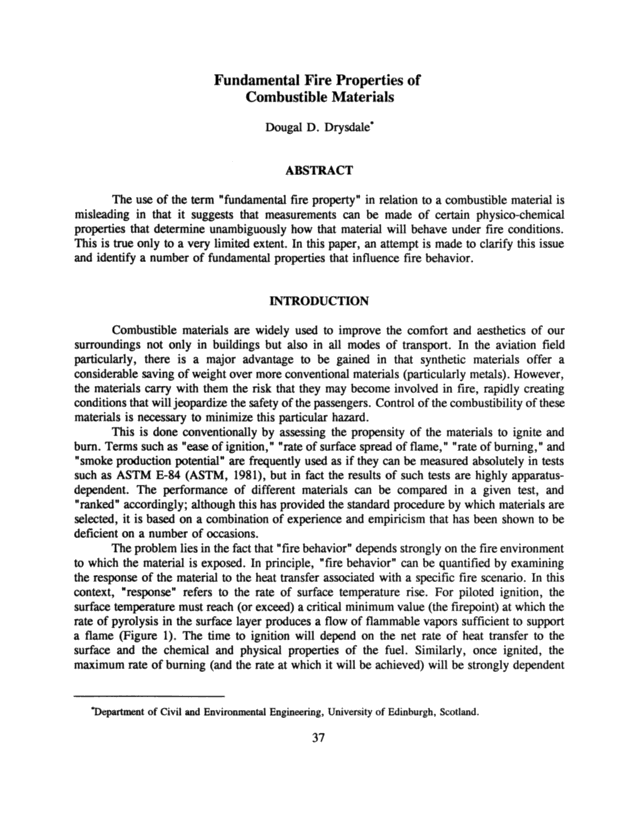
Fundamental Fire Properties of Combustible Materials Dougal D. Drysdale* ABSTRACT The use of the term "fundamental fire property" in relation to a combustible material is misleading in that it suggests that measurements can be made of certain physico-chemical properties that determine unambiguously how that material will behave under fire conditions. This is tme only to a very limited extent. in this paper, an attempt is made to cianfy this issue and identify a number of fundamental properties that influence fire behavior. INTRODUCTION Combustible materials are widely used to improve the comfort and aesthetics of our surroundings not only in buildings but also in all modes of transport. In the aviation field particularly, there is a major advantage to be gained in that synthetic materials offer a considerable saving of weight over more conventional materials (particularly metals). However, the materials carry with them the risk that they may become involved in fire, rapidly creating conditions that will jeopardize the safety of the passengers. Control of the combustibility of these materials is necessary to minimize this particular hazard. This is done conventionally by assessing the propensity of the materials to ignite and burn. Terms such as "ease of ignition," "rate of surface spread of flame," "rate of burning," and "smoke production potential" are frequently used as if they can be measured absolutely in tests such as ASTM E-84 (ASTM, 1981), but in fact the results of such tests are highly apparatus- dependent. The performance of different materials can be compared in a given test, and "ranked" accordingly; although this has provided the standard procedure by which materials are selected, it is based on a combination of experience and empiricism that has been shown to be deficient on a number of occasions. The problem lies in the fact that "fire behavior" depends strongly on the fire environment to which the material is exposed. In principle, "fire behavior" can be quantified by examining the response of the material to the heat transfer associated with a specific fire scenario. in this context, Response" refers to the rate of surface temperature rise. For piloted ignition, the surface temperature must reach (or exceed) a critical minimum value (the firepoint) at which the rate of pyrolysis in the surface layer produces a flow of flammable vapors sufficient to support a flame (Figure I). The time to ignition will depend on the net rate of heat transfer to the surface and the chemical and physical properties of the fuel. Similarly, once ignited, the maximum rate of burning (and the rate at which it will be achieved) will be strongly dependent *Department of Civil and Environmental Engineering, University of Edinburgh, Scotland. 37
38 FIGURE 1 The scenario for piloted ignition. Improved Fire- and Smoke-Resistant Materials I Source of energy 1 Combustible surface Ignition source . Nascerlt flame at surface 1 Sufficient flow of flammable vapours 1 "Suitable | conditions" 1 FIRE on the heat-transfer environment to which the burning fuel is now contributing. This is difficult to quantify, or control, which can explain many of the difficulties one encounters when attempting to interpret the results of standard test methods and apply them to "real fires." THE BURNING PROCESS It is appropriate to comment briefly on the burning process for a single, isolated "fuel bed." Following ignition, the surface temperature will increase rapidly as the developing flame provides additional heat transfer to the surface. The rate and extent of surface temperature rise will depend on the heat-transfer characteristics of the flame and other boundary conditions in particular, those affecting heat losses from the fuel surface (see Equation 3 below; see also Drysdale, 1985~. Heat losses will moderate the maximum rate of burning and can be critical in determining the acceptability of a material in a particular end-use situation.
Dougal D. Drysdale FUNDAMENTAL PROPERTIES THAT INFLUENCE FIRE BEHAVIOR 39 Although it is extremely difficult to define a "fire scenario" adequately in terms of the heat transfer boundary conditions, it is possible to identify fundamental properties of a material which are important in determining how it will behave (or respond) under fire conditions. For convenience, these can be divided into physical and chemical properties. Physical Properties A wide variety of properties are important. These include the melting (or softening) point, thermal conductivity (k), density (p), and thermal capacity (c). However, physical form, shape, and orientation must also be considered. For composites, the possibility of delamination may be critical in some applications. The thickness of a material is of overriding importance if the material is H thermally thin" (i.e., the material heals uniformly when exposed to a heat flux, and there is no temperature difference between the front and the rear faces). In the case of piloted ignition, as represented by the scenario shown in Figure I, simple heat-transfer theory shows that "thins materials (thickness r) are much easier to ignite (i.e., raise to the firepoint) than "thick" ones (Drysdale, 1985~. For a material that is thermally thin, the time to ignition is given by the following expression: ~ _~ trig= :2Ph In ~'-~° (1) where h is the convective heat-transfer coefficient. Equation ~ shows that the greater the heat capacity of the material per unit surface area (per) the longer it will take to ignite. The derivation requires the assumption that there are no temperature gradients normal to the surface of the material (i.e., the temperature within the material is uniform at all times). The parameter that determines the rate of surface temperature rise for thermally thick materials is the thermal inertia (talc) (Figure 21. Heat is conducted from the surface into the bocly of the material. This has a strong moderating influence on the rate of surface temperature rise if the material has a large thermal conductivity (such as steel). On the other hand, materials of low thermal inertia, such as standard polyurethane foam, are potentially very hazardous because the surface temperature rises rapidly when exposed to a heat flux. Similarly, a material with low thermal inertia will achieve its maximum rate of burning much more rapidly than one with a high thermal inertia. In general, combustible materials that are also good thermal insulators are potentially hazardous, unless they are intrinsically flame retardant. If the melting point is less than the firepoint, the surface melt can flow away from the source of heat, rendering ignition more difficult, or even preventing it. In a test such as the Cone Calorimeter (ASTM, 1990) in which the sample under test is in a horizontal orientation, the consequences of the formation of molten polymer cannot be assessed. If the surface was vertical, the liquid would flow downwards, effectively removing heat from the exposed surface, perhaps giving a false impression in a small-scale test of how material may behave at full scale.
a a a' a 'a a I! 3 ~ ~ ( ~ ~ 3 ~ ~ ~ ~ Hi. g ~ g: 5 O ~ ~ O `3 ~ I! Hi. to Agog ~ ~0 ~ 93 ~ 11 ~ ~ BY ~ ~ (D ~ ~ 8. cat 0 3 . , ~ ~ o = - ~ -* g: g ~ ED .l, cn - . ED in - \ \ \ \ 1 o \ \ \ \ \ w A x J M O B P. - - o ~ _ en ~ Z ~ =. o =. o ° - ~ ~ A =-3 ~ OR B P. (D i~ ~ of ~ Is I. do ~ ~ cat (D o=-o~ ~ - l - . ~. If o ~ - . o ~l cut i-) ~- eq ~ ~
Dougal D. Drysdale 41 Chemical Properties Chemical factors of importance include the heat of combustion, the heat of gasification (equivalent to the latent heat of evaporation of a liquid), whether or not the fuel forms a char on heating, the firepoint temperature (the minimum surface temperature at which a self- sustaining flame can be established at the surface), the products of decomposition and combustion, the tendency of the fuel to form soot (hence smoke) when it is burning, and stoichiometxy (in this context, mass of air required to burn a unit mass of fuel). The firepoint temperature is determined by the kinetics and mechanism of the solid-phase decomposition process. In general terms, polymers with relatively high thermal stability (such as polyethylene) have a higher firepoint than those with low thermal stability (e.g., polyoxymethylene; see Thomson and Drysdale, 19871. If fire retardants are present, gas-phase inhibitors (such as HBr) may be released with the decomposition products, thereby reducing the reactivity of the fuel vapors and a higher rate of generation of the vapors is required before the firepoint is attained. In general, if these vapors are of "low reactivity," then the firepoint will be more difficult to attain. Reactivity is a concept that does not lend itself readily to quantification. Rasbash has argued that measurement of the critical mass flux at the firepoint provides a means whereby reactivities of the vapors from different materials and their flame retarded modifications may be compared (Rasbash, 1975~. The critical mass flux can be related to a critical value of the Spaiding mass transfer number (Spalding, 1955), thus: hCr = C In ~ ~ + Bar) (2) where h is He convective heat transfer coefficient appropriate to the heat losses from the flame to the surface; c is the heat capacity of air; and BCr is given by A/~AHC, where A = 3,000kJ/g; AHc is He heat of combustion of the vapors; and ~ is the maximum fraction of the heat of combustion of the vapors that the flame can lose to the surface by convection. ~ can be taken as a measure of the "reactivity" of the vapors, but the evaluation of ~ requires a reliable value of h that is very sensitive to the experimental configuration. This approach has not been investigated in great detail, although the principle has been clearly demonstrated (Thomson and Drysdale, 1989~. Data on properties relating to the evolved vapors (e.g., their heat of evolution, heat of combustion, and reactivity) could provide a more fundamental method of assessing combustible materials, which in turn could help in formulating strategies for research to investigate "new" materials. Firepoint temperature is more easily measured than the critical flow rate of the vapors (Thomson and Drysdale, 1987) but cannot be used on its own as a means of selecting a material (except under rare conditions where there is strict control over potential ignition sources). A higher firepoint may easily be offset by unfavorable thermal properties, such as a low thermal inertia. In any event, post-ignition behavior must be taken into account in any hazard assessment. A degree of resistance to ignition may be achieved at the expense of an increase in
42 Improved Fire- aM Smoke-Resistant Materials the yield of smoke and toxic gases. This is not uncommon, as many fire retardants act by inhibiting the combustion process that will increase the yields of partially burned fire products. Although the heat of combustion is obviously significant, it is the rate at which heat is released that is the more important parameter. Indeed, it has been argued that the rate of heat release (RHR) is the most important parameter in determining fire hazard (Babrauskas and Peacock, 19921. The Cone Calorimeter was designed to allow RHR to be measured under a range of imposed heat fluxes up to 100 kW/m2. As implied above, RHR is not a material property per se, as it depends on the heat-transfer boundary conditions at the surface that are strongly scenario-dependent. The rate of burning can be expressed as a rate of mass loss: . n Q flame+Q ext ~ loss m = (3) where the burning rate is expressed as a mass flux of fuel vapor from the surface; Q"~ me is the heat flux from the flame to the surface; Qn~t is the heat flux from any external source (e.g., flames under a ceiling, or the conical heater in the Cone Calorimeter); 0"loss represents the heat losses from the surface, expressed as a heat flux through the surface, and Ly is the heat of gasification. (Flammable liquids have much lower values of Ev than solids, as there is no chemical decomposition involved in releasing the vapors; consequently, they burn very much more rapidly.) In principle, the RHR can be calculated from the product of m" and the heat of combustion, with an appropriate correction factor for incompleteness of combustion. This equation shows clearly that RHR cannot be considered in isolation from the "fire scenario." Fuels that form a char have the advantage that at an early stage a barrier is formed at the surface, which insulates the unaffected material underneath. Heat then has to be conducted through the char. This is one reason for the remarkable properties that wood has under fire conditions. The formation of char indicates that some of the fuel remains behind and does not burn as a flame. It may burn subsequently as a smoldering process but at a greatly reduced rate of heat release. Fire products consist mainly of carbon dioxide and water vapor, but the few percent of partially burned products have the potential to cause considerable harm. Smoke results in loss of visibility, which delays escape and can lead to unacceptable exposure times for those attempting to evacuate a building. The tendency of a fuel to produce smoke can be assessed by means of a single measurement (the "smoke point"; de Ris, 1994, but "ranking" materials in one of the standard tests (e.g., ASTM E-1354 [ASTM, 1990] or ASTM E-662 [ASTM, 19831) can be misleading. Little attention has been paid to the question of whether a "smoke test" is desirable, given the fact that the yield of smoke from a given material in a real fire is highly dependent on the fire scenario, including the ventilation to the fire. Indeed, smoke yield changes as a fire progresses through the early stages to flashover arid beyond. All "smoke tests" are well ventilated and are therefore relevant to the early, pre-flashover fire. The problem is in the fire process itself, in that a fuel may have a certain measurable propensity to produce soot/smoke, but the inefficient combustion that will inevitably occur in a real fire will alter this in a manner that cannot readily be predicted.
Dougal D. Drysdale 43 The same comment is equally applicable to the assessment of the production of toxic and corrosive gases in fires. Present experimental methods of assessment are poorly understood and cannot be assumed to be helpful. It seems that the "propensity to produce smoke and toxic gases" is even more scenario-dependent than the other "fire properties" that have been discussed above. CONCLUSIONS It is possible to identify a number of measurable properties of combustible materials that provide an understanding of their behavior in fires. However, the so-called "fire properties" (ignitability, rate of surface spread of flame, etc.) are scenano-dependent. They can be properly assessed only if the characteristics of the scenario are taken into account. REFERENCES ASTM. 1981. Standard Test Method for Surface Burning Characteristics of Building Materials. ASTM E-84. Philadelphia, Pennsylvania: American Society for Testing and Materials. ASTM. 1983. Standard Test Method for Specific Optical Density of Smoke Generated by Solid Materials. ASTM E-662. Philadelphia, Pennsylvania: American Society for Testing and Materials. ASTM. 1990. Standard Test Method for Heat and Visible Smoke Release Rates for Materials and Products Using Oxygen Consumption Calorimeter. ASTM E-1354. Philadelphia, Pennsylvania: American Society for Testing and Materials. Babrauskas, V., and R.D. Peacock. 1992. Heat release rate: The single most important variable in fire hazard. Fire Safety Journal 3:255-272. de Ris, I.N. 1994. 4th International Symposium on Fire Safely Science, Ottawa, June. Drysdale, D.D. 1985. An Introduction to Fire Dynamics. Chichester, England: John Wiley & Sons. Drysdale, D.D., and A.~.R. Macmillan. 1992. Flame spread on inclined surfaces. Fire Safety Journal 3:245-254. Rasbash, D.~. 1975. International Symposium on the Fire Safety of Combustible Materials. Edinburgh, September. Spalding, D.B. 1955. Some Fundamentals of Combustion. London, England: Butterworths. Thomson, H.E., and D.D. Drysdale. 1987. Flammability of plastics. I: Ignition temperatures. Fire and Materials ~ Icy: 163-172. Thomson, H.E., and D.D. Drysdale. 1989. Flammability of plastics. IT: Critical mass flux at the firepoint.FireSafetylournal14(3):179-188.
