
6
THE SHIFTING BASE OF FINANCIAL SUPPORT FOR LAND GRANT COLLEGE RESEARCH AND EXTENSION
This chapter revisits the college research and extension programs from a different perspective—their changing base of support from federal, state, local government, and private entities. It discusses the role of non-USDA federal agencies in supporting agricultural research; and the changing mechanisms for funding, including traditional formula-based funds, competitive grants, and grants "earmarked" by Congress, are described and compared.
-
Land grant colleges of agriculture are public institutions supported by the revenues generated by U.S. federal, state, and local governments. The public has, therefore, a stake in the accomplishments and services of the system. Public input into research, education, and extension direction and priorities can occur in a number of ways, but its impact may be limited or require significant time to result in redirection. Over time, changes in the respective roles of public and private entities that provide college funding, as well as changes in the mechanisms used for channeling public funds to the system, occur. These changes have an effect on the colleges' activities and priorities and the public's opportunities to influence them. Changes in the distribution of funding across institutions in the system—or differences in funding mechanisms across institutions—can affect linkages and cooperation within the system and each college's role in the integrated whole.
-
The U.S. public has a $3 billion stake in the combined research and extension activities of the land grant colleges of agriculture and their forestry and veterinary medicine counterparts. In 1992 state budgets funded slightly less than one-half of all combined research and extension expenditures at these institutions. In the same year, federal funding equaled approximately one-third of research expenditures and between one-quarter and one-third of cooperative extension costs (Table 6-1).
-
Private funds are, however, of increasing importance to the colleges' financial status and the shaping of their research programs. Over the last 20 years private funds for research at SAESs, which include grants from industry and nonprofit organizations and revenue generated by commercial sales of products (such as college-owned livestock and livestock products) and licenses, grew faster than either federal or state support. These nonpublic sources now fund 19 percent of research expenditures by all SAESs and colleges reporting to CRIS (Table 6-1). Grants from industry, often funds generated by the "check-off" programs of commodity groups (such as those for beef, pork, soybeans, and wheat), make up about 40 percent of these nonpublic funds.
The Structure of federal support for research at colleges of agriculture is shifting away from fixed formulas toward competitive grands based on scientific merit and special grands earmarked by Congress.
-
Meanwhile, support for cooperative extension activities has shifted since 1972 from the federal to the state and local governments (Table 6-1). In general, in the last 20 years there has been stronger federal support for the colleges' research programs than for their extension activities. However, lack of complete data on private sector activities in research and extension make it difficult to say with certainty which activity has become less public and more private.
-
Federal dollars for research conducted at land grant colleges of agriculture flow to the colleges through four funding mechanisms:
-
formula-based grants administered by USDA,
-
special grants earmarked by Congress for specific institutions and administered by USDA,
-
competitive grants awarded and administered by USDA, and
-
other research grants (or cooperative agreements) awarded by other federal agencies (including some USDA agencies not responsible for administering the grants in the first three categories).
TABLE 6-1
Sources of Support for Research and Extension Activities at the 1862 and 1890 Institutions and Related Colleges and Schools of Forestry and Veterinary Medicine, 1972–1992
|
|
Researcha |
|
|
|
Extensionb |
|
|
|
|
Year |
Federal |
State |
Private |
Total |
Federal |
State |
Local |
Total |
|
Millions of Dollars |
||||||||
|
1972 |
118 |
205 |
51 |
374 |
149 |
136 |
70 |
354 |
|
1977 |
201 |
341 |
94 |
636 |
198 |
220 |
105 |
524 |
|
1982 |
355 |
544 |
169 |
1,069 |
302 |
368 |
182 |
852 |
|
1987 |
415 |
778 |
253 |
1,447 |
319 |
500 |
229 |
1,048 |
|
1992 |
631 |
981 |
380 |
1,992 |
401 |
652 |
333 |
1,389 |
|
Average Annual Growth (percent) |
||||||||
|
1972–1977 |
14 |
13 |
17 |
14 |
7 |
12 |
10 |
9 |
|
1977–1982 |
15 |
12 |
16 |
14 |
11 |
13 |
15 |
13 |
|
1982–1987 |
3 |
9 |
10 |
7 |
1 |
7 |
5 |
5 |
|
1987–1992 |
10 |
5 |
10 |
8 |
5 |
6 |
9 |
6 |
|
1972–1992 |
21 |
19 |
32 |
22 |
8 |
19 |
19 |
15 |
|
NOTE: Private funds for research include grants from industry and nonprofit organizations and from the sale of products and licenses. a Research funds are expenditures reported in CRIS. b Extension funds are budget appropriations reported by the Extension Service. SOURCE: Data are from USDA Current Research Information System (CRIS) and USDA Extension Service (ERS). |
||||||||
TABLE 6-2
Sources of Federal Funds (thousands of dollars) to the 1862 and 1890 Institutions and Related Colleges and Schools of Forestry and Veterinary Medicine, 1972–1992
-
Between 1935 (when the Bankhead-Jones Act was passed) and the late 1980s, formula funding, as established by the act, comprised the largest category of federal monies for SAES research (Table 6-2). Hatch funds are funneled only to SAESs and their allocation among these institutions is inflexible with respect to the focus, scientific review, or outcome of the station's research (see box copy, p. 78). System-wide priorities for these (and other agricultural research) funds are laid out by ESCOP, but in reality each SAES has wide latitude in deciding how to allocate and use formula funds.
|
Formula Funding Mechanisms: Payments to Agricultural Experiment Stations under the Hatch Act Funds received as a result of the Hatch Act (first enacted in 1887) are allocated for research to promote sound and prosperous agriculture and rural life to the state agricultural experiment stations (SAESs) of the 50 states, the District of Columbia, Puerto Rico, Guam, the Virgin Islands, Micronesia, American Samoa, and the Northern Marianas Islands. The Amended Hatch Act (1955) provides that the distribution of federal payments to states for FY 1955 shall become a fixed base and that any sums appropriated in excess of the 1955 amount shall be distributed in the following manner:
The Hatch Act also provides that any amount in excess of $90,000 available to any state, exclusive of the regional research fund, shall be matched by the state out of its own funds available for research and for the establishment and maintenance of facilities necessary for the performance of such research. In the case of Guam, the Virgin Islands, Micronesia, American Samoa, and the Northern Marianas Islands, agencies are required by law to waive any requirement for local matching funds for federal formula funds less than $200,000. Three percent of funds appropriated under the Hatch Act is set aside for federal administration, which includes disbursement of funds and a continuous review and evaluation of the research programs of the state agricultural experiment stations supported wholly or in part by Hatch Act funds. USDA's Cooperative State Research Service (now merged with the Extension Service to form the Cooperative State Research, Education, and Extension Service or CREES) encourages and assists in establishing research linkages and partnerships within and between the states and actively participates in the planning and coordination of research programs between the states and USDA at the regional and national levels. SOURCE: National Research Council. 1989. Investing in Research: A Proposal to Strengthen the Agricultural, Food, and Environmental System. Washington, D.C.: National Academy Press. |
-
Three other formula-based grant programs are aimed at forestry research (McIntire-Stennis funds), animal-health research, and the programs of the 1890 colleges (Evans-Allen funds). McIntire Stennis funds flow to both forestry schools and SAESs; animal-health formula funds go to both veterinary medicine colleges and SAESs.
-
Between 1987 and 1992 the amount ''other federal funds'' surpassed the amount of formula (or Hatch) funds. The system as a whole (and in particular the SAESs at the 1862s) has reduced its reliance on the traditional formula funds and has diversified its funding portfolio by participating in the grants programs (typically competitive grants programs) of other federal agencies. However, researchers at the 1890s schools are still overwhelmingly dependent on USDA-administered formula funds.
-
USDA-administered competitive grants, though still small currently, also increased in importance—about sixfold between 1982 and 1992. The National Research Initiative Competitive Grants Program (NRI)—the main competitive grants program administered by USDA—is accessible to scientists at all public and private universities. In fact, about 27 percent of NRI grant applications have not come from land grant universities (National Research Council, 1994). Thus while land grant colleges of agriculture are broadening their forms of support, they must also compete more actively with non-land grant schools for research funds.
-
Access to senators and congressmen, and the influence of those politicians on appropriations for agricultural research, has been of growing importance to land grant colleges of agriculture. Much more significant today than they were 20 years ago are the special research funds earmarked by Congress (see Table 6-2). They now account for a larger percentage of total SAES research expenditures than do USDA's competitive grants (Figure 6-1).
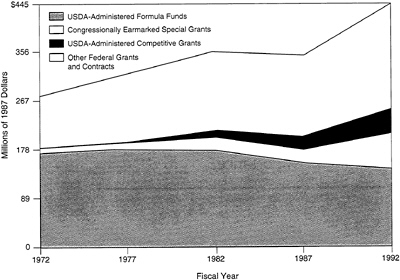
FIGURE 6-1
Over time, USDA-administered formula funds have decreased in importance in relation to other sources of research expenditures at 1862 state agricultural experiment stations.
Excluding USDA, the National Institute of Health, the Agency for International Development, and the National Science Foundation are the largest federal supporters of agricultural research.
-
Table 6-3 ranks 1862 colleges of agriculture by receipt of special research grants earmarked for them by Congress. At some colleges research funding appears to benefit from the college's political access and influence. In 1992 special research grants accounted for 25 percent of SAES research funding at the University of Vermont, 13 percent at the University of Hawaii, 11 percent at Michigan and Iowa State universities, and 10 percent at Mississippi State, North Dakota, and New Mexico.
-
Federal agencies other than USDA that provide the most support for agricultural research include the nation's major science funding agencies—National Institutes of Health (NIH) and the National Science Foundation (NSF)—and the U.S. Agency for International Development (AID) (Table 6-4). AID funds are directed to international agricultural research, particularly toward collaborative research support programs involving AID, U.S. universities, and host developing country institutions (CRSPs), which depend heavily on AID for their support.
-
In recent years, two other federal agencies, the U.S. Department of Health and Human Services and the U.S. Department of Energy (DOE), have gained prominence in agricultural research funding. SAES research expenditures based on grants from these two agencies approximately doubled between 1987 and 1992 (Table 6-4). Also, DOE collaborates with USDA and NSF in supporting grants for plant biology research (National Science Foundation, 1993).
State and federal funds are still the financial mainstay of the land grant college of agriculture system, although private and local partnerships are increasing in importance.
TABLE 6-3 Special Research Grants Allocated to 1862 Institutions, Ranked by Amount Received, 1992
|
Institution |
Amount (thousands) |
Percent of Experiment Station Research Expenditures |
|
Michigan State U. |
$6,573 |
11 |
|
Iowa State U. |
6,485 |
11 |
|
U. of California |
3,905 |
3 |
|
Mississippi State U. |
3,543 |
10 |
|
U. of Hawaii |
3,061 |
13 |
|
U. of Nebraska |
2,914 |
6 |
|
Purdue U. |
2,887 |
6 |
|
U. of Arkansas |
2,789 |
9 |
|
Oregon State U. |
2,774 |
7 |
|
Louisiana State U. |
2,587 |
7 |
|
Washington State U. |
2,527 |
7 |
|
North Dakota State U. |
2,511 |
10 |
|
Colorado State U. |
2,197 |
7 |
|
Pennsylvania State U. |
2,140 |
6 |
|
U. of Florida |
2,036 |
2 |
|
Cornell U. |
1,877 |
3 |
|
Texas A&M U. |
1,835 |
2 |
|
U. of Vermont |
1,814 |
25 |
|
U. of Georgia |
1,768 |
4 |
|
U. of Missouri |
1,699 |
5 |
|
U. of Minnesota |
1,530 |
3 |
|
Ohio State U. |
1,411 |
4 |
|
Kansas State U. |
1,383 |
3 |
|
Rutgers—The State U., Cook College |
1,324 |
5 |
|
New Mexico State U. |
1,243 |
10 |
|
U. of Idaho |
1,000 |
5 |
|
Oklahoma State U. |
862 |
3 |
|
Clemson U. |
837 |
3 |
|
Auburn U. |
799 |
2 |
|
U. of Wisconsin |
770 |
1 |
|
U. of Illinois |
733 |
2 |
|
North Carolina State U. |
708 |
1 |
|
U. of Maine |
673 |
5 |
|
Geneva AES |
659 |
6 |
|
U. of Kentucky |
597 |
2 |
|
U. of Maryland |
568 |
3 |
|
U. of Massachusetts |
485 |
4 |
|
Montana State U. |
468 |
3 |
|
U. of Connecticut |
378 |
6 |
|
U. of Arizona |
378 |
1 |
|
Virginia Polytechnic Institute and State U. |
358 |
1 |
|
U. of Puerto Rico |
332 |
3 |
|
U. of Guam |
279 |
10 |
|
U. of the Virgin Islands |
214 |
15 |
|
U. of Rhode Island |
166 |
5 |
|
Utah State U. |
138 |
1 |
|
U. of Tennessee |
138 |
1 |
|
New Haven AES |
114 |
2 |
|
U. of New Hampshire |
101 |
2 |
|
South Dakota State U. |
82 |
1 |
|
West Virginia U. |
45 |
1 |
|
U. of Wyoming |
29 |
<1 |
|
U. of Alaska |
5 |
<1 |
|
U. of Delaware |
5 |
<1 |
|
U. of Nevada |
5 |
<1 |
|
Total |
76,742 |
5 |
|
SOURCE: Data are from USDA Current Research Information System (CRIS). |
||
TABLE 6-4
Sources of Other Federal Funds (nominal dollars in thousands) Received by 1862 SAESs, 1972–1992
|
|
Funding Agency |
|||||||||||
|
Year |
USDA-CGCA |
NIH |
NSF |
AID |
HHS |
PHS |
DOD |
DOE |
NASA |
TVA |
Other |
Total |
|
1992 |
53,849 |
34,166 |
24,601 |
27,771 |
13,148 |
10,152 |
3,847 |
9,190 |
4,303 |
1,242 |
43,767 |
226,037 |
|
1987 |
33,018 |
18,251 |
18,996 |
21,587 |
6,616 |
15,183 |
3,906 |
4,850 |
2,483 |
692 |
22,343 |
147,925 |
|
1982 |
30,998 |
10,529 |
15,205 |
14,141 |
7,467 |
8,602 |
1,831 |
4,244 |
2,230 |
443 |
27,662 |
123,352 |
|
1977 |
11,739 |
10,439 |
10,559 |
7,620 |
3,022 |
6,742 |
1,085 |
2,103 |
1,613 |
136 |
15,736 |
70,793 |
|
1972 |
6,850 |
5,801 |
4,502 |
2,712 |
1,233 |
7,420 |
1,029 |
785 |
902 |
95 |
5,531 |
36,861 |
|
Abbreviations: USDA-CGCA, USDA Contracts, Grants, and Cooperative Agreements; NIH, National Institutes of Health; NSF, National Science Foundation; AID, U.S. Agency for International Development; HHS, U.S. Department of Health and Human Services; PHS, U.S. Public Health Service; DOD, U.S. Department of Defense; DOE, U.S. Department of Energy; NASA, National Aeronautics and Space Administration; TVA, Tennessee Valley Authority. SOURCE: Data are from USDA Current Research Information System (CRIS). |
||||||||||||
ISSUES FOR DISCUSSION
-
Over the decades, state support relative to federal support of the land grant system has increased. More recently, the role of private sources of funds, such as industry grants, has also increased in relative importance. What is the continued role for federal funding of the activities of colleges of agriculture? Are there issues and problems of national concern and scope to which the states may not direct adequate resources?
-
How much and what types of agricultural research would the private sector conduct in collaboration with colleges of agriculture? Will the growing use of private funds for college research help or hinder research on long-term projects of broad national interest?
-
The role of formula grants is decreasing, particularly at the large research universities, while competitive grants and congressionally earmarked grants are increasing. Should competitive grants compose a larger share of agricultural research funding, and what would be the implications for the distribution and use of funds in the system? If legislators were proposing a formula-based funding mechanism today, against the context of today's state economies, how might it differ from the one proposed many decades ago?
-
Some colleges of agriculture received substantial portions of their federal funds from non-USDA federal agencies. What should be the role of these other agencies, in relation to USDA's, in funding and influencing agricultural research priorities at colleges of agriculture and other institutions?
SUGGESTED READINGS
National Research Council. Investing in Research: A Proposal to Strengthen the Agricultural, Food, and Environmental System. Washington, D.C.: National Academy Press, 1989.
National Research Council. Investing in the National Research Initiative: An Update of the Competitive Grants Program in the U.S. Department of Agriculture. Washington, D.C.: National Academy Press, 1994.
National Research Council. Toward Sustainability: A Plan for Collaborative Research on Agriculture and Natural Resource Management. Washington, D.C.: National Academy Press, 1991.
Ruttan, Vernon W., and Carl E. Pray, eds. Policy for Agricultural Research . Westview, CT: Westview Press, 1987.
U.S. Department of Agriculture, Cooperative State Research Service. Dynamics of the Research Investment: Issues and Trends in the Agricultural Research System. Washington, D.C.: U.S. Department of Agriculture, 1993.
Von Braun, Joachim, Raymond Hopkins, Detlev Puetz, and Rajul Pandya-Lorch. Aid to Agriculture: Reversing the Decline. Washington, D.C.: International Food Policy Research Institute, 1993.


