
1
HISTORY AND OVERVIEW OF THE LAND GRANT COLLEGE SYSTEM
This chapter reviews the legislative origins of today's land grant university system, including the federal mandates to provide instruction in agriculture and the mechanical arts, conduct agricultural research, and deliver knowledge and practical information to farmers and consumers. The chapter also describes the geographical dimension of the system's infrastructure by providing names and locations of land grant colleges of agriculture and of the related colleges and schools of forestry and veterinary medicine.
WHAT ARE LAND GRANT COLLEGES OF AGRICULTURE?
-
The history of land grant colleges of agriculture is intertwined with the history of higher education for U.S. citizens of average means. The land grant system began in 1862 with a piece of legislation known as the Morrill Act (see box copy, p. 2). This law gave states public lands provided the lands be sold or used for profit and the proceeds used to establish at least one college—hence, land grant colleges—that would teach agriculture and the mechanical arts. Land grants for the establishment of colleges of agriculture and mechanical arts were also later given to U.S. territories and the District of Columbia. The legislative mandate for these land grant colleges helped extend higher education to broad segments of the U.S. population.
-
Public universities existed already in some states; however, most states responded to the Morrill Act by legislating new agricultural and mechanical arts colleges rather than by endowing existing state institutions (Kerr, 1987). The act gave rise to a network of often poorly financed colleges known as the ''1862s'' (Table 1-1; Figure 1-1). The Second Morrill Act, which provided for annual appropriations to each state to support its land grant college, was passed by Congress in 1890.
-
In addition to appropriating funding, the Second Morrill Act also forbade racial discrimination in admissions policies for colleges receiving these federal funds. A state could escape this provision, however, if separate institutions were maintained and the funds divided in a "just," but not necessarily equal, manner. Thus the 1890 act led to the establishment of land grant institutions for African Americans. Today there are 17 1890 institutions—including one private institution, Tuskegee University—located primarily in the southeast (Table 1-1; Figure 1-1). In addition to being part of the land grant system, these 17 1890 schools are among the more than 100 historically black colleges and universities in the United States.
|
The First Morrill Act (1862): Donating Public Lands for Colleges of Agriculture and Mechanic Arts Section 4 (original). And be it further enacted, That all moneys derived from the sale of the lands aforesaid by the States to which the lands are apportioned, and from the sale of land scrip herein before provided for, shall be invested in stock of the United States, or of the States, or some other safe stocks, yielding not less than five per centum upon the par value of said stocks; and that the moneys so invested shall constitute a perpetual fund, the capital of which shall remain forever undiminished (except so far as may be provided in section fifth of this act), and the interest of which shall be inviolably appropriated, by each State which may take and claim the benefit of this act, to the endowment, support, and maintenance of at least one college where the leading object shall be, without excluding other scientific and classical studies, and including military tactics, to teach such branches of learning as are related to agriculture and the mechanic arts, in such manner as the legislatures of the States may respectively prescribe, in order to promote the liberal and practical education of the industrial classes in the several pursuits and professions in life. |
-
Over the decades, as the U.S. economy grew and changed, so did the nature of demands for education and scientific pursuit. As more and more U.S. citizens began to attend college, most colleges of agriculture were transformed into full-fledged universities. In some states, like California, Maryland, Minnesota, and Wisconsin, land grant universities have become the foremost public institutions of higher education and scientific research. In others, such as North Carolina, Michigan, and Oregon, higher education and research functions are shared with other prominent public institutions.
-
Today, although many land grant universities are still known for their agricultural college roots, others have little agricultural identity and students are rarely from farm families. Despite their expansion well beyond the teaching of agriculture and mechanical arts, almost every land grant university still has a "college of agriculture"—colleges more similar to each other than are the universities where they are located.
-
Over time, colleges of agriculture have been established at non-land grant institutions as well. The relative role of the non-land grants in educating students in agriculture-related academic specializations is discussed in Chapter 3.
A series of legislative acts endowed the colleges with a three-part function encompassing teaching, research, and extension.
TABLE 1-1
Locations and Names of 1862 and 1890 Land Grant Colleges of Agriculture and Related Colleges and Schools of Forestry and Veterinary Medicine
|
|
|
|
|
Names of Agriculture-Related Colleges |
||
|
Location |
Institution |
Classification |
Established |
Agriculture |
Forestry |
Veterinary Medicine |
|
Alabama |
|
|
|
|
|
|
|
Auburn |
Auburn U. |
1862 |
1856 |
College of Agriculture |
School of Forestry |
College of Veterinary Medicine |
|
Normal |
Alabama A&M U. |
1890 |
1873 |
School of Agriculture and Home Economics |
None |
None |
|
Tuskegee |
Tuskegee U. |
1890 |
1881 |
College of Agriculture and Home Economics |
None |
School of Veterinary Medicine |
|
Alaska |
|
|
|
|
|
|
|
Fairbanks |
U. of Alaska |
1862 |
1917 |
School of Agriculture and Land Resources Management |
None |
|
|
American Samoa |
|
|
|
|
|
|
|
Pago Pago |
American Samoa Community College |
1862 |
1970 |
Agricultural Program |
None |
None |
|
Arizona |
|
|
|
|
|
|
|
Flagstaff |
Northern Arizona U. |
NLG |
1899 |
None |
School of Forestry |
None |
|
Tucson |
U. of Arizona |
1862 |
1885 |
College of Agriculture |
School of Renewable Natural Resources |
None |
|
Arkansas |
|
|
|
|
|
|
|
Fayetteville |
U. of Arkansas |
1862 |
1871 |
Division of Agriculture |
None |
|
|
Pine Bluff |
U. of Arkansas |
1890 |
1873 |
School of Agriculture and Home Economics |
None |
None |
|
California |
|
|
|
|
|
|
|
Arcata |
Humboldt State U. |
NLG |
1913 |
None |
College of Natural Resources |
None |
|
Berkeley |
U. of California |
1862 |
1868 |
College of Natural Resources |
None |
|
|
Davis |
U. of California |
1862 |
1908 |
College of Agricultural and Environmental Sciences |
None |
School of Veterinary Medicine |
|
Riverside |
U. of California |
1862 |
1907 |
College of Natural and Agricultural Sciences |
None |
None |
|
San Luis Obispo |
California Polytechnic State U. |
NLG |
1901 |
College of Agriculture |
None |
|
|
Colorado |
|
|
|
|
|
|
|
Fort Collins |
Colorado State U. |
1862 |
1870 |
College of Agricultural Sciences |
College of Natural Resources Sciences |
College of Veterinary Medicine and Biomedical Sciences |
|
Connecticut |
|
|
|
|
|
|
|
New Haven |
Yale U. |
NLG |
1701 |
None |
School of Forestry and Natural Resources |
None |
|
Storrs |
U. of Connecticut |
1862 |
1881 |
College of Agriculture and Natural Resources |
None |
|
|
Delaware |
|
|
|
|
|
|
|
Dover |
Delaware State U. |
1890 |
1891 |
Department of Agriculture and Natural Resources |
None |
None |
|
Newark |
U. of Delaware |
1862 |
1743 |
College of Agricultural Sciences |
None |
|
|
|
|
|
|
Names of Agriculture-Related Colleges |
||
|
Location |
Institution |
Classification |
Established |
Agriculture |
Forestry |
Veterinary Medicine |
|
District of Columbia |
|
|
|
|
|
|
|
Washington, D.C. |
U. of the District of Columbia |
1862 |
1851 |
College of Life Sciences |
None |
None |
|
Florida |
|
|
|
|
|
|
|
Gainesville |
U. of Florida |
1862 |
1853 |
College of Agriculture and Conservation |
School of Forest Resources |
College of Veterinary Medicine |
|
Tallahassee |
Florida A&M U. |
1890 |
1887 |
College of Engineering, Science, and Technology |
None |
None |
|
Georgia |
|
|
|
|
|
|
|
Athens |
U. of Georgia |
1862 |
1785 |
College of Agriculture and Environmental Sciences |
School of Forest Resources |
College of Veterinary Medicine |
|
Fort Valley |
The Fort Valley State College |
1890 |
1895 |
School of Agriculture, Home Economics, and Applied Programs |
None |
|
|
Guam |
|
|
|
|
|
|
|
Mangilao |
U. of Guam |
1862 |
1952 |
College of Agriculture and Life Sciences |
None |
|
|
Hawaii |
|
|
|
|
|
|
|
Honolulu |
U. of Hawaii |
1862 |
1907 |
College of Tropical Agriculture and Human Resources |
None |
|
|
Idaho |
|
|
|
|
|
|
|
Moscow |
U. of Idaho |
1862 |
1889 |
College of Agriculture |
College of Forestry, Wildlife, and Range Sciences |
|
|
Illinois |
|
|
|
|
|
|
|
Carbondale |
Southern Illinois U. |
NLG |
1874 |
College of Agriculture |
Department of Forestry |
None |
|
Urbana |
U. of Illinois |
1862 |
1867 |
College of Agriculture |
College of Veterinary Medicine |
|
|
Indiana |
|
|
|
|
|
|
|
West Lafayette |
Purdue U. |
1862 |
1869 |
College of Agriculture |
School of Veterinary Medicine |
|
|
Iowa |
|
|
|
|
|
|
|
Ames |
Iowa State U. of Science and Technology |
1862 |
1858 |
College of Agriculture |
College of Veterinary Medicine |
|
|
Kansas |
|
|
|
|
|
|
|
Manhattan |
Kansas State U. |
1862 |
1863 |
College of Agriculture |
College of Veterinary Medicine |
|
|
Kentucky |
|
|
|
|
|
|
|
Frankfort |
Kentucky State U. |
1890 |
1886 |
|
None |
None |
|
Lexington |
U. of Kentucky |
1862 |
1866 |
College of Agriculture |
||
|
Louisiana |
|
|
|
|
|
|
|
Baton Rouge |
Louisiana State U |
1862 |
1860 |
College of Agriculture |
College of Veterinary Medicine |
|
|
Baton Rouge |
Southern U. and A&M College |
1890 |
1880 |
College of Agriculture and Home Economics |
None |
None |
|
Ruston |
Louisiana Tech U. |
NLG |
1894 |
None |
School of Forestry, Wildlife, and Fisheries |
None |
|
|
|
|
|
Names of Agriculture-Related Colleges |
||
|
Location |
Institution |
Classification |
Established |
Agriculture |
Forestry |
Veterinary Medicine |
|
Maine |
|
|
|
|
|
|
|
Orono |
U. of Maine |
1862 |
1865 |
College of Natural Resources, Forestry, and Agriculture |
||
|
Maryland |
|
|
|
|
|
|
|
College Park |
U. of Maryland |
1862 |
1856 |
College of Agriculture |
None |
|
|
Princess Anne |
U. of Maryland-Eastern Shore |
1890 |
1886 |
School of Agricultural Sciences |
None |
None |
|
Massachusetts |
|
|
|
|
|
|
|
Amherst |
U. of Massachusetts |
1862 |
1821 |
College of Food and Natural Resources |
||
|
Medford |
Tufts U. |
NLG |
1852 |
None |
None |
School of Veterinary Medicine |
|
Michigan |
|
|
|
|
|
|
|
Ann Arbor |
U. of Michigan |
NLG |
1817 |
None |
School of Natural Resources |
None |
|
East Lansing |
Michigan State U. |
1862 |
1855 |
College of Agriculture and Natural Resources |
College of Veterinary Medicine |
|
|
Houghton |
Michigan Technological U. |
NLG |
1885 |
None |
School of Forestry and Wood Products |
None |
|
Micronesia |
|
|
|
|
|
|
|
Kolonia |
College of Micronesia |
1862 |
|
College of Tropical Agriculture and Sciences |
None |
None |
|
Minnesota |
|
|
|
|
|
|
|
Minneapolis |
U. of Minnesota |
1862 |
1851 |
College of Agricultural, Food, and Environmental Sciences |
College of Natural Resources |
College of Veterinary Medicine |
|
Mississippi |
|
|
|
|
|
|
|
Lorman |
Alcorn State U. |
1890 |
1871 |
Division of Agricultural Research and Applied Economics |
None |
None |
|
State College |
Mississippi State U. |
1862 |
1878 |
College of Agriculture and Home Economics |
School of Forest Resources |
College of Veterinary Medicine |
|
Missouri |
|
|
|
|
|
|
|
Columbia |
U. of Missouri |
1862 |
1839 |
College of Agriculture, Food, and Natural Resources |
College of Veterinary Medicine |
|
|
Jefferson City |
Lincoln U. |
1890 |
1866 |
College of Agriculture, Applied Sciences, and Technology |
None |
None |
|
Montana |
|
|
|
|
|
|
|
Bozeman |
Montana State U. |
1862 |
1893 |
College of Agriculture |
||
|
Missoula |
U. of Montana |
NLG |
1893 |
None |
School of Forestry |
None |
|
Nebraska |
|
|
|
|
|
|
|
Lincoln |
U. of Nebraska |
1862 |
1869 |
College of Agricultural Sciences and Natural Resources |
||
|
Nevada |
|
|
|
|
|
|
|
Reno |
U. of Nevada |
1862 |
1874 |
College of Agriculture |
||
|
New Hampshire |
|
|
|
|
|
|
|
Durham |
U. of New Hampshire |
1862 |
1866 |
College of Life Sciences and Agriculture |
None |
|
|
New Jersey |
|
|
|
|
|
|
|
New Brunswick |
Rutgers-The State U. |
1862 |
1766 |
Cook College |
None |
|
|
New Mexico |
|
|
|
|
|
|
|
Las Cruces |
New Mexico State U. |
1862 |
1888 |
College of Agriculture and Home Economics |
None |
|
|
|
|
|
|
Names of Agriculture-Related Colleges |
||
|
Location |
Institution |
Classification |
Established |
Agriculture |
Forestry |
Veterinary Medicine |
|
New York |
|
|
|
|
|
|
|
Ithaca |
Cornell U. |
1862 |
1865 |
College of Agriculture and Life Sciences |
New York Veterinary College |
|
|
Syracuse |
State U. of New York |
NLG |
1911 |
None |
College of Environmental Science and Forestry |
None |
|
North Carolina |
|
|
|
|
|
|
|
Greensboro |
North Carolina A&T State U. |
1890 |
1891 |
School of Agriculture |
None |
None |
|
Durham |
Duke U. |
NLG |
1838 |
None |
School of the Environment |
|
|
Raleigh |
North Carolina State U. |
1862 |
1887 |
College of Agriculture and Life Sciences |
College of Forest Resources |
School of Veterinary Medicine |
|
North Dakota |
|
|
|
|
|
|
|
Fargo |
North Dakota State U. |
1862 |
1890 |
College of Agriculture |
None |
|
|
Northern Marianas |
|
|
|
|
|
|
|
Saipan |
Northern Marianas College |
1862 |
|
School of Agriculture and Life Sciences |
None |
None |
|
Ohio |
|
|
|
|
|
|
|
Columbus |
The Ohio State U. |
1862 |
1870 |
College of Food, Agriculture, and Environmental Sciences |
None |
College of Veterinary Medicine |
|
Oklahoma |
|
|
|
|
|
|
|
Langston |
Langston U. |
1890 |
1897 |
Department of Agriculture |
None |
None |
|
Stillwater |
Oklahoma State U. |
1862 |
1890 |
Division of Agricultural Sciences and Natural Resources |
College of Veterinary Medicine |
|
|
Oregon |
|
|
|
|
|
|
|
Corvallis |
Oregon State U. |
1862 |
1868 |
College of Agricultural Sciences |
College of Forestry |
College of Veterinary Medicine |
|
Pennsylvania |
|
|
|
|
|
|
|
Philadelphia |
U. of Pennsylvania |
NLG |
1740 |
None |
None |
School of Veterinary Medicine |
|
University Park |
The Pennsylvania State U. |
1862 |
1855 |
College of Agricultural Sciences |
School of Forest Resources |
|
|
Puerto Rico |
|
|
|
|
|
|
|
Rio Piedras |
U. of Puerto Rico |
1862 |
1900 |
College of Agricultural Sciences |
None |
|
|
Rhode Island |
|
|
|
|
|
|
|
Kingston |
U. of Rhode Island |
1862 |
1892 |
College of Resource Development |
||
|
South Carolina |
|
|
|
|
|
|
|
Clemson |
Clemson U. |
1862 |
1889 |
College of Agricultural Science |
College of Forest and Recreational Resources |
|
|
Orangeburg |
South Carolina State College |
1890 |
1896 |
Department of Agribusiness and Economics |
None |
None |
|
South Dakota |
|
|
|
|
|
|
|
Brookings |
South Dakota State U. |
1862 |
1884 |
College of Agriculture and Biological Sciences |
||
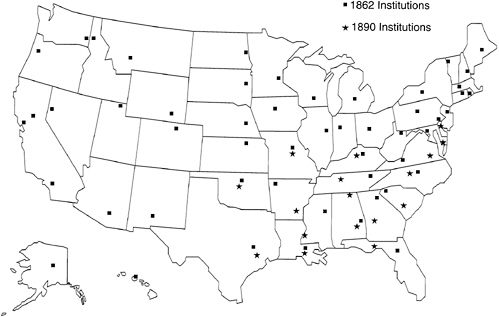
FIGURE 1-1
Map shows locations of the 1862 and 1890 land grant colleges and universities in the contiguous United States, Alaska, and Hawaii. Not shown are land grant locations at American Samoa, Guam, Micronesia, Northern Marianas, Puerto Rico, and St. Thomas in the U.S. Virgin Islands. Symbol placement indicates geographic location of each institution, showing physical proximity.
-
The 1862 Morrill Act gave the land grant colleges their mandate to teach. The colleges acquired a research function in 1887 through the Hatch Act, which recognized the need for original research to underpin the teaching of agriculture and help develop agricultural innovations. The legislation funded a system of state agricultural experiment stations (SAESs), most of which were established under the direction of the 1862 land grant colleges. Table 1-2 outlines a chronological progression of legislation mandating the many iterations of the land grant college system.
-
Today SAESs operate in conjunction with and, in almost all cases, on locations at colleges of agriculture. Connecticut and New York, in addition to on-campus SAESs, have an off-campus SAES. Many other states have branch stations, that is, SAES subsidiaries located off campus and often in agricultural areas of direct interest to the branch station's research.
-
Most faculty at land grant colleges of agriculture have SAES appointments. This grants them potential access to "Hatch" research funds, which are administered by USDA and funneled to the SAESs on a formula basis. Some faculty scientists who have SAES appointments also conduct research at other colleges that have related programs, such as in the life sciences. The SAES director and the dean of the college of agriculture are usually, but not always, the same person.
-
With the 1914 Smith-Lever Act, the colleges took on a third function, called "extension," which was designed to disseminate agricultural college-generated knowledge beyond the campus to farms and consumers. Extension was to be a cooperative activity between the federal government (through USDA) and the states (through the land grant colleges). County governments, through a network of county extension agents, soon became cooperative extension partners.
TABLE 1-2
Chronology of Major Legislation Affecting the Land Grant Colleges of Agriculture System
|
Year |
Legislation |
Provisions |
Key Result |
Funding Mechanism |
|
1862 |
Act of Congress |
Mandated the U.S. Department of Agriculture (USDA) to take over agricultural science functions of the Patent Office. |
Established the office of Commissioner of Agriculture. |
|
|
1862 |
Morrill Act |
Provided for land on which each state could establish and maintain at least one college to teach (without excluding other scientific and classical studies and including military tactics) courses related to agriculture and mechanical arts in order to promote the liberal and practical education of the industrial classes. |
Established the land grant college system. |
Each state would receive 30,000 acres of land for each senator and representative in Congress. States where not enough public land was available were given scrip to public land in other states; the income from the land to be used for operating expenses (construction, purchase, repair of buildings excluded). |
|
1887 |
Hatch Act |
Sanctioned each state to establish an experiment station to conduct original research or verify experiments bearing directly on the agricultural industry of the United States. Stations were to be established under direction of land grant colleges, but exceptions were permitted. |
Established the state agricultural experiment stations (SAESs). |
Each qualifying state would receive $15,000 per year. |
|
1890 |
Second Morrill Act |
First proposed in 1872, act provided for direct annual appropriations to each state to further support land grant colleges. Each state could receive additional funds to more completely endow and support land grant colleges. The funds were to pay for instruction in agriculture, mechanical arts, the English language, and branches of mathematics, physical, natural, and economic sciences related to agriculture and mechanical arts. African Americans were to be admitted to land grant institutions. States could establish separate land grant colleges for African Americans. |
Forbade racial discrimination in admission to colleges receiving funds and gave rise to the so called "1890 colleges." |
Congress would give each qualifying state $15,000 the first year and increase the amount by $1,000 per year for subsequent years until the annual amount reached $25,000. |
|
1906 |
Adams Act |
Provided each state additional federal funding to pay the necessary expenses of conducting original research and experiments. |
Emphasized science, and more accountability coincided with the formation of Experiment Station Committee on Organization and Policy (ESCOP). |
Each qualifying state would receive a maximum of an additional $15,000 per year. Each state was entitled to an increase of $5,000 for the first year and $2,000 more than the previous year's sum for 5 subsequent years. |
|
1907 |
Nelson Amendment |
Same as Second Morrill Act with the additional specification that a portion of the fund could be used for "providing courses for the special preparation of instructors for teaching the elements of agriculture and mechanic arts." |
|
Doubled annual appropriation to $50,000. |
|
Year |
Legislation |
Provisions |
Key Result |
Funding Mechanism |
|
1914 |
Smith-Lever Act |
Created Cooperative Extension Service to aid in disseminating to the public useful and practical information about subjects relating to agriculture and home economics and to encourage its application. The land grant colleges and USDA were to cooperate in extension work, which was to consist of instruction and practical demonstrations in agriculture and home economics to persons not attending the land grant college. Information was to be supplied through field demonstrations. |
Established the Cooperative Extension Service. |
Provided lump sum of $10,000 per state ($480,000 total) and additional formula funding. Formula funds were based on what percentage of the total U.S. rural population resided in the state. Formula funding phased in over 7 years, to a maximum of $4.1 million. The formula money was to be matched by state funds. |
|
1917 |
Smith-Hughes Vocational Education Act |
Made federal grants available to eligible states to stimulate vocational education in agriculture, home economics, and industrial arts. Grants were for (a) training of teachers by public colleges and (b) funding part of the salaries of teachers and directors of vocational agricultural subjects in secondary public schools. |
|
No specific statement made regarding funding. |
|
1925 |
Purnell Act |
Each state could receive additional federal funding for research to (a) establish and maintain a permanent and efficient agricultural industry and (b) develop and improve the rural home and rural life. |
Provided first emphasis on economics, home economics, and sociology. |
Each qualifying state could receive a maximum of $30,000 per year. Each state was entitled to an increase of $10,000 for the first year and $5,000 over the previous year's sum for 4 subsequent years. |
|
1928 |
Capper-Ketcham Act |
|
Provided for expansion of Cooperative Extension Service |
An additional lump sum grant of $20,000 per state ($980,000 total per year) and an additional $500,000 starting in 1929 to be allocated by formula. Required 1/3 of added funds to be matched in 1923 and full matching after 1928. |
|
1935 |
Bankhead-Jones Act |
Research: SAESs and USDA could receive additional funding for research into basic problems of agriculture; research relating to quality improvement, new and improved methods of production and distribution, and new and extended uses and markets for agricultural commodities; and research relating to conservation, development, and recreational use of land and water. |
Established formula funding for research and federal-state matching grants. |
Research: A maximum of $5 million per year, with $3 million to the SAESs. A total increment of $1 million per year for each of 5 years. Funds to be distributed to the states on the basis of what percentage of total U.S. rural population resided in their state, and each state must match federal contribution with nonfederal funding of the SAES. |
|
|
|
Extension: Provided for expansion of Cooperative Extension Service |
|
Extension: An additional lump sum grant of $20,000 per state ($980,000 total per year) and an additional $8 million allocated to states by formula in 1936 and $1 million additional in each of the next 4 years. Formula funds to be allocated by state's share of the U.S. farm population; matching not required. |
|
Year |
Legislation |
Provisions |
Key Result |
Funding Mechanism |
|
1945 |
Bankhead-Flannagan Act |
|
Provided for further expansion of Extension Service. |
Two percent of the federal appropriation was for federal administration, 4% was set aside for the Secretary for special need allocation, and 94% distributed by a formula based on a state's percentage of the total U.S. farm population. |
|
1946 |
Research and Marketing Act |
SAESs and USDA could receive additional funding for marketing and utilization research and for regional research involving two or more states involved in finding a solution to a problem of regional significance. |
Introduced open-ended appropriations. Linked agricultural research and development to national welfare. Stated goals of Congress to maintain a balanced farming and industrial economy. Established farming and industrial national advisory committee. |
Title I, Section 9: Total SAES funding up by $2.5 million in 1947 and 1948; $5 million increase for each of 1949, 1950, and 1951; such additional funds as Congress shall deem necessary for additional years. Allocation among states: 20% equally among states; 26% by formula according to state's percentage of U.S. rural population; 26% by formula according to a state's percentage of total U.S. farm population; 25% for regional research; 3% for federal administration. |
|
|
|
|
|
Title I, Section 10: Increased USDA funding for research. Authorized grants for ''new uses'' research to increase from $3 million in 1947 to $15 million after 1950; funds for cooperative research into farm product utilization to rise from $1.5 million in 1947 to $6 million after 1950; reauthorized $2 million annual Special Research Fund provided for in the Bankhead-Jones Act of 1935. |
|
|
|
|
|
Title II: Authorized an additional $2.5 million in 1947 and increasing to $20 million per year after 1950 for marketing research, carried out cooperatively with SAESs and other public and private institutions, on a matching grant basis. |
|
1953 |
Amended Smith-Lever Act |
Consolidated nine existing acts and provided for appropriations for federal extension staff in USDA. |
|
Provided that subsequent increases be allocated 4% to special need; 48% based on a state's percentage of the U.S. farm population; and 48% based on a state's share of the rural population. |
|
1955 |
Amended Hatch Act |
Proposed to support research contributing to the maintenance of a permanent and effective agricultural industry in the United States, including research basic to the problems of agriculture in its broadest aspects and research related to the development and improvement of the rural home and rural life and the maximum contribution of agriculture to the welfare of the consumer. Removed restrictions on buildings, but Hatch funds still had to be spent within the year awarded. |
Retained allocation formulas, matching-grant requirements, and "open-ended" appropriations. Congress rejected a proposal to reduce marketing research by 20% and insisted that earmarking apply to all increases in appropriations. |
Consolidated federal funding for SAESs into two accounts (formula funds and regional research funds). No set annual amounts were established. Allocation was according to the formula from the 1946 Research and Marketing Act: 20% of each year's appropriation equally among states; 26% by formula according to a state's percentage of the U.S rural population; 26% by formula according to a state's share of the U.S. farm population; 25% for cooperative regional research; 3% for federal administration. |
|
1955 |
Smith-Lever Amendment |
Provided for establishment of Special Program system. |
|
Provisions added permitted special nonformula funds. |
|
Year |
Legislation |
Provisions |
Key Result |
Funding Mechanism |
|
1960 |
Amendment to Title II, Section 22 of the Bankhead-Jones Act Stennis Act |
Same as Morrill Act of 1862 as "amended and supplemented." |
|
Annual appropriation of $7,650,000 distributed equally among the states and Puerto Rico; $4,300,000 allotted based on the proportion of state (Puerto Rico) population to total U.S. and Puerto Rico population. |
|
1961 |
Amended Smith-Lever Act |
Resource and community development extension added. |
|
Provided $700,000 per year for resource and community development work. |
|
1962 |
Smith-Lever Amendment |
|
|
Froze distribution of current federal funds to each state. Subsequent increases to be 4% to the federal service and, of the remainder, 20% in equal proportions to all states and 40% based on a state's percentage of the U.S. rural population and 40% according to its percentage of the U.S. farm population. |
|
1962 |
McIntire-Stennis Forestry Research Act |
Made funding available to SAESs, land grant colleges, and forestry schools for forestry research—including reforestation, woodlands and related watershed management, outdoor recreation, wildlife habitats, wood utilization, and such other studies as may be necessary to obtain the fullest and most effective use of forest resources. |
Coincided with the formation of the Cooperative State Research Service (CSRS) in 1961–1963. CSRS to administer appropriations under McIntire-Stennis Act. |
A formula allocated $10,000 to each state, 40% of the remainder according to a state's share of the nation's total commercial forest land, 40% according to the value of its timber cut annually, and 20% according to its contribution of nonfederal forestry research dollars. In both 1964 and 1965, $1 million was appropriated, 2% of CSRS-managed funds (by 1974 this figure had increased to more than $6 million annually, 7% of CSRS-managed money, and by 1984 it was up to almost $13 million or 6% of combined federal funding to the states for agricultural research and development). |
|
1965 |
Research Facilities Act |
Earmarked funds to be matched by the states for the construction, acquisition, and remodeling of buildings, laboratories, and other capital facilities. Supported new construction only of facilities for research on hazardous chemicals used in farming. Allowed each station to obligate its annual share over a 3-year period for the first time. |
|
The formula resembled that of the amended Hatch Act: one-third equally to each state; one-third based on the proportion of rural residents; one-third based on the proportion of farm population. Total allocations were $3.2 million in 1965, $2 million per year in 1966, 1967, and 1968; none was provided in 1969; and $1 million in 1970, for the last time. |
|
1965 |
Public Law 89-106 |
Established "Specific Research Grants" program to finance selected projects over a maximum of 5 years. Later became the "Special Grants" program. Earmarked funds to address specific problems of constituent concern or multistate problems. |
|
CSRS would call annually for proposals in areas singled out by Congress for special attention. In 1966, $1.6 million was offered; in 1967–1970, $1.7 million per year. $283,000 per year was allocated to the 16 1890 institutions, for an average of $17,658 each. In 1972 agricultural research allocation was increased significantly, and Tuskegee University became eligible to receive these funds, making it the seventeenth 1890 institution. |
|
Year |
Legislation |
Provisions |
Key Result |
Funding Mechanism |
|
1968 |
|
|
|
Congress abolished special program funding except for $1.6 million for agricultural marketing. These funds were to be allocated by formula. |
|
1972 |
Federal Rural Development Act |
Research: SAESs and Extension Service could receive funds for rural development and small-farm research and extension. Extension: Title V authorized work in rural communities in agriculture and nonagriculture fields. |
|
The 1972 Act authorized $10 million for 1974, $15 million for 1975, and $20 million for 1976. Actual expenditures were much less. $3 million was provided in each of the first 3 years, split between extension and research, and allocated among the SAESs on a basis similar to the Hatch formula, except that 10% was reserved for interstate projects. Funding continued at $3 million per year for another 4 years after the initial authorization expired in 1977. Funds were to be distributed 4% for federal administration, 10% for multistate work, 20% equally distributed among states, and 33% each according to a state's percentage of the U.S. rural and farm population. |
|
1977 |
National Agricultural Research, Extension and Teaching Policy Act (Title XIV of the Food and Agriculture Act of 1977) |
Continued and strengthened amended Hatch programs and initiated a new competitive grants program for high-priority research, open to all scientists, to be awarded on a competitive basis to private-and public-sector organizations, including SAESs, all colleges and universities, other research organizations, federal agencies, and individuals. Continued the Special Grants program. Dropped the requirement that 20% of amended Hatch funds be earmarked for marketing research. Transferred administration of the Bankhead-Jones Act from Office of Education to USDA. Provided formula funds for research at 1890 institutions. |
Other new earmarked grants also introduced (e.g., energy research; and animal health). New mechanisms for more formalized research planning, central (federal) direction, and accountability. |
Hatch formula funds were strengthened with $120 million called for in 1978 and increases of $25 million per year up to $220 million in 1982. Allocation was basically as by previous arrangements and formulas. The competitive grants program authorized additional spending of $25 million/year in 1978, $30 million in 1979, $35 million in 1980, $40 million in 1981, and $50 million in 1982. Permanent or sustained institutional federal funding via Section 1445 of the act—the Evans-Allen Research Program—provided formula-funded programs for 1890 institutions. The Rural Development Title V formula of 1972 was changed to 19% for farm research programs and to 77% for small-farm extension programs. |
|
1978 |
Passage of the Resource Extension Act |
Authorized funding for extension programs in forestry and other renewable national resources. |
|
Funding is by Congressional appropriation. |
|
1981 |
Amendments to Title IV (National Agricultural Research, Extension and Teaching Policy Act of 1977) |
Primarily extended the 1977 act for 4 years. Introduced $10 million annual rangeland research program and $7.5 million annual aquaculture research program. Rural development extension funds became part of Smith-Lever formula appropriation. |
Congress effectively promised not to replace, but to supplement, formula funds with competitive grants. |
(See 1977 act.) Hatch funds were authorized to increase from $220 million in 1982 to $250 million in 1985. Hatch funds were guaranteed at a minimum of 25% of USDA expenditures in cooperative programs. |
|
Year |
Legislation |
Provisions |
Key Result |
Funding Mechanism |
|
1985 |
National Agricultural Research, Extension and Teaching Policy Act (Title IV of the Food Security Act of 1981) |
Primarily extended the 1981 act for 4 years. Added a new subtitle to promote sustainable agriculture. Earmarked funds for marketing research were reintroduced ($10 million per year) along with Trade Development Centers at land grant universities (on a matching basis). |
USDA permitted to fund competitive grants for facilities at SAESs. |
(See 1981 act.) Hatch funds were to increase only 4% per year, while competitive grants were to increase substantially, especially for biotechnology research. Hatch funding of $270 million in 1986 to increase to $310 million for 1990. Competitive Grants funding to increase from $50 million in 1985 to $70 million in 1986 and subsequent years. Amended the 1977 act to provide not less than 6% of Smith-Lever funds be allocated for extension work at the 1890 institutions. |
|
1990 |
Food, Agriculture, Conservation, and Trade Act (farm bill) |
Reauthorized sustainable agriculture research and education program and added new program for training of extension service personnel in sustainable agriculture practices. |
Authorized the National Research Initiative Competitive Grants Program. |
Congressional appropriators responded to the administration's initial request for $100 million by increasing the previous year's allocation of $42.5 million to $73 million. |
|
1994 |
Elementary and Secondary Education Reauthorization Act |
Conferred land grant status to the 29 Native American colleges that compose the American Indian Higher Education Consortium. |
|
For the 29 colleges a $23 million endowment, to be built up over a 5-year period, was authorized. The colleges would receive interest payments from the endowment each year. Also authorized were funds for the colleges' education and extension programs in agricultural and natural resources. |
|
SOURCES: Adapted from Alston, J. M., and P. G. Pardey. 1995. Making Science Pay: Economics of Financing, Organizing and Managing Public-Sector Agricultural R&D. Washington, D.C.: American Enterprise Institute. Augmented with information from Huffman, W. E., and R. E. Evenson. 1993. Science for Agriculture: A Long-Term Perspective. Ames: Iowa State University Press; and Christy, R. D., and L. Williamson, eds. 1992. A Century of Service: Land-Grant Colleges and Universities, 1890–1990. New Brunswick, N.J.: Transaction Publishers. |
||||
-
Today, agricultural extension specialists are usually located at colleges of agriculture. They often have research appointments and, sometimes, teaching or teaching and research appointments. University-based extension specialists must interact with research scientists and relay scientific learning and other knowledge to farmers and other users. They also serve as the university's link to the county extension agents and the USDA's Extension Service.
-
The tripartite mission—teaching, research, and extension—has been a hallmark of the land grant college of agriculture system. Over the years, however, divisive elements within the three-part mission have emerged. Teachers, researchers, and extension specialists often respond to different administrators, to different constituents with different interests, and to different incentives and awards.
-
Over the decades a progression of legislative actions, as shown in Table 1-2, expanded funding to the college system, revamped funding mechanisms, expanded or refined the provisions for the use of federal funds, and even added institutions to the system. For example, the 1925 Purnell Act put a new emphasis on the system's role in improving rural home and rural life. The 1935 Bankhead-Jones Act established the original formula for allocating Hatch research funds among SAESs. The 1946 Research and Marketing Act revamped the formula and introduced a national advisory committee. The 1962 McIntire-Stennis Act created additional formula funds for forestry research. The 1977 National Agricultural Research, Extension, and Teaching Policy Act (the 1977 farm bill) instituted formula funds for research at 1890 colleges, formula funds for research programs in animal health, and a new competitive grants program to be administered by USDA but open to all scientists in and outside of the land grant system. The 1990 Food, Agriculture, Conservation, and Trade Act (the 1990 farm bill) expanded the competitive grants program of the 1977 act by mandating the National Initiative for Research on Agriculture, Food, and Environment (NRI). Most recently the 1994 Elementary and Secondary Education Act conferred land-grant status on 29 Native American colleges and authorized funding for their education and extension programs in agriculture and natural resources.
Schools and colleges of forestry and veterinary medicine, usually located at land grant universities, augment the college of agriculture system.
-
Colleges of veterinary medicine began their affiliation with land grant universities in 1879 with the opening of the veterinary college at Iowa State University. Today, of the 27 veterinary colleges only 2—those at the University of Pennsylvania and at Tufts University—are not affiliated with land grant schools. Of the remaining 25, nine were established after 1967. (Table 1-1 lists and Figure 1-2 maps the veterinary medicine schools and colleges.)
-
The majority of states that do not have colleges of veterinary medicine, and some that do, maintain significant programs in veterinary science in departments in colleges of agriculture.
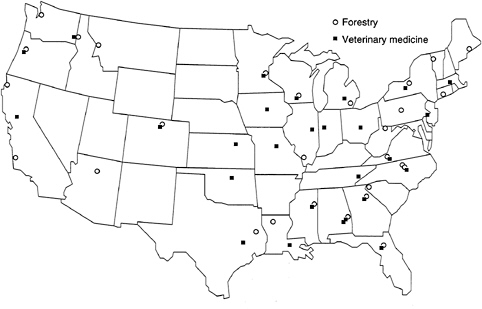
FIGURE 1-2
Map shows locations of administratively separate schools and colleges of forestry and veterinary medicine. Other forestry and veterinary medicine programs are subunits of colleges of agriculture.
-
There are a number of links, actual and potential, between colleges of agriculture and veterinary medicine. Some faculty of veterinary medicine colleges have SAES appointments. These two types of colleges have overlapping interests in animal health research, and both have access to animal health research funds administered by USDA. Many veterinary medicine students receive their prior training in animal science departments at colleges of agriculture. Both often house and manage federal-state cooperative extension programs.
-
Forestry programs are also linked to colleges of agriculture. They are located in independent forestry schools or colleges and in forestry departments in colleges of agriculture. There are more than 60 forestry programs in total. Most forestry programs are at land grant universities, though there are some prominent exceptions, such as those at the University of Washington, University of Michigan, the State University of New York at Syracuse, Yale University, Duke University, and at California's Humboldt State University. (Table 1-1 lists and Figure 1-2 maps the administratively separate forestry schools and colleges. Table 1-1 also indicates which land grant colleges of agriculture have forestry programs.)
-
The passage of the McIntire-Stennis Act in 1962 (see Table 1-2), which made federal funds available for forestry research on a formula basis, spawned more than one-half of the current forestry programs. These funds are channeled to colleges of agriculture through SAESs and to forestry colleges and schools in and outside of the land grant system. However, the much larger amount of forestry research dollars is a component of the USDA Forest Service's budget.
-
Although forestry and agricultural research and education are now often conducted in isolation, some argue the case for stronger program integration focused on ecosystem and landscape management—approaches that account for the interactions among farming, forestry, wildlife habitat, urbanization, and other land uses. One reason to pursue an integrated approach to research and education is that farmers own 82 million acres, or 17 percent, of all U.S. timberland (Powell et al., 1993).
ISSUES FOR DISCUSSION
-
The federal government has had a long and special role in the land grant college of agriculture system. Is there a continuing role for federal legislation in influencing the future missions and structure of the college of agriculture system, and what form should it take?
-
Do the components of the current system—including colleges of agriculture, home economics, forestry, and veterinary medicine—operate together efficiently to deliver education, research, and technology development? For example, what institutional or curriculum changes might promote programs that more explicitly take account of interactions between commodity production and natural resource or forestry management?
-
As land grant colleges have evolved into total universities, how have colleges of agriculture ensured that they are an integrated part of the larger university?
-
The 1890 institutions have their own special legislative history and appropriations. Do 1890s have a unique role today? How are their functions and activities supported by and linked to those of the 1862 colleges?
SUGGESTED READINGS
Christy, R. D., and L. Williamson, eds. A Century of Service: Land-Grant Colleges and Their Universities, 1890-1990. New Brunswick, N.J.: Transaction Publishers, 1992.
Kerr, N. A. The Legacy: A Centennial History of the State Agricultural Experiment Stations: 1887-1987. Columbia: University of Missouri, 1987.
Mayberry, B. D. A Century of Agriculture in the 1890 Land-Grant Institutions and Tuskegee University—1890–1990. New York: Vantage Press, 1991.
National Research Council. Forestry Research: A Mandate for Change , Washington, D.C.: National Academy Press, 1990.
Pritchard, William R., ed. Future Directions for Veterinary Medicine . Durham, N.C.: Duke University, Pew National Veterinary Education Program, 1989.
Rasmussen, Wayne D. Taking the University to the People: Seventy-five Years of Cooperative Extension. Ames:Iowa State University Press, 1989.
Schor, J. Agriculture in the Black Land-Grant System to 1930. Tallahassee: Florida A&M University, 1982.


