
9
The Effects of Ration Modifications on Energy Intake, Body Weight Change, and Food Acceptance
Edward Hirsch1
Not Eating Enough, 1995
Pp. 151–173. Washington, D.C.
National Academy Press
INTRODUCTION
Over the past 10 years military rations have undergone extensive testing during field training exercises (Hirsch and Kramer, 1993; see Baker-Fulco, Chapter 8 in this volume). On the basis of detailed data from these field tests as well as qualitative feedback from troops and their commanders, operational rations have been continuously modified to better meet customer and mission needs (see Darsch and Brandler, Chapter 7 in this volume). To determine whether these changes have produced genuine improvements in the rations, this overview examines changes in food intake and ration acceptance in those studies that have compared a new version of a ration to a version that has been in use for at least a year. In addition, these studies will be examined to see if there is an organizing principle that allows specification of the necessary and sufficient conditions for producing a ration that leads to an increase in food
intake, less weight loss, and improved customer satisfaction. These studies will also be reviewed from the perspective of trying to develop a better understanding of the factors that control food intake during military exercises.
MEAL, READY-TO-EAT
The Meal, Ready-to-Eat (MRE) was introduced as the military's operational ration in the early 1980s. Packaged in a flexible, retort pouch2, it replaced a canned ration, the Meal, Combat Individual (MCI). Components of both rations can be eaten hot or cold and provide a nutritionally complete diet. When the MRE was introduced into the military feeding system, there was considerable interest among military planners and logisticians in having troops subsist on operational rations as their sole source of food for lengthy periods of time. For this reason the initial test of the MRE was designed to determine the consequences of prolonged feeding of this ration to troops during an extended field training exercise (Hirsch et al., 1985).
During MRE test development, the remaining stock of MCIs was being depleted, and some units were already eating the MRE in the field. Undocumented reports from these units suggested that troops consuming the MRE were experiencing gastrointestinal difficulties. These rumors, in conjunction with the possibility that food monotony (Kamen and Peryam, 1961; Schutz and Pilgrim, 1958; Siegel and Pilgrim, 1958) might develop with the MRE, led to the decision to conduct a laboratory test prior to a field evaluation (Hirsch and Kramer, 1993). The Army was concerned that a serious decline in consumption might occur when a ration with as few different components as the MRE was fed as the sole source of food for an extended time.
Prolonged Feeding Studies
The results of two extended feeding studies where the MRE was fed as the only source of food (Hirsch and Kramer, 1993; Hirsch et al., 1985) provide both a definition of the underconsumption problem and potential insight into its solution. The laboratory study was conducted with paid student volunteers at the Massachusetts Institute of Technology over a 44-d period (Hirsch and Kramer, 1993). Volunteers took all their meals in a small, pleasant dining room. Hot and cold water was available for preparing beverages and
rehydrating ration components. Rations could be heated in a microwave oven. The field study took place with U.S. Army troops during a 34-d field training exercise at the Pohakuloa Training Area on the island of Hawaii (Hirsch et al., 1985).
Major findings of the feeding studies are shown in Table 9-1. Under laboratory conditions student volunteers consumed 3,149 kcal/d, lost a little more than 1 lb (0.45 kg), and rated the MRE about 6.05 on a 9-point hedonic scale (Peryam and Pilgrim, 1957). They did not experience any gastrointestinal discomfort. Feeding the MRE for 44 days under laboratory conditions, therefore, did not appear to be a problem. In contrast, when the identical ration was fed to troops under field conditions for 34 days, energy intake averaged 2,189 calories, and troops lost 4.8 percent of their original body weight, despite reporting the MRE to be quite acceptable with an average hedonic rating of 7 (Fox et al., 1989; Hirsch et al., 1985; Lichton et al., 1988; Wenkam et al., 1989). Under field conditions, sole subsistence on this ration did appear to be a problem.
These data provide both the baseline condition for examining the effectiveness of subsequent ration modifications and the clear suggestion that the nature of the eating environment has a profound effect on ration intake. This latter theme is explored in detail in four other chapters in this volume (see Chapters 11, 17, 18, and 20).
In addition to highlighting potential problems with prolonged feeding of the MRE, the field test provided valuable feedback from the troops for improving the ration. Troops completed a detailed questionnaire on the nature of the changes they would like incorporated into the MRE (Hirsch et al., 1985). Many of these modifications were accomplished in later versions of the ration.
TABLE 9-1 Effects of Long-Term Feeding of MRE IV on Paid Student Volunteers and U.S. Army Field Troops
|
|
Duration of Feeding (d) |
Energy Intake (kcal) |
Body Weight Change (lbs) |
|
Field* |
34 |
2,189 |
-10.4 |
|
Laboratory† |
44 |
3,149 |
-1.5 |
|
* Field study used U.S. Army troops from Pohakuloa Training Area, Hawaii. SOURCE: Adapted from Hirsch et al. (1985). † Laboratory study used paid student volunteers from Massachusetts Institute of Technology, Cambridge, Massachusetts. SOURCE: Adapted from Hirsch and Kramer (1993). |
|||
Changes in the Meal, Ready-to-Eat
Table 9-2 lists the major differences between earlier and later versions of the MREs that were tested in 1986 (Popper et al., 1987). The changes in MRE VII consisted of increases in entree portion sizes in seven menus and the inclusion of flavored beverages in all menus as well as hot sauce in three meals. The changes in MRE VIII were relatively minor compared to an experimental version of the ration called the Improved MRE. As Table 9-2 indicates, the Improved MRE retained the same structure and types of food as earlier versions, but the majority of the items in each food class was new and different.
The results of an 11-d field study where three U.S. Army companies were fed one of the versions of the MRE are shown in Table 9-3 (Popper et al., 1987). The Improved MRE group lost a significantly smaller, percentage (2.28 percent P < 0.05) of their initial weight than the other two ration groups, whose weight losses did not differ (2.98 percent and 3.20 percent). The group differences in weight loss were commensurate with the level of daily energy intake. Again statistical analysis revealed that the Improved MRE group consumed more calories per day than the other two groups (P < 0.05).
The three rations received quite different acceptability ratings from the troops. Items in the Improved MRE were rated very favorably, with no item receiving a rating below 6.0 on the 9-point hedonic scale. Many items in both
TABLE 9-2 Features of Three Versions of the MRE Tested in 1986
|
Improved MRE |
MRE VII |
MRE I-V |
|
12 menus: 9 new and 2 reformulated entrees |
12 menus, same entrees as MRE V but 8-oz portions for 7 menus |
12 menus |
|
8-oz portions for 7 entrees |
Fruit-flavored beverages in all menus |
2 beverages: coffee, cocoa |
|
2 breakfast entrees |
Hot pepper sauce in 3 menus |
|
|
Fruit-flavored beverages in all menus |
|
|
|
Wet pack fruits |
|
|
|
Hot pepper sauce in 4 menus; commercial candy |
|
|
|
SOURCE: Adapted from Popper et al. (1987). |
||
TABLE 9-3 Average Daily Energy Intake and Percent Body Weight Loss in Three Army Companies Fed MREs
|
MRE |
Energy Intake (kcal) |
Body Weight Loss (%) |
|
Improved |
2,842 |
2.28 |
|
MRE VII |
2,517 |
3.20 |
|
MRE IV |
2,517 |
2.98 |
|
SOURCE: Adapted from Popper et al. (1987). |
||
MRE VII and MRE IV were rated below 6.0 and in the case of MRE IV, some items were rated below 5.0, the neutral point of the scale. To compare the acceptance ratings of the three rations more formally, the average acceptance ratings for the items in each of the major food categories were computed and are shown in Table 9-4, along with results of one-way analysis of variance and post-hoc analyses, where appropriate. This table shows markedly higher ratings for the items in the Improved MRE ration compared to the other two versions of the ration. The Improved MRE was rated significantly higher than MRE IV
TABLE 9-4 Acceptance Ratings of Three Versions of the MRE by Food Class
across every food class, and for five of the eight food classes it was rated higher than the MRE VII.
These data make it clear that the changes incorporated into the Improved MRE produced a ration that was consumed in greater quantity, led to less weight loss, and was better liked by troops during a field training exercise. Beyond this positive outcome there are two important caveats. First, it is not known if these results would be obtained on a second or third exposure to the Improved MRE. Second, MRE VII, which incorporated some of the changes included in the Improved MRE, did not show higher levels of consumption. This finding raises the possibility that more substantial changes are required to produce an increase in ration consumption. A more precise definition of substantial may emerge from other studies designed to assess the effect of ration modifications.
To further improve the acceptability and consumption of the MRE, a supplement pack was developed by the U.S. Army Natick Research, Development and Engineering Center (NRDEC) that contains many of the items that soldiers most often request as additions to their rations. This supplement pack, shown in Table 9-5, was also meant to increase the total number of calories available to troops in cold weather environments where energy needs are heightened.
The MRE supplements packs were evaluated during a winter training exercise in Alaska (Edwards et al., 1989) to determine if the relatively small increase in new foods and calories was of sufficient magnitude to produce an improvement in food consumption and acceptance. One of the two supplement packs was provided to troops along with either three or four MREs per day during this test. The two different supplement packs provided a total of six new foods and either 661 or 821 additional calories.
Figure 9-1 shows that the supplement pack had large and consistent effects on energy intake in troops fed either the MRE VI or the MRE VIII. Provision
TABLE 9-5 Components of MRE Supplement Pack
|
Pack 1 |
Pack 2 |
|
Pouched bread |
Pouched Bread |
|
Cold beverage base |
Cold beverage base |
|
Tabasco sauce |
Tabasco sauce |
|
Charms |
Charms |
|
Beef jerky |
Nuts |
|
Total kcal = 661 |
Total kcal = 821 |
|
SOURCE: Adapted from Edwards et al. (1989). |
|
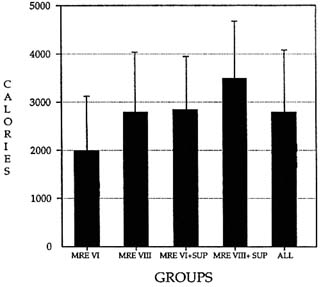
FIGURE 9-1 Mean daily energy intake in troops fed the SEP (Soldier Enhancement Program) MRE or MRE VIII with or without a supplement in the cold. SOURCE: Edwards et al. (1989).
of the supplement pack increased MRE VI intake from 2,009 kcal to 2,830 kcal, and increased MRE VIII intake from 2,802 kcal to 3,553 kcal. Not only was the supplement eaten almost in its entirety but the supplemented groups also ate more of the MRE: 215 kcal in the case of the MRE VI group and 111 kcal for the MRE VIII group.
The items in the supplement pack were well received by the soldiers, with average acceptance ratings in the two groups ranging from 6.67 to 8.86 on a 9-point scale. There was also an interesting effect of the supplement on acceptance ratings of the MRE components. Table 9-6 shows that the average acceptance ratings of the entrees, fruits, and desserts were elevated in the supplemented groups relative to the groups fed only the MRE. This difference was statistically reliable for the entrees in the MRE VIII groups and for the fruits in the MRE VI groups. One plausible interpretation of this observation is that new and well-liked ration components create a ''halo" effect that has a positive influence on troop perceptions of the other food items in the ration.
The next series of changes in the MRE occurred as part of the Soldier Enhancement Program (SEP). Twenty-nine new items were added, including:
-
six new entrees,
-
five new snack items,
TABLE 9-6 Average Acceptance Ratings of MRE Entrees, Fruits, and Desserts for Each Ration Group
|
Food Class |
MRE VI |
MRE VI + Suppl. |
MRE VIII |
MRE VIII + Suppl. |
|
Entree |
6.34 |
6.73 |
7.33 |
7.97 |
|
Fruit |
6.47 |
7.34 |
7.67 |
7.90 |
|
Dessert |
6.10 |
6.39 |
7.32 |
7.98 |
|
SOURCE: Adapted from Edwards et al. (1989). |
||||
-
two varieties of pouch bread,
-
replacement of crackers in three menus,
-
nine new desserts (pound cakes, chew bars, nuts), and
-
seven new beverages (shakes, tea mix, apple cider mix)
The SEP MRE certainly represented a ration that was substantially changed.
The performance of the SEP MRE was compared to MRE VIII during a 6-d field test with infantry troops at the Pohakuloa Training Area on the island of Hawaii (Lester et al., 1993). Figure 9-2 shows that energy intake was higher in the SEP MRE group, averaging 2,670 kcal/d compared to 1,956 in the MRE VIII group. Figure 9-3 shows that the higher level of intake of the SEP MRE was accompanied by higher acceptance ratings of the items in almost every
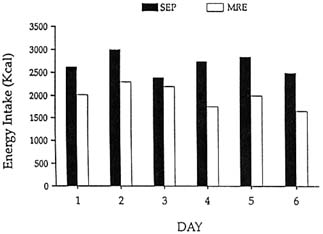
FIGURE 9-2 Mean daily energy intake in troops fed the SEP (Soldier Enhancement Program) MRE or MRE VIII during a field training exercise. SOURCE: Lester et al. (1993).
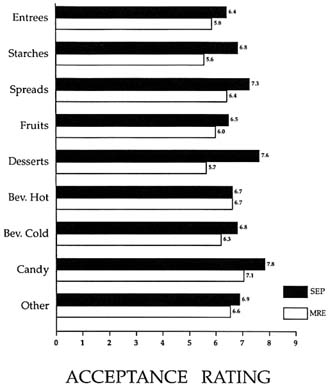
FIGURE 9-3 Mean acceptance ratings by food group for the SEP (Soldier Enhancement Program) MRE and MRE VIII. SOURCE: Lester at al. (1993).
food category of the ration. Once again, major changes in the composition of the MRE were associated with higher levels of food consumption and acceptance.
The three studies briefly reviewed showed that in every case where a revised version of the MRE was compared to an older version, it produced higher levels of food intake and customer satisfaction.
Tray Ration
The Tray ration (T Ration) is the other major component of the U.S. Army field feeding system (see Darsch and Brandler, Chapter 7 in this volume). It is a group feeding ration where individual tray-style cans hold 12 to 18
servings of an entree, vegetable, starch, bread, or dessert. The rectangular metal cans are half the size of a standard steam table opening and are thin enough to allow for more rapid heating than a round can, thus reducing processing time and improving quality. The T Ration is fed when time is not available to set up a kitchen and prepare hot meals from fresh components (A Ration) or from canned components (B Ration). Current feeding policy calls for two hot meals and one MRE per day if conditions permit. The T Ration serves as the hot meal in many circumstances.
A previous test (USACDEC/USARIEM, 1986) of the T Ration revealed that it is moderately acceptable to troops, and the Military Recommended Dietary Allowance (MRDA) (AR 40-25, 1985) for energy is met when this ration is provided for two meals a day along with an MRE for lunch (U.S. Department of the Army, 1985). The initial test of this ration system generated a number of recommendations for improving the ration such as:
-
increase the variety of breakfast entrees by including oatmeal, other breakfast cereals, and milk;
-
increase the size of dinner entrees; and
-
add bread, fresh fruit, and salads to the ration.
Many of these recommendations were incorporated into revised versions of the T Ration but their effectiveness was not evaluated. Therefore, in 1990 a field test was conducted to assess these changes as well as to compare the FY1989 version of the ration to the FY1990 version (Salter et al., 1991). The two versions of the ration differed in the length of the menu cycle3 and the substitution of new items for less popular ones. The menu cycle length of the FY1990 version had been reduced from 14 days to 10 days because of concerns that manufacturers would be unable to supply so many different menu items. Other changes to the FY1990 ration were as follows:
-
Breakfast: three items dropped, one added;
-
Dinner: five items dropped, two added;
-
Vegetables and starches: two items dropped, one added; and
-
Desserts: two items dropped, two added.
The changes in the ration had no effect on caloric intake or body weight loss during a 14-d field test. The FY1989 ration group consumed 2,888 kcal/d and lost 1.5 percent of their initial body weight, whereas the FY1990 ration group consumed 2,880 kcal/d and lost 1.0 percent of their initial body weight.
Similarly, differences in average food acceptance scores of the various food classes in the two versions of the ration were small (Figure 9-4). Neither ration was consistently rated higher than the other, but both tended to be rated higher than the same classes of food from the 1985 Combat Field Feeding System-Force Development Test and Experimentation (CFFS-FDTE) (USACDEC/USARIEM, 1986). In this instance, what appeared to be substantial changes in the ration failed to improve food consumption or acceptance.
Further changes to the T Ration were implemented, and a 7-d field test was conducted to compare the FY1990 version of the ration to a newer FY1990 version that had two new breakfast and three new lunch-dinner menus containing 10 new food items (Kramer et al., 1993). In this test the group fed the old version of the ration consumed more calories and rated the various classes of food in the T Ration as more acceptable. Some of the new ration
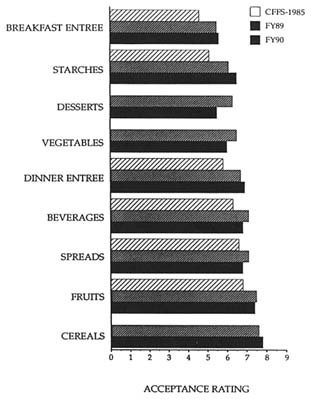
FIGURE 9-4 Mean acceptance ratings by food group for three versions of the Tray ration. SOURCE: Salter et al. (1991).
items received relatively high acceptability ratings, and others received relatively low ratings. Again it appears that the series of ration changes were not interpreted by the soldiers as overall improvements.
CONDITIONS FOR RATION IMPROVEMENT
In an effort to define the conditions that produce genuine ration improvements, each of the studies considered previously was analyzed for the magnitude of changes in the ration, as well as the nature of any changes in food intake and ration acceptability produced by ration modifications (Table 8-7). To provide a common basis for comparing ration changes, a measure, percent change, was derived. It was defined as the number of new items in a ration that would be served during one menu cycle divided by the number of all items served during that menu cycle. Note that new items that repeat throughout the menu cycle count as new items at each repetition. For example, when hot sauce is added to three menus in MRE VII, by definition, it is counted as three new items. This measure assumes that all food items listed in the menu are available, that manufacturers have not made substitutions, and that the field distribution system actually follows the listed menu. In reality, these assumptions may be violated, but the measure provides some basis for comparison across studies.
TABLE 9-7 Effects of Ration Changes on Food Intake and Troop Acceptance
|
Study |
Ration |
Percent Change |
Energy Intake |
Overall Acceptance |
x* New Items |
|
Popper et al., 1987 |
MRE VII, improved MRE |
15 |
No change |
Increase |
8.16 |
|
|
|
45 |
Increase |
Increase |
8.08 |
|
Lester et al., 1993 |
SEP* MRE |
51 |
Increase |
Increase |
7.33 |
|
Edwards et al., 1989 |
MRE VI + suppl. |
15 |
Increase |
Increase |
8.12 |
|
|
MRE VIII + suppl. |
15 |
Increase |
Increase |
8.43 |
|
Salter et al., 1991 |
FY1990 T Ration |
4.4 |
No change |
Increase |
6.58 |
|
Kramer et al., 1993 |
Revised FY1990 T Ration |
3.8 |
Decrease |
Decrease |
6.16 |
|
* SEP, Soldier Enhancement Program. |
|||||
Examining the results in Table 9-7, a general rule seems to emerge. A change in at least 15 percent of the ration items appears to be sufficient to produce an increase in calorie intake and improved consumer perception of the overall ration. The one exception concerns MRE VII (Popper et al., 1987) where the changes to the ration consisted of adding fruit-flavored beverages to all menus and hot sauce to three. In this instance, where both items repeated, the definition of ration change probably overstates the actual change. In addition, the failure of caloric beverages to increase energy intake in this study appears to be the exception (see Engell, Chapter 12 in this volume, for a complete discussion of the issue). It is clear that the definition of the magnitude of ration change needs refinement. However, it is equally clear that the vague term substantial change used earlier can be taken to mean approximately 15 percent.
An obvious corollary to this rule, revealed in Table 9-7, is that the new items must be acceptable to the consumer. In every case where a real improvement in the ration was demonstrated, the new items were highly acceptable. The mean acceptance ratings of the new items in the MRE studies ranged from 7.33 to 8.43. Specification of the exact parameters for ration improvement await further data, but on the basis of the current analysis, a 15 percent change in the ration, where new items are acceptable to the consumer, appears to be a good guideline for the ration developer.
It is not clear from Table 9-7 whether ration changes that led to increased food consumption and consumer acceptance resulted from replacing poorly rated food items by more acceptable ones, or whether these changes were due to increasing the amount of variety within the ration. In two of the three MRE studies described in Table 9-7 (Lester et al., 1993; Popper et al., 1987) these factors are confounded and it is impossible to separate out item replacement effects from variety effects. In the third MRE study (Edwards et al., 1989), only new items were added to the ration in the form of a supplement, and it appears that increased variety was responsible for the improvement in ration performance. The two T Ration studies listed in Table 9-7 can be regarded as item replacement studies, but they do not provide any real evidence on the issue of item replacement versus variety as the magnitude of ration change was probably too small to realistically expect changes in food consumption and overall ration acceptance.
The Role of Variety
One interpretation of the improved consumption and consumer acceptance in the ration modification studies is that these changes resulted from increased variety in the ration system. In every instance where there was clear evidence for improvement, the changes to the ration involved greater variety. Rolls and her colleagues have convincingly demonstrated that within the context of a
single meal, variety in the sensory attributes of food enhances intake (see Rolls [1986] for a recent review). Increases in food intake as large as 60 percent were produced by providing a four-course meal where the sensory attributes of each course varied widely (Rolls et al., 1984). More subtle sensory changes, such as variations in the shape of pasta, are capable of eliciting a 15 percent increase in food consumption (Rolls et al., 1982). These short-term changes in food intake have been convincingly linked to a reduction in the pleasantness of a food as it is consumed, and this phenomenon has been termed sensory-specific satiety (Rolls, 1986).
Despite the compelling nature of the data that link variety in a meal to enhanced food intake, there is little direct evidence that increased food variety over longer periods of time promotes increased food intake. As evidence for the role of food variety in promoting higher consumption, Rolls (1986) cites studies where overeating and weight gain were observed in both normal-weight and obese individuals provided with plentiful quantities of a varied and palatable diet (Porikos et al., 1977, 1982). Booth (1988) has suggested that the overeating seen in these studies resulted from the requirement that participants consume a minimum of two soft drinks per day and that these between-meal snacks are not compensated for by appropriate reductions in food intake at other meals.
Studies of rats provide other evidence for the effect of increased variety on food intake. Increased food intake and obesity were observed when rats were given free access to a variety of palatable foods (Rolls et al., 1980; Sclafani and Springer, 1976). However, these studies have not completely disentangled the effects of variety, palatability, and dietary composition on food intake and body weight gain. Moreover, the role of variety per se in producing overeating remains problematic (Sclafani, 1989).
The effects of reduced variety on long-term human food intake are more definitive. At the extreme, a monotonous liquid diet was provided as the sole source of food (Cabanac and Rabe, 1976; Hashim and Van Itallie, 1965). This regimen led to a reduction in calorie intake and weight loss in both obese and normal-weight individuals. A somewhat more varied diet, comprising military ration items, was tested under both field and laboratory conditions for periods ranging from 3 days to 5 weeks (Kamen and Peryam, 1961; Schutz and Pilgrim, 1958; Siegel and Pilgrim, 1958). A common finding in these studies was that food acceptability and consumption tended to decline over time, and the most palatable food items declined the least in acceptability. In addition, those items that are staples of the diet, such as milk, bread, and cereals, did not decline in acceptability at all. Moreover, giving individuals the opportunity to plan or self-select their menu reduced dissatisfaction with the repetitive diet (Kamen and Peryam, 1961). Interestingly, the field study of food monotony used a 4-d menu cycle with 41 foods. This menu cycle is identical to current versions of the MRE, although the number of foods is slightly higher in more recent versions of the ration. These data clearly reveal that limited variety can
lead to reduced acceptance and consumption, but the effect of increased variety in a long-term feeding environment remains to be demonstrated.
CONCLUSIONS
The studies reviewed indicate that a ration change that substitutes highly acceptable new food items for approximately 15 percent of the items in the old version will lead to higher levels of food consumption and consumer satisfaction. It is not possible on the basis of available evidence to specify whether this effect is due to the provision of new, highly palatable foods or the increased food variety within the ration.
A second question the available data do not address directly is whether the positive improvements in food intake and acceptance would persist on a second or third exposure to a revised ration. Many military units spend several months a year in the field eating operational rations during training exercises. Looking at the performance of a particular ration over time suggests that food monotony will occur in this setting (see Kramer, Chapter 17 in this volume). However, whether a broader range of foods and menus would produce a sufficiently varied ration to prevent food monotony after many exposures to a ration system is not known. The Sustainability Directorate, NRDEC is hoping to answer this question with 18 proposed menus in the new MRE. However there are no empirical data to guide the ration developer in knowing what constitutes sufficient variety in a feeding system. Data that addresses this issue are critical for proper ration design and success in long-term field feeding of military troops.
REFERENCES
AR (Army Regulation) 40-25 1985. See U.S. Departments of the Army, the Navy, and the Air Force.
Booth, D.A. 1988. Mechanisms from models—Actual effects from real life: The zero-calorie drink-break option. Appetite 11(suppl.):94–120.
Cabanac, M., and E.F. Rabe 1976. Influence of a monotonous diet on body weight regulation in humans. Physiol. Behav. 17:675–678.
Edwards, J.S.A., D.E. Roberts, T.E. Morgan, and L.S. Lester 1989. An evaluation of the nutritional intake and acceptability of the Meal, Ready-to-Eat, with or without a supplemental pack in a cold environment. Technical Report T18-89. Natick, Mass.: U.S. Army Institute of Environmental Medicine.
Fox, M., N. Wenkam, and E. Hirsch 1989. Acceptability studies of military ration: Meal, Ready-to-Eat. J. Foodserv. Systems 5:189–197.
Hashim, S.A., and T.B. Van Itallie 1965. Studies in normal and obese subjects with a monitored food dispensing device. Ann. N.Y. Acad. Sci. 131:654–661.
Hirsch, E., and F.M. Kramer 1993. Situational influences on food intake. Pp. 215–243 in Nutritional Needs in Hot Environments, B.M. Marriott, ed. A report of the Committee on Military Nutrition Research, Food and Nutrition Board, Institute of Medicine. Washington, D.C.: National Academy Press.
Hirsch, E., H.L. Meiselman, R.D. Popper, G. Smits, B. Jezior, I. Lichton, N. Wenkam, J. Burt, M. Fox, S. McNutt, M.N. Thiele, and O. Dirige 1985. The effects of prolonged feeding Meal, Ready-to-Eat (MRE) operational rations. Technical Report TR-85/035. Natick, Mass.: U.S. Army Natick Research and Development Center
Kamen, J.A., and D.R. Peryam 1961. Acceptability of repetitive diets. Food Technol. 15:173–177.
Kramer, F.M., K.L. Rock, M. Salamon, L.L. Lesher, D.B. Engell, C. Thomas, and S.D. Gagne 1993. The relative acceptability and consumption of the current T Ration with and without new breakfast and dinner menus. Technical Report TR-93/031. Natick, Mass.: U.S. Army Natick Research, Development and Engineering Center.
Lester, L.S., L.L. Lesher, M. Salamon, D.B. Engell, S.L. Dewey, J.L. Ward, C. Thomas, and J. Kalick 1993. Nutritional and hedonic consequences of consuming the Meal, Ready-to-Eat (MRE) VIII or the Soldier Enhancement Program (SEP) MRE. Technical Report TR-93/015. Natick, Mass.: U.S. Army Natick Research, Development and Engineering Center.
Lichton, I.J., J.B. Miyamura, and S.W. McNutt 1988. Nutritional evaluation of soldiers subsisting on Meal, Ready-to-Eat operational rations for an extended period: Body measurements, hydration, and blood nutrients. Am. J. Clin. Nutr. 48:30–37.
Peryam, D.R., and F.J. Pilgrim 1957. Hedonic scale method of measuring food preferences. Food Technol. 11(suppl.):9–14.
Popper, R., E. Hirsch, L. Lesher, D. Engell, B. Jezior, B. Bell, and W.T. Mathew 1987. Field evaluation of Improved MRE, MRE VII, and MRE IV. Technical Report TR-87/027. Natick, Mass.: U.S. Army Natick Research, Development and Engineering Center.
Porikos, K.P., G. Booth, and T.B. Van Itallie 1977. Effect of covert nutritive dilution on the spontaneous food intake of obese individuals: A pilot study. Am. J. Clin. Nutr. 30:1638–1644.
Porikos, K.P., M.F. Hesser, and T.B. Van Itallie 1982. Caloric regulation in normal-weight men maintained on a palatable diet of conventional foods. Physiol. Behav. 29:293–300.
Rolls, B.J. 1986. Sensory-specific satiety. Nutr. Rev. 44:93–101.
Rolls, B.J., E.A. Rowe, and R.C. Tunner 1980. Persistent obesity in rats following a period of consumption of a mixed, high energy diet. J. Physiol. 298:415–427.
Rolls, B.J., E.A. Rowe, and E.T. Rolls 1982. How sensory properties of foods affect human feeding behavior. Physiol. Behav. 29:409–417.
Rolls, B.J., P.M. van Duijvenvoorde, and E.T. Rolls 1984. Pleasantness changes and food intake in a varied four-course meal. Appetite 5:337–348.
Salter, C.A., D. Engell, F.M. Kramer, L.S. Lester, J. Kalick, K.L. Rock, L.L. Lesher, S.L. Dewey, and D. Caretti 1991. The relative acceptability and consumption of the current and proposed versions of the T Ration. Technical Report TR-91/031. Natick, Mass.: U.S. Army Natick Research, Development and Engineering Center.
Sclafani, A. 1989. Dietary-induced overeating. Ann. N.Y. Acad. Sci. 575:281–291.
Sclafani, A., and D. Springer 1976. Dietary obesity in adult rats: Similarities to hypothalamic and human obesity syndromes. Physiol. Behav. 17:461–471.
Schutz, H.G., and F.J. Pilgrim 1958. A field study of food monotony. Psych. Rep. 4:559–565.
Siegel, P.S., and F.J. Pilgrim 1958. The effect of monotony on the acceptance of food. Am. J. Psychol. 71:756–759
USACDEC/USARIEM (U.S. Army Combat Developments Experimentation Center and U.S. Army Research Institute of Environmental Medicine) 1986. Combat Field Feeding System-Force Development Test and Experimentation (CFFS-FDTE). Technical Report CDEC-TR-85-006A. Vol. 1, Basic Report; vol. 2, Appendix A: vol. 3, Appendixes B through L. Fort Ord, Calif.: U.S. Army Combat Developments Experimentation Center.
U.S. Departments of the Army, the Navy, and the Air Force 1985. Army Regulation 40-25/Naval Command Medical Instruction 10110.1/Air Force Regulation 160-95. ''Nutrition Allowances, Standards, and Education." May 15. Washington, D.C.
Wenkam, N.S., M. Fox, M.N. Thiele, and I. Lichton 1989. Energy and nutrient intakes of soldiers consuming MRE operational rations: Physiological correlates. J. Am. Diet. Assoc. 89:407–409.
DISCUSSION
EILEEN THOMPSON: When you compared the percentages of all the individual food items for the people in the field versus the control group, were the rank orders of the items the same, or were different items preferred in the field condition?
EDWARD HIRSCH: I am trying to remember that correlation. You know it was on the order of 0.4, 0.5. There were slight differences in the ranking.
JOHN VANDERVEEN: Have you looked at if you take a comparable amount of real food or regular food versus the same sorts of things in the MRE, are you getting the same absorption?
EDWARD HIRSCH: No, that was not done. But I think maybe I misstated it or you misunderstood me. The control group consumed about 3,250 calories per day at MIT. So they were slightly in excess of need. The MRE group was slightly below requirement as defined by the 1 1/2-pound weight loss.
JOHN VANDERVEEN: The difference was 100 calories a day which does not account for 2 1/2 pounds of weight.
JOHN DE CASTRO: When we asked people to rate the foods they self-select within their own diets, on a seven-point scale, they are between six and seven for every item. These are neutral and, in comparison to what people select in their own diets, very low ratings. But if you look at it in terms of what people will rate the foods they normally take in, those are pretty low.
EDWARD HIRSCH: Well, your population uses rating scales very differently from our population.
BARBARA ROLLS: In the student study as well, you commented that you studied them over a school term and that you tested them while they were having exams. I think stress is key here. Did intake vary when they were under more stressful circumstances?
EDWARD HIRSCH: The pattern of intake was a slight decline over time.
BARBARA ROLLS: You did not look specifically at when the exams were?
EDWARD HIRSCH: They were all on different schedules. We knew within which block of time it was. It was toward the end of the study when intake was down, so it's confounded with time on the ration.
BARBARA ROLLS: There is some literature that says that exam stress increases food intake.
JOHN VANDERVEEN: Did you ever reintroduce a food item you took out several years ago and see whether it again had an impact on rating? Is it a novel situation? If the product was reasonably good initially, it would possibly do pretty well.
EDWARD HIRSCH: I agree with you. No, we have not done that, but I think it could be done.
HOWARD MOSKOWITZ: There may be another way of looking at this data. Instead of looking at it as an item by item analysis, field versus lab, try to do a content analysis of what is present in these foods in terms of textural characteristics and other characteristics such as appearance, size, and ease of chewing. Then see whether there are any relationships that exist in the field and in the laboratory, and do those relationships differ? That is to say, are the respondents or the soldiers paying differential attention to some aspects in one venue and different aspects in another?
EDWARD HIRSCH: Our interest in the acceptability ratings was really focused on trying to understand the consumption, not trying to explain the difference in acceptability ratings.
HOWARD MOSKOWITZ: But that is the same thing. What I am saying is you can do the same paradigm to look at consumption. Look at foods as combinations of features and test when the features change.
ROBERT SMITH: What is more important, you can use that as a model to build on.
HOWARD SCHUTZ: Did you ever look at the data in terms of individuals, and whether or not you would learn something about the differences in distribution that exist? There is a possibility that distribution may not be such that you are getting all the information out by using essentially a mean number.
EDWARD HIRSCH: Yes, we did look at a lot of individual data. For example, the weight loss ranged from zero to a couple of people exceeding 10 percent. I do not have that distribution with me, but we did try and pull that out with both the consumption and the acceptability data.
HOWARD SCHUTZ: Could you please explain a bit more about how the studies were done with regard to the novelty of the ration component? Were the same soldiers studied twice?
EDWARD HIRSCH: Well, in all the studies, you are comparing a novel item or a re-ration to an old version. The troops have seen the old version, they have been in the field before, so when you introduce the novel item or the new ration, it is a novel item for all of them. The way these studies are done, we try to find a unit that is willing to tolerate these crazy psychologists coming out and tagging around and hooking up with them once a day to take these measures. And to get a repeat sample on the same unit with the same individuals in it would be virtually impossible.
JOËL GRINKER: One problem I always had trouble dealing with was the acceptability ratings. Because the way they are used, data are collected on individual items consumed. So the individual who did not consume a particular item, that item does not get a zero in here. So you are trying to relate acceptability to consumption, but the consumption includes everything they did and did not eat, whereas acceptability ratings only reflect the items they actually did eat. I think with that type of a paradigm, you will never have a relationship of acceptability ratings to actual consumption. An alternative needs to be pursued, perhaps one that deals with characteristics of the food items. I
do not have the answer of how to do it, but I think the current system is not good, and maybe the hedonic scale was designed for another purpose rather than to predict actual consumption.
STEPHEN PHINNEY: Was there a high level of rejection of some items?
EDWARD HIRSCH: Oh yes. Troops are only eating two-thirds of the items offered. One-third of the items are not consumed. Generally after the troop has an exposure to an item, they will either eat it all or none of it. So one-third of the calories are not even being opened.
ALLISON YATES: So they are not being rated.
EDWARD HIRSCH: The only place you will see it is on a final questionnaire where we asked people about the ration. Then even if they have not been consuming the item consistently through the field test, they will rate it. And interestingly enough, final questionnaire ratings are about a scale unit below field ratings. So you do get those people showing up and getting their two cents in.
RICHARD JANSEN: How much did the study conditions affect the outcome when you compare the MIT experiment versus the field? There is a tremendous amount of indoctrination of the subjects in some studies that "thou shall," and so maybe that is a factor in terms of getting the students to take their responses seriously also, because they were paid to do this research. Were the Army troops paid to participate in the project?
EDWARD HIRSCH: As a matter of fact, receiving their rations is part of their pay. But I think your point is well taken. I think what that says is we have to understand the situation, whether it is the variables you are pointing to or the very nature of the eating environment. It was clean, there were knives, forks, plates, water, and microwave. Eating was easy, pleasant, and if you will, permissive. Whereas in the field, it was none of those things.
ALLISON YATES: Did you do any acceptability testing with basic trainees as part of the intake studies reported by Carol Baker-Fulco because they probably did not have any former association with the foods?
EDWARD HIRSCH: I think the data Cory Baker-Fulco was referring to was in garrison where they are getting freshly prepared food as opposed to operational rations.
PRISCILLA DOLLOFF-CRANE: I thought I remembered this morning where you made a comparison between garrison and in field feeding and getting the
same basic results. In other words, consumption in the garrison was much better than in the field, and the hedonic ratings also were less. There was the same dichotomy in the rating. In other words, it eliminates the students as a variable in the MIT study and goes back to an earlier point that it was the context that was more important than the students.
GENERAL DISCUSSION
ROBERT NESHEIM: Thank you, Ed. What I would like to do is we have about another five minutes or so, if there are questions on the other presentations that we had this morning, we can take those at this point because we're ready to leave this sort of background information and start moving now into some discussion of the factors which might underline food intake and underconsumption of food. So are there any questions for the speakers that spoke earlier today?
GILBERT LEVEILLE: A couple of comments. One, somebody and I don't remember who, talked about troops coming back from Somalia, and while it wasn't a formal research study, they said PT tests were done. I think the Army PT tests are pretty well supervised. If this is the case, they measured body weights and performance. The troops went to the field and back. Then the tests were repeated. These data might be very helpful, because this is an experiment in actual field conditions.
RICHARD ATKINSON: I think the other piece on this is we've got new units that are deploying into a much more intense environment right now because they were there during the less stressful period of time. A lot of psychological strain in terms of the population they were assisting, but not on the same level of physical stress that the newly deployed folks are. And I think it's an opportunity staring us in the face in terms of being able to do assessments—to do a natural study collecting, starting and ending data without intruding the experimental force in terms of the mechanics of the day to day. Because one of the other things that happens when we do the two week field test assessment is that the intrusion of the measuring tool definitely has an impact. It's just like mom saying, "Are you eating your vegetables or not? Well yes, I am." As soon as you start to ask questions in terms of what are you eating, folks themselves become more aware of their own patterns and probably revert to many lessons that they've learned in other environments where there's not going to be exactly the same information if you were able to do a non-intrusive evaluation. But I think if you can obtain starting and ending weights for troops that are deployed into these very hostile environments, also collect what it is that they eat and ask them to tell you why, then you will be able to get a good set of basic information.
STEPHEN PHINNEY: Yes, and in fact that was the other point I was going to make. We've heard several reasons why we can't compare MIT students and people in the field. But I think for some of the reasons you have just said, I don't think we can compare people in the field either to what is reality. We just heard this morning that people use this as an opportunity to lose weight. That Hawaii study was done at the height of the Army weight reduction program focus and attention. I think all of these studies have to be looked at very carefully.
I think Wayne made a very good point this morning when he said, "Does it make any difference?" To address this point I thought I heard you say that there were dramatic decreases in performance on the PT test when they came back. Is this true?
DAVID SCHNAKENBERG: We've got to be careful about this. She didn't test them as they came back in terms of the PT test itself. She did do a weight assessment, but her comment to me is that towards the end of their deployment, in the last few weeks that they were out there, she saw more sloppy work, she saw a greater accident level, she just saw people with diminished performance levels. We are not talking gross motor skills, we're talking fine motor skills. I don't think any of the studies have really one a good job in terms of assessing fine motor skills that the technological soldier needs to have available to him if he's doing his job. Can we run the hills, carry the weapons? Yes, we can for an extended period of time. But can we perform at the levels that we need to and be aware of assessing the information that's in our environment and not making mistakes such as that led to that Ranger raid that was a disaster? What kind of stresses? It would be great if we could get the data, but we will never get that. However, those finer assessments are the ones that are really critical in terms of the diminished performance after a 10 or 15 pound weight loss.
KARL FRIEDL: Yes, that data would obviously be much harder to obtain, but just doing a PT test, you know what units are scheduled to go over there—do a PT test before and immediately when they get back. That's pretty simple. If you see a deterioration, then that's a critical point.
EILEEN THOMPSON: Well, I've got to back off on that. You can, but also normally when we're in our normal day-to-day environment, we know when we're going to take a PT test. And about a month, month and a half out from that date, we're going to start going home and doing our sit-ups and our push-ups and maybe spend a little bit more time at the track so that we initiate a self improvement program simply because we know we're going to be tested. To take a population of folks that had that lead-up time to get ready for the PT test, do it and then take them out of the field environment and basically on a surprise basis or a non-optional—you never had the time, you never had the
opportunity to do your rehearsals, you have distorted the start points. So you are going to see a diminishment anyway. I mean that's automatic. So maybe the question is you can either give a unit a surprise PT test, a non-scheduled PT test, get that information and then pull them out of these things, allow them proper sleep, because that's one thing about a returning unit is that normally the sleep deprivation is really severe, give them a day or two of returning to normal sleep patterns, and then pop a test on them at that point, I would feel much more comfortable about that information.
ROBERT NESHEIM: Thank you. I think we should move on to talking now about some of the factors that underlie food intake and underconsumption and we will get into hopefully some things that might explain some of the issues that have been—or at least raise other questions about some of the things that have come up in the previous studies here.


