
10
The Role of Image, Stereotypes, and Expectations on the Acceptance and Consumption of Rations
Armand V. Cardello1
Not Eating Enough, 1995
Pp. 177–201. Washington, D.C.
National Academy Press
INTRODUCTION
Underconsumption of military field rations is a well-documented problem, owing greatly to research undertaken during the past 5 years (see Meiselman and Hirsch, Chapters 3 and 9, in this volume). However, the cause of ration underconsumption is less clear, although it is likely to be due to multiple factors rather than to any single one. Analysis of the factors that control the consumption or underconsumption of food has identified three broad categories of variables that may contribute to the problem. These variables are (1) the food, (2) the situation in which the food is consumed, and (3) the individual who is consuming it. In the latter case, contributing variables include physiological as well as cognitive, perceptual, and attitudinal factors that affect both the perception of and the preference for various foods.
For military food, situational factors related to the conditions under which the food is eaten are, undoubtedly, important. Equally important for military food is the image of the food, as reflected in the attitudes of the individual toward it, his/her expectations for it, and the degree to which the food actually meets those expectations. As shall be shown, each of these variables can be a prepotent factor controlling the acceptability of food its consumption or underconsumption.
RATION IMAGE AND STEREOTYPE
General Public and Media Image
If one were to ask the average person about his or her image of military rations, their response would undoubtedly be a negative one. In fact, a negative image of military rations is widely held among the general public, in spite of the fact that many scientists who are actively engaged in research on military rations—product developers, consumer psychologists, nutritionists, etc. know that the intrinsic quality of rations is quite high. Although the origins of the stereotypical image of rations may be obscure, it is certainly perpetuated by the mass media. Figure 10-1 shows what are perhaps the best examples of this stereotypical image of rations—Beetle Bailey cartoons. Even a casual examination of these cartoons reveals that they impugn all aspects of military rations, including their texture (top panels), their general acceptability (middle panels), and their ingredients and/or nutritional quality (bottom panels).
What is surprising about the cartoons in Figure 10-1 is that they were all taken from the Army Times, the weekly military newspaper read by millions of enlisted soldiers worldwide. Thus, U.S. soldiers are constantly exposed to negative images of rations, even from promilitary media sources. As a result, one of the first issues that must be addressed to better understand the problem of underconsumption of rations is the image of military food as held by its primary consumer group—U.S. soldiers.
Image of Rations Among Military
Figures 10-2 and 10-3, from A. V. Cardello and R. Bell (U.S. Army Natick Research Development and Engineering Center, Natick, Mass., unpublished manuscript, 1995), show data collected from approximately 100 active-duty troops stationed at Fort Devens, Massachusetts, and at Schofield Barracks, Hawaii. Troops were asked, on a written questionnaire, to rate the expected acceptability (Figure 10-2) and the expected quality (Figure 10-3) of 12 different foods when served in each of 7 different military and commercial foodservice facilities.
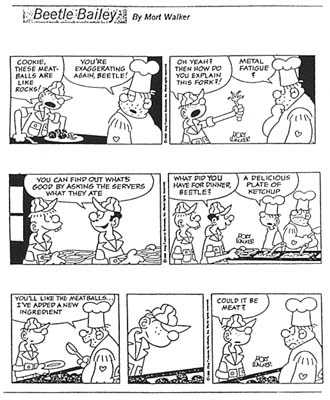
FIGURE 10-1 Selected Beetle Bailey cartoons from the Army Times. SOURCE: Reprinted with special permission of King Features Syndicate.
There are three noteworthy aspects to these data. First, the overall patterns of the data are very similar between the two groups. In fact, for the 12 food items there are few statistically significant group effects or group × foodservice interaction effects. Second, for both groups, analyses of variance (ANOVAs) with Newman-Keuls post-hoc tests (P < 0.05) showed the mean expected acceptability of foods eaten at home to be significantly higher than that for all other foods. Similarly, for the vast majority of the food items, those obtained at a family restaurant, diner/fast food restaurant, and school cafeteria were rated significantly higher than those from the remaining three foodservice operations. As can be seen in the data, ratings of the expected acceptability of military food were low and not significantly different from those for airline and hospital food. The 12 test foods used in the questionnaire were chosen to represent a range of items that differed in the degree of quality among the foodservice facilities. Some foods, such as steak, burgers, and french fries, could be expected to vary greatly in quality among the different foodservices.
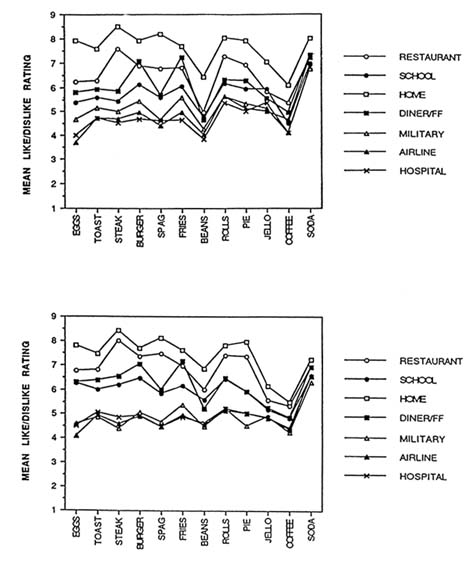
FIGURE 10-2 Mean expected acceptability ratings for 12 food items as served in 7 different foodservice operations. Data are from two groups of military subjects: top, stationed at Fort Devens, Mass. and, bottom, stationed at Schofield Barracks, Hawaii, FF, fast food; SPAG, spaghetti. SOURCE: A. V. Cardello and R. Bell (U.S. Army Natick Research, Development and Engineering Center, Natick, Mass., unpublished manuscript, 1995).
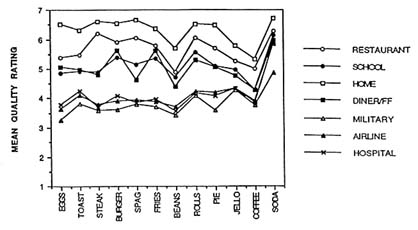
FIGURE 10-3 Mean expected quality for 12 food items as served in 7 different foodservice operations. Data are from military subjects stationed at Schofield Barracks, Hawaii. FF, fast food; SPAG, spaghetti. SOURCE: A. V. Cardello and R. Bell (U.S. Army Natick, Research, Development and Engineering Center, Natick, Mass., unpublished manuscript, 1995)
Others, such as Jell-O and soda, were foods in which great differences in quality would not be expected. Yet, even for the latter items, although the statistical variability among foodservices was smaller, the relative order of expected liking across foodservices remained the same, a fact which suggests that the effect seen in these data is a robust one.
Turning to the judgments of expected quality of the food, Figure 10-3 shows the ratings of expected quality for the troops stationed at Schofield Barracks in Hawaii. The ratings of expected quality are similar to those for expected acceptability in this group of subjects (Figure 10-2, bottom). In fact, expected acceptability and quality ratings were highly correlated (Pearson r's = .92 and .94) for both subject groups, as well as for those subjects whose data are shown in Figure 10-4, discussed below. This strong association is a reflection of the fact that, to most consumers, the concept of food quality is highly correlated with the hedonic value of the food.
Since the subjects in this study were consumers of military food, it is not clear whether the data in Figures 10-2 and 10-3 are a reflection of a stereotypical image of these foods or if they are a reflection of reality. To address this question, an age-matched sample of students at the University of Massachusetts at Amherst, none of whom had ever eaten military food, was administered the same questionnaire. Figure 10-4 shows the ratings for both expected acceptability and expected quality among this group of subjects. As can be seen, the data for military food are almost identical to those depicted in
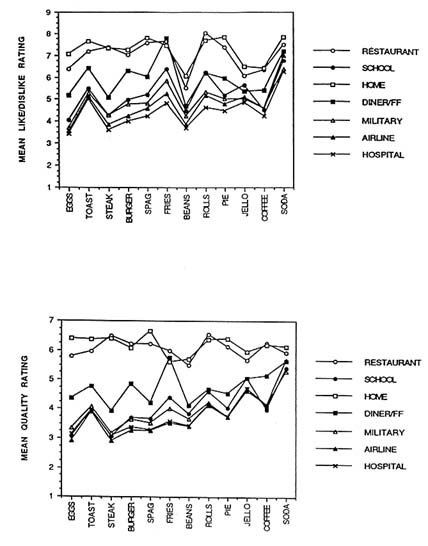
FIGURE 10-4 Mean expected acceptability (top and mean expected quality (bottom ) for 12 food items as served in 7 different foodservice operations. Data are from students at the University of Massachusetts, Amherst, none of whom had ever eaten military food. FF, fast food; SPAG, spaghetti. Source: A. V. Cardello and R. Bell (U.S. Army Natick Research, Development and Engineering Center, Natick, Mass., unpublished manuscript, 1995).
Figures 10-2 and 10-3 for military subjects. The fact that the civilian subjects had never eaten military food suggests that the data reflect a common stereotype in the population that is not affected by exposure to the food. In fact, ANOVAs conducted on the data from the military subjects in Figures 10-2 and 10-3 showed no effect of their length of service on ratings of expected acceptability or expected quality.
The results reported above are supported by data from other recent studies. Salter et al. (1990) studied Navy personnel, evaluating their liking or disliking for 20 foods normally served in Navy dining halls versus commercial cafeterias or restaurants. As shown in Table 10-1, subjects rated the acceptability of every tested food item to be significantly higher in commercial foodservice establishments than in Navy dining halls. In addition, this negative opinion of food items in Navy dining halls extended to other aspects of the foodservice situation (Table 10-2). In almost every case, Navy foodservice scored significantly lower on such factors as cleanliness, portion size, and even the ambient temperature of the dining hall.
Characteristics of the Image and its Origins
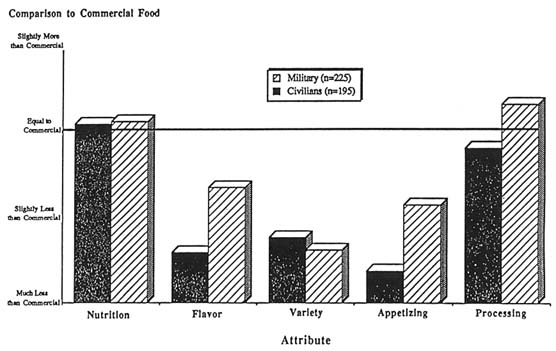
If one accepts that the image of military food is a poor one, the next question to be asked is why the food is perceived to be inferior. Figure 10-5 are data from A. V. Cardello and R. Bell (U.S. Army Natick Research, Development and Engineering Center, Natick, Mass., unpublished manuscript, 1995). In this study, 225 military and 195 civilian subjects were asked to rate military food as compared to commercial food on five different attributes of the food: (1) perceived nutrition, (2) flavor, (3) variety, (4) appetizing quality, and (5) degree of processing. Attributes were each rated on a 5-point scale where 1 corresponds to ''less than commercial" and 5 corresponds to "much more than commercial." As shown in Figure 10-5, neither subject group perceived a difference between military and commercial food in terms of the nutrition or the degree of processing of the food. However, for both groups of subjects, military food was rated significantly less flavorful (military: [F{1} = 4.38, P = 0.02]; civilians: [F{1} = 8.17, P < 0.001]); less appetizing (military: [F{1} = 4.72, P = 0.015]; civilians: [F{1} = 9.54, P < 0.001); and having less variety (military: [F{1} = 8.61, P < 0.001]; civilians: [F{1} = 7.09, P < 0.001]) than commercial food. It is noteworthy that each of the attributes for which military food scored significantly lower relates directly to the hedonic characteristic of the food.
When asked to report the sources of information from which their opinion of military food evolved, civilian subjects in the above study identified television shows and movies, especially those seen during elementary and high school years, as critical sources of information contributing to their current
TABLE 10-1 Mean Acceptability Ratings* of Navy Personnel for 19 Different Food Items When Served in either Navy Dining Halls or Commercial Foodservice Establishments
|
Food Item |
Dining Hall |
Commercial |
|
Chicken noodle soup |
6.1 |
7.0† |
|
French onion soup |
4.0 |
5.7† |
|
Meat loaf |
5.2 |
6.3† |
|
Macaroni and cheese |
5.1 |
6.6† |
|
Pizza |
6.0 |
7.9† |
|
Spaghetti with meat sauce |
6.0 |
7.5† |
|
Fried chicken |
5.8 |
7.3† |
|
Cheeseburger |
6.1 |
7.5† |
|
Hamburger |
5.9 |
7.4† |
|
Grilled ham & cheese sandwich |
6.1 |
6.9† |
|
Rice |
5.2 |
6.4† |
|
Mashed potatoes |
5.6 |
6.8† |
|
French fries |
6.3 |
7.5† |
|
Sweet potatoes |
5.1 |
6.0† |
|
Carrots |
5.3 |
6.1† |
|
Green beans |
5.6 |
6.5† |
|
Spinach |
4.9 |
5.8† |
|
Green peas |
5.3 |
6.2† |
|
Chocolate cake |
6.1 |
7.3 |
|
Overall average: |
5.7 |
6.9† |
|
* Ratings are based on a 9-point scale, in which 1 corresponds to "dislike extremely," 5 corresponds to "neither like nor dislike," and 9 corresponds to ''like extremely." † P < 0.001. SOURCE: Salter et al. (1990). |
||
TABLE 10-2 Mean Satisfaction Ratings· of Navy Personnel for 16 Different Aspects of Foodservice in Navy Dining Halls versus Commercial Foodservice Establishments
|
Item |
Dining Hall |
Commercial |
|
Noise level |
4.1 |
5.3† |
|
Cleanliness |
4.9 |
5.5† |
|
Number of items per meal |
4.3 |
5.7† |
|
Waiting line |
3.2 |
5.5† |
|
Preparation of food |
4.0 |
5.4† |
|
Nutritional quality |
4.5 |
5.6† |
|
Portion size |
3.9 |
5.3† |
|
Taste of food |
4.1 |
5.3† |
|
Appearance of food |
4.3 |
5.8† |
|
Dining hall staff |
4.5 |
5.5† |
|
Hours of operation |
4.9 |
5.6† |
|
Appearance of dining areas |
4.9 |
5.7† |
|
Lighting |
5.3 |
5.6† |
|
Temperature of dining areas |
4.6 |
5.6† |
|
Air quality (smoke) |
5.2 |
5.2 |
|
Number of available seats |
4.3 |
5.5† |
|
Overall average: |
4.4 |
5.5† |
|
· Ratings are based on a 7-point scale, in which I corresponds to "extremely dissatisfied," 4 corresponds to "neither satisfied nor dissatisfied," and 7 corresponds to "extremely satisfied." † P < 0.001 SOURCE: Salter et al. (1990). |
||
image of military rations. In contrast, military subjects reported that information and/or exposure to military food during their basic training or during their first military assignment were the critical factors contributing to their current image of rations.
Taken together, the above studies support the notion of a strong negative image of military food among both military and civilian populations. Moreover, this negative image appears to be stereotypical, since it is the same among military personnel and individuals who have never consumed military rations. Among military personnel, this stereotype may also be influenced by
negative associations with military food during basic training or early military assignments. Given this strong negative image of rations, the next question is whether such an image can affect the perception and acceptance (liking or disliking) of the rations when they are eaten. If so, this negative image may be an important factor contributing to the underconsumption of rations.
THE ROLE OF CONSUMER EXPECTATIONS IN FOOD ACCEPTANCE
Informational Variables
In a series of studies begun in the author's laboratory in 1985 (Cardello et al., 1985), the role of informational variables (e.g., product name, brand labeling, packaging, nutritional information, and product information) has been examined for its effect on the rated acceptability of military and other foods. This program has now evolved into a general program of research that investigates the role of consumer expectations on product acceptance. The basic premise of the research is that attitudes and information about food products create sensory and hedonic expectations for these foods. Subsequent perception and liking/disliking for a food is not simply a function of the intrinsic quality of the food. Rather it is a function of the expectations that a consumer has for the food and the degree to which the food matches or mismatches these expectations (see Cardello, 1994; Cardello and Sawyer, 1992).
Product names and brand labels are important informational variables that establish expectations and that can influence food acceptance. Data in Figure 10-6 are from a study (A. V. Cardello and R. Bell (U.S. Army Natick Research, Development and Engineering Center, Natick, Mass., unpublished manuscript, 1995) showing the effect of militaryversus commercial-brand labeling on food acceptance. The test product was a commercial canned corn that was presented under two different informational conditions. Forty subjects first evaluated the corn in a blind taste test 1 month prior to the main test. The baseline acceptability of the corn from this blind taste test is shown as the horizontal line in Figure 10-6. The same subjects were then brought back 6 weeks after the baseline test for two more sessions, approximately 4 weeks apart. In one session, subjects were informed by written and visual information that the corn was a military (MRE) corn product. In the other session they were informed that it was a commercial (Green Giant brand) corn product. After receiving the information but before tasting the sample in each session, subjects were asked to rate how much they expected to like/dislike the corn, using a 9-point hedonic scale. Mean expected liking/disliking, obtained in this way, is shown by the arrows on the graph. Subjects then tasted the corn and rated its acceptability on the same 9-point hedonic scale. The data in Figure 10-6
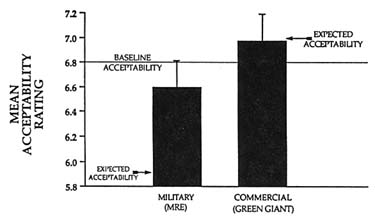
FIGURE 10-6 Mean acceptability ratings of the same commercial canned corn product when labeled as either military or commercial. The horizontal line at the top of the figure represents the baseline level of acceptability as determined from a blind taste test. The arrows indicate the levels of expected acceptability for the products as measured after the label information was presented but before the actual tasting. SOURCE: A. V. Cardello and R. Bell (U.S. Army Natick Research, Development and Engineering Center, Natick, Mass., unpublished manuscript, 1995).
show that when subjects thought the corn was "military," they rated it significantly lower on both expected acceptability (P < 0.01) and actual acceptability (P < 0.05) than when the same corn was labeled as "Green Giant."
Note in Figure 10-6 that the actual acceptability ratings shifted from their baseline level in the direction of the expected liking. Although this result may seem intuitive, one might argue that if subjects expected a poor product but received something better, they might overcompensate and rate the product higher than they would have otherwise. Similarly, if they expected something better than what was received, they might rate the product lower than if they had not held the higher expectation. This issue of the direction of change in acceptability ratings relative to the level of expected acceptability lies at the heart of the theoretical issues involved in predicting the effect of disconfirmed expectations on perceived product acceptance.
Models of Disconfirmed Expectations
In the consumer psychology literature, there are four models of the effect of disconfirmed expectations on perceived product performance. Table 10-3 schematizes the predicted effects of these models based on an expansion of the models to predict food quality and acceptability (Cardello, 1994). The first model is known as assimilation and was proposed by Sherif and Hovland
TABLE 10-3 Summary of the Predicted Effects of Disconfirmed Consumer Expectations on the Direction of Increase/Decrease in Perceived Product Performance for the Assimilation, Contrast, Generalized Negativity, and Assimilation-Contrast Models
|
|
Product Performance versus Expectation |
|
|
Model |
Product Better Than Expected (Positive Disconfirmation) |
Product Worse Than Expected (Negative Disconfirmation) |
|
Assimilation |
Decrease |
Increase |
|
Contrast |
Increase |
Decrease |
|
Generalized negativity |
Decrease |
Decrease |
|
Assimilation-Contrast |
Decrease (under low disconfirmation) or increase (under high disconfirmation) |
Increase (under low disconfirmation) or decrease (under high disconfirmation) |
(1961). Like all of the models, this model predicts that when the intrinsic quality or acceptability of the product matches its expected quality or acceptability (i.e., there is no disconfirmation), perceived quality or acceptability will be unchanged from the intrinsic or baseline level. However, if the expectation level is high but intrinsic quality is low (a state of negative disconfirmation), the assimilation model predicts that perceived acceptability will be elevated in the direction of the expected level. Similarly, if expectations are low but intrinsic quality is high (a state of positive disconfirmation),perceived acceptability is predicted to decrease in the direction of the lower expectation level.
The second or contrast model (Sherif and Hovland, 1961) predicts just the opposite effect. If expectations are high but intrinsic quality or acceptability is low, perceived acceptability is predicted to decrease below its intrinsic level. Concomitantly, if expectations are low and actual intrinsic quality is high, perceived acceptance is predicted to increase.
A third model, known as assimilation-contrast (Hovland et al., 1957) is a hybrid of the first two and maintains that perceived product quality will conform to the assimilation model predictions under conditions of low-positive or low-negative disconfirmation (product not very different from expectation), but will conform to the contrast model predictions under conditions of high disconfirmation (product very different from expectation).
The last model, generalized negativity, was proposed by Carlsmith and Aronson (1963). This model predicts a reduction in acceptance under all conditions in which expectations are not met.
Assimilation Effects
Over the past 25 years, the bulk of empirical research on the role of disconfirmed expectations on product performance has supported an assimilation model of these effects (Anderson, 1973; Bearden and Teel, 1983; Oliver, 1977; Olshavsky and Miller, 1972). Unfortunately, until recently, relatively few studies have examined these effects using food as the test product. However, one such study (Olson and Dover, 1976) examined the effect of consumer expectations on the belief strengths for the bitterness of coffee. These investigators employed an experimental group of 20 subjects who received a series of written communications about the test coffee prior to tasting it. Information in these communications consisted of advertising copy that extolled the coffee as having "no bitterness." Subjects in the experimental group also received a questionnaire asking them to indicate their strength of belief that the coffee was "not at all bitter," "somewhat bitter," ''fairly bitter," or "very bitter." Following data collection, the average of these ratings served as a measure of expected bitterness for this group. Four days after the last communication, subjects met to taste the coffee, which was actually brewed to have considerable bitterness. Subjects rated the bitterness of the coffee by using the same descriptive categories and assigning belief strengths to each. A control group of 18 subjects received no written communication, but merely attended the tasting session and evaluated the coffee using the same rating scales.
The data from this study are shown in Figure 10-7. For all bitterness categories, the rated belief strengths of the experimental group "moved away from the pretrial expectancy and towards, but did not achieve, the objective post-trial belief strength of the control group" (Olson and Dover, 1976, p. 173). Investigators concluded from these data that "the direction, if not the magnitude of each post-trial belief expectancy change constitutes a perfect example of an assimilation effect" and that "these findings of consistent assimilation effects are in agreement with the results of virtually all the earlier disconfirmation research in marketing" (Olson and Dover, 1976, p. 173).
In several studies from the author's laboratory, strong assimilation effects have been shown using a variety of foods as the test products. Figure 10-8 presents data from a study on cola beverages (Cardello and Sawyer, 1992) in which 163 subjects were led to expect that they would receive one of several cola beverages. The cola expected for different subjects ranged from their favorite brand to their least favorite brand, as determined in prior blind taste tests. However, in some cases subjects were given the cola they expected, while in others they were given either a more preferred or a less preferred cola. Pretrial expected acceptability and post-trial actual acceptability were obtained from all subjects. The ordinate in Figure 10-8 is the change in product acceptance from baseline level as a function of whether subjects
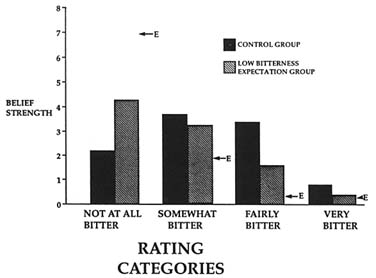
FIGURE 10-7 Mean ratings of belief strength for four different belief categories of the bitterness of coffee. The arrows (E) index the levels of expected belief strengths about the bitterness of the coffee for the subjects in the "low bitterness expectation group. " SOURCE Adapted from Olson and Dover (1976).
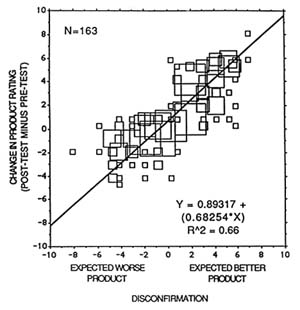
FIGURE 10-8 Plot of the change in product rating (acceptability) from pretest levels as a function of the degree to which subjects expected a better or worse cola product. SOURCE: Cardello and Sawyer (1992), used with permission.
expected a better or worse product. The strong linear association (r2 = 0.66) in the data reflects the fact that acceptance moved in the direction of the expectation, which supports an assimilation model.
Similarly, in a recent study by Tuorila et al. (1994) in which the same experimental paradigm was used as above, subjects were led to expect that they would receive either fat-free or regular-fat pound cake, cheese, and/or crackers. In fact, subjects received either the expected product or its unexpected counterpart. Pretrial expected acceptability and post-trial actual acceptability were obtained from all subjects. Results in Figure 10-9 are from subjects who participated in only the cracker portion of the study. However, these data parallel the results found for pound cake and cheese. Like Figure 10-8, the data in Figure 10-9 show a strong, positive, linear association between the change in product rating and subjects' expectations, which provides support for an assimilation model of the effect of disconfirmed expectations on food product acceptance.
Although the bulk of the data collected to date supports an assimilation model, contrast effects do occur. Debra A. Zellner (Department of Psychology, Shippensburg State University, unpublished data, 1992) has shown contrast effects using extremely high levels of disconfirmation. For example, she has given subjects a medicinal tasting pill, telling them that it is either medicine or candy. Results obtained under these conditions show evidence of contrast effects. However, the majority of data from studies working within the levels of disconfirmation that are likely to be found with traditional food products show assimilation effects.
Implications of an Assimilation Model
The implications of an assimilation model for ration acceptance are two-fold. First, on the negative side, if expectations of rations are low, the assimilation model predicts that acceptance will suffer. Thus, given the negative image and negative expectations of military rations as outlined at the start of this chapter, one may very well expect reduced acceptability for field rations. However, on the positive side, if expectations can be elevated, acceptance should increase. This latter prediction is consistent with the assumption operating in commercial advertising and food marketing, whereby products are "hyped" on the basis of their positive features and qualities.
However, for the purpose of identifying strategies to overcome underconsumption, the important question is not whether acceptance increases or decreases in response to changing expectations, but more directly, whether consumption increases or decreases in response to these changes.
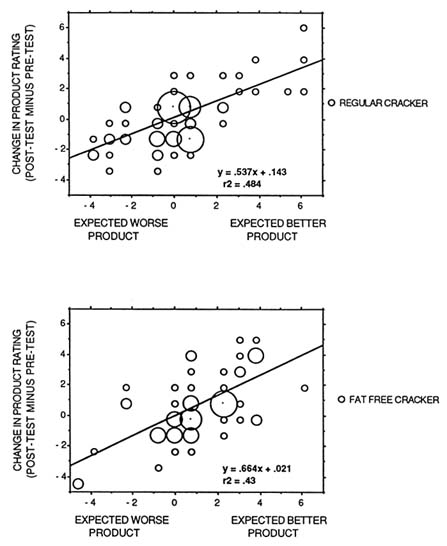
FIGURE 10-9 Plot of the change in acceptability ratings from pretest levels as a function of the degree to which subjects expected a better or worse product. Top, ratings for a regular fat cracker labeled as either regular fat or fat-free. Bottom, ratings of a fat-free cracker when labeled similarly. SOURCE: Tuorila et al. (1994), used with permission.
EFFECTS ON CONSUMPTION
Effects of Information and Packaging
On the basis of previous research showing that food preference and acceptance measures constitute up to 50 percent of the variability in consumption measures (Kamenetzky and Pilgrim, 1958; Pilgrim, 1961; Seaton and Peryam, 1970; Sidel et al., 1972; Smutz et al., 1974; Sullins et al., 1977; Wyant et al., 1979), one can argue that any variable that affects food acceptance will, in turn, affect consumption of that food. However, data are now beginning to emerge that indicate a direct relationship between consumer expectations (and/or the informational variables that have been shown to control expectations) and consumption. For instance, in a recent study by Hellemann et al. (1993), 79 consumers were served a low-fat meal, but half were told that the items were low-fat, while the other half received no information. Pretest measures of expected liking were obtained, as well as posttest measures of acceptability, likelihood to purchase the meal items, and actual consumption. Results indicated that disconfirmed expectations produced negative affect (acceptability), a lower likelihood to purchase the product, and reduced consumption of the food.
In another series of studies, image-related informational variables concerning military food were investigated for their effect on both the perceived acceptance and consumption of the food. In the first of these studies, Kramer et al. (1989) served four different flavors of pudding to 58 subjects in one of three different containers—a plain white bowl, a military (khaki-colored) bowl, or a military (khaki-colored) pouch. It was predicted that the military package conditions would generate lower expectations for the pudding and, in turn, reduce acceptance and consumption. Consistent with this hypothesis, subjects rated the acceptability of the pudding in both military packages lower [F (2, 55) = 5.96, P < 0,01], and as shown in Figure 10-10, ate significantly less of the product [t (56) = 2.44, P < 0.05]. The same subjects were then brought back 4 months later, at which time all of them were presented with the puddings in their normal commercial packaging (Hunts brand). As seen in Figure 10-10, there were no significant differences in intake among the groups; and the two groups that were previously given the pudding in the military containers now ate significantly more of the puddings ([t{14} = 3.80, P < 0.01] for military bowl; [t{19} = 3.81, P < 0.001] for military pouch).
Working on the assumption that commercial packaging creates a higher expectation than military packaging, Kalick (1992) undertook a study to determine if ration acceptance and consumption could be increased by altering ration packaging to look more like commercial packaging. Primary and secondary packaging of the standard combat ration Meal, Ready-to-Eat (MRE)
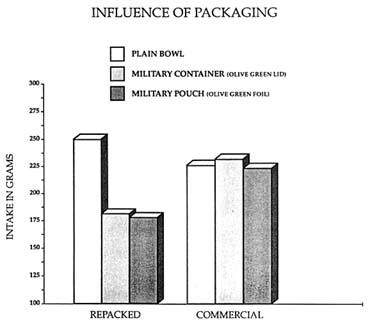
FIGURE 10-10 Mean intake (g) of subjects exposed to commercial puddings in either a plain bowl, military container, or military foil pouch ("repacked"). The data labeled "commercial" were collected several weeks later from the same subjects when exposed to the puddings in their regular commercial packages. SOURCE: Kramer et al. (1989), used with permission.
were given commercial-like colors, labeling, and graphics. Two different commercial-like designs were created. Both designs, along with the standard MRE package design, were used to package identical MRE meals. Subjects—192 military troops stationed at Fort Campbell, Kentucky—were divided into three groups, and each person received a single meal packaged in one of the three alternative designs while on a field mission. The three test groups were spatially separated to prevent communication about the packaging manipulation. Subjects rated the acceptability of each of the components of the meal, the overall meal acceptability, the acceptability of the packaging, as well as other nonfood aspects of the ration (e.g., the effectiveness of the ration heater). Consumption of items in the meal was measured by visual estimation. As shown in Table 10-4, the mean acceptability ratings for the entree (chicken stew), the beverage (orange drink), and two of the candies (Tootsie Roll and Charms) were significantly higher when packaged in either of the commercial-like packages than when packaged in the traditional MRE package. Unfortunately, the consumption data were confounded by the fact that the MRE group
TABLE 10-4 Mean Acceptability Ratings of Ration Items for which Statistically Significant Differences (P < 0.05) were Found as a Function of the Type of Packaging Used
|
|
Mean Acceptability Rating by Package Type |
||
|
Food Item |
MRE |
NEW 1 (BEIGE) |
NEW 2 (GREEN) |
|
Entree (chicken stew) |
5.8 |
6.8 |
6.8 |
|
Beverage (orange drink) |
5.8 |
6.6 |
7.2 |
|
Candy (Tootsie Roll brand) |
7.5 |
7.5 |
8.2 |
|
Candy (Charms brand) |
6.0 |
6.4 |
7.2 |
|
SOURCE: Kalick (1992). |
|||
missed breakfast on the day of the test, so their hunger ratings were significantly higher than those for the two commercial package groups [F (2, 189) = 4.98, P < 0.05]. In spite of the increased hunger in this group, subjects in the MRE package group ate no more of the ration than subjects receiving rations in either of the two commercial-like packages.
Effects of Social Communications
Lastly, Engell et al. (1990) demonstrated that the opinions of a group leader about ration quality directly affected ration consumption. In this study, two cohorts of military personnel participated in lunch-time meal tests of rations. Participants in each group were members of the same platoon, and neither group knew that their platoon sergeants had been recruited to serve as confederates (allies) in this study. Each platoon assembled in a dining room to eat and evaluate "new rations." In one condition, the sergeant accompanied the troops into the dining room, sat at their table, began to eat the rations, and proceeded to make negative comments about the quality and acceptability of the new rations. In the other condition, the sergeant followed the same procedure, but made only positive comments about the quality and acceptability of the new rations. Following the meal, subjects evaluated the rations for acceptability on a 9-point hedonic scale, and subsequently, the amount they consumed was indexed using a plate waste measure. The rated acceptability of the rations was significantly higher in the condition in which the sergeant made positive comments about the rations when compared to the condition in which the sergeant made negative comments about the rations. More importantly, the data in Figure 10-11 show that the subjects in the positive
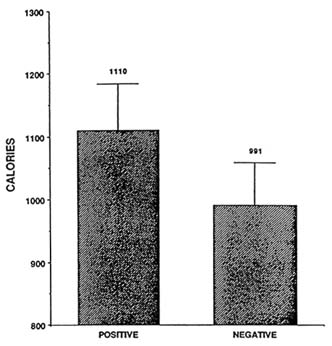
FIGURE 10-11 Mean energy intake of a tray-pack ration in kilocalories for troops participating in a lunch study on social influence. The data on the left were collected from troops who were exposed to positive communications by a confederate. The data on the right were collected from troops who were exposed to negative communications. SOURCE: Engell et al. (1990), used with permission.
communication condition consumed significantly more total calories than did subjects in the negative communication condition [t (27) = 2.36, P < 0.05)].
CONCLUSIONS AND RECOMMENDATIONS
The following conclusions can be drawn from the data presented in this chapter:
-
A strong negative image of military rations exists.
-
The negative image is the same among both consumers (soldiers) and nonconsumers (civilians) of the ration products, which suggests that the image is stereotypical.
-
Data on the effect of disconfirmed expectations on product acceptance support an assimilation model.
-
The implications of an assimilation model for ration acceptance are: (a) the negative image of rations will decrease their acceptance and consumption, and (b) improving the image will increase ration acceptance and consumption.
-
Recent studies manipulating expectations of rations through information and packaging show positive effects on rated acceptance.
-
Effects of expectations and/or informational variables on consumption, although fewer in number, are now being demonstrated.
Based on the available data, the following recommendations are made in support of the goal of developing strategies to overcome underconsumption of rations:
-
Conduct a detailed analysis of all factors contributing to the current negative image and expectations for military field rations, including sources both inside and outside the military.
-
Develop a program to improve the image of and expectations for military rations among soldiers, using as vehicles: (a) informational communications (e.g., pamphlets and training videos that emphasize the quality and acceptability of field rations), (b) commercial-like packaging that creates a more positive image of the contents of the package, and (c) commercial-brand labeling to take advantage of positive associations that have been created with these brands.
-
Continue basic research into the cognitive mechanisms by which attitudes and expectations affect ration and product perception, acceptance, and consumption.
REFERENCES
Anderson, R.E. 1973. Consumer dissatisfaction: The effect of disconfirmed expectancy on perceived product performance. J. Marketing Res. 10:38–44.
Bearden, W.O., and J.E. Teel 1983. Selected determinants of consumer satisfaction and complaint reports. J. Marketing Res. 20:21–28.
Cardello, A.V. 1994. Consumer expectations and their role in food acceptance. Pp. 253–297 in Measurement of Food Preferences, H.J.H. MacFie and D.M.H. Thomson, eds. Glasgow: Blackie Academic and Professional.
Cardello, A.V., and F.M. Sawyer 1992. The effects of disconfirmed consumer expectations on food acceptability. J. Sensory Studies 7:253–277.
Cardello, A.V., O. Maller, H. Bloom-Masor, C. DuBose, and B. Edelman 1985. Role of consumer expectancies in the acceptance of novel foods. J. Food Sci. 50:1707–1718.
Carlsmith, J.M., and E. Aronson 1963. Some hedonic consequences of the confirmation and disconfirmation of expectancies. J. Abnorm. Soc. Psychol. 66(2):161.
Engell, D., F.M. Kramer, S. Luther, and S. Adams 1990. The effect of social influence on food intake. Paper presented at the Society for Nutrition Education Annual Meeting, Anaheim, Calif.
Hellemann, U., J.J. Aaron, R. Evans, and D.J. Mela 1993. Effects of expectations on the acceptance of a low-fat meal. Paper presented at Food Preservation 2000 Conference, Natick, Mass.
Hovland, C.I., O.J. Harvey, and M. Sherif 1957. Assimilation and contrast effects in reactions to communication and attitude change. J. Abnorm. Soc. Psychol. 55:244–152.
Kalick, J. 1992. The effect of consumer-oriented packaging designs on acceptance and consumption of military rations. Technical Report TR-92/034. Natick, Mass.: U.S. Army Natick Research, Development and Engineering Center.
Kamenetzky, J., and F.J. Pilgrim 1958. Interpretation of preference ratings. Report No. 16-58. Chicago, III.: Quartermaster Food and Container Institute.
Kramer, F.M., J. Edinberg, S. Luther, and D. Engell 1989. The impact of food packaging on food consumption and palatability. Paper presented at the Association for Advancement of Behavior Therapy, Washington, D.C.
Oliver, R.L. 1977. Effect of expectation and disconfirmation on postexposure product evaluations: An alternative interpretation. J. Appl. Psychol. 62(4):480–486.
Olshavsky, R.W., and J.A. Miller 1972. Consumer expectation, product performance, and perceived product quality. J. Marketing Res. 9:19–21.
Olson, J.C., and P. Dover 1976. Effects of expectation creation and disconfirmation on belief elements of cognitive structure. Pp. 168–175 in Advances in Consumer Research, vol. 3, B.B. Anderson, ed. Atlanta: Association for Consumer Research.
Pilgrim, F.J. 1961. What foods do people accept or reject? J. Am. Dietetic Assoc. 38:439.
Salter, C.A., D. Sherman, S. Adams, and K. Rock 1990. Feeding concept, military vs. civilian system. Technical Report TR-91/011. Natick, Mass.: U.S. Army Natick Research, Development and Engineering Center.
Seaton, R.W., and D.H. Peryam 1970. Hunger, food preference, and consumption. Human Factors 12(6):515.
Sherif, M., and C.I. Hovland 1961. Social Judgment: Assimilation and Contrast Effects in Communication and Attitude Change. New Haven, Conn.: Yale University Press.
Sidel, J.L., H. Stone, A. Woolsey, and J.M. Mecredy 1972. Correlation between hedonic ratings and consumption of beer. J. Food Sci. 37:335.
Smutz, E.R., H.L. Jacobs, D. Waterman, and M. Caldwell 1974. Small sample studies of food habits: 1. The relationship between food preference and food choice in naval enlisted personnel at the Naval Construction Battalion Center, Davisville, Rhode Island. Technical Report TR-75-52-FSL. Natick, Mass.: U.S. Army Natick Research and Development Command.
Sullins, W.R., Jr., L.E. Symington, J.R. Siebold, and J.G. Rogers 1977. Food preference, acceptance, and consumption in a simulated, isolated-duty station. Technical Report TR-78-027. Natick, Mass.: U.S. Army Natick Research and Development Command.
Tuorila, H., A.V. Cardello, and L.L. Lesher 1994. Antecedents and consequences of expectations related to fat-free and regular-fat foods. Appetite 23:247–263.
Wyant, K.W., H.L. Meiselman, and D. Waterman 1979. U.S. Air Force food habits study: Part I, Method and overview. Technical Report TR-79-041. Natick, Mass.: U.S. Army Natick Research and Development Command.
DISCUSSION
EILEEN THOMPSON: The whole idea of a shelf-stable, packaged, pouch food in itself has a negative reaction quite separate from the military site. We did some studies where we compared frozen products like spaghetti and meat sauce with a shelf-stable product called Top Shelf. When we did it ''blind", the Top Shelf product was definitely preferred over the frozen product. But as soon as the study participants knew that one was frozen and one was shelf-stable, the scores were completely reversed, and the frozen product was preferred.
ARMAND CARDELLO: Yes, the variables that control that are important.
HOWARD SCHUTZ: (Off mike.) — If we look to the consumer behavioral literature, I think we have to have some concern about how far we take this issue of packaging. That is, if you increase the expectations based on packaging a great deal because we know that satisfaction is related to disconfirmation, at some point they're going to be expecting so much and be disappointed.
ARMAND CARDELLO: Yes, I could have expanded on the other model, the assimilation contrast model, which basically says that you get assimilation effects when the product comes close to the expectation in either direction. However, when the actual product characteristics differ greatly from the expectation, you get a reversal and then a contrast effect.
RICHARD JANSEN: How do you explain the MRE food acceptance rating data based on the theory you've presented? They've had this food, they've had bad expectations. They eat it, it's probably not that great, they don't eat that much of it, and yet they rate it a seven. In other words, why aren't those acceptance ratings lower if in fact this model is going to hold?
ARMAND CARDELLO: I think part of the explanation goes back to John De Castro's previous point. I think that when I go home and select the fruit that I want, the sandwich that I want, I'm going to rate that an eight or a nine. These ratings here appear to be moderate, but in fact they're probably not as high as the ratings they would give food that they chose and selected. So I
think we have to be careful of how we characterize ratings of six and seven. Is it low? is it high? Is it acceptable? I think it is in fact on the low end because the people don't choose the food that they actually want.
RICHARD JANSEN: I hate to be pessimistic, but I think rehabilitating the image of the MRE is about as probable as rehabilitating the athletic prowess of Gerry Ford. It is past the point. You would have to bribe every cartoonist and every talk show host in the country. I think you're on the right track, in terms of the fact that the MRE needs to be perceived as commercial food. When it is perceived that way, they in fact consume it. Now one of Vice-President Gore's "Re-inventing Government" mandates is getting away from military specifications for a whole raft of items. In other words, you don't need to have a particular specification for a toilet seat; you can use a commercial toilet seat instead. I would think that would include the use of commercially produced and labeled foods in military rations.
ARMAND CARDELLO: One of the things I want to point out is that changing attitudes is much more difficult than establishing attitudes. I think any of these efforts needs to be done with new rations as they're being fielded, rather than to go back, and as you say, rehabilitate the MRE image.


