
14
When Does Energy Deficit Affect Soldier Physical Performance?
Karl E. Friedl 1
Not Eating Enough, 1995
Pp. 253–283. Washington, D.C.
National Academy Press
During the last month of the siege men at fatigues, such as trench-digging, after ten minutes' work had to rest a while and go at it again; men on sentry-go would drop down from syncope (the spell of duty had to be reduced to one hour instead of two); those carrying loads would rest every hundred yards or so.
Observations on the effects of restricted rations on British and Indian soldiers during the 1915–1916 Siege of Kut (Hehir, 1922, p. 867).
INTRODUCTION
Several decades ago, Army nutritionists concluded that soldiers could maintain normal work capacity during short periods (< 10 days) of severely restricted intakes (Consolazio et al., 1967, 1979). This finding corroborated the conclusions from longer-term studies conducted at the University of Minnesota that an energy deficit resulting in less than 10 percent loss of body weight
does not impair physical performance (Taylor et al., 1957). There is a long history of such Army-sponsored research on performance decrements related to energy-deficient diets that reaches back to laboratory studies from the University of Minnesota in the 1940s and 1950s (for review, see Grande, 1986) and field studies conducted by the U.S. Army Medical Research and Nutrition Laboratory in the 1960s and 1970s (for review, see Consolazio, 1983). In the past decade, the Occupational Physiology Division at the U.S. Army Research Institute of Environmental Medicine has repeatedly performed physical testing during ration studies (e.g., Askew et al., 1987; Moore et al., 1992; Teves et al., 1986). The data from these more recent studies have been largely overlooked because of the general absence of findings of performance decrements. These negative findings could be the result of protocols failing to produce an actual energy deficit or because the tests used were insensitive to real performance decrements. However, after these and other interpretations of the data are considered, the conclusion of this chapter will be that militarily relevant physical performance appears to be well sustained through the range of voluntarily low intakes (underconsumption) of modern military rations.
If underconsumption occurs for sufficient duration it will unquestionably produce deficits in physical performance. Changes in the oxidative capacity of muscle, the oxygen carrying capacity of the blood, and the mass of metabolically active tissue probably account for most of the observed decrease in aerobic capacity, which in turn, explains reduced stamina and physical work capacity (Keys et al., 1950; Spurr, 1986). Loss of skeletal muscle, changes in muscle biochemistry, and changes in the balance of muscle fiber types produce reductions in dynamic strength (Henriksson, 1990; Taylor et al., 1957). Such decrements in physical performance have been established at extreme levels of underconsumption in the 1950 Minnesota Starvation Study and in studies of soldiers in the U.S. Army Ranger course (Johnson et al., 1976; Moore et al., 1992 [Ranger I]; Shippee et al., 1994 [Ranger II]). These levels of underconsumption were voluntary only in the sense that the participants could quit the programs; if offered more food, these men would have readily consumed it. However, these studies are important for this book because they illustrate an extreme of underconsumption, which permits interpolation of the effects of the more pertinent (i.e., modest) energy deficits. A different militarily relevant extreme of underconsumption—very high deficits for a short period of time—will also be addressed.
ASSESSING UNDERCONSUMPTION
Baseline Nutritional Status
A typical, fit, young male soldier weighs about 75 kg, and 15 percent of this weight is fat. These fat energy stores are adequate to fuel the soldier for a 1,000 kcal deficit per day lasting for about 75 days; beyond this point, energy deficits will be made up primarily from organ and muscle protein as the soldier enters an advanced stage of starvation. A certain proportion of lean mass, usually about one-third of the total weight change, is lost or gained along with changes in storage fat (Forbes, 1993), but as fat stores become increasingly scarce with a severe weight loss, this proportion increases. This was illustrated in the Ranger-I study (Moore et al., 1992) where an increased proportion of the lean tissue contributed to overall weight loss between 6 weeks (30 percent) and 8 weeks (40 percent). At the end of the 8-wk study, soldiers had lost an average 16 percent of body weight, and the majority of men were on the brink of a metabolic transition to severe starvation because they had little or no fat stores remaining (Friedl et al., 1994). This metabolic threshold also appeared to coincide with the approach of a psychological limit to voluntary participation, a point recognized by the Ranger Training Brigade commander by the number of soldiers who were disqualified near the end of the course for food violations (see Appendix 1 in Moore et al. [1992]). Thus, the paradigm of Ranger-I, a 1,200 kcal deficit per day for 60 days, appears to define an extreme limit of voluntary underconsumption for contemporary male soldiers.
Current-day soldiers can better tolerate an energy deficit (in terms of preserving performance) because they are better nourished and begin with more fat-free mass than the soldiers of earlier eras. This point is illustrated by a wartime example that involved apparently modest weight losses but resulted in profound physiological consequences. In the winter of 1915, 15,000 British and Indian soldiers were surrounded by Turkish troops at Kut in southern Mesopotamia; they surrendered when their rations were depleted 5 months later. By the time of surrender, intake for the British soldiers had been reduced to half of the estimated normal 3,600 kcal/d (Hehir, 1922). Weight loss averaged 10 and 14 percent of weights measured near the start of the siege for the British and Indian soldiers, respectively. Although these losses are not even as large as the relative weight loss observed in Ranger-I, the restriction had a greater impact on the average soldier than that observed in the Ranger studies. The chief medical officer recorded that ''the present condition of the average officer and fighting man…is much below par in stamina, and, without feeling any decided weakness, he is incapable of doing anything approaching the
normal amount of physical or mental work" (Hehir, 1922, p. 869). Numerous starvation deaths occurred before the surrender of the garrison.
The first point to be made from this example is that relative weight losses cannot be meaningfully compared unless the initial nutritional status is also considered. The soldiers at Kut were already at reduced weight from earlier fighting and a long march to Kut. More importantly, even at baseline, soldiers of this earlier era were not as well nourished as current-day soldiers. U.S. soldiers today have an average of 20 lb (9.1 kg) more body weight, including 15 lb (6.8 kg) more lean mass, than U.S. soldiers in World War I, and approximately 10 lb (4.5 kg) more than World War II soldiers (Friedl, 1992). A large loss of body weight (˜10 percent) in these soldiers with initially lower body fat stores and muscle mass could be a much more severe physiological challenge than it would be for typical modern-day, well-nourished soldiers. Consistent with this hypothesis, soldiers who began training with very low body fat (< 10 percent) in the Ranger-I study were less likely to succeed than were slightly fatter soldiers (Moore et al., 1992).
Current-day soldiers also receive nutrition of better quality than their earlier counterparts. The soldiers at Kut did not have a vegetarian Multi-Faith Meal (MFM), and at least 1,000 Indian soldiers who would not eat horseflesh were diagnosed with scurvy. They did not have rations carefully constructed to meet military recommended daily allowances (MRDAs) and to provide a balanced intake even in situations involving high stress and restricted intake. Many of the British soldiers suffered from beriberi with symptoms of degraded work ability superimposed on the problem of a deficient energy intake. These are problems that soldiers should no longer face. For example, in the recent Ranger studies, even in the face of a large average energy deficit over 2 months, no substantial vitamin, mineral, or nutrient deficiency could be established even when soldiers were subsisting on only one Meal, Ready-to-Eat (MRE) or one Long Life Ration Packet (LLRP) per day (up to 10 days continuously). Thus, comparisons to earlier studies must take into account the underlying baseline nutritional status.
Overnourished Soldiers
Improvements in nutrition during this century have led to an increase in the proportion of overnourished soldiers. Thus, any study of the consequences of underconsumption must be carefully interpreted with respect to the number of soldiers who could well afford an energy deficit and particularly with respect to those soldiers who may be actively attempting to lose weight. In the 1991 study of the nutritional adequacy of the MRE compared to hot rations during field training, overweight men deliberately attempting to lose weight
emerged as a significant confounding factor in the data analysis (Thomas et al., 1995). Fortunately, at the start of the study the investigators had asked who was trying to lose weight. One-third of the MRE test group was trying to lose weight and achieved a loss of 4.4 kg (4.8 percent of initial body weight; n = 13), compared to 2.3 kg (or 3.1 percent weight loss; n = 22) for the remainder of the group (Thomas et al., 1995). This weight loss was appropriate for men averaging a robust 26.5 ± 3.8 percent body fat2 (compared to 18.2 ± 4.8 percent for the men not intending to lose weight). There was no indication from detailed nutritional and clinical serum biochemical tests that health or nutritional status was adversely affected with this weight loss, nor was there any indication that performance suffered (Thomas et al., 1995).
Another recent study investigated body composition changes in young female basic trainees eating without restriction (Westphal et al., 1995). This study revealed that at least one-fourth of the women exceeded Army body fat standards at the start of basic training. Despite an average intake of 2,600 kcal/d, this fattest group of women, averaging 36 ± 3.8 percent body fat2, lost weight (0.5 ± 3.2 kg). However, the true magnitude of the body composition changes is overlooked if only reported as change in body weight; this group gained 1.7 ± 1.8 kg of fat-free mass at the same time they lost 2.2 ± 2.7 kg of fat (3 percent of body weight). Despite this loss of fat weight, the physical performance of these women was markedly improved at the end of basic training (Sharp et al., 1994; Westphal et al., 1994). This improved performance included an increased muscular endurance demonstrated by large improvements in push-up and sit-up ability, increased strength marked by an average increase of 10 lb (4.5 kg) in maximal lift capacity, and improved aerobic capacity indicated by an average 5-min reduction in 2-mi run times.
These recent studies of men (the MRE study) and women (the study of basic trainees) highlight the problems in evaluating the effect of field rations in modern-day overnourished soldiers. Voluntary underconsumption and/or some loss of fat weight in these subgroups are not necessarily harmful. There is even evidence that some aspects of physical performance will be improved. In an earlier Committee on Military Nutrition Research report, Kirk J. Cureton provided compelling evidence that the loss of excess fat weight can indeed enhance various types of physical performance, most notably run time (Cureton, 1992).
Nutritional Status of Female Soldiers
Although women have not been studied during extreme conditions such as those in the Minnesota Starvation Study or Ranger training, there is evidence to suggest that physical performance could be better maintained by female soldiers. This conclusion is based, in part, on a superior nutritional status in the form of larger gender-appropriate fat stores. A typical, young female soldier weighing 60 kg with 30 percent body fat carries sufficient storage fat to survive an energy deficit for approximately twice as long as her male counterpart. This hypothesis is corroborated by numerous wartime studies demonstrating the disproportionate survival of women over men during periods of extreme starvation (Brozek et al., 1946; Burger et al., 1948). Greater fat stores are only part of the advantage; at a comparable exercise level, women utilize fat energy better than men (Nygaard, 1985), and because of lower lean body mass relative to men, women have lower basal metabolic requirements.
Although female soldiers may hold a theoretical advantage during caloric restriction, and performance may improve rather than degrade with the loss of fat weight, underconsumption of rations produces a performance risk in women that is not encountered in men. Premenopausal women with restricted intakes are likely to encounter deficiencies of minerals and nutrients related to red cell formation (iron and folate). This increased potential for iron-deficiency anemia also leads to compromised work capacity (Finch and Huebers, 1982), as demonstrated by detailed studies performed on Sri Lankan tea leaf pickers (Edgerton et al., 1979; Gardner et al., 1977). In one study of these workers, all women with serum hemoglobin over 13 g/dl could complete an 18-min graded treadmill test, but fewer than half of the women with less than 12 g/dl could complete the same test (Gardner et al., 1977). The relationship between iron intake and performance was demonstrated with iron supplementation, where the effect could be calculated as a 0.75 kg increase in tea picked per day per gram of hemoglobin increase per dl of serum (Edgerton et al., 1979). Thus, work performance can be influenced by iron deficiency even within the clinically normal range for hemoglobin.
This problem of iron deficiency in women has direct relevance to U.S. servicewomen. Most recent studies of female soldiers indicate a large proportion of women to be only marginal for iron balance (King et al., 1993; Westphal et al., 1994). Inadequate intakes related to weight-loss attempts are responsible for at least some of this imbalance. In the 1989 West Point Nutritional Survey (Klicka et al., 1993), 80 percent of female cadets stated that they were attempting to lose weight. Measured nutrient intakes confirmed restricted caloric intakes, with at least 10 percent of cadets taking in less than 1,700 kcal/d (i.e., < 70 percent of the 2,400 kcal/d female MRDA for energy). Even when iron supplement use is included in the estimates, one-third of
female cadets had iron intakes below the MRDA of 18 mg/d. One-third of the women sampled had hemoglobin levels of less than 12 g/dl of serum (Friedl et al., 1990), a point of diminished work capacity in the Sri Lankan women in Gardner et al.'s study (1977). The results of the West Point study suggest that women consuming less than 2,000 kcal/d at conventional nutrient densities may not take in sufficient iron and folacin to maintain optimal performance.
The effect of reduced hemoglobin (< 12 g/Dl) on performance has been recently demonstrated in young women in Army basic training. The women with lower hemoglobin concentrations had 2-mi run times that were 1 to 11/2 minutes slower than the others (Westphal et al., 1995).
Male cadets in the West Point study did not demonstrate problems with iron, and male soldiers do not develop signs of iron or other mineral deficiencies even during intensive training with reduced intakes observed in the Ranger course (iron intake averaged 13 mg/d over 2 months) (Moore et al., 1993). Thus, single nutrient deficiencies do not appear to be a concern in male soldiers, where the only compromise from restricted military rations is an energy deficiency.
ASSESSING PERFORMANCE
Work Capacity and Energy Expenditure
The importance of adequate intake to work productivity (i.e., voluntary energy expenditure) can be demonstrated when energy deficits are high or prolonged, specifically because additional calories will be readily consumed when offered, and productivity will increase (for extensive review, see Consolazio, 1983; Spurr, 1986, 1990). Thus, the circumstances are somewhat different from the problem of voluntary underconsumption. For example, coal and steel production in German factories during World War II fell off with the reduction in energy intakes as food supplies diminished, particularly when average intakes decreased from 2,200 kcal/d to 1,800 kcal/d (Consolazio, 1983). When the rations of a group of young coal miners increased from 2,800 to 3,200 kcal/d, production increased from 7 to 9.6 tons of coal per day per man; an additional 400 kcal/d produced a small additional increase in productivity (Kraut and Muller, 1946). Such studies suggest that voluntary work output can be limited by restricted daily intake.
Spurr has demonstrated an energy "ceiling" effect produced by chronic underconsumption. Using continuous heart rate monitoring, he showed lower average energy expenditures in undernourished Columbian boys mixed into a group of normal Columbian boys in a summer sports program. For several hours following a hot lunch, heart rates did not differ between the groups.
However, after that time heart rates fell off in the undernourished group (Spurr and Reina, 1988). Although other factors such as mood and morale may contribute to these phenomena, the reduction in physical work capacity is most probably related to reduced energy stores, including low body fat and perhaps inadequately replenished muscle glycogen (Karlsson and Saltin, 1971).
Ranger students present a variation where a sustained physical effort is not optional, demonstrating behavioral and metabolic adaptations to accommodate the reduction in energy intake while maintaining the required level of effort. By the end of Ranger training, soldiers move with great deliberation and visibly demonstrate no wasted motion. There is also a marked reduction in circulating thyroid hormones and an increased sensitivity to cold, even in summer classes, which suggests the same reduction in cellular metabolism that has been measured in earlier studies such as the Minnesota study. Even Major General Sir Hehir (1922) demonstrated reduced body temperatures in his 1916 observations of semi-starved soldiers.
Results of increased feeding in this setting appear to be split between contributions to reducing the energy deficit (reducing the rate of catabolism of body energy stores) and increasing energy expenditure (raising the "ceiling"). In the Ranger-I study, energy expenditure estimated from changes in body composition and estimated intakes indicated an average energy deficit of 1,200 kcal/d and a total energy expenditure of 4,000 kcal/d (Moore et al., 1992). When the intakes were increased by 400 kcal/d in the Ranger-II study (Shippee et al., 1994), the deficit was reduced to 1,000 kcal/d, implying also an increase in energy expenditure to approximately 4,200 kcal/d (Figure 14-1A). However, the attenuated decline in triiodothyronine when the soldiers were given more food suggests that it was basal metabolic functions (e.g., body heat production) that were better sustained with the small increase in rations (Figure 14-1B). This result does not necessarily signify an increase in productive work.
After 24 weeks of semistarvation in the Minnesota study at nearly half of normal intakes, resting energy expenditure had declined by 40 percent. Although the majority of this decline was explained by the reduction in body cell mass, a portion of the reduction (15–25 percent) was attributed to reduced cellular energy requirements (Keys et al., 1950). In shorter-term studies, Grande et al. (1958) concluded that most of a decrease in resting metabolic rate was due to the decline in cellular metabolic rate, with no more than one-third of the decrease accounted for by loss of cell mass. An even greater savings in energy expenditure (accounting for approximately 1,000 kcal/d) in the Minnesota Starvation Study came from reductions in voluntary activity. These studies suggest several mechanisms, such as increased economy of movement and decreased resting metabolic rates, through which soldiers who are voluntarily underconsuming might demonstrate a reduction in energy expenditure
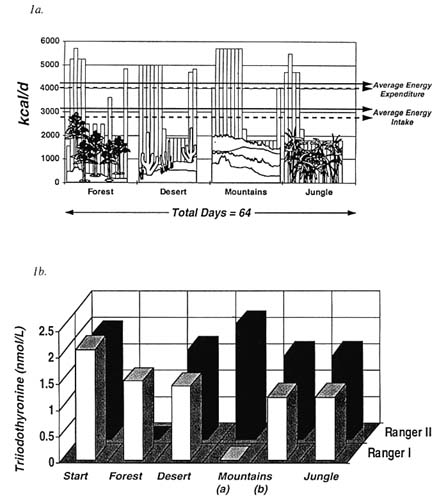
FIGURE 14-1 Daily intakes (A) are represented for soldiers through the four phases of training in the Ranger-II study. Dashed horizontal lines indicate the average daily energy intake and expenditure of the Ranger-I study, with a deficit of 1,200 kcal/d; solid lines indicate the effect of +400 kcal/d intake in Ranger-II, with a reduction in the deficit (to 1,000 kcal/d) and an increase in the total daily energy expenditure. This increased intake in Ranger-II was adequate to maintain normal circulating levels of triiodothyronine (B), which suggests a more normal metabolic rate, but not necessarily a change in soldier work capacity or productivity.
without necessarily decreasing productive work. However, the early responses to restricted energy intake in a normal subject do not include a change in resting metabolic rate; instead there is an increased utilization of body fat, reflected in weight loss and a change in the respiratory quotient.
Note that in all of these more extreme examples, including wartime coal miners, undernourished Columbian children, Army Ranger students, and volunteers in the Minnesota Starvation Study, all would have willingly consumed more calories, if they were offered. In normal circumstances, it is assumed that appetite would increase energy intakes following voluntary underconsumption before energy expenditure is noticeably affected. At least at the extreme level of deprivation of Ranger students, there was a strong hunger drive even in the face of multiple stressors.
Specific Tests of Performance
The measurement of physical performance end points is not a trivial task in the context of military field studies. Unlike the picking of tea leaves or cutting of sugarcane, most military work does not readily lend itself to quantification through measurement of a single end product that signifies productivity. A few studies have successfully tested work productivity, such as a recent examination of the metabolic costs of a sustained-operations howitzer firing simulation, where the number of rounds loaded and fired could be assessed over discrete periods of time (Sharp and Vogel, 1992). However, as it is difficult to measure work productivity in military field settings, operational rations have been typically assessed for their effects on specific work capabilities.
The specific types of physical performance expected of soldiers in different specialties have been previously characterized. A 1980 review of the specific fitness requirements of each Military Occupational Specialty (MOS) categorized all MOSs into one of five combinations of strength and aerobic demands (Vogel et al., 1980). Strength was a key aspect of many MOSs, but high aerobic demand (> 11.25 kcal/min) only occurred in association with high strength demands (> 40 kg lifted to waist height). There was no job specialty where the performance typical of a trained distance runner would be favored; thus, an appropriate evaluation of militarily relevant physical performance must involve more than aerobic fitness and, most importantly, should include strength assessments.
Tasks that represent realistic job requirements in these different categories have been constructed but are generally too complicated and difficult to control for the assessment of adequacy of rations. A representative task for the most demanding cluster of MOSs (e.g., infantryman) was "carry a 45-kg bag for 1
km in 20 minutes"; a less-demanding MOS task (e.g., supply clerk) would require a soldier to "lift and carry 27 kg for 15 m, 40 times per hour." As a test becomes more complex, individual skill and motivation increasingly confuse interpretation of the tests, and test conditions may be more difficult to duplicate between sessions. The significant disadvantage of using these tasks as the end point measurement in a field study is that nothing is learned about the mechanism of the performance decline. Well-validated tests that assess different types of performance (with dependence on different energy sources) such as strength, muscular endurance, and aerobic capacity can better address nutrition questions and pinpoint the nature of the deficit.
Many studies have used expedient tests such as handgrip strength or scores on the Army Physical Fitness Test (APFT); unfortunately, these are not the tests of choice for a nutrition study. Maximal handgrip is used as an indicator of strength, but it lacks the desirable sensitivity to changes in nutritional status, as will be further discussed. Push-ups and sit-ups from the APFT reveal something about muscular endurance but are also somewhat dependent on strength, and they do not optimally isolate muscle groups of interest. The third test of the APFT, the 2-mi run, is a good surrogate measure of aerobic capacity (Daniels et al., 1984; Mello et al., 1988). The correlation between 2-mi run time and maximal oxygen uptake can be as high as r = 0.9, with a narrow standard error of ~ 3 ml/kg/min (Mello et al., 1988). This measure is the most useful of the "expedient" tests, if a good effort can be obtained from volunteers in the test. Purer tests of physical capacity, which at least differentiate muscle energy sources, such as a dynamic lift test for strength, the Wingate test (30 seconds of maximal cycling exercise against a relative resistance) for anaerobic power, and a treadmill test to exhaustion for maximal aerobic capacity, can be carefully monitored and reproduced in a standardized way (see Vogel, 1994).
A variety of factors must be considered in choosing the most appropriate physical performance tests for military field studies:
-
Relevance to military task performance should be established.
-
Type of performance must rely on energy sources of interest.
-
High skill component may reduce the validity of repeated testing.
-
One must be able to monitor the effort of individual subjects.
-
Expedience of the test determines how many subjects can be tested.
-
Safety of the test is critical to avoid injury and so that subjects can confidently give a best effort.
An important aspect of physical test selection is to use expedient tests that are reasonably reproducible and that soldiers may be willing to perform in a consistent manner. Tests with a large learning curve are generally unsuitable,
particularly if no control group is available. For example, in the 44-d Combat Field Feeding System-Force Development Test and Experimentation (CFFS-FDTE), where soldiers remained in energy balance, a marked learning curve was apparent for the 38-cm pull (Figure 14-2). The maximal lift test and grip strength demonstrated better stability (Teves et al., 1986).
Testing strength with an isokinetic dynamometer can be very useful because specific muscle groups can be targeted, for example, representing upper body, lower body, and trunk muscle strength. However, this type of testing also tends to exhibit a learning curve (e.g., Patton et al., 1989), and it can be difficult to conduct in a field training environment, particularly with time constraints. It also produces a type of muscular contraction (constant velocity) that does not occur during normal muscular activity.
Performance in any of these tests is highly dependent on psychological factors, and they must always be considered in test interpretation. For example, a 5 percent decrement in maximal aerobic capacity may be statistically significant in a controlled laboratory study but has little meaning in a field exercise when other factors such as motivation, fatigue, and blistered feet are superimposed. The road march involves both strength and aerobic components (e.g., 12 miles with a 35-lb [15.9-kg] rucksack) and has high military relevance; however, it has usually been used in studies of large units where it
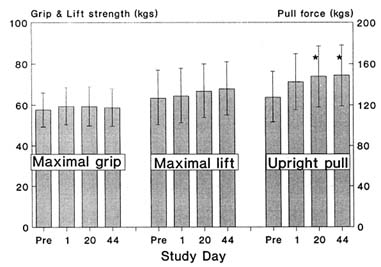
FIGURE 14-2 Three tests performed during the Combined Field Feeding System-Force Development Test and Experimentation (CFFS-FDTE) before the start (Pre), and at days 1, 20, and 44. The upright pull test revealed a significant technique effect, with significant improvements in the test at day 20 and 44 as soldiers improved the skill with repeated testing. The other two tests were more resistant to this effect. SOURCE: Teves et al., 1986.
is even more difficult to interpret because individual soldier motivation cannot be closely monitored and best performances may not be elicited. At the end of a long field exercise, it is likely that most soldiers would rather be somewhere else doing something besides a performance test for an experiment. However, some soldiers will view the tests as a challenge and will try to improve on their previous performance or try to exceed the performance of their peers. Clearly, testing design, including such factors as the setting and rewards, are an important consideration.
EFFECTS OF ENERGY DEFICIT ON STRENGTH
The consequences of energy deficiencies on muscular strength have been studied in a variety of military settings, but the results are highly dependent on the tests used. The desirable test is one that measures dynamic strength involving major muscle groups and represents typical Army lifting and carrying tasks (Harman et al., 1991). However, one of the most convenient strength measurements is the handgrip. This test may not be the most suitable predictor of militarily relevant strength capacity, and conclusions of the many studies that have used this test should be cautiously interpreted. Other tests such as the isokinetic testing of isolated muscle groups are mechanistically interesting but, as previously discussed, difficult to administer to a large sample and more prone to a learning effect that can confound pre- and posttest comparisons. The maximal lift test developed for strength screening of recruits who enter military specialties with high strength requirements may be a suitable test for performance nutrition studies, but this test also has a skill component that can confound results if not carefully administered. Although this maximal lift test has been used in only a limited number of nutrition studies, these results and those of a correlated jump test suggest levels of chronic undernutrition that may result in decrements in military performance (Frykman et al., 1993; Johnson et al., 1994).
Grip strength is exceptionally convenient, but compared to other tests, it is insensitive to large changes in nutritional status. Grip strength may be a useful prognostic end point for postsurgical survival of severely catabolic patients in hospital; however, in the hospital setting the deficit may be so extreme that the test is whether or not the patient can squeeze the doctor's hand. Applied to healthy soldiers, grip strength is unlikely to demonstrate any relationship to nutritional deficit. In the Ranger-I study with 16 percent decline in weight, there was no loss of grip strength or grip strength endurance (Johnson et al., 1994). Even the soldier with the most extreme weight loss of 23 percent of body weight in 8 weeks demonstrated no decline in grip strength performance. Other studies examining large weight losses and grip strength in
soldiers have demonstrated no decrement (Taylor et al., 1957). Only the Minnesota Starvation Study charted reductions in grip strength, with a linear decline over 24 weeks with greater than 25 percent reduction in grip strength when subjects had achieved a 25 percent loss of initial body weight (Taylor et al., 1957). At this point, the men had lost greater than 15 percent of fat-free mass compared to less than 7 percent in the studies involving soldiers (Johnson et al., 1994; Taylor et al., 1957). Thus, grip strength appears to be well preserved until nutritional status is severely compromised.
The maximal lift test has been used in several nutrition studies, and a large Army data base exists from the testing performed by Marilyn Sharp and others (Sharp and Vogel, 1992). This test had the highest correlation with field performance ratings of light infantry soldiers (the correlation was further enhanced against a combined ranking of maximal lift and maximal oxygen uptake [Vo2 max]) (Daniels et al., 1984). This test is also well correlated with other tests of muscular strength. Recently, Frykman et al. (1993) examined the relationship between power calculated from a maximal jump and the maximal lift test. In the Ranger-II study the two measures were correlated (n = 50; r = 0.7), and both the predicted power and the maximal lift declined by 20 percent of initial over 8 weeks of dietary restriction (Shippee et al., 1994). In the Fort Jackson study of female basic trainees, the measures were also correlated (n = 168; r = 0.7), suggesting that these two tests reflect similar aspects of muscular strength (Sharp et al., 1994).
Using the limited data available for these types of physical performance and weight loss in healthy individuals, the point of diminished performance can be interpolated (Table 14-1). Fogelholm et al. (1993) measured jump performance in a group of young male athletes and found no decline over a 3-wk period with a 5 percent weight loss. In fact, there was a slight increase in jump performance in another jump test, when weight was added to make up for the body weight lost. (There were also no changes observed in two tests of anaerobic power.) Soldiers consuming the Ration, Lightweight 30-day (RLW-30) for 30 days lost 5 percent of their body weight and demonstrated a significant 8 percent decline in one of the isokinetic leg extension strength tests (Askew et al., 1987). Strength performance was sustained in the comparison group of men who ate the MRE and lost only 1.6 percent of body weight. (Neither group demonstrated any change in grip strength.) In a study comparing the Ration, Cold Weather (RCW) to the MRE in a 10-d cold-weather scenario, soldiers lost 3 and 4 percent of body weight, respectively, but demonstrated no pre- to postchanges in the same isokinetic leg strength tests used in the RLW-30 test (Roberts et al., 1987). Very high urine specific gravities in this study suggest that a disproportionate amount of the 3 to 4 percent weight loss may have been due to dehydration.
TABLE 14-1 Reductions in Body Weight Compared to Changes in Strength Performance Measured by a Maximal Lift Test, by a Related Jump Test, or by Isokinetic Testing of Isolated Muscle Groups (Other than Grip Strength)
|
Study |
Relative Change in Body Weight |
Test Result |
|
Teves et al., 1986 |
No change |
No change in lift. |
|
Askew et al., 1987 (MRE*) |
-1.6% |
No decline in ILE.† |
|
Roberts et al., 1987 |
-3 to -4% in 10 days |
No decline in ILE. |
|
Fogelholm et al., 1993 |
-5% in 3 weeks |
No decline in jump. |
|
Askew et al., 1987 |
-5% in 4 weeks |
No decline in strength except in ILE. |
|
|
------------------------------------------------------ |
|
|
Frykman et al., 1993 |
-13% in 8 weeks |
-21% in lift; -21% jump power |
|
Johnson et al., 1994 |
-16% in 8 weeks |
-24% in lift |
|
NOTE: ---, change to demonstrate performance decrement * Meal, Ready-to-Eat ration. † ILE, isokinetic leg extension. |
||
In the Ranger-II study, a 13 percent decline in body weight over 8 weeks was associated with a 21 percent decline in both jump power and maximal lift; a significant decline in absolute jump height, even with the work advantage of this decrease in body weight, was also noted (Frykman et al., 1993). In Ranger-I (where grip strength demonstrated no decrease), maximal lift declined by 24 percent (the jump test was not performed), and body weight declined by 16 percent (Johnson et al., 1994). From these results, it can be concluded that strength performance is adversely affected sooner than handgrip data would suggest (> 16 percent weight loss) but not at weight losses of less than 5 percent, and possibly only at weight losses exceeding 10 percent (Table 14-1).
These conclusions are limited because they are based exclusively on data derived from physically trained men, often with larger-than-average muscle mass. Although a larger muscle mass increases metabolic requirements, physiological adaptation to training would conceivably delay the decline in muscular strength during an energy deficit. In any case, physically elite soldiers will retain a proportionately larger functional strength. For example, in the Ranger studies, soldiers lost 20 percent of their maximal lift strength, but this severe decline in strength only reduced them to the average strength of normally nourished soldiers (Johnson et al., 1994).
It cannot be determined from the available data if strength declines are gradual with progressive weight loss or if they are associated with a sudden decline at some threshold level of energy restriction. A gradual decline in strength would be expected if the primary factor is simply muscle mass, while a threshold pattern would fit a metabolic limitation (e.g., muscle enzyme or substrate deficiency) imposed by some critical level of deficit.
Perhaps the decline in strength represents a combination of these two possibilities; loss of muscle mass during energy deficiency involves specific reductions in the fast twitch fibers, with better preservation of slow twitch fibers (Henriksson, 1990). A study of Swedish men on ski patrol (1,500 km/50 d with 25-kg backpacks) demonstrated the effects of energy deficit combined with prolonged low intensity (45 percent of Vo2 max) training. For 2 weeks of this study, the men subsisted on Swedish army rations (4,000 kcal/d) but expended an estimated 5,000 kcal/d (measured by heart rate and calibrated to individual bicycle exercise tests). At the end of this period of energy deficit, muscle biopsies from the triceps and the vastus lateralis indicated a decrease in muscle fiber size for Type IIa (''fast twitch") but not for Type I ("slow twitch"). Following an additional 5 weeks of training without energy deficit (food provided ad libitum) the fast twitch fibers returned to baseline size (Schantz et al., 1983). Similar findings of decreased fast-to-slow fiber ratios with energy deficit have been reported from animal studies (Goldspink and Ward, 1979) and severely overweight subjects (Russell et al., 1984). This effect may be mediated through nutritional influences on thyroid hormones, where reduced circulating thyroid hormones produced by energy deficit as observed in the Ranger studies produce a reduction in Type IIa fiber size (Caizzo et al., 1992; Henriksson, 1990).
EFFECTS OF ENERGY DEFICIT ON AEROBIC CAPACITY
Aerobic capacity has been examined (by treadmill testing) for soldiers in several nutrition studies involving energy deficits (Table 14-2). Compared to the results of the Minnesota Starvation Study, the changes observed in these studies seem almost trivial. A 25 percent loss of body weight was associated with a decline in maximal oxygen consumption (Vo2 max) of more than 40 percent. In contrast, body weight losses of around 10 percent produced 10–15 percent declines in Vo2 max in a 24-d lab study with restricted rations (Taylor et al., 1957) and in a 60-d field study of Ranger students (Johnson et al., 1976). Even smaller weight losses have been associated with declines in excess of 10 percent of Vo2 max. The most energy-restricted group in the
TABLE 14-2 Reductions in Body Weight Compared to Changes in Treadmill Maximal Oxygen Intakes of Physically Active Soldiers Participating in Various Nutrition Studies
|
|
Sample Size |
Intakes |
Duration |
Body Weight (kg) |
Vo2 max (liter/min) |
||
|
Study/Subgroup |
(no. of soldiers) |
(kcal/d) |
(d) |
Pre (±SD) |
Δ (%) |
Pre (±SD) |
Δ (%) |
|
Askew et al., 1986 |
15 |
2,200 |
12 |
71±2.9 |
-2.8 |
3.9±0.56 |
-5.7 |
|
Askew et al., 1987 (MRE)* |
17 |
2,780 |
30 |
75±2.1 |
-1.6 |
4.2±0.45 |
-10.2 |
|
Askew et al., 1987 (RLW-30)† |
16 |
1,950 |
30 |
79±1.8 |
-5.0 |
4.3±0.33 |
-14.8 |
|
Consolazio et al., 1979 |
10 |
3,500 |
10 |
71±8.8 |
0 |
3.0±0.22 |
-2.0 |
|
Consolazio et al., 1979 |
7 |
1,500 |
10 |
79±4.0 |
-3.7 |
3.4±0.39 |
-7.4 |
|
Consolazio et al., 1979 |
11 |
1,000 |
10 |
74±8.3 |
-5.0 |
3.1±0.36 |
+5.0 |
|
Consolazio et al., 1979 |
10 |
600 |
10 |
71±18.5 |
-3.6 |
3.1±0.68 |
-11.0 |
|
Johnson et al., 1976 |
14 |
1,200– 3,700 |
60 |
72±9.2 |
-9.4 |
3.5±0.44 |
-14.1 |
|
Taylor et al., 1957 ("53")‡ |
6 |
580 |
12 |
75±10.7 |
-7.4 |
3.5±0.38 |
-4.0 |
|
Taylor et al., 1957 ("54")§ |
13 |
1,010 |
24 |
69±11.3 |
-10.2 |
3.6±0.62 |
-10.1 |
|
* Meal, Ready-to-Eat control group in the Ration, Lightweight 30-day study. † Ration, Lightweight 30-day experimental group. ‡ Experiment "53" (1953) at the University of Minnesota, using soldier subjects. § Experiment "54" (1954) at the University of Minnesota, using soldier subjects. |
|||||||
jungle ration study of Consolazio et al. (1979) demonstrated a large decline in Vo2 max after 10 days even though they lost only 3.5 percent of body weight. The MRE control group of a 30-d field ration test lost only 1.6 percent of body weight, yet demonstrated a 10 percent reduction in Vo2 max (Askew et al., 1987). Even allowing a generous 5 percent variation in the reproducibility of a Vo2 max, these various studies demonstrate decrements outside of this window and implicate factors other than the cumulative energy deficit.
Detraining3 is almost certainly one of those factors. Aerobic capacity declines in the most highly trained men in most military training scenarios because their training levels are not maintained. For example, in basic training for the Danish army, men scoring the highest aerobic capacities at the start of training demonstrated significant declines 3 months later, while the men starting in poorer condition improved significantly (Hartling, 1975). Thus, standard military training usually does not meet the more specialized training requirements to maintain physical performance levels in the best-trained soldiers. This is a likely explanation for the large decline from initially high values for Vo2 max in the Special Forces' soldiers who participated in the RLW-30 study. This decline cannot be readily attributed to nutritional influences because the nutritionally adequate MRE group demonstrated declines in aerobic capacity comparable to the RLW-30 group, which lost 5 percent of initial body weight (Askew et al., 1987). This reduction is also not explained by reductions in fat-free mass, the best correlate of aerobic capacity in undernourished populations (Spurr, 1986), because there was no significant change in fat-free mass in the MRE group and only a 2 percent reduction in the RLW-30 test group.
In a 1973 study of Ranger students, Herman Johnson and colleagues concluded that some of the 14 percent decline in aerobic capacity might be attributable to "fatigue-induced lack of motivation to continue" (Johnson et al., 1976, p. 13) on the treadmill at the end of the course. Fatigue has also been found to hamper postcourse testing in the more recent Ranger studies, and one might speculate how different some results would be after even 24 hours of refeeding and sleep. Johnson et al. (1976) answered this question with respect to aerobic capacity. Three days after the end of Ranger training, following sleep and ad-libitum refeeding, the soldiers had recovered from nearly 10 percent to within 2 percent of their original body weight but still demonstrated a significant decrement in aerobic capacity (-6 and -9.4 percent of initial Vo2 max for two groups tested). Thus, the reduced Vo2 max was not simply due to an acute muscle glycogen depletion, although this is a contributor (Jacobs et al., 1983), nor was it due to a poorer performance by sleep-deprived
Rangers, although a decrease in efficiency has been measured (both resting and submaximal exercise oxygen consumption increased) after 5 days of sleep deprivation and severe energy deprivation in Norwegian rangers (Bahr et al., 1991). It was also not evident that the changes were produced by any deficiencies in cardiac function, at least as might be manifested in electrocardiogram abnormalities (Johnson et al., 1976).
The pattern that emerges from all of these studies suggests that energy deficits resulting in 10 percent weight loss produce decrements in Vo2 max; there is some question about changes attributable to lower levels of weight loss (Figure 14-3).
Reductions in aerobic capacity could be important because physical work capacity is largely determined by maximal aerobic capacity (Spurr, 1986). Physical tasks in the Army may involve short bursts of high-intensity work but more typically involve work at less than 40 percent of maximal aerobic capacity (Table 14-3). Thus, Ira Jacobs and colleagues (1989) have demonstrated that short-term activities such as running an assault course can approach maximal effort, but foot marches and other longer duration activities invariably result in self-pacing to ~35 percent of maximal aerobic capacity. This is a typical upper limit for sustainable work rates in other physically demanding
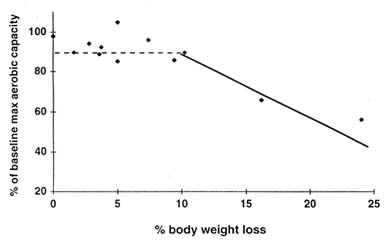
FIGURE 14-3 Changes in maximal oxygen uptakes (relative changes in absolute uptake, not corrected for body weight changes) compared against reductions in body weight in various studies detailed in Table 14-2. If the two groups tested in the Ration, Lightweight 30-day study are discounted on the basis of their initially high aerobic fitness and greater susceptibility to detraining, a threshold at approximately 10 percent weight loss can be projected from the results of Johnson et al. (1976), Taylor et al. (1957), and the extreme results of Keys et al. (1950). Below this level of weight loss, measured changes fall within an 8 to 10 percent range of test reproducibility.
TABLE 14-3 Metabolic Demands of Various Military Tasks Performed by Elite Male Soldiers During a Canadian Field Exercise
|
Activity |
Oxygen Uptake (ml/kg/min) |
Peak VO2(%) |
|
Grenade assault course |
49* |
90 |
|
Bayonet assault course |
48* |
89 |
|
Unload vehicle |
36* |
67 |
|
10-km march with pack |
16 |
31 |
|
Trench dig |
15 |
29 |
|
Cross-country march |
18 |
35 |
|
* Predicted from heart rate; other measurements of oxygen uptake were made directly. SOURCE: Jacobs et al. (1989). |
||
professions for a normal 8-h workday (Spurr, 1986). Moderate reductions (e.g., 15 percent) in aerobic capacity from chronic undernutrition are not likely to have much impact on low-to-moderate levels of work (e.g., 35 percent of maximum); thus, a soldier normally working at 35 percent of maximal aerobic capacity would be performing at only a slightly higher relative work level (41 percent of maximum) (Spurr, 1986).
Behavioral efficiencies can easily buffer this difference. For example, an accommodation effect has been demonstrated where soldiers, adequately fed, became more efficient and reduced energy requirements in a realistically demanding combat scenario (Sharp and Vogel, 1992). Soldiers performed a howitzer loading task, firing 640 rounds/d continuously for 45 hours. In the first half-hour cycle, crew members worked at nearly 50 percent of their peak aerobic capacity, but by their last cycle of loading, firing missions were completed in a shorter period of time, and work was achieved at less than 40 percent of peak aerobic capacity. This result suggests that to have a significant impact on this performance, maximal oxygen uptake must be markedly reduced, to a magnitude greater than that observed in any of the voluntary consumption studies (i.e., > 20 percent reduction).
The inconsistent relationship between maximal and submaximal tests supports the concept that motivation can overcome a modest physiological handicap (i.e., reduced Vo2 max) during submaximal work. For example, a 10-km loaded foot march was performed at the start and end of the RLW-30 study and yielded conclusions different from the test of maximal aerobic power. The RLW-30 group that had suffered a 15 percent decrease in Vo2 max demonstrated a significant improvement in road march time, with an average 5-min decrease in time to completion. In contrast, the non-deprived MRE test
group participants apparently did not rise to the end-of-study challenge and demonstrated an average 10-min increase in time to completion (+13 percent over baseline time) (Askew et al., 1987). Similarly, in the 1-wk altitude MRE feeding study there was a significant decline in Vo2 max (— 6 percent), but there was no change in the daily 2-h run performance; soldiers successfully completed 10.3 miles on the first day and 10.9 miles on the seventh day (Askew et al., 1986). These results lead to the inescapable conclusion that the changes in Vo2 max that have been measured in various nutrition studies are of little consequence to soldier physical performance.
SHORT-TERM STUDIES WITH HIGH-ENERGY EXPENDITURES
A different problem of underconsumption occurs in short-term (less than 1 week) missions when soldiers choose to forgo their rations because of weight limitations. An example of this is a special operations direct-action scenario where rations have a lower priority than ammunition and mission-essential equipment. Such high-intensity but short actions with limited food intake are training models for elite forces in many countries including Norway (Opstad and Aakvaag, 1981), Japan (Kosano et al., 1986), and Canada (Jacobs et al., 1989). This problem was also the focus of a concerted research effort by Consolazio and his colleagues (1979). Their concept was to determine the minimum requirements that would best sustain the performance of soldiers in such operations instead of assuming that soldiers would individually select the nutritionally optimal components from their ration packs.
Very high-intensity efforts can be maintained by elite soldiers over relatively short periods, as indicated by measured energy expenditures. The MRDA for energy for male and female soldiers is 3,200 kcal/d (2,800 to 3,600) and 2,400 kcal/d (2,000 to 2,800), respectively (AR 40-25, 1985), although there are special circumstances where actual energy requirements may be higher, such as the average 4,000 kcal/d measured in the 2-mi long Ranger course (Hoyt et al., 1993; Moore et al., 1992) and in British infantrymen on simulated jungle patrols (Haisman, 1970).
In the Ranger course, a deliberate energy deficit is imposed as a stress challenge to the students. However, energy balance is possible at this work intensity as demonstrated by a study of Gurkhas4 eating an early version of group rations. In a 21-d exercise in the foothills of the Himalayas, these Nepalese tribal soldiers consumed 4,000 kcal/d, maintaining weight and reportedly improving biochemical and fitness status (Kark et al., 1945). Even
higher requirements for several-day periods may occur, such as 6,000 kcal/d during 1 week of mountain training in the Ranger course (Moore et al., 1993), at least 5,500 kcal/d for the 5-d U.S. Navy Sea, Air, and Land (SEAL) trainee "hell week" (Smoak et al., 1988), 5,300 kcal/d in Zimbabwean recruits during dry hot-weather operations (MJR Kaka Mudambo, Zimbabwe Defense Forces, unpublished results using doubly labeled water, 1994), and greater than 8,000 kcal/d in the 5-d Norwegian ranger course involving little or no sleep (Opstad and Aakvaag, 1981). It is questionable whether calorie intakes that are better matched to energy expenditure have any demonstrable benefit in these highest energy expenditure scenarios.
Compared to longer-term undernutrition, this direct-action scenario presents a different set of physiological limiters to physical performance. It is unlikely that even lean men will exhaust available fat energy stores in this period of time (a soldier with 10 percent body fat working at an exceptionally high 10,000 kcal/24 h for 5 days would not exhaust body energy stores). Instead of a gradual loss of lean mass to feed a chronic energy deficit, the problem is one of maintaining muscle function during high-intensity work without pausing for an appropriate rest phase ("overtraining"). For example, in Japanese rangers in a 93-h exercise (30- to 40-kg loads, 50-km travel in mountainous terrain, sleep < 3 h/d, consuming ~600 kcal/d), a marked increase in skeletal muscle enzymes indicates changes in muscle metabolism in response to the new level of strenuous work; however, there is only a small increase in myoglobin which suggests that this does not reflect actual muscle cell damage or catabolism (Kosano et al., 1986). Other examples of decrements in physical performance during continuous operations also suggest an overtraining phenomena related to higher-than-usual work loads. This effect has been observed in a study of 8-d continuous field artillery operations (Legg and Patton, 1987) and a 5-d scenario also involving upper body exertion such as load carriage (Murphy et al., 1984); in both cases, with minimal weight losses, upper body muscular strength and endurance significantly decreased. In another 8-d field artillery scenario with somewhat lower work levels, no decrements were observed (Patton et al., 1989).
Acute "overtraining" effects may also include depletion of energy sources, which may not be restored to initial levels simply by increasing carbohydrate consumption (Jacobs et al., 1983). Thus, this is a special subset of the underconsumption problem that does not appear to benefit from increasing consumption. In fact, whether or not soldiers deprive themselves of food for a 3- to 5-d direct-action mission probably has little effect on their short-term performance, as long as they ingest sufficient carbohydrate to prevent ketosis and obtain adequate mineral supplements to replenish losses (Krzywicki et al., 1979; Taylor et al., 1954).
Norwegian Ranger Training: Intensive Training with Large Energy Deficits
Male cadets from the Norwegian Military Academy participate in a 5-d ranger course as part of their training program. This course typically involves little or no sleep, and daily energy expenditure has been estimated to be greater than 10,000 kcal (Opstad and Aakvaag, 1981). When the cadets receive 1,500 kcal/d, they typically lose 4 to 5 percent of body weight and demonstrate a shift to an increased fat energy utilization during exercise (Bahr et al., 1991). Most of the weight loss is from fat, which has been further demonstrated by the triglyceride emptying of abdominal and gluteal adipocytes obtained both pre- and posttraining by biopsy (Rognum et al., 1982). The effects of increased energy intake were examined with the addition of 6,400 kcal/d over the 1,500 kcal/d normally given to cadets. The high-energy group still lost body weight (o.6 kg) but substantially less than the control group, which was fed 1,500 kcal/d (3.6 kg). There were no differences in performance between the two groups when compared for time on a 1-km assault course (days 2, 3, and 4), with 20 kg of combat equipment on a 350-m assault course requiring balance and agility (day 5), or on marksmanship scores (days 3 and 4) (Rognum et al., 1986). Although there were no differences in physical or mental performance attributable to energy intake, by the fourth day of this course, observer evaluations of all cadets rated them as totally ineffective soldiers (Rognum et al., 1986). This conclusion was attributed to the effects of sleep deprivation.
In other, more-controlled laboratory studies of short-term high-energy deficit, tests of power, such as the Wingate test, and tests of isometric strength, including grip strength, have usually not been affected (Consolazio et al., 1967; Henschel et al., 1954; Hickner et al., 1991). However, Henschel et al. (1954) noted a reduced capacity for anaerobic work during 4.5 days of starvation. This finding was based on a substantial increase in lactate levels following a 75-s anaerobic treadmill run and a decrease in calculated efficiency of ~8 percent (Henschel et al., 1954). These changes occurred without a decrement in maximal aerobic capacity. Bahr et al. (1991) have noted a 15 percent decrease in efficiency following the 5-d Norwegian ranger course, measured at a fixed work load involving 30 minutes of treadmill at 50 percent of maximal oxygen uptake. In both of these short-term starvation studies, the decreased efficiency has been related to the increase in fat utilization. In both cases, the absence of food also produced severe gastric distress, presenting other potential complications to assessment of work performance (Henschel et al., 1954; Oektedalen et al., 1983).
Canadian Forces Commandos Study: Intensive Training With Small Energy Deficits
Studies by Ira Jacobs involving Canadian Forces Commandos have examined the effects of supplemental carbohydrate feeding on physical performance and muscle glycogen levels during a 5-d high-intensity field training scenario (Jacobs et al., 1983, 1989). These studies include comparison between a group of soldiers receiving standard field rations (3,880 kcal/d offered; 3,350 kcal/d consumed) and a group receiving an additional energy supplement (5,420 kcal/d offered; 3,720 kcal/d consumed) to increase caloric intake above normal requirements to more closely match the requirements of this cold-weather exercise (5,500 to 6,500 kcal/d) (Jacobs et al., 1983). This situation reflects another form of "voluntary" underconsumption, where soldiers have difficulty ingesting enough energy to meet very high demands.
In this study, a variety of strength parameters decreased from baseline levels, on the order of 15 percent, and aerobic capacity declined by 6 percent. These results should be interpreted as part of the "overtraining" phenomenon and may also include fatigue and motivation components in the posttesting. There were no differences between the two groups in terms of performance decrements or in muscle glycogen concentrations (Jacobs et al., 1989).
Results of the study illustrate a problem for which a nutritional intervention has not yet been devised: the replenishment of muscle glycogen levels during a continuous effort without rest or with extraordinarily high daily energy expenditures (Costill et al., 1988). Endurance efforts such as the Tour de France may appear to be similar paradigms, but they differ because soldiers in these field exercises may not have rest periods greater than 2 hours at any given point, while cyclists usually have overnight rests.
CONCLUSIONS
The conclusions of Taylor et al. (1957) still ring true:
It seems reasonable to conclude that a loss of about 10 percent of the body weight is an acceptable compromise in a survival situation when the intake of calories and salt are adequate to prevent extracellular dehydration and significant hypoglycemia(p. 429).
They added that "it must be remembered that these results are limited to young men in good physical condition and that the rate of weight loss is important"(Taylor et al., 1957, p. 429). However, it appears that even a very high rate of weight loss for a short duration (< 1 week) probably has little effect on physical performance, as evidenced by the work of Consolazio, Johnson, and others. The primary concern during weight loss involves loss of muscle
strength, but this loss requires a substantial loss of muscle mass, occurring with body weight losses at least in excess of 5 percent and possibly 10 percent of initial body weight. Even a 15 percent decline in aerobic capacity has relatively little effect on soldier performance when it involves work at normal sustainable levels. As in the example of the field artillery men who adjusted their relative work load through increased efficiency, soldiers could readily accommodate a change of this magnitude. In the case of overnourished soldiers, some weight loss is likely to be beneficial to health and performance.
Women have not been studied in the context of physical performance and weight loss in field conditions with operational rations. Such studies may provide a quite different relationship, since aerobic and upper body strength capacities are usually lower to begin with, and female soldiers are more prone to iron deficiency. However, female soldiers may perform better than men at low-intensity work during high-energy deficits because of their greater capacity for fat metabolism and larger fat stores.
ACKNOWLEDGMENTS
The author has relied heavily on reports about which John F. Patton and Herman Johnson had first-hand knowledge, and the author thanks them both for their assistance. The author also thanks Bradley Nindl for his help in fact checking and Lorraine Farinick for creating the figures.
REFERENCES
AR (Army Regulation) 40-25 1985. See U.S. Departments of the Army, the Navy, and the Air Force.
Askew, E.W., J.R. Claybaugh, S.A. Cucinell, A.J. Young, and E.G. Szeto 1986. Nutrient intakes and work performance of soldiers during seven days of exercise at 7,200 feet altitude consuming the Meal, Ready-to-Eat ration. Technical Report T3-87, AD A176 273. Natick, Mass.: U.S. Army Research Institute of Environmental Medicine.
Askew, E.W., I. Munro, M.A. Sharp, S. Siegel, R. Popper, M.S. Rose, R.W. Hoyt, J.W. Martin, K. Reynolds, H.R. Lieberman, D. Engell, and C.P. Shaw 1987. Nutritional status and physical and mental performance of special operations soldiers consuming the ration, Lightweight or the Meal, Ready-to-Eat military field ration during a 30-day field training exercise. Technical Report T7-87, AD A179 553. Natick, Mass.: Army Research Institute of Environmental Medicine.
Bahr, R., P.K. Opstad, J.I. Medbo, and O.M. Sejersted 1991. Strenuous prolonged exercise elevates resting metabolic rate and causes reduced mechanical efficiency. Acta Physiol. Scand. 141:555–563.
Brozek, J., S. Wells, and A. Keys 1946. Medical aspects of semistarvation in Leningrad (Siege 1941–1942). Am. Rev. Sov. Med. 4:70–86.
Burger, G.C.E., J.C. Drummond, and H.R. Sanstead 1948. Malnutrition and Starvation in Western Netherlands, Part I. The Hague, Netherlands: General State Printing Office.
Caizzo, V.J., R.E. Herrick, and K.M. Baldwin 1992. Response of slow and fast muscle to hypothyroidism: Maximal shortening velocity and myosin isoforms. Am. J. Physiol. 263:C86–C92.
Consolazio, C.F. 1983. Nutrition and performance. Prog. Food Nutr. Sci. 7(1-2):29–42.
Consolazio, C.F., R.A. Nelson, and H.L. Johnson 1967. Metabolic aspects of acute starvation in normal humans: Performance and cardiovascular evaluation. Am. J. Clin. Nutr. 20:684–693.
Consolazio, C.F., H.L. Johnson, R.A. Nelson, R. Dowdy, H.J. Krzywicki, T. A. Daws, L.K. Lowry, P.P. Waring, W.K. Calhoun, B.W. Schwenneker, and J.E. Canham 1979. The relationship of diet to the performance of the combat soldier. Minimal calorie intake during combat patrols in a hot humid environment (Panama). Report No. 76, AD A078 695. Presidio of San Francisco, Calif.: Letterman Army Institute of Research.
Costill, D.L., M.G. Flynn, J.P. Kirwan, J.A. Houmard, J.B. Mitchell, R. Thomas, and S.H. Park 1988. Effects of repeated days of intensified training on muscle glycogen and swimming performance. Med. Sci. Sports Exerc. 20:249–254.
Cureton, K.J. 1992. Effects of experimental alterations in excess weight on physiological responses to exercise and physical performance. Pp. 89–104 in Body Composition and Physical Performance, B.M. Marriott and J. Grumstrup-Scott, eds. A report of the Committee on Military Nutrition Research, Food and Nutrition Board, Institute of Medicine. Washington D.C.: National Academy Press.
Daniels, W.L., J.A. Vogel, and B.H. Jones 1984. Comparison of aerobic power and dynamic lift capacity with performance during a 5-day sustained combat scenario. Technical Report T4-85, AD A160 618. Natick, Mass.: U.S. Army Research Institute of Environmental Medicine.
Edgerton, V.R., G.W. Gardner, Y. Ohira, K.A. Gunawardena, and B. Senewiratne 1979. Iron-deficiency anemia and its effect on worker productivity and activity patterns. Br. Med. J. 2:1546–1549.
Finch, C.A., and H. Huebers 1982. Perspectives in iron metabolism. N. Engl. J. Med. 306:1520–1528.
Fogelholm, G.M., R. Koskinen, J. Laakso, T. Rankinen, and I. Ruokonen 1993. Gradual and rapid weight loss: Effects on nutrition and performance in male athletes. Med. Sci. Sports Exerc. 25:371–377.
Forbes, G. B. 1993. The companionship of lean and fat. Pp. 1–14 in Human Body Composition, K.J. Ellis and J.D. Eastman, eds. New York: Plenum Press.
Friedl, K.E. 1992. Body composition and military performance: Origins of the Army standards. Pp. 31–56 in Body Composition and Physical Performance, B.M. Marriott and J. Grumstrup-Scott, eds. A report of the Committee on Military Nutrition Research, Food and Nutrition Board, Institute of Medicine. Washington D.C.: National Academy Press.
Friedl, K.E., L.J. Marchitelli, D.E. Sherman, and R. Tulley 1990. Nutritional assessment of cadets at the U.S. Military Academy: Part 1. Anthropometric and biochemical measures. Technical Report T4-91, AD A231 918. Natick, Mass.: Army Research Institute of Environmental Medicine.
Friedl, K.E., R.J. Moore, L.E. Martinez-Lopez, J.A. Vogel, E.W. Askew, L. J. Marchitelli, R.W. Hoyt, and C.C. Gordon 1994. Lower limit of body fat in healthy active men. J. Appl. Physiol. 77(2):933–940.
Frykman, P.N., B.C. Nindl, K.E. Friedl, E.A. Harman, and R.L. Shippee 1993. Effects of extended physical training and caloric deficit on power output of young healthy males [abstract]. Med. Sci. Sports Exerc. 25(suppl.):S58.
Gardner, G.W., V.R. Edgerton, B. Senewiratne, R.J. Barnard, and Y. Ohira 1977. Physical work capacity and metabolic stress in subjects with iron deficiency anemia. Am. J. Clin. Nutr. 30:910–917.
Goldspink, G., and P.S. Ward 1979. Changes in rodent muscle fiber types during post-natal growth, undernutrition and exercise. J. Physiol. 296:453–469.
Grande, F. 1986. Impact of food restriction on physical performance. Pp. 81–98 in Predicting Decrements in Military Performance Due to Inadequate Nutrition. A report of the Committee on Military Nutrition Research, Food and Nutrition Board, Commission on Life Sciences, National Research Council. Washington D.C.: National Academy Press.
Grande, F., J.T. Anderson, and A. Keys 1958. Changes of basal metabolic rate in man in semistarvation and refeeding. J. Appl. Physiol. 12:230–238.
Haisman, M.F. 1970. The energy expenditure of jungle patrols. Report RR-1/70, AD 881 642. Farnborough, England: Army Personnel Research Establishment.
Harman, E.A., M.T. Rosenstein, P.N. Frykman, R.M. Rosenstein, and W.J. Kraemer 1991. Estimation of human power output from vertical jump. J. Appl. Sport Sci. Res. 5:116–120.
Hartling, O. 1975. The effect of the first three months of military service on the physical work capacity of conscripts. Forsvarsmedicin Swed. J. Defense Med. 11:213–218.
Hehir, P. 1922. Effects of chronic starvation during the siege of Kut. Br. Med. J. 1:865–869.
Henriksson, J. 1990. The possible role of skeletal muscle in the adaptation to periods of energy deficiency. Eur. J. Clin. Nutr. 44(suppl. 1):55–64.
Henschel, A., H.L. Taylor, and A. Keys 1954. Performance capacity in acute starvation with hard work. J. Appl. Physiol. 6:624–633.
Hickner, R.C., C.A. Horswill, J.M. Welker, J. Scott, J.N. Roemmich, and D.L. Costill 1991. Test development for the study of physical performance in wrestlers following weight loss. Int. J. Sports Med. 12:557–562.
Hoyt, R.W., R.J. Moore, J.P. DeLany, K.E. Friedl, and E.W. Askew 1993. Energy balance during 62 days of rigorous physical activity and caloric restriction [abstract]. Fed. Am. Soc. Exp. Biol. J. 7:A726.
Jacobs, I., A. Anderberg, R. Schele, and H. Lithell 1983. Muscle glycogen in soldiers on different diets during military field manoeuvres. Aviat. Space Environ. Med. 54:898–900.
Jacobs, I., D. Van Loon, L. Pasut, J. Pope, D. Bell, M. Kavanagh, A. Beach, M. Scherzinger, and D. Kerrigan-Brown 1989. Physical performance and carbohydrate consumption in CF commandos during a 5-day field trial. Technical Report 89-RR-48, AD A217 204. North York, Ontario, Canada: Defense and Civil Institute of Environmental Medicine.
Johnson, H.L., H.J. Krzywicki, J.E. Canham, J.H. Skala, T.A. Daws, R.A. Nelson, C.F. Consolazio, and P.P. Waring 1976. Evaluation of calorie requirements for ranger training at Fort Benning, Georgia. Technical Report 34, AD A070 880. Presidio of San Francisco, Calif.: Letterman Army Institute of Research.
Johnson, M.J., K.E. Friedl, P.N. Frykman, and R.J. Moore 1994. Loss of muscle mass is poorly reflected in grip strength performance in healthy young men. Med. Sci. Sports Exerc. 26:235–240.
Kark, R.M., H.F. Aiton, and E.D. Pease 1945. Jungle field trial of Indian 8-man composite ration (I.T.). Report C 6191 to Associated Committee Army Medical Research, National Research Council Canada. Summarized by H.L. Johnson and H.E. Sauberlich in Prolonged Use of Operational Rations—A Review of the Literature (unpublished, 1982).
Karlsson, J., and B. Saltin 1971. Diet, muscle glycogen, and endurance performance. J. Appl. Physiol. 31:203–206.
Keys, A., J. Brozek, A. Henschel, O. Mickelsen, and H.L. Taylor 1950. The Biology of Human Starvation, vol. 1. Minneapolis: The University of Minnesota Press.
King, N., K.E. Fridlund, and E.W. Askew 1993. Nutrition issues of military women. J. Am. Coll. Nutr. 12:344–348.
Klicka, M.V., D.E. Sherman, N. King, K.E. Friedl, and E.W. Askew 1993. Nutritional assessment of cadets at the U.S. Military Academy: Part 2. Assessment of nutritional intake. Technical Report T1-94, AD A270 580. Natick, Mass.: U.S. Army Research Institute of Environmental Medicine.
Kosano, H., T. Kinoshita, N. Nagata, O. Takatani, M. Isobe, and Y. Yazaki 1986. Change in concentrations of myogenic components of serum during 93 hours of strenuous physical exercise. Clin. Chem. 32:346–350.
Kraut, H.A., and E.A. Muller 1946. Calorie intake and industrial output. Science 104:495–497.
Krzywicki, H.J., C.F. Consolazio, H.L. Johnson, and N.F. Witt 1979. Metabolic aspects of caloric restriction (500 Calories)—Body composition changes. Technical Report LAIR-73, AD A082 495. Presidio of San Francisco, Calif.: Letterman Army Institute of Research.
Legg, S.J., and J.F. Patton 1987. Effects of sustained manual work and partial sleep deprivation on muscular strength and endurance. Eur. J. Appl. Physiol. 56:64–68.
Mello, R.P., M.M. Murphy, and J.A. Vogel 1988. Relationship between two mile run for time and maixmal oxygen uptake. J. Appl. Sport Sci. Res. 2:9–12.
Moore, R.J., K.E. Friedl, T.R. Kramer, L.E. Martinez-Lopez, R.W. Hoyt, R.T. Tulley, J.P. DeLany, E.W. Askew, and J.A. Vogel 1992. Changes in soldier nutritional status and immune function during the Ranger training course. Technical Report T13-92, AD A257 437. Natick, Mass.: U.S. Army Research Institute of Environmental Medicine.
Moore, R.J., K.E. Friedl, R.T. Tulley, and E.W. Askew 1993. Maintenance of iron status in healthy men during an extended period of stress and physical activity. Am. J. Clin. Nutr. 58:923–927.
Murphy, M.M., J.J. Knapik, J.A. Vogel, and F.R. Drews 1984. Relationship of anaerobic power capacity to performance during a 5-day sustained combat scenario. Technical Report T5/84, AD A181 444. Natick, Mass.: U.S. Army Research Institute of Environmental Medicine.
Nygaard, E. 1985. Energy supply and utilization during exercise in women and men—A comparison. Pp. 249–258 in Metabolic Complications of Human Obesities. Proceedings of the 6th International Meeting of Endocrinology, May 30–June 1, Marseille. International Congress Series No. 682. New York: Elsevier Science Publishers.
Oektedalen, O., P.K. Opstad, O.B. Schaffalitzky de Muckadell, O. Fausa, and O. Flaten 1983. Basal hyperchlorhydria and its relation to the plasma concentrations of secretin, vasoactive intestinal polypeptide (VIP) and gastrin during prolonged strain. Regul. Pept. 5:235–244.
Opstad, P.K., and A. Aakvaag 1981. The effect of a high calory diet on hormonal changes in young men during prolonged physical strain and sleep deprivation. Eur. J. Appl. Physiol. 46:31–39.
Patton, J.F., J.A. Vogel, A.I. Damokosh, and R.P. Mello 1989. Effects of continuous military operations on physical fitness capacity and physical performance. Work and Stress 3:69–77.
Roberts, D.E., E.W. Askew, M.S. Rose, M.A. Sharp, S. Bruttig, J.C. Buchbinder , and D.B. Engell 1987. Nutritional and hydration status of special forces soldiers consuming the Ration, Cold Weather or the Meal, Ready-to-Eat ration during a 10-day, cold weather field training exercise. Technical Report T8-87, AD A179 886. Natick, Mass.: U.S. Army Research Institute of Environmental Medicine.
Rognum, T.O., K. Rodahl, and P.K. Opstad 1982. Regional differences in the lipolytic response of the subcutaneous fat depots to prolonged exercise and severe energy deficiency. Eur. J. Appl. Physiol. 49:410-408.
Rognum, T.O., F. Vartdal, K. Rodahl, P.K. Opstad, O. Knudsen-Baas, E. Kindt, and W.R. Withey 1986. Physical and mental performance of soldiers on high- and low-energy diets during prolonged heavy exercise combined with sleep deprivation. Ergonomics 29:859–867.
Russell, D. McR., P.M. Walker, L.A. Leiter, A. Sima, W.K. Tanner, D.A.G. Mickle, J. Whitwell, E.B. Marliss, and K.N. Jeejeebhoy 1984. Metabolic and structural changes in skeletal muscle during hypocaloric dieting. Am. J. Clin. Nutr. 39:503–513.
Schantz, P., J. Henriksson, and E. Jansson 1983. Adaptation of human skeletal muscle to endurance training of long duration. Clin. Physiol. 3:141–151.
Sharp, M.A., and J.A. Vogel 1992. Maximal lifting strength in military personnel. Pp. 1261–1267 in Advances in Industrial Ergonomics and Safety IV, S. Kumar, ed. Washington, D.C.: Taylor and Francis.
Sharp, M.A., J.J. Knapik, and A.W. Schopper 1992. Energy cost and post-exercise effects of a prolonged high rate of fire, howitzer simulator training exercise. Technical Report T9-92, AD A255 428. Natick, Mass.: U.S. Army Research Institute of Environmental Medicine.
Sharp, M.A., B.C. Nindl, K.A. Westphal, and K.E. Friedl 1994. The physical performance of female Army basic trainees who pass and fail the Army body weight and percent body fat standards. Pp. 743–750 in Advances in Industrial Ergonomics and Safety VI, E. Agazadeh, ed. Washington, D.C.: Taylor and Francis.
Shippee, R., K. Friedl, T. Kramer, M. Mays, K. Popp, E.W. Askew, B. Fairbrother, R. Hoyt, J. Vogel, L. Marchitelli, P. Frykman, L. Martinez-Lopez, E. Bernton, M. Kramer, R. Tulley, J. Rood, J. DeLany, D. Jezior, and J. Arsenault 1994. Nutritional and immunological assessment of Ranger students with increased caloric intake. Technical Report T95-5. Natick, Mass.: U.S. Army Research Institute of Environmental Medicine.
Smoak, B.L., A. Singh, B.A. Day, J.P. Norton, S.B. Kyle, S.J. Pepper, and P.A. Deuster 1988. Changes in nutrient intakes of conditioned men during a 5-day period of increased physical activity and other stresses. Eur. J. Appl. Physiol. 58:245–251.
Spurr, G.B. 1986. Physical work performance under conditions of prolonged hypocaloria. Pp. 99–135 in Predicting Decrements in Military Performance Due to Inadequate Nutrition. A report of the Committee on Military Nutrition Research, Food and Nutrition Board, Commission on Life Sciences, National Research Council. Washington D.C.: National Academy Press.
1990. Physical activity and energy expenditure in undernutrition. Prog. Food. Nutr. Sci. 14:139–192.
Spurr, G.B., and J.C. Reina 1988. Influence of dietary intervention on artificially increased activity in marginally undernourished Columbian boys. Eur. J. Clin. Nutr. 42:835–846.
Taylor, H.L., A. Henschel, O. Mickelsen, and A. Keys 1954. Some effects of acute starvation with hard work on body weight, body fluids and metabolism. J. Appl. Physiol. 6:613–623.
Taylor, H.L., E.R. Buskirk, J. Brozek, J.T. Anderson, and F. Grande 1957. Performance capacity and effects of caloric restriction with hard physical work on young men. J. Appl. Physiol. 10:421–429.
Teves, M.A., J.A. Vogel, D.E. Carlson, and D.D. Schnakenberg 1986. Body composition and muscle performance aspects of the 1985 CFFS test. Technical Report T12-86, AD A172 752. Natick, Mass.: U.S. Army Research Institute of Environmental Medicine.
Thomas, C.D., K.E. Friedl, M.Z. Mays, S.H. Mutter, R.J. Moore, D.A. Jezior, C.J. Baker-Fulco, L.J. Marchitelli, R.T. Tulley, and E.W. Askew 1995. Nutrient intakes and nutritional status of soldiers consuming the Meal, Ready-to-Eat (MRE XII) during a 30-day field training exercise. Technical Report T6-95. Natick, Mass.: U.S. Army Research Institute of Environmental Medicine.
U.S. Departments of the Army, the Navy, and the Air Force 1985. Army Regulation 40-25/Naval Medical Command Instruction 10110.1/Air Force Regulation 160-95. ''Nutrition Allowances, Standards, and Education." May 15. Washington D.C.
Vogel, J.A. 1994. Evaluation of physical performance. Pp. 113–126 in Food Components to Enhance Performance, B.M. Marriott, ed. A report of the Committee on Military Nutrition Research, Food Nutrition Board, Institute of Medicine. Washington D.C.: National Academy Press.
Vogel, J.A., J.E. Wright, J.F. Patton, J. Dawson, and M.P. Eschenback 1980. A system for establishing occupationally-related gender-free physical fitness standards. Technical Report T5-80, AD A094 518. Natick, Mass.: U.S. Army Research Institute of Environmental Medicine.
Westphal, K.A., K.E. Friedl, T.R. Kramer, N. King, M.A. Sharp, and K.L. Reynolds 1994. Health and performance of female soldiers during U.S. Army basic training [abstract]. Fed. Am. Soc. Exp. Biol. J. 8:A168.


