
17
The Physical Eating Situation
F. Matthew Kramer1
Not Eating Enough, 1995
Pp. 319–339. Washington, D.C.
National Academy Press
INTRODUCTION
Eating, like all human behavior, takes place within a physical context or environment. Recognizing that the environment has a significant role in food consumption, standard laboratory research is typically designed to allow conclusions to be made about one or more variables of interest while controlling for or eliminating the influence of other factors. The situation present during military field training would seem to be the antithesis of laboratory research in that researchers collecting data in this physical environment have minimal control over the factors that influence eating. Nonetheless, the disparate situations of lab and field can be brought together if one accepts Collier's (1989) assertion that eating behavior is determined by the economic context in which it occurs. This viewpoint acknowledges the role of specific factors but places less emphasis on any particular factor and more
on the resulting overall context or environment in which the organism must operate.
The context is frequently labeled as economic because it is hypothesized that the organism—the soldier—chooses what, when, and how to eat in order to best balance the costs and benefits of the situation. For example, in a study conducted by Engell et al. (see Engell, Chapter 12 in this volume), subjects given a pitcher of water within reach during a laboratory lunch meal drank approximately twice as much water with their meal as did subjects who were required to walk across the room or a hallway to obtain water. Apparently the extra "cost" of obtaining water outweighed any motivation to drink water for physiological, sensory, or psychological reasons. It is reasonable to hypothesize that subjects in the higher cost conditions recognized that any fluid "deficit" could easily be met shortly after the meal and hence responded to the cost by decreasing fluid consumption while eating. If, however, subjects had reason to expect that they would be unable to drink for several hours after the meal, they might then have chosen to drink similar amounts of water in all conditions regardless of the differences in required effort. Likewise, for most people, ordering a meal in a restaurant is not purely a function of which meal would give the greatest hedonic pleasure, but a balance of pleasure with factors such as meal price, health concerns, occasion, hunger, time available for eating, and who else is present.
Collier's approach, thus, is not confined to the common research question of what organisms do when given the opportunity to eat. Rather it is an effort to capture the entire process of obtaining (or foraging for) food: locating, procuring, preparing, consuming, and metabolizing food in the broader context of the organism's overall existence. Admittedly, at times the situation is fairly simple. People pick one dessert over another for the simple reason that it tastes better, or they do not drink at dinner because they will soon be driving home. Still, the immediately simple, discrete decisions are obviously the product of a complex, ongoing process that takes a great many forces into account. Current models of optimization have yet to fully reflect what happens in actual situations, yet they do at the very least provide a sense of the importance of different viewpoints.
The impact of taking an economic viewpoint of the eating situation is that while any given factor may indeed have an influential role in human food consumption, that role will change with the specifics of the situation. The work of Collier (1989) and others (Hursh, 1984; Lea, 1978), for example, make apparent that the magnitude and type of consequences for specific factors will vary depending on the multiple inputs of the many variables relevant to the eating situation. Soldiers eating in a field scenario provide one instance of a complex physical environment in which accomplishing one's mission, obtaining sufficient nutrients, and meeting other needs or desires requires soldiers (and their commanders) to adopt strategies (preplanned or not) to achieve an acceptable outcome.
Collier's work provides a schema for understanding a particular behavioral response (i.e., eating) within the overall context of the organism's existence, but it is less concerned with the specific physiological or psychological mechanisms mediating the behaviors that are seen. Woods (1991), in contrast, deals more with the internal milieux of the organism in describing how organisms learn about their environment and develop anticipatory responses to maintain physiological functioning at acceptable levels in the face of disruptive events such as a sudden influx of nutrients. This behavioral tolerance reflects both internal and external behaviors aimed at minimizing risk and maximizing safety. Woods' arguments fit well with those presented by Collier and others and could conceivably be seen as the microeconomic complement to the macroeconomic viewpoint described above or, perhaps, as the details of the interface of physiology and behavior. The importance of Woods' concepts in trying to understand underconsumption of operational rations lies in increasing one's awareness that not only must soldiers strive to follow the most useful strategies available in optimizing food intake, accomplishing their duties, and so forth, but they must attempt this in a physical environment where adaptive behaviors—especially anticipatory ones—learned previously may be relatively ineffective, inoperable, or even inappropriate.
This is not to say that particular proximate factors such as physiological variations, social conditions, or palatability are either unrelated or unimportant in determining food consumption. As a vast literature and the contributions to the present volume make abundantly clear, such proximate factors have a marked impact. However, in any environment, be it the real-life environment of the soldier in the field or a closely controlled meal situation in the laboratory, organisms do not typically respond to a given stimulus in a vacuum but rather achieve some sort of balance among all factors present. By controlling the eating situation, laboratory studies help to elucidate how a particular factor can influence behavior. Clearly, how this same factor influences eating in real life will vary depending on the other relevant forces present. The failures sometimes seen of generalization from the laboratory to the field (or the reverse) may be due more to researcher limitations in identifying and quantifying the forces governing food intake in real life, rather than to inherent flaws in the laboratory research itself.
The relevance of the viewpoints espoused by Collier (1989) and Woods (1991) to ration consumption is apparent in at least two lines of research. First, as noted previously, consumption (or lack thereof) of operational rations takes place within a complex environment in which a variety of forces impinge on the eating situation and soldiers' behavior. Prior investigations (c.f., Hirsch and Kramer, 1993) have repeatedly found that both simple and complex alterations of the situational aspects of eating have pronounced effects on ration consumption. Thus, understanding of ration consumption and development and implementation of methods to enhance ration intake (c.f., Hirsch, Chapter 9 in this volume) require investigation of both specific variables and the overall
context. Second, as seen in Figure 17-1 and described by others in this volume (e.g., Baker-Fulco in Chapter 8 and Meiselman in Chapter 3), underconsumption of operational rations and consequent energy deficit is a consistent phenomenon in the field setting. This trend appears to be the case across a range of climate conditions, types of soldiers, and duration of the field training. Although other papers in this volume address specific risks of underconsumption and possible solutions, it is clear that soldiers generally do underconsume and that the low average consumption indicates that a significant number of soldiers are markedly below recommended energy intake.
This chapter will describe the overall feeding situation in which soldiers find themselves, focus on several especially pertinent areas in greater detail,
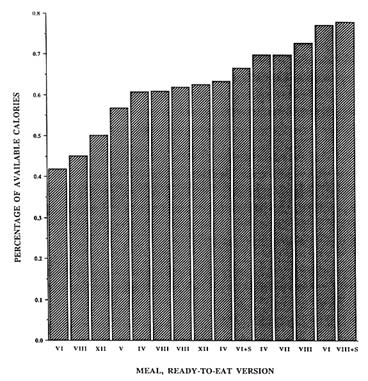
FIGURE 17-1 Mean daily caloric intake as a percentage of available calories for different versions of the Meal, Ready-to-Eat (MRE) operational ration. Each bar represents the results from a specific study, with some studies having more than one condition. Some MRE versions are shown repeatedly due to multiple studies. SOURCE: Data adapted from Askew et al. (1986, 1987), Edwards et al. (1989), Engell et al. (1987), Hirsch et al. (1985, in press), Lester et al. (1993), Morgan et al. (1988), Popper et al. (1987), and C. Thomas (Personal communication, U.S. Army Natick Research, Development and Engineering Center, Natick, Mass., 1993).
and attempt to show how each relates to an economic viewpoint of feeding behavior. The goal is to provoke thought, suggest ways to understand the outcomes seen, and offer alternatives for further research and practical recommendations to the military community.
THE PHYSICAL SITUATION
No one description can capture the unique features of every field exercise. Nonetheless, a number of factors are typically present. Some of these factors will have a relatively direct impact on ration consumption, while other aspects, although not specifically linked to eating, can be expected to have gross effects on behavior.
General Conditions
The goal of field exercises is to prepare soldiers and commanders for performing in real-life conflict situations. Thus, while varying from exercise to exercise, the field carries with it certain demands and costs. Soldiers, for example, are relatively exposed to the elements. If the weather is cold and wet, then it will be more difficult to prepare and eat a meal in comfortable conditions, as will also be the case for sleeping and other creature comforts. Being in the field generally increases the difficulty of obtaining food or other personal items or otherwise having the freedom of choice seen in day-to-day living. The physical demands of training, harsh weather conditions, and the evaluative nature of training exercises can also be significant stressors for the soldier.
The field situation also puts a high premium on activities that compete with eating. Given a choice between accomplishing a mission or eating a meal, soldiers and especially their commanders will generally forgo eating. Similarly, soldiers may be more apt to give up eating for other comforts such as dry clothing or sleep than might typically be the case when in garrison. This relative willingness not to eat even at times when food is available reflects what Lea (1978) would term demand elasticity.
Deployment to the Field
When troops are deployed to the field, the process can be lengthy and can involve significant food and water deprivation. For example, soldiers preparing to depart for Pohakuloa Training Area in Hawaii from Schoffield Barracks on Oahu might be awakened at 4 a.m. on the day of departure, actually leave several hours later, be transported from the airport to the training area, and
then march to their designated location. During this time, soldiers might have little opportunity for eating or drinking and as a result might begin a training exercise in an already depleted state. The impact of soldiers' deployment or transportation to field training is apparent in Figure 17-2. Average hydration and weight changes during an approximately 24-h deployment were equivalent to approximately 50 percent of the total changes observed over an 11-d training exercise (Popper et al., 1987). Engell (see Chapter 12 in this volume) notes that lower water intake is associated with lower food intake, suggesting that soldiers who are dehydrated by deployment might consume less food as a strategy to maintain the ratio of food to water.
In addition to depriving soldiers of water or food, deployment may also effect ration consumption through disturbances of circadian rhythm. This effect will be particularly relevant for sudden and lengthy deployments such as those to Saudi Arabia and Somalia. Although the effects on food intake are not as apparent or well known as those for sleep or body temperature patterns, it seems likely that disruption of circadian rhythms or sleep loss would exacerbate the effects of irregular schedules on consumption described below.
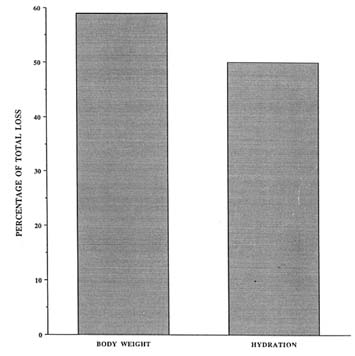
FIGURE 17-2 Body weight loss and change in hydration during deployment as a percentage of total change during an 11-d field training exercise. SOURCE: Adapted from Popper et al. (1987).
Beyond the specific consequences of deployment on energy or fluid balance and circadian rhythms, an important aspect of the field situation is the lack of time for adaptation. Soldiers typically go from their normal garrison situation to the field in a matter of hours where training can last for as little as a few days to as much as several weeks. Thus, for the soldier, the field situation is not only a complex environment, but one that is relatively unpredictable and into which he or she is thrust rather suddenly.
Soldiers' Attitudes
Soldiers' attitudes about ration consumption will also be generally relevant to energy balance. For example, on any given field exercise, between 10 and 30 percent of soldiers report that they hope to lose weight while training in the field (Lester et al., 1989, 1993; Popper et al., 1987; Salter et al., 1991). Similarly, Special Forces' soldiers may deliberately choose to bring insufficient food for a mission and willingly lose weight rather than either have too much to carry or be forced to give up personal or operational items they perceive as essential. These kinds of individual-difference effects are not well documented, but the data are sufficient to conclude that weight loss can be seen as both positive (i.e., benefit) and negative (i.e., cost) and that the ration intake of soldiers will vary accordingly. Similarly, soldiers' health, religious, or other personal values will influence the perceived costs and benefits of ration consumption.
Meal Timing
Soldiers, like most Americans, typically have ready access to a varied, affordable, and relatively tasty array of foods when they are in garrison (i.e., at their home base). They are well aware of what, where, and when food will be available, and mealtimes are a reliable and predictable event. During field exercises, however, mealtimes and their duration are irregular and often not predictable. Circumstances may impose an unexpected break for eating or, conversely, may interrupt or prevent a meal that soldiers were expecting to occur. A substantial body of human and animal research on issues related to meal timing exists that covers meal frequency, regularity and timing of meal schedules, and time permitted to eat. Selected aspects pertinent to military field feeding will be reviewed below.
Meal Frequency
Initial studies of meal frequency suggested that few, large meals tended to be more "obesifying" than more frequent but smaller meals (Fabry and Tepperman, 1970; Metzner et al., 1977). Although later work on meal frequency has weakened the proposed relationship between body weight and meal frequency (Adams and Morgan, 1981), recent findings confirm a metabolic advantage for more frequent meals for parameters such as blood glucose and lipid levels (Jenkins et al., 1989). If nutrient intake, particularly in large amounts, is viewed as a threat to homeostasis (Woods, 1991), then it is logical to see smaller meals that are anticipated by the organism as less costly in their metabolic demands and consequences.
Meal Duration
Research has shown that insufficient time for eating is associated with a variety of deleterious consequences, including poorer consumption and greater loss of body weight, even in the presence of equivalent food intake. Kanarek and Collier (1983) and Lambert and Peacock (1989) found that animals permitted to eat for 60 min/d were unable to maintain food intake or body weight at normal levels particularly if the 60 minutes were given as a single block of time. Both studies also found that the failure to maintain body weight was exacerbated when the animals had access to a running wheel, which suggests that aside from the impact of increased energy expenditure or reduced time available for eating, higher levels of activity decreased the animals' ability to adapt to the meal schedule imposed upon them. For humans, the role of meal duration in food and body weight maintenance is unclear. Nonetheless, factors which promote larger meals such as eating with other people may influence intake by increasing meal length (de Castro, 1990).
Meal Regularity and Predictability
Animal studies focused on the regularity or predictability of meals have consistently shown irregular schedules to be stressful and detrimental to metabolic patterns (e.g., blood glucose levels) and to be associated with poorer food intake and maintenance of body weight (Bazotte et al., 1989; Ulm et al., 1987; Valle, 1981; Welker et al., 1977). In humans, the consequences of irregular schedules are less clear (Moore-Ede and Richardson, 1985; Tepas, 1990), and the study of the effects of rotating shift-work schedules is methodologically difficult (Moore-Ede and Richardson, 1985). While inconclusive, the available data suggest that irregular schedules (as found for rotating shift workers) disrupt normal eating habits and are associated with less
satisfaction with eating and with physical symptoms (e.g., gastrointestinal complaints) (Moore-Ede and Richardson, 1985; Tepas, 1990).
Meals and Circadian Rhythms
At what time meals are eaten during the day appears to be relevant to food consumption and utilization. Several studies have indicated that metabolic responses and net energy balance differ as a function of the time of day food is eaten (Armstrong et al., 1981; Caviezel et al., 1981; Graeber et al., 1978; Halberg et al., Chapter 19 in this volume). These studies show that nutrients are utilized differently at different times of day, and therefore net energy balance will reflect not only total calorie intake but also when during the day calories are consumed. Both human epidemiological and laboratory studies also indicate that morning meals are typically smaller than those eaten at later times (Chao and Vanderkooy, 1989; Fricker et al., 1990; Kramer et al., 1992). In addition, Schutz (1988; Chapter 18 in this volume) has shown, as have others (Birch et al., 1984; Kramer et al., 1992), that people have clear standards for what foods are appropriate for a given time of day.
The stressful and less-energy-efficient nature of irregular meal times and lengths is consistent with the more general propositions discussed by Moore-Ede (1986) regarding reactive and predictive homeostasis. Reactive homeostasis is a response by an organism detecting a state of imbalance. Predictive homeostasis is more in line with Woods' (1991) discussion of behavioral tolerance. That is, organisms learn that certain events of physiological importance such as the opportunity to eat occur at certain times or are associated with other cues in the physical environment (time of day, a dining room, odors of cooking). Consequently, they use this learning to engage metabolic responses to optimize handling of the physiological challenges and utilization of ingested nutrients.
Ration Aspects of the Field Situation
Sensory Cues
Eating under normal conditions is associated with a large set of sensory cues that are markedly reduced when soldiers eat in the field. Given the packaging of operational rations in plain cardboard boxes and flexible retort2
|
2 |
Retort pouches are opaque and flexible in nature. They are constructed of a trilaminate material consisting of polyethlylene as the food contact layer, a thin layer of aluminum foil, and polyester. Use of retort pouches for the Meal, Ready-to-Eat (MRE) and other rations are detailed in Darsch and Brandler (see Chapter 7 in this volume). |
pouches, soldiers have little opportunity for either the visual or olfactory cues typically associated with food or food preparation in nonfield environments. Similarly, as with most processed foods that have extended shelf life, operational rations have historically provided limited tactile or gustatory variety for the consumer. Sensory cues can add to or detract from the perceptions of foods and play a significant role in food choices and consumption (Mattes, 1987; Rolls, 1990; Warwick et al., 1993). Mattes (1987) notes that the impact of sensory stimuli on food intake is apt to reflect both the hedonic qualities and intensity of the stimuli. It is apparent that neither of these qualities can be optimal given the constraints (e.g., shelf-life requirements, cost) within which military food developers must operate.
Sensory cues appear to have a further impact on the metabolic utilization of ingested nutrients (Mattes, 1987; Powley and Berthoud, 1985; Woods, 1991) as a result of the physiological responses elicited by sensory stimuli. These cephalic-phase responses include such reactions as salivating after smelling the aroma from a bakery and less-visible responses such as changes in gastric secretion and insulin release. Rodin (1985) suggests that sensory stimuli and physiological responses may create a positive feedback loop. Sensory cues are associated with elevated blood insulin, for example, which in turn is associated with larger meal intake and increased ability to utilize ingested nutrients (Rodin, 1985; Woods, 1991). Fewer and less-intense sensory stimuli may result in lower intake of available rations due to decreased perceived desirability of the items and less-than-optimal utilization of the nutrients that are ingested. Thus the relative benefit of rations in an economic context is reduced in both the psychological and physiological realms. Lack of reliable sensory cues would also be apt to exacerbate the disruptions in anticipatory behavioral and physiological responses discussed previously (Moore-Ede, 1986; Woods, 1991).
Ration Preparation and Use
A further cost of operational rations arises from the time and effort required for preparation and consumption. Such costs include the large number of packages to be opened and the difficulty of opening them (Kalick, 1991) and an historical lack of easy, quick, and militarily acceptable heating methods (Lester and Kramer, 1991).
Increasing response cost or degree of effort associated with eating has a long history of application as one of many techniques in the behavioral control of obesity or similar clinical problems (Brownell and Kramer, 1989). As described by Engell (Chapter 12 in this volume) and others (Meiselman et al., 1994), modest increases in effort to obtain beverages or food have marked effects on intake of those items. Durrant and Garrow (1982) studied subjects over a number of days in a controlled eating environment in which foods were
obtained from a vending machine. Interestingly, when the ''price" of more preferred food items was increased relative to other foods, subjects typically made compromises between choosing preferred foods and sufficient food to maintain energy intake. Although intake of the preferred foods decreased dramatically, subjects did not increase their intake of less-preferred items to the level necessary to maintain caloric balance. Similarly, Lappalainen and Epstein (1990) and Logue et al. (1990) have found that human subjects' willingness to work for food varied according to the desirability of the food, the relative effort needed to obtain it, and the availability of alternative behavioral choices (food and nonfood).
Initial results of the first field testing (Personal communication, K. L. Rock, U.S. Army Natick Research, Development and Engineering Center, Natick, Mass., 1993) of operational rations in packages designed to be easier to open indicated that soldiers in an active training scenario did find the new packages easier to open and liked them more overall than the standard packaging. Average consumption of the Meal, Ready-to-Eat (MRE) was also approximately 16 percent higher in the easier-to-open bag conditions. Soldiers in this test were fed one hot group meal a day in addition to being issued two MREs. Only MRE intake was assessed during this exercise. As a result, while the consumption results are intriguing, they do not represent total daily consumption, and further testing is needed to determine if easier-to-open packages will actually enhance total ration intake.
Reliable access to easy-to-use ration heating may also be viewed as improving the cost/benefit ratio of eating. Prior laboratory studies (Cardello and Maller, 1982; Zellner et al., 1988) have shown, as would be predicted, that foods are liked better when they are served at the expected temperature (e.g., hot coffee and hot main courses; cold fruit beverages). Field tests of rations also indicate that both ration acceptability and consumption are greater when soldiers can and do heat their food and beverages (Lester and Kramer, 1991). This study found enhanced consumption for the ration as a whole rather than only for the components designed to be heated, which suggests that heating had both direct effects (e.g., a hot entree is preferred and eaten more readily) and indirect effects (e.g., other food items were perceived as better, there was more time to eat the other ration components, etc.)
Food Choice and Selection
The prepackaged nature of individual MREs and the overall ration limit soldiers' options regarding choices among foods as well as the amount of food they can consume. The current MRE (see Darsch and Brandler, Chapter 7 in this volume) contains 12 different menus and is packed in cases of 12 meals, including one of each menu. Limited choices among ration menus and items will increase the relative cost or, perhaps more accurately, reduce the perceived
benefits of eating. Soldiers cannot readily rely on being able to choose their most preferred foods nor on being able to eat large amounts of one item at a meal in lieu of another (see below). The necessity of having preplanned, fixed menus also reduces the likelihood of soldiers finding meals containing items that are all well liked. Although soldiers trade with one another to obtain desired food components or voluntarily carry nonration items to the field, lack of choice will to some extent reduce variety, which may adversely affect consumption (see Hirsch, Chapter 9 in this volume). Studies have also shown that having a degree of control or choice over one's diet is generally associated with a more positive energy balance (Graeber et al., 1978; Pliner et al., 1980) and less dissatisfaction with repetitive menu plans (Kamen and Peryam, 1961). Research by Langer (1983) among others suggests that opportunities for control (both perceived and actual) by individuals improves a wide range of outcomes. Conversely, lack of control is deleterious (e.g., Seligman's learned helplessness [1975]).
Soldiers eating operational rations have minimal control over portion size as a strategy for optimizing food consumption and frequently report that ration portion sizes should be larger (Engell and Popper, 1988). Little research on portion size is available, and the findings are inconclusive regarding its impact on consumption (Booth et al., 1981; Edelman et al., 1986). However, field testing of versions of the MRE with 5- and 8-oz (143- and 229-g) entrees suggests that the MRE version with larger portions was linked to larger meal sizes and increased total daily intake over an 11-d period (Popper et al., 1987). In addition, intake records from field testing of rations indicate that soldiers consume approximately 95 percent of items that they begin to eat. These findings suggest that modest increases in caloric content of items consumed at high rates (e.g., entrees, desserts) could result in an increase in total consumption. For the soldier in the field, larger entrees or larger portions of selected items could permit a more flexible strategy for meeting energy needs at no additional cost for that individual. Future operational rations could also include this approach with or without adopting ration items and packaging that increase soldiers' eating options.
The Eating Context
Nonsensory Cues
In addition to the direct sensory cues associated with foods, eating is typically associated with a host of nonfood factors such as a dining room or cafeteria, dishes and silverware, sitting at a table to eat, and so on. In other words, a meal is an event or situation with specific parameters linked to its initiation and consumption (Weingarten, 1984). In the field, soldiers have few if any of these cues when consuming operational rations. Neither the research
in this lab nor the literature generally provide clear-cut indications of the effects of these types of stimuli on food intake though their potential importance is evident. It is pertinent to note that behavioral treatment for clinical problems such as obesity place significant emphasis on reducing the nonfood cues associated with eating (Brownell and Kramer, 1989). For example, patients are instructed to eat in only one location in the house, to use a specific place setting for their meals, and to refrain from watching television or engaging in other activities while eating. Furthermore, conditioning studies with both animals (Detke et al., 1989; Weingarten, 1984; Woods et al., 1977) and humans (Cornell et al., 1989) have found that nonfood cues can effectively stimulate eating and metabolic response (e.g., insulin release) even after a full meal is consumed or without the actual presence of food stimuli. Such cues also play a prominent role in the anticipatory learning described by Woods (1991) and Moore-Ede (1986); lack of cues will be apt to result in less desire to eat and less behavioral and metabolic preparation to obtain and utilize foods.
Individual Versus Group Rations
Although certainly not conclusive, studies of average energy intake of soldiers consuming two or more group meals per day (Figure 17-3) lend support to the idea that by increasing the soldier's ability to anticipate meals, to have more of the cues associated with eating a meal, and generally to increase the strategies or options open to the soldier, increased food consumption will be seen (King et al., 1992; Kramer et al., 1993; Salter et al., 1991). The larger meal sizes seen when soldiers eat rations designed for group feeding compared to those designed for the individual soldier also raise the possible role of socially mediated influences upon ration consumption.
De Castro (Chapter 20 in this volume) has shown repeatedly in recent work that people consume more food when eating socially than when eating alone. This social facilitation (Latane, 1981) effect is further supported by data collected during military training exercises (Hirsch and Kramer, 1993). Other studies have found a potentially powerful role for social influences such as modeling upon eating (Engell et al., 1990, Goldman et al., 1991; Polivy et al., 1979). Although certain social influences on eating are not situation specific (e.g., generally negative expectations for institutional products such as military rations), social facilitation as described by de Castro and any immediate effect of peers or others depend on having opportunities for these influences to take place. When soldiers are fed a ration designed for feeding groups, then opportunities for eating and interacting with fellow soldiers are much more probable. When soldiers consume individual operational rations such as the MRE, no explicit chance is given for meals to be social occasions.
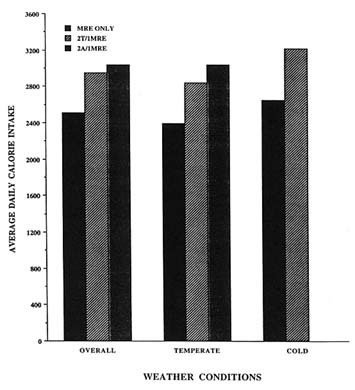
FIGURE 17-3 Average daily caloric intake for soldiers consuming only MREs, two T Ration meals and one MRE (2T/1MRE), or two A Ration meals and one MRE (2A/1MRE), in cold and temperate climates and overall. SOURCE: Data adapted from Edwards et al. (1989), Engell et al. (1987), King et al. (1992), Lester et al. (1993), and Morgan et al. (1988) (cold); Askew et al. (1986, 1987), Hirsch et al. (1985, in press), Kramer et al. (1993), Popper et al. (1987). Rose and Carlson (1987), Salter et al. (1991), and USACDEC/USARIEM (1986) (temperate).
SUMMARY AND RECOMMENDATIONS
Hirsch (Chapter 22 in this volume) describes a concept for demonstrating and testing approaches for improving ration consumption in the field. The goal of this chapter has been to make the point that the specific efforts described by Hirsch or suggested by others in this volume (e.g., Rolls, Engell, and de Castro, in Chapters 11, 12, and 20 respectively) are apt to be effective only to the extent that they give soldiers strategies to use in optimizing ration consumption or to improve the cost/benefit ratio of consumption behaviors.
The environment of actual combat situations or realistic training scenarios will likely preclude soldiers' ability to meet energy needs on a consistent basis. Nonetheless, it is apparent that military doctrine and commanders on the scene
can apply methods to reduce ration underconsumption and waste. Similarly, changes in ration design, packaging, and variety can be used to increase soldiers' options for maintaining energy intake.
In conclusion:
-
Despite current limits on scientific knowledge and restrictions inherent to combat field feeding, military planners, scientists, and commanders do have options for improving the "economics" of the feeding situation.
-
Commanders and foodservice personnel frequently can improve the economics of the physical eating situation in one or more of the following ways: beverage and ration supply during deployment; when and how long soldiers can eat; ration type to maximize sensory and hedonic appeal and minimize preparation and effort to eat; feeding soldiers in groups rather than individually; and creating a more "meal"-like situation (e.g., serving food from tables, setting food up to enhance visual appeal, and soldier choice).
-
Ration developers and scientists also can explore opportunities for improving feeding economics: increase ease of use through package design and preparation requirements; explore role of number and size of meal components; evaluate the value of rations in varying field contexts and relative to other factors related to overall quality of life (e.g., clothing and leadership); and examine the impact of time, sensory, or other cues associated with eating on nutrient intake and status.
-
An economic viewpoint provides one method for creating an integrated approach to the development, study, and use of operational rations.
ACKNOWLEDGMENTS
The author would like to thank Dianne Engell, Ed Hirsch, Teresa Malafi, and Herbert Meiselman for their suggestions and comments.
REFERENCES
Adams, C.E., and K.J. Morgan 1981. Periodicity of eating: Implications for human food consumption. Nutr. Res. 1:525–550.
Armstrong, S., C. Shahbaz, and G. Singer 1981. Inclusion of meal-reversal in a behavior modification program for obesity. Appetite 2:1–5.
Askew, E.W., J.R. Claybaugh, S.A. Cucinell, A.J. Young, and E.G. Szeto 1986. Nutrient intakes and work performance of soldiers during seven days of exercise at 7,200 ft. altitude consuming the Meal, Ready-to-Eat ration. Technical Report T3-87, AD A176 273. Natick, Mass.: U.S. Army Research Institute of Environmental Medicine.
Askew, E.W., I. Munro, M.A. Sharp, S. Siegel, R. Popper, M.S. Rose, R.W. Hoyt, J.W. Martin, K. Reynolds, H.R. Lieberman, D.B. Engell, and C.P. Shaw 1987. Nutritional status and physical and mental performance of special operations soldiers consuming the Ration, Lightweight or the Meal, Ready-to-Eat military field ration during a 30-day field training exercise. Technical Report T7-87, AD A179 553. Natick, Mass.: U.S. Army Research Institute of Environmental Medicine.
Bazotte, R.B., R. Curi, and N.S. Hell 1989. Metabolic changes caused by irregular-feeding schedule as compared with meal-feeding. Physiol. Behav. 46:109–113.
Birch, L.L., J. Billman, and S.S. Richards 1984. Time of day influences food acceptability. Appetite 5:109–116.
Booth, D.A., J. Fuller, and V. Lewis 1981. Human control of body weight: Cognitive or physiological? Some energy-related perceptions and misperceptions. Pp. 305–314 in The Body Weight Regulatory System: Normal and Disturbed Mechanisms, L.A. Cioffi, W.P.T. James, and T.B. Van Itallie, eds. New York: Raven Press.
Brownell, K.D., and F.M. Kramer 1989. Behavioral management of obesity. Med. Clin. North Am. 73:185–201.
Cardello, A.V., and O. Maller 1982. Acceptability of water, selected beverages and foods as a function of serving temperature. J. Food Sci. 47:1549–1552.
Caviezel, F., A.G. Cattaneo, W. Mantoni, W. Vigano, A.E. Pappalettera, and G. Pozza 1981. Single daily meal treatment in obesity. Pp. 105–115 in Obesity: Pathogenesis and Treatment, G. Enzi, G. Crepaldi, G. Pozza, and A.E. Renold, eds. New York: Academic Press.
Chao, E.S.M., and P.S. Vanderkooy 1989. An overview of breakfast nutrition. J. Can. Diet. Assoc. 50:225–228.
Collier, G. 1989. The economics of hunger, thirst, satiety and regulation. Ann. N.Y. Acad. Sci. 575:136–154.
Cornell, C.E., J. Rodin, and H. Weingarten 1989. Stimulus induced eating when satiated. Physiol. Behav. 45:695–704.
de Castro, J.M. 1990. Social facilitation of duration and size but not rate of the spontaneous meal intake of humans. Physiol. Behav. 47:1129–1135.
Detke, J.J., S.E. Brandon, H.P. Weingarten, J. Rodin, and A.R. Wagner 1989. Modulation of behavioral and insulin responses by contextual stimuli paired with food. Psysiol. Behav. 45:845–851.
Durrant, M.L., and J.S. Garrow 1982. The effect of increasing the relative cost of palatable food with respect to ordinary food on total-energy intake of eight obese inpatients. Int. J. Obes. 6:153–164.
Edelman, B., D. Engell, P. Bronstein, and E. Hirsch 1986. Environmental effects on the intake of overweight and normal-weight men. Appetite 7:71–83.
Edwards, J.S.A., D.E. Roberts, T.E. Morgan, and L.S. Lester 1989. An evaluation of the nutritional intake and acceptability of the Meal, Ready-to-Eat, with and without a supplemental pack in a cold environment. Technical Report T18-89. Natick, Mass.: U.S. Army Research Institute of Environmental Medicine.
Engell, D., and R. Popper 1988. Evaluation of the Meal, Ready-to-Eat VIII at Market Square II. Technical Report Natick TR-88/078. Natick, Mass.: U.S. Army Natick Research, Development and Engineering Center.
Engell, D.B., D.E. Roberts, E.W. Askew, M.S. Rose, J. Buhbinder, and M.A. Sharp 1987. Evaluation of the Ration Cold Weather during a 10-day cold weather field training exercise. Technical Report TR-87/030. Natick, Mass.: U.S. Army Natick Research, Development and Engineering Center.
Engell, D., F.M. Kramer, S. Luther, and S. Adams 1990. The effect of social influences on food intake. Paper presented at the Annual Meeting of the Society for Nutrition Education, Anaheim, Calif.
Fabry, P., and J. Tepperman 1970. Meal frequency—a possible factor in human pathology. Am. J. Clin Nutr. 23:1059–1068.
Fricker, J., S. Giroux, F. Fumeron, and M. Apfelbaum 1990. Circadian rhythm of energy intake and corpulence status in adults. Int. J. Obes. 14:387–393.
Goldman, S.J., C.P. Herman, and J. Polivy 1991. Is the effect of a social model on eating attenuated by hunger? Appetite 17:129–140.
Graeber, R.C., R. Gatty, F. Halberg, and H. Levine 1978. Human eating behavior: Preferences, consumption patterns, and biorhythms. Food Science Laboratories Technical Report DAAK03-74-C-023. Natick, Mass.: U.S. Army Research and Development Command.
Hirsch, E., and F.M. Kramer 1993. Situational influences on food intake. Pp. 215–243 in Nutritional Needs in Hot Environments, B.M. Marriott, ed. A report of the Committee on Military Nutrition Research, Food and Nutrition Board, Institute of Medicine . Washington, D.C.: National Academy Press.
Hirsch, E., H.L. Meiselman, R.D. Popper, G. Smits, B. Jezior, I. Lichton, N. Wenkam, J. Burt, M. Fox, S. McNutt, T.N. Thiele, and O. Dirige 1985. The effects of prolonged feeding Meal, Ready-to-Eat (MRE) operational rations. Technical Report TR-85/035. Natick, Mass.: U.S. Army Natick Research and Development Center.
Hirsch, E., L. Lester, L. Lesher, A. Vance, K. Anderson, M. Bordic, L. Mastrodicasa, and E. Redorsky In Press Natick. Acceptability and consumption of alternative rations for remote feeding: Comparing the MRE XII, MRE (CT) and the SMORE. Technical Report. Natick, Mass.: U.S. Army Research, Development and Engineering Center.
Hursch, S.R. 1984. Behavioral economics. J. Exp. Anal. Behav. 42:435–452.
Jenkins, D.J.A., T. Wolever, V. Vuksan, F. Brighenti, S.C. Cunnane, A.V. Rao, A.L. Jenkins, G. Buckley, R. Patten, W. Sinder, P. Corey, and R.G. Josse 1989. Nibbling versus gorging: Metabolic advantages of increased meal frequency. New Engl. J. Med. 321:929–934.
Kalick, J. 1991. Consumer oriented package design: Improving military ration acceptance. Proc. Res. Dev. Assoc. 44:40–43.
Kamen, J.A., and D.R. Peryam 1961. Acceptability of repetitive diets. Food Technol. 15:173–177.
Kanarek, R.B., and G.H. Collier 1983. Self-starvation: A problem of overriding the satiety signal. Physiol. Behav. 30:307–311.
King, N., S.H. Mutter, D.E. Roberts, E.W. Askew, A.J. Young, T.E. Jones, M.Z. Mays, M.R. Sutherland, J.P. DeLany, B.E. Cheema, and R. Tulley 1992. Nutrition and hydration status of soldiers consuming the 18-man Artic Tray Pack ration module with either the Meal, Ready-to-Eat or the Long Life Ration Packet during a cold weather field training exercise. Technical Report T4-92. Natick, Mass.: U.S. Army Research Institute of Environmental Medicine.
Kramer, F.M., K. Rock, and D. Engell 1992. Effects of time of day and appropriateness on food intake and hedonic ratings at morning and midday. Appetite 18:1–13.
Kramer, F.M., K.L. Rock, M. Salomon, L.L. Lesher, D.B. Engell, C. Thomas, and S.D. Gagne 1993. The relative acceptability and consumption of the current T Ration with and without new breakfast and dinner menus. Technical Report TR-93/031. Natick, Mass.: U.S. Army Natick Research, Development and Engineering Center.
Lambert, K.G., and L.J. Peacock 1989. Feeding regime affects activity-stress ulcer production. Physiol. Behav. 46:743–746.
Langer, E.J. 1983. The Psychology of Control. Ann Arbor, Mich.: S. Demand.
Lappalainen, R., and L.H. Epstein 1990. A behavioral economics analysis of food choice in humans. Appetite 14:81–93.
Latane, B. 1981. The psychology of social impact. Am. Psychol. 36:343–355.
Lea, S.E.G. 1978. The psychology and economics of demand. Psychol. Bull. 85:441–466.
Lester, L.S., and F.M. Kramer 1991. The effects of heating on food acceptability and consumption. J. Foodservice Systems 6:69–87.
Lester, L.S., F.M., Kramer, J. Edinberg, S. Mutter, and D.B. Engell 1989. Evaluation of the canteen cup stand and ration heater pad: Effects on acceptability and consumption of the Meal, Ready-to-Eat in a cold weather environment. Technical Report TR-90/008L. Natick, Mass.: U.S. Army Natick Research, Development and Engineering Center.
Lester, L.S., L.L. Lesher, M. Salomon, D.B. Engell, S.L. Dewey, J.L. Ward, C. Thomas, and J. Kalick 1993. Nutritional and hedonic consequences of consuming the Meal, Ready-to-Eat (MRE) VIII or the Soldier Enhancement Program (SEP) MRE. Technical Report TR-93/015. Natick, Mass.: U.S. Army Natick Research, Development and Engineering Center.
Logue, A.W., G.R. King, A. Chavarro, and J.S. Volpe 1990. Matching and maximizing in a self-control paradigm using human subjects. Learn. Motiv. 21:340–368.
Mattes, R.D. 1987. Sensory influences on food intake and utilization in humans. Human Nutr. 41A:77–95.
Meiselman, H.L., S.L. Staddon, D. Hedderly, B.J. Pierson, and C.R. Symonds 1994. Effect of effort on meal selection and meal acceptability in a student cafeteria. Appetite 23:43–55.
Metzner, H.L., D.E. Lamphiear, N.C. Wheeler, and F.A. Larkin 1977. The relationship between frequency of eating and adiposity in adult men and women in the Tecumseh Community Health Study. Am. J. Clin. Nutr. 30:712–715.
Moore-Ede, M.C. 1986. Physiology of the circadian timing system: Predictive versus reactive homeostasis. Am. J. Physiol. 250:735–752.
Moore-Ede, M.C., and G.S. Richardson 1985. Medical implications of shift-work. Ann. Rev. Med. 36:607–617.
Morgan, T.E., L.A. Hodges, D. Schillig, R.W. Hoyt, E.J. Iwanyk, G. McAnich, T.C. Wells, and E.W. Askew 1988. A comparison of the Meal, Ready-to-Eat, Ration Cold Weather and Ration, Lightweight nutrient intakes during moderate altitude cold weather field training operations. Technical Report T5-89. Natick, Mass.: U.S. Army Research Institute of Environmental Medicine.
Pliner, P., J. Polivy, C.P. Herman, and I. Zakalusny 1980. Short-term intake of overweight individuals and normal weight dieters and non-dieters with and without choice among a variety of foods. Appetite 1:203–213.
Polivy, J., C.P. Herman, J.C. Younger, and B. Erskine 1979. Effects of a model on eating behavior: The induction of a restrained eating style. J. Pers. 47:100–117.
Popper, R., E.S. Hirsch, L. Lesher, D. Engell, B. Jezior, B. Bell, and W.T. Matthew 1987. Field evaluation of Improved MRE, MRE VII, and MRE IV. Technical Report TR-87/027. Natick, Mass.: U.S. Army Natick Research, Development and Engineering Center.
Powley, T.L., and H.R. Berthoud 1985. Diet and cephalic phase insulin responses. Am. J. Clin. Nutr. 42:991–1002.
Rodin, J. 1985. Insulin levels, hunger, and food intake: An example of feedback loops in body weight regulation. Health Psychol. 4:1–24.
Rolls, B.J. 1990. The role of sensory-specific satiety in food intake and food selection. Pp. 197–209 in Taste, Experience and Feeding, E.D. Capaldi and T.L. Powley, eds. Washington, D.C.: American Psychological Association.
Rose, M.S., and D.E. Carlson 1986. Effects of A Ration meals on body weight during sustained field operations. Technical Report T2-87. Natick, Mass.: U.S. Army Research Institute of Environmental Medicine.
Salter, C.A., D. Engell, F.M. Kramer, L.S. Lester, J. Kalick, K.L. Rock, L.L. Lesher, S.L. Dewey, and D. Caretti 1991. The relative acceptability and consumption of the current and proposed versions of the T Ration. Technical Report TR-91/031. Natick, Mass.: U.S. Army Natick Research, Development and Engineering Center.
Schutz, H.G. 1988. Beyond preference: Appropriateness as a measure of contextual acceptance of food. Pp. 115–134 in Food Acceptability, D.M.H. Thomson, ed. London: Elsevier Applied Science.
Seligman, M.E.P. 1975. Helplessness. San Francisco, Calif.: W.H. Freeman and Co.
Tepas, D.I. 1990. Do eating and drinking schedules interact with work schedule variables? Work and Stress 4:203–211.
Ulm, R.R., J.R. Volpicelli, R. Cerpa, and K. McIntyre 1987. Weight gain in postweaned rats as a function of predictable and unpredictable feeding schedules. Physiol. Behav. 40:287–289.
USACDEC/USARIEM (U.S. Army Combat Developments Experimentation Center and U.S. Army Research Institute of Environmental Medicine) 1986. Combat Field Feeding System-Force Development Test and Experimentation (CFFS-FDTE). Technical Report CDEC-TR-85-006A. Vol. 1, Basic Report; vol. 2, Appendix A; vol. 3, Appendixes B through L. Fort Ord, Calif.: U.S. Army Combat Developments Experimentation Center.
Valle, F.P. 1981. Detrimental effects of irregular meals on rats' ability to adjust to meal feeding. Am. J. Physiol. 94:3–11.
Warwick, Z.S., W.G. Hall, T.N. Pappas, and S.S. Schiffman 1993. Taste and smell sensations enhance the satiating effect of both a high-carbohydrate and high-fat meal in humans. Physiol. Behav. 53:553–563.
Weingarten, H.P. 1984. Meal initiation controlled by learned cues: Basic behavioral properties. Appetite 5:147–158.
Welker, R.L., J. Garber, and F. Brooks 1977. Stress as a function of irregular feeding of food-deprived rats. Physiol. Behav. 18:639–645.
Woods, S.C. 1991. The eating paradox: How we tolerate food. Psychol. Rev. 98:488–505.
Woods, S.C., J.R. Vaselli, E. Kaestner, G.A. Szakmary, P. Milburn, and M.V. Vitello 1977. Conditioned insulin secretion and meal feedings in rats. J. Comp. Physiol. Psychol. 91:128–133.
Zellner, D.A., W.F. Stewart, P. Rozin, and J.M. Brown 1988. Effect of temperature and expectations on liking for beverages. Physiol. Behav. 44:61–68.
DISCUSSION
MARY MAYS: I may be asking a really obvious question. Has anybody tried taking the same amount of food and dividing it differently into meals? I am thinking of something like meal or an evening snack, something with sweet chocolate or maybe a separate sub-pack in each meal that could be carried and eaten throughout the afternoon.
Or is it, from a military discipline standpoint, really important to have food in three packs?
F. MATTHEW KRAMER: In one cold-weather study, there was the MRE plus a supplement. The supplement was located in a small pack, easy for soldiers to carry in their pocket, and eat whenever. In fact, it was supposedly designed so that soldiers could eat the supplement they were on the move. Phil Brandler, you may want to fill that in.
PHILIP BRANDLER: Yes. We tried something like that with good results in the cold-weather study in particular. But it was never adopted for whatever reason. The Quartermaster School decided that it was not a necessary addition. Therefore it never came into the system, despite the data.
Generally speaking, when soldiers get their MREs, they tear open the pack and stuff their pockets with whatever it is they want to eat later. Therefore, they are eating some items when they are ready. They might have crackers and jelly, M&Ms, or a chocolate bar in their packet. So, in a sense, they are not necessarily tied to eating times. They have some measure of freedom in terms of when they want to eat some items.
F. MATTHEW KRAMER: Except that I think the data show that soldiers eat at mealtime, and as Diane's data show, they drink at mealtime. The concept
is that they can stuff their pockets and snack when ever they want to, but in fact, that does not happen as often as one might expect.
MARY MAYS: I saw something in Saudi Arabia that was very unusual. We came into an established group that had been given MREs for a long time, and we joined them and were also living on MREs for a long time.
We began to see a dramatic change in behavior. Where the soldiers had been snacking and eating at odd times, they suddenly began to gravitate together to eat. Someone would, ''I am hungry; I am going to eat." And someone else would say, "Oh, you are going to eat. I will eat, too." Then someone would say, "Let's turn the fire on and actually heat this stuff." And we would turn the fire on, and we would find seven or eight people gravitating toward the tent,
That was a dramatic change in behavior, and this goes back to exactly what you are saying. The drinking went on at mealtimes, the eating went on at mealtimes, and it went on in groups.
Some soldiers stuck food in their pockets with the intention of eating it later and alone, but in fact they did not do so.


