5
Commanders' Perceptions and Attitudes About Their Responsibility for Feeding Soldiers
Celia F. Adolphi1
Not Eating Enough, 1995
Pp. 77–89. Washington, D.C.
National Academy Press
INTRODUCTION
Since the mid-1980s, the U.S. Army has been the torch bearer in health promotion for the Department of Defense with its Fit to Win Program (U.S. Department of the Army, 1987). Commanders at all levels have responsibility for executing this program. Because there has never been a survey of commanders' utilization of the health promotion program, a survey was conducted to obtain information from former commanders on their perceptions and attitudes about feeding soldiers. This information was compiled as a part of the author's military studies project, while a resident student at the Army War College in Carlisle, Pennsylvania from August 1991 to May 1992. Two additional goals of the survey were to determine what nutrition resources were being utilized as a part of health promotion and to estimate commanders' knowledge of nutrition.
SURVEY METHODS
Of the 288 members of the 1992 Army War College class, 132 Army officers had been in battalion level command sometime during the period from January 1990 to July 1991. These commanders were asked to take the survey. The survey group, which included three female officers, represented 63 percent of the active Army officers in the class. Because students were being asked to complete several other surveys, the scope of this survey was purposely limited.
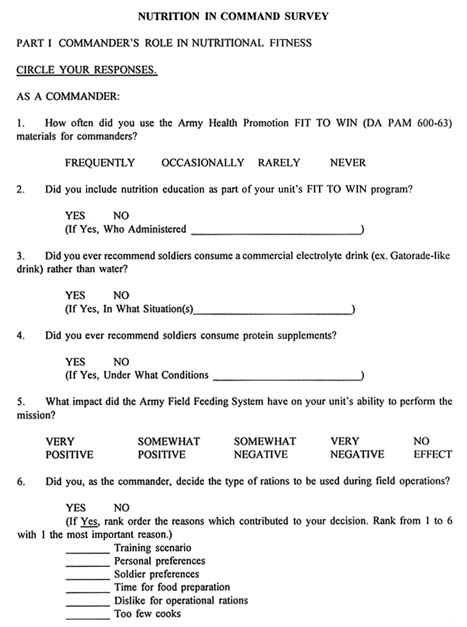
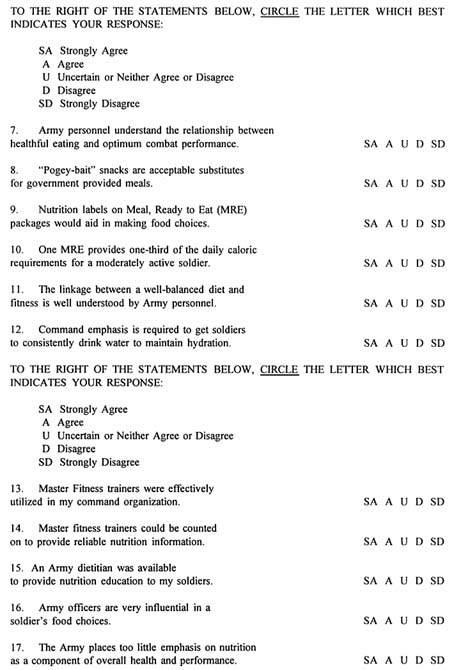
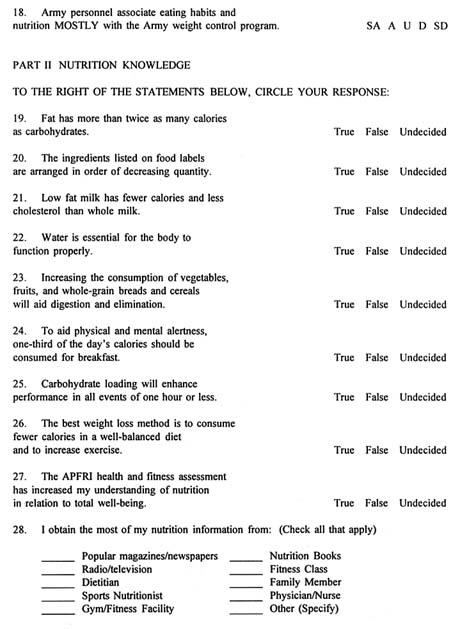
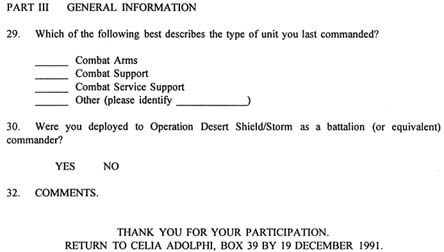
To encourage maximum participation and minimize the time required to complete the survey, only 32 questions were constructed. The 32 questions were divided into 3 parts. In the first part of the survey, commanders were asked questions about their decisions on water discipline and ration selection during field training. They were asked whether they recommended electrolyte replacement beverages and protein supplements. Ten nutrition knowledge questions were included in the survey. These questions were taken from the U.S. Army Research Institute of Environmental Medicine's (USARIEM) August 1988 survey of Army basic trainees at Fort Jackson, South Carolina (Rose et al., 1989). Commanders were also asked to rank order their sources of nutrition education. Finally, the officers were offered the opportunity to make written comments following the survey. A Likert-type scale, with statements to which respondents indicated their agreement on a 5-point continuum, was used for response to 12 of the 32 questions. True or false (or undecided) were the response choices for the personal nutrition knowledge questions. The survey questions were analyzed using the statistical software program SPSS/PC+. A copy of the survey is included at the end of this chapter.
RESULTS
Eighty-six percent (113) of the 132 commanders completed the survey. Fifty percent of respondents had commanded combat arms units; 25 percent commanded combat support units, and 25 percent commanded combat service support units. Thirty percent of the respondents had been deployed to Operation Desert Shield/Storm.
Nutrition Knowledge
In response to the nutrition knowledge questions, only 43 percent of respondents could correctly identify that fat has twice as many calories as carbohydrates. Seventy-nine percent did not know that carbohydrate loading
is only beneficial for events of 1 hour or less. Sixty-five percent did not know that one Meal, Ready-to-Eat (MRE) provides one-third of a day's calorie requirements. Ninety percent knew that breakfast is essential for enhanced physical and mental alertness. Fifty-five percent also knew that ingredients on food labels are arranged in order of decreasing quantity. When USARIEM asked basic trainees at Fort Jackson the same questions, 64 percent answered every question correctly, while only 7 percent of the former commanders correctly identified all nutrition questions (Rose et al., 1989). The wide variation in results between basic trainees' and officers' nutrition knowledge could result from increasing emphasis on nutrition education as early as elementary school.
Not surprising was the response from commanders that they had gained their nutrition knowledge from popular mass media sources rather than from nutrition professionals. As shown in Figure 5-1, commanders most often cited popular magazines as the source of their personal nutrition information, followed by popular books, their family members, and television. Doctors and dietitians were among the least frequently cited sources of nutrition information.
Sixty percent of the officers agreed that the Army places too little emphasis on nutrition as a component of overall health and fitness. Half of the
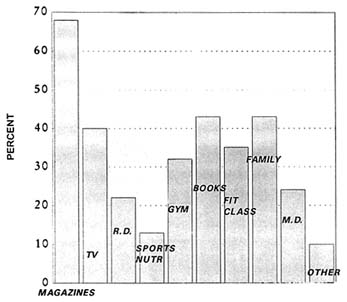
FIGURE 5-1 Factors influencing personal knowledge of nutrition. Factors are shown as percentages. Commanders could indicate as many choices as applied.
respondents also indicated that the relationship of fitness and nutrition is not well understood. Eighty-eight percent indicated that Army personnel associate nutrition only with weight control. This finding is important to remember when exploring the reasons for underconsumption of rations.
Commanders' Perceived Responsibility for Feeding Soldiers
What soldiers eat is often determined by the training priorities of commanders. Since it is known that over time, nutritional fitness can affect combat readiness, the survey included questions about the commanders' perceived relationship of healthful eating and combat performance. Only 51 percent indicated that there was any relationship. Sixty-three percent of the former commanders surveyed by this questionnaire responded that they were involved in the decision process to determine the type of rations used during field training. Their answers are summarized in Figure 5-2. When asked to rank order the reasons that framed their decisions, the training scenario was rated as the most important reason (38 percent), followed by time to prepare rations (23 percent), soldier preference (16 percent), dislike for operational
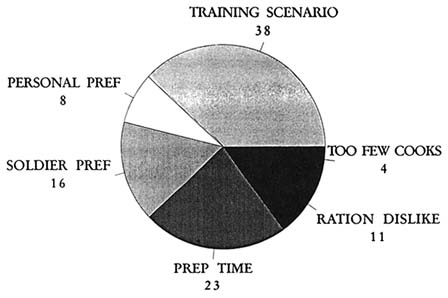
FIGURE 5-2 Factors which influence ration choice during field operations. Factors were rank ordered by commanders. Factors are shown as percentaged rankings.
rations (11 percent), and personal preferences (8 percent). Of those commanders, the answers from those who had been deployed to Operation Desert Shield/Storm were subsequently analyzed separately. Their answers did not differ from the other commanders. When asked whether "pogey bait," a common troop term for nonnutritionally dense snack foods, provided acceptable substitutes for military rations, 87 percent indicated that pogey bait is not an acceptable substitute.
Several commanders indicated that they knew their soldiers purposely planned to lose weight during field training. Little, if any, command emphasis is placed on eating to maintain performance. Commanders are no longer required to have all their soldiers line up for meals, a method intended to ensure that soldiers were eating.
Anecdotal Comments
There was a section of the survey that encouraged comments. One former commander wrote that his battalion was in excellent shape before and during Operation Desert Shield/Storm because of the emphasis on nutrition and physical training. He felt that more emphasis on nutrition would have been beneficial. Another former commander stated that soldiers are fast-food factories and self-perceived as immortal—a true product of American society. He felt that there needs to be a focus on changing the young soldier's understanding of nutrition. A former reception battalion commander said that young soldiers have an aversion to anything green or anything that looks or tastes unusual. This officer felt that eating habits are a reflection of society and home and that soldier eating habits will not improve until those of the general society improve. He suggested that the Army incorporate more nutrition training as a part of basic and unit training.
A commander deployed to Operation Desert Shield/Storm indicated his battalion ate MREs for 52 days straight, with only two minor cases of constipation because of command emphasis on water and fresh fruit consumption. This commander felt that feeding was the biggest morale factor that could be controlled. In contrast, another commander stated that MREs are a disaster and that pogey bait is the only thing to get troops through when MREs are the only ration available. Adding ingredient and nutrition information to the MRE package was suggested by several commanders.
DISCUSSION
This small sample cannot be construed as representative of all commanders' perceptions and attitudes about feeding soldiers, but it does indicate that much can be done to increase commanders' (and soldiers') nutrition knowledge. Over half of those surveyed had not used the Army's Fit to Win Program (U.S. Department of the Army, 1987), including the nutrition education component, in the ways envisioned by proponents of the program. The survey also revealed that commanders' information on nutrition is more likely to come from popular magazines than from nutrition professionals. In order to set a positive leadership climate, change unfounded perceptions about eating, and make an impact on solders' attitudes about eating, officers need more focused information on the rationale for healthful eating under various military conditions as well as an orientation to reliable nutrition sources. Such fitness and nutrition education needs to begin early in an officer's career.
RECOMMENDATIONS
Deciding that eating is important to the maintenance of combat performance is a state of mind. This survey of former commanders underscores the need for a hierarchical educational program to provide a basic understanding of the relationship between nutrition and combat performance. Such a hierarchical program would begin at the lowest military education level. At each succeeding level of military education, more complex fitness and nutrition concepts are added. Hierarchical programs should be provided for both officers and enlisted personnel. As officers reach command levels, they should be given a list of appropriate resources for nutrition education and healthful eating information, such as dietitians and master fitness trainers. The following recommendations address this need:
-
Survey commanders and soldiers returning from any operation other than war about ration consumption and weight loss.
-
Include progressively more complex health promotion instruction, including nutrition education, in all U.S. Army Training and Doctrine Command programs of instruction, including precommand courses.
-
Train physician's assistants to teach soldiers the fundamentals of nutrition and performance, since they are often the first, and only, medical personnel to interface with soldiers.
-
Provide USARIEM's publication, Nutritional Guidance for Military Field Operations in Temperature and Extreme Environments (Thomas et al., 1993), to all precommand course participants.
-
Army Regulation 350-15 charges the Commandant of the Army War College with responsibility for conducting fitness education and training programs for Army War College personnel and for conducting applied fitness research. This responsibility is performed by the Army Physical Fitness Research Institute (APFRI). Therefore, it is recommended that APFRI annually survey Army War College and Command and General Staff College classes to measure the understanding of the fundamental concepts of nutrition and performance, ration consumption patterns, and influences on soldiers' eating habits.
Although 51 percent of the commanders who were surveyed indicated a positive relationship between nutrition and combat performance, the study also shows that the nutrition education component of the Army's Fit to Win Program is not supporting this fundamental principle. Unfortunately, achieving an understanding of the role of nutrition in combat efficiency has not progressed very far since R. M. Kark's (1954) comment: "… loss of military efficiency through inadequate nutrition is most often due to inadequate planning, catering or supply, and to inadequate training or indoctrination… Maintaining good nutrition is like maintaining freedom of speech or democracy. You need eternal vigilance to make it work" (p. 194). Implementing the recommendations is part of the eternal vigilance of which Kark speaks. Indiscriminate nutrition information will not ensure that commanders properly understand how to fulfill their obligation in feeding soldiers, under any and all military environments.
REFERENCES
Kark, R.M. 1954. Studies on troops in the field. Pp. 193–195 in Nutrition Under Climatic Stress, H. Spector and M.S. Peterson, eds. A report of the Committee on Food, Advisory Board on Quartermaster Research and Development. Washington, D.C.: National Academy of Sciences/National Research Council.
Rose, R.W., C.J. Baker, C. Salter, W. Wisnaskas, J.S.A. Edwards, and M.S. Rose 1989. Dietary assessment of U.S. Army basic trainees at Fort Jackson, South Carolina. Technical Report T6-89. Natick, Mass.: U.S. Army Research Institute of Environmental Medicine.
Thomas, C.D., C.J. Baker-Fulco, T.E. Jones, N. King, D.A. Jezior, B.N. Fairbrother, and E.W. Askew 1993. Nutrition for health and performance: Nutritional guidance for military field operations in temperature and extreme environments. Technical Note 93-3, AD 261 392. Natick, Mass.: U.S. Army Research Institute of Environmental Medicine.
U.S. Department of the Army 1987. Army Regulation 600-63. "Army Health Promotion." November 17. Washington, D.C.
DISCUSSION
RICHARD JANSEN: It seems like in the reports from 1977, increasingly the whole thrust of nutrition education has been to reduce the risk of chronic disease, and it has not been related to these problems of the Army at all, which are more important from a functional standpoint or from a performance standpoint. We cannot worry so much about your percentage of calories from fat if they are not getting enough food to maintain body weight. Or for that matter, I think for us today even within the labeling regulations, we do not worry about vitamins and minerals at all. We just assume they are there, we are just going to worry about fat. I am wondering what, within the curriculum today at West Point or in ROTC or at OCS, the officer trainees are being taught about the importance, not of reducing chronic disease, but of making sure that soldiers eat adequately for performance.
CELIA ADOLPHI: I can tell you we are not doing enough. We are kind of skimming the surface, and what we are teaching is that moderation and variety are important to achieving balance, but we do not focus on the aspect of eating for performance.
EILEEN THOMPSON: But I think that has been a more difficult thing to demonstrate.
CELIA ADOLPHI: There is one ray of hope in that the American Dietetic Association 1993 Survey of American Attitudes toward nutrition has just come out. They found that the biggest increase in interest and concern about nutrition was in young men. So they are getting there.
ROBERT SMITH: A question on your survey. Was the military concerned about being obese, overweight?
CELIA ADOLPHI: Well, let me say this. Everybody tries to stay off the weight control program. It is kind of a stigma really. Once you are on the weight control program, you cannot get promoted, you cannot go to school, your record is flagged. It is a punitive program, frankly, so that is why I think that nutrition gets wrapped into that aspect of weight control.
GILBERT LEVEILLE: I would like to get to Dick's point. If you have the same kind of dichotomy in the military that you do elsewhere, you are talking about underconsumption during field operations and not during regular garrison feeding where you have a problem of overconsumption there more than anywhere else.
CELIA ADOLPHI: I would like to share with you, though, that one of the problems we have now is underconsumption of field rations. As our Army gets smaller, they are going to go to the field more often. I can tell you after having been to Fort Stewart, Georgia last Friday, and having talked to other commanders, they hardly come home, have a chance for a shower, and a chance to kiss their wife and kids until they are off again. The frequency of rotations at the National Training Center is increasing. They want to keep that tempo, that readiness alive, to make sure we do not have what we call the "hollow Army" again as we did after Korea. So there is a lot of stress being placed on commanders to keep the training, keep going to the field. So I am somewhat concerned that this issue, if we have one, increases.
ROBERT NESHEIM: It is complicated by virtue of an education program that now has the dual objectives of maintaining adequate consumption in the field but preventing overconsumption in the garrison.